Stewart_Calc_7ET ch04sec09
MULTIPLE CHOICE
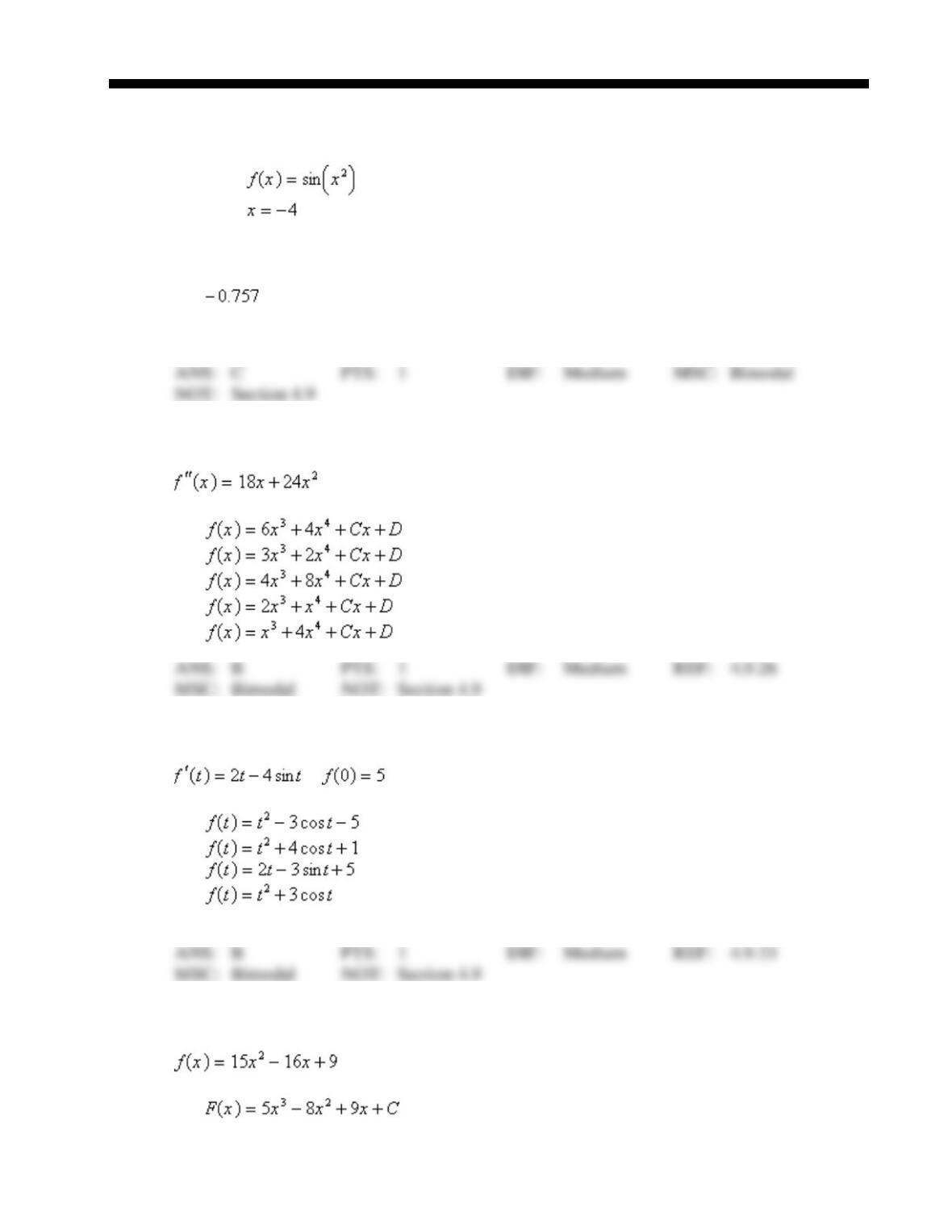
1. Evaluate , and tell whether its antiderivative F is increasing or decreasing at
the point radians.
a.
– 0.288, increasing
b.
0.757, decreasing
c.
, decreasing
d.
0.757, increasing
e.
0.277, decreasing
2. Find f.
a.
b.
c.
d.
e.
3. Find f.
,
a.
b.
c.
d.
e.
None of these
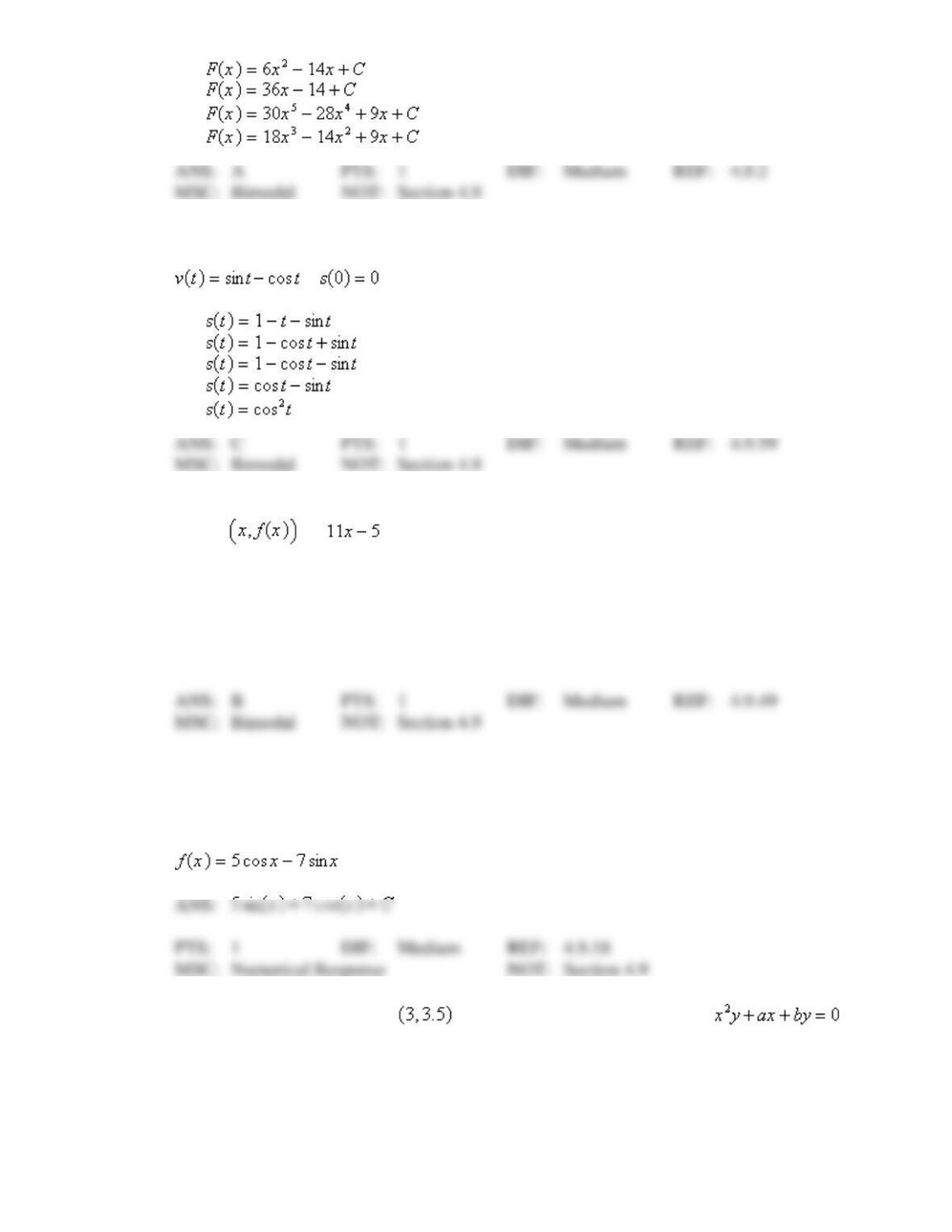
4. Find the most general antiderivative of the function.
a.
b.
c.
d.
e.
5. A particle is moving with the given data. Find the position of the particle.
,
a.
b.
c.
d.
e.
6. Given that the graph of f passes through the point (4, 69) and that the slope of its tangent
line at is , find f (1) .
a.
0
b.
6
c.
1
d.
11
e.
12
NUMERIC RESPONSE
1. Find the most general antiderivative of the function.
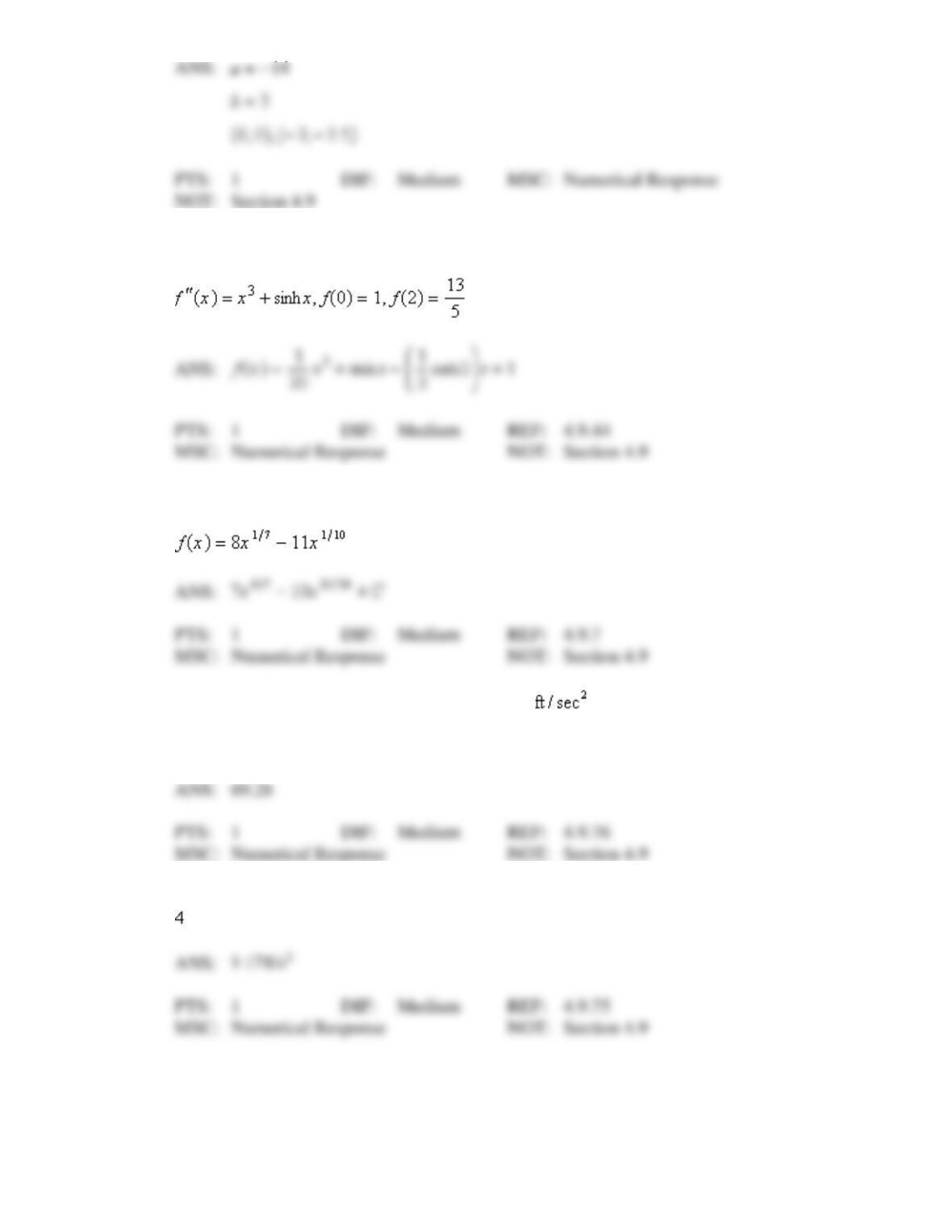
2. For what values of a and b is is an inflection point of the curve ?
What additional inflection points does the curve have?
3. Find f.
4. Find the most general antiderivative of the function.
5. A car braked with a constant deceleration of 40 , producing skid marks measuring 60
ft before coming to a stop. How fast was the car traveling when the brakes were first
applied?
6. What constant acceleration is required to increase the speed of a car from 20 ft/s to 45 ft/s in
s?
SHORT ANSWER
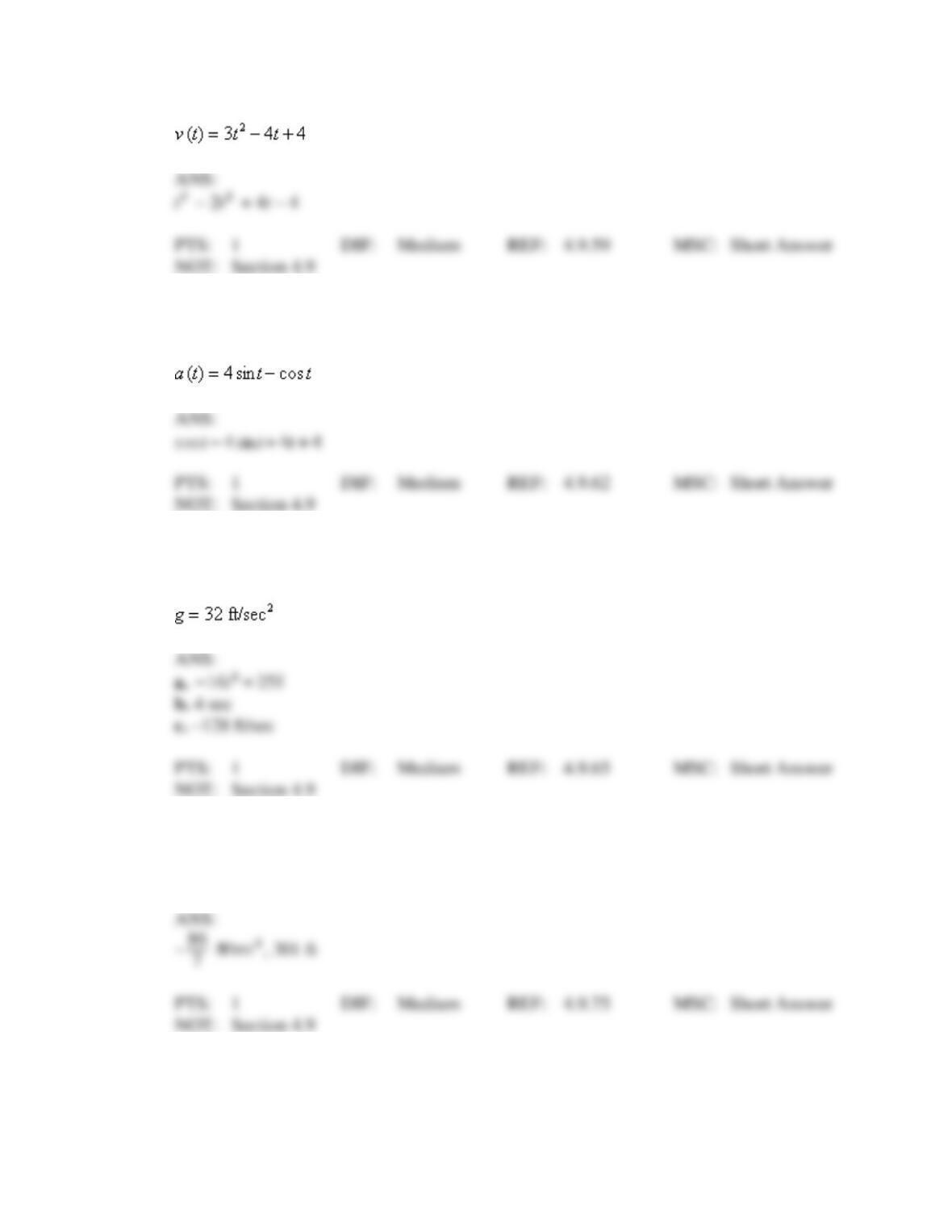
1. Find the position function of a particle moving along a coordinate line that satisfies the
given condition.
, s(1) = –1
2. Find the position function of a particle moving along a coordinate line that satisfies the
given conditions.
, s (0) = 5, v (0) = 0
3. A ballast is dropped from a stationary hot-air balloon that is at an altitude of 256 ft. Find (a)
an expression for the altitude of the ballast after t seconds, (b) the time when it strikes the
ground, and (c) its velocity when it strikes the ground. (Disregard air resistance and take
.)
4. To what constant deceleration would a car moving along a straight road be subjected if the
car were brought to rest from a speed of 86 ft/sec in 7 sec? What would the stopping
distance be?