Chapter 4: Integrating Skills in Interviews
Chapter Assessment
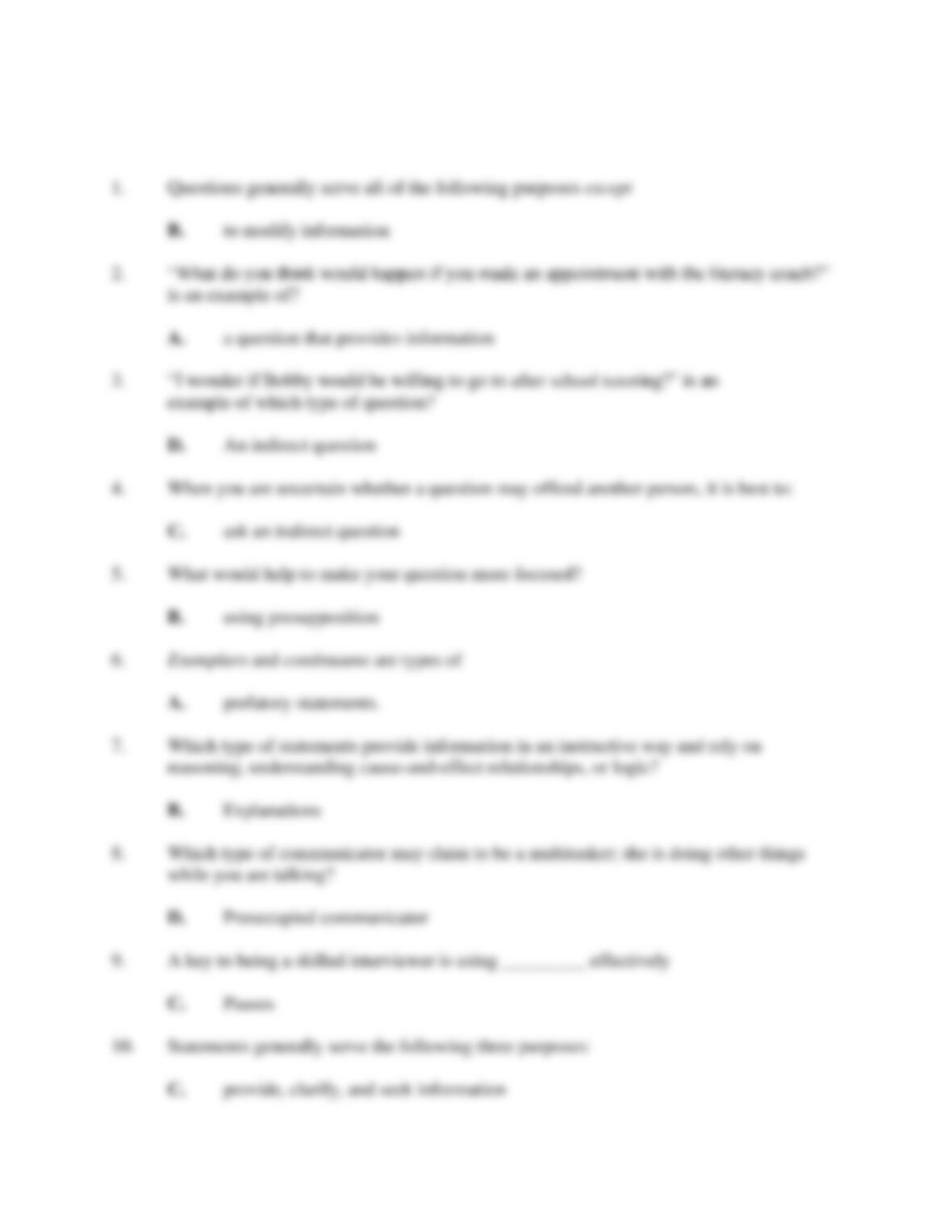
1. Questions generally serve all of the following purposes except
A. to seek information
B. to modify information
C. to provide information
D. to clarify or confirm information
2. “What do you think would happen if you made an appointment with the literacy coach?”
is an example of?
A. a question that provides information
B. a question that modifies information
C. a question that seeks information
D. a question that clarifies information
3. “I wonder if Bobby would be willing to go to after school tutoring?” is an example of
which type of question?
A. a question that seeks information
B. a question that confirms information
C. a direct question
D. an indirect question
4. When you are uncertain whether a question may offend another person, it is best to:
A. ask a closed question
B. ask an advisory question
C. ask an indirect question
D. ask a direct question
5. What would help to make your question more focused?
A. asking an open question
B. using presupposition
C. asking an indirect question
D. using generalities
6. Exemplars and continuums are types of
A. prefatory statements
B. presuppositions
C. open questions
D. evaluative questions
7. Which type of statements provide information in an instructive way and rely on
reasoning, understanding cause-and-effect relationships, or logic?
A. Advice
B. Explanations
C. Direct command
D. Overt descriptive
8. Which type of communicator may claim to be a multitasker; she is doing other things
while you are talking?
A. Passive communicator
B. Distracted communicator
C. Pseudo-communicator
D. Preoccupied communicator
9. A key to being a skilled interviewer is using _________ effectively.
A. Descriptive statements
B. Pauses
C. Explanations
D. Advice
10. Statements generally serve the following three purposes:
A. provide, clarify, and guide information
B. seek, clarify, and guide information
C. provide, clarify, and seek information
D. provide, seek, and guide information
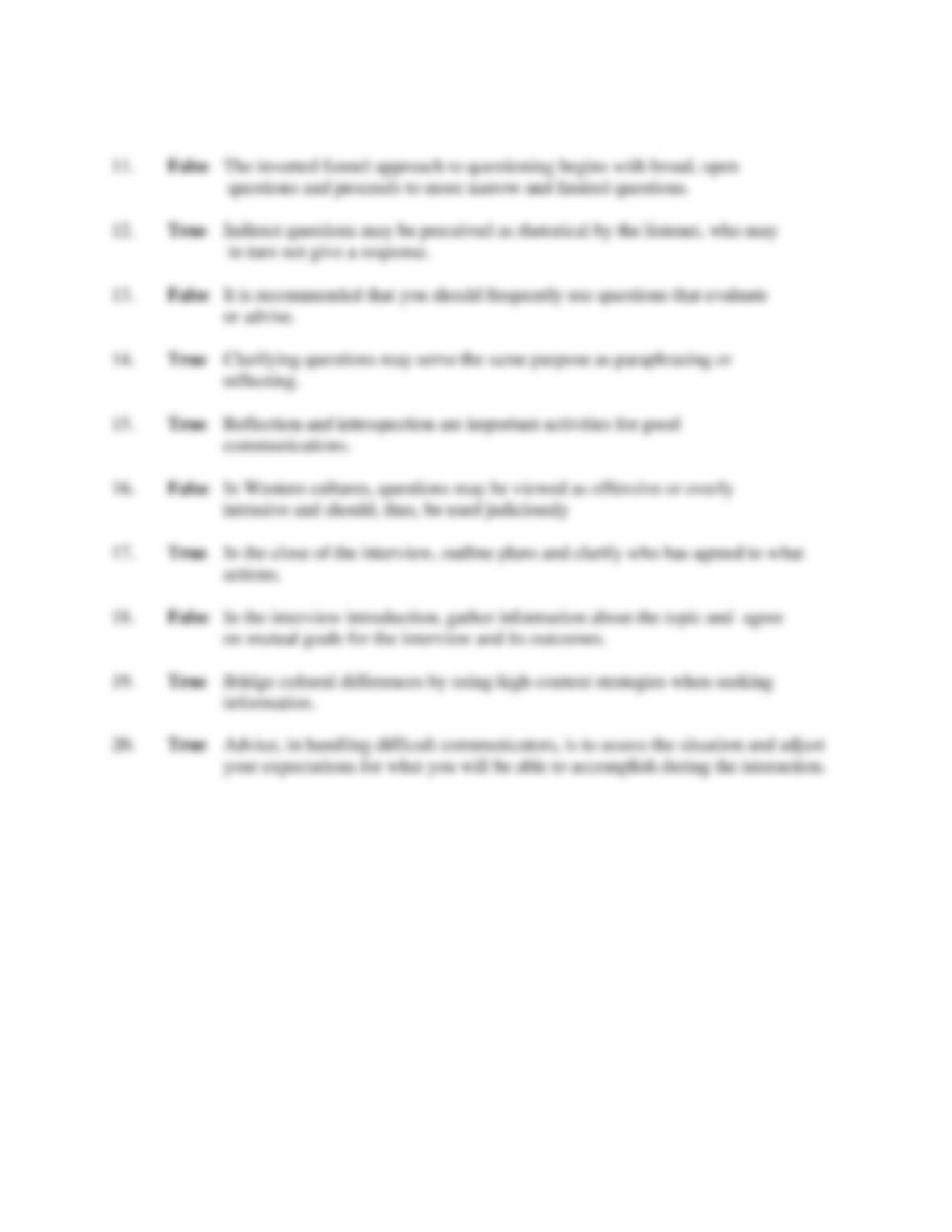
11. True or False The inverted funnel approach to questioning begins with broad, open
questions and proceeds to more narrow and limited questions.
12. True or False Indirect questions may be perceived as rhetorical by the listener, who may
in turn not give a response.
13. True or False It is recommended that you should frequently use questions that evaluate
or advise.
14. True or False Clarifying questions may serve the same purpose as paraphrasing or
Reflecting questions.
15. True or False Reflection and introspection are important activities for good
communications.
16. True or False In Western cultures, questions may be viewed as offensive or overly
intrusive and should, thus, be used judiciously.
17. True or False In the close of the interview, outline plans and clarify who has agreed to
what actions.
18. True or False In the interview introduction, gather information about the topic and agree
on mutual goals for the interview and its outcomes.
19. True or False Bridge cultural differences by using high-context strategies when seeking
information.
20. True or False Advice, in handling difficult communicators, is to assess the situation and
adjust expectations for what will be accomplished during the interaction.
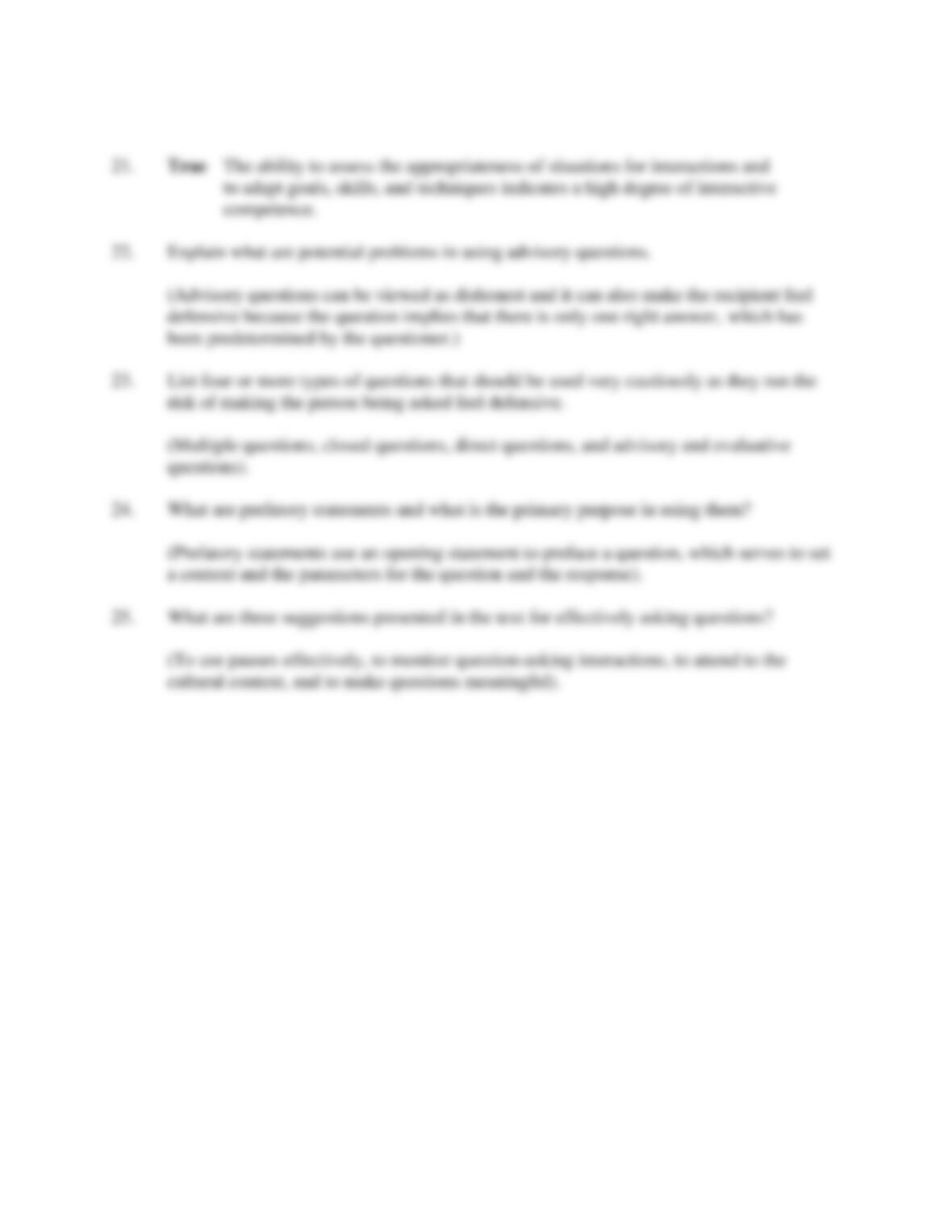
21. True or False The ability to assess the appropriateness of situations for interactions and
to adapt goals, skills, and techniques indicates a high degree of interactive
competence.
22. List and explain potential problems in using advisory questions.
23. List four or more types of questions that should be used very cautiously as they run the
risk of making the person being asked feel defensive.
24. What are prefatory statements and what is the primary purpose in using them?
25. What are three suggestions presented in the text for effectively asking questions?
Chapter 4: Integrating Skills in Interviews
Chapter Assessment