Survey of Economics, 6e (O’Sullivan/Sheffrin/Perez)
Chapter 4 Elasticity: A Measure of Responsiveness
4.1 The Price Elasticity of Demand
1) The price elasticity of demand reflects the responsiveness of
A) firms to changes in demand.
B) demand to a change in price of a substitute good.
C) demand to a change in price.
D) quantity demanded to a change in price.
2) Suppose that Victoria and her friends are running a fundraiser by selling donuts. They want to
know what will happen to their revenue if they increase the price of each donut from $0.80 to $1.
What concept do they need to apply to find out their expected revenue?
A) price elasticity of supply
B) price elasticity of demand
C) cross elasticity of demand
D) income elasticity of demand
3) A good synonym for elasticity would be
A) change.
B) demand.
C) responsiveness.
D) stickiness.
4) The price elasticity of demand is calculated by
A) the change in price divided by the change in quantity demanded.
B) the change in quantity demanded divided by the change in price.
C) the percentage change in price divided by the percentage change in quantity demanded.
D) the percentage change in quantity demanded divided by the percentage change in price.
5) The ratio of the percentage change in quantity demanded to the percentage change in price is
known as the
A) demand-side shift factor.
B) income elasticity of demand.
C) price elasticity of demand.
D) cross elasticity of demand.
6) If the price elasticity of demand is 0.5, this means that a ________ increase in price causes a
________ decrease in quantity demanded.
A) 20%; 100%
B) 30%; 15%
C) 20%; 1%
D) 5%; 1%
7) If the price elasticity of demand is 2, this means that a ________ increase in price causes a
________ decrease in quantity demanded.
A) 15%; 100%
B) 15%; 10%
C) 20%; 40%
D) 30%; 20%
8) The price of apples increases from $1 to $1.10. At the same time, the quantity of apples
demanded decreases from 100 to 90. The price elasticity of demand for apples (calculated using
the initial value formula) is
A) 0.02.
B) 0.9.
C) 1.
D) 1.1.
9) Suppose that in a month the price of milk increases from $2 to $3 a gallon. At the same time,
the quantity of gallons of milk demanded decreases from 200 to 190. The price elasticity of
demand for milk (calculated using the initial value formula) is
A) 0.1.
B) 0.2.
C) 1.
D) 10.
10) Suppose that in a month the price of a dozen of eggs increases from $1.50 to $2. At the same
time, the quantity of dozens of eggs demanded decreases from 200 to 150. The price elasticity of
demand for dozens of eggs is
A) perfectly inelastic.
B) inelastic.
C) unitary elastic.
D) elastic.
11) Suppose that in a month the price of oranges increases from $.75 to $1. At the same time, the
quantity of oranges demanded decreases from 100 to 80. The price elasticity of demand for
oranges (calculated using the initial value formula) is
A) 0.75.
B) 0.6.
C) 0.25.
D) 20.
12) Suppose that in a month the price of tulips increases from $1 to $1.50. At the same time, the
quantity of tulips demanded decreases from 200 to 190. The price elasticity of demand for tulips
(calculated using the initial value formula) is
A) 0.1.
B) 0.5.
C) 10.
D) 20.
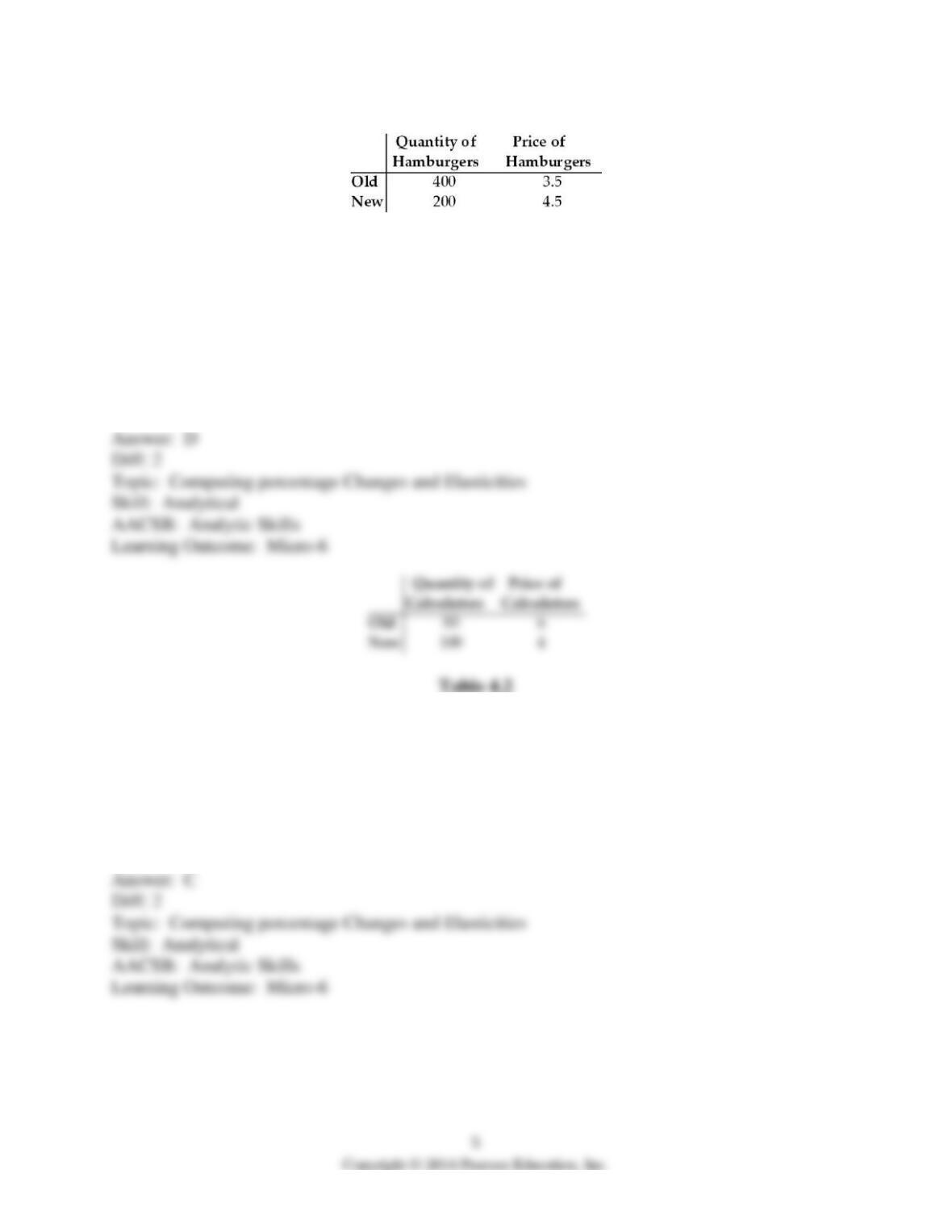
Table 4.1
13) Refer to Table 4.1. A change in the price of hamburgers caused the change in quantity
demanded shown in the table. The price elasticity of demand for hamburgers (calculated using
the initial value formula) is
A) 0.25.
B) 0.50.
C) 1.
D) 1.75.
14) Refer to Table 4.2. A change in the price of calculators caused the change in quantity
demanded shown in the table. The price elasticity of demand for calculators, using the initial-
value formula, is
A) 25.
B) 1.75.
C) 0.75.
D) 0.25.
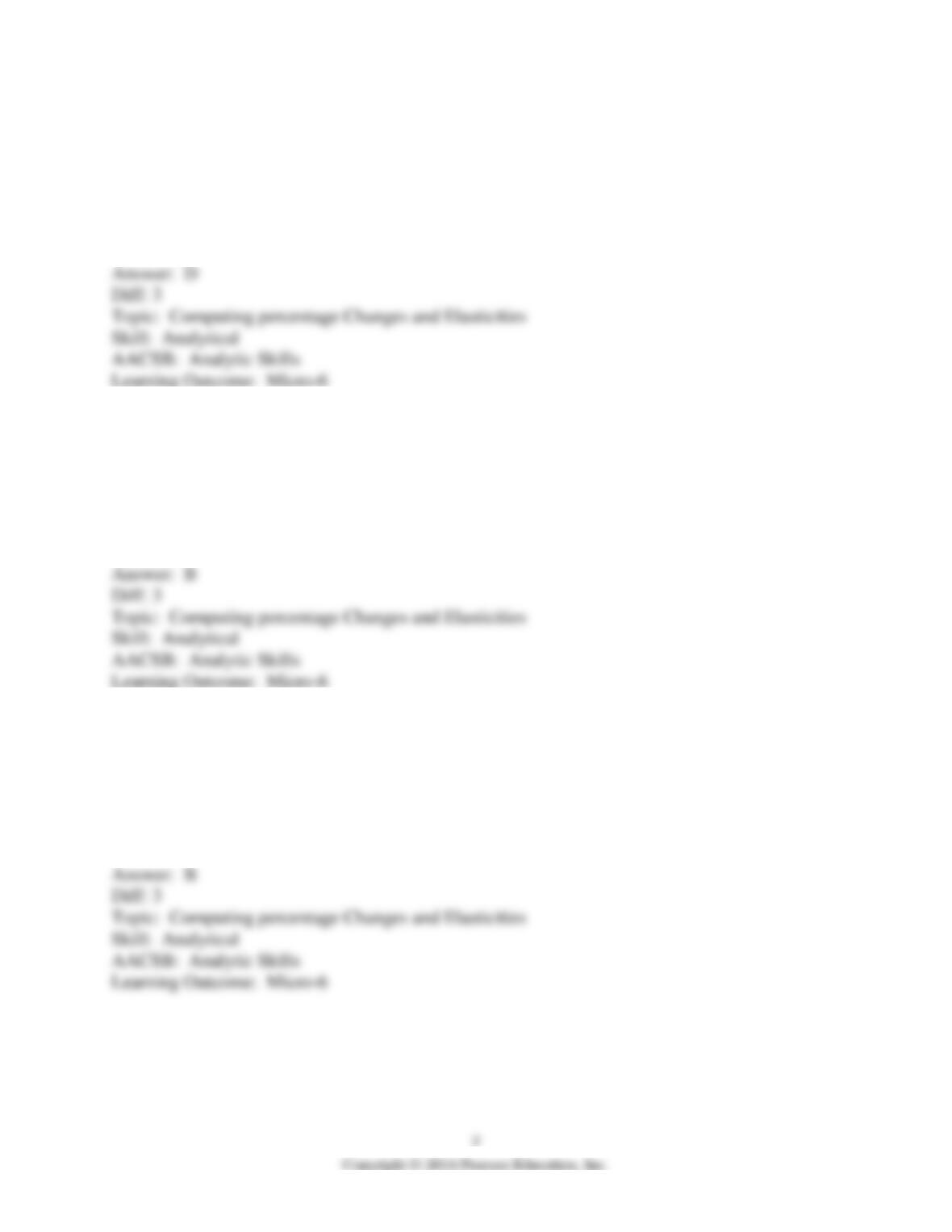
Table 4.3
15) Refer to Table 4.3. A change in the price of computers caused the change in quantity
demanded shown in the table. The price elasticity of demand (calculated using the initial value
formula) is
A) 4.
B) 1.
C) 0.25.
D) 0.125.
16) Refer to Table 4.3. After calculating the price elasticity of demand for computers, we can say
the demand for computers is
A) upward sloping.
B) inelastic.
C) unitary elastic.
D) elastic.
17) The quantity of pencils sold is 1000 at the unit price $0.5. Suppose the price elasticity of
demand for pencils by the initial value method is 2, and you would like to increase the quantity
sold to 1200. Then the new price for pencils must be
A) $0.05.
B) $0.25.
C) $0.30.
D) $0.45.
18) At Tony’s Restaurant, the quantity of large pizzas sold is 200 at the unit price $15. Suppose
the price elasticity of demand for pizzas by the initial value method is 1.5, and you would like to
increase the quantity sold to 250. Then the new price must be
A) $13.
B) $12.50.
C) $11.50.
D) $11.25.
19) The quantity of TVs sold is 100 at the unit price $200. Suppose the price elasticity of
demand for TVs by the initial value method is 2.0, and you would like to decrease the unit price
for TVs to $150. Then the new quantity sold must be
A) 125.
B) 150.
C) 200.
D) 250.
20) The midpoint formula for elasticity of demand solves the problem of
A) whether elasticity of demand is really positive or negative.
B) whether to use quantity or price in the numerator.
C) which price or quantity to use as the initial value of the variable.
D) whether to use quantity demanded or supplied.
21) Suppose that in a month the price of a gallon of milk increases from $2 to $2.50. At the same
time, the quantity of gallons of milk demanded decreases from 100 to 80. The price elasticity of
demand for gallons of milk (calculated using the midpoint formula) is approximately
A) 0.11.
B) 0.2.
C) 1.
D) 1.2.
22) Suppose that in a month the price of movie rentals decreases from $3.25 to $3. At the same
time, the quantity of movie rentals demanded increases from 100 to 120. The price elasticity of
demand for movie rentals (calculated using the midpoint formula) is
A) zero.
B) inelastic.
C) unitary elastic.
D) elastic.
23) Suppose that in a month the price of pizza increases from $4 to $5. At the same time, the
quantity of pizzas demanded decreases from 200 to 190. The price elasticity of demand for pizza
(calculated using the midpoint formula) is
A) 0.1.
B) 0.23.
C) 0.25.
D) 4.35.
24) Suppose that in a month the price of pizza increases from $4 to $5. At the same time, the
quantity of pizzas demanded decreases from 200 to 190. The price elasticity of demand for pizza
(calculated using the midpoint formula) is
A) zero.
B) inelastic.
C) unitary elastic.
D) elastic.
25) Suppose that in a month the price of a cup of coffee increases from $1 to $1.50. At the same
time, the quantity of cups of coffee demanded decreases from 200 to 190. The price elasticity of
demand for cups of coffee (calculated using the midpoint formula) is approximately
A) 0.13.
B) 0.5.
C) 7.8.
D) 20.
26) Suppose that in a month the price of a cup of coffee increases from $1 to $1.50. At the same
time, the quantity of cups of coffee demanded decreases from 200 to 190. The price elasticity of
demand for cups of coffee (calculated using the midpoint formula) is
A) zero.
B) inelastic.
C) unitary elastic.
D) elastic.
27) Suppose that David buys the same number of energy drinks every weekend no matter what
happens to the price of the energy drinks. What does this suggest about David’s demand for
energy drinks?
A) It is elastic.
B) It is perfectly inelastic.
C) It is unitary elastic.
D) It is not something that can be characterized without knowing the prices of the energy drinks.
28) The price of pens increases from $2 to $2.20. At the same time, the quantity of pens
demanded decreases from 100 to 90. Demand for pens is
A) perfectly inelastic.
B) inelastic.
C) unitary elastic.
D) elastic.
29) If the price elasticity of demand is 1.3, demand is
A) upward sloping.
B) inelastic.
C) unitary elastic.
D) elastic.
30) If the price elasticity of demand is 1, demand is
A) upward sloping.
B) inelastic.
C) unitary elastic.
D) elastic.
31) If the price elasticity of demand is infinite, demand is
A) upward sloping.
B) inelastic.
C) elastic.
D) perfectly elastic.
32) If the price elasticity of demand is very elastic, which of the following could be a possible
value of the elasticity?
A) 2
B) 1
C) 1/3
D) 0
33) If the price elasticity of demand for water is inelastic, which of the following could be a
possible value of the elasticity?
A) 2
B) 1
C) 0.5
D) all of the above
34) If Juan purchases the same number of gallons of gasoline per week regardless of changes in
gasoline price, Juan’s demand for gasoline is
A) perfectly elastic.
B) elastic.
C) perfectly inelastic.
D) inelastic.
35) If the demand curve is a vertical line, it means that
A) regardless of price, the quantity demanded is a constant amount.
B) regardless of quantity, the price is a constant amount.
C) the good is inferior.
D) the good has many substitutes.
36) If, regardless of price, the quantity demanded is a constant amount, then the demand curve is
A) horizontal.
B) vertical.
C) upward sloping.
D) downward sloping.
37) If the quantity demanded is infinitely responsive to any change in price, the demand curve is
A) upward sloping.
B) downward sloping.
C) horizontal.
D) vertical.
38) In the case of perfectly elastic demand, the demand curve is
A) upward sloping.
B) downward sloping.
C) vertical.
D) horizontal.
39) In the case of perfectly inelastic demand, the demand curve is
A) upward sloping.
B) downward sloping.
C) vertical.
D) horizontal.
40) If demand is perfectly inelastic, the price elasticity of demand is equal to
A) 1.
B) 0.
C) infinity.
D) a negative number between 0 and infinity.
41) If demand is perfectly elastic, the price elasticity of demand is equal to
A) 1.
B) 0.
C) infinity.
D) a positive number between 0 and infinity.
42) If the price elasticity of demand is equal to zero and the price were to rise, the quantity
demanded would
A) decrease slightly.
B) fall to zero.
C) not change.
D) increase.
43) If the demand curve facing a firm had a price elasticity of demand equal to zero and the firm
raised its price, its total revenue would
A) decrease slightly.
B) fall to zero.
C) not change.
D) increase.
44) If the demand curve facing a firm had a price elasticity of demand equal to infinity and the
firm raised its price, its total revenue would
A) decrease slightly.
B) fall to zero.
C) not change.
D) increase.
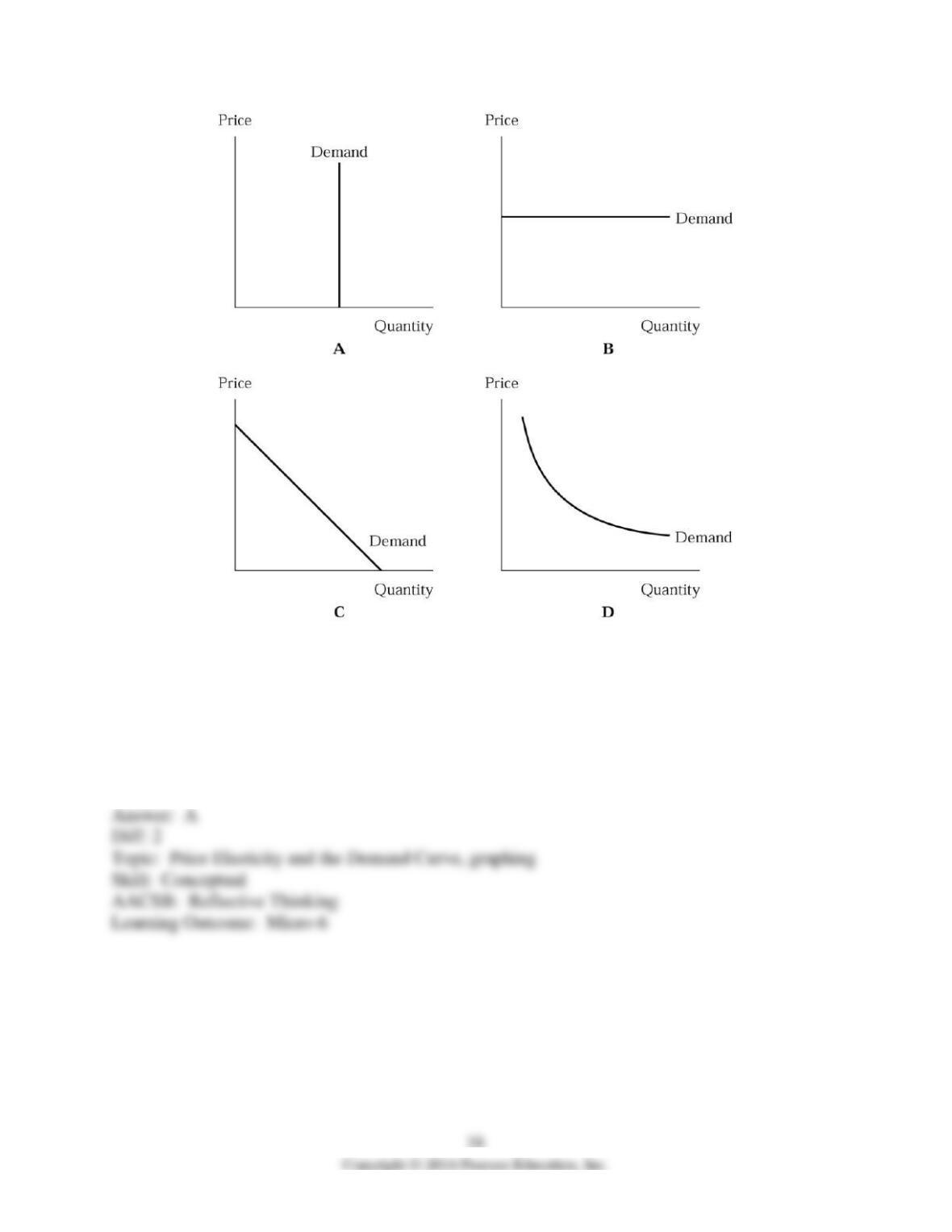
Figure 4.1
45) In Figure 4.1 the demand curve that is perfectly inelastic is on graph
A) A.
B) B.
C) C.
D) D.
46) In Figure 4.1 the demand curve that is perfectly elastic is on graph
A) A.
B) B.
C) C.
D) D.
47) In Figure 4.1 the demand curve along which price elasticity of demand changes as you move
along it is on graph
A) A.
B) B.
C) C.
D) D.
48) In Figure 4.1 the demand curve that has a zero elasticity is show in graph
A) A.
B) B.
C) C.
D) D.
49) In Figure 4.1 the demand curve that has an infinite elasticity is shown on graph
A) A.
B) B.
C) C.
D) D.
50) Which of the following statements is INCORRECT?
A) The price elasticity of demand tends to be greater for a specific brand of a product than for a
product in general.
B) The price elasticity of demand tends to be smaller when consumers have less time to adjust to
price changes.
C) The price elasticity of demand tends to be greater when a product accounts for a smaller
portion of the consumer’s budget.
D) The price elasticity of demand tends to be greater for a product with more substitutes
available.
51) If a product is a necessity and has no substitutes at all, demand for the product is most likely
to be
A) very inelastic.
B) inelastic.
C) unitary elastic.
D) elastic.
52) If a product has only a few acceptable substitutes, demand for the product is most likely to be
A) very inelastic.
B) inelastic.
C) elastic.
D) very elastic.
53) Ceteris paribus, if more alternative forms of energy become available, we would expect the
demand for gasoline to become
A) more elastic.
B) more inelastic.
C) perfectly elastic.
D) perfectly inelastic.
54) If a product has several good substitutes, demand for the product is most likely to be
A) very inelastic.
B) inelastic.
C) unitary elastic.
D) elastic.
55) Which of the following products has the most elastic demand?
A) Raspberry Mocha Kona coffee blend at Starbuck’s
B) Starbuck’s coffee
C) coffee
D) all beverages
56) Which of the following products has the least elastic demand?
A) Raspberry Mocha Kona coffee blend at Starbuck’s
B) Starbuck’s coffee
C) coffee
D) all beverages
57) Which of the following products has the most elastic demand?
A) Coca Cola in 12 oz cans
B) all cola drinks
C) all carbonated beverages
D) all beverages
58) Which of the following products has the least elastic demand?
A) Coca Cola in 12 oz. cans
B) all cola drinks
C) all carbonated beverages
D) all beverages