Exam
Name___________________________________
MULTIPLE CHOICE. Choose the one alternative that best completes the statement or answers the question.
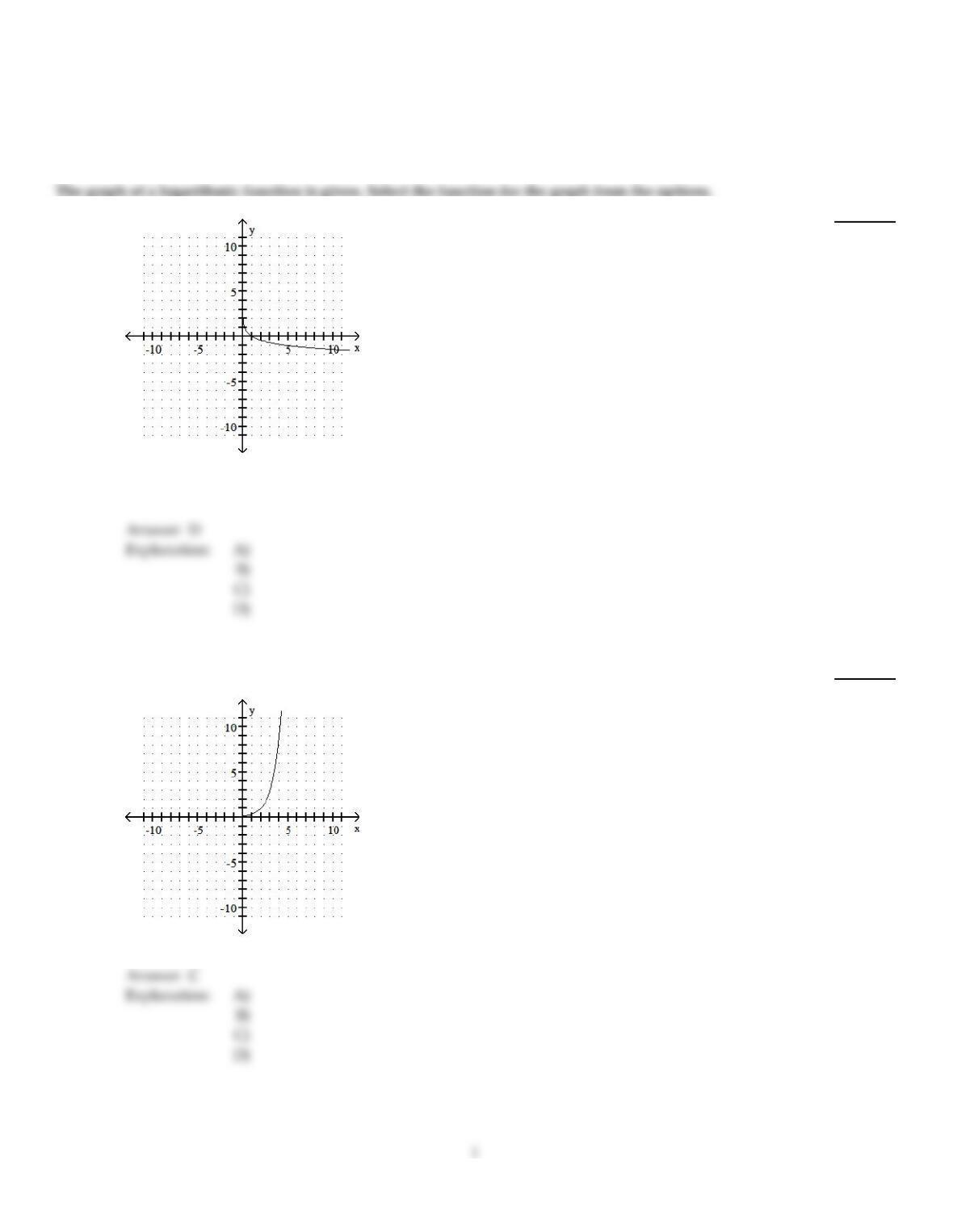
1)
1)
A)
f(x) =log 5(–x)
B)
f(x) = 1 –log 5x
C)
f(x) =log 5x
D)
f(x) = – log 5x
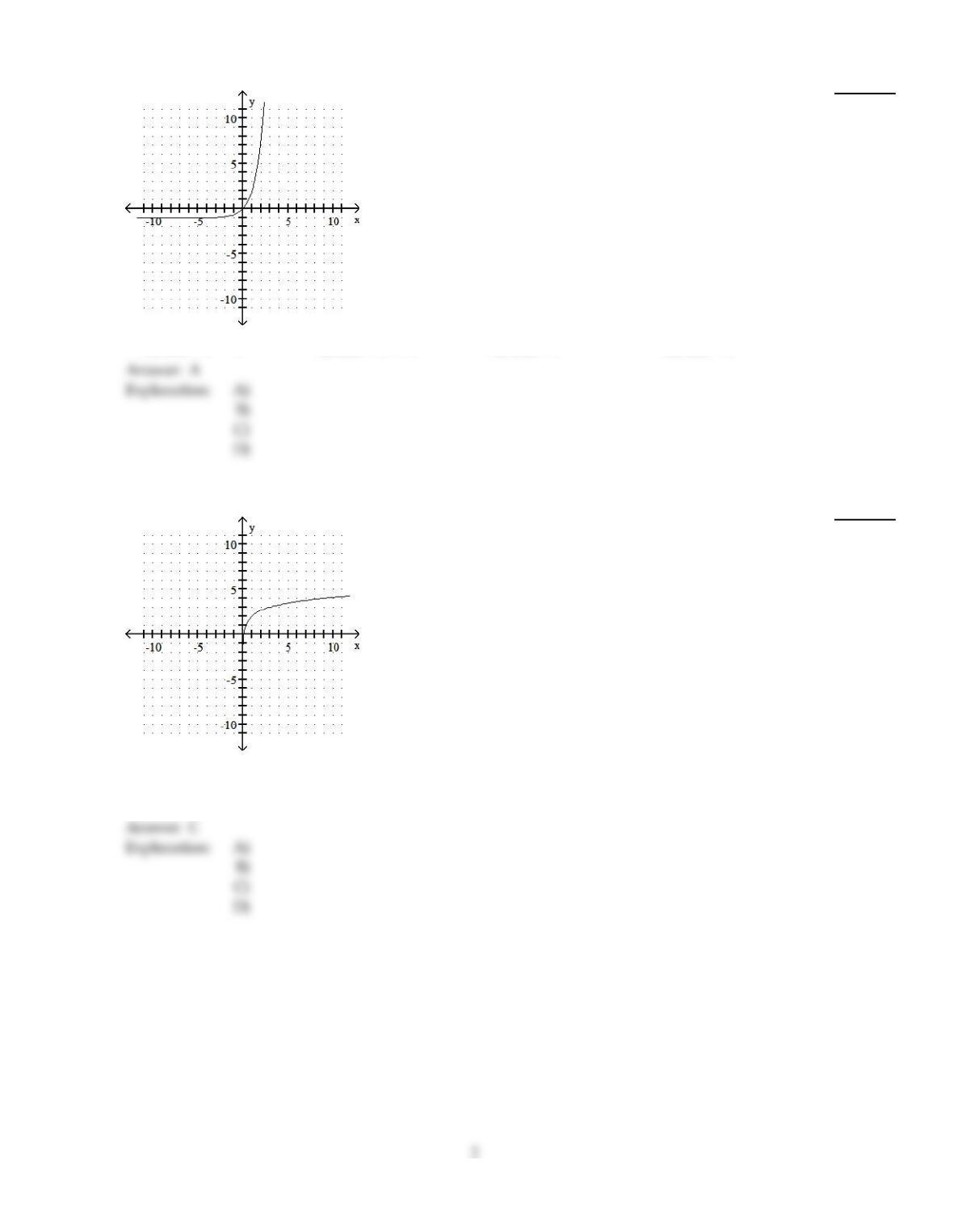
The graph of an exponential function is given. Select the function for the graph from the functions listed.
2)
2)
A)
f(x) =3x
B)
f(x) =3x+ 2
C)
f(x) =3x – 2
D)
f(x) =3x– 2
3)
3)
A)
f(x) =3x– 1
B)
f(x) =3x+ 1
C)
f(x) =3x
D)
f(x) =3x – 1
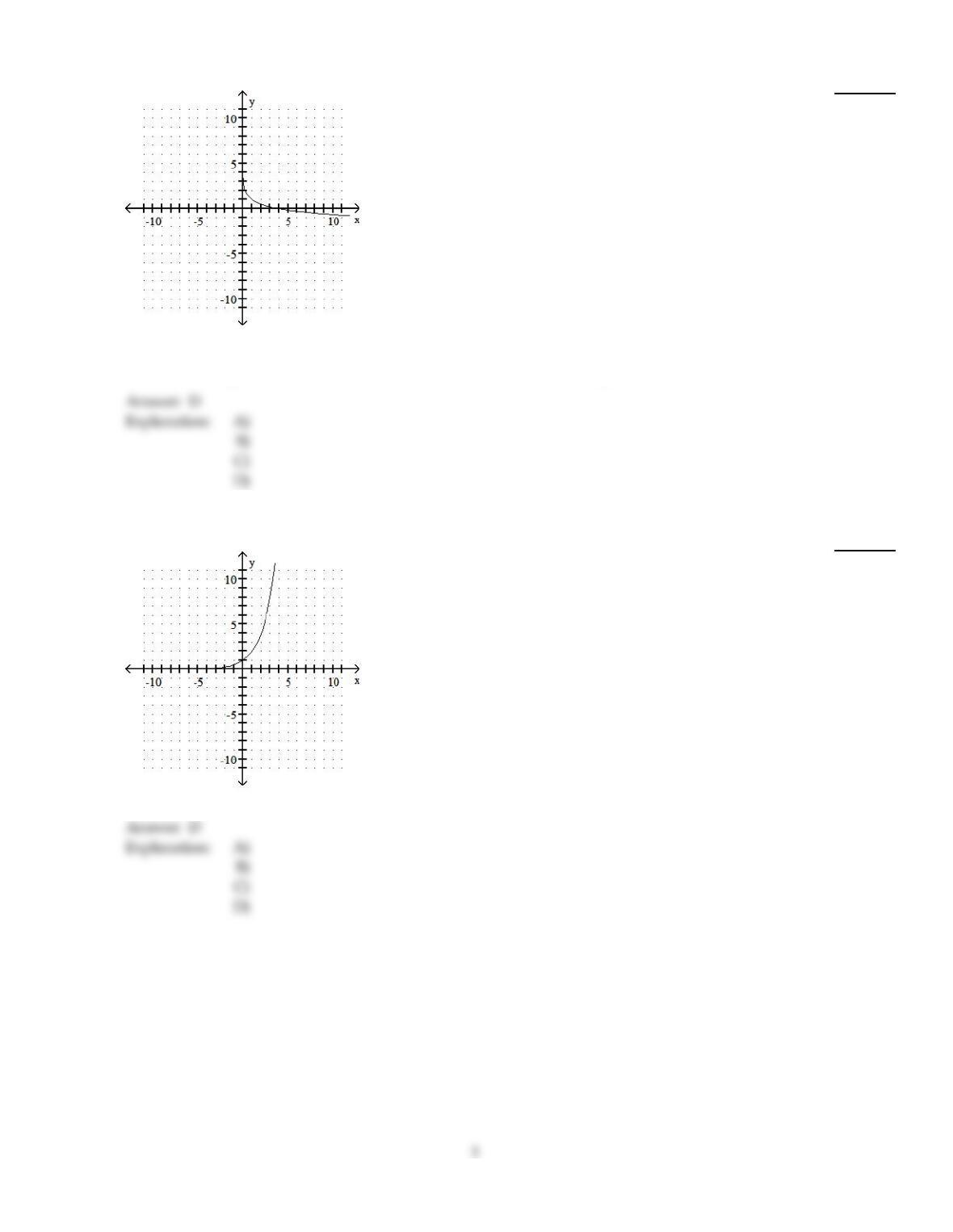
The graph of a logarithmic function is given. Select the function for the graph from the options.
4)
4)
A)
f(x) =log 3(x + 2)
B)
f(x) =log 3(x – 2)
C)
f(x) =log 3x + 2
D)
f(x) =log 3x
5)
5)
A)
f(x) = – log 4x
B)
f(x) =log 4x
C)
f(x) =log 4(–x)
D)
f(x) = 1 –log 4x
The graph of an exponential function is given. Select the function for the graph from the functions listed.
6)
6)
A)
f(x) =2x + 1
B)
f(x) =2x– 1
C)
f(x) =2x+ 1
D)
f(x) =2x
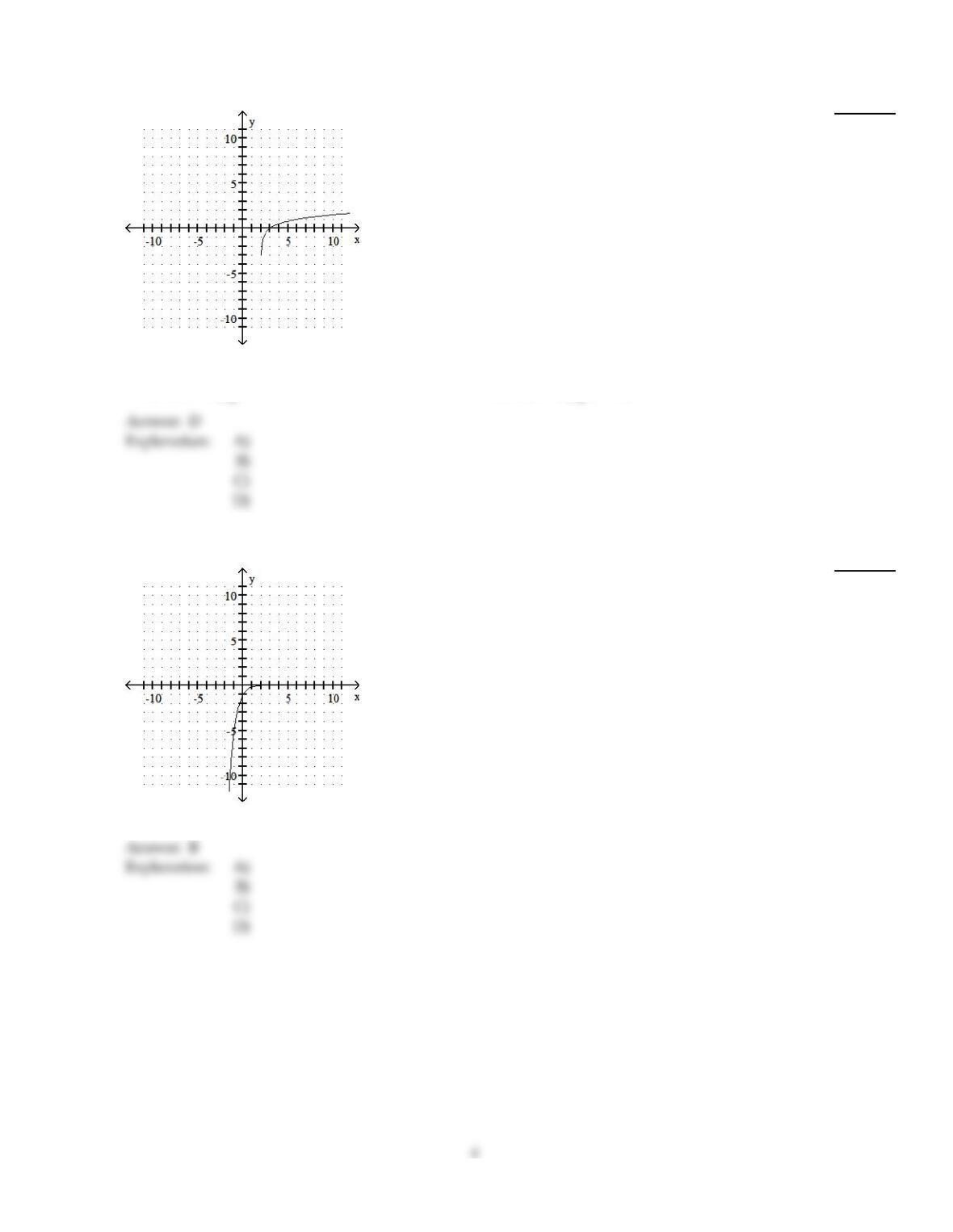
The graph of a logarithmic function is given. Select the function for the graph from the options.
7)
7)
A)
f(x) =log 4(x + 2)
B)
f(x) =log 4x – 2
C)
f(x) =log 4x
D)
f(x) =log 4(x – 2)
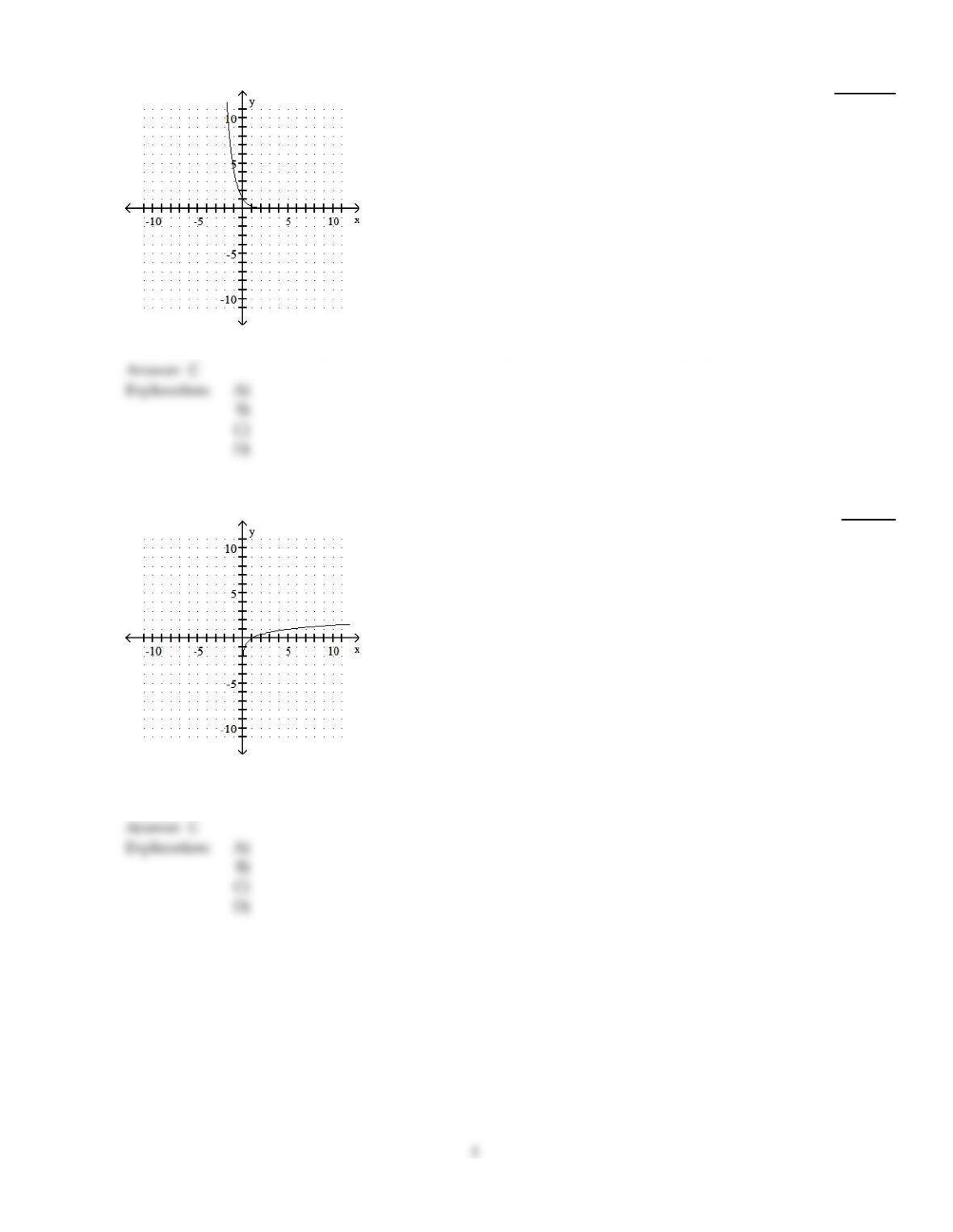
The graph of an exponential function is given. Select the function for the graph from the functions listed.
8)
8)
A)
f(x) =5x
B)
f(x) = – 5–x
C)
f(x) = – 5x
D)
f(x) =5–x
9)
9)
A)
f(x) = – 4x
B)
f(x) = – 4–x
C)
f(x) =4–x
D)
f(x) =4x
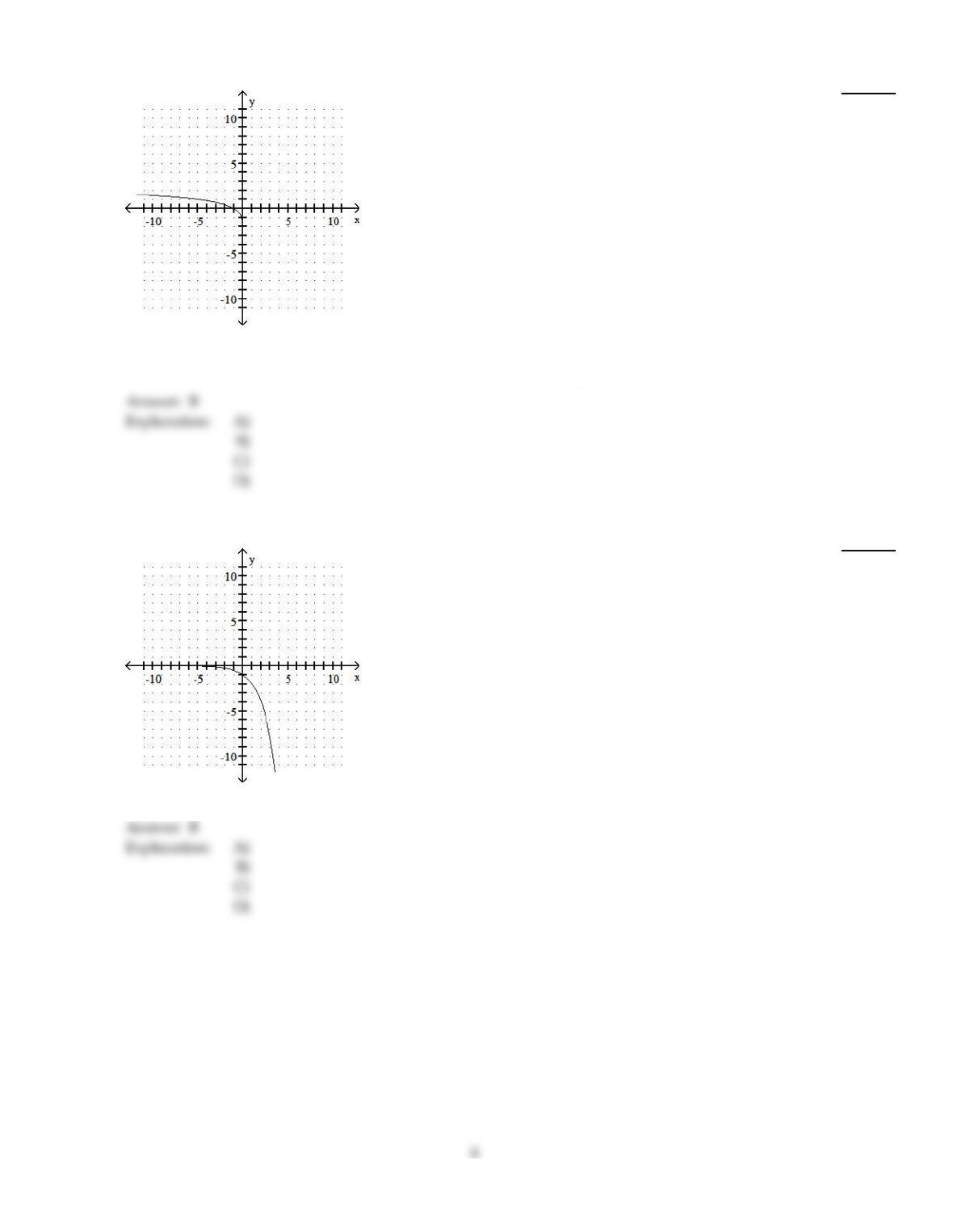
The graph of a logarithmic function is given. Select the function for the graph from the options.
10)
10)
A)
f(x) =log 5x + 1
B)
f(x) =log 5(x – 1)
C)
f(x) =log 5x
D)
f(x) =log 5(x + 1)
11)
11)
A)
f(x) = – log 5x
B)
f(x) =log 5(–x)
C)
f(x) = 1 –log 5x
D)
f(x) =log 5x
The graph of an exponential function is given. Select the function for the graph from the functions listed.
12)
12)
A)
f(x) =2x
B)
f(x) = – 2x
C)
f(x) =2–x
D)
f(x) = – 2–x
SHORT ANSWER. Write the word or phrase that best completes each statement or answers the question.
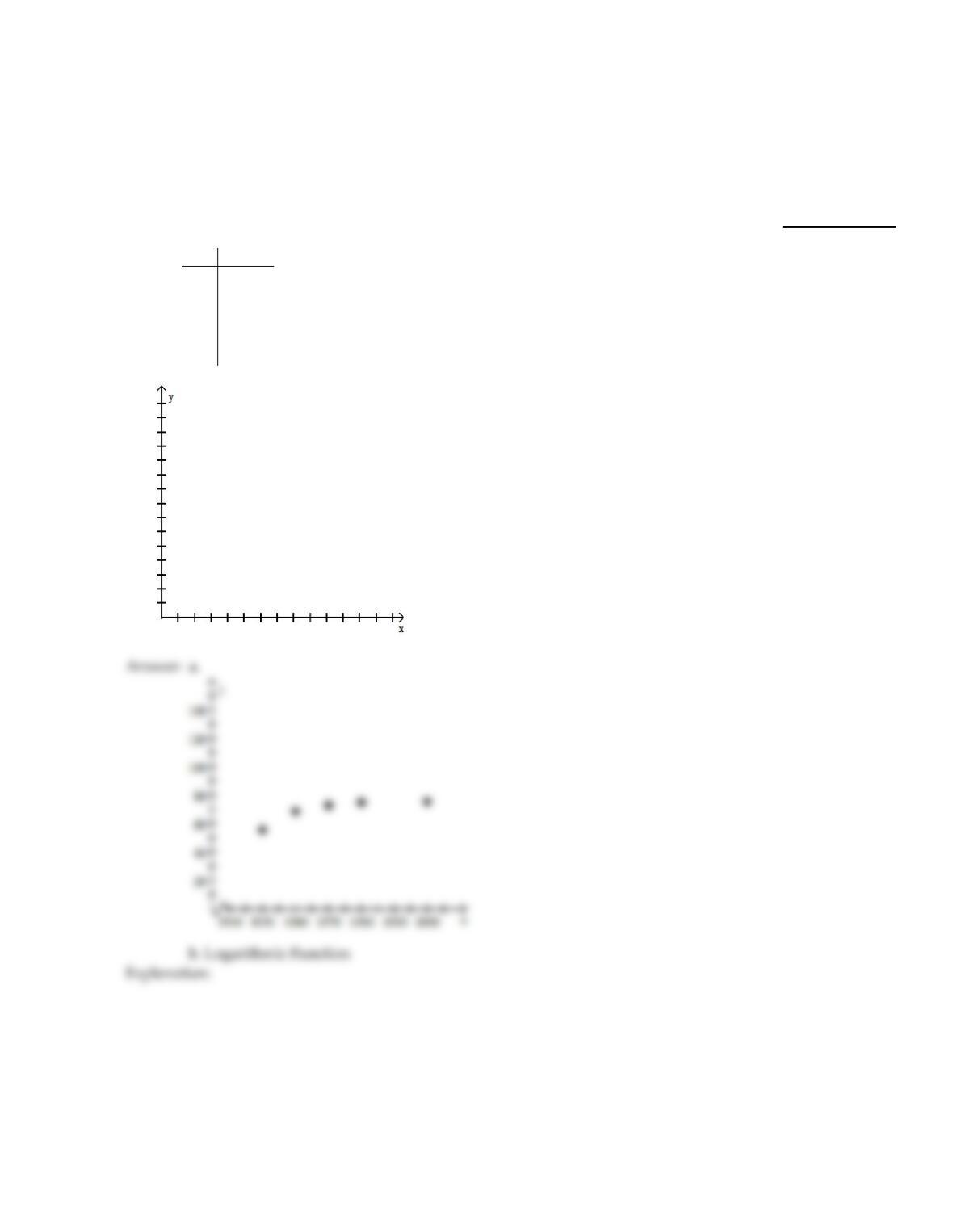
Present data in the form of tables. For the data set shown by the table,
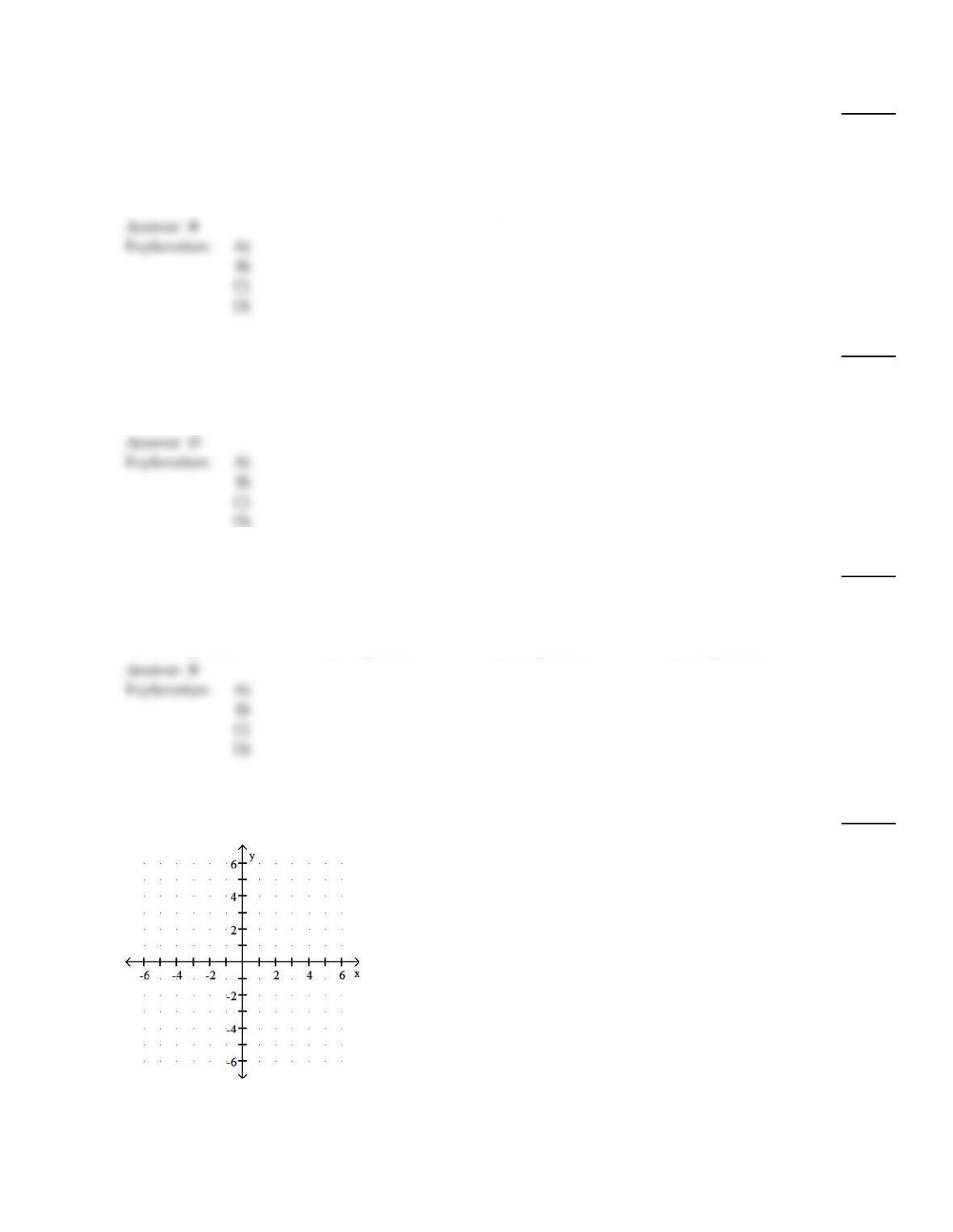
a. Create a scatter plot for the data.
b. Use the scatter plot to determine whether an exponential function or a logarithmic function is the best
choice for modeling the data.
13)
Percentage of Population Living in the
South Suburbs of a Large City
Year Percent
1950 55
1960 69
1970 73
1980 75
2000 77
13)
7
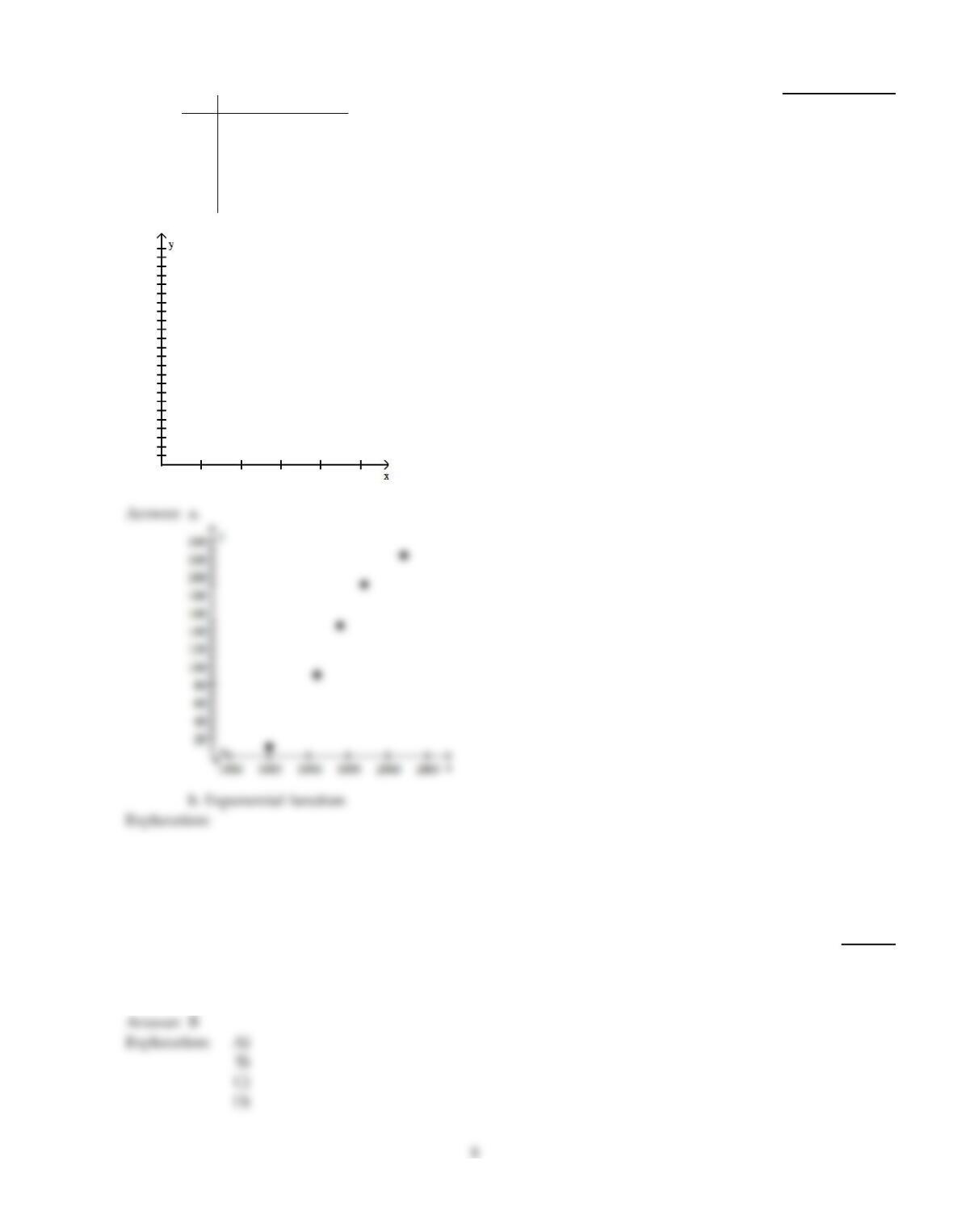
14)
Number of Homes Built in a Town by Year
Year Number of Homes
1985 11
1991 91
1994 146
1997 192
2002 224
14)
MULTIPLE CHOICE. Choose the one alternative that best completes the statement or answers the question.
Use properties of logarithms to expand the logarithmic expression as much as possible. Where possible, evaluate
logarithmic expressions without using a calculator.
15)
log 6(7 ·3)
15)
A)
log 67–log 63
B)
log 67+log 63
C)
log 621
D)
(log 67)(log 63)
Solve the problem.
16)
The function f(x) = 1 +1.5 ln (x + 1) models the average number of free–throws a basketball player
can make consecutively during practice as a function of time, where x is the number of consecutive
days the basketball player has practiced for two hours. After 206 days of practice, what is the
average number of consecutive free throws the basketball player makes?
16)
A)
13 consecutive free throws
B)
9 consecutive free throws
C)
10 consecutive free throws
D)
12 consecutive free throws
17)
The population in a particular country is growing at the rate of 2.8% per year. If 7,638,000 people
lived there in 1999, how many will there be in the year 2005? Use f(x) =y0e0.028t and round to the
nearest ten–thousand.
17)
A)
9,940,000
B)
8,850,000
C)
10,840,000
D)
9,040,000
18)
The function f(x) =600(0.5)x/80 models the amount in pounds of a particular radioactive material
stored in a concrete vault, where x is the number of years since the material was put into the vault.
Find the amount of radioactive material in the vault after 140 years. Round to the nearest whole
number.
18)
A)
171 pounds
B)
178 pounds
C)
525 pounds
D)
404 pounds
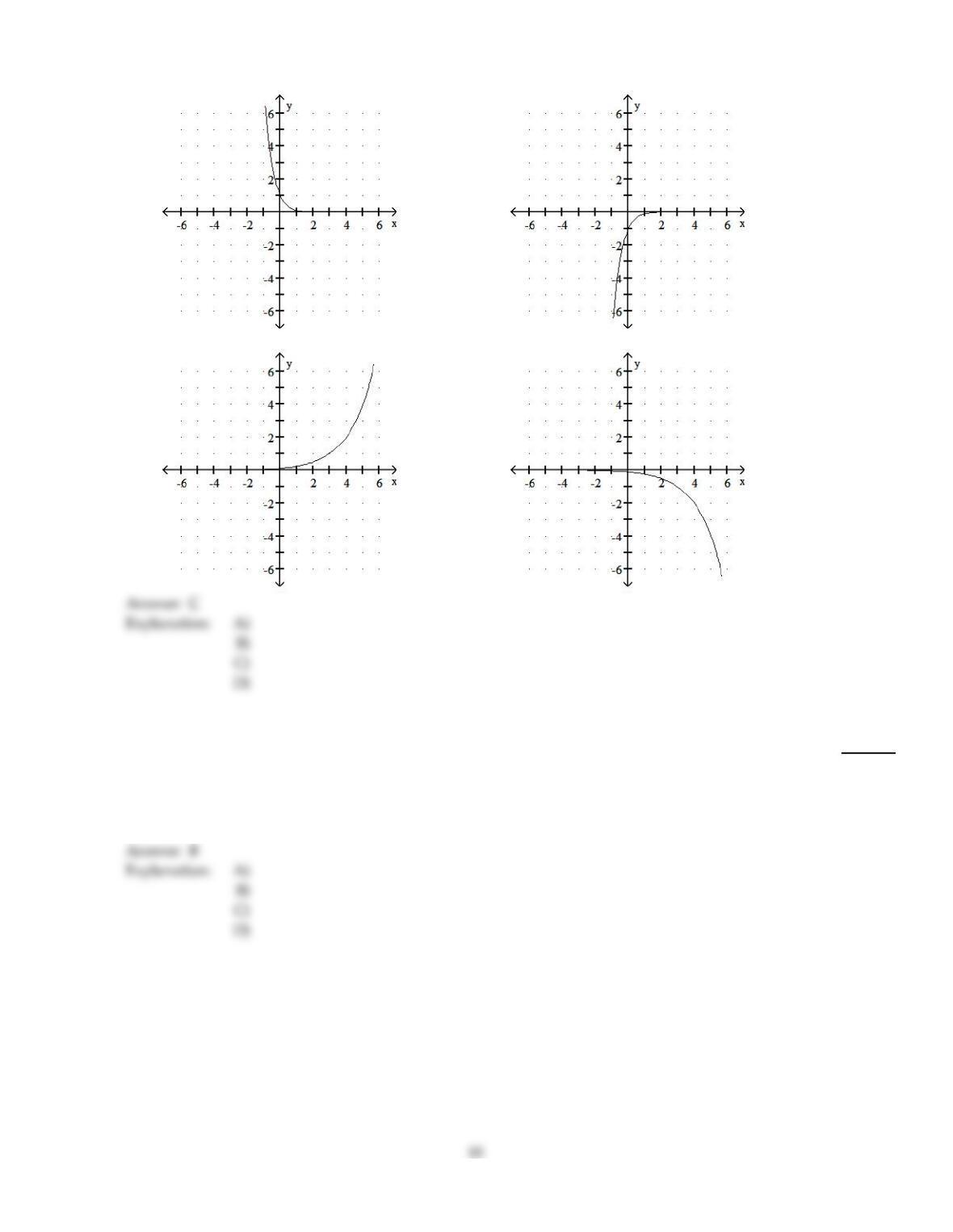
Graph the function.
19)
Use the graph of f(x) =2x to obtain the graph of g(x) =2x – 3.
19)
9
A)
B)
C)
D)
Solve.
20)
The population of a particular country was 25 million in 1982; in 1992, it was 35 million. The
exponential growth function A =25ekt describes the population of this country t years after 1982.
Use the fact that 10 years after 1982 the population increased by 10 million to find k to three
decimal places.
20)
A)
0.677
B)
0.034
C)
0.230
D)
0.044
Use properties of logarithms to expand the logarithmic expression as much as possible. Where possible, evaluate
logarithmic expressions without using a calculator.
21)
ln 3ey
21)
A)
1
3 ln y +1
3
B)
y
3
C)
3 ln y +3
D)
1
3 ln 3ey +1
3
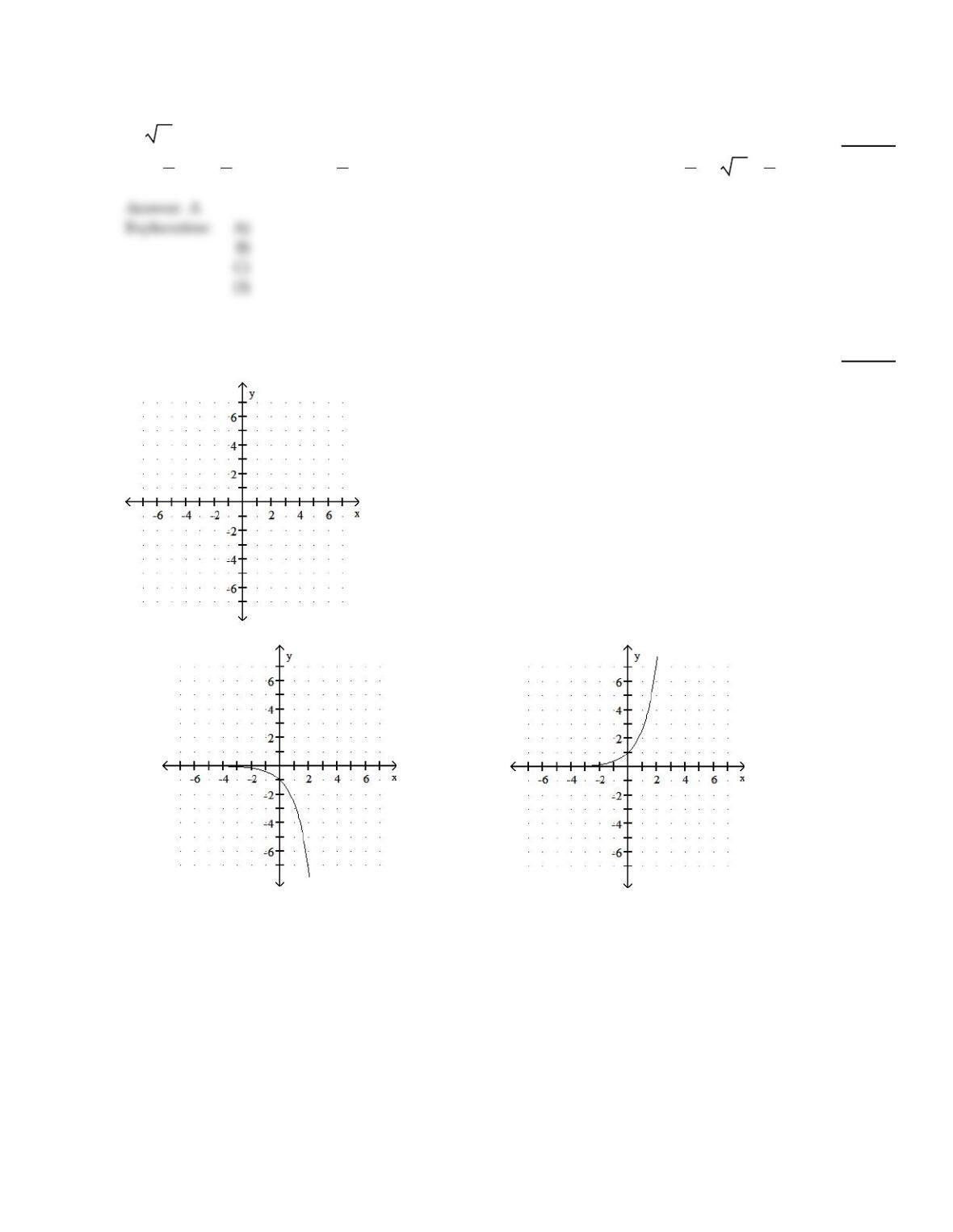
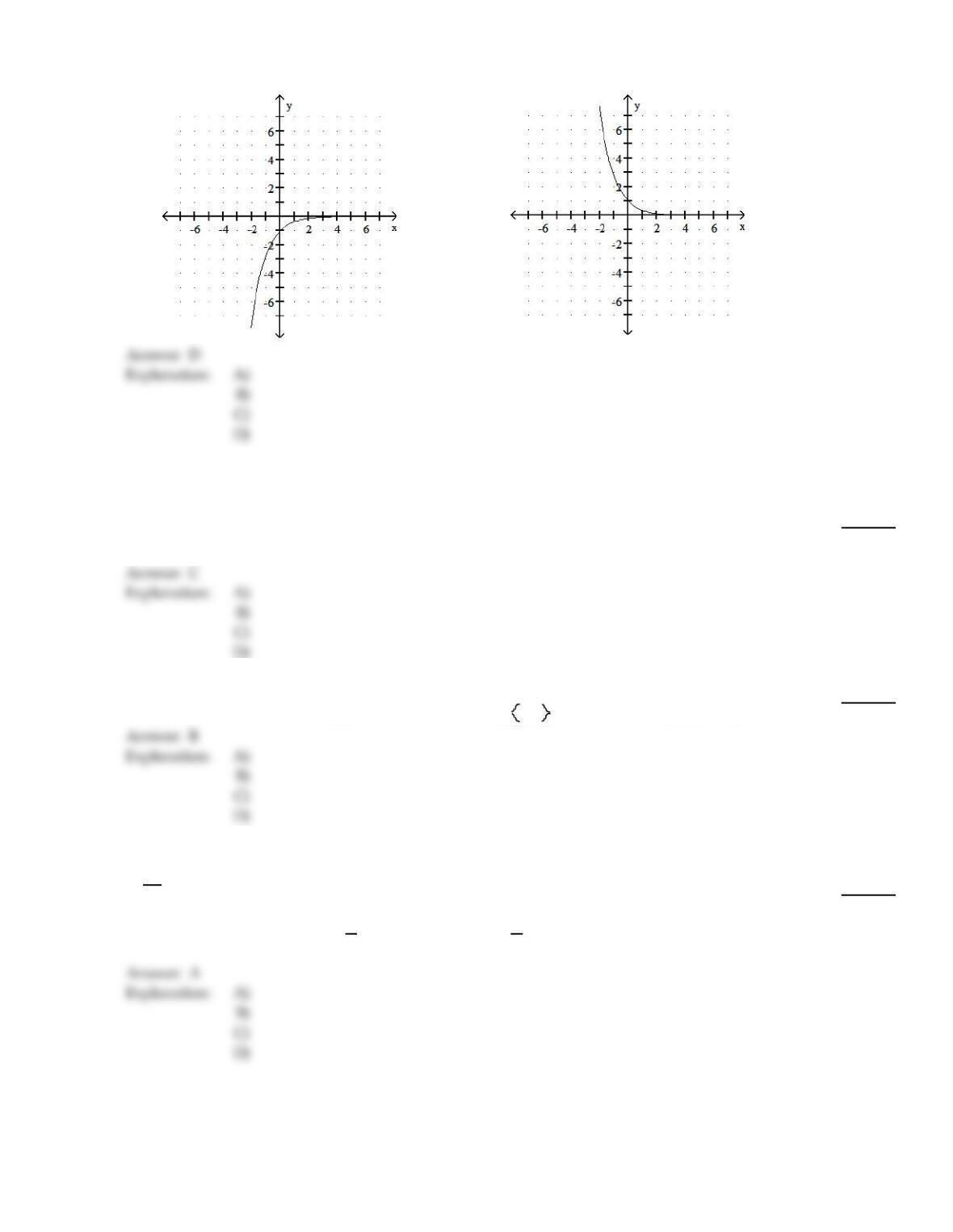
Graph the function.
22)
Use the graph of f(x) =ex to obtain the graph of g(x) =e–x.
22)
A)
B)
11
C)
D)
Solve the logarithmic equation. Be sure to reject any value that is not in the domain of the original logarithmic
expressions. Give the exact answer.
23)
log9 (x2– 8x) = 1
23)
A)
{–9, 1}
B)
{1}
C)
{9, –1}
D)
{9}
24)
2log x – log 5= log 180
24)
A)
{–30}
B)
{30}
C)
450
D)
{30, –30}
Evaluate the expression without using a calculator.
25)
ln 1
e7
25)
A)
–7
B)
–1
7
C)
1
7
D)
7
Graph the function.
12
26)
Use the graph of f(x) =ex to obtain the graph of g(x) = – ex.
26)
A)
B)
C)
D)
Solve the equation by expressing each side as a power of the same base and then equating exponents.
27)
ex +2=1
e4
27)
A)
{–2}
B)
{–6}
C)
{2}
D)
{6}
Solve the problem.
28)
The formula A =173e0.046t models the population of a particular city, in thousands, t years after
1998. When will the population of the city reach 329 thousand?
28)
A)
2012
B)
2015
C)
2013
D)
2014
Use the compound interest formulas A = P 1 +r
n
nt and A = Pert to solve.
29)
Find the accumulated value of an investment of $3000 at 7% compounded continuously for 6 years.
29)
A)
$4260.00
B)
$4502.19
C)
$4665.88
D)
$4565.88
Evaluate or simplify the expression without using a calculator.
30)
10log 5x
30)
A)
5
B)
x–1/5
C)
x1/5
D)
x5
Use the compound interest formulas A = P 1 +r
n
nt and A = Pert to solve.
31)
Suppose that you have $10,000 to invest. Which investment yields the greater return over 6 years:
8.75% compounded continuously or 8.9% compounded semiannually?
31)
A)
$10,000 invested at 8.9% compounded semiannually over 6 years yields the greater return.
B)
Both investment plans yield the same return.
C)
$10,000 invested at 8.75% compounded continuously over 6 years yields the greater return.
Use properties of logarithms to expand the logarithmic expression as much as possible. Where possible, evaluate
logarithmic expressions without using a calculator.
32)
ln 7x
32)
A)
7ln x
B)
1
7ln x
C)
7ln x
D)
x ln 7
Solve the exponential equation. Use a calculator to obtain a decimal approximation, correct to two decimal places, for the
solution.
33)
ex +8=5
33)
A)
–6.30
B)
2.56
C)
–5.44
D)
–6.39
Approximate the number using a calculator. Round your answer to three decimal places.
34)
2.4
34)
A)
15.648
B)
7.540
C)
36.462
D)
15.601
Use common logarithms or natural logarithms and a calculator to evaluate to four decimal places
35)
log 15
35)
A)
0.4227
B)
0.6789
C)
1.6732
D)
2.3657
Use properties of logarithms to expand the logarithmic expression as much as possible. Where possible, evaluate
logarithmic expressions without using a calculator.
36)
log 5(25x)
36)
A)
2+log 5x
B)
2log 5x
C)
2x
D)
10 +log 5x
Solve the problem.
37)
The pH of a solution ranges from 0 to 14. An acid has a pH less than 7. Pure water is neutral and
has a pH of 7. The pH of a solution is given by pH = – log x where x represents the concentration of
the hydrogen ions in the solution in moles per liter. Find the hydrogen ion concentration if the
pH =3.
37)
A)
0.33
B)
103
C)
1.1
D)
10–3
Solve the logarithmic equation. Be sure to reject any value that is not in the domain of the original logarithmic
expressions. Give the exact answer.
38)
ln (x –2) – ln (x +2) = ln (x –9) – ln (x +4)
38)
A)
B)
–10
9
C)
–26
9
D)
–10
13
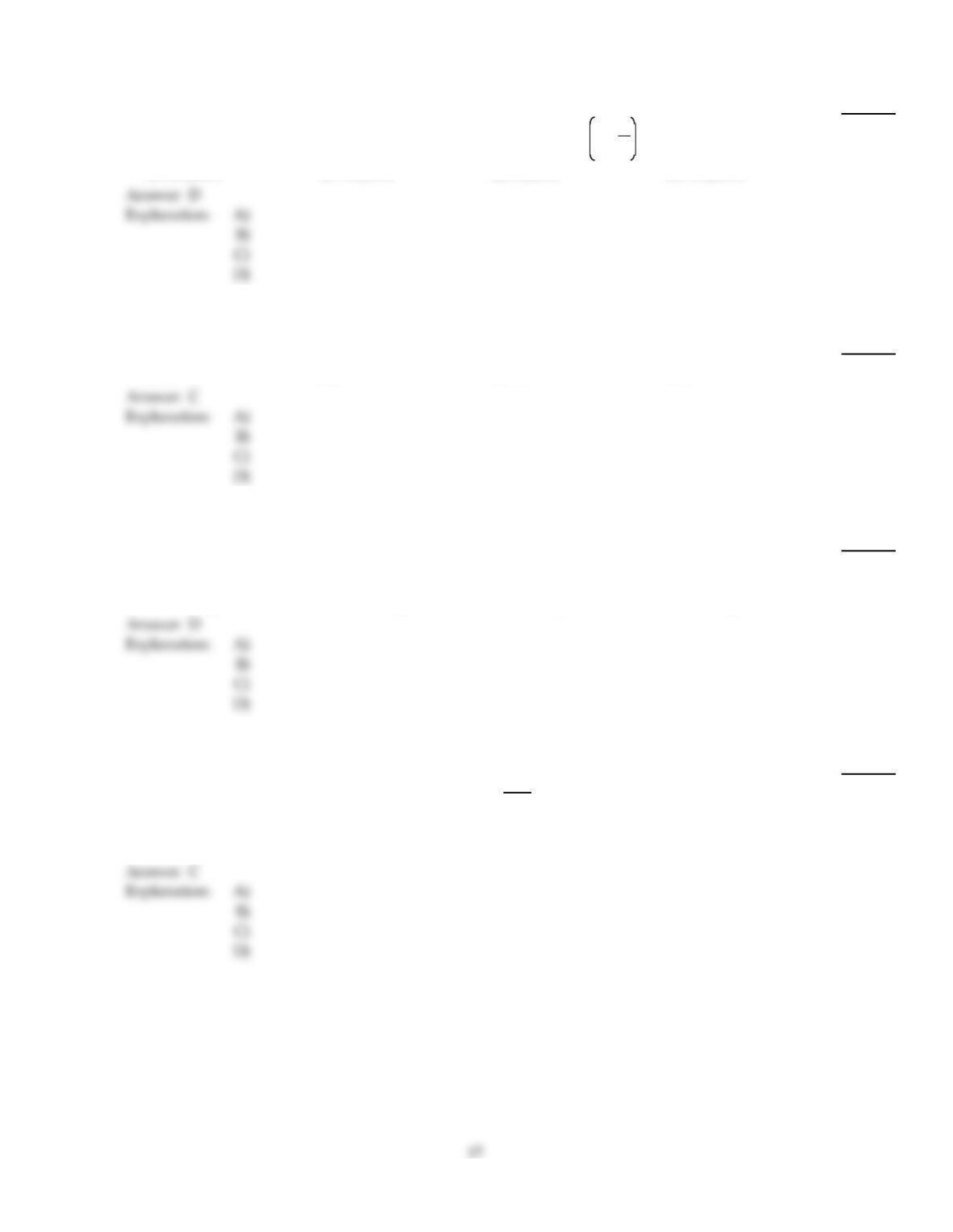
16
Solve the problem.
39)
Find out how long it takes a $2800 investment to double if it is invested at 9% compounded
quarterly. Round to the nearest tenth of a year. Use the formula A = P 1 +r
n
nt.
39)
A)
8.2 years
B)
7.6 years
C)
8 years
D)
7.8 years
Evaluate the expression without using a calculator.
40)
eln 9x3
40)
A)
ln 9x3
B)
3
C)
9x3
D)
e9x3
Solve the problem.
41)
The function D(h) =6e–0.4h can be used to determine the milligrams D of a certain drug in a
patient’s bloodstream h hours after the drug has been given. How many milligrams (to two
decimals) will be present after 9 hours?
41)
A)
4.02 mg
B)
219.59 mg
C)
0.82 mg
D)
0.16 mg
Solve.
42)
The population of a certain country is growing at a rate of 1.9% per year. How long will it take for
this country’s population to double? Use the formula t =ln 2
k, which gives the time, t, for a
population with growth rate k, to double. (Round to the nearest whole year.)
42)
A)
37 years
B)
38 years
C)
36 years
D)
35 years
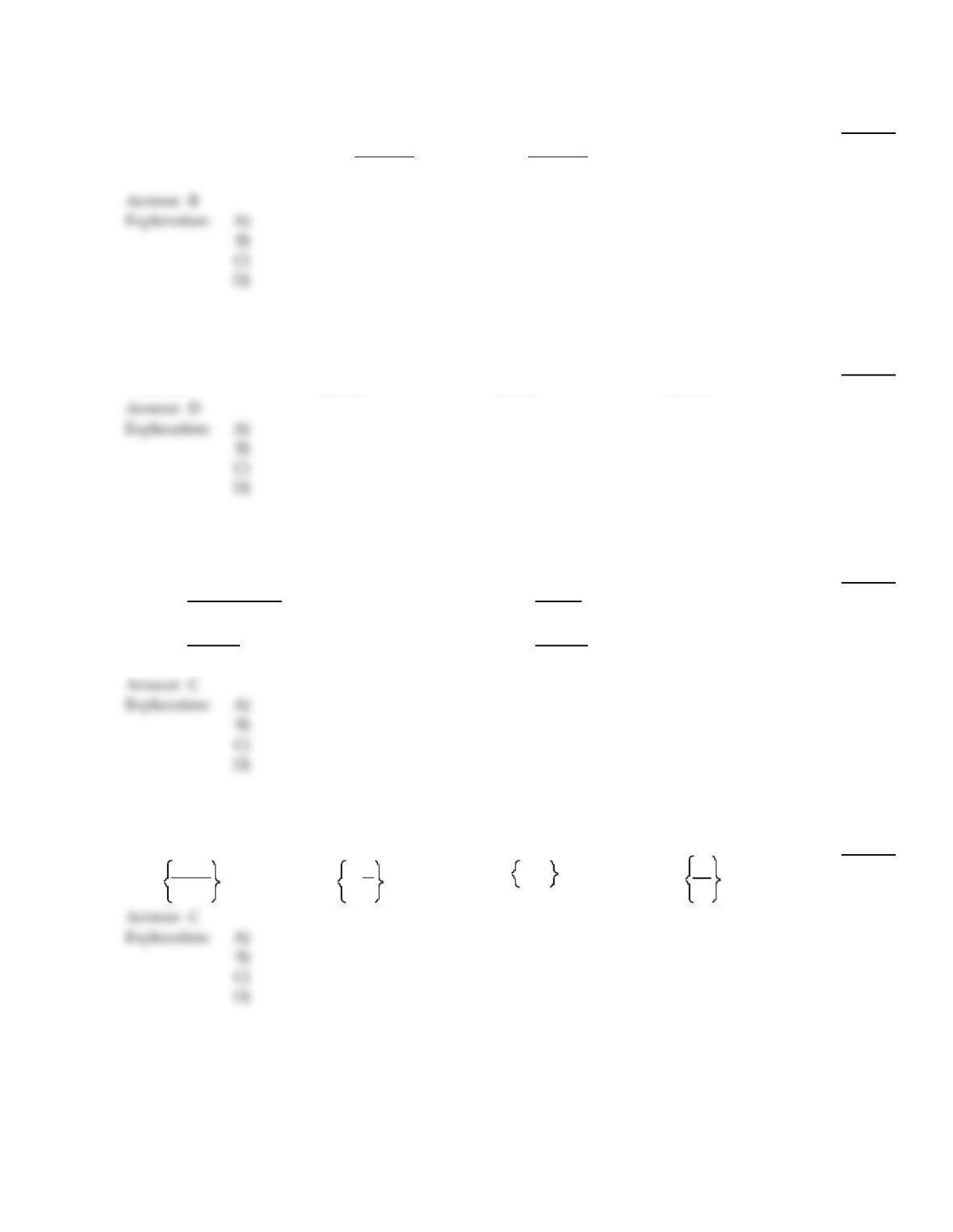
Use properties of logarithms to condense the logarithmic expression. Write the expression as a single logarithm whose
coefficient is 1. Where possible, evaluate logarithmic expressions.
43)
8ln (x –12) –9 ln x
43)
A)
ln 72x(x –12)
B)
ln (x –12)8
x9
C)
ln 8(x –12)
9x
D)
ln x9(x –12)8
Solve the exponential equation. Use a calculator to obtain a decimal approximation, correct to two decimal places, for the
solution.
44)
27x =2.3
44)
A)
0.21
B)
8.41
C)
6.46
D)
0.17
Use properties of logarithms to condense the logarithmic expression. Write the expression as a single logarithm whose
coefficient is 1. Where possible, evaluate logarithmic expressions.
45)
log x + log (x2–9) – log 7– log (x –3)
45)
A)
log x(x –9)(x –3)
7
B)
log 2x +3)
10 – x
C)
log x(x +3)
7
D)
log x(x –9)
7(x –3)
Solve the logarithmic equation. Be sure to reject any value that is not in the domain of the original logarithmic
expressions. Give the exact answer.
46)
7+3 ln x =15
46)
A)
8
3 ln 1
B)
ln 8
3
C)
e8/3
D)
e8
3
18
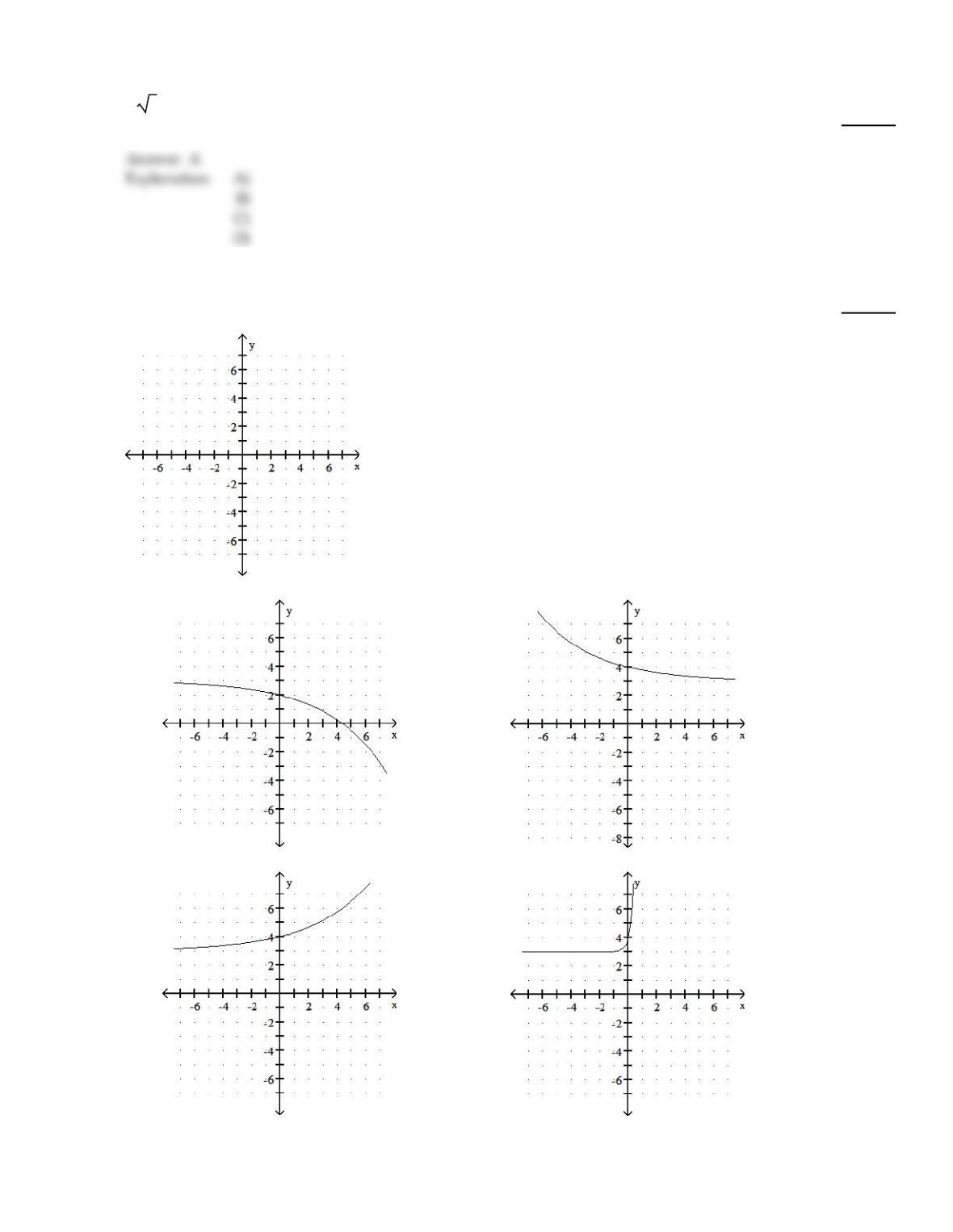
Approximate the number using a calculator. Round your answer to three decimal places.
47)
27
47)
A)
6.258
B)
7.000
C)
64.000
D)
5.292
Graph the function.
48)
Use the graph of f(x) =ex to obtain the graph of g(x) =ex/4+ 3.
48)
A)
B)
C)
D)
19
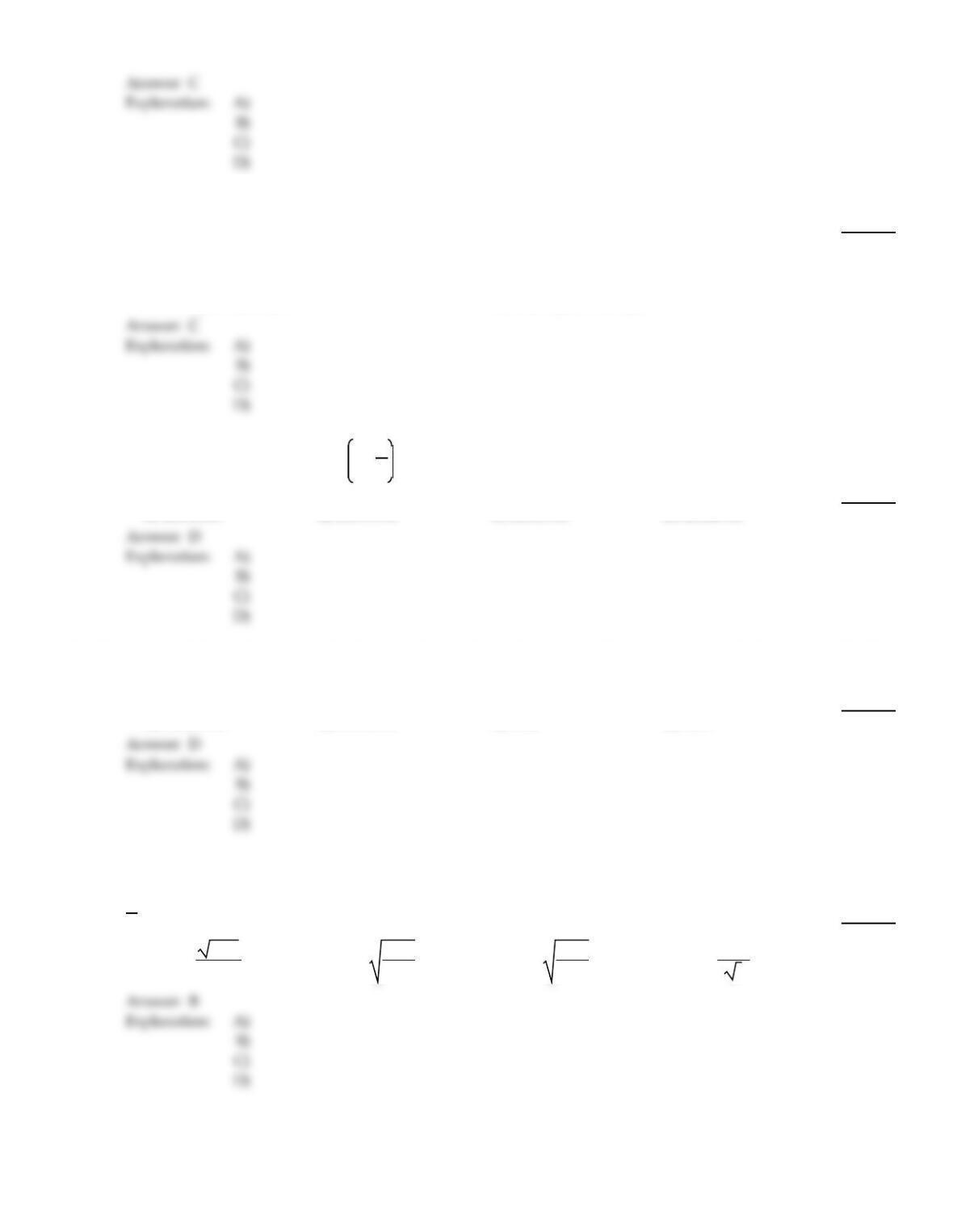
Solve the problem.
49)
If Emery has $2000 to invest at 11% per year compounded monthly, how long will it be before he
has $3000? If the compounding is continuous, how long will it be? (Round your answers to three
decimal places.)
49)
A)
0.052 yrs, 0.369 yrs
B)
0.324 yrs, 0.307 yrs
C)
3.703 yrs, 3.686 yrs
D)
56.274 yrs, 3.868 yrs
Use the compound interest formulas A = P 1 +r
n
nt and A = Pert to solve.
50)
Find the accumulated value of an investment of $1500 at 10% compounded quarterly for 2 years.
50)
A)
$1800.00
B)
$1575.94
C)
$1815.00
D)
$1827.60
Solve the exponential equation. Use a calculator to obtain a decimal approximation, correct to two decimal places, for the
solution.
51)
e2x +ex– 6 = 0
51)
A)
1.10, 0.14
B)
0.69, 1.10
C)
0.14
D)
0.69
Use properties of logarithms to condense the logarithmic expression. Write the expression as a single logarithm whose
coefficient is 1. Where possible, evaluate logarithmic expressions.
52)
1
2(log5 (r –5) –log5 r)
52)
A)
log5r –5
r
B)
log5r –5
r
C)
log5r –5
2r
D)
log5r –5
r
Graph the function.
20