
CHAPTER 4
Planning the Curriculum
AUTHENTIC ASSESSMENTS
1. Select a topic and design a lesson or unit of your own choosing. Make this an exemplary plan to be
included in your portfolio as an example of your competency in early childhood curriculum planning. You
may wish to do a project plan or follow one of the suggested formats in this chapter of the text.
2. Prepare a short class presentation on one of the topics in this chapter; for example, field experiences,
visitors in the classroom, or using computers and technology in the early childhood classroom. This
presentation should give the instructor an assessment of your understanding of the topic.
3. Select and evaluate at least two different early childhood software programs.
4. Describe three early childhood cooperative learning activities.
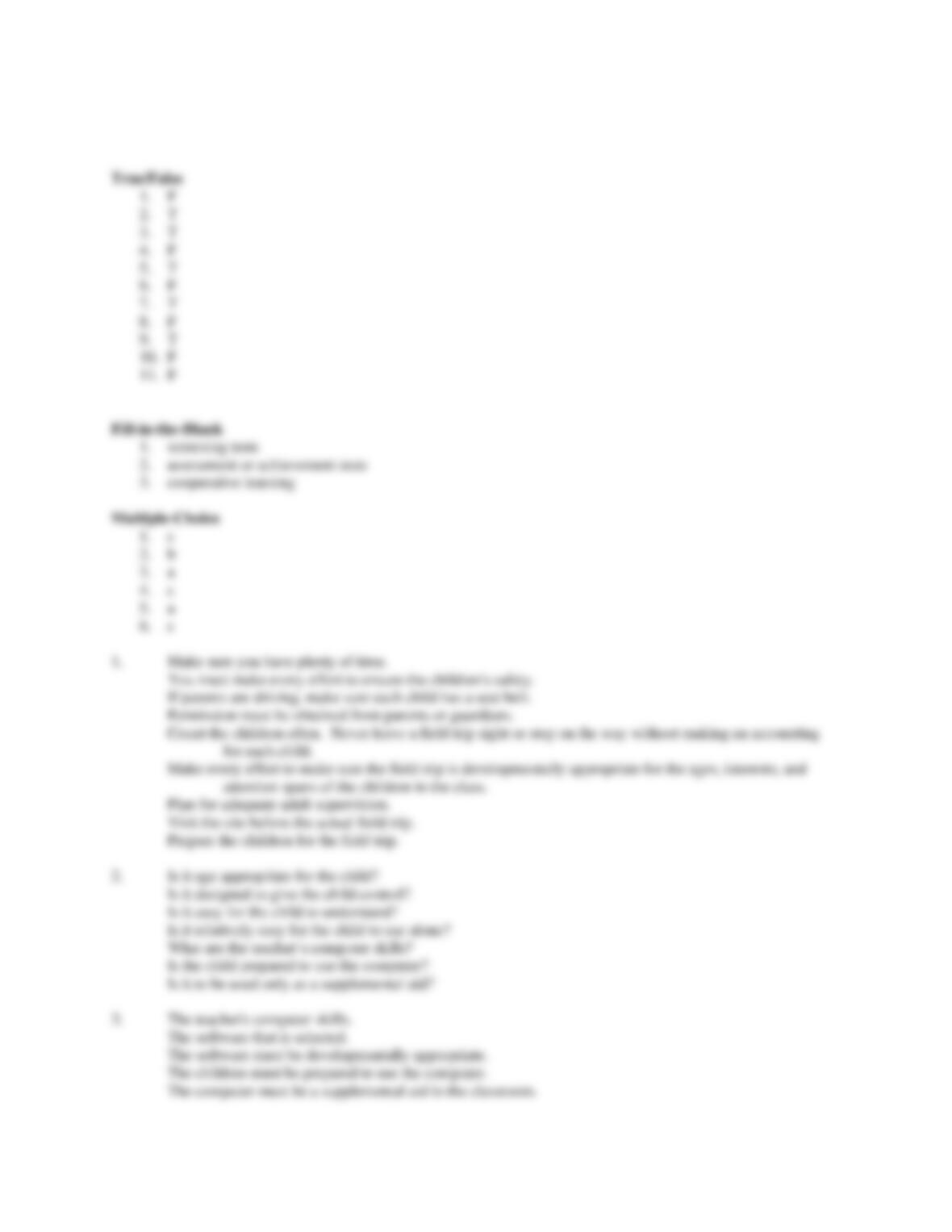
SUGGESTED TEST QUESTIONS
1. Children should not be a part of planning the early childhood curriculum.
2. Even in an early childhood classroom with a one-year age range, teachers can expect a wide range
of individual differences in children.
3. Part of planning includes arranging the classroom environment.
4. Curriculum should be planned according to a timetable or clock schedule.
5. Cooperative learning is different from regular small group activities.
6. Every activity in the lesson plan should relate to the theme or concept being explored that day.
Fill–in-the-Blank Questions
1. is children working together in small groups or on teams with a
common goal in mind.
Multiple-Choice Questions
1. Early childhood curriculum should
I. be factually based.
II. be active.
III. be planned around the developmental needs of the children it serves.
IV. develop and increase critical thinking skills.
V. give young children adequate opportunity to express themselves.
a. All of the above b. I, II, III, V
c. II, III, IV, V d. I, II, III, IV
2. During free play teachers can
I. take a quick break.
II. engage individual children in play activities through stimulation and encouragement.
III. acknowledge children‘s efforts in their play.
IV. ask thought-provoking questions and extend children’s play experiences.
V. redirect children that need a change in their play.
a. All of the above b. II, III, IV, V
c. I, II, III, V d. I, II, III, IV
3. Cooperative learning
I. is used only in small groups.
II. emphasizes social skills and working together.
III. creates stronger individuals.
IV. promotes interdependence.
V. encourages group accountability but not individual accountability.
a. II, III, IV b. I, II, IV
c. III, IV, V d. I, II, IV, V
4. Appropriate subjects for unit themes are
I. countries of the world.
II. those that strengthen and broaden the children’s understandings of the world they live in.
III. those that are developmentally appropriate for the children in the class.
IV. those things children can actually experience.
a. All of the above b. I, III, IV
c. II, III, IV d. I, II, II
5. Field trips are an important kind of activity because
I. they provide first-hand or real experiences.
II. first-hand experiences are often most memorable.
III. the opportunity for knowledge and understanding is enhanced.
IV. they reinforce and extend concepts taught.
V. they acquaint children with their community and the diversity of its people.
a. All of the above b. I, III, and V
c. I, III, IV d. I, II, IV
6. With regard to computer effectiveness in early childhood classrooms:
I. Teachers must be computer literate.
II. The key to the effectiveness of computers is in the quality and appropriateness of the
software selected.
III. The important quality is the kind of computer in the classroom.
IV. The use of the computer must be planned to meet the level of understanding the children
have.
V. The children must be trained in how to use the computer.
a. All of the above b. I, III, IV
c. I, II, IV, V d. II, III, IV, V
1. What are some guidelines in planning and taking field trips with early childhood groups?
2. What are some criteria or considerations we should consider when selecting computers and
software for the early childhood classroom? (May put these in question form.)
3. What are some considerations for the early childhood teacher in adding the computer to the
classroom?
Chapter 4