
Chapter 4—Completing the Accounting Cycle Key
1. After analyzing transactions, the next step would be to post the transactions in the ledger.
2. The most important output of the accounting cycle is the financial statements.
3. The work sheet is not considered a part of the formal accounting records.
4. Cross-referencing is useful in assuring that the debits and credits are in balance.
5. When accounts do not appear on the unadjusted trial balance but are needed to post adjustments, they are
simply added to the account title column.
6. Once the adjusted trial balance is in balance, the flow of accounts will now go into the financial statements.
7. There is really no benefit in preparing financial statements in any particular order.
8. Round tripping is a fraudulent scheme where business A artificially inflates revenue by lending money to
customer B who uses that money to buy products from A.

9. On the income statement, miscellaneous expenses are usually presented as the last item without regard to the
dollar amount.
10. The usual presentation of the statement of owner’s equity is (1) Beginning capital, (2) Net income or loss,
(3) Drawing, (4) Owner’s contributions, (5) Ending capital.
11. The difference between a classified balance sheet and one that is not classified is that the classified one has
subheadings.
12. Cash and other assets that may reasonably be expected to be realized in cash, sold, or consumed through the
normal operations of a business, usually longer than one year, are called current assets.
13. Prepaid Insurance is an example of a current asset.
14. Land is an example of a plant asset.
15. Liabilities that will be due within one year or less and that are to be paid out of current assets are called
current liabilities.
16. The amount of the net income for a period appears on both the income statement and the balance sheet for
that period.
17. Accrued taxes payable are generally reported on the balance sheet as a current liability.

18. At the end of the fiscal period, prepaid expenses are reported on the income statement as expenses.
19. Office Equipment is an example of a current asset account.
20. Capital and Drawing are reported in the owner’s equity section of the balance sheet.
21. Deferred expenses that benefit a relatively short period of time are listed on the balance sheet as current
assets.
22. Unearned revenues that will be earned in a relatively short period of time are listed on the balance sheet as
current assets.
23. Accrued expenses are ordinarily listed on the balance sheet as current assets.
24. Accrued revenues are ordinarily listed on the balance sheet as current liabilities.
25. The income statement is prepared from the adjusted trial balance or the income statement columns on the
work sheet.
26. Examples of temporary accounts are supplies and prepaid expenses which are in the ledger for just a short
time before they expire.

27. Accumulated Depreciation is a permanent account.
28. The drawing account is a temporary account.
29. The balance sheet accounts are referred to as real or permanent accounts.
30. Journalizing and posting the adjustments and closing entries updates the ledger for the new accounting
period.
31. The income summary account is closed to the owner’s capital account.
32. The accumulated depreciation account is closed to the income summary account.
33. The drawing account is closed to the income summary account.
34. The trial balance prepared after all the closing entries have been posted is called a pre-closing trial balance.
35. Entries required to close the balances of the temporary accounts at the end of the period are called final
entries.
36. Journalizing and posting closing entries must be completed before financial statements can be prepared.

37. During the closing process, some balance sheet accounts are closed and end the period with a zero balance.
38. Closing entries are entered directly on to the work sheet.
39. The post-closing trial balance will generally have fewer accounts than the trial balance.
40. A post-closing trial balance contains only asset and liability accounts.
41. A post-closing trial balance should be prepared before the financial statements are prepared.
42. Assets, liabilities, and owner’s capital are real accounts and do not get closed at the end of the period.
43. The income summary account is also known as the clearing account.
44. All income statement accounts will be closed at the end of the period.
45. Balance Sheet accounts are not considered real accounts.
46. It is not necessary to post the closing entries to the general ledger.

47. Once an account has been closed for the period, inserting a line in the balance columns zeros out the
account, making it ready for the following period.
48. The last step of the accounting cycle is to prepare a post-closing trial balance.
49. The accounting cycle begins with preparing an unadjusted trial balance.
50. Financial statements should be prepared before the closing entries are journalized and posted.
51. The unadjusted, adjusted, and final trial balances are prepared during the accounting cycle of a period.
52. Any twelve-month accounting period adopted by a company is known as its fiscal year.
53. A fiscal year that ends when business activities have reached their lowest point is called the natural business
year.
54. All companies must use a calendar year as their fiscal year.
55. The majority of businesses end their fiscal year on December 31.

56. The balances of the capital accounts from the Adjusted Trial Balance of the work sheet are extended to the
Statement of Owner’s Equity columns.
57. The work sheet is a working paper that accountants can use to summarize adjusting entries and the account
balances for the financial statements.
58. In a computerized accounting system, a work sheet may not be necessary because the software program
automatically posts entries to the accounts and prepares financial statements.
59. The trial balance may be listed on the work sheet instead of being prepared separately.
60. The totals of the Adjusted Trial Balance columns on a work sheet will always be the sum of the Trial
Balance column totals and the Adjustments column totals.
61. A work sheet heading is dated for a period of time.
62. On the work sheet, the capital and drawing account balances are extended to the Balance Sheet columns.
63. After the account balances have been extended from the Adjusted Trial Balance columns on the work sheet,
the difference between the initial totals of the Balance Sheet debit and credit columns is Net Income or Net
Loss.
64. After Net Income or Loss is entered on the work sheet, the debit column total must equal the credit column

65. A net loss is shown on the work sheet in the credit columns of both the Income Statement columns and the
Balance Sheet columns.
66. Net income is shown on the work sheet in the Income Statement debit column and the Balance Sheet credit
column.
67. If the totals of the Income Statement debit and credit columns of a work sheet are $27,000 and $29,000,
respectively, after all account balances have been extended, the amount of the net loss is $2,000.
68. The worksheet and the financial statements both require dollar signs.
69.
The balance in the capital account on the worksheet will equal the amount presented in the balance sheet.
70. Since the adjustments are entered on the work sheet, it is not necessary to record them in the journal or post
them to the ledger.
71. The chart of accounts, the journal, and the ledger are essential parts of the accounting system.
72. The closing process is sometimes referred to as closing the books.
73. Accounts reported on the balance sheet that are carried forward from year to year are known as permanent
accounts.
74. Real accounts are not permanent accounts.
75. In the accounting cycle, the last step is
76. During the end-of-period processing which of the following best describes the logical order of this process
77. What is the major difference between the Unadjusted Trial Balance and the Adjusted Trial Balance?
78. Once the adjusting entries are posted, the Adjusted Trial Balance is prepared to
79. When preparing the statement of owner’s equity, the beginning capital balance can always be found
80. Accumulated Depreciation appears on the
81. Notes Receivable due in 350 days appear on the
82. Unearned Fees appear on the
83. Which one of the fixed asset accounts listed below will not have a related contra asset account?
84. Prepaid insurance is reported on the balance sheet as a
85. The income statement is prepared from:
86. Round-tripping is when
87. The Statement of Owner’s Equity should be prepared
88. The income statement should be prepared
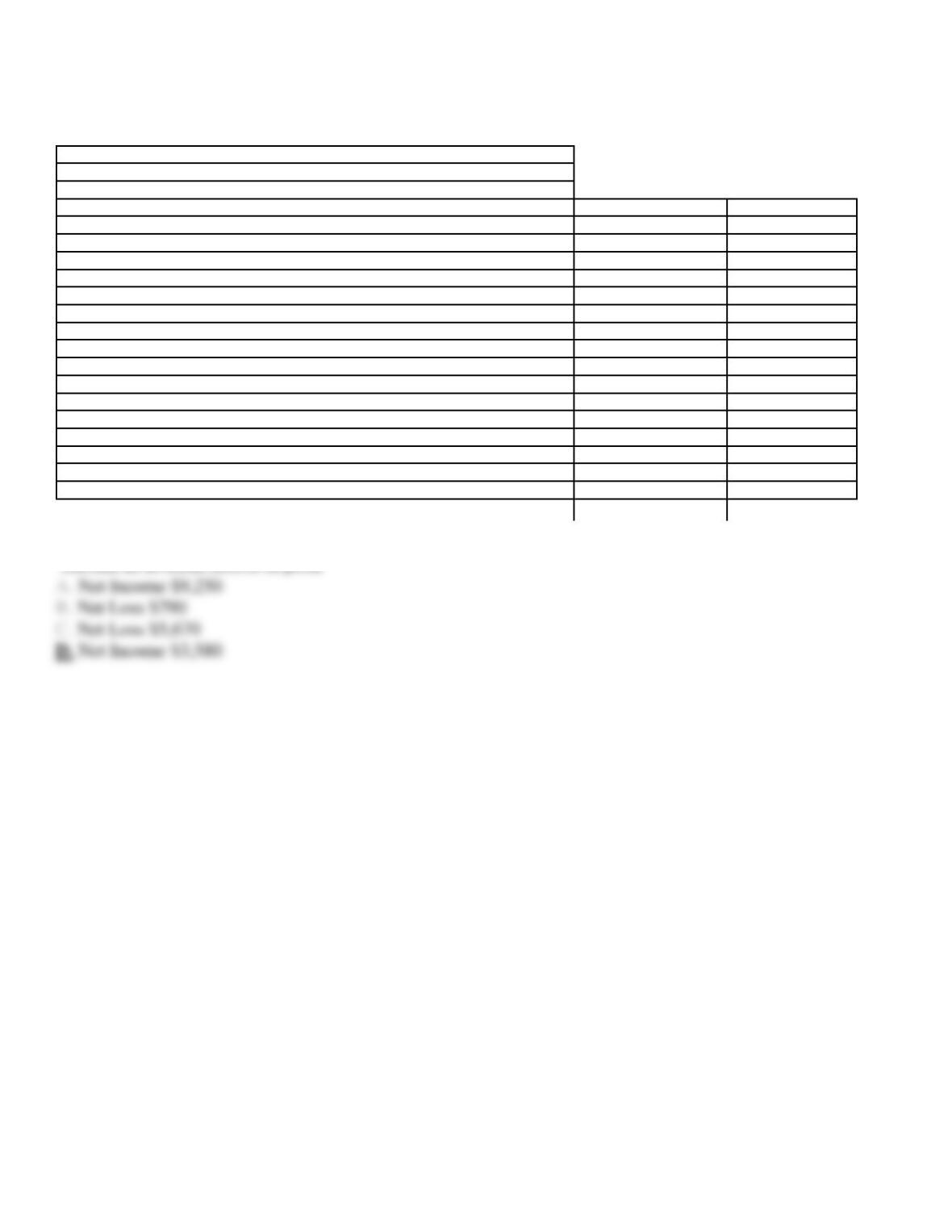
89. Use the following information in the adjusted trial balance for Stockton Company to answer the following
questions.
Stockton Company
Adjusted Trial Balance
For the Year ended December 31, 20XX
Cash
$ 6,530
Accounts Receivable
2,100
Prepaid Expenses
700
Equipment
13,700
Accumulated Depreciation
$ 1,100
Accounts Payable
1,900
Notes Payable
4,300
Bob Steely, Capital
12,940
Bob Steely, Withdrawals
790
Fees Earned
9,250
Wages Expense
2,500
Rent Expense
1,960
Utilities Expense
775
Depreciation Expense
250
Miscellaneous Expense
185
Totals
$29,490
$29,490
90. Use the following information in the adjusted trial balance for Stockton Company to answer the following
questions.
Stockton Company
Adjusted Trial Balance
For the Year ended December 31, 20XX
Cash
$ 6,530
Accounts Receivable
2,100
Prepaid Expenses
700
Equipment
13,700
Accumulated Depreciation
$ 1,100
Accounts Payable
1,900
Notes Payable
4,300
Bob Steely, Capital
12,940
Bob Steely, Withdrawals
790
Fees Earned
9,250
Wages Expense
2,500
Rent Expense
1,960
Utilities Expense
775
Depreciation Expense
250
Miscellaneous Expense
185
Totals
$29,490
$29,490
Determine the Owner’s Equity ending balance for the period.
91. Use the following information in the adjusted trial balance for Stockton Company to answer the following
questions.
Stockton Company
Adjusted Trial Balance
For the Year ended December 31, 20XX
Cash
$ 6,530
Accounts Receivable
2,100
Prepaid Expenses
700
Equipment
13,700
Accumulated Depreciation
$ 1,100
Accounts Payable
1,900
Notes Payable
4,300
Bob Steely, Capital
12,940
Bob Steely, Withdrawals
790
Fees Earned
9,250
Wages Expense
2,500
Rent Expense
1,960
Utilities Expense
775
Depreciation Expense
250
Miscellaneous Expense
185
Totals
$29,490
$29,490
Determine total assets.
92. Use the following information in the adjusted trial balance for Stockton Company to answer the following
questions.
Stockton Company
Adjusted Trial Balance
For the Year ended December 31, 20XX
Cash
$ 6,530
Accounts Receivable
2,100
Prepaid Expenses
700
Equipment
13,700
Accumulated Depreciation
$ 1,100
Accounts Payable
1,900
Notes Payable
4,300
Bob Steely, Capital
12,940
Bob Steely, Withdrawals
790
Fees Earned
9,250
Wages Expense
2,500
Rent Expense
1,960
Utilities Expense
775
Depreciation Expense
250
Miscellaneous Expense
185
Totals
$29,490
$29,490
Determine the current assets.
93. Use the following information in the adjusted trial balance for Stockton Company to answer the following
questions.
Stockton Company
Adjusted Trial Balance
For the Year ended December 31, 20XX
Cash
$ 6,530
Accounts Receivable
2,100
Prepaid Expenses
700
Equipment
13,700
Accumulated Depreciation
$ 1,100
Accounts Payable
1,900
Notes Payable
4,300
Bob Steely, Capital
12,940
Bob Steely, Withdrawals
790
Fees Earned
9,250
Wages Expense
2,500
Rent Expense
1,960
Utilities Expense
775
Depreciation Expense
250
Miscellaneous Expense
185
Totals
$29,490
$29,490
Determine the total liabilities for the period.
94. The Balance Sheet should be prepared
95. The Statement of Owner’s Equity begins with the beginning balance followed by
96. The Income Statement will include the following accounts
97. The classified Balance Sheet will subsection the assets section as follows
98. The classified Balance Sheet will divide its Liabilities Section as the following subsections
99. Short-term liabilities are those liabilities that
100. Owner’s Equity is
101. Balance sheet accounts
102. On which financial statement will Income Summary be shown?
103. Which of the following is not true about closing entries?
104. The income summary account is also called
105. After posting the second closing entry to the income summary account, the balance will be equal to
106. What is the last account that should be listed in the Post Closing Trial Balance?
107. Which of the following account groups are all considered nominal accounts?
108. There are four closing entries. The first one is to close ____, the second one is to close ____, the third one
is to close ____, and the last one is to close ____.
109. Closing entries
110. Closing entries are dated in the journal as of
111. Which of the accounts below would be closed by posting a debit to the account?
112. Which of the following accounts should be closed to Income Summary at the end of the fiscal year?
113. Which of the following accounts will not be closed to Income Summary at the end of the fiscal year?
114. Which of the following accounts will be closed to the Capital account at the end of the fiscal year?
115. The entry to close the appropriate insurance account at the end of the accounting period is
116. Which of the following accounts ordinarily appears in the post-closing trial balance?
117. The post-closing trial balance differs from the adjusted trial balance in that it
118. The following accounts were taken from the Adjusted Trial Balance columns of the work sheet:
Accumulated Depreciation
$ 3,200
Fees Earned
17,400
Depreciation Expense
1,300
Insurance Expense
200
Prepaid Insurance
4,800
Supplies
900
Supplies Expense
3,800
Net income for the period is