Exam
Name___________________________________
SHORT ANSWER. Write the word or phrase that best completes each statement or answers the question.
Provide an appropriate response.
1)
If g(3) =3, g (3) =2, f(3) =2, and f (3) =1, what is the value of h (3) where h(x) = f(x)g(x)?
Show your work.
1)
2)
Revenues of a company are increasing. One analyst says it is due to an increase in sales. Is
this necessarily true? Explain.
2)
3)
How is the graph of y = f(x) = x4– 4x + 3 related to the graph of
y = g(x) = (x +4)4– 4(x +4) + 3? How is the slope of the graph of g(x) at x = a related to the
slope of the graph of f(x) at x = a +4?
3)
4)
How is the graph of y = f(x) = x4+ 2x – 5 related to the graph of y = g(x) = (3x)4+ 2(3x) – 5?
How is the slope of the graph of g(x) at x = a related to the slope of the graph of f(x) at
x = a?
4)
5)
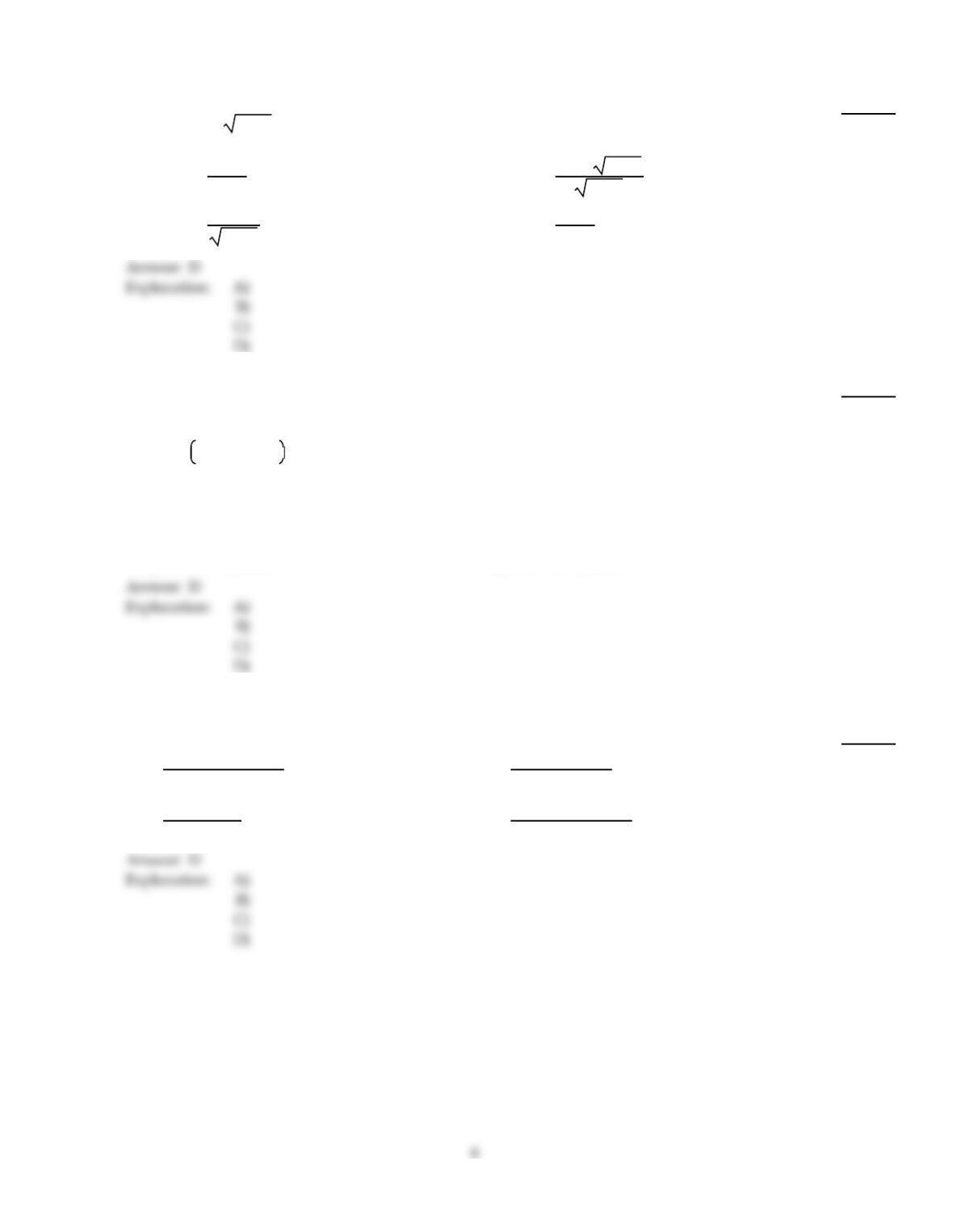
Find the error that was committed below when taking the derivative of f(x) =6x +7
x2+13 . Be
specific.
Dx6x +7
x2+13
=6 x2+13 +6x +7(2x)
x2+13 2=18x2+14x +78
x2+13 2
5)
1
6)
Use the chain rule to prove the quotient rule for f(x) =g(x)
h(x) .
6)
7)
Prove that if average cost is decreasing, then marginal cost is less than average cost.
7)
8)
What is true when marginal revenue and marginal cost are equal?
8)
9)
Find the derivative of f(x) = (2x – 4)3 in two ways. First multiply out and differentiate.
Then use the power rule. Show that the answers are equivalent.
9)
10)
What must be true about a demand function so that, at a given price per item, revenue will
decrease if the price per item is increased?
10)
MULTIPLE CHOICE. Choose the one alternative that best completes the statement or answers the question.
Find an equation for the line tangent to given curve at the given value of x.
11)
y =x2
4; x = – 5
11)
A)
y = – 10x –6.25
B)
y = – 2.5x +6.25
C)
y = – 2.5x –12.5
D)
y = – 2.5x –6.25
Solve the problem.
12)
Researchers have found that the maximum number of successful trials that a laboratory rat can
complete in a week is given by
P(t) =58(1 –e–0.3t),
where t is the number of weeks the rat has been trained. Find the rate of change P'(t).
12)
A)
P'(t) =58(1 +0.3e–0.3t)
B)
P'(t) = – 17.4e–0.3t
C)
P'(t) =17.4e–0.3t
D)
P'(t) =58e–0.3t
Use the product rule to find the derivative.
13)
f(x) = (3x – 2)(4x3– x2+ 1)
13)
A)
f'(x) =48x3– 33x2+ 4x + 3
B)
f'(x) =36x3+ 33x2– 11x + 3
C)
f'(x) =12x3+ 11x2– 33x + 3
D)
f'(x) =48x3– 11x2+ 33x + 3
Provide an appropriate response.
14)
If Q =56e0.5t what happens to Q and to Q’ as t increases?
14)
A)
Q increases and Q’ decreases.
B)
Q increases and Q‘ increases.
C)
Q decreases and Q’ increases.
D)
Q decreases and Q’ decreases.
Find the derivative.
15)
f(x) = (x3– 8)2/3
15)
A)
f'(x) =2x2
3
x3– 8
B)
f'(x) =x2
3
x3– 8
C)
f'(x) =x
3
x3– 8
D)
f'(x) =2x
3
x3– 8
Let f(x) = 8x2– 5x and g(x) = 7x +
9.
Find the composite.
16)
g[f(4)]
16)
A)
148
B)
2983
C)
765
D)
37
Write an equation of the tangent line to the graph of y = f(x) at the point on the graph where x has the indicated value.
17)
f(x) = (2x2+ 3x – 2)(–4x + 1), x = 0
17)
A)
y =11x – 2
B)
y =1
11 x + 2
C)
y =11x + 2
D)
y =1
11 x – 2
Solve the problem.
18)
A company’s total cost, in millions of dollars, is given by C(t) =140 –70e–t where t = time in years.
Find the marginal cost when t =4.
18)
A)
5.13 million dollars per year
B)
2.56 million dollars per year
C)
1.28 million dollars per year
D)
1.89 million dollars per year
Find the derivative of the function.
19)
y =x2 ln x2
19)
A)
2x(1 + ln x2)
B)
2x2+ 2
x
C)
2x2(1 + ln x2)
x
D)
2x + ln x2
Find the derivative.
20)
y =ln (6x +7)
e6x +7
20)
A)
1 –6[ln (6x +7)]2
ln [6x +7] e(6x +7)
B)
6– (36x +42) ln (6x +7)
(6x +7) e(6x +7)
C)
1
(6x +7) e(6x +7)
D)
1 – (6x +7) ln (6x +7)
(6x +7) e(6x +7)
Find the derivative of the function.
21)
y =log6 |(3x2– 2x)5/2|
21)
A)
5(3x – 1)
ln 6(3x2– 2x)
B)
ln 6 (3x – 1)
(3x2– 2x)
C)
10(3x – 1)
ln 6 (3x2– 2x)
D)
5
ln 6 (3x2– 2x)
Find f[g(x)] and g[f(x)].
22)
f(x) = 5x3+ 8; g(x) = 2x
22)
A)
f[g(x)] = 40x3+ 8
g[f(x)] = 10x3+ 16
B)
f[g(x)] = 10x3+ 16
g[f(x)] = 40x3+ 8
C)
f[g(x)] = 10x3+ 8
g[f(x)] = 40x3+ 16
D)
f[g(x)] = 40x3+ 16
g[f(x)] = 10x3+ 8
5
Solve the problem.
23)
Suppose that the population of a town is given by
P(t) =8 ln 3t +7,
where t is the time in years after 1980 and P is the population of the town in thousands. Find P'(t).
23)
A)
P'(t) =4
3t +7
B)
P'(t) =12 ln 3t +7
3t +7
C)
P'(t) =8
3t +7
D)
P'(t) =12
3t +7
24)
The following formula accurately models the relationship between the size of a certain type of
tumor and the amount of time that it has been growing:
V(t) =350 1 –e–0.0015t3,
where t is in months and V(t) is measured in cubic centimeters. Calculate the rate of change of
tumor volume at 150 months.
24)
A)
0.08 cm3/month
B)
0.221 cm3/month
C)
0.037 cm3/month
D)
0.051 cm3/month
Find the derivative.
25)
y = ex5 ln x
25)
A)
ex5+5x4 ex5 ln x
x
B)
ex5+5ex5 ln x
x
C)
5x5 ex5+ 1
x
D)
ex5+5x5 ex5 ln x
x
Let f(x) = 8x2– 5x and g(x) = 7x +
9.
Find the composite.
26)
f[g(3)]
26)
A)
408
B)
7050
C)
1212
D)
618
Find all values of x (if any) where the tangent line to the graph of the function is horizontal.
27)
y = x2+ 2x – 3
27)
A)
–1
B)
0
C)
1
2
D)
1
Let f(x) = 8x2– 5x and g(x) = 7x +
9.
Find the composite.
28)
f[g(k)]
28)
A)
392k2– 973k + 603
B)
56k2– 35k + 9
C)
56k2+ 35k + 9
D)
392k2+ 973k + 603
Solve the problem.
29)
The concentration of a certain drug in the bloodstream t minutes after swallowing a pill containing
the drug can be approximated using the equation C(t) =1
74t + 1 –1/2, where C(t) is the
concentration in arbitrary units and t is in minutes. Find the rate of change of concentration with
respect to time at t =12 minutes.
29)
A)
–1
49 units/min
B)
–2
49 units/min
C)
–2
2401 units/min
D)
–1
4802 units/min
Use the differentiation feature on a graphing calculator to find the indicated derivative.
30)
f(x) =0.18x3–1.09x2+4.43x + 4.1; f (–3)
30)
A)
15.830
B)
19.930
C)
12.560
D)
–10.330
Use the product rule to find the derivative.
31)
f(x) = (4x – 4)(5x + 1)
31)
A)
f'(x) =40x – 8
B)
f'(x) =40x – 16
C)
f'(x) =40x – 24
D)
f'(x) =20x – 16
Find all values of x (if any) where the tangent line to the graph of the function is horizontal.
32)
y = 2 + 8x – x2
32)
A)
4
B)
–8
C)
8
D)
–4
Find f[g(x)] and g[f(x)].
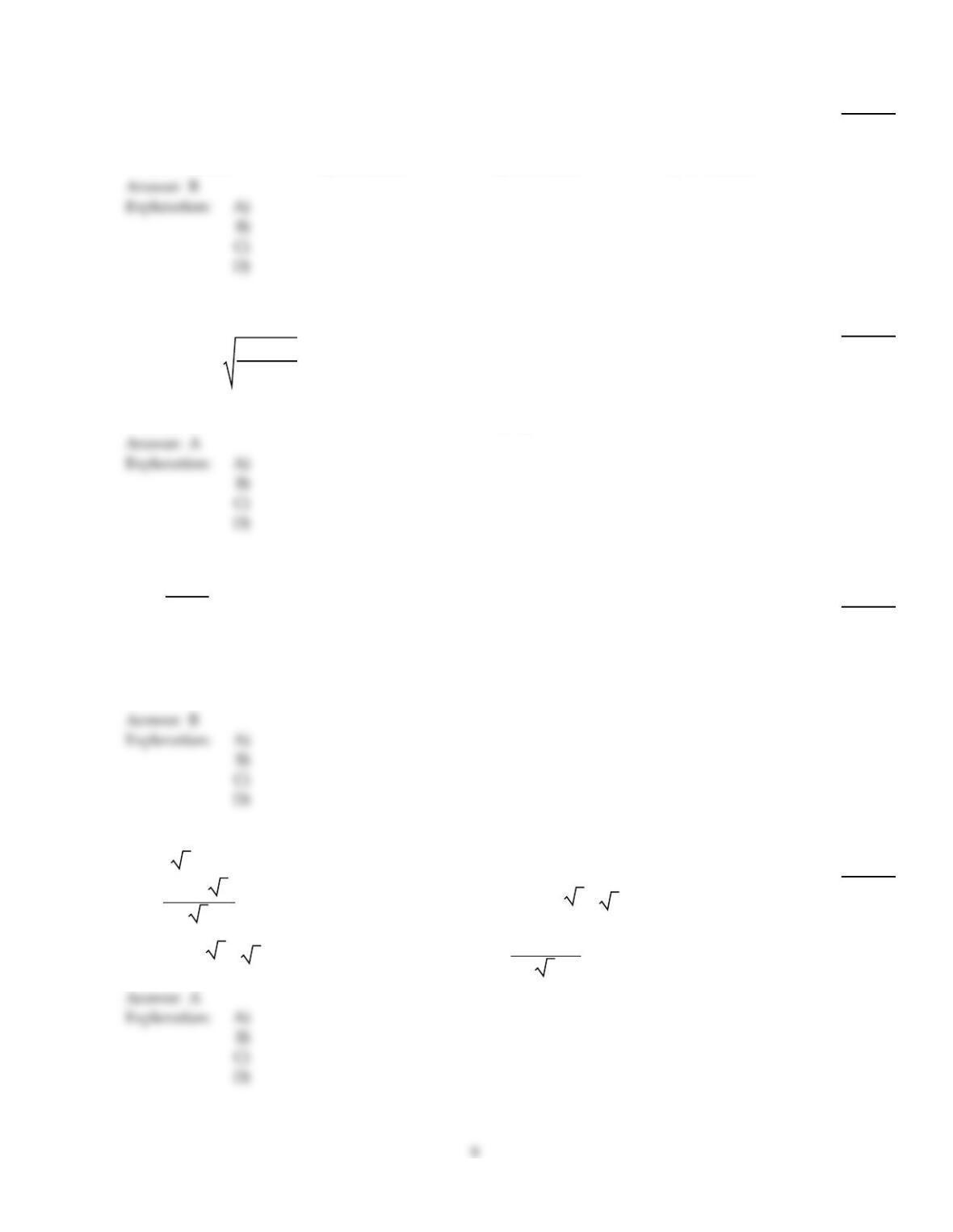
33)
f(x) =7
x; g(x) =x –7
33)
A)
f[g(x)] =7
x–7
g[f(x)] =7–7x
x
B)
f[g(x)] =7
x–7
g[f(x)] =7
x–7
C)
f[g(x)] =7
x –7
g[f(x)] =7–7x
x
D)
f[g(x)] =7
x –7
g[f(x)] =7
x–7
Solve the problem.
34)
Suppose that the population of a certain type of insect in a region near the equator is given by
P(t) =11 ln (t + 11), where t represents the time in days. Find the rate of change of the population
when t =3.
34)
A)
1.0 insects
B)
0.8 insects
C)
1.8 insects
D)
3.7 insects
Provide an appropriate response.
35)
What rule is applied first to find the derivative of the function
f(x) = (4x3– 4)(2x – 3)4
3x2+ 3 ?
35)
A)
Product rule
B)
Power rule
C)
Quotient rule
D)
Square root rule
A
Using a graphing calculator, find the values of x for which f(x) = 0, to three decimal places.
36)
f(x) =x2–4
x4+3
36)
A)
–2.828, 2.828
B)
0, –2.891, 2.891
C)
0
D)
There are no real values of x for which f(x) = 0.
B
Find the derivative.
37)
y = 2(5x)
37)
A)
ln 5 (5x)
x
B)
2 ln 5 (5x) ( x)
C)
ln 5 (5x) ( x)
D)
2 ln 5 (5x)
x
A
B
Find f[g(x)] and g[f(x)].
38)
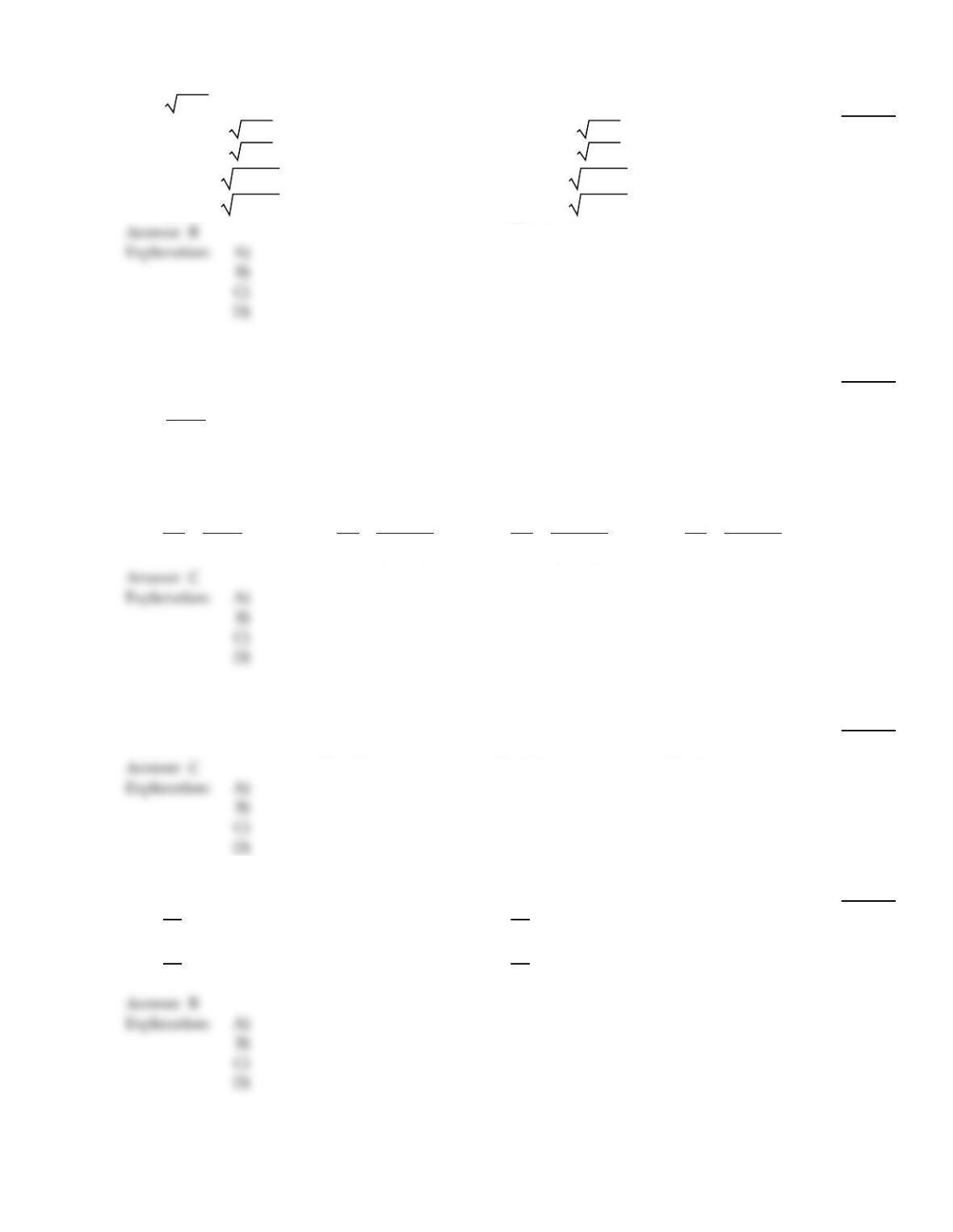
f(x) =x + 5; g(x) = 4x – 1
38)
A)
f[g(x)] = 2 x + 5
g[f(x)] = 4 x + 1 – 1
B)
f[g(x)] = 2 x + 1
g[f(x)] = 4 x + 5 – 1
C)
f[g(x)] =4x2+ 1
g[f(x)] =4x2– 5
D)
f[g(x)] =4x2– 5
g[f(x)] =4x2– 5
Solve the problem.
39)
Assume that the temperature of a person during an illness is given by:
T(t) =8t
t2+ 1
+ 98.6,
where T = the temperature, in degrees Fahrenheit, at time t, in hours. Find the rate of change of the
temperature with respect to time.
39)
A)
dT
dt =8
t2+ 1
B)
dT
dt =8(t2– 1)
(t2+ 1)2
C)
dT
dt =8(1 –t2)
(t2+1)2
D)
dT
dt =8(1 –t2)
t2+ 1
Find the derivative.
40)
y = – 6e12x
40)
A)
–72xe12x
B)
–6xe–72x
C)
–72e12x
D)
–6e–72x
41)
f(x) = 9x7/5 – 5x2+ 104, find f'(x)
41)
A)
63
5 x2/5 – 10x + 4000
B)
63
5 x2/5 – 10x
C)
63
5 x6/5 – 10x + 4000
D)
63
5 x6/5 – 10x
10
Find f[g(x)] and g[f(x)].
42)
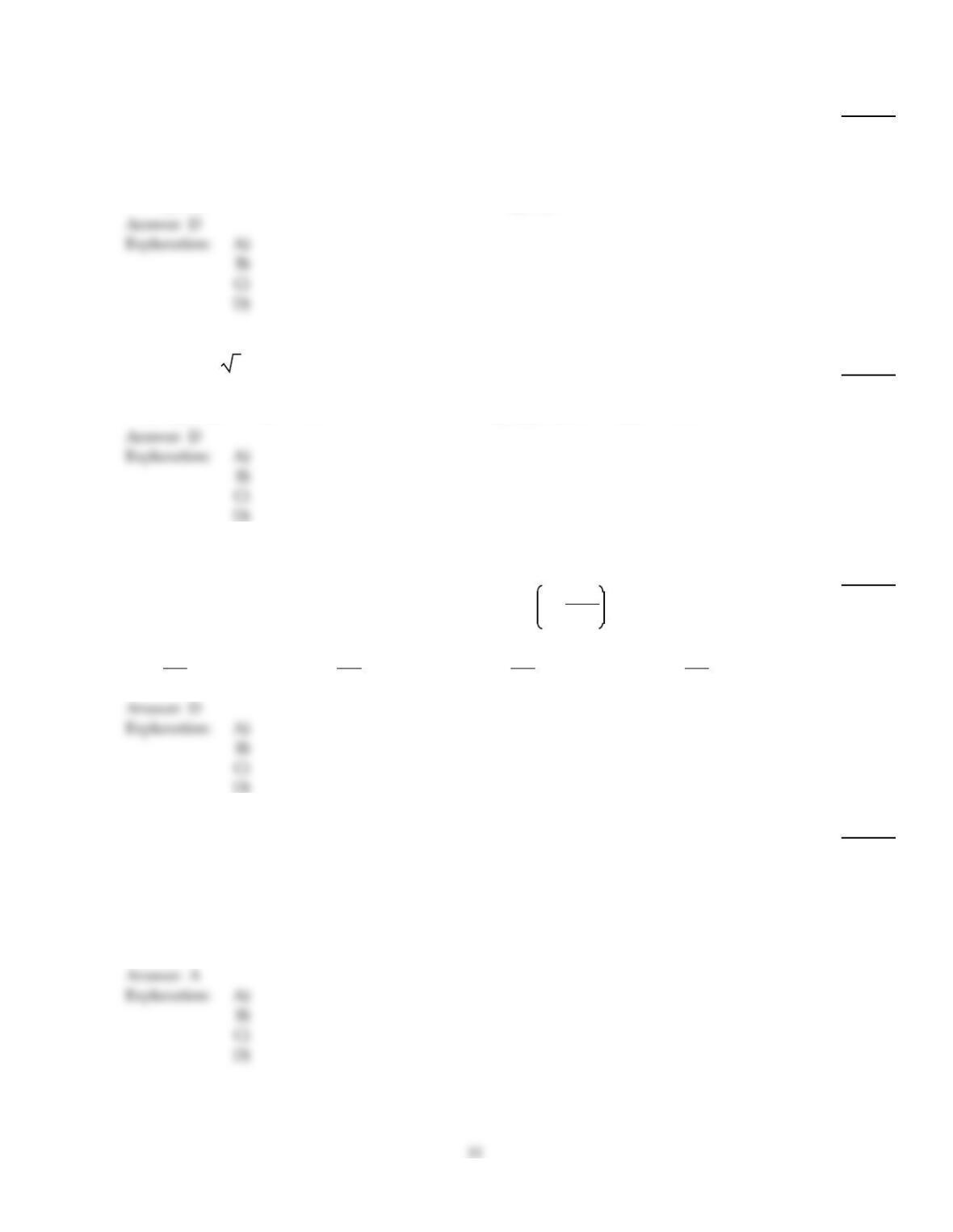
f(x) = 5x2; g(x) = x + 3
42)
A)
f[g(x)] = 5x2+ 30x + 3
g[f(x)] = 5x2+ 45
B)
f[g(x)] = 5x2+ 45
g[f(x)] = 5x2+ 30x + 3
C)
f[g(x)] = 5x2+ 3
g[f(x)] = 5x2+ 30x + 49
D)
f[g(x)] = 5x2+ 30x + 45
g[f(x)] = 5x2+ 3
Use the product rule to find the derivative.
43)
f(x) = (3x – 5)( x+ 3)
43)
A)
f'(x) =2x1/2 – 2.5x–1/2 + 9
B)
f'(x) =4.5x1/2 – 5x–1/2 + 9
C)
f'(x) =2x1/2 – 5x–1/2 + 9
D)
f'(x) =4.5x1/2 – 2.5x–1/2 + 9
Solve the problem.
44)
$2800 is deposited in an account with an interest rate of r% per year, compounded monthly. At the
end of 8 years, the balance in the account is given by A =2800 1 +r
1200 96. Find the rate of change
of A with respect to r when r =4.
44)
A)
dA
dr =225.5
B)
dA
dr =224.75
C)
dA
dr =308.31
D)
dA
dr =307.29
45)
The median weight, w, of a girl between the ages of 0 and 36 months can be approximated by the
function
w(t) = 0.0006t3– 0.0484t2+ 1.61t + 7.60,
where t is measured in months and w is measured in pounds.
For a girl of median weight, find the rate of change of weight with respect to time at age 20
months.
45)
A)
0.394 lb/mo
B)
1.362 lb/mo
C)
0.882 lb/mo
D)
0.086 lb/mo
Use the quotient rule to find the derivative.
46)
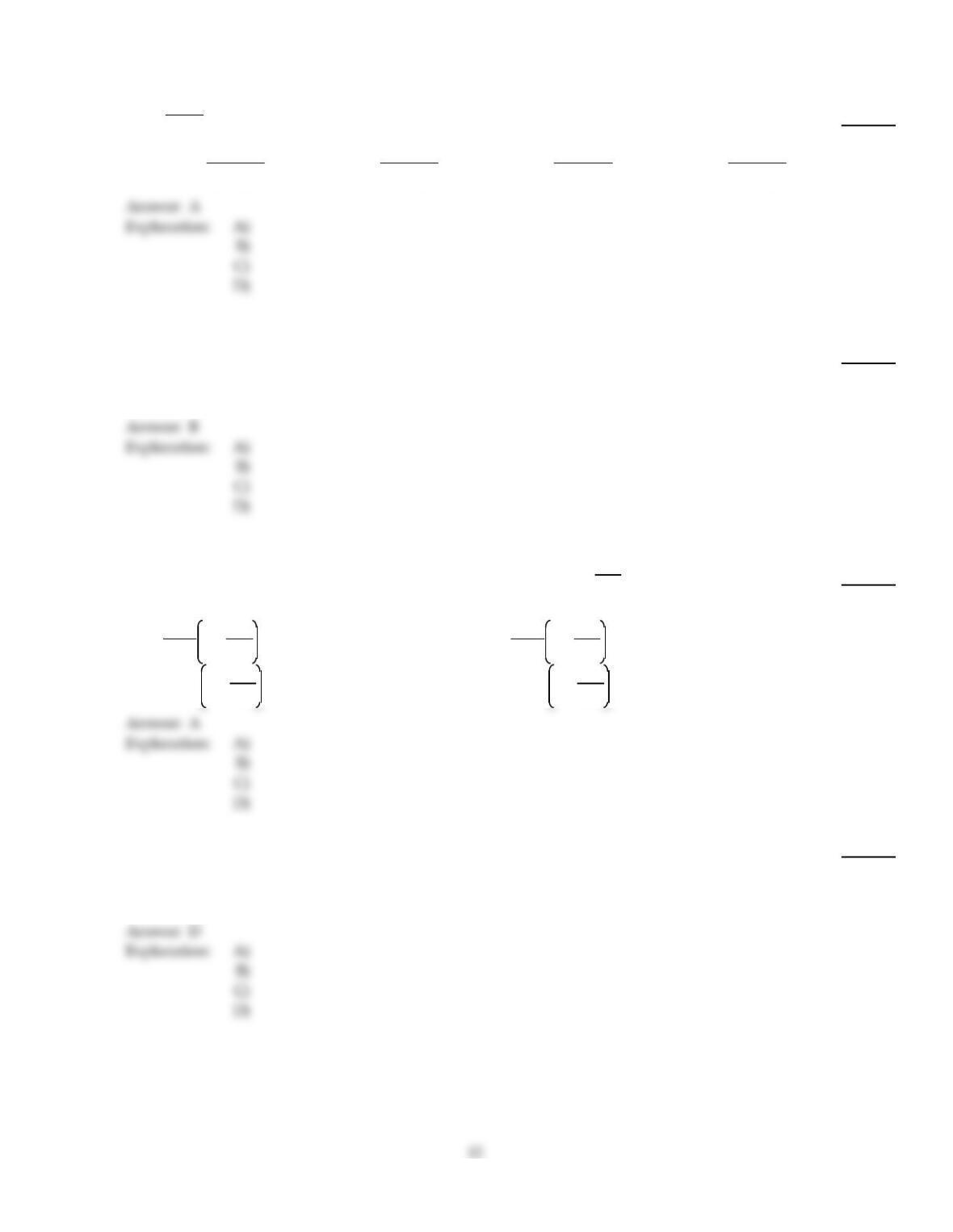
g(t) =t2
t – 11
46)
A)
g'(t) =t2– 22t
(t – 11)2
B)
g'(t) =22t
(t – 11)2
C)
g'(t) =t2+ 22t
(t – 11)2
D)
g'(t) =t2
(t – 11)2
Find the derivative of the given function.
47)
y =(4x2+6x)2
47)
A)
32x3+72x2+36x
B)
64x3+144x2+72x
C)
32x3+72x2+72x
D)
64x3+72x2+72x
Solve the problem.
48)
The total revenue from the sale of x stereos is given by R(x) =3000(1 –x
400)2. Find the average
revenue from the sale of x stereos.
48)
A)
3000
x1 –x
400 2
B)
1500
x1 –x
400 2
C)
3000x1 –x
400 2
D)
1500x1 –x
400 2
49)
The power P (in W) generated by a particular windmill is given by P = 0.015 V3 where V is the
velocity of the wind (in mph). Find the instantaneous rate of change of power with respect to
velocity when the velocity is 11.4 mph. Round your answer to the nearest tenth.
49)
A)
13.0 W/mph
B)
0.5 W/mph
C)
44.4 W/mph
D)
5.8 W/mph
50)
When a radioactive substance decays, the number N of grams remaining from an initial mass N0
(in grams) is given by N =N0(1/2)n, where n is the number of half–lives for which the substance
has decayed. Given that the half–life for tritium is 10 years, find the rate in (grams/half–life) at
which a 138–gram initial mass of radioactive tritium decays after 32 years.
50)
A)
–15.01 g/half–life
B)
–10.41 g/half–life
C)
–95.65 g/half–life
D)
–2.41 g/half–life
Let f(x) = 8x2– 5x and g(x) = 7x +
9.
Find the composite.
51)
g[f(–3)]
51)
A)
7050
B)
1212
C)
618
D)
408
Solve the problem.
52)
A(x) = – 0.015x3+ 1.05x gives the alcohol level in an average person’s bloodstream x hours after
drinking 8 oz of 100–proof whisky. If the level exceeds 1.5 units, a person is legally drunk. Find the
rate of change of alcohol level with respect to time when x = 2 hours.
52)
A)
1.92 units/hr
B)
1.23 units/hr
C)
0.99 units/hr
D)
0.87 units/hr
Find the derivative.
53)
y = (x + 1)2(x2+ 1)–3
53)
A)
dy
dx = 2(x + 1)(x2+ 1)–4(2x2– 3x – 1)
B)
dy
dx = 2(x + 1)(x2+ 1)–4(2x2+ 3x – 1)
C)
dy
dx = – 2(x + 1)(x2+ 1)–4(2x2– 3x – 1)
D)
dy
dx = – 2(x + 1)(x2+ 1)–4(2x2+ 3x – 1)
13
54)
f(x) =5x4– 6x3– 5, find f'(x)
54)
A)
20x3– 18x2
B)
20x3– 18x2– 7
C)
4x3+ 3x2– 7
D)
4x3+ 3x2
Provide an appropriate response.
55)
True or false? If marginal product is increasing then the average product must be increasing.
55)
A)
True
B)
False
Use the quotient rule to find the derivative.
56)
y =x2+ 8x + 3
x
56)
A)
dy
dx =2x + 8
2x3/2
B)
dy
dx =3x2+ 8x – 3
2x3/2
C)
dy
dx =2x + 8
x
D)
dy
dx =3x2+ 8x – 3
x
Use the product rule to find the derivative.
57)
f(x) = (5x + 6)2
57)
A)
f'(x) =50x + 60
B)
f'(x) =25x + 30
C)
f'(x) =10x + 12
D)
f'(x) =25x + 36
Provide an appropriate response.
58)
The derivative of 8x=
58)
A)
8x
ln 8
B)
8x ln 8
C)
x8x – 1
D)
8x
Solve the problem.
59)
The formula E = 1000(100 – T) + 580(100 – T)2 is used to approximate the elevation (in meters)
above sea level at which water boils at a temperature of T (in degrees Celsius). Find the rate of
change of E with respect to T for a temperature of 86°C.
59)
A)
–17,240 m/°C
B)
–67,120 m/°C
C)
17,240 m/°C
D)
–16,240 m/°C
Find the slope of the line tangent to the graph of the function at the given value of x.
60)
y = 9x5/2 – 7x3/2; x = 4
60)
A)
8
B)
159
C)
96
D)
6
Find the derivative.
61)
y =8(27x – 7) – 2
61)
A)
14 ln 2 (27x – 7)
B)
56 ln 16 (27x – 7)
C)
56 ln 2 (27x – 7)
D)
14 ln 16 (27x – 7)
62)
y = (x–2+ x)–3
62)
A)
dy
dx =3x4(2 – x3)
(1 + x3)3
B)
dy
dx =3x5(2 – x3)
(1 + x3)3
C)
dy
dx =3x5(2 – x3)
(1 + x3)4
D)
dy
dx =3x4(2 – x3)
(1 + x3)4
15
Find the derivative of the function.
63)
y = ln (x – 7)
63)
A)
–1
x + 7
B)
1
7– x
C)
1
x + 7
D)
1
x – 7
Solve the problem.
64)
Researchers have found that the maximum number of successful trials that a laboratory rat can
complete in a week is given by
P(t) =53(1 –e–0.2t),
where t is the number of weeks the rat has been trained. What is the maximum number of
successful trials that a laboratory rat can complete in a week after being trained for 6 weeks.
64)
A)
6
B)
37
C)
69
D)
10
Find all values of x for the given function where the tangent line is horizontal.
65)
f(x) =x
(x2+1)3
65)
A)
0
B)
0, ±5
5
C)
±1
5
D)
±5
5
Find the derivative of the function.
66)
y =5x2
ln |3x|
66)
A)
ln |3x| – 5x
(ln |3x|)2
B)
ln |3x| – 10x
(ln |3x|)2
C)
5x ln |3x| – 10x
(ln |3x|)2
D)
10x ln |3x| – 5x
(ln |3x|)2
Use the quotient rule to find the derivative.
67)
f(x) =x1.6 +2
x3.3 + 1
67)
A)
f'(x) =–1.7x3.9 –1.7x1.6 –6.6x2.3 –6.6
(x3.3 + 1)2
B)
f'(x) =–1.7x3.9 +1.6x0.6 –6.6x2.3
(x3.3 + 1)2
C)
f'(x) =–1.7x3.9 +1.6x0.6 –3.3x1.6 +2x2.3 –6.6
(x3.3 + 1)2
D)
f'(x) =–1.7x3.9 +1.6x0.6 –3.3x1.6 –6.6x2.3 –6.6
x3.3 + 1
Use the product rule to find the derivative.
68)
f(x) = (3x3+ 3)(2x7– 8)
68)
A)
f'(x) =12x9+ 42x6– 72x
B)
f'(x) =12x9+ 42x6– 72x2
C)
f'(x) =60x9+ 42x6– 72x
D)
f'(x) =60x9+ 42x6– 72x2
Use the quotient rule to find the derivative.
69)
f(x) =1
x7+ 2
69)
A)
f'(x) = – 1
(7x7+ 2)2
B)
f'(x) =7x6
(x7+ 2)2
C)
f'(x) =1
(7x7+ 2)2
D)
f'(x) = – 7x6
(x7+ 2)2
70)
y =x2– 3x + 2
x7– 2
70)
A)
dy
dx =–5x8+ 18x7– 14x6– 3x + 6
(x7– 2)2
B)
dy
dx =–5x8+ 18x7– 14x6– 4x + 6
(x7– 2)2
C)
dy
dx =–5x8+ 19x7– 14x6– 4x + 6
(x7– 2)2
D)
dy
dx =–5x8+ 18x7– 13x6– 4x + 6
(x7– 2)2
Find f[g(x)] and g[f(x)].
71)
f(x) = 5x + 9; g(x) = 4x – 7
71)
A)
f[g(x)] = 20x + 26
g[f(x)] = 20x – 29
B)
f[g(x)] = 20x – 26
g[f(x)] = 20x + 29
C)
f[g(x)] = 20x – 29
g[f(x)] = 20x + 26
D)
f[g(x)] = 20x + 29
g[f(x)] = 20x – 26
Find the derivative.
72)
y = 4ex2
72)
A)
8xe2x
B)
8xe4x2
C)
8xex2
D)
8xe
Find f[g(x)] and g[f(x)].
73)
f(x) =2
x; g(x) = 2x3
73)
A)
f[g(x)] = 16/x3; g[f(x)] = 1/x3
B)
f[g(x)] = 1/x3 ; g[f(x)] = 4/x3
C)
f[g(x)] = 1/x3 ; g[f(x)] = 16/x3
D)
f[g(x)] = 4/x3 ; g[f(x)] = 1/x3
Solve the problem.
74)
Students in a math class took a final exam. They took equivalent forms of the exam in monthly
intervals thereafter. The average score S(t), in percent, after t months was found to be given by
S(t) =74 –15 ln (t + 1), t 0.
Find S'(t).
74)
A)
S'(t) =74 –15
t + 1
B)
S'(t) = – 15 ln 1
t + 1
C)
S'(t) = – 15
t + 1
D)
S'(t) =15
t + 1
Write the function as the composition of two functions f and g such that y = f[g(x)]).
75)
y =(–6x + 10)9
75)
A)
f(x) = – 6x + 10, g(x) =x9
B)
f(x) = (–6x)9, g(x) =10
C)
f(x) =x9, g(x) = – 6x + 10
D)
f(x) = – 6x9, g(x) = x + 10
Find the derivative.
76)
f(x) =x +7
x, find f'(x)
76)
A)
x3/2 +7 x
B)
1
2 x
–7
2 x3/2
C)
1
2 x
–7
2 x
D)
1
x
+7
x3/2
Find the derivative of the function.
77)
y = ln 8x
77)
A)
–1
x
B)
1
x
C)
1
8x
D)
–1
8x

Find the derivative.
78)
f(x) =5
(2x – 3)4
78)
A)
f'(x) =5
8(2x – 3)5
B)
f'(x) =–40
(2x – 3)3
C)
f'(x) =–40
(2x – 3)5
D)
f'(x) =5
4(2x – 3)3
Find the derivative of the function.
79)
y =7ln(x +1)
10 –7x
79)
A)
7
(x +1)(10 –7x)2
B)
70 –49x +49(x +1) ln(x +1)
(x +1)(10 –7x)2
C)
70 –49x +49ln(x +1)
(x +1)(10 –7x)
D)
70 +49x +49(x +1) ln(x +1)
(x –1)(10 –7x)2
Use the product rule to find the derivative.
80)
f(x) = (x2– 5x + 2)(5x3– x2+ 4)
80)
A)
f'(x) =25x4– 100x3+ 45x2+ 4x – 20
B)
f'(x) =5x4– 100x3+ 45x2+ 4x – 20
C)
f'(x) =25x4– 104x3+ 45x2+ 4x – 20
D)
f'(x) =5x4– 104x3+ 45x2+ 4x – 20
Solve the problem.
81)
The total cost to produce x units of perfume is C(x) = (2x + 5)(6x + 4). Find the marginal average
cost function.
81)
A)
24x + 38
B)
12 –20
x2
C)
24 –38
x
D)
12x + 38 +20
x
20