Exam
Name___________________________________
MULTIPLE CHOICE. Choose the one alternative that best completes the statement or answers the question.
1)
An import quota is a limit on the
1)
A)
number of foreign workers allowed to work in a country.
B)
value of low–priced foreign goods that are allowed to be imported into the United States.
C)
number of container ships allowed to enter the territorial waters of the United States.
D)
amount of a product that may be imported.
2)
Prices ration goods to
2)
A)
the people who most deserve it.
B)
the richest people.
C)
the people willing and able to pay the highest price.
D)
the people with the lowest opportunity cost of time.
3)
If the federal government sets a minimum price for wheat at $5.00 per bushel when the equilibrium
price is $4.50, then
3)
A)
a permanent surplus will develop because the government established the minimum price at
$5.00.
B)
a surplus will be created causing the price to fall to the equilibrium price of $4.50.
C)
a shortage will be created causing the price to rise to the equilibrium price of $4.50.
D)
a permanent shortage will develop because the government established the minimum price at
$5.00.
4)
A black market is a market in which
4)
A)
goods are traded at prices above their legal maximum prices.
B)
goods are sold at outlet prices.
C)
sales taxes are effectively doubled.
D)
sales take place exclusively at outlet prices.
5)
Under rent controls
5)
A)
there is a shortage of rental units.
B)
there is less government involvement in rental markets overall because there is a better
supply of low–income housing.
C)
all renters are better off than under freely competitive markets.
D)
the quantity supplied of rental units is greater than it would be under freely competitive
markets.
6)
An increase in demand and an increase in supply will lead to
6)
A)
unambiguous increases in both price and quantity.
B)
unambiguous decreases in both price and quantity.
C)
an unambiguous increase in quantity, but the effect on price is indeterminate.
D)
an unambiguous increase in price, but the effect on quantity is indeterminate.
7)
In the housing market, rents serve the purpose of
7)
A)
making landlords rich.
B)
increasing tax collections by the community.
C)
rationing the availability of existing housing.
D)
providing an entry by the government into the housing market.
8)
Which of the following is a possible outcome of setting a legal maximum rental rate below the
market clearing rental rate?
8)
A)
an increase in the quantity of rental housing supplied
B)
a decrease in the quantity of rental housing demanded
C)
a surplus of rental housing
D)
a black market in rental housing
9)
Suppose we observe the following two simultaneous events in the market for beef. First, there is a
decrease in the demand for beef due to changes in consumer tastes. And second, there is a
reduction in supply due to cattle farmers selling their land to real estate developers. We know with
certainty that these two simultaneous events will cause which of the following?
9)
A)
a decrease in the equilibrium quantity and an indeterminate change in the equilibrium price
B)
a decrease in the equilibrium quantity and an increase in the equilibrium price
C)
no change in the equilibrium quantity and a reduction in the equilibrium price
D)
an increase in the equilibrium quantity and in the equilibrium price
10)
After an increase in the demand for construction workers, the market will attain its new long–run
equilibrium faster if
10)
A)
wages are inflexible, forcing new people to enter the market.
B)
wages are flexible.
C)
unions restrict the number of new construction workers.
D)
people ignore the shortage in the short run.
B
11)
Following adjustments to a new equilibrium in a market, the market clearing price remains
unchanged, but the equilibrium quantity is now lower. Which of the following could definitely
have caused this outcome?
11)
A)
Demand decreased, and supply increased.
B)
Demand and supply both increased.
C)
Demand and supply both decreased.
D)
Demand increased, and supply decreased.
C
12)
During the Winter Olympics in Vancouver, some residents rented rooms to visitors. This behavior
12)
A)
reduced the demand for tickets to the Olympics since many local residents left town while
they rented out space in their homes.
B)
helped reduce the shortage of hotel rooms caused by the high demand during the Olympics.
C)
hurt the hotel market in Vancouver in the long run because new hotels that should have been
built were not built for the Olympics.
D)
raised the demand for hotel rooms in Vancouver and should have been prevented by the city
of Vancouver.
B
A
13)
The more flexible prices are, the
13)
A)
larger the shifts in supply will be after a change in demand.
B)
greater the reliance by sellers to change the nominal price.
C)
more quickly a shock to the economy can be absorbed.
D)
greater demand shifts have to be to bring about a new equilibrium.
14)
A price ceiling represents
14)
A)
a maximum price that can be legally charged for a product or service.
B)
a first come, first served mechanism for controlling prices.
C)
a lottery imposed upon producers by the government.
D)
a minimum price that can be legally charged for a good or service.
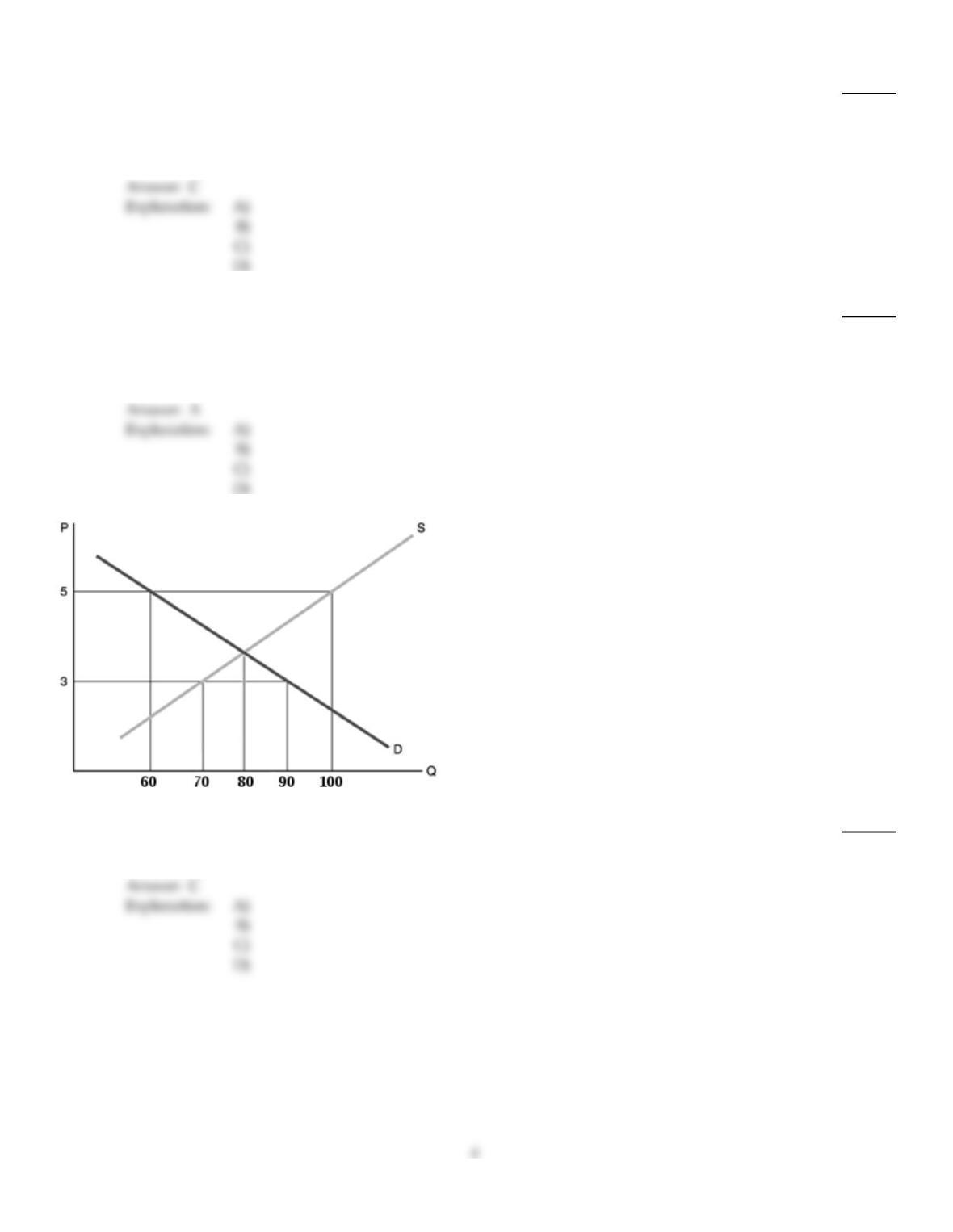
15)
Refer to the above figure. If a price ceiling of $3 was set
15)
A)
there would be a surplus of 40 units.
B)
the quantity sold would be 80 units.
C)
there would be a shortage of 20 units.
D)
there would be a shortage of 40 units.
16)
A decrease in demand and an increase in supply will lead to
16)
A)
unambiguous increases in both price and quantity.
B)
unambiguous decreases in both price and quantity.
C)
an unambiguous decrease in price, but the effect on quantity is indeterminate.
D)
an unambiguous decrease in quantity, but the effect on price is indeterminate.
17)
A reduction in the minimum wage will tend to cause which of the following?
17)
A)
an increase in the quantity supplied of labor
B)
a reduction in the quantity demanded of labor
C)
an increase in the number of workers employed
D)
a reduction in poverty
18)
Goods X and Y are complementary goods. An increase in the price of good X has occurred. In the
market for good Y this will lead to
18)
A)
an increase in price and a decrease in quantity.
B)
an increase in price and an increase in quantity.
C)
a decrease in price and a decrease in quantity.
D)
a decrease in price and an increase in quantity.
19)
Which of the following statements about a price system is TRUE?
I. Prices ration goods and services.
II. Prices indicate relative scarcity.
19)
A)
I only
B)
II only
C)
Both I and II
D)
Neither I nor II
20)
Assume that the market clearing price for a shirt is $20, but that the maximum price that can be
charged is $15. This is an example of
20)
A)
markets failing to ration a fixed quantity of a good.
B)
a price control that will lead to a surplus of shirts on the market.
C)
a price ceiling that will likely lead to a shortage of shirts on the market.
D)
a price floor that will lead to a shortage of shirts on the market.
21)
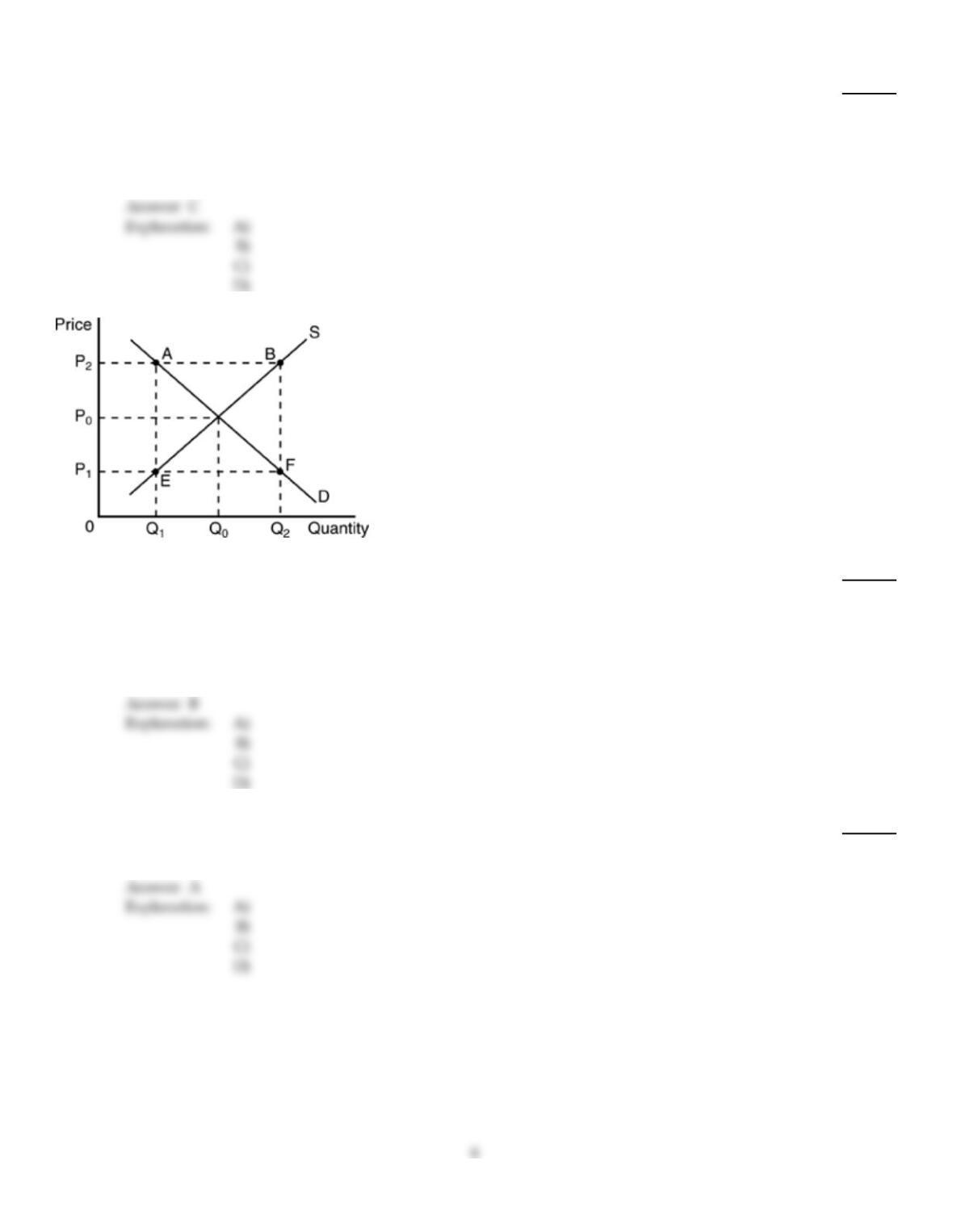
Refer to the above figure. Other things being equal, when the government imposes a price floor at
P2, then we would expect
21)
A)
the quantity demanded is Q2.
B)
a surplus will occur.
C)
consumers to bid against each other for goods and force the price even higher.
D)
price to decline until an equilibrium is achieved at P0.
B
22)
Rationing goods on the basis of price is a direct result of
22)
A)
scarcity.
B)
the profit motive.
C)
government intervention.
D)
queuing.
A
C
23)
Which of the following is a price floor?
23)
A)
college tuition caps
B)
minimum wage rates
C)
rent controls
D)
a freeze on upward–moving gasoline prices
24)
An increase in the equilibrium quantity of good X can be caused by
24)
A)
a technological improvement in the process of producing good X.
B)
an increase in the price of good X.
C)
an increase the price of inputs utilized in producing good X.
D)
a reduction in the number of producers of good X.
A
25)
If both buyers and sellers expect the price of a commodity to fall in the future, it is likely that the
market clearing price ________ and the equilibrium quantity ________.
25)
A)
cannot be predicted, will fall
B)
will fall, cannot be predicted
C)
cannot be predicted, will rise
D)
will rise, cannot be predicted
B
26)
Governments may intervene in private markets through
26)
A)
price floors.
B)
price ceilings.
C)
rationing by political power.
D)
all of the above.
D
27)
Suppose a price ceiling is currently set below the equilibrium price. Now suppose that policy
makers decide to lower the price ceiling. This reduction in the price ceiling will cause which of the
following to occur?
27)
A)
The shortage in the market will increase.
B)
The surplus in the market will increase.
C)
The surplus in the market will decrease.
D)
The shortage in the market will decrease.
A
B
28)
A decrease in demand and a decrease in supply will lead to
28)
A)
unambiguous increases in both price and quantity.
B)
unambiguous decreases in both price quantity.
C)
an unambiguous decrease in price, but the effect on quantity is indeterminate.
D)
an unambiguous decrease in quantity, but the effect on price is indeterminate.
29)
When prices are used as a rationing device, goods that are relatively more scarce than they used to
be will have
29)
A)
lower excess demands.
B)
long queues.
C)
higher prices.
D)
greater demand.
C
30)
In which of the following situations will market clearing price increase and the equilibrium
quantity decrease?
30)
A)
an increase in demand with no change in supply
B)
an increase in supply with no change in demand
C)
a decrease in supply with no change in demand
D)
a decrease in demand with no change in supply
C
D
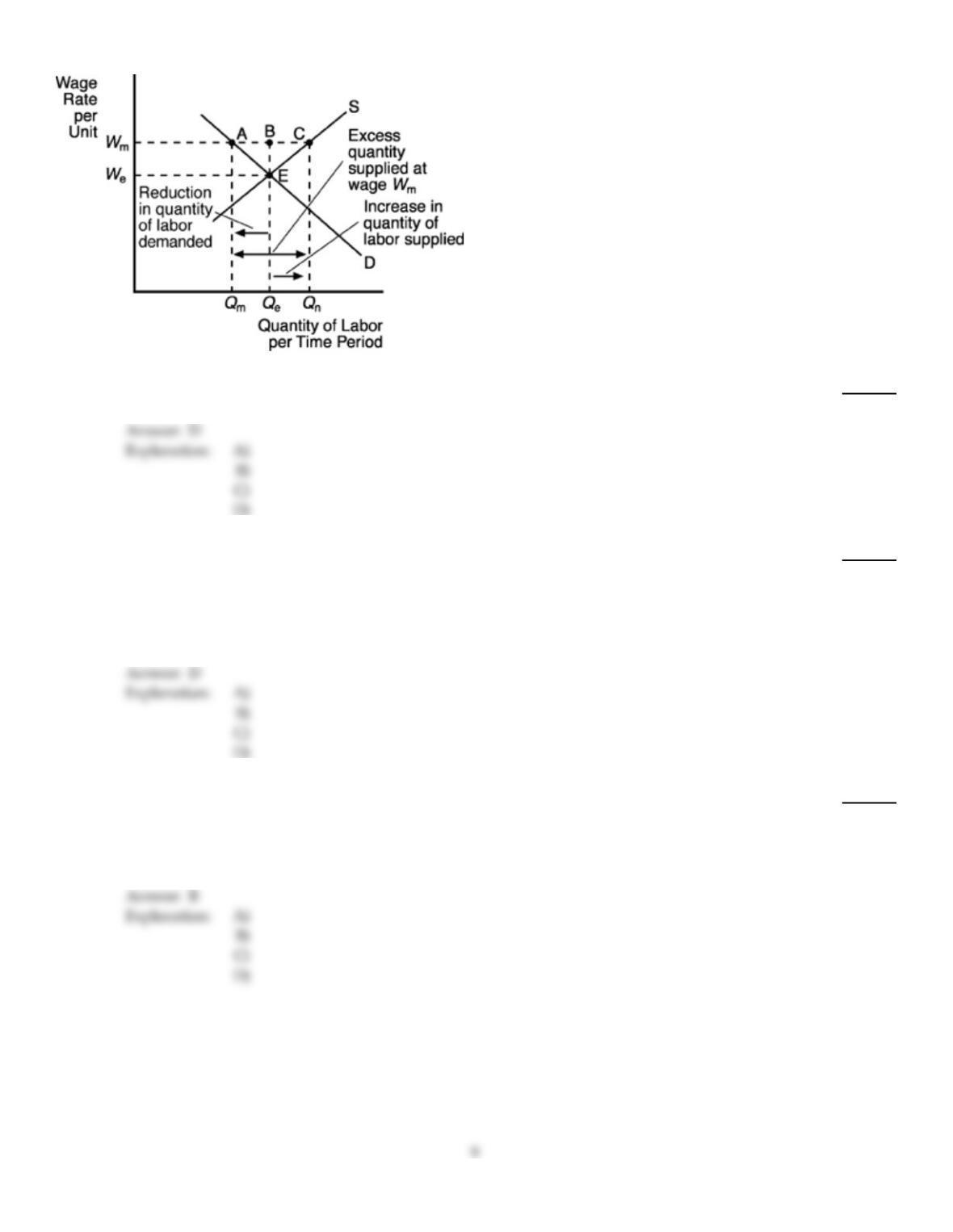
31)
According to the above figure, the market clearing wage rate is
31)
A)
We– Wm.
B)
Wm+ We.
C)
Wm.
D)
We.
32)
Which of the following will cause, other things being equal, a movement along the supply curve for
LED televisions?
32)
A)
an improvement in the technology of producing LED televisions
B)
an expectation that the price of LED televisions will be lower in the future
C)
an increase in resource costs for producing LED televisions
D)
a reduction in the price of LED televisions
D
33)
A price ceiling is
33)
A)
the lowest price a seller can charge without losing all of its customers.
B)
a legal price above which a good or service cannot be sold.
C)
a nonprice rationing device.
D)
a legal minimum price below which a good or service cannot be sold.
B
D
34)
If supply increases and demand decreases
34)
A)
the market clearing price definitely falls, and the effect on the equilibrium quantity is
indeterminate.
B)
the market clearing price definitely rises, and the effect on the equilibrium quantity is
indeterminate.
C)
the effect on the market clearing price is indeterminate, and the equilibrium quantity
definitely falls.
D)
the market clearing price definitely rises, and the equilibrium quantity definitely falls.
35)
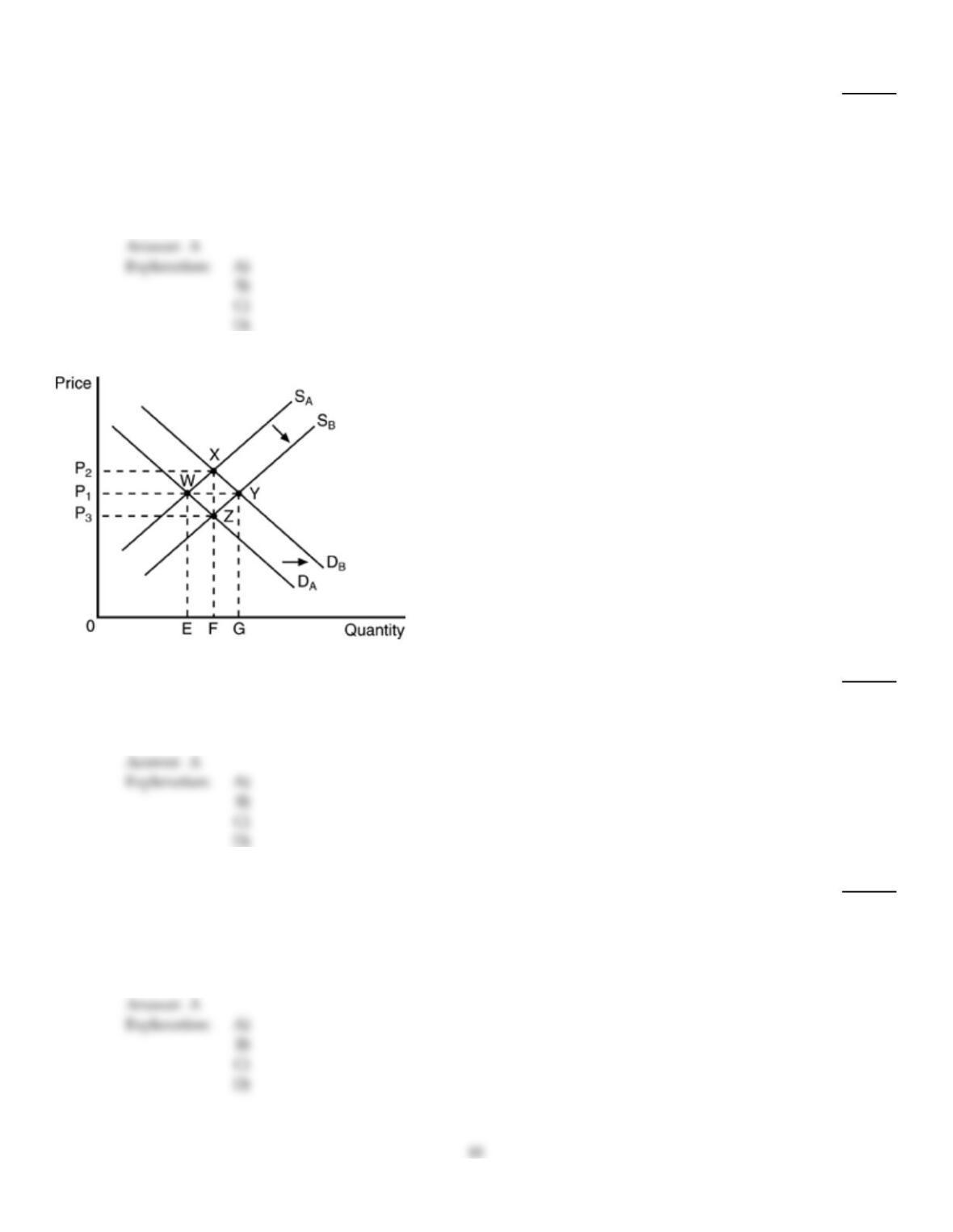
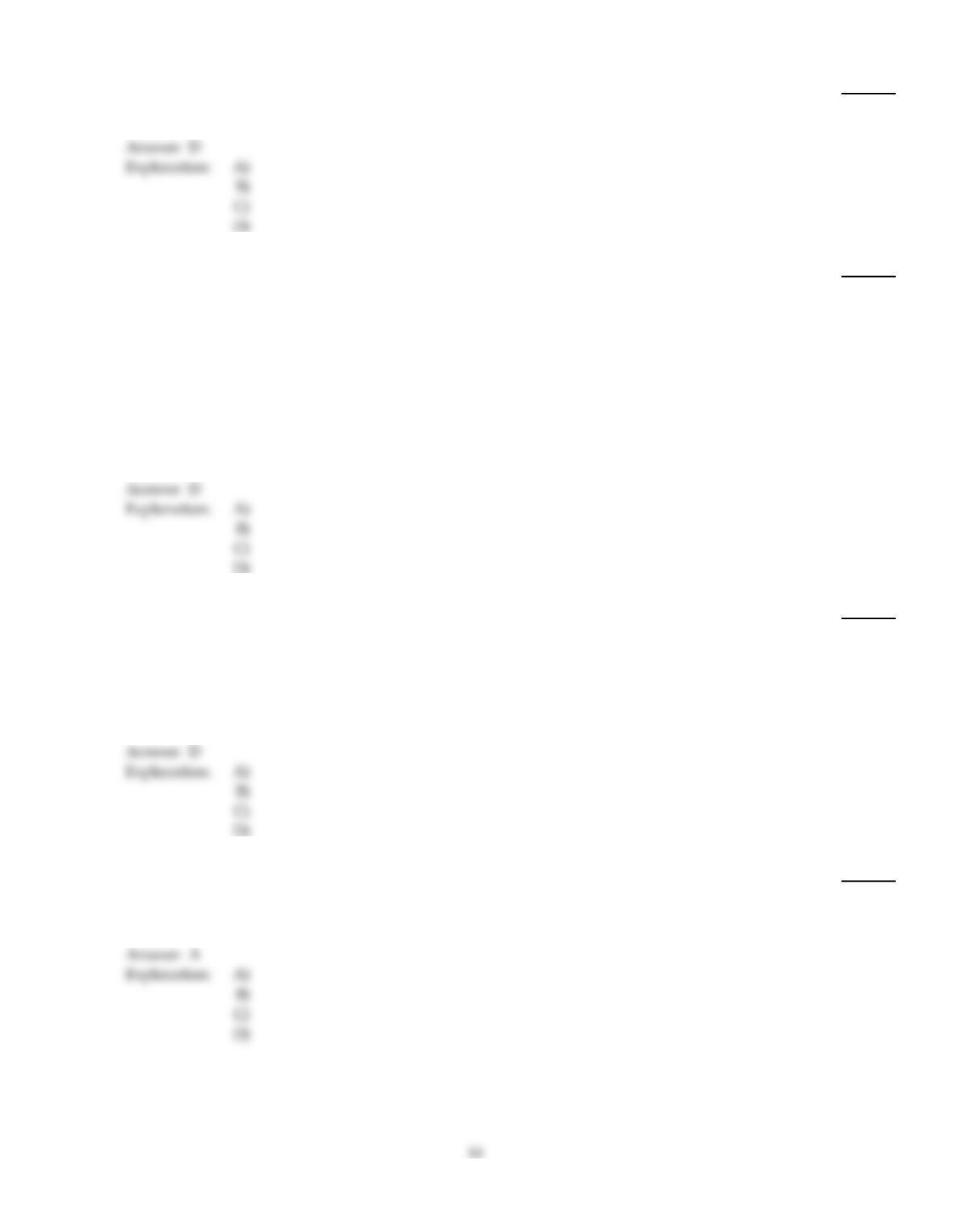
Refer to the above figure. Suppose that the supply curve shifts from SA to SB while the demand
curve remains at DA. Which of the following is TRUE?
35)
A)
Supply has increased.
B)
Supply has decreased.
C)
Only quantity demanded has decreased.
D)
Only quantity supplied has increased.
36)
Suppose the price of lumber decreases. In the market for new homes, we would expect which of the
following to occur?
36)
A)
the market clearing price will fall and the equilibrium quantity will rise.
B)
both the market clearing price and the equilibrium quantity will fall.
C)
the market clearing price will rise and the equilibrium quantity will fall.
D)
both the market clearing price and the equilibrium quantity will rise.
37)
An increase in the price of labor used to produce good Y will lead to
37)
A)
an increase in the supply of good Y.
B)
an increase in the market clearing price of good Y.
C)
a decrease in the demand for good Y.
D)
an increase in the demand for good Y.
38)
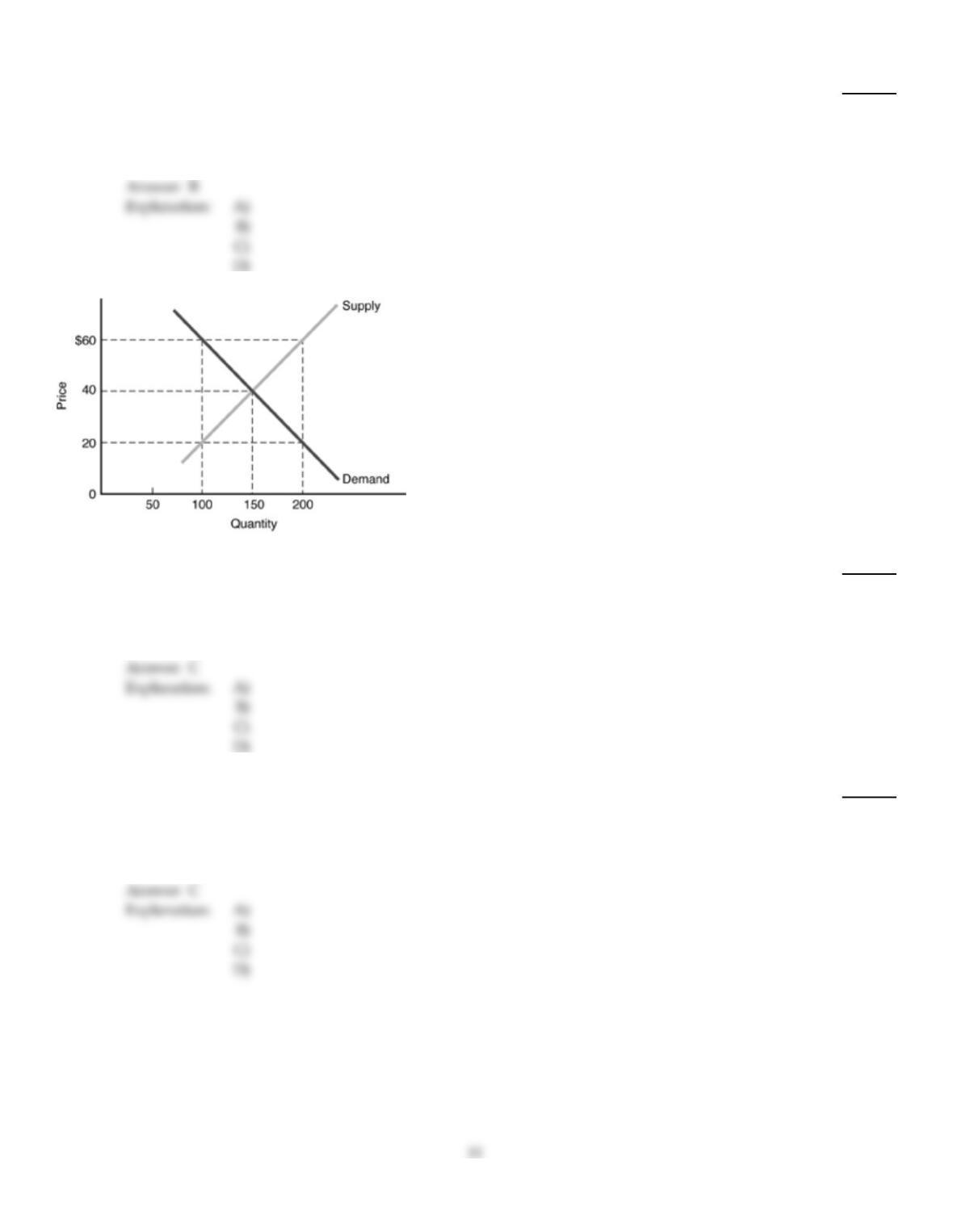
Refer to the above figure. If the government imposes a price ceiling of $60
38)
A)
the quantity traded will be 100, and the price will be $60.
B)
the quantity traded will be 150, and the price will be $60.
C)
the quantity traded will be 150, and the price will be $40.
D)
the quantity traded will be 200, and the price will be $60.
39)
What will happen when there is a rightward shift in the demand curve?
39)
A)
Product prices do not change in this situation.
B)
Producers will decrease the product price.
C)
A new, higher price is not instantaneously achieved, but the price will rise over time.
D)
The product price will instantaneously adjust downward.
40)
An effective rent control will
40)
A)
be set at the price where quantity supplied equals quantity demanded.
B)
keep rents above the competitive market level.
C)
keep rents below the competitive market level.
D)
lead to a surplus of housing units.
41)
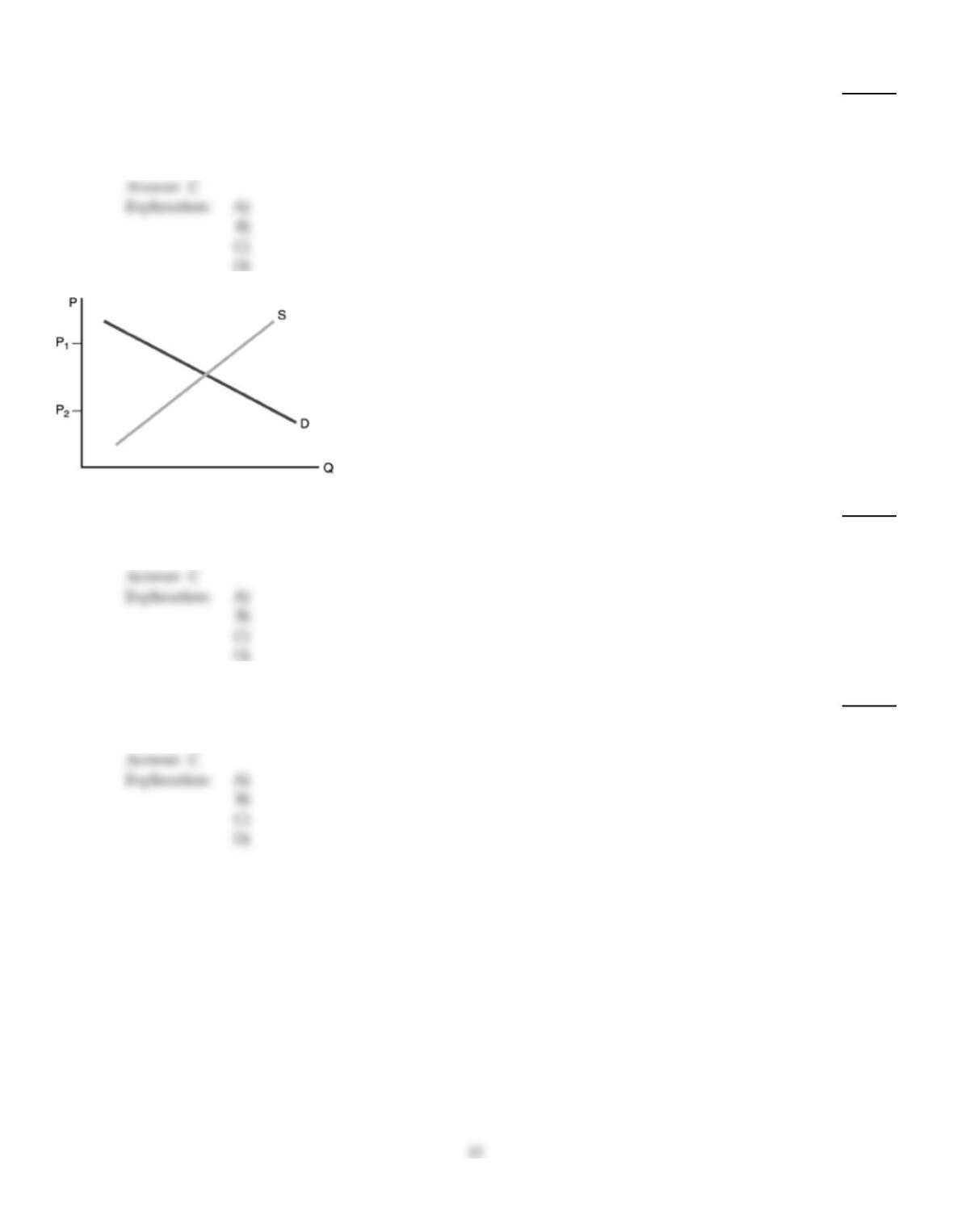
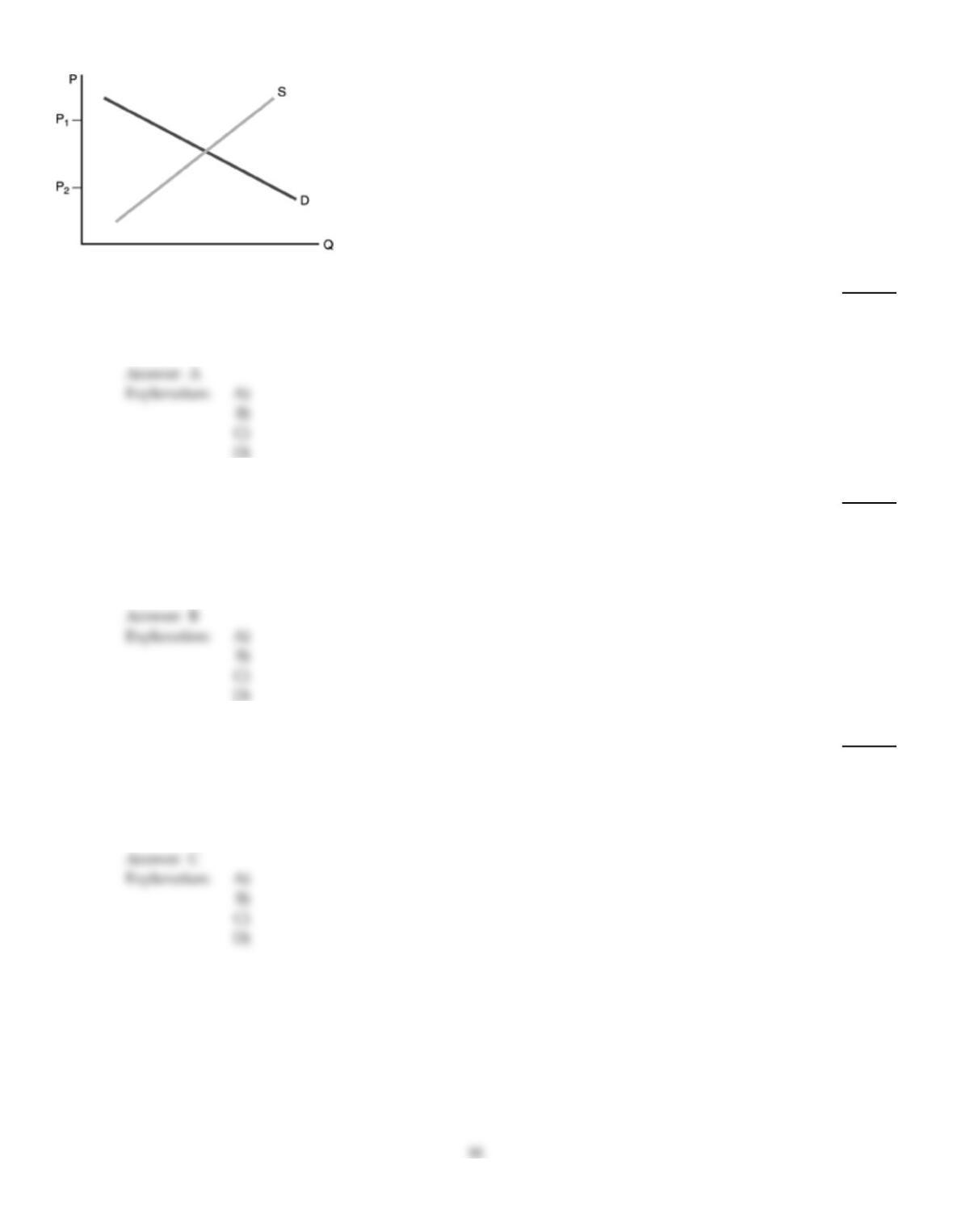
Refer to the above figure. A price control has been set which has led to a surplus. This means that a
41)
A)
price floor has been set at P2.
B)
price ceiling has been set at P2.
C)
price floor has been set at P1.
D)
price ceiling has been set at P1.
42)
In a market, the rationing function of prices results in
42)
A)
a price ceiling.
B)
long queues or waiting lines.
C)
equilibrium.
D)
a shortage or surplus.
43)
The decrease in the price of gasoline to a national average of less than $3.20 during the summer of
2012 was most likely a result of
43)
A)
an increase in demand due to increase in summer driving along with a decrease in supply
resulting from reduced refinery output.
B)
an increase in supply resulting from higher refinery output.
C)
an increase in supply resulting from higher refinery output along with a decrease in demand
in summer driving.
D)
an increase in demand due to reduced summer driving.
44)
Rent control is an example of
44)
A)
the government increasing the demand for certain products.
B)
the rationing function of prices not working.
C)
a price floor.
D)
a price ceiling.
45)
Refer to the above figure. Suppose the demand curve shifts from DA to DB, while the supply curve
remains at SA. Which of the following statements is FALSE?
45)
A)
There has been an increase in demand.
B)
Supply has increased.
C)
The new equilibrium price is P2, and the new equilibrium quantity is F.
D)
More consumers in the market might have caused the demand curve to shift.
46)
Suppose the market clearing price is $15 and the price ceiling is $17. The price that prevails in the
market will be
46)
A)
$17.
B)
more than $17.
C)
less than $15.
D)
$15.
47)
Suppose that an early frost damages the Florida orange crop. As a result, the price of California
oranges increases. Ceteris paribus, which one of the following statements best explains this
situation?
47)
A)
The demand for Florida oranges fell because of the freeze, and this led to a higher demand for
California oranges.
B)
The supply of Florida oranges decreased, causing the supply of California oranges to increase,
which resulted in a higher price.
C)
The supply of Florida oranges decreased, causing the supply of California oranges to
decrease, which resulted in a higher price.
D)
The supply of Florida oranges decreased, causing their price to increase, and thus causing the
demand for California oranges to increase.
48)
The rationing function of prices refers to
48)
A)
the situation when government must intervene in a market when there is a large shortage or
surplus.
B)
the synchronization of decisions by buyers and sellers through the direction of government
agencies.
C)
the situation when only the rich get the goods they want.
D)
the synchronization of decisions by buyers and sellers that leads to an equilibrium.
49)
Which of the following is most likely to benefit from government established price floors in
agriculture?
49)
A)
large farm owners and corporate farms
B)
cattle ranchers
C)
low income farmers
D)
small farmers
50)
The effect of a legal minimum wage set above the equilibrium wage rate is
50)
A)
an excess quantity of labor demanded.
B)
an increase in the quantity of labor demanded.
C)
an excess quantity of labor supplied.
D)
a decrease in quantity of labor supplied.
51)
If supply decreases and demand increases
51)
A)
the market clearing price definitely rises, and the equilibrium quantity is indeterminate.
B)
the market clearing price definitely rises, and the equilibrium quantity falls.
C)
the market clearing price definitely falls, and the effect on the equilibrium quantity is
indeterminate.
D)
the effect on the market clearing price is indeterminate, and the equilibrium quantity
definitely falls.
52)
Producer surplus is
52)
A)
the total difference between the total amount that producers actually receive for an item and
the total amount that they would have been willing to accept.
B)
the total difference between the utility consumers derive from purchasing an item and the
total costs firms incur in producing the item.
C)
the total difference between the total amount that consumers are willing to pay for an item
and the total amount that producers would like to receive.
D)
the total difference between the total costs firms incur in producing an item and the utility
consumers derive from purchasing the item.
53)
Refer to the above figure. A price control has been set which has led to a shortage. This means that
a
53)
A)
price ceiling has been set at P2.
B)
price floor has been set at P1.
C)
price ceiling has been set at P1.
D)
price floor has been set at P2.
54)
Goods X and Y are complementary goods. A decrease in price of good X has occurred. In the
market for good Y, this will lead to
54)
A)
an increase in price and a decrease in quantity.
B)
an increase in price and an increase in quantity.
C)
a decrease in price and a decrease in quantity.
D)
a decrease in price and an increase in quantity.
55)
We cannot predict the effect on the equilibrium quantity, but know that the market clearing price
will increase when
55)
A)
supply and demand increases simultaneously.
B)
supply and demand decreases simultaneously.
C)
supply decreases and at the same time demand increases.
D)
supply increases and demand increases simultaneously.
Price Quantity Demanded Quantity Supplied
Per Phone Per Month Per Month
$400 2,000 12,000
375 3,000 11,000
350 4,000 10,000
325 5,000 9,000
300 6,000 8,000
275 7,000 7,000
250 8,000 6,000
225 9,000 5,000
200 10,000 4,000
56)
Refer to the above table. Suppose there are technological advances in the production of
smartphones. The new equilibrium price will be
56)
A)
between $275 and $375.
B)
$375.
C)
$275.
D)
less than $275.
57)
Who is most likely to benefit from rent controls?
57)
A)
consumers who are unable to obtain apartments at the controlled rents
B)
landowners who can lease the apartments at the controlled rents
C)
the government that controls the rents
D)
consumers who are able to obtain apartments at the controlled rents
Garbanzo Beans
Price QdQs
$2 5,000 1,000
$4 4,000 2,000
$6 3,000 3,000
$8 2,000 4,000
$10 1,000 5,000
58)
Consider the above table. If the government imposes a price ceiling on garbanzo beans of $8, what
would be the likely result?
58)
A)
a surplus of 2,000 garbanzo beans on the market
B)
The quantity demanded of garbanzo beans would fall to zero.
C)
a shortage of 2,000 garbanzo beans on the market
D)
Market equilibrium will be reached.
59)
If the government sets a minimum price at which a good or service can be sold, it thereby creates
59)
A)
a black market price.
B)
a price floor.
C)
a price ceiling.
D)
an illegal price control.
B
60)
If a price ceiling were established above the equilibrium price,
60)
A)
it would have no effect on the quantity demanded.
B)
it would create a surplus.
C)
it would create a shortage.
D)
none of the above.
A
61)
Which of the following is NOT a device to reduce transaction costs?
61)
A)
auto dealers located close together
B)
government prohibitions on advertising
C)
banks that direct funds from savers to borrowers
D)
shopping centers
B
D
62)
To enhance their prestige, some country clubs like to point to the fact that they have a waiting list
for new members. Even at clubs with high initiation fees, it is common that prospective members
have to wait three or more years before there is room for them on the membership rolls. How do
these country clubs set the price of membership to ensure that they have a waiting list?
62)
A)
Set the price at a level that will generate a surplus of memberships.
B)
Set the membership price above the market clearing price.
C)
Set the membership price below the market clearing price.
D)
Set the price so that the quantity supplied of memberships exceeds the quantity demanded.
63)
People consume more fresh fruit in the summer than during the rest of the year, yet the prices of
fresh fruit are lower in the summer than in other seasons. What accounts for this?
63)
A)
Fresh fruit is not subject to the law of demand.
B)
Fresh fruit is an inferior good.
C)
Fresh fruit is not subject to the law of supply.
D)
The supply of fresh fruit increases in the summer.
64)
A market in which a price–controlled good is sold at an illegally high price is known as
64)
A)
a flooring market.
B)
a ceiling market.
C)
a supermarket.
D)
a black market.
65)
In 2010, a British Petroleum oil rig exploded in the Gulf of Mexico. The explosion resulted in a
major oil spill and a decrease in the supply of oil. At the same time, the average price of gasoline
decreased. Which of the following best explains the decrease in the price of gasoline?
65)
A)
The demand for gasoline remained unchanged.
B)
The demand for gasoline increased, and the effect of the increase in demand on the gasoline
price was less than the price effect of the decrease in supply.
C)
The demand for gasoline decreased, and the effect of the decrease in demand on the gasoline
price was greater than the price effect of the decrease in supply.
D)
The quantity demanded of gasoline increased.
66)
Rent controls often have adverse effects, including
66)
A)
too much housing in a community.
B)
too much construction of new rental units in the community.
C)
deterioration in the quality of existing rental units.
D)
income transfers from the poor to landlords.
67)
A limit on the amount of strawberries that can be imported into the United States is an example of
67)
A)
an import quota.
B)
a price ceiling set by government.
C)
the rationing function of prices protecting domestic strawberry farmers.
D)
a price floor set by the government.
A
68)
An increase in the minimum wage will tend to cause which of the following to occur?
68)
A)
an increase in the size of the surplus of labor
B)
a rightward shift in the supply of labor
C)
a leftward shift in the demand for labor
D)
a reduction in the unemployment rate
A
69)
List prices on new cars do not change very often, so
69)
A)
price flexibility shows up primarily through the negotiations between buyers and sellers.
B)
the prices of new cars can only be flexible if there are changes in the cost of materials.
C)
the real price of cars is very inflexible.
D)
price flexibility is not an important feature in the auto market.
A
C