CHAPTER 4
True-False Questions
4–2
must have been, an employer-employee relationship.
4–2
they are not defined as employers under the federal income tax
withholding law.
4–2
excludes partners.
The amount of federal income taxes to be withheld is determined after
4–2
subtracting from the employee’s gross wages any local and state taxes.
4–3
withheld from the value of meals that employers furnish workers on the
employers’ premises for the employers’ convenience.
4–4
nontaxable income and thus are excluded from federal income tax
withholding.
All taxable noncash fringe benefits received during the year can only be
4–4
added to the employees’ taxable pay on the last payday of the year.
4–4
month are treated as remuneration subject to federal income tax
withholding.
4–4
must report the amount of the cash tips to the employer by the 10th of
the month following the month they receive the tips.
4–5
employee is made from the employee’s wages that are under the
employer’s control.
4–5
reported by tipped employees and the tips that the employer allocates to
the employees.
There is no limit to the amount of educational assistance that is exempt
4–6
from federal income tax withholdings.
The payments to a cook employed by a college fraternity are excluded
4–6
from federal income tax withholding.
There is no limit to the amount that an employer can contribute in an
4–8
employee’s SIMPLE retirement account.
Before any federal income taxes may be withheld, there must be, or
E–28 Chapter 4/Examination Questions
4–8
extra $10,000 of their wages from federal income tax.
4–8
specified amount of their compensation without paying federal income
taxes on that amount.
The IRA format of the SIMPLE plan allows employees to make tax-free
4–8
contributions of up to $12,500.
4–8
match the employee’s contribution, dollar-for-dollar, up to 3% of the
employee’s compensation.
4–10
allowances. Evers must claim the three allowances with each of the
two employers during the entire calendar year.
After completion of Form W-4, an employer must copy the employee’s
4–11
social security card and place it in the employee’s employment file.
4–11
the employer must withhold according to the withholding tables for
single employees.
The special withholding allowance may be claimed only by those
4–10
employees who do not itemize deductions on their income tax returns.
Gere became the father of triplets on June 20. He must file an
4–11
amended Form W-4 on or before June 30.
4–11
the number of allowances claimed. Hunt’s employer must put the new
withholding allowance certificate into effect before the next weekly
payday on August 5.
A person holding two jobs may have additional income tax withheld by
4–12
increasing the number of withholding allowances claimed.
4–13
not replace it with a valid form. The employer should withhold federal
income taxes at the rate for a single person claiming no exemptions.
4–13
the IRS if the employee has claimed 15 or more withholding allowances.
By completing Form W-4P, a person can elect to have no income tax
4–14
withheld from the annuity amounts the person receives.
Of the two main methods of withholding, only the wage-bracket
4–15
method distinguishes unmarried persons from married persons.
The standard deduction varies according to whether the wage-bracket
4–15
method or the percentage method is used.
In the case of a 401(k) plan, employees age 50 or over can shelter an
Examination Questions/Chapter 4 E–29
4–19
wages, the method of calculating the withholding is the same for
vacation payments as for semiannual bonuses.
4–21
does not use the OASDI/HI tax rates in the formula.
Employees must be given Form W-2 on or before January 31 following
4–21
the close of the calendar year.
4–24
transmitting information returns on Forms W-2.
4–30
filing rather than paper Forms W-2.
For state income tax purposes, all states treat 401(k) plan payroll
4–31
deductions as nontaxable.
Multiple-Choice Questions
4–2
not defined as an employee?
a. Partner who draws compensation for services rendered the
partnership
b. General manager, age 66
c. Payroll clerk hired one week ago
d. Governor of the state of Florida
e. Secretary employed by a not-for-profit corporation
4–4
taxable income subject to federal income tax withholding?
a. Flight on employer-provided airline
b. Personal use of company car
c. Sick pay
d. Employer-paid membership to a country club
e. All of the above are taxable.
4–4
withhold federal income taxes?
a. Advances made to sales personnel for traveling expenses
b. Tipped employee’s monthly tips of $120
c. Deceased person’s wages paid to the estate
d. Minister of Presbyterian church
e. All of the above
E–30 Chapter 4/Examination Questions
4–5
of federal income taxes and social security taxes on tips?
a. Tips amounting to $10 or more in a calendar month must be re-
ported by tipped employees to their employers.
b. The withholding of federal income taxes on employees’ reported
tip income is made from the amount of tips reported by
employees.
c. When employees report taxable tips in connection with
employment in which they also receive regular wages, the amount
of tax to be withheld on the tips is computed as if the tips were a
supplemental wage payment.
d. Employers do not withhold FICA taxes on the tipped employees’
reported tip income.
e. None of the above statements is correct.
4–6
withholding of federal income taxes except:
a. year-end bonus.
b. kitchen appliances given by manufacturer in lieu of cash wages.
c. dismissal payment.
d. vacation pay.
e. payments made under worker’s compensation law.
4–7
a. Health insurance
b. Group-term life insurance (first $50,000 of coverage)
c. Dependent care assistance (first $5,000)
d. Self-insured medical reimbursement plan
e. Educational assistance
4–10
a. amounted to $2,000 in 2016.
b. may be claimed to exempt a portion of the employee’s earnings
from withholding.
c. is indexed for inflation every calendar quarter.
d. may be claimed at the same time with each employer for whom an
employee is working during the year.
e. for one person is a different amount for a single versus a married
taxpayer.
Examination Questions/Chapter 4 E–31
4–11
to you, the payroll manager, when she was hired. You should:
a. tell Beech that it is OK since you know that she was recently
divorced and is reluctant to talk about it.
b. inform Beech that she will have to write the IRS and give her
reasons for refusing to state her marital status.
c. tell Beech that you will have to withhold income taxes as if she
were married and had claimed one allowance.
d. tell Beech that you will have to withhold income taxes according to
the withholding table for a single employee with no allowances.
e. advise Beech to write “It is no business of yours.” in the margin of
her Form W-4.
4–12
which he claims two additional withholding allowances. He asks you to
refund the excess taxes that were deducted from January 1 to March
11 when Arch claimed only one withholding allowance. You should:
a. repay the overwithheld taxes on Arch’s next payday.
b. tell Arch that you will spread out a refund of the overwithheld taxes
equally over the next six pays.
c. inform Arch that you are unable to repay the overwithheld taxes
that were withheld before March 11 and that the adjustment will
have to be made when he files his annual income tax return.
d. tell Arch to write the IRS immediately and ask for a refund of the
overwithheld taxes.
e. inform Arch that you will appoint a committee to study his request.
4–13
requires that an employer submit to the agency a copy of each Form W–4:
a. the IRS has requested in writing.
b. on which an employee, usually earning $180 each week at the
time Form W-4 was filed, now claims to be exempt from
withholding.
c. on which an employee claims to be single but has 9 withholding
allowances.
d. on which a married employee claims no withholding allowances.
e. on which a recently divorced employee claims 5 withholding
allowances and authorizes an additional $10 to be withheld each
week.
E–32 Chapter 4/Examination Questions
4–28
distributions from pension and retirement plans?
a. Form W-2c
b. Form 1099-R
c. Form 1099–PEN
d. Form W-3p
e. Form W-4
4–28
conditions except:
a. to report $1,000 of compensation paid to an individual who is not
an employee.
b. to report the wages totaling $600 paid to an independent
contractor during the calendar year.
c. to report dividends totaling $600 paid to an individual during the
calendar year.
d. to report commissions of $500 paid to a self-employed salesman.
e. An information return must be filed under each of the above
conditions.
4–28
landlords?
a. Form 1099–R
b. Form 1099–INT
c. Form 1099–MISC
d. Form 1099–G
e. Form 8027
4–29
to independent contractors in which of the following cases?
a. When there is a signed contract between the parties
b. When the contractor is paid more than $10,000
c. When the contractor is a corporation
d. When the contractor has not provided a taxpayer identification
number and the contract is $600 or more
e. All of the above
Examination Questions/Chapter 4 E–33
Problem-Solving
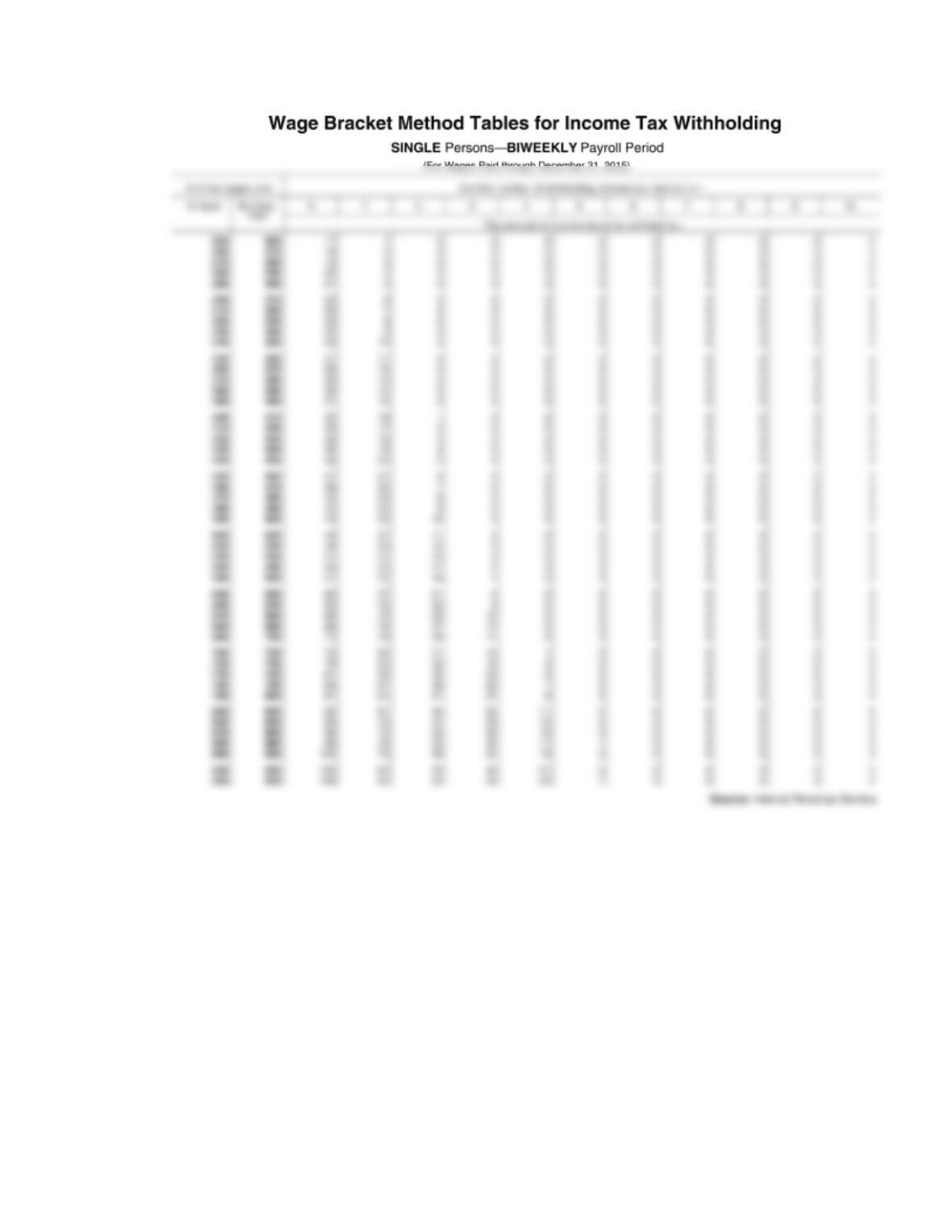
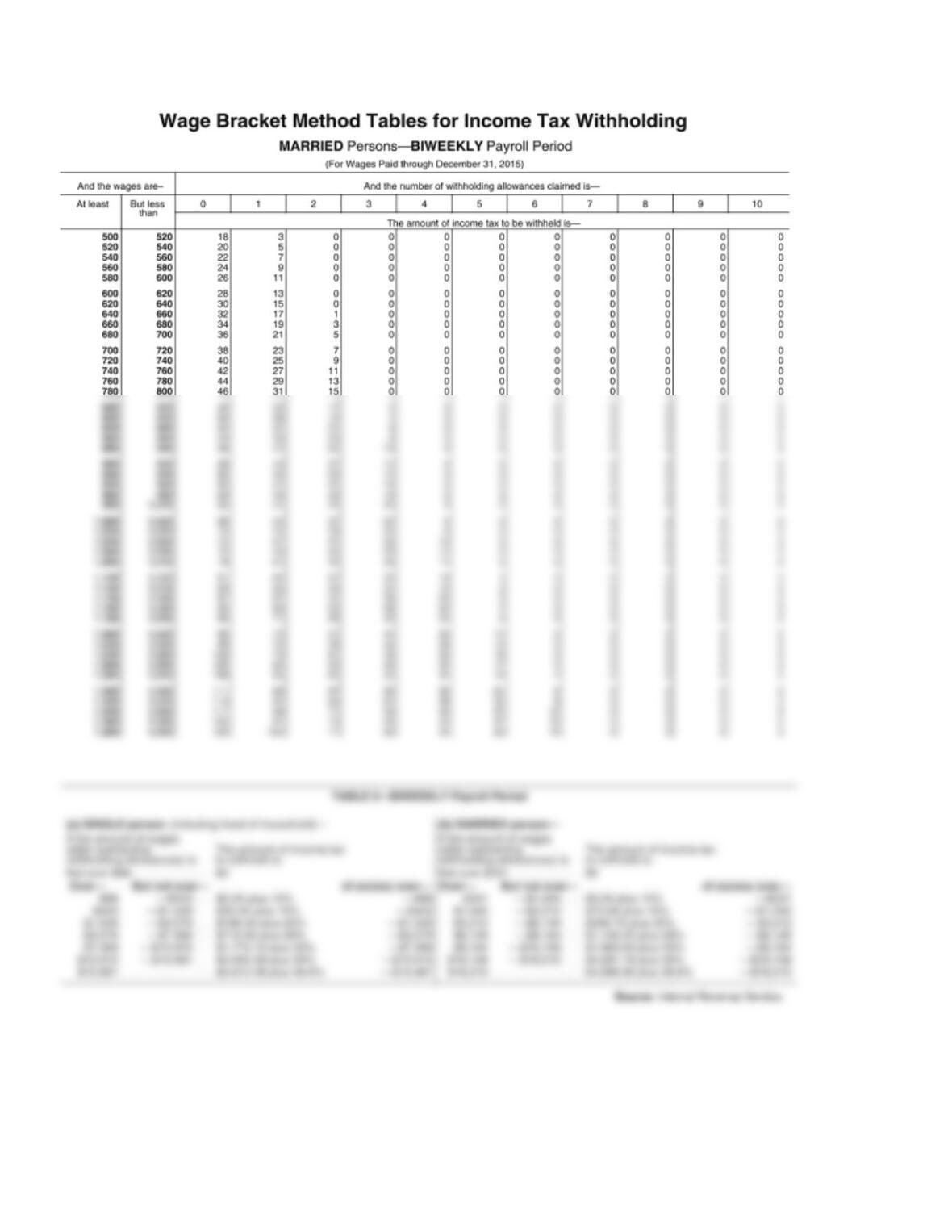
Note: Use the tables on the following pages to calculate the answers to the problems
listed.
1. Determine the income tax to withhold from the biweekly wages of the following
employees (wage-bracket):
E–34 Chapter 4/Examination Questions
Examination Questions/Chapter 4 E–35
E–36 Chapter 4/Examination Questions