1
Chemistry for Changing Times, 14e (Hill/McCreary)
Chapter 4 Chemical Bonds
4.1 Multiple Choice Questions
1) The nature of bonding forces in matter influences which of the following observable properties of the
matter?
A) the optical property
B) the state of the matter at room temperature
C) the strength and rigidity
D) all of the above
2) The noble gases are inert. This means they
A) undergo very few chemical reactions.
B) exist as gases at room temperature.
C) undergo many chemical reactions.
D) lose and gain electrons easily.
3) The inertness of the noble gases is due to
A) the outermost shell has six electrons.
B) the number of protons and neutrons.
C) the bonds they form with other elements.
D) the outermost shell has an octet of electrons, except for helium which has two electrons.
4) A sodium ion, Na+, has the same electron configuration as a(n)
A) sodium atom.
B) chlorine atom.
C) neon atom.
D) argon atom.
2
5) A chloride ion, Cl– has the same electron configuration as a(n)
A) sodium atom.
B) chlorine atom.
C) neon atom.
D) argon atom.
6) The number of electrons in a chloride ion, Cl–, is
A) 16.
B) 17.
C) 18.
D) 35.
7) The number of protons in a chloride ion, Cl–, is
A) 16.
B) 17.
C) 18.
D) 35.
8) The number of electrons in a sodium ion, Na+, is
A) 10.
B) 11.
C) 12.
D) 23.
9) The number of protons in a sodium ion, Na+, is
A) 10.
B) 11.
C) 12.
D) 23.
10) When calcium reacts with iodine, calcium ions, Ca2+, and iodide ions, I–, are formed. In this reaction,
calcium atoms
A) lose electrons.
B) gain electrons.
C) lose protons.
D) gain protons.
Answer: A
Diff: 2 Var: 12 Page Ref: Sec. 4.1
Global Obj: Global 2: Demonstrate the ability to think critically and employ critical thinking skills.
Learning Obj: LO 4.1 Determine the number of electrons in an ion.
11) When barium reacts with iodine, barium ions, Ba2+, and iodide ions, I–, are formed. In this reaction,
iodine atoms
A) lose electrons.
B) gain electrons.
C) lose protons.
D) gain protons.
12) When atoms lose or gain electrons in chemical reactions they form
A) new atoms.
B) noble gases.
C) nucleons.
D) ions.
13) Which molecule is NOT likely to exist?
A) N2
B) Br2
C) CI4
D) Ar2
14) Noble gases are unreactive because of their electronic structures. The kind of reasoning that states “if
other elements could be made to achieve noble gas electronic structures they would be more stable” is
called
A) logic.
B) inductive reasoning.
C) deductive reasoning.
D) critical thinking.
15) Mg2+ has the same electronic structure as
A) Ne.
B) Mg.
C) C.
D) Ar.
16) The number of electrons in a sulfide ion, S2-, is
A) 16.
B) 14.
C) 18.
D) 32.
5
17) Which of the following molecules is NOT likely to exist?
A) CO2
B) HCl
C) CCl4
D) RnH
18) Which of the following pairs is isoelectronic?
A) Ar and Ne
B) Ar and Na+
C) Ar and F–
D) Ar and S2-
19) All of the following pairs are isoelectronic EXCEPT
A) Ne and Rn.
B) Rb+ and Sr2+.
C) Ne and Mg2+.
D) F– and Ne.
20) All of the following species are isoelectronic to Mg2+ EXCEPT
A) Li+.
B) Na+.
C) Ne.
D) O2-.
21) With respect to chemical bonding, which particles play the most active role?
A) protons
B) neutrons
C) valence electrons
D) core electrons
22) An electron-dot structure is a convenient method of representing
A) valence electrons of an atom.
B) core electrons of an atom.
C) all electrons of the atom.
D) the complete electron configuration of the atom.
23) From the periodic table, the number of valence electrons for most of the main group elements may be
determined directly from the
A) atomic number.
B) group number.
C) period number.
D) nucleon number.
24) Which is the electron dot structure of magnesium?
A) Mg
B)
C)
D)

25) Which is the electron dot structure of sulfur?
A)
B)
C)
D) 2
26) Which is the electron dot structure of oxygen?
A)
B)
C)
D)
27) Which is the electron dot structure of nitrogen?
A)
B)
C)
D)
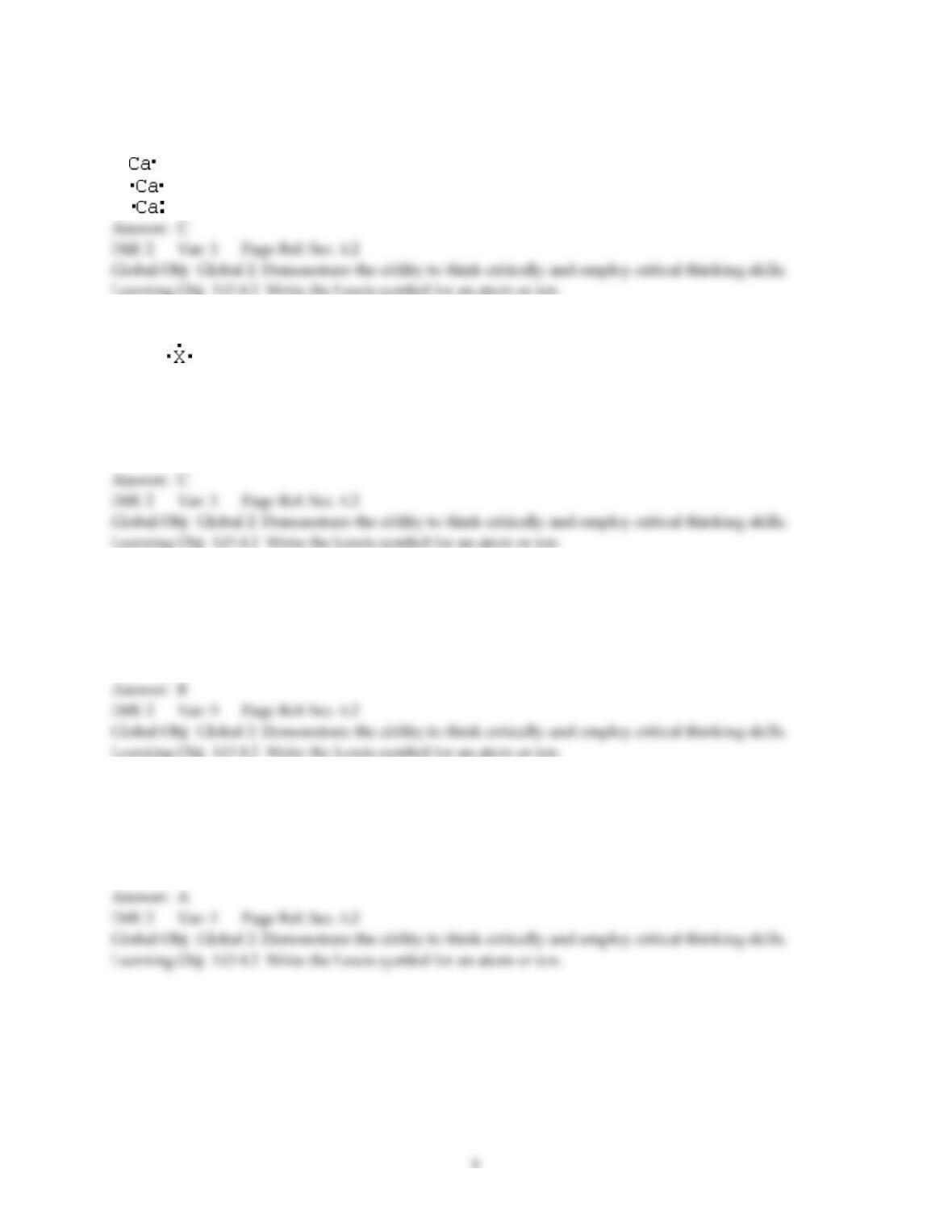
28) Which is the electron dot structure of calcium?
A) Ca
B)
C)
D)
29) Where does an element X with the electron dot structure
fit in the periodic table?
A) Group 1A
B) Group 2A
C) Group 3A
D) Group 5A
30) An element with 7 electrons in its outer shell is in which group on the periodic table?
A) Group 5A
B) Group 7A
C) Group 6A
D) Group 2A
31) Which of the noble gases does NOT have an octet of electrons in its outer shell?
A) He
B) Ne
C) Ar
D) Kr
32) In a Lewis formula, the dots represent
A) all the electrons in the atoms.
B) the valence electrons in all the atoms.
C) only the electrons that are being transferred or shared.
D) whatever number of electrons are needed to satisfy the octet rule.
33) With respect to chemical bonding, which particles play the least active role?
A) nucleons
B) core electrons
C) valence electrons
D) All play equal roles.
34) How many dots will appear in the Lewis dot structure for an element from in Group 1A of the
periodic table?
A) five
B) eight
C) one
D) four
35) Why do chemists use the Lewis symbols to represent chlorine and sodium rather than drawing the
electron diagrams of each element before and after the reaction?
A) Lewis symbols are easier to use.
B) Lewis symbols are more scientific.
C) Lewis symbols are more accurate.
D) Lewis symbols are more abstract.
36) When a freshly cut piece of sodium metal, Na, is dropped into a flask with chlorine gas, a violent
reaction takes place creating a new compound. This compound
A) has properties that are more like Na than Cl.
B) has properties that are totally unlike either Na or Cl.
C) has properties that more like Cl than Na.
D) has properties that are like both Cl and Na.
37) An anion is
A) an element that has lost protons.
B) an element that has gained protons.
C) an element that has lost electrons.
D) an element that have gained electrons.
38) The attraction between positive and negative ions is known as a(n)
A) covalent bond.
B) crystal bond.
C) ionic bond.
D) molecular bond.
39) When ions arrange themselves in an orderly structure, that structure is known as a
A) crystal.
B) dipole.
C) molecule.
D) tetrahedron.
40) When magnesium combines with bromine, the bond formed is best classified as
A) ionic.
B) polar covalent
C) metallic.
D) nonpolar covalent.
41) Which substance has ionic bonds?
A) O2
B) BaO
C) H2O
D) OF2
42) Which substance has ionic bonds?
A) Br2
B) NH3
C) H2O
D) LiI
43) Which substance has ionic bonds?
A) K2S
B) SO3
C) CI4
D) N2
44) Which pair of atoms would form an ionic bond?
A) Na and Mg
B) Ca and S
C) Cl and Br
D) N and N
45) A sodium ion is
A) Na+.
B) Na2+.
C) Na–.
D) Na2-.
46) A iodide ion is
A) I+.
B) I2+.
C) I–.
D) I2-.
47) An oxide ion is
A) O+.
B) O2+.
C) O–.
D) O2-.
48) A nitride ion is
A) N+.
B) N3+.
C) N2-.
D) N3-.
49) Chlorine forms monatomic ions with a charge of
A) 1-.
B) 1+.
C) 2-.
D) 2+.
50) Oxygen forms monatomic ions with a charge of
A) 2+.
B) 3+.
C) 1-.
D) 2-.
51) Which atom is least likely to form an ion?
A) chlorine
B) sodium
C) carbon
D) oxygen
52) Which atom is least likely to form an ion?
A) bromine, Br
B) phosphorus, P
C) aluminum, Al
D) carbon, C
53) Calcium reacts with chloride to form
A) CaCl.
B) CaCl2.
C) Ca2Cl.
D) Ca2Cl3.
54) Magnesium reacts with oxygen to form
A) MgO.
B) Mg2O.
C) MgO2.
D) Mg3O2.
55) Potassium reacts with iodine to form
A) KI.
B) K2I.
C) KI2.
D) K2I3.
56) When magnesium combines with oxygen, the reaction involves a
A) transfer of electrons from Mg to O.
B) transfer of electrons from O to Mg.
C) sharing of electrons between Mg and O.
D) conversion of protons into electrons.
57) When magnesium reacts with chlorine, the reaction involves a
A) transfer of electrons from Mg to Cl.
B) transfer of electrons from Cl to Mg.
C) sharing of electrons between Mg and Cl.
D) creation of electrons.
58) When calcium reacts with chlorine, the reaction involves a
A) transfer of electrons from Ca to Cl.
B) transfer of electrons from Cl to Ca.
C) sharing of electrons between Ca and Cl.
D) creation of electrons.
59) In reactions to form ionic compounds, metals generally
A) lose electrons.
B) gain electrons.
C) become non-metals.
D) do not react.
60) In reactions to form ionic compounds, nonmetals generally
A) lose electrons.
B) gain electrons.
C) become metals.
D) do not react.
61) Octet means
A) stable electrons.
B) valence electrons.
C) eight.
D) filled shell.
62) The cation formed when a sodium atom loses an electron is called the
A) sodide ion.
B) sodate ion.
C) sodium ion.
D) soda ion.
63) The anion formed when oxygen gains two electrons is called the
A) oxygen ion.
B) oxyide ion.
C) oxide ion.
D) oxy ion.
64) The anion formed when nitrogen gains three electrons is called the
A) nitride ion.
B) nitrite ion.
C) nitrogide ion.
D) nitro ion.
65) For which atom is it difficult to predict the most probable ionic charge using the periodic table?
A) Co
B) K
C) Al
D) Br
66) For which atom is it difficult to predict the most probable ionic charge using the periodic table?
A) H
B) Fe
C) O
D) Ne
67) The name of the compound with the formula AlCl3 is
A) aluminum(III) chloride.
B) aluminum trichloride.
C) monoaluminum trichlorine.
D) aluminum chloride.
68) The formula of aluminum oxide is
A) AlO.
B) AlO2.
C) AlO3.
D) Al2O3.
69) The formula of magnesium nitride is
A) Mg3N2.
B) Mg2N3.
C) Mg2N.
D) MgN.
70) An ionic bond is formed when electrons are
A) transferred.
B) shared.
C) split.
D) destroyed.
71) The formula for the compound calcium bromide is
A) CaBr.
B) Ca2Br.
C) CaBr2.
D) Ca3Br2.
72) Which of the following is a binary compound?
A) HCN
B) O2
C) LiBr
D) Na2SO4
73) How many electrons are there in a double bond?
A) 1
B) 2
C) 4
D) 6
74) The name of the compound S2O3 is
A) disulfur oxide.
B) disulfur trioxide.
C) sulfur oxide.
D) sulfur trioxide.
75) The prefix which means seven is
A) hexa.
B) hepta.
C) octa.
D) tetra.
76) A covalent bond is formed when a pair of electrons is
A) transferred.
B) shared.
C) split.
D) destroyed.
77) Covalent bonds generally form between
A) ions.
B) metals.
C) metals and nonmetals.
D) nonmetals.
78) If two atoms from the same element share three pairs of electrons in forming a molecule the bond is
called a
A) single covalent bond.
B) double covalent bond.
C) triple covalent bond.
D) coordinate covalent bond.
79) In a molecule of nitrogen, N2, the nitrogen atoms are bonded to each other by
A) an ionic bond.
B) a single covalent bond.
C) a double covalent bond.
D) a triple covalent bond.
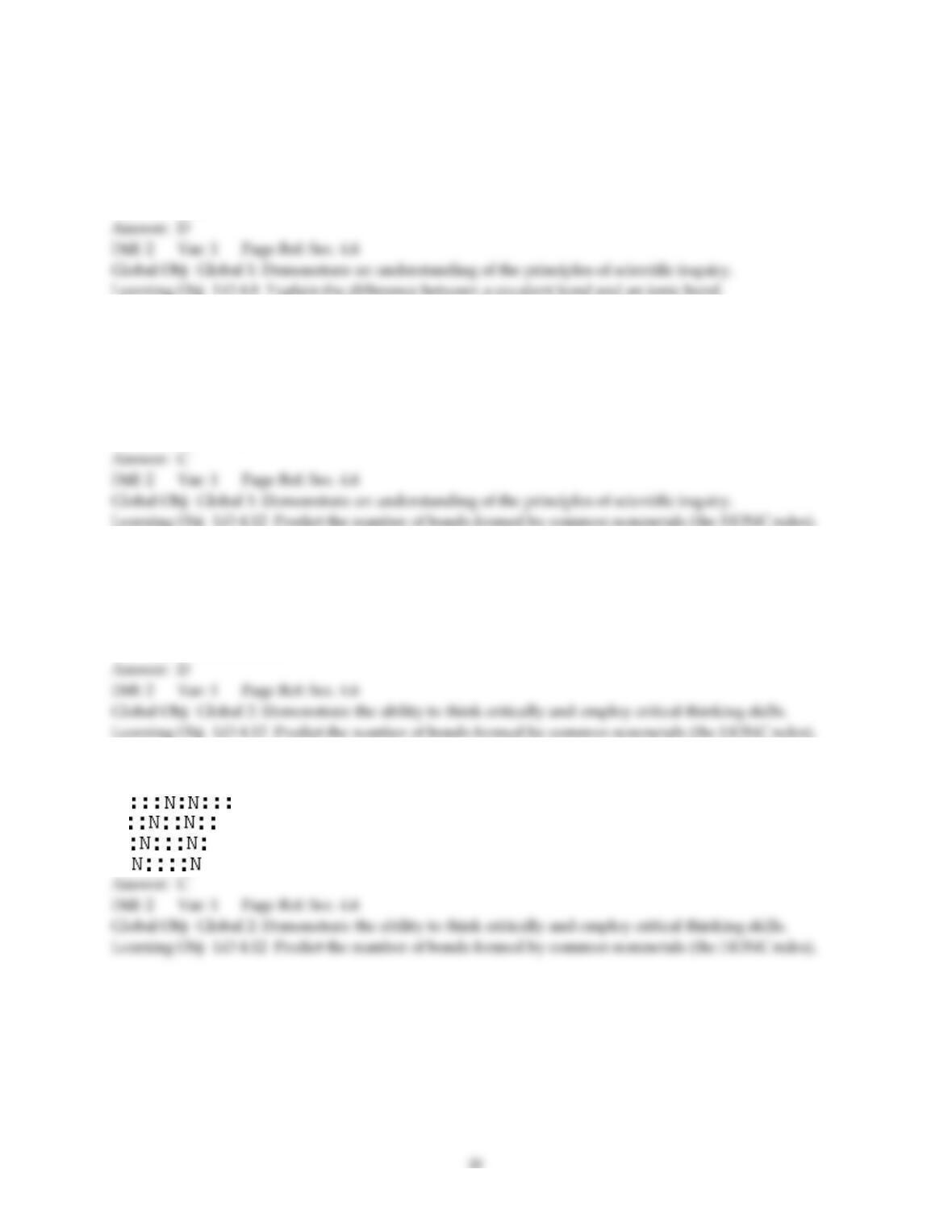
80) Which is the electron dot structure for nitrogen, N2?
A)
B)
C)
D)