Chapter 4
Using Financial Statements to Analyze Value Creation
MULTIPLE CHOICE QUESTIONS
1. The current ratio is
a. current assets divided by current liabilities.
b. current liabilities divided by current assets.
c. current assets divided by total liabilities.
d. total assets divided by total liabilities.
2. The current ratio
a. provides users with an estimate of a company’s human resources.
b. is reported on a company’s balance sheet in the asset section.
c. is a measure of a company’s solvency.
d. is a measure of a company’s liquidity.
3. Return on equity compares
a. the market price of the company’s stock to its dividend policy.
b. a company’s earnings to the dividends paid for the year.
c. the profits of a company to the investment made by its shareholders.
d. the profits of a company to the selling price of each share of stock.
4. Liquidity is the ability
a. to increase net assets through regular operations.
b. to generate cash from sources other than regular operations.
c. to convert existing assets into cash.
d. of financial statement users to predict a company’s cash flows.
4-2 Test Bank – Chapter4 – Using Financial Statements to Analyze Value Creation
5. The current ratio helps assess a company’s
a. profitability.
b. asset turnover.
c. capital structure leverage.
d. solvency.
6. Return on equity helps assess a company’s
a. marketability.
b. solvency.
c. profitability.
d. leverage.
7. The quick ratio helps assess a company’s
a. annual stock price.
b. solvency.
c. inventory turnover.
d. profit during the current period.
8. Which of the following ratios would be of primary importance to a manager in evaluating
the success of a new policy of reducing the stock of goods needed to meet customer
demand?
a. Total asset turnover
b. Fixed assets turnover
c. Receivables turnover
d. Inventory turnover
9. Which of the following ratios might a potential investor use to determine if the return to
shareholders is a large portion of the total return generated by a company?
a. Earnings per share
b. Common equity leverage
c. Current ratio
d. Total asset turnover
Test Bank – Chapter 4 – Using Financial Statements to Analyze Value Creation 4-3
10. Assessing a company’s inventory turnover helps assess the
a. effectiveness of a company’s collection activities.
b. ability to measure the quality of the inventory on hand.
c. speed at which inventories move through operations.
d. efficiency of a company.
11. Which of the following ratios would be of primary importance to a supplier in deciding to
extend credit for goods delivered?
a. Earnings per share
b. Debt/equity ratio
c. Accounts receivable turnover
d. Quick ratio
12. Which of the following ratios would be of primary importance to a creditor in deciding to
extend long-term credit?
a. Current ratio
b. Debt/equity ratio
c. Inventory turnover
d. Return on sales
13. Which of the following ratios would be of primary importance to a manager in evaluating
the success of a computerized collection process?
a. Accounts receivable turnover
b. Account payable turnover
c. Quick ratio
d. Return of equity
14. The long-term debt ratio
a. measures the significance of long-term debt as a source of asset financing.
b. measures the effect of management’s use of long-term debt.
c. compares profits to the company’s total debt.
d. is a measure of profitability.
4-4 Test Bank – Chapter4 – Using Financial Statements to Analyze Value Creation
15. The primary measure of the overall success of a company is
a. total shareholders’ equity.
b. total assets.
c. net income.
d. the number of shares of stock it has sold to investors.
16. Using borrowed funds to generate returns for the shareholders is called
a. leverage.
b. profitability.
c. taking a bath.
d. solvency.
17. A company that reports high levels of common equity leverage is probably
a. reporting higher earnings per share than other companies in the same industry.
b. meeting its financing needs effectively.
c. using leverage very effectively.
d. demonstrating it has a large amount of off-balance-sheet financing.
18. The DuPont model is
a. a method of off-balance sheet financing.
b. a framework to analyze ROE changes and identify value drivers.
c. a method of preparing a balance sheet.
d. a solvency calculation.
Test Bank – Chapter 4 – Using Financial Statements to Analyze Value Creation 4-5
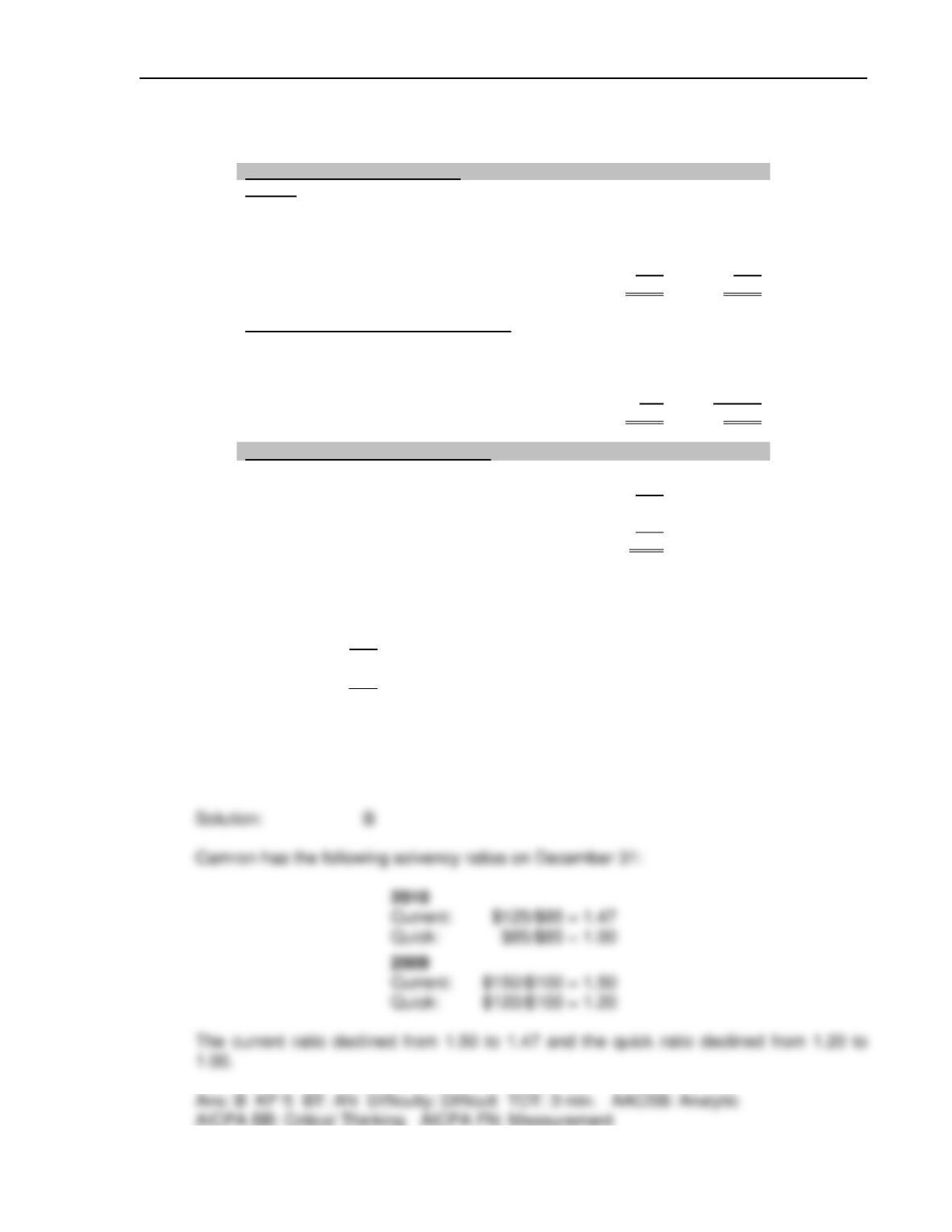
Use the information that follows taken from Camron Company’s financial statements for the
years ending December 31, 2010 and 2009 to answer problems 19 through 23.
Balance Sheet Information
2010
2009
Assets
Cash
$ 25
$ 50
Accounts receivable
60
70
Inventory
40
30
Land, building, and equipment
225
250
Total Assets
$350
$400
Liabilities and Shareholders’ Equity
Accounts payable
$ 85
$ 100
Long term note payable
180
200
Common stock
150
150
Retained earnings
–65
–50
Total Liabilities & Shareholders’ Equity
$350
$400
Income Statement Information
Sales (all sales are on credit)
$850
Cost of goods sold
425
Gross profit
$425
Operating expenses
440
Net income
$-15
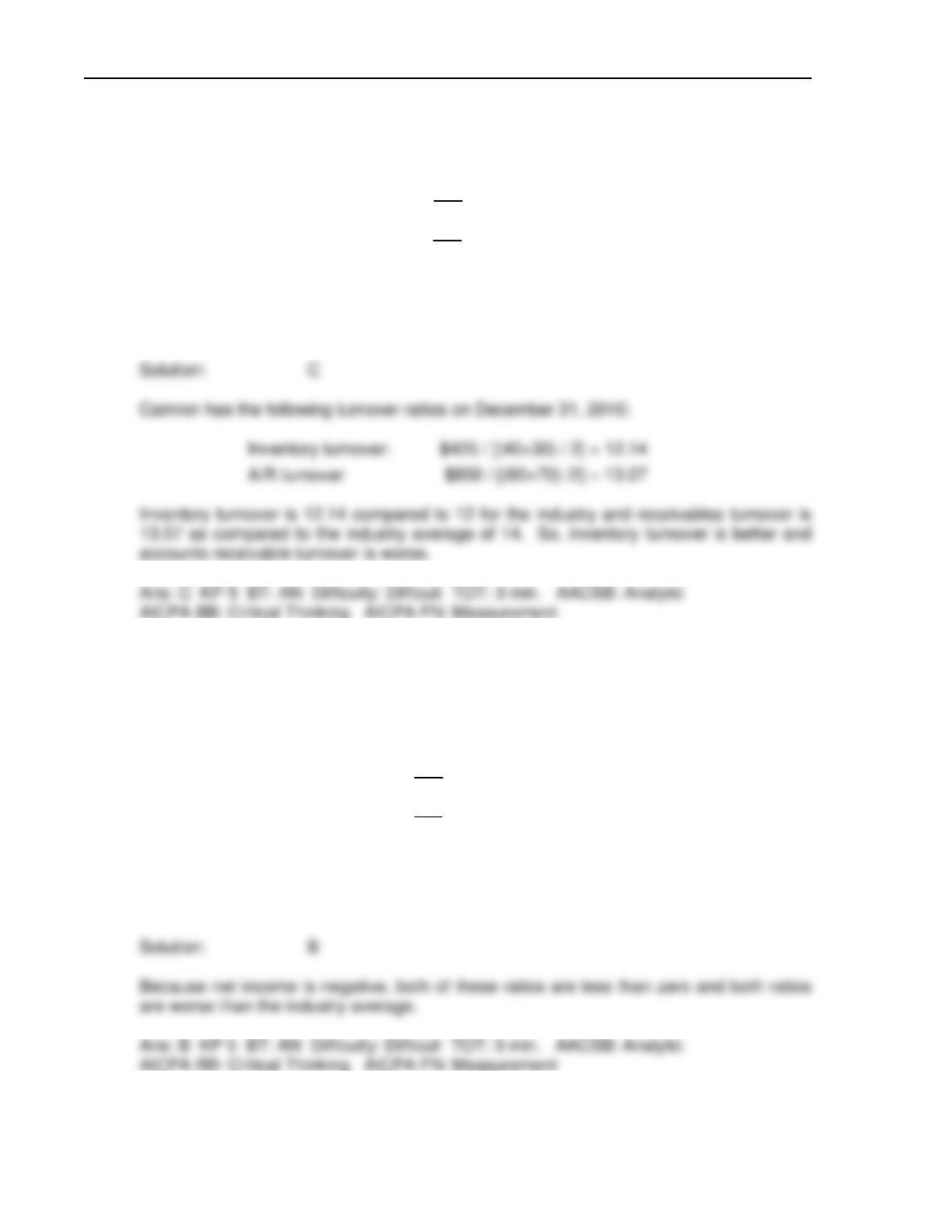
19. Calculate Camron’s current and quick ratios as of December 31, 2009 and December
31, 2010 and choose the correct answers below:
a. Camron’s quick and current ratios improved from December 31, 2009 to December
31, 2010.
b. Camron’s quick and current ratios worsened from December 31, 2009 to December
31, 2010.
c. Camron’s quick ratio improved but the current ratio worsened December 31, 2009 to
December 31, 2010.
d. Camron’s quick ratio worsened but the current ratio improved from December 31,
2009 to December 31, 2010.
Quick:
Current:
Quick:
4-6 Test Bank – Chapter4 – Using Financial Statements to Analyze Value Creation
20. Calculate Camron’s inventory turnover ratio and accounts receivable turnover ratio for
the year ended 2010. Further, assume that in Camron’s industry, the industry average
inventory turnover ratio is 12 and the industry average receivables turnover ratio is 14.
a. Camron’s inventory turnover ratio and accounts receivable turnover ratios are better
than average for Camron’s industry.
b. Camron’s inventory turnover ratio and accounts receivable turnover ratios are worse
than average for Camron’s industry.
c. Camron’s inventory turnover ratio is better but the accounts receivable turnover
ratio is worse than average for Camron’s industry.
d. Camron’s inventory turnover ratio is worse and accounts receivable turnover ratio is
better than average for Camron’s industry.
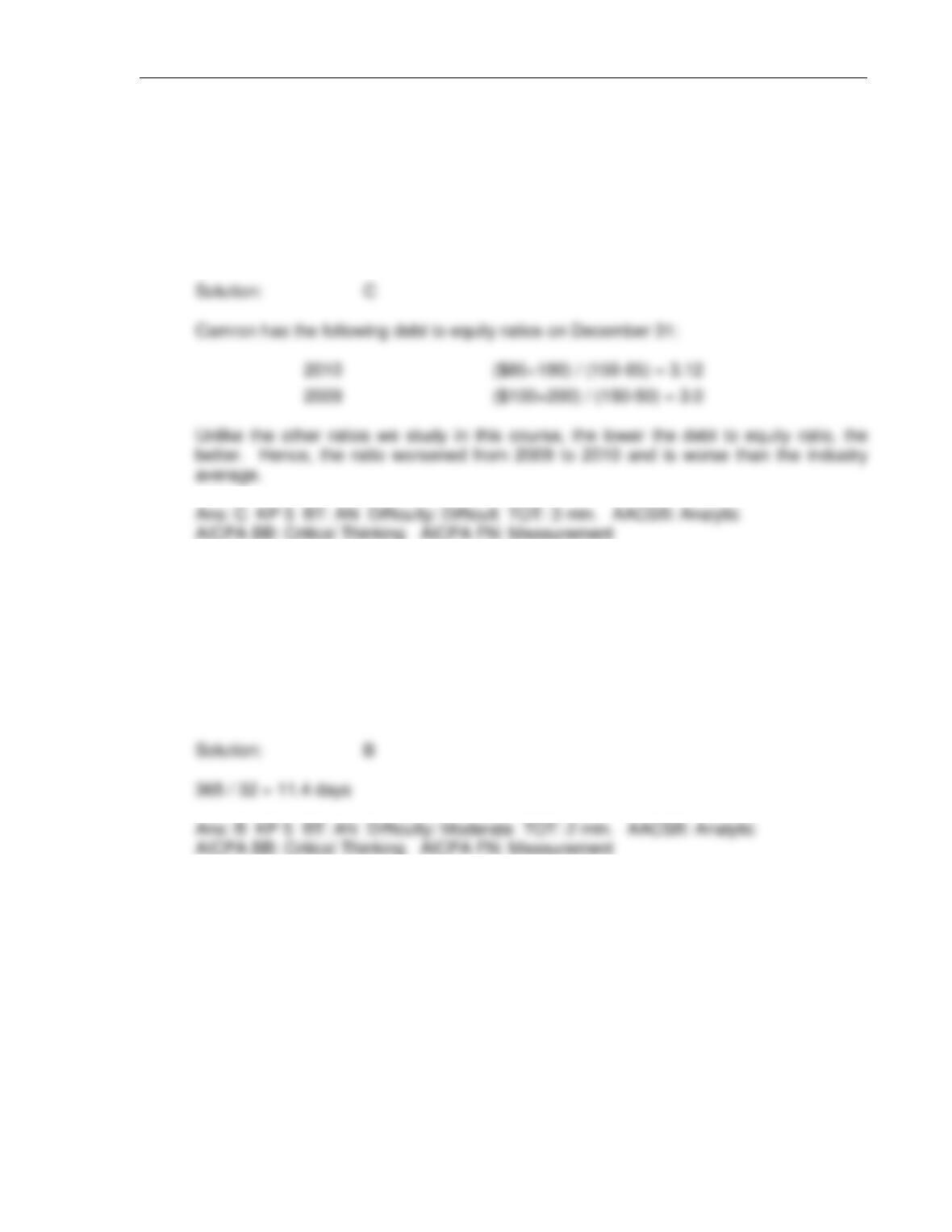
21. Calculate Camron’s return on equity and return on assets for the year ended December
31, 2010. Assume that the income tax rate is 30%. Also assume that in Camron’s
industry, the industry average return on equity is 19% and the average return on assets
is 11%.
a. Camron’s return on equity and return on assets are better than average for
Camron’s industry.
b. Camron’s return on equity and return on assets are worse than average for
Camron’s industry.
c. Camron’s return on equity is better but return on assets is worse than average for
Camron’s industry.
d. Camron’s return on equity is worse but return on assets is better than average for
Camron’s industry.
Test Bank – Chapter 4 – Using Financial Statements to Analyze Value Creation 4-7
22. Calculate Camron’s debt to equity ratio as of December 31, 2009 and as of December
31, 2010. Also assume that in Camron’s industry, the industry average debt to equity
ratio is 2.75 as of December 31, 2009 and as of December 31, 2010.
a. Camron’s debt to equity ratio improved from 2009 to 2010.
b. Camron’s debt to equity ratio was better than average for the industry both years.
c. Camron’s debt to equity is worse than average for the industry for both years.
d. Both a and b above, but not c.
23. Carina Inc. has an inventory turnover ratio of 32. Carina’s average number of day’s
inventory is:
a. Less than 10.
b. Between 10 and 12.
c. More than 12.
d. Unable to be determined based on this limited information.
4-8 Test Bank – Chapter4 – Using Financial Statements to Analyze Value Creation
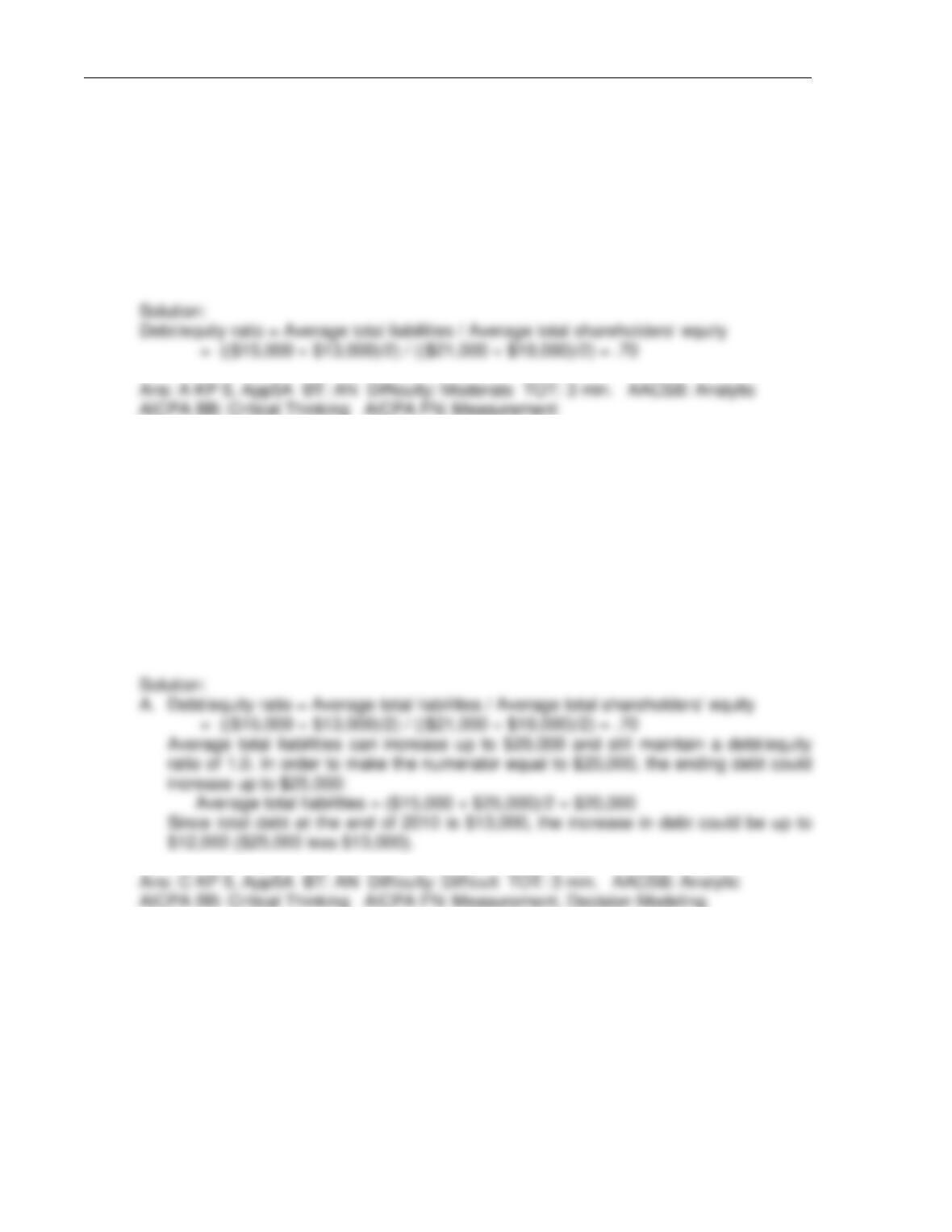
24. Timberlake Company has total assets, liabilities, and shareholders’ equity of $28,000,
$15,000, and $21,000, respectively, at the beginning of 2010. At the end of 2010, total
assets, liabilities, and shareholders’ equity were reported at $24,000, $13,000, and
$19,000, respectively. What is Timberlake’s debt to equity ratio?
a. 0.70
b. 1.17
c. 0.71
d. 1.13
25. Timberlake Company has total assets, liabilities, and shareholders‘ equity of $28,000,
$15,000, and $21,000, respectively, at the beginning of 2010. At the end of 2010, total
assets, liabilities, and shareholders’ equity were reported at $24,000, $13,000, and
$19,000, respectively. How much additional debt can Timberlake Company incur and
still have its debt/equity ratio remain less than or equal to 1.00?
a. $6,000
b. $25,000
c. $12,000
d. $24,000
Test Bank – Chapter 4 – Using Financial Statements to Analyze Value Creation 4-9
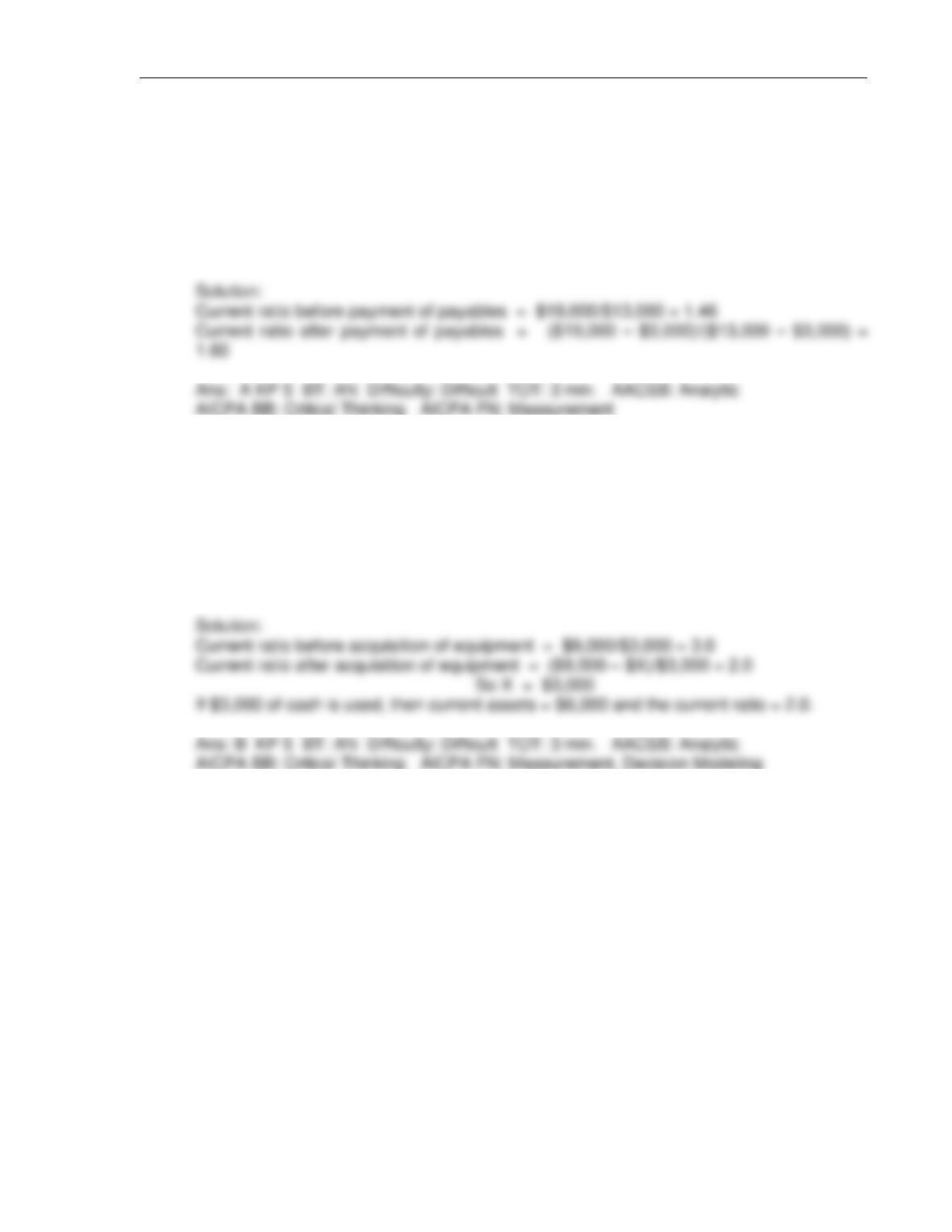
26. Fowler Company has current assets, current liabilities, and long-term liabilities of
$19,000, $13,000, and $17,000, respectively. Within these amounts, $3,000 is accounts
payable, and $3,500 is accounts receivable. If $3,000 of cash were used to pay off the
accounts payable, what effect would this have on the current ratio?
a. The current ratio would increase by approximately 0.14.
b. The current ratio would decrease by approximately 0.14.
c. The current ratio would decrease by approximately 0.07.
d. There would be no change in the current ratio.
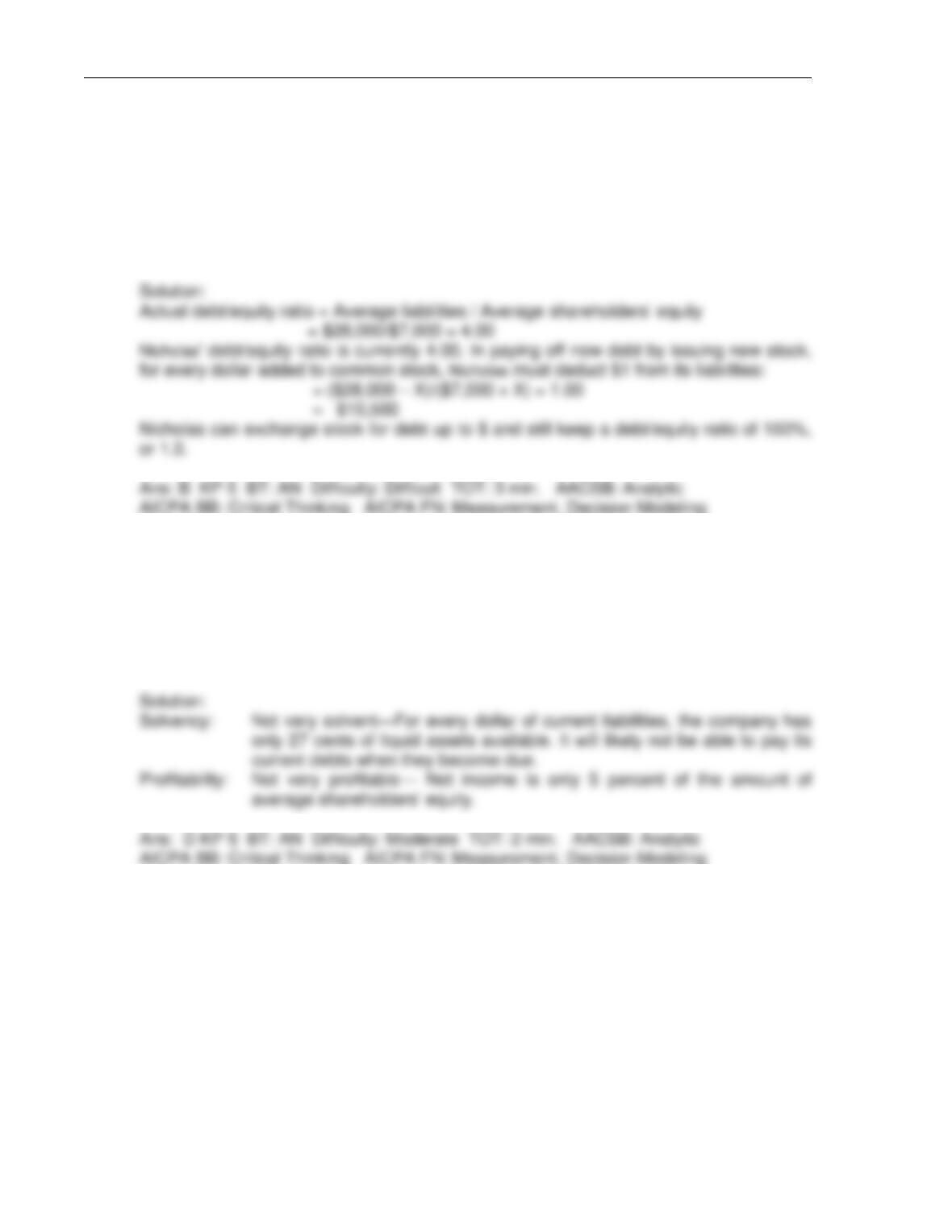
27. Detroit Company has current assets, current liabilities, and long-term liabilities of $9,000,
$3,000, and $5,000, respectively at the end of 2010. How much cash can Detroit use to
acquire equipment and retain a current ratio of at least 2.0?
a. $1,000
b. $3,000
c. $4,000
d. $6,000
4-10 Test Bank – Chapter4 – Using Financial Statements to Analyze Value Creation
28. Nicholas Company has total assets, liabilities, and shareholders‘ equity of $35,000,
$28,000, and $7,000, respectively. Assume no material change occurred during the year
to totals on the balance sheet. What amount of long-term debt must Nicholas exchange
for new shares of common stock issued in order to decrease its debt/equity ratio to 1.0?
a. $17,500
b. $10,500
c. $14,000
d. $21,000
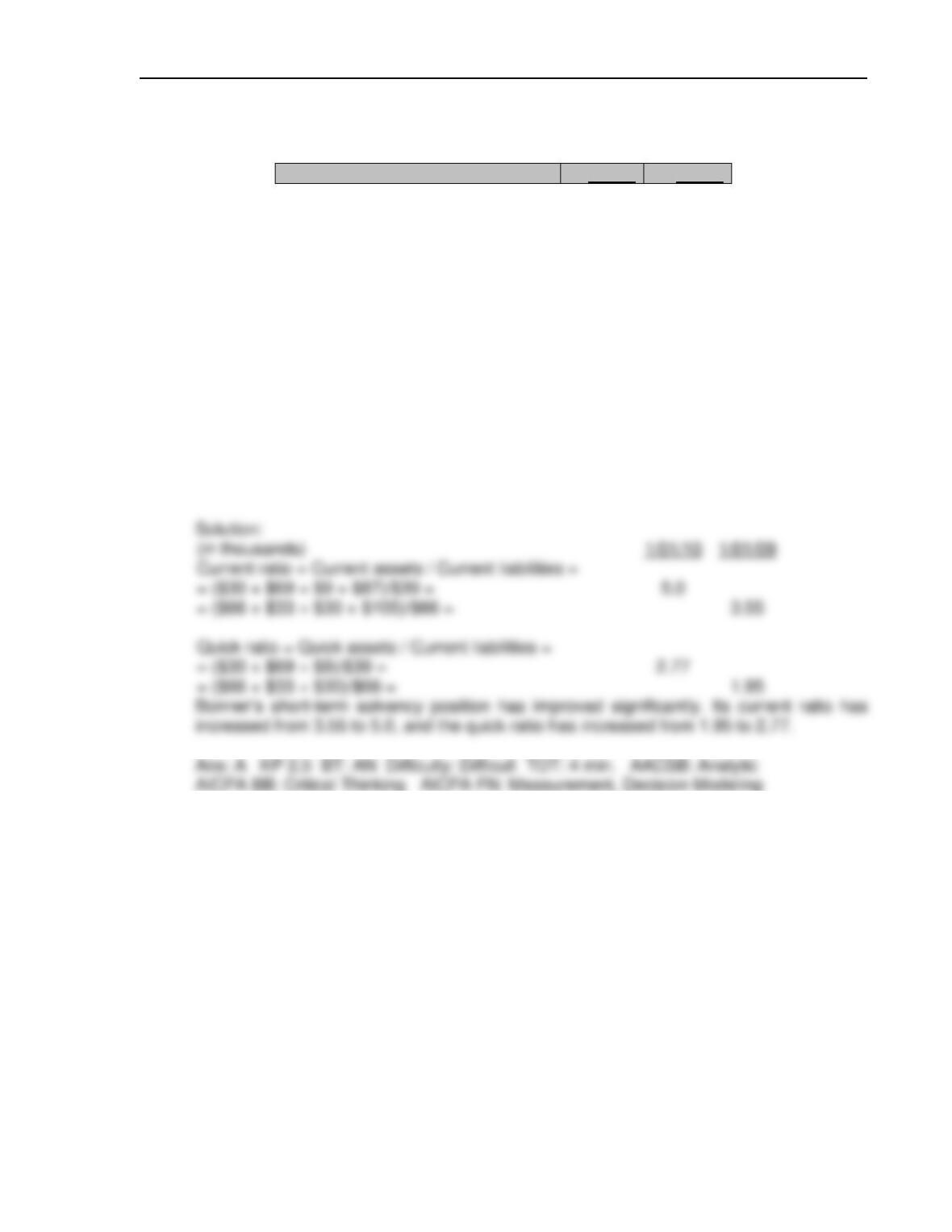
29. Dorian Company has a current ratio of 0.27 and return on equity of 0.05. Which of the
following statements is the best regarding Dorian’s profitability and solvency?
a. Dorian is very profitable, but not very solvent.
b. Dorian is very profitable and very solvent.
c. Dorian is not very profitable, but very solvent.
d. Dorian is not very profitable and not very solvent.
Test Bank – Chapter 4 – Using Financial Statements to Analyze Value Creation 4-11
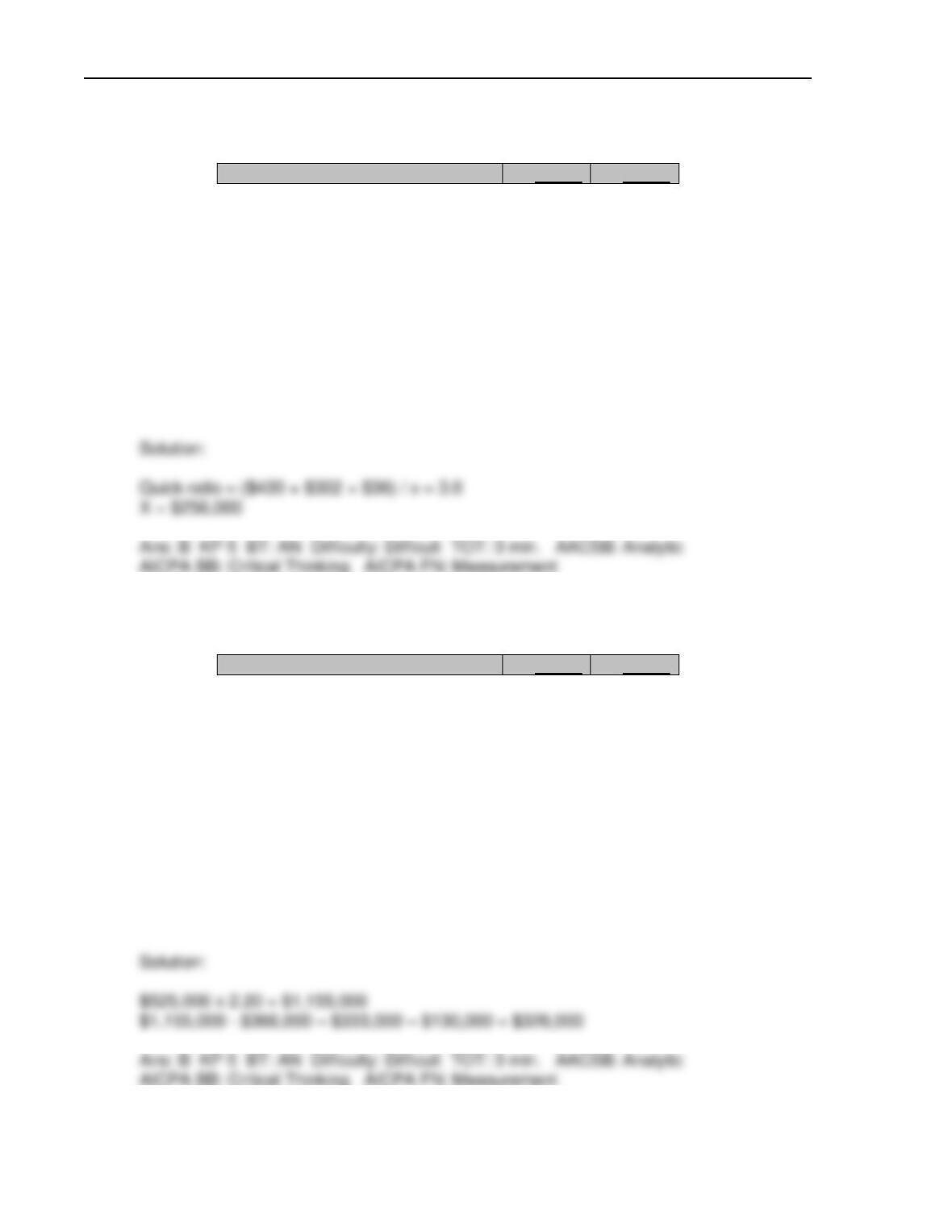
30. Bonner Company has the following financial data on January 1, 2010 and January 1,
2009.
1/1/10
1/1/09
Cash
$30,000
$66,000
Accounts receivable
69,000
33,000
Marketable securities
9,000
30,000
Inventory
87,000
105,000
Net plant and equipment
120,000
96,000
Current liabilities
$39,000
$66,000
Long-term debt
147,000
90,000
Shareholders’ equity
131,000
174,000
In terms of the quick and current ratio, which of the following statements is true?
a. Bonner’s short-term solvency position has improved.
b. Bonner’s short-term solvency position has declined.
c. Bonner’s short-term solvency position has remained the same
d. Bonner’s quick ratio is increasing, but its current ratio is decreasing.
(in thousands)
1/01/10
1/01/09
Current ratio = Current assets / Current liabilities =
= ($30 + $69 + $9 + $87)/$39 =
= ($66 + $33 + $30 + $105)/$66 =
Quick ratio = Quick assets / Current liabilities =
= ($30 + $69 + $9)/$39 =
= ($66 + $33 + $30)/$66 =
4-12 Test Bank – Chapter4 – Using Financial Statements to Analyze Value Creation
31. Egan Company has the following assets on January 1, 2010 and January 1, 2009.
1/1/10
1/1/09
Cash
$430,000
$366,000
Accounts receivable
302,000
333,000
Marketable securities
36,000
30,000
Inventory
87,000
105,000
Net plant and equipment
120,000
96,000
If Egan’s quick ratio is 3.00 for 2010, what is the amount of its current liabilities?
a. $325,000
b. $256,000
c. $285,000
d. There is not enough information to answer this question.
32. Norton Company has the following assets on January 1, 2010 and January 1, 2009.
1/1/10
1/1/09
Cash
$430,000
$366,000
Accounts receivables
?
333,000
Marketable securities
36,000
130,000
Inventory
220,000
?
Net plant and equipment
120,000
129,000
If Norton’s current ratio is 2.20 for 2009 and its current liabilities are $525,000, what is
the amount of its inventory?
a. $197,000
b. $326,000
c. $238,636
d. There is not enough information to answer this question.
Test Bank – Chapter 4 – Using Financial Statements to Analyze Value Creation 4-13
33. Norton Company has the following assets on January 1, 2010 and January 1, 2009.
1/1/10
1/1/09
Cash
$430,000
$366,000
Accounts receivables
?
333,000
Marketable securities
186,000
130,000
Inventory
220,000
?
Net plant and equipment
120,000
129,000
If Norton’s quick ratio is 2.50 for 2010 and its current liabilities are $512,000, what is the
amount of its accounts receivables?
a. $324,000
b. $204,800
c. $664,000
d. There is not enough information to answer this question.
34. The following ratios were computed from the financial statement of Carlos Technologies:
2011
2010
2009
Return on equity
0.30
0.27
0.24
Return on assets
0.17
0.20
0.22
Common equity leverage
0.87
0.90
0.92
Capital structure leverage
2.22
1.60
1.24
Profit margin
0.11
0.10
0.09
Asset turnover
1.69
2.27
2.87
Which of the following statements is true?
a. There has been a steady decline in ROE from 2009 through 2011.
b. The increase in ROA is due primarily to the changes in asset turnover.
c. The changes in ROA could be due to increasing sales.
d. The change in ROA could be due to a large increase in the asset base of the
company.
4-14 Test Bank – Chapter4 – Using Financial Statements to Analyze Value Creation
35. Assume that the following financial ratios were computed from the 2009 financial
statements of Carolina Industries:
Return on sales (profit margin)
0.30
Return on assets
0.17
Common equity leverage
0.87
Capital structure leverage
2.22
Asset turnover
1.69
What was the return on equity for Carolina in 2009?
a. 4%
b. 33%
c. 51%
d. 11%
36. Assume that the following financial ratios were computed from the 2009 financial
statements of Carolina Industries:
Return on sales (profit margin)
0.30
Return on assets
0.17
Common equity leverage
0.87
Capital structure leverage
2.22
Asset turnover
1.69
If Carolina holds its other ratios constant in 2010, but increases its capital structure
leverage ratio to 3.00, what will be the 2010 return on equity?
a. 15%
b. 51%
c. 86%
d. 44%