Chapter 4
The Mechanics of Financial Accounting
MULTIPLE CHOICE QUESTIONS
1. An event for which an appropriate monetary measure can be derived is considered to be
a. objectively measured.
b. economically viable.
c. relevant.
d. capitalized.
2. An event that affects assets, liabilities, or shareholders’ equity is considered to be
a. timely.
b. objectively measured.
c. relevant.
d. capitalized.
3. If an event is considered to change assets, liabilities, or shareholders’ equity with an
appropriate monetary measure, then it is
a. considered a financial changing event.
b. listed on the U.S. stock exchange.
c. considered a debt or payable of a company.
d. recorded in the books of a company.
4. Which of the following is not one of the sources of assets?
a. They are borrowed.
b. They are contributed by shareholders.
c. They are paid to shareholders as dividends.
d. They are generated by the company’s profitable operating activities.
4-2 Test Bank – Chapter 4 – The Mechanics of Financial Accounting
5. Which one of the following changes describes the receipt of $3,000 from the issuance of
common stock?
a. Assets and shareholders’ equity increase by $3,000.
b. Assets and shareholders’ equity decrease by $3,000.
c. Assets and liabilities increase by $3,000.
d. Assets increase and shareholders’ equity decreases by $3,000.
6. A revenue account
a. is increased with a debit.
b. is not considered to be an item on the income statement.
c. is reported on the balance sheet at the end of the accounting period.
d. when offset with expenses ultimately leads to net income and an increase to retained
earnings.
7. The declaration of dividends
a. increases with a credit.
b. decreases retained earnings.
c. is necessary for proprietorships.
d. is an expense account on the income statement.
8. Which one of the following changes describes the receipt of $4,000 from the issuance of
a long-term note payable?
a. Assets and shareholders’ equity increase by $4,000.
b. Assets and shareholders’ equity decrease by $4,000.
c. Assets and liabilities increase by $4,000.
d. Assets and liabilities decrease by $4,000.
9. Which of the following changes describes the purchase of $3,000 of inventory on credit?
a. Assets and shareholders’ equity increase by $3,000.
b. Assets and shareholders’ equity decrease by $3,000.
c. Assets and liabilities increase by $3,000.
d. Assets and liabilities decrease by $3,000.
Test Bank – Chapter 4 – The Mechanics of Financial Accounting 4-3
10. Providing $5,000 of services to customers on account causes
a. assets and shareholders’ equity to decrease by $5,000.
b. assets and shareholders’ equity to increase by $5,000.
c. assets and liabilities to increase by $5,000.
d. assets and liabilities to decrease by $5,000.
11. Which of the following changes describes the payment of $2,000 for cash dividends?
a. Assets and shareholders’ equity increase by $2,000.
b. Assets and shareholders’ equity decrease by $2,000.
c. Assets and liabilities increase by $2,000.
d. Assets and liabilities do not change.
12. Which of the following changes describes the purchase of $4,000 of equipment financed
by the issuance of a long-term note payable?
a. Assets and shareholders’ equity increase by $4,000.
b. Assets and shareholders’ equity decrease by $4,000.
c. Assets and liabilities decrease by $4,000.
d. Assets and liabilities increase by $4,000.
13. Acacia Company provided landscaping services and received $3,000 from customers
immediately. Which of the following occurred?
a. Assets and shareholders’ equity increase by $3,000.
b. Assets and shareholders’ equity decrease by $3,000.
c. Assets and liabilities increase by $3,000.
d. Assets and liabilities decrease by $3,000.
14. Lakesha Corp. purchased $3,000 of supplies on account. The supplies will be used over
the next few months. This event causes
a. assets and shareholders’ equity to increase by $3,000.
b. assets and shareholders’ equity to decrease by $3,000.
c. assets and expenses to decrease by $3,000.
d. assets and liabilities to increase by $3,000.
4-4 Test Bank – Chapter 4 – The Mechanics of Financial Accounting
15. Which one of the following changes describes the payment of $900 for utilities for the
current month?
a. Assets and shareholders’ equity decrease by $900.
b. Assets and shareholders’ equity don’t change.
c. Assets and liabilities increase by $900.
d. Assets and liabilities decrease by $900.
16. Which of the following changes describes the payment of $30,000 for a new bulldozer?
a. Assets and shareholders’ equity decrease by $30,000.
b. Assets decrease and shareholders’ equity increases by $30,000.
c. No net change in total assets.
d. Assets decrease by $30,000.
17. Which of the following changes describes the collection of $7,000 from customers who
had been charged on account for services performed during a previous accounting
period?
a. Assets and shareholders’ equity increase by $7,000.
b. Assets and liabilities increase by $7,000.
c. Assets and liabilities decrease by $7,000.
d. No changes in total assets, liabilities, or shareholders’ equity.
18. A year-end cash balance is shown on which of the following financial statements?
a. Statement of cash flows only.
b. Balance sheet, income statement, and statement of cash flows.
c. Balance sheet and statement of cash flows.
d. Balance sheet, statement of shareholders’ equity, and statement of cash flows.
19. An expense account
a. is increased with a credit.
b. ultimately decreases shareholders’ equity.
c. appears on the balance sheet at the end of the accounting period.
d. is not an income statement account.

Test Bank – Chapter 4 – The Mechanics of Financial Accounting 4-5
4-6 Test Bank – Chapter 4 – The Mechanics of Financial Accounting
20. All of the following statements are true except:
a. All economic events recorded in financial statements must be relevant.
b. All economic events recorded in financial statements must affect liabilities.
c. All economic events recorded in financial statements must be objectively measurable
in monetary terms.
d. All economic events recorded in financial statements must maintain the equality of
the accounting equation.
21. If the balance sheet is in balance,
a. assets must equal liabilities.
b. assets must exceed liabilities.
c. transactions recorded must be correctly recorded.
d. errors may still exist.
22. Items and rights that a company acquires through objectively measurable transactions
that can be used in the future to generate economic benefits are
a. liabilities.
b. assets.
c. contributing capital.
d. revenues.
23. Shareholders’ equity increases because of two primary reasons, which are the
a. sale of stock and the earning of income.
b. earning of income and the payment of dividends.
c. payment of dividends and payment of expenses.
d. collection of cash from customers and the payment of expenses to creditors.
24. Subdivisions of assets, liabilities, and shareholders’ equity are called
a. revenues.
b. accounts.
c. contributed capital.
d. journals.
Test Bank – Chapter 4 – The Mechanics of Financial Accounting 4-7
25. Which of the following sets of accounts consists of temporary accounts?
a. Interest Expense, Interest Payable, Interest Receivable
b. Unearned Revenue, Sales Revenue, Interest Revenue
c. Interest Expense, Rent Revenue, Dividends
d. Retained Earnings, Sales Revenue, Unearned Revenue
26. The statement of cash flows provides information about
a. operating activities.
b. financing activities.
c. investing activities.
d. all of the above.
27. The statement of shareholders’ equity is a record of activity over a period of time of the
a. contributed capital accounts.
b. retained earnings account.
c. dividends account.
d. both contributed capital accounts and the retained earning account.
28. Closing entries result in net income being transferred to
a. a revenue account.
b. the cash account.
b. the contributed capital account.
d. the retained earnings account.
29. Which of the following debits and credits describes the payment of interest and principal
on a loan?
a. Debit an asset and credit a liability
b. Debit an asset, debit an expense, and debit a liability
c. Credit an asset, debit an expense, and debit a liability
d. Credit an asset and debit a liability
4-8 Test Bank – Chapter 4 – The Mechanics of Financial Accounting
30. Favre Company paid for insurance in advance. Which transaction will Favre record?
a. Debit Cash and credit Insurance Expense.
b. Debit Prepaid Insurance and credit Cash.
c. Debit Prepaid Insurance and credit Accounts Payable.
d. Debit Cash and Credit Prepaid Insurance.
31. Gilbert Company purchased equipment financed by the issuance of a 4-year note
payable. To record this, Gilbert will
a. debit assets and credit shareholders’ equity.
b. debit shareholders’ equity and credit liabilities.
c. debit assets and credit liabilities.
d. debit liabilities and credit assets.
32. Goodyear Co. purchased $5,000 of equipment with a $5,000 cash payment. Goodyear
Co. should
a. debit one asset and credit another asset for $5,000.
b. debit shareholders’ equity and credit assets for $5,000.
c. debit assets and credit liabilities for $5,000.
d. Record no entry.
33. During April, Tempe Corp. paid $5,000 on account for supplies that were purchased,
recorded, and used during March. In recording this transaction, Tempe will
a. debit Accounts Payable and credit Cash.
b. debit Cost of Goods Sold and credit Accounts Payable.
c. debit Supplies Expense and credit Accounts Payable.
d. accrue an expense of $5,000.
34. Scottsdale Corp. received several invoices in the mail for oil changes performed on its
company trucks during the last week of April. The total of the invoices was $900 and all
are due on May 13. What entry should Scottsdale make at April 30 as a result of
receiving the invoices?
a. Debit Accounts Receivable and credit Cash for $900.
b. Debit Maintenance and Repairs Expense and credit Accounts Payable for $900.
c. Debit Maintenance and Repairs Expense and credit Cash for $900.
d. Debit Prepaid Expenses and credit Cash for $900.

Test Bank – Chapter 4 – The Mechanics of Financial Accounting 4-9
4-10 Test Bank – Chapter 4 – The Mechanics of Financial Accounting
35. Dobson Company sold stock for cash and received cash for services performed during
the current month. Which of the following summarizes the income statement impact of
these transactions for the current month?
a. Both the sale of stock and the performance of services increased revenues for the
company.
b. Only the performance of services caused an increase in revenues.
c. Only the performance of services caused a decrease in revenues.
d. Only the sale of stock caused revenues to increase.
36. A company sold vacant land that it had owned for three years. The difference between
the amount of cash receipts and the original cost of land owned by the company
a. is reported as a revenue or expense on the income statement.
b. represents the amount of gain or loss associated with the asset sold.
c. represents the amount of cash associated with the asset sold.
d. should be debited or credited directly to retained earnings.
37. Vera Company, which prepares monthly financial statements, acquired a new forklift in
exchange for signing a 6-month, 10%, $20,000 note dated May 1, 2018. Vera agreed to
repay the entire principal at the end of the 6-month period. Vera should:
a. record one month of interest expense only if the forklift runs as intended.
b. record all 6 months of expense when the interest is paid.
c. accrue one month of interest expense at May 31, 2018.
d. record the interest payments as prepaid interest when paid.
38. Alberto Company paid its insurance premiums for a two-year insurance policy on May 1,
2018, and recorded them in a prepaid insurance account. The adjusting entry required at
May 31, 2018, to recognize the one-month portion for the month of May will
a. increase an expense account and increase a liability account.
b. increase an expense account and decrease an asset account.
c. increase an asset account and decrease an expense account.
d. increase a revenue account and decrease an asset account.
Test Bank – Chapter 4 – The Mechanics of Financial Accounting 4-11
39. On May 31, 2018, the physical count of supplies was $2,400. During June, supplies
were acquired at a cost of $1,600 and the company debited Supplies Expense. At June
30, actual supplies on hand totaled $500. The credit part of the adjusting entry required
at the end of June is
a. Supplies Expense of $1,900.
b. Supplies of $1,900.
c. Supplies Expense of $2,400.
d. Supplies of $500.
Solution: $2,400 − $500 = $1,900
40. When making adjustments to plant asset accounts,
a. the total dollar amount in the accumulated depreciation account will determine the
amount of depreciation expense for the current accounting period.
b. depreciation expense is added to the plant asset account.
c. depreciation expense reduces net income.
d. the current market value of the long-lived asset determines the amount of
depreciation expense.
41. Temporary accounts
a. begin with a new balance each period.
b. have balances that accumulate from one period to the next.
c. are reported on the balance sheet.
d. are never reported on the statement of shareholders’ equity.
42. Which of the following describes the receipt of $6,000 from the issuance of common
stock?
a. Debit liabilities and credit sharholders’ equity
b. Debit shareholders’ equity and credit assets for $6,000
c. Debit assets and credit shareholders’ equity for $6,000
d. Debit liabilities and credit assets for $6,000
4-12 Test Bank – Chapter 4 – The Mechanics of Financial Accounting
43. Buckeye Company received $2,000 from customers for services provided during the
current month. Buckeye will
a. debit liabilities and credit revenue for $2,000.
b. debit revenue and credit assets for $2,000.
c. debit assets and credit revenue for $2,000.
d. debit liabilities and credit assets for $2,000.
44. An asset account
a. has a debit balance.
b. is increased with a credit.
c. is a shareholders’ equity account because it has a book value.
d. will have a negative balance if the company’s expenses exceed revenues for the
period.
45. Recognition of a gain or loss may result from
a. the sale of goods to customers on account.
b. the sale of a company’s common stock to an investor.
c. the sale of a non-current asset.
d. the revenue recognition process associated with selling products to customers.
46. Which one of the following transactions will ultimately cause a decrease in Retained
Earnings?
a. Payment of the current month’s telephone bill
b. Collection of cash from a customer for services provided in the current month
c. Payment of the prior month’s Account Payable balance
d. Receipt of interest on a note receivable
47. Which one of the following is a characteristic of the double entry system?
a. For every debit in every account, there must be a corresponding credit of the same
dollar amount in the same account.
b. The total dollar value of debits and credits must equal the total value of assets and
liabilities.
c. For every asset recorded in the accounting records, there must be a corresponding
liability of the same dollar amount.
d. The total dollar amount of debits must equal the total dollar amount of the credits.
Test Bank – Chapter 4 – The Mechanics of Financial Accounting 4-13
48. Journal entries are used to indicate how
a. much profit was earned during the accounting period.
b. events affect the retained earnings account.
c. events affect the accounting equation.
d. much dividends were paid to shareholders.
49. The biggest distinction between accruals and deferrals is
a. one emphasizes conservatism while the other promotes aggressive accounting
positions.
b. how long a company must wait until the collection of cash occurs.
c. with accruals, no record of the activity has been made prior to the adjustment
process, and with deferrals, the activity has already been recorded in the accounting
records, but the proper amount of revenue or expense has not been recognized.
d. adjustments are necessary for accruals, whereas, adjustments are not necessary for
deferrals.
50. What effect does recognizing accrued wages expense at the end of the accounting
period have on the accounting equation?
a. Assets decrease and shareholders’ equity decreases.
b. Liabilities increase and shareholders’ equity decreases.
c. Assets decrease and liabilities decrease.
d. Liabilities decrease and shareholders’ equity decreases.
51. What effect does recognizing revenue at the end of the accounting period for rent
received in advance have on the accounting equation?
a. Revenues increase and liabilities decrease.
b. Assets increase and shareholders’ equity increases.
c. Revenues decrease and liabilities decrease.
d. Liabilities increase and revenues decrease.
4-14 Test Bank – Chapter 4 – The Mechanics of Financial Accounting
52. A multinational is
a. a company that prepares accruals and deferrals throughout the year as well as
yearend.
b. a corporation that has no home country due to operations in several countries.
c. a corporation that has its home in one country but operates under the laws of other
countries as well.
d. a type of adjusting entry necessary for companies that trade with corporations in
other countries.
53. A company has a 4-month, 11%, $20,000 Notes Payable account in its general ledger at
the end of the year. The note matures two months after the end of the accounting period.
Which statement is true?
a. Interest revenue must be accrued at the end of the accounting period.
b. The notes payable would generate a gain if the note is paid off early.
c. The interest was paid when the cash was borrowed.
d. Interest expense must be accrued at the end of the accounting period.
54. When an adjusting entry that recognizes accrued interest revenue is recorded,
a. assets increase and liabilities increase.
b. shareholders’ equity increases and liabilities decrease.
c. assets decrease and liabilities decrease.
d. shareholders’ equity and assets increase.
55. The accounting concepts that underlie the accrual system of accounting are
a. debits and credits.
b. revenue recognition and matching.
c. revenue recognition and debits equal credits.
d. matching and deferrals.
56. Which one of the following statements is true?
a. Accruals are adjustments that are recorded prior to the associated cash flow taking
place.
b. Cash is used in the accrual process.
c. Accrual accounting recognizes revenues and expenses based on current period
cash flows.
d. Accrual accounting may use either two asset or two liability accounts.
Test Bank – Chapter 4 – The Mechanics of Financial Accounting 4-15
57. The main purpose of the adjusting process is
a. to remove the effects of all transactions recorded during the accounting period.
b. to make the account balances reflect the company’s true position according to the
guidelines of accrual accounting.
c. to get the accounting records ready for a new accounting period.
d. to identify the amount of cash available for dividends to be paid.
58. Which one of the following is a required characteristic of accruals and deferrals?
a. An asset or a liability will always be affected.
b. Cash is either increased or decreased as a result of recording an accrual or deferral.
c. Accruals record revenues, and expenses record deferrals.
d. An asset and an expense item will always be affected.
59. When an adjusting entry for depreciation expense for the accounting period is recorded,
a. assets and shareholders’ equity increase.
b. the amount of depreciation expense is subtracted from accumulated depreciation.
c. assets and shareholders’ equity decrease.
d. assets increase and shareholders’ equity decreases.
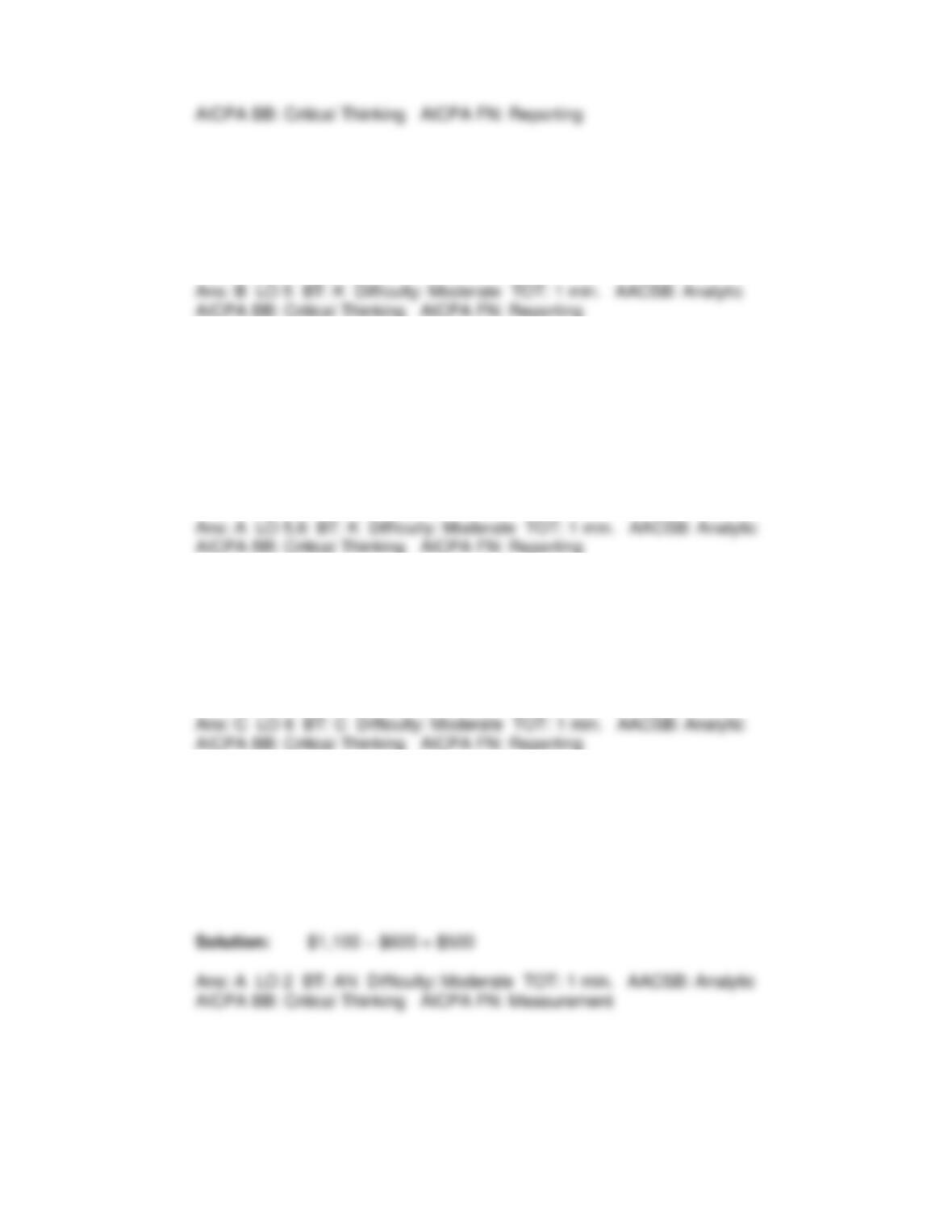
60. If assets are $1,100, liabilities are $600, and contributed capital is $200, then
shareholders’ equity is
a. $500.
b. $1,700.
c. $800.
d. $900.
4-16 Test Bank – Chapter 4 – The Mechanics of Financial Accounting
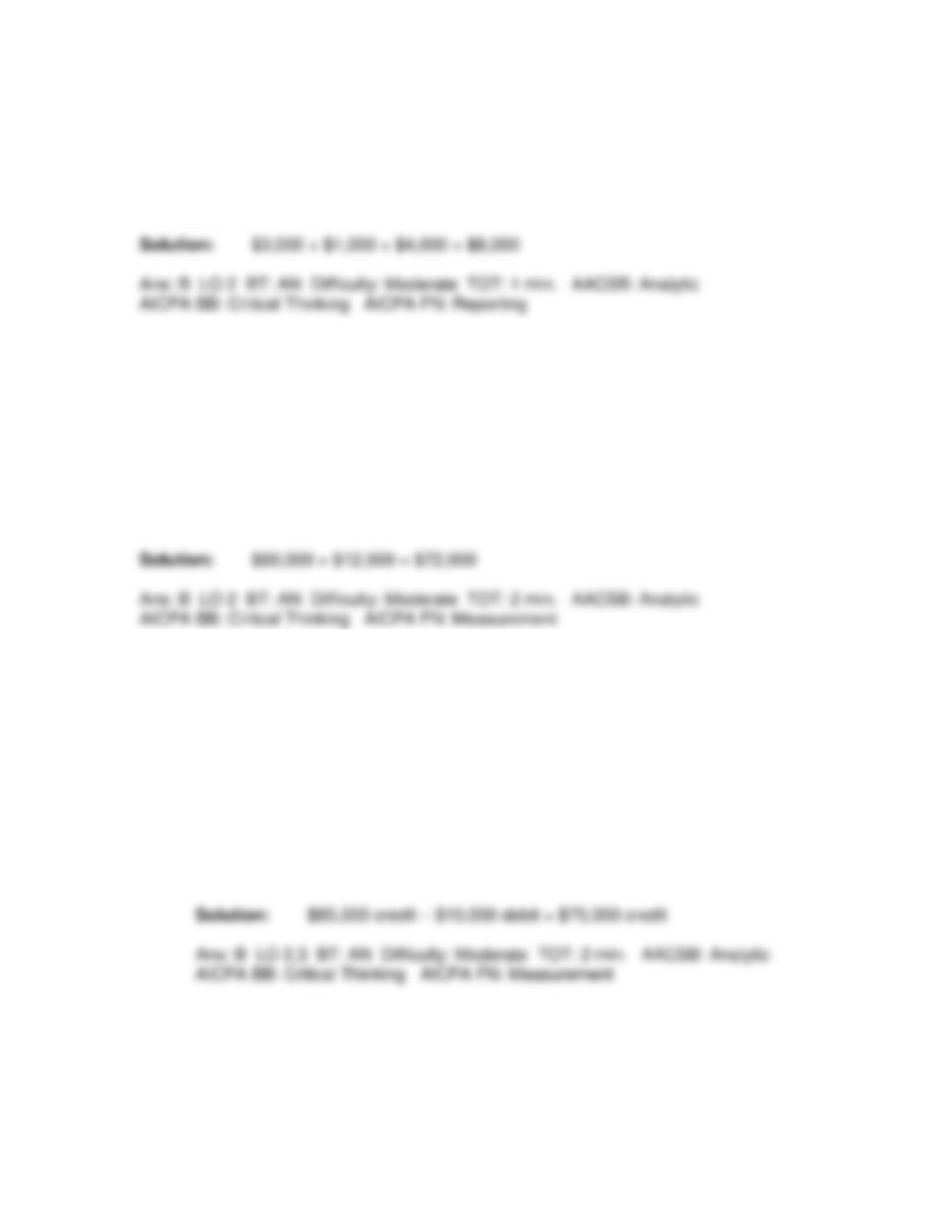
61. Liabilities are $3,000, retained earnings are $1,000, and contributed capital is $4,000.
Assets must be
a. $4,000.
b. $8,000.
c. $5,000.
d. $6,000.
62. On December 31, 2018, immediately after all the adjustments were made to Kingman
Corp’s accounting records for the 2018 fiscal year, but before the books were closed, the
retained earnings account reflected a balance of $60,000. Kingman Corp’s net income
for 2018 was $12,000. Kingman paid no dividends during 2018. On the balance sheet for
January 1, 2019, the balance in the retained earnings account will be
a. $0
b. $72,000
c. $38,000
d. $60,000
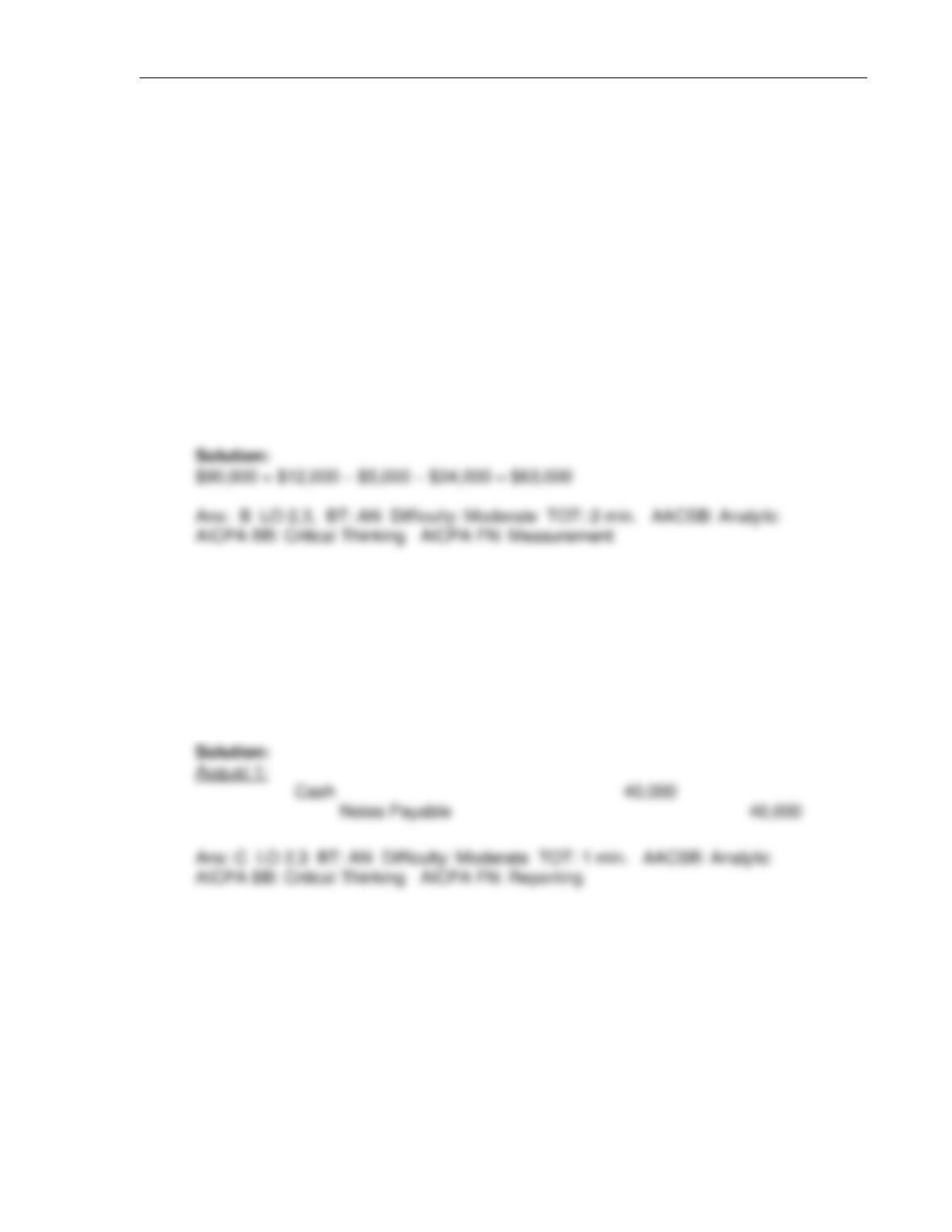
63. On December 31, 2018, immediately after all the adjustments were made to
Gilbert Inc.’s accounting records for the 2018 fiscal year, but before the books
were closed, the retained earnings account reflected a balance of $85,000. The
sum of the pre-closing balances of all of Gilbert’s temporary accounts was a net
debit balance of $10,000. Gilbert paid no dividends during 2018. On the balance
sheet for January 1, 2019, the balance in the retained earnings account will be
a. $0
b. $75,000 credit
c. $85,000 credit
d. $95,000 credit
Test Bank – Chapter 4 – The Mechanics of Financial Accounting 4-17
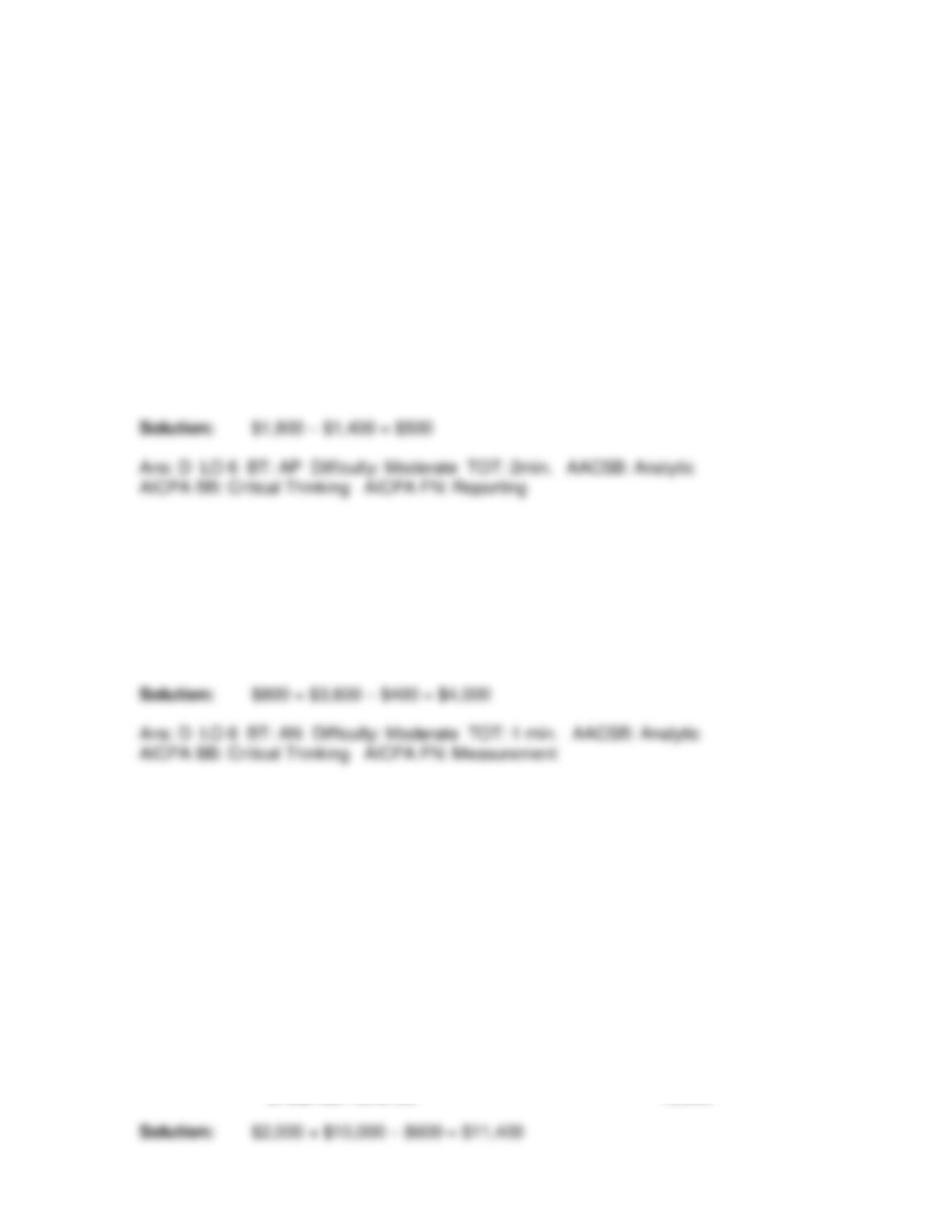
64. Meadville, Inc. began operations during 2018. During January of 2018, the following
transactions occurred:
• Received $95,000 from shareholders as initial investments
• Received cash of $90,000 for services performed during January
• Billed customers an additional $12,000 for services performed during January
• Borrowed $11,500 from Regions Bank Company, and signed a one-year note
payable
• Paid rent in the amount of $5,000 for January
• Paid dividends in January amounting to $8,000
• Paid wages equal to $34,000 for January
How much net income should Meadville, Inc. report for January?
a. $120,000
b. $63,000
c. $132,000
d. $52,000
65. On August 1, Amy Company borrowed $40,000 from another company on a 6%, one–
year note. The journal entry that Amy would record on August 1 would include which of
the following?
a. A debit to Notes Receivable for $40,000.
b. A credit to Cash for $40,000.
c. A credit to Notes Payable for $40,000.
d. A debit to Interest Expense for $2,400.
4-18 Test Bank – Chapter 4 – The Mechanics of Financial Accounting
66. The balance sheet reported supplies of $1,900 at December 31, 2018. On December 31,
2018, the actual supplies on hand amounted to $1,400. The adjusting entry required at
the end of December 31, 2018 is
a.
Supplies
1,900
Supplies Expense
1400
Cash
3,300
b.
Supplies Expense
1,900
Supplies
1,900
c.
Supplies
1,400
Supplies Expense
1,400
d.
Supplies Expense
500
Supplies
500
67. Marks Corp. purchased supplies at a cost of $3,600 during 2018. At January 1, 2018,
supplies on hand amounted to $800. At December 31, 2018, supplies on hand are $400.
Supplies expense for 2018 is
a. $2,200.
b. $3,200.
c. $2,600.
d. $4,000.
68. On December 13, 2018, Michael Company received $10,000 in cash as a payment in
advance from a customer and credited Unearned Revenue. The balance in the
Unearned Revenue account was $2,000 at the beginning of December. At the end of
December, all but $600 had been earned. What adjusting entry is necessary at the end
of December?
a.
Cash
10,000
Unearned Revenue
1,500
Service Revenue
11,500
b.
Unearned Revenue
10,600
Service Revenue
10,600
c.
Unearned Revenue
11,400
Service Revenue
11,400
d.
Service Revenue
10,000
Unearned Revenue
10,000
Test Bank – Chapter 4 – The Mechanics of Financial Accounting 4-19
69. On December 13, 2018, Tucson Corp. paid $12,000 for a two-year property insurance
policy covering their corporate headquarters for the period December 15, 2018 to
December 15, 2020. The payment was charged to insurance expense. What adjusting
entry is needed at the end of December?
a.
Cash
12,000
Prepaid Insurance
12,000
b.
Prepaid Insurance
11,750
Insurance Expense
11,750
c.
Insurance Expense
12,000
Cash
12,000
d.
Insurance Expense
11,750
Accounts Payable
11,750
70. On January 1, Salaries and Wages Payable for Flagstaff Company equals $19,000. By
the end of the current year, Wage Expense equals $345,000, and cash payments for
wages were $353,200. What is the balance in the T-account, Salaries and Wages
Payable, on December 31?
a. $17,500
b. $8,200
c. $25,700
d. $10,800
4-20 Test Bank – Chapter 4 – The Mechanics of Financial Accounting
71. On July 1, 2018, Erie Company rented a building from another company for $90,000 for
a three-year time period. Erie Company debited the rent expense account when the
payment was made. What adjustment for rent is necessary at December 31, 2018?
a. $30,000
b. $60,000
c. $75,000
d. $90,000
72. On August 1, Amy Company borrowed $40,000 from another company on a 6%, one-
year note. The journal entry on December 31 would include which of the following?
a. A debit to Notes Payable for $40,000.
b. A debit to Interest Receivable for $1,000.
c. A credit to Interest Payable for $2,400.
d. A debit to Interest Expense for $1,000.
73. If accounts receivable on January 1 totals $20,000, and during the current year sales
revenue is $112,000, and cash receipts from customers is $98,000, then what is the
balance in Accounts Receivable on December 31?
a. $13,000
b. $16,000
c. $34,000
d. $2,000