
Biology: A Guide to the Natural World, 5e (Krogh)
Chapter 36 An Interactive Living World 3: Ecosystems and Biomes
1) Which of the following is a biotic factor of an ecosystem?
A) soil minerals
B) water
C) oxygen
D) bacteria
2) What is the term for movement of water and nutrients between biotic and abiotic portions of
an ecosystem?
A) bio-cycling
B) biogeochemical cycling
C) decomposer-detrital cycling
D) energy cycling
3) One of the proposed solutions to global warming is to grow a large number of trees. This
could be effective because:
A) trees would move carbon from CO2 in the atmosphere to organic molecules.
B) the gross primary production of trees moves CO2 into soil.
C) plant carbon is different from atmospheric carbon.
D) when decomposed, plant carbon is impossible to convert back to CO2.
E) plants are the base of all ecological food chains.
4) CO2 makes up about ________ percent of the atmosphere.
A) 0.035
B) 0.35
C) 3.5
D) 35
E) 37

5) Photosynthesizers take in carbon dioxide, whereas decomposers ________ carbon dioxide.
A) yield up
B) take in
C) destroy
D) fix
6) Nitrogen gas in the atmosphere is converted to forms of nitrogen usable by vegetation via:
A) assimilation.
B) denitrification.
C) fixation.
D) nitrification.
E) decomposition.
7) Why have legumes been planted as a cover crop to improve the soil fertility of a field?
A) Legumes aid organic decomposition.
B) The leaves of legumes absorb more nitrogen than other plants.
C) Legumes need about 100 times less nitrogen than other plants.
D) Legumes have carbon-fixing bacteria in their root nodules.
E) Legumes have nitrogen-fixing bacteria in their root nodules.
8) What major agricultural innovation in the early twentieth century allowed for production of
far more food on arable land?
A) the discovery of crop rotation
B) use of fish as fertilizer
C) concentration of carbon fertilizer
D) industrial nitrogen fixation
E) genetically modified crops

9) Why are nitrogen and the nitrogen cycle important to living things?
A) Nitrogen is an essential part of all organic molecules.
B) Nitrogen is an essential part of proteins, RNA, and DNA.
C) Nitrogen is an important biotic component of ecosystems.
D) The release of nitrogen from fossil fuels counteracts global warming.
E) The release of nitrogen during cellular respiration contributes to global warming.
10) About how much of the atmosphere is composed of nitrogen?
A) 1 percent
B) 23 percent
C) 52 percent
D) 78 percent
11) What is the “downside” to extensive use of synthesized nitrogen-containing fertilizers?
A) The use of the fertilizers results in fertilizer resistance in crops.
B) The use of the fertilizers results in loss of a large percentage of crops to fertilizer burn every
year
C) Nitrogen-rich runoff contributes to algal blooms and dead zones in bodies of water.
D) The expense of the process makes food less affordable.
E) Synthesized nitrogen interferes with transport in some plants.
12) Which of the following was historically considered to be the biggest limiting factor in
worldwide food production up until the last century?
A) nitrogen
B) carbon
C) seed availability
D) land

13) Which of the following statements is true?
A) Glaciers make up about 20 percent of Earth’s freshwater pool.
B) An aquifer is a pool of freshwater perched over the base groundwater that is accessible by
humans.
C) Transpiration moves saltwater to the atmosphere and then to freshwater pools on Earth’s
surface.
D) About 2.5 percent of Earth’s water is fresh at any given time.
E) The process of respiration is critical for maintaining the freshwater pools on Earth’s surface.
14) The two main processes that return water to the atmosphere are evaporation and:
A) leaching.
B) transpiration.
C) runoff.
D) aquifer containment.
15) Groundwater that is trapped between two layers of impermeable rock is called a/an:
A) confined well.
B) confined aquifer.
C) unconfined aquifer.
D) unconfined well.
16) An astounding 20 percent of the world’s freshwater runoff comes from what single source?
A) icebergs
B) aquifer discharge
C) the Great Lakes
D) the Mediterranean Sea
E) the Amazon River

17) Which of the following water uses is estimated to be the highest in human society?
A) households
B) agriculture
C) sewage systems
D) industry
18) What is the main consideration in determining a trophic level?
A) energy loss level
B) efficiency level
C) feeding level
D) community level
E) production level
19) Herbivores would usually be placed in which trophic level?
A) first
B) second
C) third
D) fourth
E) either the third or fourth
20) Which of the following trophic levels could include carnivores?
A) first
B) second
C) third
D) fourth
E) either the third or fourth

21) What role is a wolf playing when it eats a rabbit that eats grass on a prairie in Wisconsin?
A) producer
B) primary consumer
C) secondary consumer
D) tertiary consumer
E) detritivore
22) Decomposer fungi are examples of a:
A) producer.
B) primary consumer.
C) secondary consumer.
D) tertiary consumer.
E) detritivore.
23) A dung beetle is an example of a:
A) producer.
B) primary consumer.
C) secondary consumer.
D) tertiary consumer.
E) detritivore.
24) As a general rule, for each jump up in trophic level, about how much does the available
energy drop?
A) 10 percent
B) 30 percent
C) 50 percent
D) 90 percent
E) practically 100 percent

25) Phytoplankton are:
A) producers.
B) primary consumers.
C) secondary consumers.
D) tertiary consumers.
E) detritivores.
26) Net primary production is:
A) the amount of material a plant accumulates as a result of photosynthesis.
B) the net energy received by plants after subtracting what is turned into plant material.
C) the total energy received by plants from sunlight.
D) the total energy received by plants from sunlight in usable wavelengths.
E) only the energy received by plants that is converted into protein.
27) Which of the following would produce an ecosystem with a small number of trophic levels?
A) an ecosystem with short growing seasons
B) coldwater ocean ecosystems
C) an ecosystem in which insects are absent
D) an ecosystem small in size and biomass
28) The Venus flytrap is a photosynthetic plant that can trap and eat small insects. The Venus
flytrap is a:
A) secondary consumer.
B) producer.
C) tertiary consumer.
D) both a producer and secondary consumer.
E) both a producer and tertiary consumer.

29) Humans function primarily at which trophic levels?
A) producers; primary consumers
B) all trophic levels
C) secondary consumers; tertiary consumers
D) primary consumers; secondary consumers
30) The lowest layer of the atmosphere, from sea level to about 7.4 miles, is the:
A) troposphere.
B) stratosphere.
C) ozone layer.
D) ionosphere.
31) About 99 percent of the UV radiation that the sun showers on Earth is blocked by:
A) stratospheric ozone.
B) stratospheric greenhouse gases, such as CO2 and water.
C) the magnetic fields that surround the Earth.
D) tropospheric greenhouse gases, such as CO2 and water.
E) ground level ozone.
32) The “ozone hole” is caused by the:
A) buildup of toxic ozone in the troposphere over cities such as Los Angeles from human-caused
pollution.
B) depletion of ozone in the troposphere by chemicals such as CFCs.
C) depletion of ozone in the stratosphere by chemicals such as CFCs.
D) increase in warming due to high levels of ozone in the troposphere.
E) depletion of ozone in the troposphere due to greenhouse gases.

33) CO2 is a greenhouse gas because it:
A) increases the heat capacity of the stratosphere.
B) increases the reflection of short-wave energy from the sun.
C) traps long-wave heat energy near Earth’s lower atmosphere.
D) traps short-wave energy near Earth’s lower atmosphere.
E) causes the destruction of ozone in the near-surface atmosphere.
34) Which major problem for land-based ecosystems would result from global warming?
A) A rise in sea levels would drive in competitors.
B) A danger would result for species that cannot migrate in response to habitat change.
C) The excess CO2 could be lethal.
D) Increased fire danger would result in northern United States and Canada.
35) Ecosystems in the United States experience seasonality because:
A) Earth is tilted with respect to the orbit around the sun.
B) the rotation of Earth causes a rhythmic circulation of Earth’s atmosphere.
C) Earth rotates on it’s axis relative to the sun.
D) there is a predictable seasonal solar activity cycle.
E) Earth is closer to the sun in summer and farther away in winter.
36) The “rain shadow” effect occurs because:
A) cloud shadows move from east to west, dropping moisture on the east of mountain ranges in
the northern hemisphere.
B) cool air masses warm as they move closer to the sun, dropping moisture on the west side of
mountains.
C) air cools as it rises and drops most of its moisture on one side of the mountain, and then
mostly dry air moves to the other side of the mountain.
D) clouds don’t drop moisture over mountain chains.
E) precipitation patterns follow the tilt of Earth’s axis.

37) At about 30 degrees north and south of the equator there are dry regions on Earth. Why?
A) Warm air rises and evaporates, leaving dry, cool air with no clouds.
B) Cool air falls, is warmed, and absorbs moisture.
C) Warm air falls and absorbs moisture as it cools near the surface.
D) Cool air rises, and water condenses.
E) Air flows laterally across the land from the temperate zone.
38) Earth is generally hotter at the equator because:
A) the sun shines over the equator evenly through the year, rather than seasonally.
B) Earth’s rotation on a tilted axis increases seasonality.
C) the natural oval shape of Earth places the equator nearer the sun than the poles.
D) the Earth receives the most direct sunlight over the course of the year at the equator.
E) Earth’s rotation on a tilted axis creates an atmospheric drag at the equator, warming the air.
39) Which of the following best describes a biome?
A) large terrestrial regions with similar climate and similar types of plant life
B) small terrestrial regions with similar climate and the similar communities of organisms
C) three different classes of ecosystems based on high, medium, or low rainfall
D) three different classes of ecosystems based high, medium, or low temperature
40) Tundra is characterized by:
A) low rainfall, deep water penetration, and trees with a vibrant understory of moss.
B) high rainfall, slowly growing trees, and low temperatures.
C) low rainfall, coniferous trees, and permafrost.
D) low rainfall, dry soils, and permafrost.
E) low rainfall, seasonally wet soils, and permafrost.

41) Taiga is characterized by:
A) pines as an early successional stage before deciduous trees, rich understory, and cold climate.
B) few ecological dominants, short growing seasons, and sparse deciduous trees.
C) poor drainage over permafrost, few to no trees, and short growing season; shrubs and sedges
dominate.
D) permafrost, short growing seasons, and sparse coniferous trees.
E) coniferous forest, low tree diversity, and no permafrost.
42) Nutrient-poor and often acidic soils with low amounts of organic matter are often found in a
________ ecosystem.
A) desert
B) temperate grassland
C) tropical rain forest
D) deciduous forest
E) chaparral
43) Which of the following statements is true?
A) The temperate deciduous forest is composed of a high diversity of deciduous trees that lose
their leaves in the fall because of low soil fertility.
B) Agriculture is often not very successful in a tropical forest because of the poor soils.
C) The high species diversity of a tropical rain forest is supported by a high diversity of soil
organisms, high soil fertility, and high rainfall.
D) Agriculture is often not very successful in grasslands because of the poor soils.
44) Is there photosynthetic activity in the benthic zone of the ocean?
A) No, because nutrient availability is too low.
B) No, because this is below the photic zone.
C) Yes, because this is the zone of high light penetration and photosynthetic activity.
D) Yes, because this is the richest zone for nutrient turnover due to microbial activity.
E) Yes, because high light and high nutrient conditions are optimal for phytoplankton
production.

12
45) A marine biologist designs a study to measure net primary productivity in the world’s oceans.
She travels to the coastal zone of each continent, takes measurements from north, south, east, and
west points along the continent, and combines her data into a global average. Will these
measurements be accurate?
A) No, because ocean productivity is greatest past the intertidal zone.
B) Yes, but only if she is sure to sample different climatic zones carefully, because production in
different climatic zones may vary by an order of magnitude.
C) No, because the continental edges have much higher productivities than the open ocean.
D) No, because ocean life is greatest near the poles and decreases toward the equator.
E) Yes, because although production in different climate zones differs, the open ocean is well
mixed because of strong ocean circulation patterns.
46) The coastal zone is best described as the:
A) area between high and low tide.
B) main profundal zone of the ocean.
C) zone where freshwater and saltwater mix.
D) area between high tide and the edge of the continental shelf.
E) area between low tide and the start of the benthic zone.
47) Coral reefs are highly productive and diverse ecosystems because :
A) they are made of limestone that supports many species of zooplankton with high productivity.
B) corals produce limestone skeletons that create habitats for many ocean species.
C) they are composed of polyps that live in and are adapted to warm, shallow tropical waters
with high nutrient availability.
D) they have high turnover rates with high polyp production.
48) In lakes, rooted plants may grow in the ________ zone but no photosynthesizing life is found
in the ________ zone.
A) littoral; profundal
B) profundal; pelagic
C) littoral; pelagic
D) benthic; profundal
E) littoral; benthic
49) Oligotrophic lakes have:
A) low oxygen concentrations in the summer.

B) clear water with high production.
C) clear water with low nutrient levels.
D) high nutrient levels and high production by phytoplankton.
E) the largest numbers and diversity of organisms.
50) Which aquatic ecosystem is characterized by ocean tides and river flow stirring up nutrients
and producing abundant life?
A) the pelagic zone
B) the intertidal zone
C) estuaries
D) coral reefs
E) wetlands
51) The biotic factors in an ecosystem include all organic materials, living and nonliving.
52) Photosynthesis is the main process by which carbon dioxide moves from the atmosphere to
biomass.
53) Respiration is the only major process through which carbon moves from organic molecules
back to the atmosphere.
54) Atmospheric N2 is useless to plants.

55) Too much nutrient runoff, particularly from nitrogen fertilizers, can cause dead zones in
bodies of water.
56) Lakes and rivers account for slightly more available freshwater than groundwater does.
57) Human industry is responsible for more nitrogen fixation worldwide than soil bacteria.
58) An animal that exclusively eats grasses would be both a primary consumer and an herbivore.
59) An animal that eats a primary consumer is categorized as being in the second trophic level.
60) There would be roughly the same biomass of secondary consumers as tertiary consumers in
an ecosystem.
61) Most of the gases in the atmosphere are found in the troposphere.
62) Recent evidence has shown chlorofluorocarbons have no effect on ozone.

63) Scientists predict climate change related to CO2 will increase temperatures over the next
century but will have no effect on sea level or precipitation patterns.
64) Warm air can hold more moisture than cold air.
65) Areas near the equator tend to be wetter because of the combination of ocean evaporation
and rising air.
66) Both the taiga and tundra are known for having permafrost soils.
67) The North American prairie and the Russian “steppes” are both temperate grasslands.
68) Hot weather is common to all deserts.
69) Tropical rainforests are known for having high biodiversity but relatively poor soil.
70) Overall, the abundance of life is higher in the coastal zones of marine ecosystems than the
open ocean.

16
Match the following.
A) abundant trees; many woody and herbaceous plants
B) prairie; somewhat lower rainfall than forests
C) evergreen shrubs; rainy winters/dry summers
D) conifers; low species diversity
E) “treeless plain”; permafrost
71) Tundra
Topic: Section 36.7
Skill: Knowledge/Comprehension
72) Taiga
Topic: Section 36.7
Skill: Knowledge/Comprehension
73) Temperate grassland
Topic: Section 36.7
Skill: Knowledge/Comprehension
74) Chaparral
Topic: Section 36.7
Skill: Knowledge/Comprehension
75) Temperate deciduous forest
Topic: Section 36.7
Skill: Knowledge/Comprehension
76) An aquifer that may contribute some surface water is a/an ________ aquifer.
77) A carnivore, such as a lion, that mainly eats herbivores, such as zebras and wildebeests,
would be placed at which trophic level?
78) The ozone layer is found in which layer of the atmosphere?
79) You are hiking with a friend and reach the peak of a mountain after a long climb. On your
climb upward, you had a clear trail with a little grass and small shrubs along the way. But
looking down the other side, you see lush vegetation and many broadleaf trees farther down the
slope. Your friend wonders why there is such a big difference. What explanation can you offer
your friend?
80) The tropical savannahs of Africa are a type of tropical ________.
81) You have been working with a marine biologist on a trip from Baltimore through the
Chesapeake Bay, to the open ocean, and back to test salinity levels and the kinds of plankton that
live in each sampled area. The marine biologist is very nearsighted and she cannot see more than
a few feet without the eyeglasses she lost two days ago when out on the open ocean. She arises
one morning late in the trip, with no idea where the ship is. But after an hour of hearing you
report salinity readings that vary by as much as 1 percent, she says, “So, we’re in the Chesapeake
Bay?” How did she (correctly) make that conclusion based on the information provided?
82) From studying ecosystems and biomes, it may seem as if there is complete “bottom up”
control, that the producers determine the life and success of the ecosystem. Yet closer
examination shows “top down” control by the third trophic level is essential as well. Evaluate
why this is so, citing at least one good example.
83) Many animal rights activists and “Hunger Watch” groups have claimed that if beef cattle and
other sources of meat were eliminated, more people could be fed. What is the ecological theory
behind the argument that humans should eat a greater proportion of their food “lower in the food
chain”? Also speculate about a situation in which this principle may be less applicable.
84) Evaluate the similarities and differences between marine and freshwater ecosystems of the
biosphere.
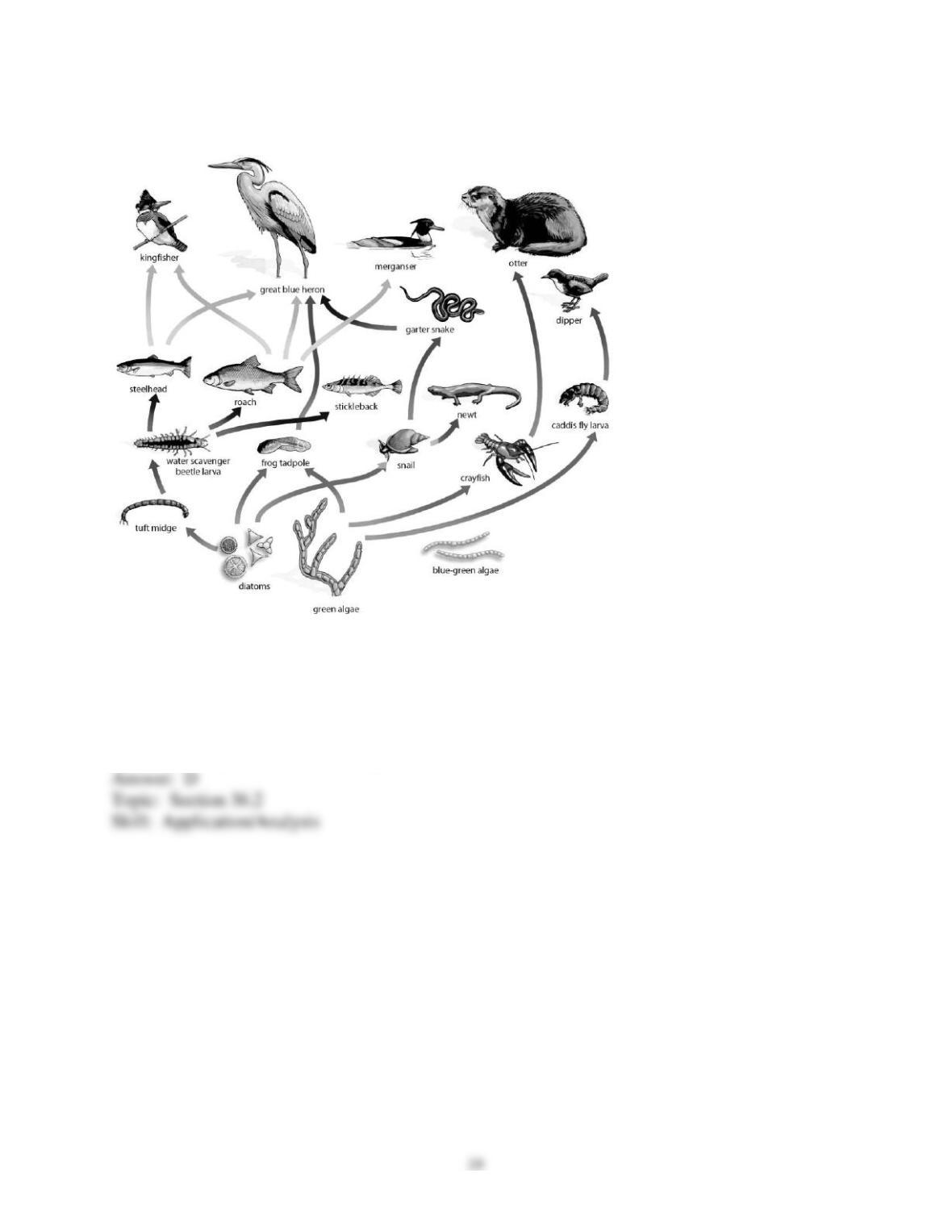
Refer to the figure below, and then answer the question that follows.
85) In this diagram, the blue heron is playing which role in the ecosystem when it eats the garter
snake?
A) primary consumer and second trophic level
B) secondary consumer and third trophic level
C) tertiary consumer and third trophic level
D) tertiary consumer and fourth trophic level
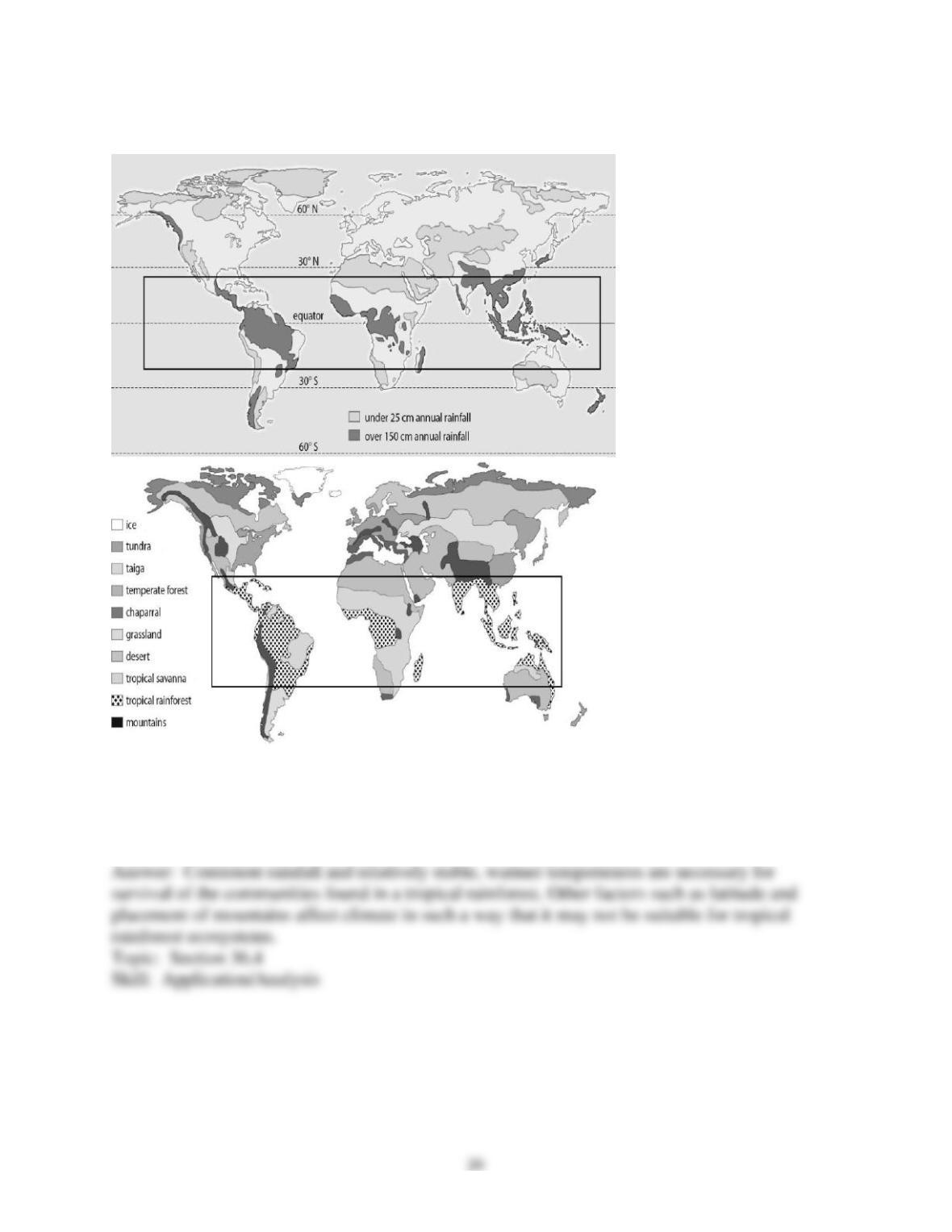
Refer to the figure below, and then answer the question that follows.
86) Looking at the boxed portions of these two diagrams, it seems clear that all the areas where
Earth gets very high rainfall (dark areas of top diagram) do not match precisely with places
where we have tropical rainforests (black and white dotted portions of boxed area of bottom
diagram). Propose a reason for this.