
Biology: A Guide to the Natural World, 5e (Krogh)
Chapter 35 An Interactive Living World 2: Communities in Ecology
1) In a typical ecosystem, a species whose removal would have a bigger impact than any other
would be a/an:
A) community species.
B) ecological dominants.
C) dominant species.
D) keystone species.
2) A small number of species that are abundant in a given community are called:
A) community species.
B) ecological dominants.
C) dominant species.
D) keystone species.
3) Keystone species are:
A) always at the top of the food chain.
B) always the most numerous.
C) never at the top of the food chain.
D) might be of any number, anywhere on the food chain.
4) An accidental spill of a pesticide locally wiped out the most abundant species of butterfly in
coastal California. Most of the bird species in the area had fed on this butterfly, but they
switched prey to moths, and thus the birds showed only a small decrease in population size. The
butterflies were a/an:
A) keystone species, and thus they were driven to extinction very easily.
B) endangered species.
C) ecological dominant, but they were not a keystone species.
D) pioneer species.

5) Biodiversity includes the:
A) genetic diversity within only the keystone species.
B) distribution of species in only one population.
C) diversity of species in a given area.
D) number of individuals in a population.
6) On a hike along the desert slope of the Sierra Nevada Mountains in California, you notice that
there is an abundance of pinyon pine and juniper trees. We would identify these two plants as:
A) competitors.
B) mutualistic species.
C) ecological dominants.
D) symbiotic species.
7) The coral organisms on a coral reef cannot be replaced by any other organism. For that reason,
we identify those species as:
A) ecological dominants.
B) keystone species.
C) mutualistic species.
D) symbiotic species.
8) Choose the characteristic associated with a top predator who is also a keystone species.
A) the largest animal in the community
B) the fastest animal in the community
C) a species that can easily cause extinction of the community
D) a species whose loss may alter diversity within the community

9) A botanist has found that the giant saguaro, Carnegiea gigantea, lives in the Sonoran Desert
below the freeze line and in some very dry regions (such as Yuma) to the eastern edge of
Arizona. She has described the ________ of saguaro.
A) resource spectrum
B) vital resource
C) resource band
D) habitat
10) The “address” where a species lives within a certain area is identified as its:
A) ecosystem.
B) habitat.
C) community.
D) population.
11) The “occupation” of a species in an area is identified as its:
A) habitat.
B) community.
C) niche.
D) population.
12) Barnacles live on exposed rocks washed over by waves at the shore. This is a description of
the barnacles’:
A) community.
B) habitat.
C) niche.
D) ecosystem.

4
13) Barnacles are filter-feeding molluscs that live by filtering plankton from seawater. This is a
description of the barnacles’:
A) community.
B) habitat.
C) niche.
D) ecosystem.
14) In interspecific competition, the competitors are generally competing for:
A) mates.
B) coexistence.
C) social status.
D) resources.
15) A red-shouldered hawk chases a falcon away from a dead squirrel. This is an example of:
A) interspecific competition.
B) coexistence.
C) mutualism.
D) commensalism.
16) You are doing biology field work studying two species of lizards on a small volcanic island.
Although quite hostile to each other when they accidentally meet, the two species usually remain
in separate parts of the island. Species A seems to live and hunt insects only in the lower
grassland part of the island. Species B seems to live and hunt only in the upper rocky areas.
Species A has a short tongue but has longer legs and is a faster runner. Species B is short, squat,
runs slower, but has a long tongue. You observe Species A chasing down some pretty large, fast-
moving insects, while Species B meanders from rock to rock, using its long tongue to get insects
hiding between rocks and in cracks. What principle of ecology do your two lizard species
demonstrate?
A) competitive exclusion
B) resource partitioning
C) coexistence
D) convergent evolution
17) When placed in the same habitat, Paramecium aurelia will replace Paramecium caudatum.
This is an example of:
A) mutualism.

B) commensalism.
C) parasitism.
D) competitive exclusion.
18) If two species of woodpeckers eat two different kinds of beetle larvae on pine trees in a
forest, we would identify that as:
A) mutualism.
B) resource partitioning.
C) competitive exclusion.
D) commensalism.
19) If we find an orange plant that lacks chlorophyll living on a green plant, it is likely that the
orange plant is a:
A) parasite.
B) commensal.
C) predator.
D) host.
20) The population of a carnivore has doubled this year. Predict what will likely happen to the
population of its prey over the next 12 months.
A) It will also increase.
B) It is likely to decrease.
C) It will remain stable, like all predator—prey relationships.
D) It will be erratic but increase slightly.

6
21) A harmless moth that resembles a poisonous wasp is an example of:
A) mutualism.
B) commensalism.
C) Batesian mimicry.
D) Müllerian mimicry.
22) For a parasite living in human skin, the person is the:
A) prey.
B) victim.
C) mimic.
D) host.
23) When faced with a threat, gopher snakes and bull snakes, who have markings similar to
rattlesnakes, will “rattle” their tails in brush to sound like a rattlesnake. In this case, the gopher
and bull snakes are mimics, and the rattlesnake is the:
A) predator.
B) prey.
C) model.
D) commensal.
24) You are doing field work on a small, uninhabited island. You are supplementing your food
supply with fish that live in some of the ponds on the island. You catch a brightly colored fish
with red and black stripes, filet it, pan fry it, and spit out your first bite because it tastes like it
had been soaked in urine. Back at camp, your guide from a nearby island is pan frying fish with
red and black stripes he caught in an adjacent pond. When you tell him not to eat those, he smiles
and says these are the best-tasting fish in the whole island chain! You look closer and see the
pattern of the red and black stripes is just a little different from the fish you caught.What
principle of ecology have you just experienced firsthand?
A) commensalism
B) mutualism
C) Müllerian mimicry
D) Batesian mimicry
25) The Venus flytrap, a carnivorous plant, might be considered a:
A) parasite.
B) predator.

C) mutualistic plant.
D) pioneer.
26) Two moths with similar markings each produce a chemical that makes their bird predators
sick to their stomach if eaten. Which principle of ecology does this demonstrate?
A) commensalism
B) mutualism
C) Müllerian mimicry
D) Batesian mimicry
27) An interaction in which one species benefits and the other is not affected is classified as:
A) commensalism.
B) mutualism.
C) coevolution.
D) competition.
28) Which of the following is an example of coevolution?
A) the reliance of flowers and bees on each other
B) the visual acuity of eagles and hawks
C) the development of a watertight seed
D) the ability of plants to use sunlight to make their own fuel

29) Many plant species produce flowers of a certain color and shape to attract honeybees. These
plants produce nectar, and the bees transport pollen from one plant to another while searching for
nectar. This is an example of:
A) succession.
B) predation.
C) commensalism.
D) mutualism.
30) Many bromeliads are epiphytes on the bark of tropical trees. They do not tap into the
vascular system of the trees, but they collect the nutrient-rich water that drips through the canopy
of the trees. This is an example of:
A) predation.
B) succession.
C) mutualism.
D) commensalism.
31) Generally speaking, the term for the process by which two species drive each other‘s
evolution is:
A) succession.
B) coevolution.
C) competition.
D) mutualism.
32) A landslide in the Oregon Cascades causes all the soil in a 30-meter by 300-meter section of
a mountain to fall away, taking the trees and their roots and all other vegetation with it. Within
three years, however, lichens and some small herbaceous plants can be seen on the surface of the
remaining rock. This is an example of:
A) secondary succession.
B) primary succession.
C) a climax community.
D) facilitation.

33) Many farms in New England were abandoned in the 1800s as settlers reached the more
fertile grasslands of the Midwest. These farms had been planted in different crops, but within
five to ten years the farms appeared to have similar herbaceous and small tree species on them.
This is an example of:
A) convergent evolution.
B) primary succession.
C) coevolution.
D) secondary succession.
34) Which of the following happens when a new island arises from the ocean and life begins to
colonize the island?
A) competitive exclusion
B) coevolution
C) primary succession
D) secondary succession
35) What do we call the first species that invade a new island that has risen from the ocean?
A) pioneer species
B) climax communities
C) commensals
D) invaders
36) After succession, a stable group of species that persists over long periods is referred to as a:
A) coevolution group.
B) climax community.
C) population.
D) competitive population.

37) The process in succession in which the actions of early-arriving species enable the success of
later-arriving species is:
A) coevolution.
B) mutualism.
C) facilitation.
D) mimicry.
38) Ecological dominants are typically the top predators in a community.
39) A community is a more inclusive category than a population.
40) Communities with the most biodiversity are found in areas with low geographic diversity.
41) Ecological dominants are always the most abundant members of a community.
42) Because their absence may have negative repercussions for population control and resource
use for the whole community, lions on the African savanna are identified as a keystone species.
43) To be a keystone species, an organism must be the most numerous species in an
environment.

44) Genetic diversity may be one of the characteristics of a biologically diverse community.
45) Biodiversity is essential for all communities to survive.
46) The term “niche” is usually limited to a description of the physical surroundings in which a
species is normally found.
47) Competitive exclusion of native organisms is a frequent result of the introduction, by
humans, of non-native organisms to an environment.
48) Competition among species may lead to resource partitioning in an ecosystem.
49) Kudzu replacing native plants is a type of predation.
50) A flea is considered to be a predator on a dog.
51) The number of prey species is one of several factors determining the number of predators
that can live in an area.

52) Parasites usually kill their hosts.
53) Batesian mimicry involves several harmful species evolving the same kind of characteristics.
54) A mutualistic relationship involves two species who both benefit from the relationship.
55) In a commensal relationship, one species benefits while the other one is harmed.
56) Commensalism often results in competitive exclusion.
57) Organisms in communities may be important factors in the evolution/adaptation of other
organisms in the community.
58) Climax communities in succession are those that persist for long periods of time.
59) Pioneers are the first invaders of a newly exposed habitat.

Match the following.
A) may result in resource partitioning
B) living with or on a host for nourishment
C) a species enables the success of another
D) series of community replacements in a barren area
E) killing/eating prey for nourishment
60) Interspecific competition
Topic: Section 35.3
Skill: Knowledge/Comprehension
61) Parasitism
Topic: Section 35.4
Skill: Knowledge/Comprehension
62) Predation
Topic: Section 35.4
Skill: Knowledge/Comprehension
63) Facilitation
Topic: Section 35.6
Skill: Knowledge/Comprehension
64) Primary succession
Topic: Section 35.6
Skill: Knowledge/Comprehension
65) What is the relationship between a biodiversity and geographic diversity?
66) A species whose absence would bring about major changes in a community is called a
________.

67) Low genetic diversity, narrow geographic distribution of species, and few different species in
an area would be correlated with low ________.
68) A horseshoe crab walking on the bottom of shallow coastal waters, feeding on algae,
invertebrates, and other small life forms, describes the horseshoe crab’s ________.
69) G. F. Gause’s experiments with interaction of Paramecium caudatum and P. aurelia resulted
in his describing the principle of ________.
70) A chameleon avoiding predation by being colored similarly to its surroundings demonstrates
which strategy?
71) Two ways that one species obtains its nourishment at the expense of another are predation
and ________.
72) An interaction between species in which one benefits and the other is essentially unaffected
is ________.
73) When two species, such as bees and angiosperms, both benefit from their interdependent
relationship, this is referred to as ________.
74) Which form of biological succession occurs in an area where most life has been destroyed,
but fertile soil remains?
75) Demonstrate why keystone species play a large role in community despite the fact that they
may be present in relatively small numbers.
76) Throughout the story of the evolution of parasites, we frequently see a shift from parasites
that seriously harmed their hosts, to those who evolve benign, nearly commensal relationships
with their hosts. Evaluate why parasites are more likely to evolve “live and let live” relationships
while predators do not.
77) Explain the differences between a primary succession and a secondary succession. Give an
example of each type of succession.
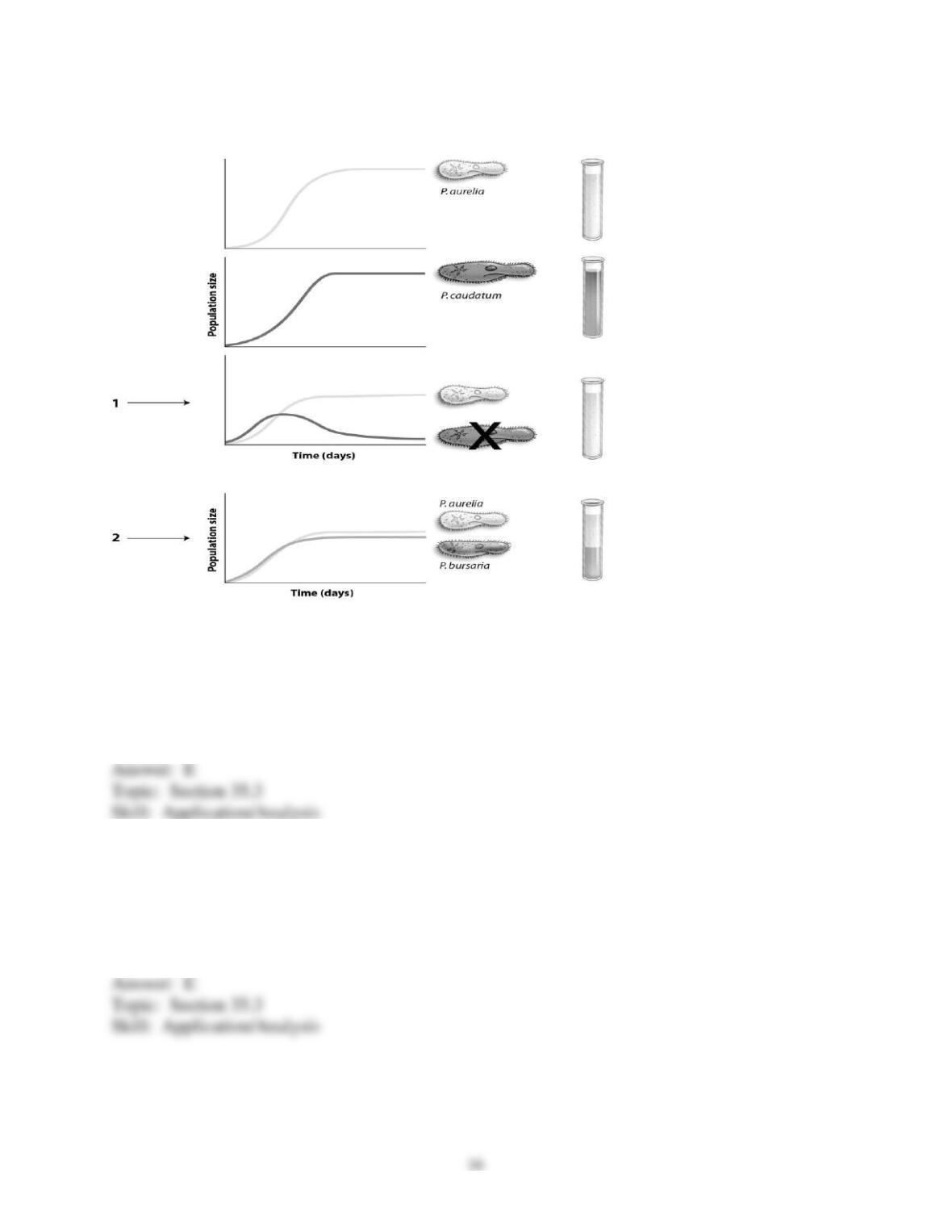
Refer to the figure below, and then answer the following question(s).
78) The graph indicated by a “1” demonstrates which principle of community ecology?
A) biodiversity
B) ecological dominants
C) facilitation
D) resource partitioning
E) competitive exclusion
79) The graph indicated by a “2” demonstrates which principle of community ecology?
A) biodiversity
B) ecological dominants
C) facilitation
D) resource partitioning
E) competitive exclusion