Biology: A Guide to the Natural World, 5e (Krogh)
Chapter 34 An Interactive Living World 1: Populations in Ecology
1) Which of the following might cause an exponential increase in deer populations across the
United States?
A) reduction in parasites that are found in emaciated deer
B) reduction in the population of wolves and bobcats
C) increase in atmospheric carbon dioxide levels
D) improvement in forest soil
2) Which of the following might an ecologist study?
A) general nature of digestive enzymes of deer
B) genetics of mosquitoes
C) effects of increasing carbon dioxide on forest growth
D) function of the immune system in human populations
3) Studying the egg production rates of a certain species of frog in a particular pond would be an
example of studying ecology at which level?
A) ecosystem
B) population
C) biosphere
D) community
4) Studying the changes in densities of pocket gophers when large herbivores such as elk are
excluded from mountain forests would be an example of studying ecology at which level?
A) community
B) ecosystem
C) biosphere
D) population
5) Studying the amount of carbon stored in the forest floor per hectare in a boreal forest in
Canada after a fire would be an example of studying ecology at which level?
A) biosphere
B) ecosystem
C) community
D) population
6) Studying the variations in the number of carp in Lake Erie over a 20-year period would be an
example of studying ecology at which level?
A) community
B) population
C) ecosystem
D) biosphere
7) Studying the total amount of oxygen generated and released into the atmosphere by living
things would be an example of studying ecology at which level?
A) community
B) population
C) ecosystem
D) biosphere
8) A community ecologist might study:
A) the behavior of a species in its natural environment.
B) all the members of a single species that live together in a single geographic area.
C) the rates of increase or decrease in the population size of individual species in different
environments.
D) the interactions among species living in a single area.
9) Generally speaking, which of the following would be the best description of ecology?
A) study and preserve the environment
B) study and conserve the environment
C) study the environmental conditions that plants and animals depend on for survival
D) study the interactions of living things with each other and their environments
10) Which of the following is true of exponential growth?
A) Exponential growth occurs when there are many environmental limits to reproduction.
B) Exponential growth resembles an S-shaped curve when plotted on a graph.
C) Exponential growth is growth that continues accelerating with time.
D) Exponential growth resembles a straight line when plotted on a graph.
11) Which of the following is true of logistic growth?
A) Logistic growth occurs when predators are very limited in population size.
B) Logistic growth may start in a way that resembles exponential growth but slows and
stabilizes.
C) Logistic growth describes the growth of a population in an environment with an unlimited
carrying capacity.
D) Logistic growth is plotted as a J-shaped curve.
12) Which of the following is true of a population’s intrinsic rate of increase?
A) It is the rate at which a population would grow if there were no external limits to growth.
B) It is the death rate minus the birth rate, or a measure of annual population change in a
population near K.
C) It is the rate at which populations grow in nature in the face of all environmental limits.
D) It occurs when the birth rate equals the death rate.
13) The maximum population density of a given species that a defined geographical area can
sustain over time is known as the:
A) community capacity.
B) ecosystem capacity.
C) maximum yield.
D) carrying capacity.
14) Which of the following would be an example of environmental resistance?
A) food supply increasing along with a population
B) bacteria populations producing more toxic waste as they grow
C) slow gestation periods
D) life span that increases with population size
15) A population of rabbits introduced to an island grows rapidly for a few years, and then
growth slows and stabilizes. The population becomes stable because:
A) the intrinsic rate of increase has declined.
B) environmental resistance declined.
C) immigration was reduced.
D) the carrying capacity has been reached.
16) K, in population growth equations, refers to:
A) carrying capacity.
B) the predation factor.
C) environmental resistance.
D) biotic potential.
5
17) A negative rate of increase, or a negative r, means that:
A) the population is shrinking.
B) the population has a short generation time.
C) death rates have decreased.
D) there is zero population growth.
18) A population’s intrinsic rate of increase can be calculated by:
A) subtracting r from K.
B) multiplying r by K.
C) multiplying r by the initial population size, N.
D) subtracting birth rate from death rate.
19) The average amount of time that passes between the birth of a woman and the birth of her
child is called:
A) reproductive time.
B) generation time.
C) birth rate.
D) population rate.
20) Which of the following would be a valid, general pattern seen in generation time?
A) Nearly all K-selected organisms have short generation times.
B) Species with the fastest growth rates have the longest generation times.
C) The larger the species is, the longer its generation time tends to be.
D) All vertebrates have long generation times.
21) If a population’s death rate is 5 percent and birth rate is 10 percent, its r value would be:
A) 15 percent.
B) 5 percent.
C) 50 percent.
D) essentially zero.
22) Which of the following organisms represent a K-selected species?
A) whales
B) houseflies
6
C) grasshoppers
D) salmon
23) Which of the following is a density dependent limiting factor?
A) weather
B) rain
C) frost
D) food supply
24) Which of the following species would be classified as an opportunistic species?
A) humans
B) houseflies
C) chimpanzees
D) kangaroos
25) Mosquitoes have a short life span and produce a very large number of eggs. This is typical of
a/an:
A) K-selected species.
B) equilibrium species.
C) r-selected species.
D) density dependent species.
26) Which of the following would be a characteristic of a K-selected species?
A) Most K-selected species live until older age.
B) All K-selected species live very long life spans.
C) Individuals tend to die at all ages in the life span.
D) Most die at relatively young ages.
27) Oak trees grow slowly and put a lot of resources into the trunk, bark, and roots. Seeds are
relatively heavy. In the plant kingdom, oaks might be considered:
A) density independent.
B) r-selected.
C) opportunistic.
D) K-selected.
28) Humans would be typical of which survivorship curve category?
A) early-loss species
B) constant-loss species
C) late-loss species
D) late-gain species
E) early-gain species
29) Most insects would be typical of which survivorship curve category?
A) early-loss species
B) constant-loss species
C) late-loss species
D) late-gain species
E) early-gain species
30) “Life is a lottery and it makes sense simply to buy many tickets” is a strategy for organisms
that exhibit:
A) K-selected growth.
B) sigmoidal growth.
C) density dependent growth.
D) density independent growth.
31) A biologist is studying the population dynamics of pocket gophers in a meadow in central
Oregon. She noted that, when population numbers are high, death rates from disease and
starvation increase. This is an example of:
A) r-selected growth.
B) the principle of intrinsic rate of growth.
C) exponential growth.
D) density dependent control.
32) Which of the following items can be classified as a density independent factor in population
growth?
A) food supply
B) disease
C) temperature
D) drinking water supply
33) Which of the following would be generally true of r-selected species?
A) Most live until older age.
B) All live very short life spans.
C) R-selected species are larger organisms that produce few offspring.
D) R-selected species are smaller organisms that produce many offspring.
34) You are doing field study work with a scientist studying spiders in the Amazon rainforest.
You come across a previously undiscovered species of spider and set up a video camera with a
zoom lens to observe it closely without disturbing it. You see the female spider lay two eggs, kill
an ant that tried to eat one of the eggs, and preserve the ant to feed the hatchlings the next day.
She lays two more eggs as soon as the two offspring grow larger and leave. When your mentor
asks for a monthly update, what exciting news do you have for her about this species?
A) It exhibits unusual r-selected tendencies.
B) It exhibits unusual K-selected tendencies.
C) It exhibits unusual intelligent learning tendencies.
D) It exhibits unusual zero population growth tendencies.
35) From the time of the industrial revolution until about 50 years ago, the human population
growth rate most closely resembles:
A) linear growth.
B) exponential growth.
C) variable, unpredictable growth.
D) fluctuating increases and decreases, with overall slow growth.
36) A population with a fertility rate of 2.1 will:
A) slowly shrink.
B) slowly grow.
C) double each generation.
D) decrease by half each generation.
E) exhibit zero population growth.
37) What would be a reasonable conclusion about a country with a fertility rate of about 1.6?
A) The population will grow at a yearly rate of 1.6 percent.
B) The population is likely to shrink.
C) Zero population growth will occur.
D) It must be a relatively young population.
38) What would be logical to conclude about a country with a population pyramid having a
disproportionately large number of individuals in the 15—44 year old range?
A) The country is a developed country.
B) The country will exhibit little population growth.
C) The country will exhibit large population growth.
D) The country will exhibit zero population growth.
39) Which is true of predictions about the expected population of the United States in the year
2050?
A) The U.S. population will exceed 1.5 billion.
B) Immigration is not expected to have a large effect on the U.S. population.
C) The population is expected to grow about 43 percent.
D) Emigration is expected to have a large effect on the U.S. population.
40) Ecologists often say that one individual living in a developed country cannot be counted as
ecologically equal to one individual from a developing country because:
A) the fertility rates are the same.
B) the use of natural resources per person is different.
C) r is different.
D) K is different.
41) A country’s fertility rate suggests zero population growth, but it shows an increase of 20—30
percent over 50 years. What might account for this?
A) better food availability
B) a larger proportion of post-reproductive females
C) higher environmental resistance
D) lower logistic growth
E) immigration
42) The job of an ecologist is to preserve the natural world.
43) All the members of a single species of frog in a particular pond would be an example of a
population.
44) A community of organisms and the physical environment with which they interact is an
ecosystem.
45) A population that grows by an unvarying number of new units added to the population per
unit of time is undergoing exponential growth.
46) Arithmetic growth will produce a faster population increase over time than an exponential
growth curve.
47) The carrying capacity of an environment can cause a population initially growing very
quickly to level off, resulting in an S-shaped curve.
48) The intrinsic rate of increase of a population is usually referred to as “r.”
49) The intrinsic rate of growth of a population is calculated by adding the death rate and the
birth rate.
50) Most r-selected species are small and short lived.
51) Most K-selected species have short generation times.
52) Elephants are good examples of r-selected species.
53) K-selected species are also called equilibrium species.
54) Equilibrium species are usually limited by density dependent factors.
55) Life tables are used to predict how many individuals will be born in any specific year.
56) Total human fertility rates have dropped globally in the past 50 years.
57) Except for the period during which the bubonic plague occurred, the human population
demonstrated logistic growth from the Middle Ages until about 50 years ago.
58) The total fertility rate is defined as the average number of children born to each woman in a
population.
59) Per capita use of resources and CO2 emissions may be just as important as population size
when considering stress to the global environment.
Match the following.
A) straight line graph of growth
B) J-curve graph of growth
C) carrying capacity
D) birth rate minus death rate
E) S-curve graph of growth
60) Exponential growth
Topic: Section 34.2
Skill: Knowledge/Comprehension
61) Logistic growth
Topic: Section 34.2
Skill: Knowledge/Comprehension
62) Arithmetic growth
Topic: Section 34.2
Skill: Knowledge/Comprehension
63) Intrinsic rate of increase
Topic: Section 34.2
Skill: Knowledge/Comprehension
64) Maximum sustainable population density
Topic: Section 34.2
Skill: Knowledge/Comprehension
65) Define the term biosphere.
66) What is the relationship between a community and an ecosystem?
67) A friend tells you that vintners use yeast that produce alcohol to turn grape juice into wine.
He also observes that wine must still have living yeast in it because vintners don’t pasteurize
wine to kill the yeast. To make wine himself, he explains, he added wine to grape juice with the
expectation that the yeast would turn the juice into wine. It didn’t work, and your friend wonders
why not. In terms of population ecology, what can you explain to your friend about the death of
his yeast?
68) Species that are introduced to new habitats, such as islands, often exhibit very high growth
rates, but then growth rates level off. Explain this phenomenon, and describe the different
patterns of growth.
69) What would be the “r” value or intrinsic rate of growth of a population that had 50 births and
40 deaths per year out of 1000?
70) Environmental pressures on a population, such as temperature and pH, are density ________
factors.
71) An “S” shaped curve would be indicative of ________ growth.
72) Why are K-selected species also known as equilibrium species?
73) Species with individuals that die equally or linearly at all different ages throughout their life
span are known as ________-loss species.
74) Species with populations that are likely to rise and fall rapidly in reaction to variations in the
environment are referred to as ________ species.
75) What is the total fertility rate number associated with zero population growth, and why?
76) What factors may affect the carrying capacity for a species in an environment? Is the
carrying capacity usually a fixed number, and why or why not?
77) Compare the trends seen in the characteristics of r-selected and K-selected species, also
noting exceptions learned in your study of population ecology.
78) Evaluate why intrinsic rate of increase alone is not necessarily an indication of how quickly a
population will grow over a given period of time compared to that of another population or
species.
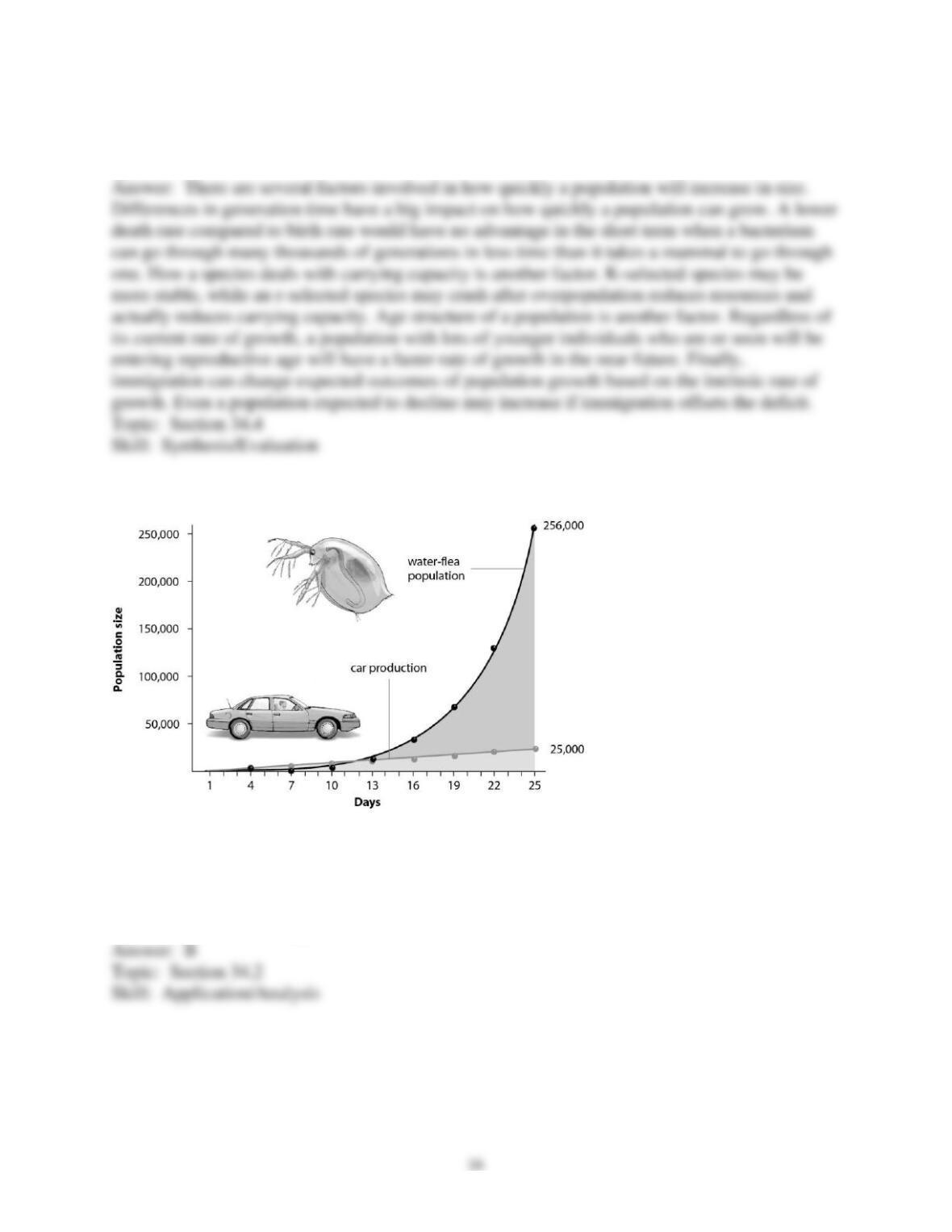
Refer to the figure below, and then answer the question that follows.
79) What does the graph of Daphnia population growth suggest about this species?
A) The slow start suggests long generation time and a K-selected species.
B) The J-curve suggests short generation time and an r-selected species.
C) The straight line suggests a changing carrying capacity.
D) The high numbers suggest arithmetic increase.
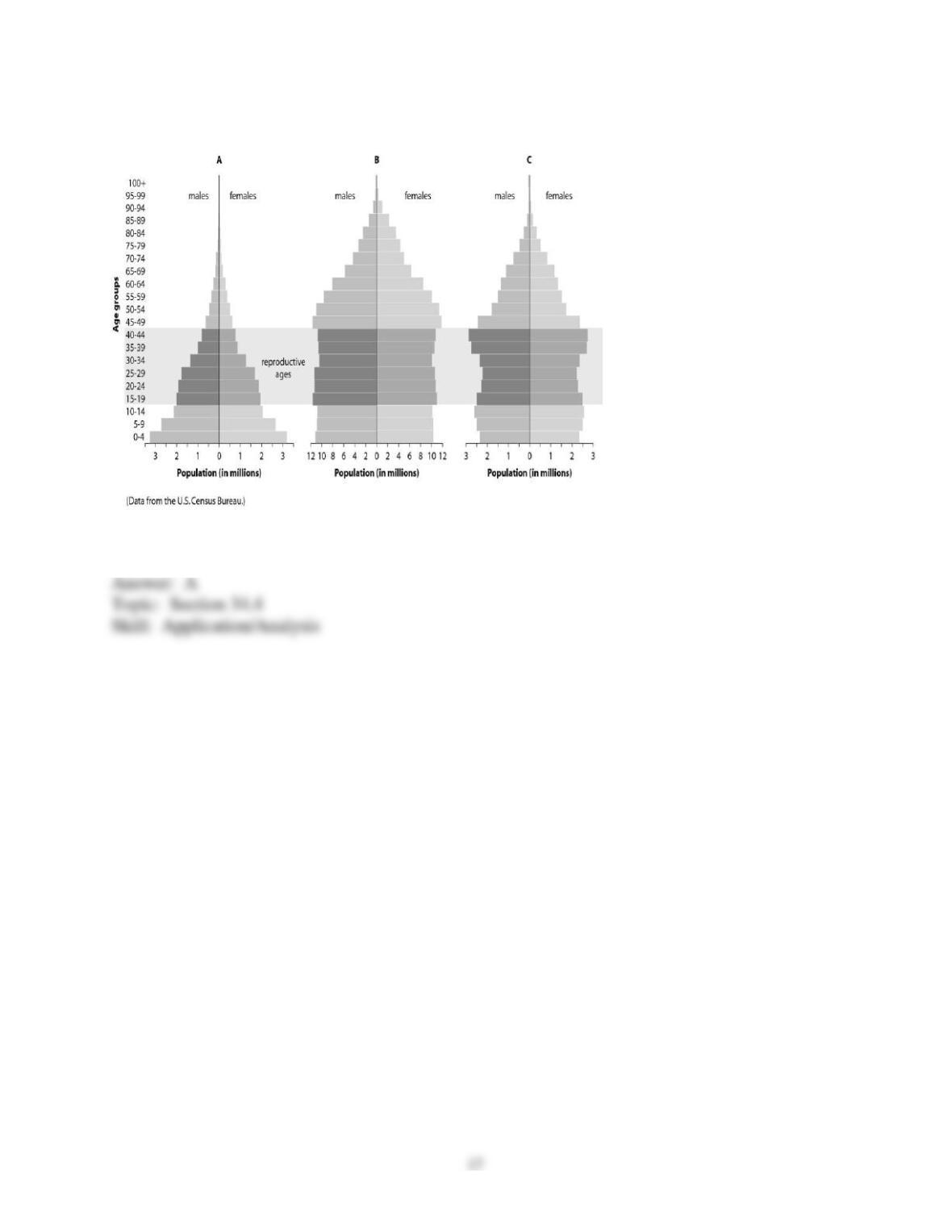
Refer to the figure below, and then answer the question that follows.
80) Which graph, A, B, or C, represents a population likely to exhibit the greatest population rate
increase over the next few decades?