CHAPTER 33—THE PLANT BODY
MULTIPLE CHOICE
1. Human agriculture started about ______ years ago.
a.
100
b.
1,000
c.
11,000
d.
110,000
e.
1,100,000
2. The structure and arrangement of internal parts of a plant is the ____ of the plant.
a.
morphology
b.
ecology
c.
anatomy
d.
distribution
e.
physiology
3. The external form of a plant is the ____ of the plant.
a.
morphology
b.
ecology
c.
anatomy
d.
distribution
e.
physiology
4. The mechanisms by which the body of a plant functions in its environment is the ____ of the plant.
a.
morphology
b.
ecology
c.
anatomy
d.
distribution
e.
physiology
5. Vascular plant bodies typically consist of a(n) ____ shoot system and a ____ root system.
a.
photosynthetic; photosynthetic
b.
nonphotosynthetic; photosynthetic
c.
photosynthetic; nonphotosynthetic
d.
nonphotosynthetic; nonphotosynthetic
e.
autotrophic; heterotrophic
6. A plant stem would be considered to be
a.
a shoot system.
b.
a tissue.
c.
a root system.
d.
a meristem.
e.
an organ.
7. Which of the following is NOT typically found in primary plant cell walls?
a.
lignin
b.
hemicelluloses
c.
pectin
d.
cellulose
e.
chitin
8. Which of the following is often used to congeal jams and jellies?
a.
lignin
b.
hemicelluloses
c.
pectin
d.
cellulose
e.
chitin
9. Which of the following can waterproof cell walls, allowing for structures such as watertight
conduction channels?
a.
lignin
b.
hemicelluloses
c.
pectin
d.
cellulose
e.
chitin
10. The ____ of a plant is self-perpetuating embryonic tissue typically found at the tips of shoots and
roots.
a.
ground tissue
b.
protoderm
c.
vascular tissue
d.
meristem
e.
dermal tissue
11. Growth from apical meristems, generally resulting in an increase in the length of a plant, is referred to
as
a.
horizontal growth.
b.
typical growth.
c.
secondary growth.
d.
longitudinal growth.
e.
primary growth.
12. Which of the following is true of typical plant development?
a.
Growing tips and zones are present throughout a plant’s life, and final plant form is not
influenced by the environment.
b.
Plant bodies have a fixed final size, and final plant form is influenced by the environment.
c.
Final plant form is not influenced by the environment, and growing tips and zones are
present throughout a plant’s life.
d.
Growing tips and zones are present throughout a plant’s life, and plant bodies do not have
a fixed final size.
e.
Plant bodies do not have a fixed final size, and final plant form is not influenced by the
environment.
13. Which term refers to plants that complete their life cycle in one growing season?
a.
perennials
b.
annuals
c.
monocots
d.
biennials
e.
eudicots
14. Which term refers to plants that complete their life cycle in two growing seasons?
a.
perennials
b.
annuals
c.
monocots
d.
biennials
e.
eudicots
15. Which term refers to plants that typically grow for many years?
a.
perennials
b.
annuals
c.
monocots
d.
biennials
e.
eudicots
16. Among other functions, the ____ of a vascular plant performs most of the photosynthesis that is
conducted by the plant.
a.
ground tissue
b.
protoderm
c.
vascular tissue
d.
meristem
e.
dermal tissue
17. Plant cells called ____ make up the bulk of the soft primary growth of roots, stems, leaves, flowers,
and fruits.
a.
sclerenchyma
b.
tracheids
c.
collenchyma
d.
parenchyma
e.
vessel members
18. Plant cells called ____ form flexible support strands such as the “strings” in celery.
a.
sclerenchyma
b.
tracheids
c.
collenchyma
d.
parenchyma
e.
vessel members
19. Plant cells called ____ are a type of ground tissue that often develop thick secondary walls that
become heavily lignified and are dead when mature.
a.
sclerenchyma
b.
tracheids
c.
collenchyma
d.
parenchyma
e.
vessel members
20. Plant cells called ____ form the protective coat around seeds.
a.
sclerenchyma
b.
tracheids
c.
collenchyma
d.
parenchyma
e.
vessel members
21. Plant tissue specialized for conducting fluids is
a.
ground tissue.
b.
protoderm.
c.
vascular tissue.
d.
meristem.
e.
dermal tissue.
22. Cells called ____ are a type of vascular tissue with long, tapered, overlapping ends. They develop
thick, lignified cell walls and die at maturity, leaving a water conducting tube with pits at the tapered
ends that allow for lateral water transport between cells.
a.
sclerenchyma
b.
tracheids
c.
collenchyma
d.
parenchyma
e.
vessel members
23. Cells called ____ are a type of vascular tissue that join end to end in tubelike columns. They develop
thick, lignified cell walls and die at maturity, leaving a water-conducting tube. At maturity the ends of
the cells are open or have large openings, allowing for enhanced water flow compared to other types of
vascular tissue.
a.
sclerenchyma
b.
tracheids
c.
collenchyma
d.
parenchyma
e.
vessel members
24. Xylem and phloem are types of
a.
ground tissue.
b.
protoderm.
c.
vascular tissue.
d.
meristem.
e.
dermal tissue.
25. What tissue in vascular plants would be used to move water and dissolved minerals from roots to the
stems and leaves?
a.
sclerenchyma
b.
phloem
c.
collenchyma
d.
parenchyma
e.
xylem
26. What tissue in vascular plants would be used to move sugars from roots to the stems and leaves, and
from leaves to roots and stems?
a.
sclerenchyma
b.
phloem
c.
collenchyma
d.
parenchyma
e.
xylem
27. Sieve tube members are part of the
a.
ground tissue.
b.
phloem.
c.
dermal tissue.
d.
meristem.
e.
xylem.
28. Companion cells are connected via plasmodesmata to
a.
trichomes.
b.
tracheids.
c.
sieve tube members.
d.
guard cells.
e.
vessel members.
29. Plant surfaces are covered and protected by
a.
ground tissue.
b.
protoderm.
c.
vascular tissue.
d.
meristem.
e.
dermal tissue.
30. Cuticle, guard cells, stomata, and trichomes are all terms associated with
a.
ground tissue.
b.
vascular tissue.
c.
meristem.
d.
dermal tissue.
e.
secondary tissue
31. Epidermal cells secrete a coating called the ____ that protects the plant from water loss and attacks by
microbes.
a.
cuticle
b.
protoplast
c.
stoma
d.
trichome
e.
bark
32. In response to increased carbon dioxide levels in the atmosphere, stomata in leaves of some species
have ________.
a.
become smaller
b.
declined in number
c.
increased in number
d.
become encoded by the gene YDA
e.
become larger
33. Specialized outgrowths of the plant epidermis called ____ are hairlike projections, such as root hairs.
a.
cuticles
b.
protoplasts
c.
stomata
d.
trichomes
e.
bark
34. The mixta gene in snapdragons helps determine flower color by regulating
a.
anthocyanin production.
b.
production of pigments other than anthocyanin.
c.
cell shape.
d.
production of anthocyanin and other pigments.
e.
anthocyanin production and cell shape.
35. Which of the following is NOT typically a main function of stems?
a.
mechanical support
b.
storage of water, nutrients and sugars
c.
energy capture
d.
routes for vascular tissues
e.
new growth
36. The place on a stem where one or more leaves are attached is called the
a.
terminal bud.
b.
internode.
c.
axil.
d.
lateral bud.
e.
node.
37. The upper angle between a stem and attached leaf is called a(n)
a.
terminal bud.
b.
internode.
c.
axil.
d.
lateral bud.
e.
node.
38. The site of new primary growth at the apex of a shoot is the
a.
terminal bud.
b.
internode.
c.
axil.
d.
lateral bud.
e.
node.
39. Apical dominance is maintained by
a.
hormones released by the terminal bud.
b.
sugars produced in the leaves.
c.
water transported from the roots.
d.
hormones released by the lateral buds.
e.
sugars produced in the lateral buds.
40. When an apical meristem cell divides, one daughter cell is called the initial and the other is called the
derivative. What are the fates of these cells?
a.
The initial is used to form primary meristems, and the derivative remains part of the apical
meristem.
b.
Both the initial and the derivative remain part of the apical meristem.
c.
The initial remains part of the apical meristem, and the derivative is used to form primary
meristems.
d.
Both the initial and the derivative are used to form primary meristems.
e.
The initial is used to form primary meristems, and the derivative is used to form secondary
meristems.
41. Which of the following represents the correct order of structures from outside to inside for a stem that
has a vascular cylinder?
a.
stele, cortex, epidermis, pith
b.
epidermis, pith, cortex, stele
c.
cortex, stele, pith, epidermis
d.
epidermis, cortex, stele, pith
e.
stele, epidermis, pith, cortex
42. Multistranded cords of primary xylem and phloem are
a.
vascular bundles.
b.
found only in monocots.
c.
found only in dicots.
d.
formed by stele.
e.
formed by pith.
43. Which of the following most directly gives rise to primary vascular tissues?
a.
protoderm
b.
apical meristem
c.
ground meristem
d.
vascular cambium
e.
procambium
44. Rhizomes, tubers, corms, and stolons are examples of modified
a.
leaves.
b.
bulbs.
c.
roots.
d.
flowers.
e.
stems.
45. Often connected to a petiole, these plant organs may be either simple or compound and are typically
the main organs of photosynthesis and gas exchange.
a.
roots
b.
leaves
c.
flowers
d.
stems
e.
trichomes
46. Which of the following has a structure on the leaf that releases salt?
a.
Dionaea muscipula
b.
Atriplex spongiosa
c.
Lathynus odoratus
d.
Phaseolus
e.
Quercus
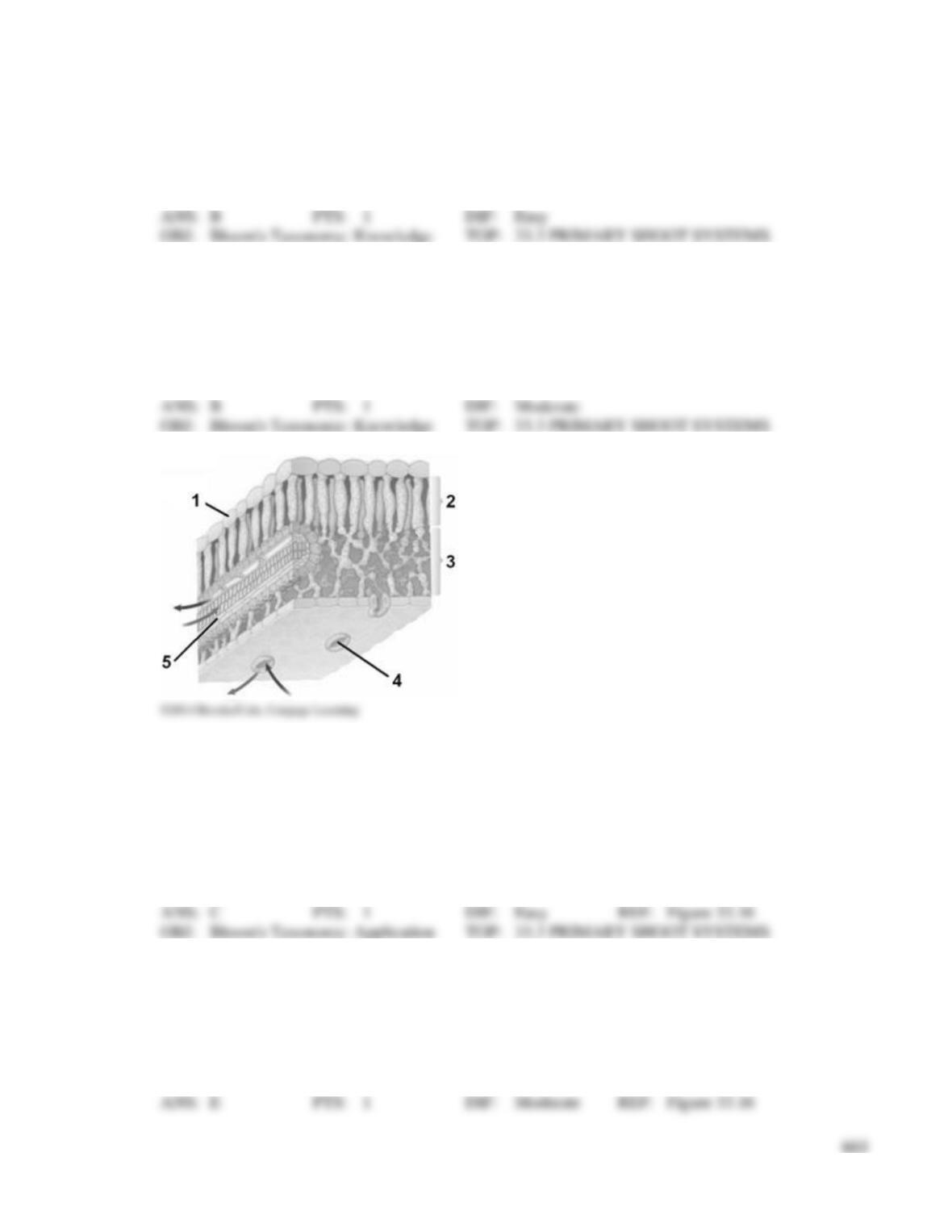
Use the figure above for the following question(s).
47. In the internal leaf structure shown above, the item labeled “1” is
a.
a vascular bundle.
b.
spongy mesophyll.
c.
epidermis.
d.
a stoma.
e.
palisade mesophyll.
48. In the internal leaf structure shown above, the item labeled “2” is
a.
a vascular bundle.
b.
spongy mesophyll.
c.
epidermis.
d.
a stoma.
e.
palisade mesophyll.
49. In the internal leaf structure shown above, the item labeled “3” is
a.
a vascular bundle.
b.
spongy mesophyll.
c.
epidermis.
d.
a stoma.
e.
palisade mesophyll.
50. In the internal leaf structure shown above, the item labeled “4” is
a.
a vascular bundle.
b.
spongy mesophyll.
c.
epidermis.
d.
a stoma.
e.
palisade mesophyll.
51. In the internal leaf structure shown above, the item labeled “5” is
a.
a vascular bundle.
b.
spongy mesophyll.
c.
epidermis.
d.
a stoma.
e.
palisade mesophyll.
52. The KN-1 gene in maize is normally expressed
a.
in primary meristems, where it initiates the process of differentiation.
b.
in apical meristems, where it maintains the undifferentiated state.
c.
in apical meristems, where it initiates the process of differentiation.
d.
in primary meristems, where it maintains the undifferentiated state.
e.
in lateral meristems, where it initiates the process of secondary growth.
53. A single main root that is adapted for storage and that typically grows downward and fairly deep is
called
a.
an adventitious root.
b.
a fibrous root.
c.
a rhizome.
d.
a taproot.
e.
a tuber.
54. Root systems that are adapted to absorb water and nutrients from the upper layers of soil are called
a.
adventitious root systems.
b.
prop root systems.
c.
fibrous root systems.
d.
taproot systems.
e.
storage root systems.
55. The root apical meristem is surrounded and protected by a structure called the
a.
endodermis.
b.
root cap.
c.
quiescent center.
d.
pericycle.
e.
root hairs.
56. The innermost layer of the root cortex, which is a selectively permeable barrier that helps control the
movement of water and dissolved minerals, is called the
a.
endodermis.
b.
root cap.
c.
quiescent center.
d.
pericycle.
e.
root hairs.
57. Lateral roots arise from the
a.
endodermis.
b.
root cap.
c.
quiescent center.
d.
pericycle.
e.
root hairs.
58. The uptake of water and mineral ions from the soil occurs primarily at the
a.
endodermis.
b.
root cap.
c.
quiescent center.
d.
pericycle.
e.
root hairs.
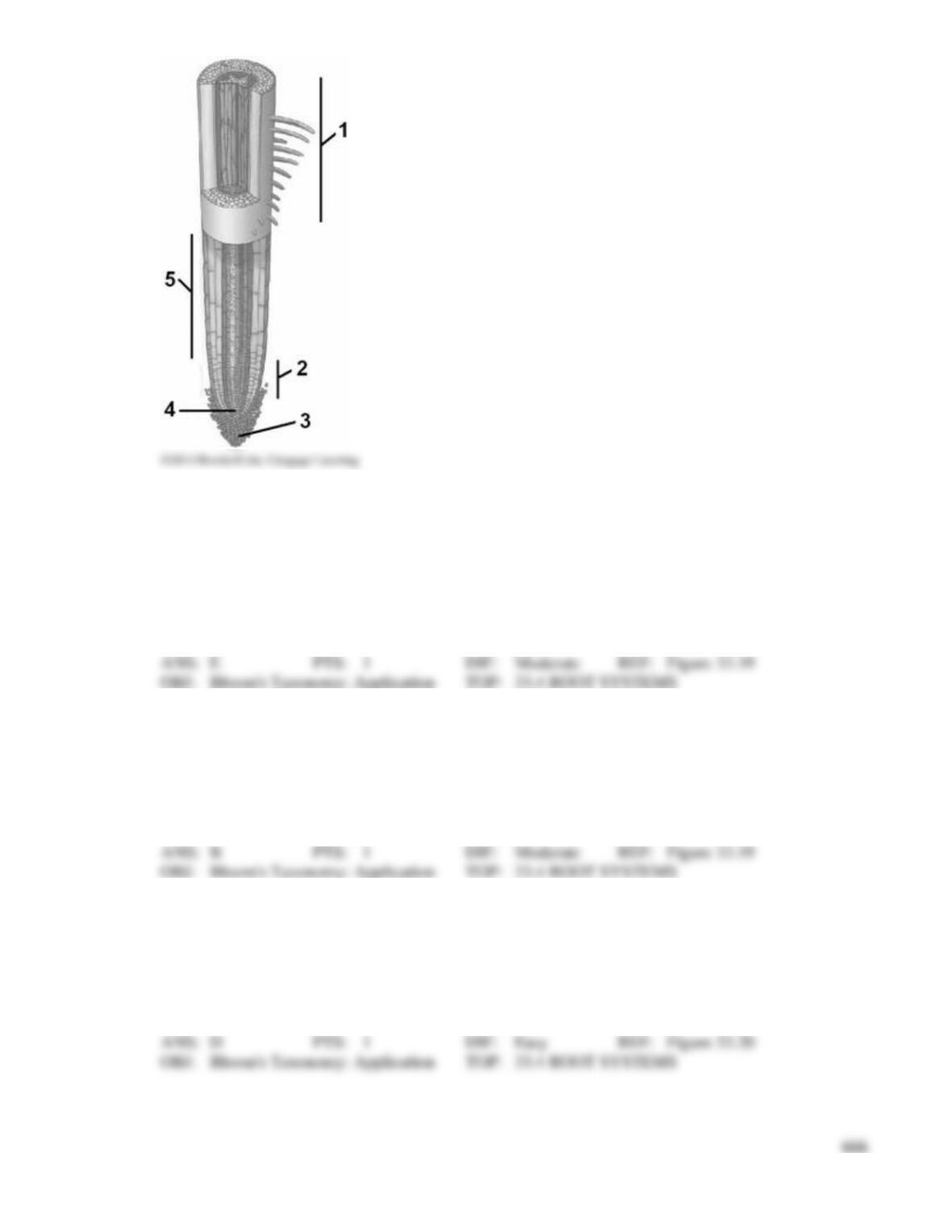
Use the figure above for the following question(s).
59. In the diagram of a root tip shown above, the item labeled “1” is the
a.
quiescent center.
b.
zone of cell division.
c.
zone of elongation.
d.
root cap.
e.
zone of maturation.
60. In the diagram of a root tip shown above, the item labeled “2” is the
a.
quiescent center.
b.
zone of cell division.
c.
zone of elongation.
d.
root cap.
e.
zone of maturation.
61. In the diagram of a root tip shown above, the item labeled “3” is the
a.
quiescent center.
b.
zone of cell division.
c.
zone of elongation.
d.
root cap.
e.
zone of maturation.
62. In the diagram of a root tip shown above, the item labeled “4” is the
a.
quiescent center.
b.
zone of cell division.
c.
zone of elongation.
d.
root cap.
e.
zone of maturation.
63. In the diagram of a root tip shown above, the item labeled “5” is the
a.
quiescent center.
b.
zone of cell division.
c.
zone of elongation.
d.
root cap.
e.
zone of maturation.
64. Which of the following most directly gives rise to secondary xylem and phloem?
a.
protoderm
b.
apical meristem
c.
ground meristem
d.
vascular cambium
e.
procambium
65. Cork cambium produces
a.
vascular tissue.
b.
heartwood.
c.
vascular cambium.
d.
sapwood.
e.
secondary epidermis.
66. Girdling a tree is eventually lethal because it prevents
a.
water uptake.
b.
photosynthesis.
c.
respiration.
d.
sugar transport to roots.
e.
water transport to leaves.
67. Primary and secondary xylem that can no longer transport water and solutes, and can store defensive
compounds, is called
a.
bark.
b.
heartwood.
c.
vascular cambium.
d.
sapwood.
e.
secondary epidermis.
68. Imagine that you have found a mutant oak plant that cannot produce fusiform initials. Which of the
following would be the most direct result of this mutation?
a.
The plant would not be able to perform photosynthesis.
b.
The plant would not be able to make secondary xylem and phloem.
c.
The plant would not be able to make roots.
d.
The plant would not be able to transport sugar to the roots.
e.
The plant would not be able to make leaves.
69. Starting from the outside and moving in toward the center, which gives the correct order of tissues in
the stem of a young tree?
a.
secondary phloem, primary phloem, primary xylem, secondary xylem
b.
primary xylem, secondary xylem, secondary phloem, primary phloem
c.
primary phloem, secondary xylem, secondary phloem, primary xylem
d.
secondary phloem, primary xylem, secondary xylem, primary phloem
e.
primary phloem, secondary phloem, secondary xylem, primary xylem
70. Most plant cells are pluripotent, meaning that they
a.
constantly switch tissue types throughout their lives.
b.
cannot change after differentiating into a specific cell type.
c.
end up as a hybrid of tissue types.
d.
can function in any environmental condition.
e.
retain the ability to change cell types when necessary.
71. A unique characteristic of plant cells is their
a.
ability to photosynthesize.
b.
ability to carry out cellular respiration.
c.
ability to continuously grow and generate new organs throughout their life cycle.
d.
ability to form defensive compounds.
e.
ability to protect themselves through movement
669
MATCHING
Choice
For each of the following descriptions of a plant characteristic, provide the letter that represents the
plant group or groups (or no plant groups) that typically have that characteristic. Each letter may be
used once, more than once, or not at all.
a.
eudicots
b.
monocots
c.
both eudicots and monocots
d.
neither eudicots nor monocots
72. one pore or furrow in pollen grains
73. reproduction using seeds
74. vascular bundles organized in a ring in ground tissue
75. three pores or furrows in pollen grains
76. floral parts in threes (or multiples of three)
77. parallel leaf veins
78. two cotyledons
79. branching fibrous root system
80. vascular tissues
81. one cotyledon
82. lack of meristems
83. leaf veins in a netlike array
84. floral parts in fours or fives (or multiples of four or five)
SHORT ANSWER
85. Explain the difference between primary and secondary growth.
86. Why would mowing grass not damage the meristem and inhibit growth in height, but pruning a shrub
would?
87. What types of cells in plants function like stem cells in animals, and how do they function?
88. If you were analyzing tree rings how might you distinguish between fires that occurred in the spring
versus fires that occurred in the summer, assuming the fires left fire scars?
89. If you completely girdle a deciduous tree’s trunk in mid-summer, why could the tree potentially retain
leaves throughout some or all of the rest of the growing season, but eventually die?
MODIFIED TRUE/FALSE
If the statement is true, answer “T“. If the statement is false, answer “F” and make it correct by
changing the underlined word(s) and writing the correct word(s) in the answer blank(s).
90. All perennials have secondary tissues.
91. Meristems produce three plant organ systems.
92. Parenchyma ground tissue is where plant metabolism occurs.
93. Guard cells contain chloroplasts.
94. Molecular studies have revealed that flower colors may depend on light.
95. Terminal buds release a hormone that inhibits the growth of nearby lateral buds.
96. Cactus leaves are modified as trichomes.
97. Veins throughout a leaf are formed by vascular epidermis.
98. Adventitious roots arise from a plant’s stem.
99. If you damaged the root cap of a root, you might also likely damage the quiescent center.