
Biology: A Guide to the Natural World, 5e (Krogh)
Chapter 33 How the Baby Came to Be: Human Reproduction
1) Which of the following is considered a gamete?
A) embryo
B) child
C) oocyte
D) zygote
2) If a chemical were to destroy all oocytes:
A) sperm would not form.
B) sperm would form but have no chromosomes.
C) eggs would not form.
D) eggs would form but have no chromosomes.
3) Through what structure does an oocyte travel on its way to the uterus?
A) uterine tube
B) cervix
C) vagina
D) ovary
4) On average, about how often does ovulation occur?
A) every 6 months
B) every 28 days
C) every 14 days
D) every day

2
5) Sperm are made in the:
A) testes.
B) epididymis.
C) ovary.
D) vas deferens.
6) Which of the following is a structure in which sperm mature and are stored?
A) vas deferens
B) testis
C) accessory glands
D) epididymis
7) Implantation occurs in the:
A) ovary.
B) vagina.
C) uterine tube.
D) uterus.
8) The specialized tissue of the uterus where implantation occurs is the:
A) cervix.
B) vagina.
C) endometrium.
D) uterine tube.
9) The stages of follicle development are:
A) tertiary follicle, secondary follicle, primary follicle, corpus luteum.
B) ovarian follicle, mature follicle, oocyte.
C) corpus luteum, tertiary follicle, secondary follicle, primary follicle.
D) primary follicle, secondary follicle, tertiary follicle, corpus luteum.
10) Fraternal twins develop when:

A) one egg is fertilized by two sperm.
B) two eggs are fertilized by one sperm.
C) multiple ovulations occur, and two eggs are fertilized.
D) one egg is fertilized by one sperm, but the resulting cells separate from one another and
continue development.
11) What changes occur in the endometrium as the time of possible fertilization approaches?
A) Menstruation occurs.
B) The endometrium enters the proliferative phase.
C) The endometrium enters the secretory phase.
D) The endometrium secretes estrogen.
12) Which structure would be best described as helping to prepare the female tract for pregnancy
and maintain it during the early phases of pregnancy?
A) vagina
B) uterine tube
C) oocyte
D) corpus luteum
13) From which structure does the corpus luteum develop?
A) oocyte
B) tertiary follicle
C) primary follicle
D) secondary follicle

14) Why does a female have millions of ovarian follicles as a fetus but has perhaps just over a
thousand in her early fifties?
A) Several hundred follicles ovulate per monthly cycle and deplete the follicle supply at a steady
rate.
B) Several thousand follicles ovulate per monthly cycle and deplete the follicle supply at a
steady rate.
C) Natural degeneration of follicles speeds up in later years.
D) Production of new follicles from stem cells slows in her fifties.
15) Which statement concerning gamete production is correct?
A) Sperm cells can be produced only at certain points in the reproductive cycle.
B) The number of sperm a man can produce is essentially unlimited, whereas the number of eggs
a woman can potentially produce is limited.
C) A man is born with all of the sperm he will need for the rest of his life.
D) Progestins stimulate development of new follicles.
16) Spermatids are produced by:
A) spermatogonia.
B) primary spermatocytes.
C) secondary spermatocytes.
D) sertiary spermatocytes.
17) Sperm development begins in the:
A) prostate gland.
B) seminiferous tubules.
C) epididymis.
D) vas deferens.

5
18) The vas deferens ducts empty sperm into the:
A) seminal vesicles.
B) epididymis.
C) uterus.
D) urethra.
19) Which of these is not a supporting gland in males?
A) prostate gland
B) seminal vesicle
C) epididymis
D) bulbourethral gland
20) Development of sperm occurs from the:
A) inside of the seminiferous tubule toward the outside.
B) outside of the epididymis toward the inside.
C) outside of the seminiferous tubule toward the inside.
D) middle of the penis toward the prostate gland.
21) The sequence of development of sperm is:
A) primary spermatocyte, secondary spermatocyte, tertiary spermatocyte, spermatid, sperm.
B) primary spermatocyte, spermatogonia, sperm.
C) immature sperm, mature sperm, secondary sperm, spermatocyte.
D) spermatogonia, spermatocyte, spermatid, sperm.
22) When a spermatogonium divides, it produces one primary spermatocyte and:
A) two secondary spermatocytes.
B) one spermatogonium.
C) one spermatid.
D) one nurse cell.
23) Sperm development takes about:

A) 1 month.
B) 28 days.
C) 6 months.
D) 2.5 months.
24) A fertility doctor is trying to determine why a couple is infertile. It has been determined that
the woman is fertile, so the problem may be with the man. In analyzing his semen, the doctor
notices adequate sperm production, but the sperm are largely inactive. He concludes that the
semen may be lacking in proper nutrients for the sperm. Which structure would be the most
likely candidate for the source of the problem?
A) urethra
B) seminiferous tubules
C) vas deferens
D) seminal vesicles
25) Why is it useful for accessory glands to produce alkaline substances to accompany sperm?
A) Alkaline substances neutralize the acidic environment of the vagina.
B) Alkaline substances produce a pH optimum for nutrient absorption.
C) Alkaline substances are mainly fats used for energy.
D) Alkaline substances function as enzymes needed for swimming.
26) A man has been experiencing reduced urine flow problems. After examination by his doctor,
the diagnosis is an enlarged prostate gland. What is the connection between prostate enlargement
and reduced urine flow?
A) The prostate is located where the ureters enter the bladder.
B) The prostate surrounds the urethra, the tube that transmits sperm and urine.
C) An enlarged prostate is a sign of cancer that affects the kidneys.
D) An enlarged prostate is a sign of cancer that affects the bladder.

7
27) The portion of a sperm that carries enzymes needed for fertilization is the:
A) tail.
B) nucleus.
C) acrosome.
D) mitochondrion.
28) Which of the following statements concerning sperm and fertilization is correct?
A) The first sperm that approaches the egg is the one to fertilize the egg.
B) Many sperm release their enzymes before one can get through.
C) The first capacitated sperm fertilizes the egg.
D) Several sperm must contribute their DNA to the egg for fertilization to occur.
29) What prevents multiple sperm from fertilizing one egg?
A) release of granules that harden the membrane outside of the oocyte
B) atresia
C) phagocytosis by accessory cells once one sperm contacts the membrane
D) egg immediately divides and becomes impervious to sperm
30) An ectopic pregnancy is:
A) implantation of the embryo in the uterus.
B) another name for fraternal twins.
C) another name for identical twins.
D) attachment of an embryo outside the uterus.
31) Three weeks after conception, which of the following has happened in an embryo?
A) organ formation
B) neural tube formation
C) limb bud formation
D) primitive eye formation
32) Immature versions of all the major organ systems have formed by about what point in

pregnancy?
A) 16 days
B) 3 weeks
C) 12 weeks
D) not until at least 30 weeks
33) Which of the following best describes the period during which the developing offspring is
considered a fetus?
A) from fertilization to three weeks
B) from fertilization to eight weeks
C) the first trimester only
D) the third trimester only
E) from nine weeks until birth
34) Which of these becomes the baby?
A) outer cell mass
B) trophoblast
C) inner cell mass
D) placenta
35) When does the fetus achieve about 15 percent of its birth weight and start kicking?
A) at the end of embryonic phase
B) at the start of organogenesis
C) in the first trimester
D) in the second trimester
E) in the third trimester

9
36) Why is production of lung surfactant important for a baby?
A) Without lung surfactant, the baby’s lungs do not develop properly.
B) Lung surfactant may block the placenta from exchanging oxygen.
C) Lung surfactant keeps the lung sacs from collapsing.
D) Lung surfactant keeps the lungs from sticking to the diaphragm.
37) How many sperm participate in the formation of fraternal twins?
A) one
B) two
C) three
D) four
38) In the human birth process, what does labor refer to?
A) the period between birth and expulsion of the placenta
B) the period between the first contraction and dilation of the cervix
C) the last part of the process when the fetus is expelled from the vagina
D) regular contractions of uterine muscles
39) Which hormone stimulates the muscular contractions associated with birth of a child?
A) estrogen
B) progesterone
C) luteinizing hormone
D) oxytocin
40) What is the “afterbirth” associated with the birth process?
A) the amniotic fluid
B) the blood lost from the uterus in the weeks after birth
C) the placenta
D) the process of cutting the umbilical cord
41) How much does the cervix ultimately dilate during labor?

A) 10 centimeters
B) 5 centimeters
C) 3 centimeters
D) 1 centimeter
42) Normally, anywhere from one to four sperm fertilize the egg.
43) Semen is the mixture of sperm and secretions from male reproductive glands.
44) As sperm are made, they travel through the vas deferens and are stored in the seminal
vesicles until ejaculation.
45) Fallopian tube is another name for the uterine tube.
46) Ejaculation initially deposits the sperm in the uterus.
47) Ovulation refers to growth of the primary follicle.
48) An egg is not a gamete.
49) In humans, females contribute more resources to reproduction and development than males.

50) Women produce oocytes from stem cells from puberty all throughout life.
51) An egg implants in the uterus and awaits sperm for fertilization.
52) An ovarian follicle is a developing oocyte and the follicular cells surrounding it.
53) Corpus luteum translates as “yellow body.”
54) Menstruation refers to the later life cessation of the monthly ovarian cycle.
55) A woman begins puberty with about 400,000 follicles.
56) Sperm are fully mature when they reach the epididymis.
57) There is an epididymis adjacent to each testis.
58) Sperm development requires temperatures somewhat cooler than found in the rest of the
body.
59) Sperm develop in the seminal vesicles.
60) The male stem cells in sperm production are the spermatogonia.
61) It generally takes the enzymes from dozens of sperm for one sperm to gain access to the
oocyte membrane.
62) Sperm cells do not need a nucleus and expel it during development as a weight-saving tactic.
63) Human embryos do not go through a morula stage of development as do most other animals.
64) Human pregnancy lasts an average of about 38 weeks.
65) The developing organism is referred to as a fetus during its first eight weeks.

13
66) The normal position of the fetus at the start of labor is “upside down.”
Match the following.
A) makes female hormones
B) sperm storage
C) sperm stem cell
D) becomes the fetal portion of the placenta
E) enzyme storage
67) Epididymis
Topic: Section 33.3
Skill: Knowledge/Comprehension
68) Trophoblast
Topic: Section 33.5
Skill: Knowledge/Comprehension
69) Spermatogonia
Topic: Section 33.3
Skill: Knowledge/Comprehension
70) Corpus luteum
Topic: Section 33.2
Skill: Knowledge/Comprehension
71) Acrosome
Topic: Section 33.4
Skill: Knowledge/Comprehension
72) The release of an oocyte from an ovary is called ________.
73) Implantation occurs in the ________ of the uterus.
74) Primary and secondary ________ develop into spermatids.
75) What is the long tube through which mature sperm are transported to the urethra during
ejaculation?
76) Enzymes are carried in the ________ of a sperm.
77) Which is the only trimester to include both the embryo and fetal stages?
78) Given the loss of childbearing ability and negative health effects associated with menopause,
there is cause to question why it exists given that evolution usually selects against most negative
health effects and reduced fertility. Appraise and compare the two possible explanations covered
in this section.
79) Propose reasons to explain why the female reproductive system evolved a menstrual cycle,
but the male system does not adhere to any kind of true cycle.
80) Evaluate this statement: By the end of the first trimester, most growth in a fetus is in size, not
complexity.
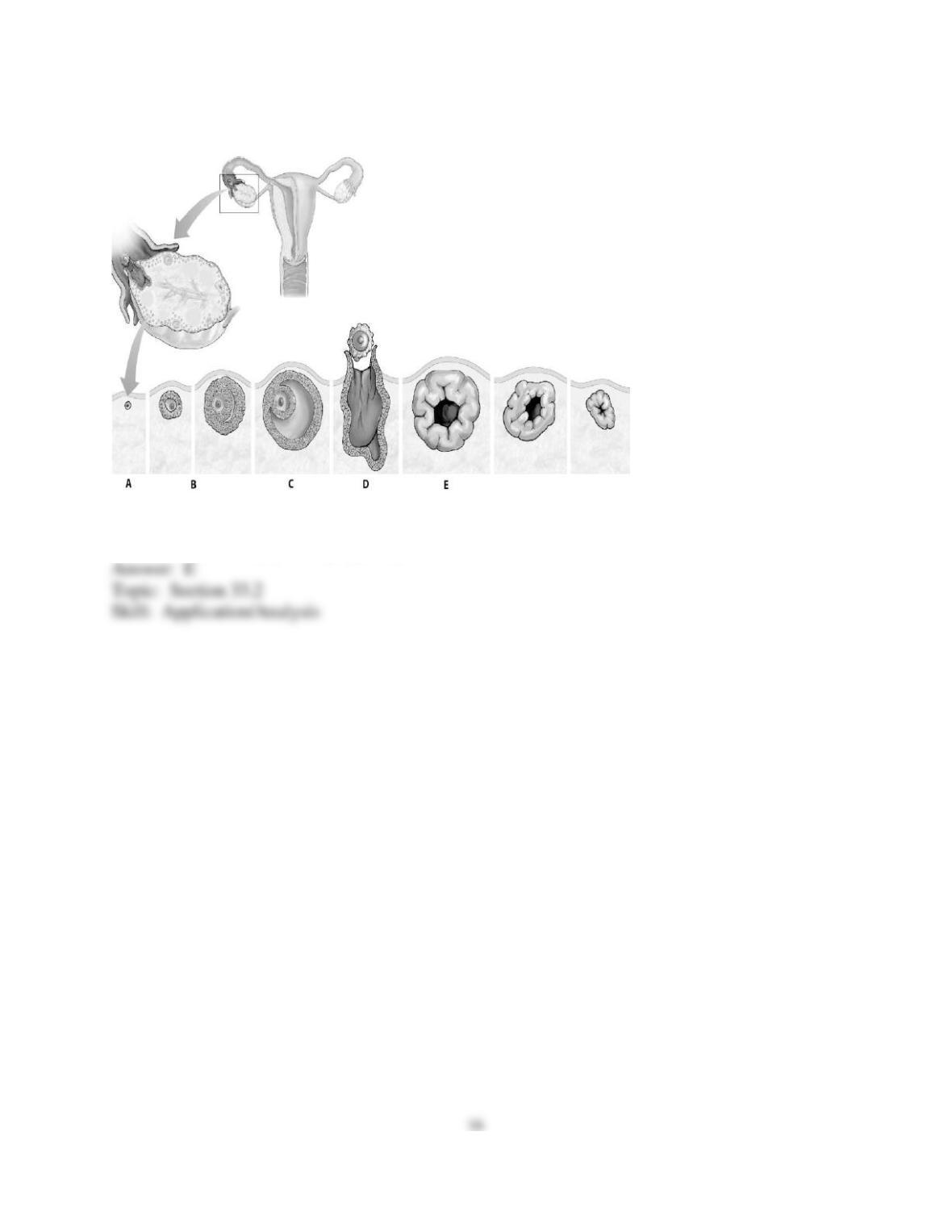
Refer to the figure below, and then answer the question that follows.
81) Which item, A, B, C, D, or E, represents the structure that maintains the female reproductive
tract during the early part of pregnancy?
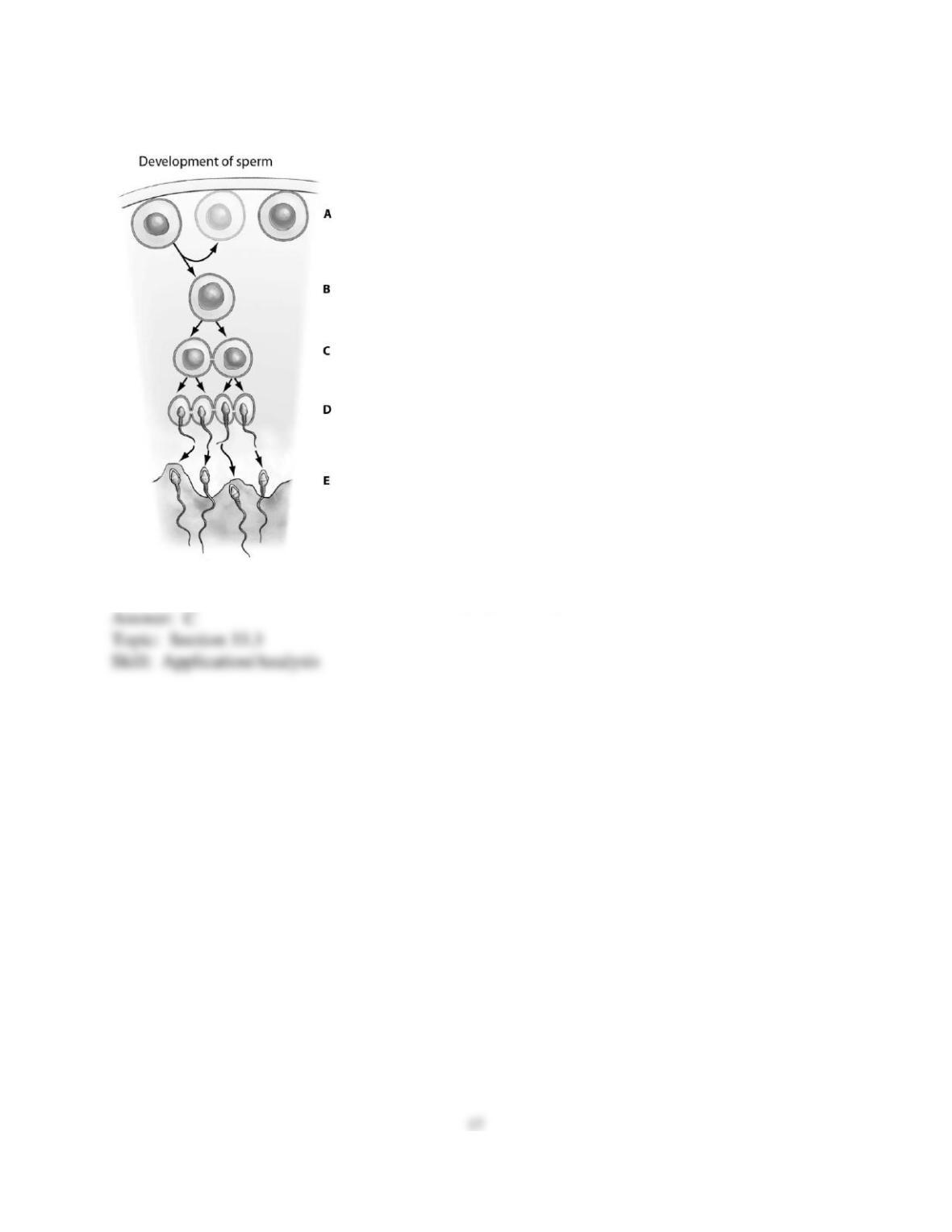
Refer to the figure below, and then answer the question that follows.
82) Which item, A, B, C, D, or E, is a secondary spermatocyte?