234)
If the Mexican peso appreciates against the U.S. dollar
234)
A)
U.S. exports will become more expensive in Mexico.
B)
Mexican exports will become more expensive in the United States.
C)
there will be no change in the price of Mexican imports in the United States.
D)
Mexican exports will become cheaper in the United States.
235)
A country’s balance of payments shows a
235)
A)
summary record of a country’s economic transactions with foreign residents and governments
over a year.
B)
detailed record of the country’s imports.
C)
detailed record of the import and export of services for the country.
D)
summary record of international financial assistance received by the country.
236)
If the foreign exchange rate is 70 cents for one Swiss franc, then
236)
A)
a car that costs 40,000 francs will cost $7,143.00.
B)
a clock that costs 500 francs will cost $350.00.
C)
a wine that costs 200 francs will cost $14.00.
D)
a house that costs 100,000 francs will cost $700,000.00.
237)
Current account transactions are all payments that are related to the purchase or sale of
237)
A)
goods and services excluding government purchases.
B)
goods only.
C)
services only.
D)
goods and services only.
238)
Demand for the Brazilian real is
238)
A)
determined by how well the real maintains its value.
B)
derived from the supply of U.S. dollars.
C)
a function of the Brazilian banking system.
D)
derived from the demand for Brazilian goods.
239)
With the Bretton Woods system of international exchange rates
239)
A)
the value of a country’s currency was determined by its stock of gold.
B)
the value of a country’s currency was determined strictly by the laws of supply and demand.
C)
a nation’s balance of payments was eliminated.
D)
there were fixed exchange rates, and most countries were obligated to intervene to maintain
the values of their currencies within 1 percent of par value.
D
240)
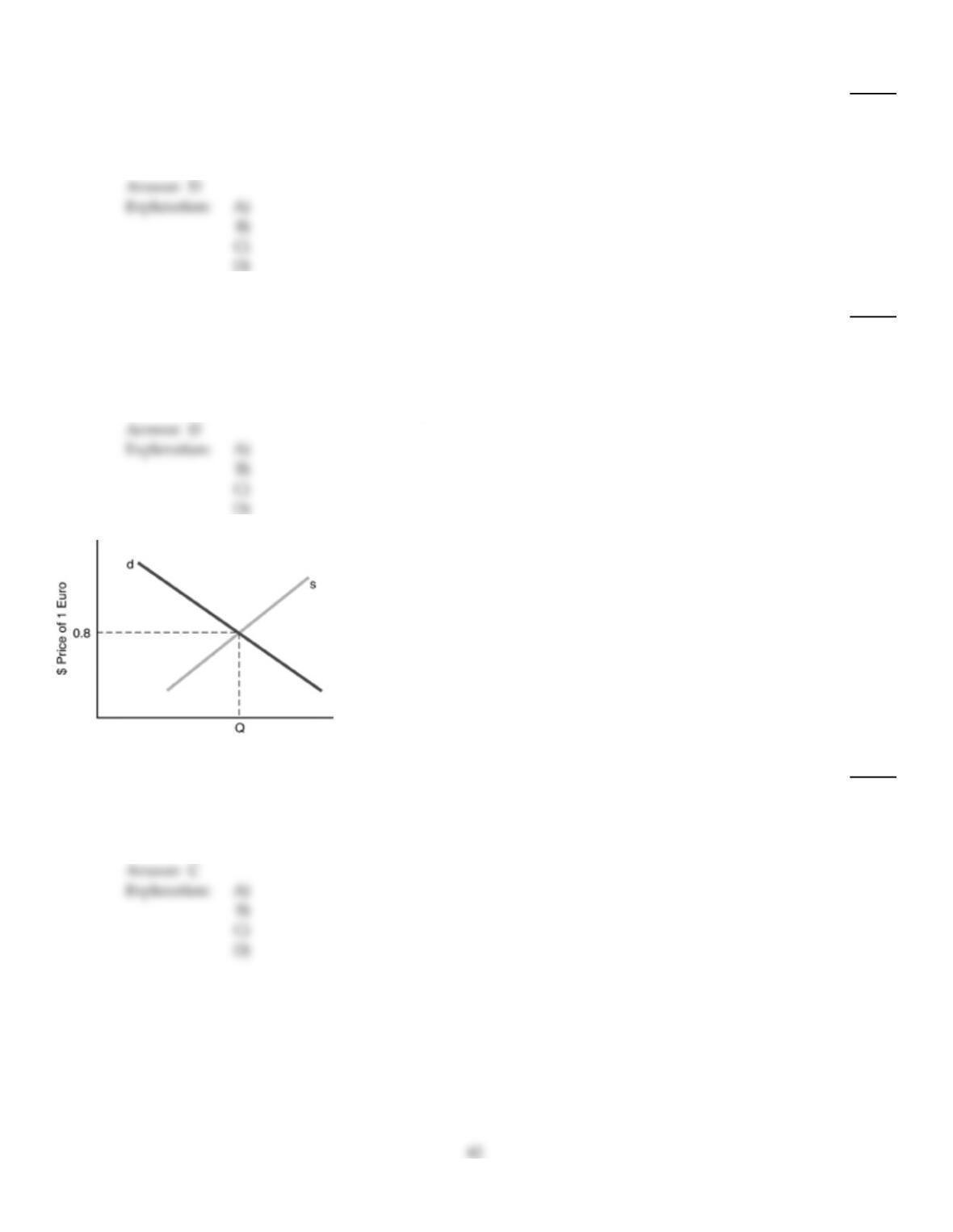
Using the above figure. A rightward shift of the supply curve, ceteris paribus, would result in
240)
A)
euro appreciation.
B)
dollar depreciation.
C)
dollar appreciation.
D)
decreasing the equilibrium quantity of euros.
C
D
241)
As the dollar price of the euro increases
241)
A)
U. S. residents will increase their travel to France.
B)
French residents will purchase more U.S. goods.
C)
the demand for euros will increase.
D)
the price of French goods will fall for U.S. residents.
242)
If people in the United States buy more of a foreign good when its price falls, then
242)
A)
fixed exchange rates will make foreign exchange markets more efficient.
B)
the exchange rate will increase when there is inflation.
C)
the supply curve for U.S. dollars will slope up.
D)
the demand curve for U.S. dollars will slope up.
C
243)
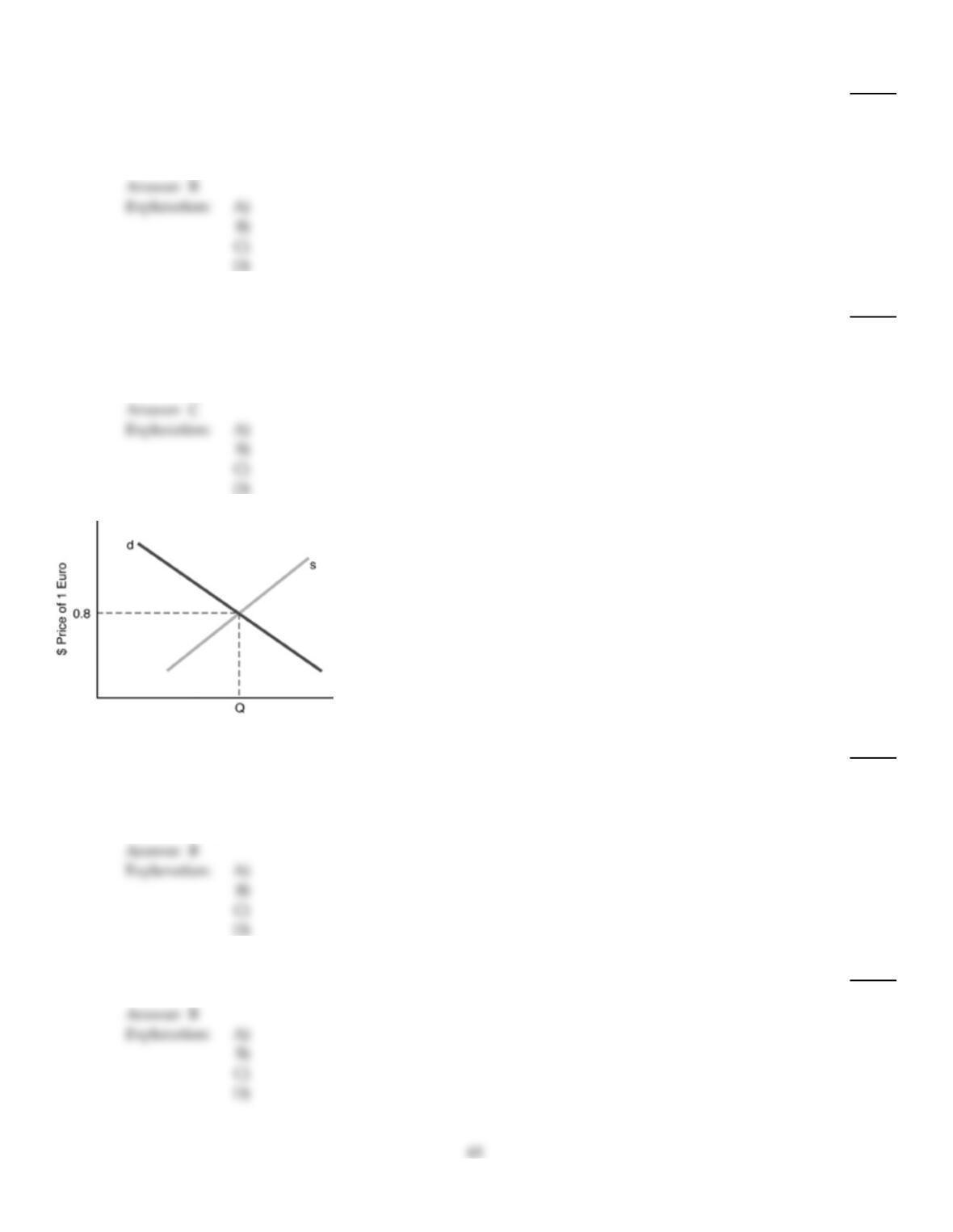
Use the above figure. A rightward shift of the demand curve, ceteris paribus, would result in
243)
A)
euro depreciation.
B)
dollar depreciation.
C)
dollar appreciation.
D)
reducing the equilibrium quantity of euros.
B
244)
The price of one nation’s currency in terms of the currency of another nation is called the
244)
A)
discount rate.
B)
exchange rate.
C)
fed funds ratio.
D)
IMF rate.
B
B
245)
Which of the following best describes exchanges rates that are determined by the demand and
supply foreign exchange in the absence of official intervention?
245)
A)
target zones
B)
the Bretton Woods system
C)
the gold standard
D)
floating exchange rates
246)
In July 2011, $1 was worth 45 Indian rupees and in July 2012, $1 was worth 55 Indian rupees. We
can therefore conclude that
246)
A)
the U.S. dollar has depreciated.
B)
the Indian rupee depreciated.
C)
the Indian rupee appreciated.
D)
the value of the U.S. dollar has fluctuated.
247)
When a Chinese company builds an auto plant in the United States, the immediate result of this
Chinese investment in the United States is a ________ item in the U.S. ________ account.
247)
A)
deficit; capital
B)
surplus; capital
C)
deficit; current
D)
surplus; current
248)
An example of a transaction that will be a surplus item on the U.S. balance of payments is
248)
A)
a Nissan plant in Tennessee buying parts from the main plant in Japan.
B)
the purchase of a Mercedes–Benz by an American.
C)
a gift of wheat from the United States government to Egypt.
D)
the purchase of General Motors stock by a German resident.
249)
A decrease in the market clearing exchange value of the home nation’s currency in terms of the
currency of another nation is a home currency
249)
A)
devaluation.
B)
appreciation.
C)
revaluation.
D)
depreciation.
250)
Suppose that the current exchange rate between the dollar and peso is $1 equals 10 pesos. If the
exchange rate changes to $1 equals 8 pesos, which of the following is TRUE?
250)
A)
The peso depreciates and imports from Mexico become cheaper.
B)
The dollar depreciates and U.S. exports become cheaper.
C)
The dollar appreciates and U.S. exports become cheaper.
D)
The peso appreciates and imports from Mexico become cheaper.
251)
If there are no interventions by finance ministers or control banks in the international market, then
251)
A)
the current account will be greater than the capital market.
B)
the capital market will be greater than the current account.
C)
the capital market will equal the current account.
D)
the current account and the capital account must sum to zero.
D
252)
One way that countries can settle international payment obligations is
252)
A)
to run a balance of payments deficit.
B)
to use special drawing rights.
C)
to run a balance of payments surplus.
D)
to stop trading.
B
253)
In a nation’s balance of payments, the current account includes
253)
A)
the purchases of foreign assets.
B)
the changes in the official reserve transaction account.
C)
the balance of the trade account, the balance of the services account, and net unilateral
transfers.
D)
all of the above.
C
A
254)
The capital account is
254)
A)
the price of one nation’s currency in term of the currency of another country.
B)
a category of the balance of payments transactions that measures flows of real and financial
assets.
C)
the reserve assets created by the International Monetary Fund for countries to use in settling
international payment obligations.
D)
a category of the balance of payments transactions that measures the exchange of
merchandise, the exchange of services, and unilateral transfers.
255)
Under a flexible exchange rate system, an increase in the value of a domestic currency in terms of
other currencies is referred to as
255)
A)
a devaluation.
B)
an appreciation.
C)
a revaluation.
D)
a depreciation.
256)
The effect that a gift given to a U.S. citizen from a foreign resident will have on the balance of
payments is to
256)
A)
have no effect on the balance of payments if the gift was made by a foreign country.
B)
increase the current account balance.
C)
have no effect on the balance of payments if the gift was made in the U.S.
D)
decrease the balance of payments.
257)
If interest rates in Sweden go up relative to the rest of the world, the
257)
A)
supply of Swedish currency will fall.
B)
supply of Swedish currency will rise.
C)
demand for Swedish currency will fall.
D)
demand for Swedish currency will rise.
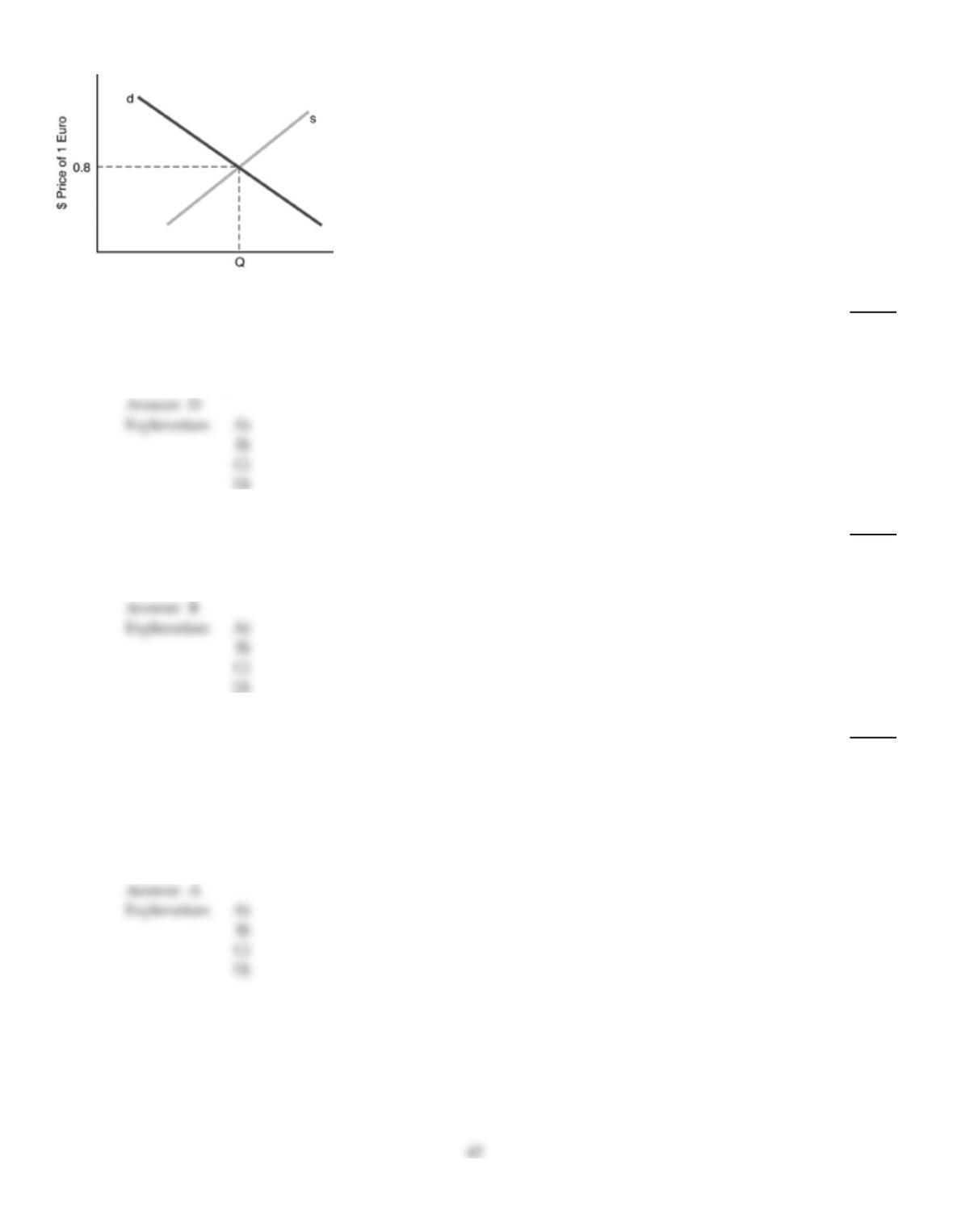
258)
Use the above figure. A leftward shift of the supply curve, ceteris paribus, would result in
258)
A)
dollar appreciation.
B)
euro depreciation.
C)
increasing the equilibrium quantity of euros.
D)
dollar depreciation.
259)
Exchange rates that are allowed to fluctuate in response to changes in supply and demand is
known as
259)
A)
fixed exchange rates.
B)
flexible exchange rates.
C)
the foreign exchange markets.
D)
standard drawing rights.
260)
What happens if the Brazilian real appreciates relative to the U.S. dollar?
260)
A)
The quantity of reals supplied increases because the lower price (in reals) for U.S. goods
induces Brazilians to buy more U.S. products.
B)
Brazilians will buy fewer U.S. goods, which generates an increase in the quantity supplied of
dollars.
C)
The U.S. Federal Reserve Bank increases the supply of dollars to the world economy.
D)
The quantity demanded of reals increases as U.S. residents want to buy more Brazilian
products.
261)
Under a pure gold standard
261)
A)
the dollar is tied to gold and all other currencies are fixed relative to the dollar.
B)
all trade involves government agencies.
C)
all currencies are defined in terms of gold and these rates are fixed.
D)
all foreign exchanges involve gold for goods and services.
262)
The financing of U.S. export transactions, ceteris paribus
262)
A)
increases the amount of foreign currency held by U.S. banks.
B)
reduces U.S. interest rates.
C)
reduces the amount of foreign currency held by the Fed.
D)
reduces U.S. GDP.
A
263)
Special Drawing Rights are
263)
A)
financial assets held by the U.S. Treasury Department.
B)
the term given for official reserves taken as a whole.
C)
loans granted by the International Monetary Fund to countries that experience balance of
payments problems.
D)
a reserve asset created by the International Monetary Fund that can be used to settle
international payments.
D
264)
Which of the following would contribute to a positive trade balance for a country?
264)
A)
importing financial services
B)
importing textiles
C)
having tourists visit the country
D)
having foreign residents buy the government bonds of the country
C
C
265)
Under the Bretton Woods agreement, the officially determined value of a country’s currency is
referred to as its
265)
A)
value–to–weight ratio.
B)
par value.
C)
GDP.
D)
exchange rate.
266)
Suppose a central bank tries to keep exchange rates fixed. When there is an increase in the demand
for foreign goods, the central bank will most likely
266)
A)
do nothing.
B)
sell the domestic currency in exchange for foreign reserves.
C)
use foreign reserves to buy the domestic currency.
D)
buy foreign currency in exchange for the domestic currency.
C
Explanation:
267)
The balance of trade is
267)
A)
the difference between exports and imports of services.
B)
the summary record of a country’s economic transactions with foreigners in a year.
C)
the difference between exports and imports of goods and services.
D)
none of the above.
D
Explanation:
268)
Which of the following is a surplus item in the U.S. current account?
268)
A)
The U.S. government cuts back on military personnel stationed in S. Korea.
B)
IBM pays dividends to British shareholders.
C)
Finn vodka becomes more popular in the United States.
D)
The U.S. government reduces the tariff rates on some imported goods.
A
Explanation:
B
Explanation:
269)
Ahmed is working and is spending more than he is earning by using his savings to make up the
difference. Which of the following statements is TRUE?
269)
A)
By using savings Ahmed is using special drawing rights.
B)
Ahmed is in equilibrium since he pays all of his bills.
C)
Ahmed is in disequilibrium.
D)
By using savings Ahmed has caused the balance of payments to go into a deficit situation.
270)
A nation’s balance of payments can be affected by
270)
A)
the country’s inflation rate relative to other nations’ inflation rates.
B)
per capita GDP relative to other nations’ per capita GDP.
C)
the country’s population increases relative to other nations’ populations.
D)
none of the above.
A
271)
If the price of the Brazilian real is 60 cents and a U.S. resident purchases a Brazilian–manufactured
item for 60,000 real, there will be
271)
A)
a quantity demanded of 60,000 real and a quantity supplied of $60,000.
B)
a quantity supplied of 60,000 real and a quantity demanded of 60,000 yen.
C)
a quantity demanded of 60,000 real and a quantity supplied of $36,000.
D)
a quantity demanded of 60,000 real, but we cannot determine the effect in the market for
dollars.
C
272)
The international financial market moved towards equilibrium under the gold standard due to
272)
A)
negotiations among central banks.
B)
flows of gold among countries.
C)
changes in interest rates.
D)
shifts in exchange rates caused by changes in supply and demand for foreign exchange.
B
C
273)
When a Japanese resident buys a good or service from a U.S. producer, there is a(n)
273)
A)
increase in the supply of yen in the foreign exchange market.
B)
decrease in the demand for yen in the foreign exchange market.
C)
decrease in the supply of yen in the foreign exchange market.
D)
increase in the demand for yen in the foreign exchange market.
274)
Under the Bretton Woods Agreement, the goal of the IMF was to
274)
A)
provide oversight to the functioning of central banks in the member countries.
B)
lend to countries experiencing balance of payment deficits.
C)
help less developed countries advertise their goods in the developed countries.
D)
finance international transactions in gold.
B
275)
The agency which functions as a “lender of last resort” for national governments is the
275)
A)
International Trade Organization.
B)
World Trade Organization.
C)
World Trade Fund.
D)
International Monetary Fund.
D
276)
Suppose the Chinese central bank wants to keep the exchange rate of its currency value constant
over time. An increase in the demand for Chinese goods by American residents will lead the
Chinese central bank to
276)
A)
coordinate with the U.S. central bank in order to increase the supply of the U.S. dollar in the
foreign exchange market.
B)
sell the Chinese currency in exchange for U.S. dollars in the foreign exchange market.
C)
use its dollar reserves to buy the Chinese currency in the foreign exchange market.
D)
increase the demand for the Chinese currency in the foreign exchange market.
B
A
277)
A record of all transactions between households, firms, and the government of one country and the
rest of the world is the
277)
A)
International Monetary Fund.
B)
government budget.
C)
balance of trade.
D)
balance of payments.
278)
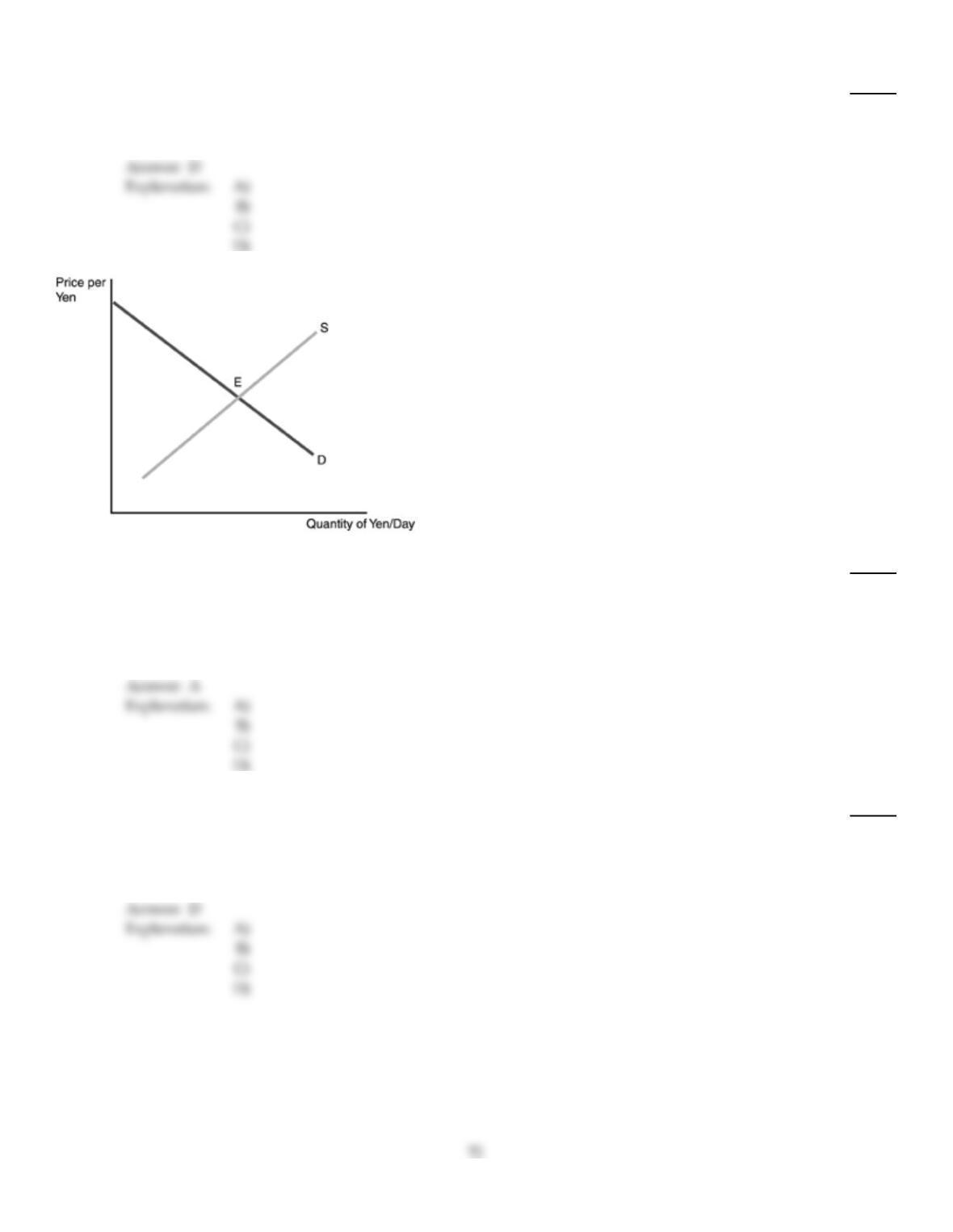
Refer to the above figure. Suppose E is the original equilibrium. An increase in the demand for
dollars will be reflected in this figure by
278)
A)
an increase in the supply of yen as Japan tries to buy more U.S. goods.
B)
an increase in the demand for yen as both imports and exports increase.
C)
a decrease in the demand for yen as the U.S. balance of payments improves.
D)
a decrease in the supply of yen as Japan is able to pay less for U.S. goods.
279)
As the dollar price of a euro falls
279)
A)
French residents will increase their purchases of U.S. assets.
B)
U.S. residents will purchase fewer French imports.
C)
the quantity of euros supplied will increase.
D)
French goods will be less expensive to U.S. residents.