155)
Any transaction that leads to a payment by a country’s residents or government is a(n)
155)
A)
asset.
B)
surplus item.
C)
debt.
D)
deficit item.
156)
In international trade, all payments and gifts that are related to the purchase or sale of both goods
and services are referred to as the
156)
A)
labor account.
B)
official reserve transactions account.
C)
capital account.
D)
current account.
157)
A summary of a country’s economic transactions with foreign residents and governments is called
the
157)
A)
balance of trade.
B)
current account balance.
C)
balance of payments.
D)
capital account balance.
158)
The balance of payments is
158)
A)
a summary record of the financial transactions of a country’s government with foreign
governments.
B)
a summary record of a country‘s purchases and sales of goods and services in the world
market.
C)
a summary record of a country’s economic transactions with foreign residents and
governments.
D)
a summary record of a country’s imports and exports of goods with foreign residents and
governments.
159)
The possibility that changes in the value of a nation’s currency will result in variations in the
market value of a business’s assets is referred to as
159)
A)
foreign exchange risk.
B)
transaction risk.
C)
hedge risk.
D)
conversion risk.
160)
All of the following are surplus items on the balance of payments accounts EXCEPT
160)
A)
sales of U.S. dollars to foreign residents.
B)
exports of merchandise.
C)
foreign tourists spending funds in the United States.
D)
U.S. residents purchases of gold from foreign residents.
161)
Under a flexible exchange rate system, a decrease in the value of a domestic currency in terms of
foreign currencies is referred to as
161)
A)
a revaluation.
B)
a depreciation.
C)
an appreciation.
D)
a devaluation.
162)
If interest rates in the European Union decrease
162)
A)
the demand for euros will fall in the foreign exchange market.
B)
nothing will change in the foreign exchange market.
C)
the supply of U.S. dollars will fall in the foreign exchange market.
D)
the demand for U.S. dollars will fall in the foreign exchange market.
163)
Current account transactions are payments and gifts that are related to the purchase or sale of
163)
A)
both goods and services.
B)
services only.
C)
goods only.
D)
financial instruments only.
164)
Under flexible exchange rates, the exchange rate is set by
164)
A)
the International Monetary Fund.
B)
the U.S. Federal Reserve’s Board of Governors.
C)
negotiations among central banks of the major industrial powers.
D)
the intersection of demand and supply curves in the currency markets.
165)
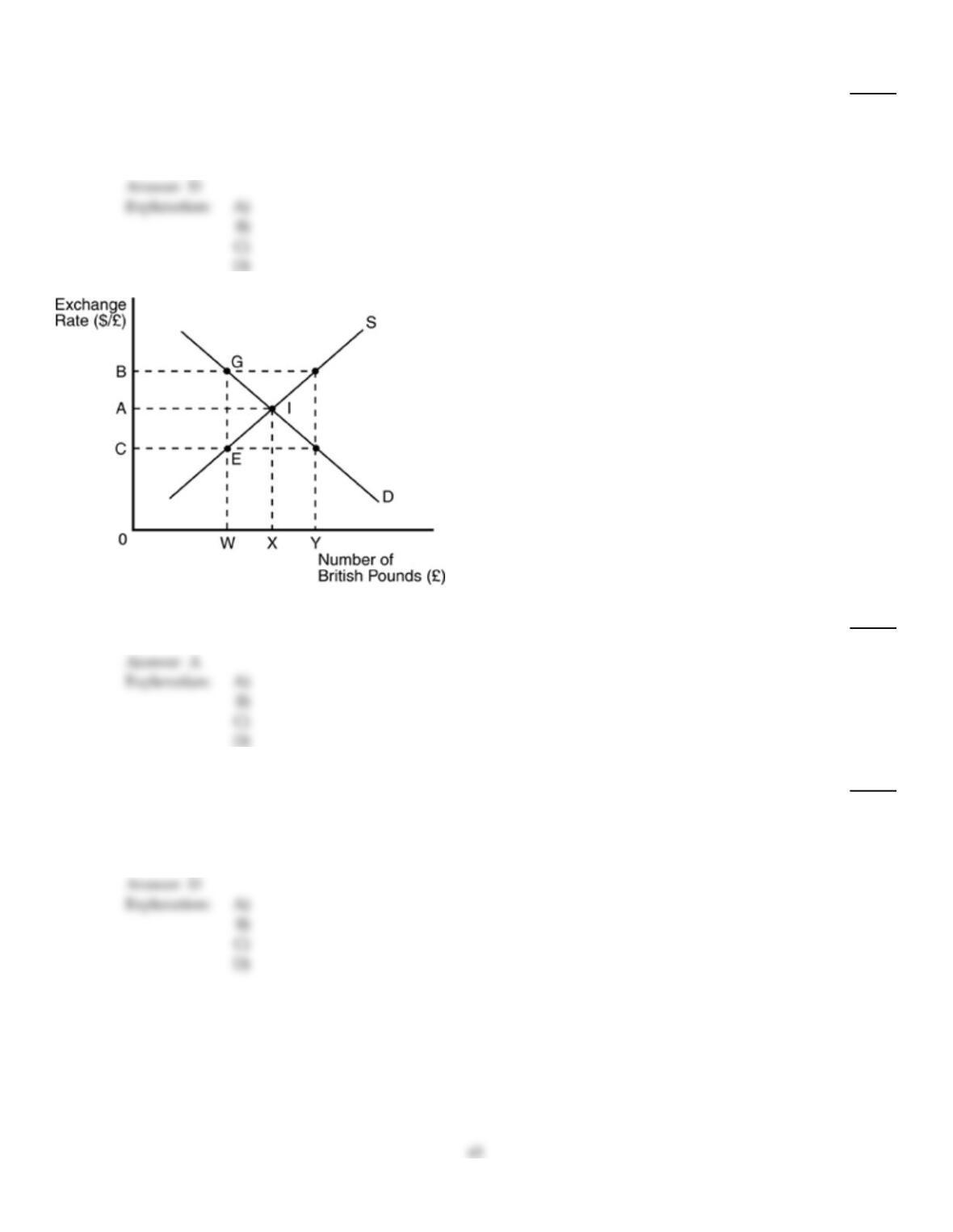
In the above figure, the equilibrium exchange rate between U.S. dollars and British pounds is
165)
A)
A.
B)
B.
C)
C.
D)
W.
A
166)
Which of the following would NOT increase German exports to the United States?
166)
A)
a depreciation of the euro
B)
an appreciation of the U.S. dollar
C)
an increase in German demand for U.S. exports
D)
an appreciation of the euro
D
D
167)
A key objective of the gold standard was to
167)
A)
create a flexible exchange rate system between countries.
B)
allow nations to tax its citizens in gold.
C)
create a fixed exchange rate system between countries.
D)
allow nations to maintain their gold reserves.
168)
In the balance of payments, the buying and selling of real and financial assets is represented in
168)
A)
labor account.
B)
capital account.
C)
current account.
D)
official reserve transactions account.
B
169)
When a Mexican resident buys a ukulele from a U.S. producer, there is a(n)
169)
A)
increase in the supply of dollars in the foreign exchange market.
B)
increase in the demand for dollars in the foreign exchange market.
C)
decrease in the supply of dollars in the foreign exchange market.
D)
decrease in the demand for dollars in the foreign exchange market.
B
170)
In the balance of payments, any transaction that leads to a receipt by a resident of a country or its
government is a(n)
170)
A)
surplus item.
B)
asset.
C)
minus item.
D)
deficit item.
A
C
171)
Suppose the Canadian central bank wants to keep the exchange rate of the Canadian dollar with
the U.S. dollar constant over time. An increase in the demand for Canadian goods by American
residents will lead the Canadian central bank to
171)
A)
sell American goods in exchange for Canadian dollars.
B)
increase the demand for Canadian dollars in the foreign exchange market.
C)
increase the supply of Canadian dollars in the foreign exchange market.
D)
buy more Canadian goods with Canadian dollars.
172)
A resident of the U.S. just purchased a share of stock on the London stock market. As far as the U.S.
balance of payments this purchase will
172)
A)
be entered as a unilateral transfer in the current account.
B)
be entered in the capital account.
C)
have no influence on the balance of payments since stock is not a good or service.
D)
require special drawing rights.
173)
At the Bretton Woods conference, all currencies were given
173)
A)
a floating value.
B)
a fixed value.
C)
a variable value.
D)
a par value.
174)
Jane has just sent a gift that was made in the U.S. to her relatives in Italy. As far as the balance of
payments is concerned this gift will
174)
A)
be considered an export since it has left the U.S.
B)
be part of the capital account since the gift is a physical item.
C)
be part of the current account as a unilateral transfer.
D)
have no influence on the balance of payments since it was made in the U.S.
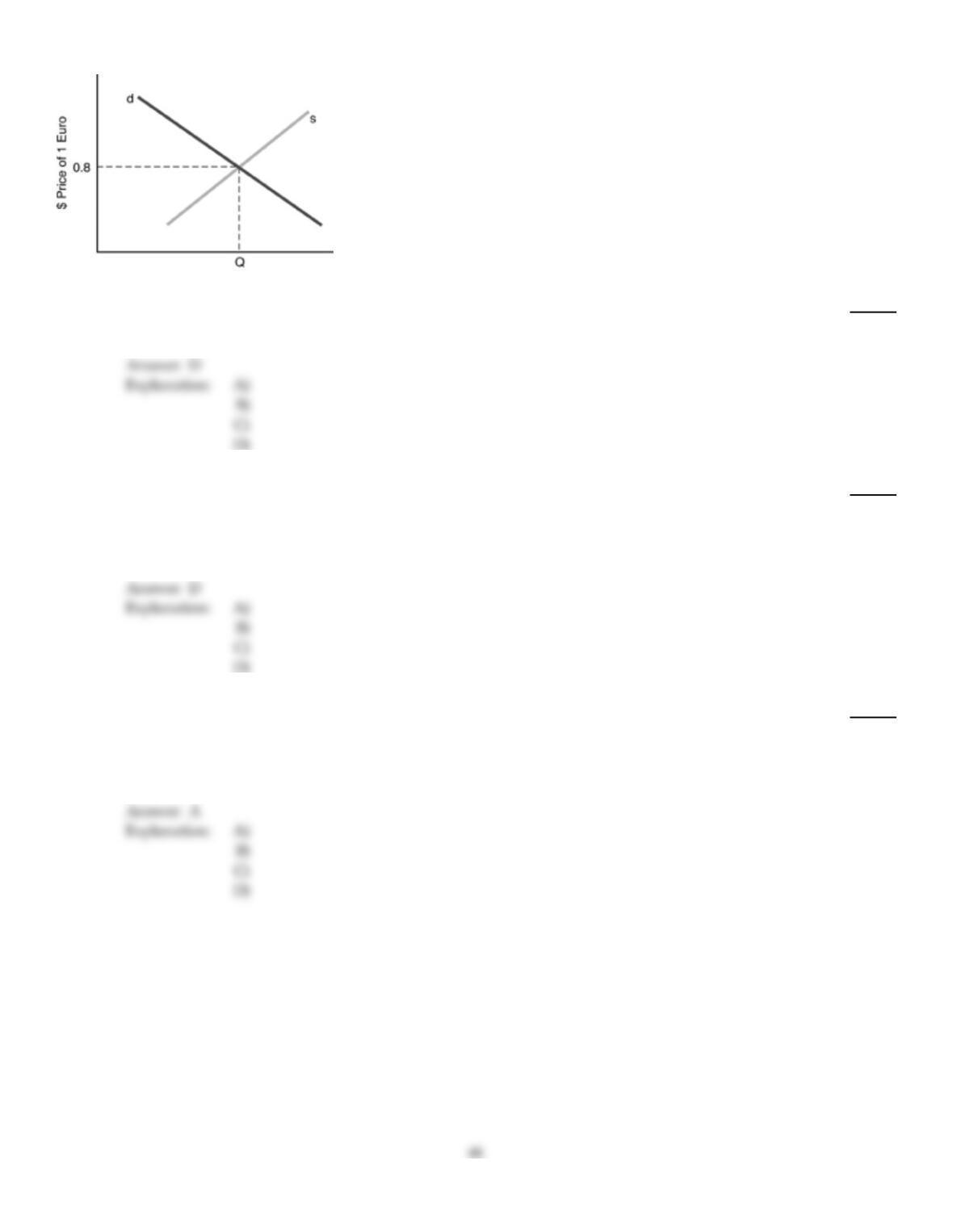
175)
Use the above figure. At equilibrium, the exchange rate is
175)
A)
$1 = 8 euros.
B)
1 euro = $1.25.
C)
$0.80 = 1.25 euro.
D)
$1 = 1.25 euro.
176)
Which of the following will cause a change in the exchange rate?
176)
A)
changes in consumer preferences
B)
changes in real interest rates
C)
changes in the perception of economic stability
D)
all of the above
177)
If there is unrest in the Middle East, and Saudi Arabian investors purchase German securities, the
177)
A)
supply of Saudi Arabian currency will rise.
B)
supply of Saudi Arabian currency will fall.
C)
demand for Saudi Arabian currency will fall.
D)
demand for Saudi Arabian currency will rise.
Hypothetical Data for Nation “A” in Billions of Local Currency
Exports of goods 50
Imports of goods –100
Exports of services 80
Imports of services –20
Net unilateral transfers –25
Capital account 100
Official reserve transaction accounts –85
178)
Refer to the above table. Nation “A” has a current account
178)
A)
deficit of 60.
B)
deficit of 15.
C)
surplus of 60.
D)
surplus of 15.
179)
All of the following are deficit items in the balance of payments accounts EXCEPT
179)
A)
U.S. tourists spending funds in Europe.
B)
exports of merchandise.
C)
U.S. purchases of foreign companies’ stocks and bonds.
D)
U.S. residents purchases of gold from foreign residents.
180)
Flexible exchange rates occur when
180)
A)
speculators bet that a currency will soon depreciate.
B)
governments and central banks spend foreign exchange to prop an exchange rate at a certain
level.
C)
exchange rates are determined by forces of supply and demand.
D)
no one knows the true value of a currency.
181)
The demand curve for Japanese yen will shift to the right when
181)
A)
there is a decrease in the demand for U.S.–made goods in Japan.
B)
there is an increase in the demand for Japanese–made goods in the United States.
C)
there is no change in the demand for Japanese–made goods in the United States.
D)
there is a decrease in demand for Japanese–made goods in the United States.
182)
A citizen of Mexico who has lived in El Paso during the past three years has just sent $100 to
relatives in Mexico for Christmas. This transaction is
182)
A)
counted in the U.S. balance of payments as an export item.
B)
counted in the U.S. balance of payments as a current account item.
C)
counted in the U.S. balance of payments as a surplus item.
D)
none of the above.
183)
Which of the following is NOT a deficit item on a country’s balance of payments?
183)
A)
gold sales to foreigners
B)
a personal gift to a foreign individual
C)
imports
D)
none of the above
D
184)
If the dollar used to buy 360 yen and now buys 100 yen, there has been
184)
A)
appreciation of the dollar.
B)
depreciation of the yen.
C)
depreciation of the dollar.
D)
a decrease in the demand for yen.
C
185)
A hedge is
185)
A)
an exchange rate arrangement in which a country pegs the value of its currency to the
exchange value.
B)
the possibility that changes in the value of a nation’s currency will result in variations in the
market value of assets.
C)
active management of a floating exchange rate on the part of a country’s government.
D)
a financial strategy that reduces the change of suffering losses arising from foreign exchange
risk.
D
B
186)
Under the gold standard, because all currencies had values fixed in units of gold
186)
A)
exchange rates were essentially floating.
B)
exchange rates were set to a crawling peg.
C)
exchange rates were essentially fixed.
D)
none of the above
187)
Which of the following is an advantage of fixing exchange rates?
187)
A)
eliminating trade deficits
B)
making residents more mobile across countries
C)
making the prices of foreign goods more flexible in the domestic market
D)
limiting foreign exchange risk
D
188)
The gold standard is a type of
188)
A)
fixed exchange rate system.
B)
floating exchange rate system.
C)
managed exchange rate system.
D)
flexible exchange rate system.
A
189)
In the balance of payments, a deficit item is any transaction
189)
A)
that makes residents of a country worse off.
B)
that leads to a payment by a resident of a country or its government.
C)
that is an export of a good or service.
D)
that leads to a receipt by a resident of a country or its government.
B
C
190)
The foreign exchange market is
190)
A)
the decrease in the exchange value of one nation’s currency in terms of another nation.
B)
a market in which households, firms, and governments buy and sell national currencies.
C)
a market in which exchange rates are allowed to fluctuate in the open market in response to
changes in supply and demand.
D)
the increase in the exchange value of one nation’s currency in terms of an other nation.
191)
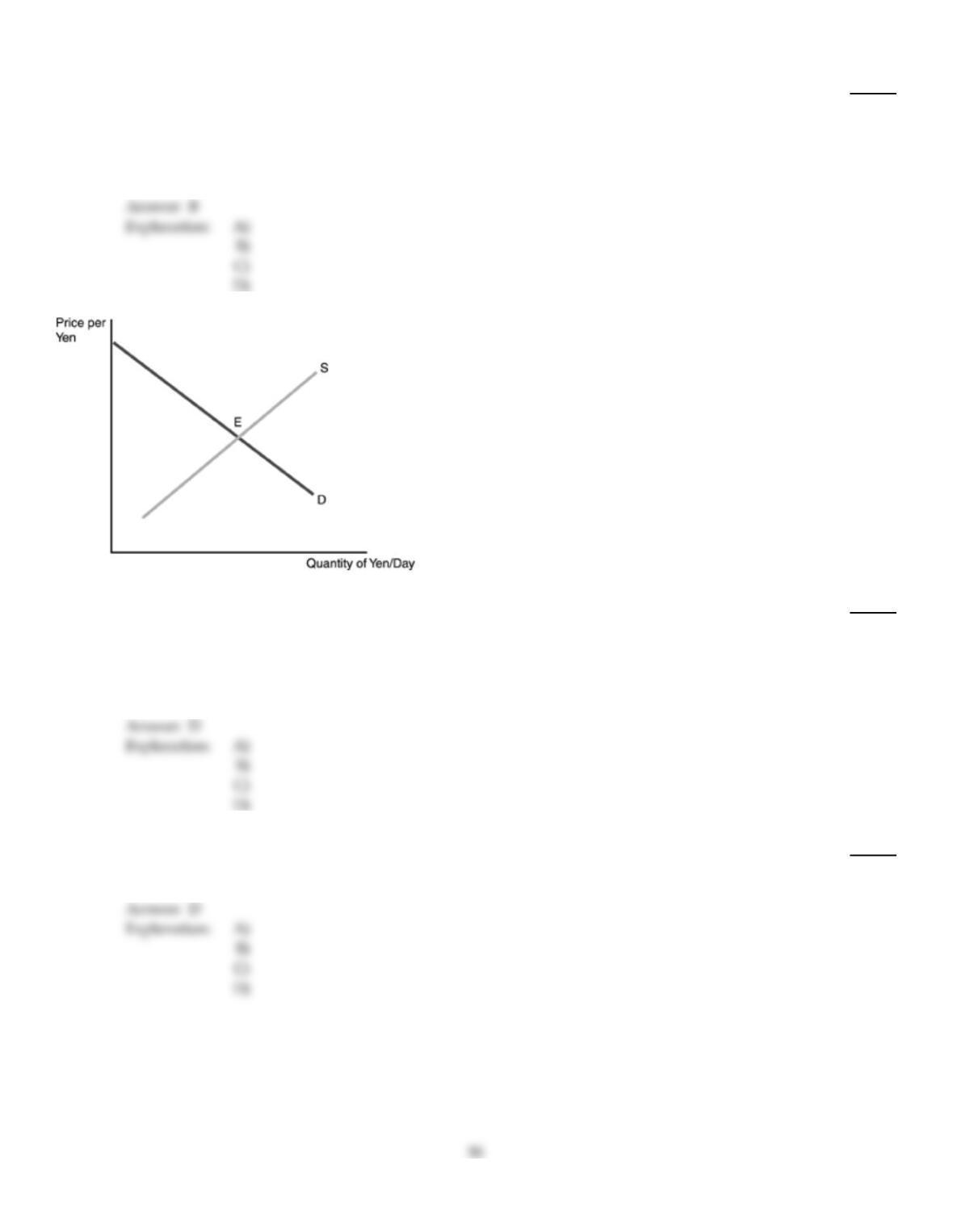
Refer to the above figure. Suppose E is the original equilibrium. Japanese residents have increased
their demand for U.S. goods. This will lead to
191)
A)
a depreciation of the yen and an increase in the quantity of yens sold per week.
B)
an appreciation of the yen and a decrease in the quantity of yens sold per week.
C)
a depreciation of the yen and a decrease in the quantity of yens sold per week.
D)
an appreciation of the yen and an increase in the quantity of yens sold per week.
192)
When there is a current account deficit, it is likely that
192)
A)
the country has a budget surplus.
B)
exports exceed imports for the country.
C)
the country is an exporter of capital.
D)
the capital account has a surplus.
193)
An example of a unilateral transfer is
193)
A)
a gift to a relative who lives abroad.
B)
a check received in payment for an import.
C)
SDR payments to world creditors.
D)
gold payments to foreign companies.
194)
The balance of trade is defined as
194)
A)
the difference between the value of services exported and the value of services imported.
B)
the difference between the value of goods exported and the value of goods imported.
C)
the difference between the value of goods and services exported and the value of goods and
services imported.
D)
none of the above.
B
195)
Checking exchange rates, you find $1 equals 0.75 euros. Then the price of 1 euro is
195)
A)
$0.75.
B)
$4.30.
C)
$0.25.
D)
$1.33.
D
196)
To prevent the dollar from depreciating, the U.S. central bank can try to fix the currency value of
the dollar when they
196)
A)
sell U.S. dollars in the foreign exchange market.
B)
abandon the U.S. dollar and use another country’s currency as its legal currency.
C)
buy U.S. dollars in the foreign exchange market.
D)
buy foreign currencies in the foreign exchange market.
C
197)
The foreign exchange system that has the highest foreign exchange risk is
197)
A)
the dirty floating exchange rate.
B)
the floating exchange rate.
C)
the Bretton Woods system.
D)
the fixed exchange rate.
B
A
198)
An increase in the U.S. interest rate will most likely
198)
A)
provide a stimulus to U.S. export industries.
B)
reduce the attractiveness of investment in the United States.
C)
lead to a decrease in the value of the U.S. dollar.
D)
lead to an inflow of funds to the United States and an appreciation of the dollar.
199)
All of the following are deficit items in the balance of payments EXCEPT
199)
A)
purchases of foreign assets.
B)
foreign tourist expenditures.
C)
imports of merchandise.
D)
purchases of foreign currency.
B
200)
The price of one currency in terms of another is the
200)
A)
price of gold.
B)
price of foreign stock.
C)
foreign exchange rate.
D)
price of a SDR.
C
201)
A surplus item is
201)
A)
the import or export of products that are by–products of the manufacturing of export goods.
B)
any transaction that leads to a payment by a resident of a country or its government.
C)
any transaction that leads to a receipt by a resident of a country or its government.
D)
the import of goods or services that is not needed by residents of a country.
C
D
202)
Foreign exchange risk is
202)
A)
an exchange rate arrangement in which a country pegs the value of its currency to the
exchange value.
B)
active management of a floating exchange rate on the part of a country’s government.
C)
the possibility that changes in the value of a nation’s currency will result in variations in the
market value of assets.
D)
a financial strategy that reduces the change of suffering losses arising from foreign exchange
risk.
203)
An important problem with the gold standard was that
203)
A)
a country did not have control of its domestic monetary policy.
B)
one country could easily manipulate the system to its advantage and the disadvantage of
other countries.
C)
exchange rates tended to fluctuate a great deal, making it difficult for businesses to make
long–run plans.
D)
it was too complicated and restricted business activity.
A
Hypothetical Data for Nation “A” in Billions of Local Currency
Exports of goods 50
Imports of goods –100
Exports of services 80
Imports of services –20
Net unilateral transfers –25
Capital account 100
Official reserve transaction accounts –85
204)
Refer to the above table. The overall balance of payments of Nation “A” is
204)
A)
– 85.
B)
+85.
C)
0.
D)
+25.
C
C
205)
In the balance of payments, if there are no statistical errors or discrepancies, which of the following
is TRUE of the sum of the capital account balance, the current account balance, and the official
reserve transactions account balance?
205)
A)
This sum is either positive or negative, depending on whether the sum of all surplus and
deficit items associated with cross–border transactions is positive or negative.
B)
This sum is positive only if the U.S. government operates with a budget deficit.
C)
This sum is positive only if the U.S. government operates with a budget surplus.
D)
This sum must always be zero, because the sum of all surplus and deficit items associated
with cross–border transactions must equal zero.
206)
Every transaction concerning the importation of goods into the United States constitutes a
206)
A)
supply of foreign currencies and a demand for dollars.
B)
demand for dollars with no effect on markets for foreign currencies.
C)
demand for foreign currencies and a supply of dollars.
D)
supply of foreign currency with no effect on the market for the dollar.
C
207)
Assume that $1 equals 100 yen (¥). A Japanese visitor to the United States wants to pay her $400
hotel bill. How many yen should she exchange in order to have enough dollars to pay the bill?
207)
A)
¥4,000
B)
¥40,000
C)
¥4
D)
¥40
B
208)
All of the following would be considered a current account transaction EXCEPT the
208)
A)
importing of services.
B)
importing of capital.
C)
exporting of goods.
D)
importing of goods.
B
D
209)
In the balance of payments, all of the following are deficit items EXCEPT
209)
A)
sales of dollars to foreigners.
B)
imports of merchandise.
C)
tourism expenditures abroad.
D)
funds placed in foreign depository institutions.
210)
Under the gold standard, when a nation had a deficit in its balance of payments,
210)
A)
interest rates would rise which would reduce foreign investment.
B)
gold would flow into the country leading to an increase in the domestic money supply.
C)
interest rates would fall which would increase foreign investment.
D)
gold would flow to foreign residents and the domestic money supply would decrease.
D
211)
Which of the following combinations is plausible for a nation’s balance of payments? (All numbers
in billions.)
211)
A)
current account = 50, capital account = – 30, official reserve transaction account = 20
B)
current account = 30, capital account = – 20, official reserve transaction account = – 10
C)
current account = 10, capital account = 40, official reserve transaction account = 50
D)
current account = 40, capital account = 20, official reserve transaction account = – 50
B
212)
A U.S. family flies from Boston to Shanghai on a China Airlines plane. This transaction is
212)
A)
considered an export of service in the U.S balance of payment accounts.
B)
a deficit item in the balance of payment accounts of China.
C)
Both of the above are correct.
D)
none of the above.
D
A
213)
One source of the supply of dollars in the world is
213)
A)
the sale of U.S. domestic assets to foreigner residents.
B)
the purchase of U.S. exports by foreign residents.
C)
U.S. sales of gold to foreigner residents.
D)
U.S. imports of foreign merchandise.
214)
The U.S. government suspended the convertibility of the dollar into gold in
214)
A)
the 1930s.
B)
1991, when the first Gulf War broke out.
C)
the 1950s.
D)
the 1970s.
215)
Which of the following transactions leads to an inflow of funds on the U.S. capital account?
215)
A)
A resident of Mexico visits the United States.
B)
A resident of China purchases U.S. government bonds.
C)
A U.S. resident purchases a share of stock on the Hong Kong exchange.
D)
A U.S. resident sells wheat to an African nation.
216)
Today, the most common exchange rate arrangement in the world is
216)
A)
the fixed exchange rate system.
B)
the freely floating exchange rate system.
C)
the managed floating system.
D)
the gold standard system.
217)
Which of the following items is NOT a deficit item in the balance of payments?
217)
A)
purchases of gold from foreigners
B)
imports of merchandise
C)
military spending abroad
D)
sales of domestic assets to foreigners
218)
Caitlin has just decided to order a computer that is made in Japan. She needs to convert U.S. dollars
for Japanese yen. This conversion takes place in the
218)
A)
SDRs.
B)
foreign exchange markets.
C)
International Monetary Fund.
D)
target zone.
219)
According to the text, over 40 percent of member nations of the International Monetary Fund have
219)
A)
an independently floating exchange rate.
B)
a managed floating exchange rate.
C)
a fixed exchange rate.
D)
no separate legal currency.
220)
The demand for Canadian cheese by a U.S. store is also a
220)
A)
demand for SDRs.
B)
demand for Canadian dollars.
C)
supply of Canadian dollars.
D)
supply of U.S. dollars.
221)
If the dollar used to buy 100 yen and now buys 360 yen, there has been
221)
A)
appreciation of the yen.
B)
an increase in special drawing rights.
C)
depreciation of the dollar.
D)
appreciation of the dollar.
222)
Flexible exchange rates are determined by
222)
A)
the IMF.
B)
the government of the importing country.
C)
the forces of supply and demand.
D)
the government of the exporting country.
223)
Which of the following is a deficit item on the balance of payments?
223)
A)
purchases of foreign assets
B)
sales of gold to foreigners
C)
foreign tourist dollars spent domestically
D)
exports of merchandise
224)
If there is an outward shift in U.S. demand for French goods, the result will be
224)
A)
a decrease in the dollar price of a euro.
B)
a decrease in euros traded.
C)
an inward shift in French demand for U.S. goods.
D)
an increase in the dollar price of a euro.
225)
If there is unrest in the Middle East that threatens the economic stability of Saudi Arabia, the
225)
A)
demand for Saudi Arabian currency will fall.
B)
supply of Saudi Arabian currency will rise.
C)
demand for Saudi Arabian currency will rise.
D)
supply of Saudi Arabian currency will fall.
226)
An example of an import of a service in the U.S. balance of payments would be when
226)
A)
a U.S. resident buying insurance from a firm in Toronto.
B)
an U.S. resident purchases a Japanese stereo.
C)
a Norwegian traveling in the United States rides a trolley car in San Francisco.
D)
a U.S. firm purchases 100 shares of a Dutch firm.
227)
Assume the U.S. government wants to hold the value of the dollar at $1.00 U.S. equals 10 Chinese
yuan, but it finds that the value of yuan is depreciating against the U.S. dollar. What would be an
appropriate policy to reverse this trend?
227)
A)
Increase government spending within the U.S.
B)
Increase the money supply in the U.S.
C)
Buy U.S. dollars.
D)
Sell U.S. dollars.
228)
The foreign exchange rate describes the
228)
A)
law of comparative advantage.
B)
balance of payments.
C)
price of foreign currency in terms of domestic currency.
D)
balance of trade.
C
Country X2015 Transactions (billions of dollars)
Exports of goods $100
Net Unilateral Transfers –10
Imports of Services –50
Official Transactions –45
Capital Inflows 150
Imports of Goods –200
Exports of Services 125
Capital Outflows –70
229)
In the above table, the fact that there is a minus sign before the number for unilateral transfers
means that
229)
A)
Country X imported more goods than it exported.
B)
Country X has significant inflation.
C)
Country X received more in foreign aid than it gave in foreign aid.
D)
Country X gave more to foreign residents than foreign residents gave to Country X.
D
D
230)
If U.S. residents boycotts French goods, this will
230)
A)
increase the demand for euros in the foreign exchange market.
B)
have no effect on the euro.
C)
reduce the demand for euros in the foreign exchange market.
D)
cause the euro to appreciate.
Country X2015 Transactions (billions of dollars)
Exports of goods $100
Net Unilateral Transfers –10
Imports of Services –50
Official Transactions –45
Capital Inflows 150
Imports of Goods –200
Exports of Services 125
Capital Outflows –70
231)
In the above table, the trade balance on goods and services for Country X is ________ billion
dollars.
231)
A)
–25
B)
–100
C)
+100
D)
+25
A
232)
In the above table, the balance on the current account for Country X is ________ billion dollars.
232)
A)
–200
B)
–75
C)
+75
D)
–35
D
233)
In a fixed exchange rate system
233)
A)
market forces and the country’s stock of gold determine its exchange rate.
B)
market forces play a role in determining the fixed value of a currency.
C)
a central bank affects the value of a currency by changing its foreign exchange reserves.
D)
the International Monetary Fund determines exchange rates.
C
C