81)
An example of a deficit item on the U.S. balance of payments is
81)
A)
a U.S. resident flies from New York to Rome on British Airways.
B)
the sale of a carburetor made in Michigan to a Honda plant in Ohio.
C)
a deposit in a bank in New York by a British firm.
D)
the payment of a dividend from a Canadian firm to an American living in Maine.
82)
The legally established value of a country’s monetary unit in terms of another under the Bretton
Woods system was called the
82)
A)
special draw.
B)
exchange rate.
C)
dirty float.
D)
par value.
D
83)
Which of the following is a deficit item in the U.S. current account?
83)
A)
Toyota builds a new plant in California.
B)
Many U.S. residents who previously had not traveled abroad decide to make Mexico a tourist
destination.
C)
Sony buys a new film studio in Florida.
D)
A Saudi Arabian prince builds six new homes in California.
B
84)
When the value of exports exceeds the value of imports then
84)
A)
international trade is in balance.
B)
changes in productivity will occur.
C)
the country is running a trade deficit.
D)
the country is running a trade surplus.
D
85)
The U.S. balance of payments status may improve when
85)
A)
political instability in other countries increases.
B)
the American government increases its spending on foreign aid.
C)
the inflation rate increases in the United States relative to other countries.
D)
the world demand for U.S. products falls.
A
A
86)
The official reserve account includes all of the following EXCEPT
86)
A)
silver and other precious metals.
B)
gold.
C)
foreign currencies.
D)
SDRs.
87)
Assets that the IMF created to be used by countries to settle international payment obligations are
called
87)
A)
gold reserves.
B)
foreign currency reserves.
C)
special drawing rights.
D)
capital intervention accounts.
Hypothetical Data for Nation “A” in Billions of Local Currency
Exports of goods 50
Imports of goods –100
Exports of services 80
Imports of services –20
Net unilateral transfers –25
Capital account 100
Official reserve transaction accounts –85
88)
Refer to the above table. Nation “A” has a balance of trade
88)
A)
deficit of 50.
B)
surplus of 10.
C)
deficit of 10.
D)
surplus of 50.
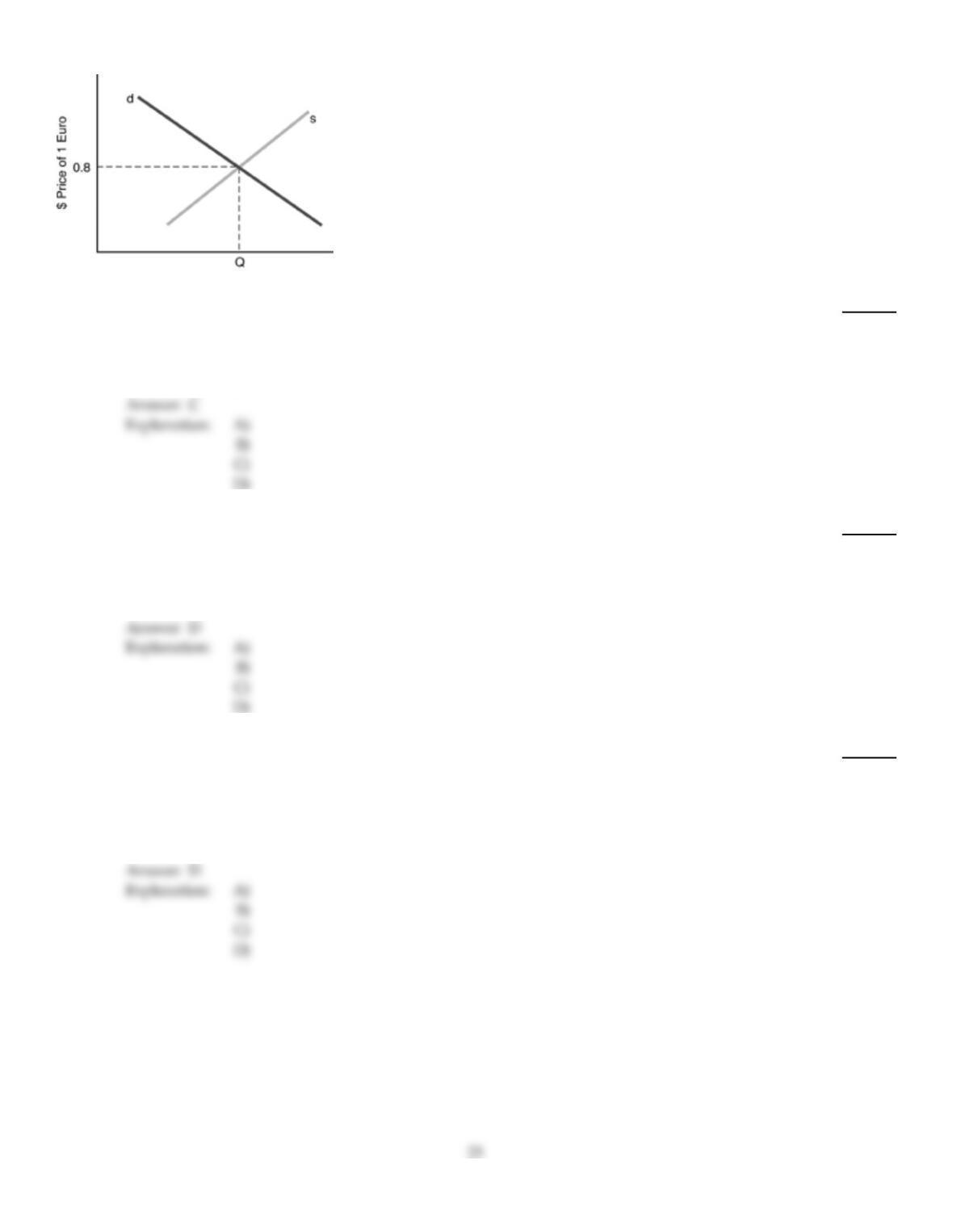
89)
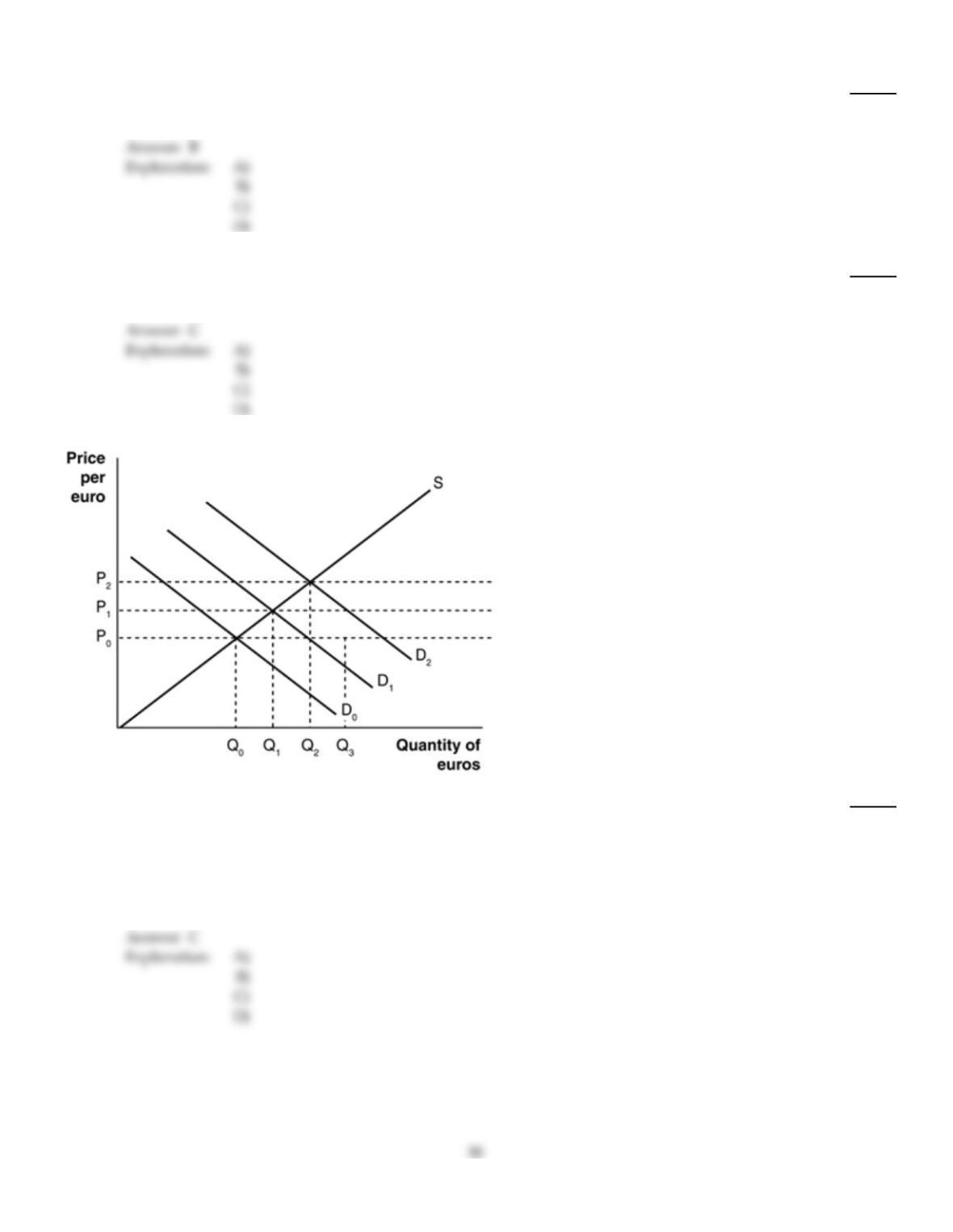
Use the above figure. A leftward shift in the demand curve, ceteris paribus, would result in
89)
A)
a euro appreciation.
B)
increasing the equilibrium quantity of the euro.
C)
a dollar appreciation.
D)
a dollar depreciation.
90)
If the inflation rate in Japan is higher than the inflation rate in the United States
90)
A)
there will be no change is U.S. imports from Japan.
B)
there will be an increase in Japanese exports to the United States.
C)
there will be an increase in U.S. imports from Japan.
D)
there will be a decrease in U.S. imports from Japan.
D
91)
Suppose economic stability in the United States increases. This will tend to cause which of the
following to occur?
91)
A)
Nothing will change in the foreign exchange market.
B)
The supply of U.S. dollars will rise in the foreign exchange market.
C)
The demand for euros will rise in the foreign exchange market.
D)
The demand for U.S. dollars will rise in the foreign exchange market.
D
C
92)
The major factor affecting a nation’s balance of payments is
92)
A)
its stock market movements.
B)
its rate of inflation relative to the rate of inflation of its trading partners.
C)
an increase in its rate of unemployment.
D)
a change in the productivity of its labor.
93)
Suppose that the current exchange rate between the dollar and peso is $1 equals 10 pesos. If a firm
in Mexico wanted to purchase $100,000 worth of U.S. televisions, how many pesos must they
exchange?
93)
A)
11,000,000 pesos
B)
10,000 pesos
C)
100,000 pesos
D)
1,000,000 pesos
94)
All of the following are market determinants of exchange rates EXCEPT
94)
A)
changes in real interest rates in one country relative to another.
B)
changes in product preferences between countries.
C)
changes in the relative prices of goods and services within a country.
D)
changes in productivity in one country relative to another.
95)
If residents of the United States give more gifts to relatives abroad than they receive, unilateral
transfers will be
95)
A)
negative.
B)
positive.
C)
unaffected.
D)
zeroed out.
96)
A reduction in a country’s rate of inflation should
96)
A)
increase its exports.
B)
lead to an outflow of SDRs.
C)
increase its imports.
D)
lead to a negative trade balance.
97)
Unilateral transfers are
97)
A)
government transactions that involve reserves.
B)
transactions that take place across geographic boundaries but in which both participants are
citizens of the same country.
C)
gifts from residents of one country to foreign residents.
D)
transactions that take place within the geographic boundaries of a country.
98)
The exchange rate for a foreign currency that is determined by supply and demand is
98)
A)
a constrained exchange rate.
B)
a flexible exchange rate.
C)
a fixed exchange rate.
D)
a controlled exchange rate.
B
99)
A depreciation of a nation’s currency is
99)
A)
the increase in the exchange value of one nation’s currency in terms of an other nation.
B)
a nation in which households, firms, and governments buy and sell national currencies.
C)
the decrease in the exchange value of one nation’s currency in terms of another nation.
D)
a situation in which exchange rates are allowed to fluctuate in the open market in response to
changes in supply and demand.
C
100)
With a pure gold standard
100)
A)
a balance of payments deficit will lead to an increase in the domestic price level.
B)
an inflow of gold will reduce the money supply of a country.
C)
there will be a tendency for a too rapid increase in the volume of world trade.
D)
a nation may not pursue an independent monetary policy.
D
C
101)
If the current account is in deficit, we know that
101)
A)
the capital account is in surplus.
B)
the merchandise trade balance is in surplus.
C)
there is a statistical discrepancy in the surplus.
D)
the merchandise trade balance is also in deficit.
102)
Exchanging dollars for euros to pay a computer manufacturer in Belgium would occur
102)
A)
at the Federal Reserve.
B)
at the European Central Bank.
C)
in the letter of credit market.
D)
in the foreign exchange market.
103)
Which of the following statements is TRUE about the role of gifts given to U.S. citizens from foreign
residents?
103)
A)
Gifts are not included in the balance of payments because of the nature of the gift.
B)
Gifts are only included in the balance of payments if the gift is given to a government official.
C)
Gifts given to U.S. citizens are not included in the balance of payments but gifts given to
foreigners are included.
D)
Gifts are included in the balance of payments.
104)
Net unilateral transfers would appear in a nation’s
104)
A)
current account.
B)
official reserve transaction account.
C)
capital account.
D)
financial account.
105)
Official reserve assets include all of the following EXCEPT
105)
A)
special drawing rights.
B)
gold.
C)
foreign currencies.
D)
gifts to foreign countries.
106)
Which of the following is NOT a deficit item on the international accounts balance sheet for a
country?
106)
A)
exports of merchandise
B)
imports of merchandise
C)
purchases of foreign currency
D)
military spending abroad
107)
Which of the following is an example of a surplus item on the balance of payments?
107)
A)
private gifts to foreign residents
B)
public gifts to foreign residents
C)
purchases of gold from foreign residents
D)
interest receipts from foreign residents
D
108)
The Japanese yen will appreciate against the dollar if
108)
A)
Japanese residents demand more U.S. goods.
B)
U.S. residents demand fewer Japanese goods.
C)
U.S. residents demand more Japanese goods.
D)
none of the above.
C
109)
Special Drawing Rights are
109)
A)
reserve assets created by the International Monetary Fund.
B)
financial assets held by the U.S. Treasury Department.
C)
the new currency for the European Union and a part of official reserves.
D)
credits provided by the World Bank that permits less developed countries to borrow
international reserves.
A
A
110)
An appreciation of the U.S. dollar relative to the Japanese yen causes
110)
A)
a lower dollar–price of Japanese goods which induces the U.S. to increase their purchasing of
Japanese goods.
B)
the quantity demanded of U.S. dollars to increase because the Japanese want to buy more U.S.
goods.
C)
the U.S. to buy less Japanese goods, causing the U.S. to depreciate.
D)
the Japanese to buy more U.S. goods, causing the dollars to appreciate further.
111)
Which of the following will lead to a depreciation of the U.S. dollar against the British pound?
111)
A)
a decrease in British demand for U.S. assets
B)
an increase in British demand for U.S. imports
C)
an increase in U.S. interest rates
D)
a decrease in U.S. demand for British goods
A
112)
Assume the U.S. government wants to hold the value of the dollar at $1.00 U.S. equals 100 Japanese
yen, but it finds that the value of yen is appreciating against the U.S. dollar. What would be an
appropriate policy to reverse this trend?
112)
A)
Sell U.S. dollars.
B)
Buy more Japanese goods.
C)
Buy U.S. dollars.
D)
Encourage U.S. investments abroad.
C
113)
The difference between exports and imports of goods is the
113)
A)
balance of trade.
B)
balance of paying.
C)
balance of accounts.
D)
balance of payments.
A
A
114)
An accounting identity is
114)
A)
when the balance of trade is in surplus or deficit.
B)
when the balance of payments is running a surplus or deficits.
C)
special drawing rights.
D)
an expression of values that are equivalent by definition.
115)
Every transaction concerning the exportation of U.S. goods constitutes a
115)
A)
demand for dollars, with no effect on markets for foreign currencies.
B)
supply of foreign currency and demand for dollars.
C)
supply of foreign currency, with no effect on the market for dollars.
D)
demand for foreign currency and a supply of dollars.
B
116)
The International Monetary Fund was created
116)
A)
in the aftermath of World War II to help nations move off of the gold standard.
B)
in 1971 when President Richard Nixon signed the Bretton Woods Agreement.
C)
in 1945 by the Bretton Woods Agreement.
D)
to collect money from member countries that were running balance of payments deficits.
C
117)
In the market for euros, the demand for euros (€) is
117)
A)
upward sloping, because at higher dollar prices for the euro, Europeans will buy more U.S.
goods and services.
B)
downward sloping, because at lower dollar prices for the euro, U.S. residents will buy more
European goods and services.
C)
horizontal, because dollar prices of euros and euro prices of dollars are directly related.
D)
upward sloping, because at higher dollar prices for the euro, U.S. residents will buy more
European goods and services.
B
D
118)
When a dinner in Bulgaria costs 150 Bulgarian levas, it will cost a U.S. resident ________ dollars, if
the exchange rate is 1.5 Bulgarian levas to the dollar.
118)
A)
$10
B)
$100
C)
$120
D)
$150
119)
The total of all economic transactions between a nation and the rest of the world is referred to as the
119)
A)
exchange rate.
B)
balance of power.
C)
balance of payments.
D)
balance of trade.
120)
In the above figure, suppose the value of the European euro is P1 and U.S. demand for French wine
declines. The effect on the franc can be shown by
120)
A)
an increase in the value of the euro to P2.
B)
a shift in the demand for euros from D1 to D0, but no change in the value of the euro.
C)
the decrease in the value of the euro to P0.
D)
the excess demand of euro equal to Q3– Q1.
121)
An example of a deficit item on the U.S. balance of payments is
121)
A)
the sale of a spark plug made by a U.S. firm in Michigan to a Nissan plant in Tennessee.
B)
a deposit in a bank in Chicago by the government of Saudi Arabia.
C)
the payment of a dividend by a British firm to a U.S. family.
D)
the purchase of Japanese yen by a U.S. firm.
122)
The market in which households, firms and governments buy and sell national currencies is known
as
122)
A)
standard drawing rights.
B)
the foreign exchange market.
C)
the exchange rate.
D)
flexible exchange rates.
123)
If the United States exports $250 billion worth of goods and imports $420 billion worth of goods
123)
A)
the balance of trade will be –$170 billion.
B)
the balance of trade will be $670 billion.
C)
the official reserve transaction will be $170 billion.
D)
the balance of payments will be –$170 billion.
124)
The supply of dollars in foreign exchange markets is
124)
A)
determined by the demand for U.S. goods.
B)
a function of the international banking system.
C)
determined by the U.S. demand for foreign goods.
D)
determined by the Federal Reserve’s Board of Governors.
125)
If a country moves from fixed to flexible exchange rates, its macroeconomic policy
125)
A)
is no longer restricted.
B)
is restricted, as it can only use monetary policy to achieve its economic goals.
C)
must follow policy directives from the IMF.
D)
is restricted, as it can only use fiscal policy to achieve its economic goals.
International Transactions
1. U.S. resident buys a Chinese camera $300
2. U.S. resident buys stock in a Chinese company 20,000
3. U.S. resident purchases insurance from a Chinese company 1,500
4. U.S. resident sends a present to someone in China 200
5. Chinese buys a U.S. car 30,000
6. Chinese family goes to Disney World in the U.S. 2,000
126)
Based on the transactions in the above table, what is the change in the U.S. balance of merchandise
trade?
126)
A)
–$31,000
B)
$11,000
C)
–$30,000
D)
$29,700
127)
Special drawing rights (SDRs) are
127)
A)
a country’s surpluses in their fiscal budgets.
B)
exchanges of gold between nations.
C)
a liability payment from a branch bank to a nation’s central bank.
D)
a reserve asset created by the International Monetary Fund that countries can use to settle
international payment obligations.
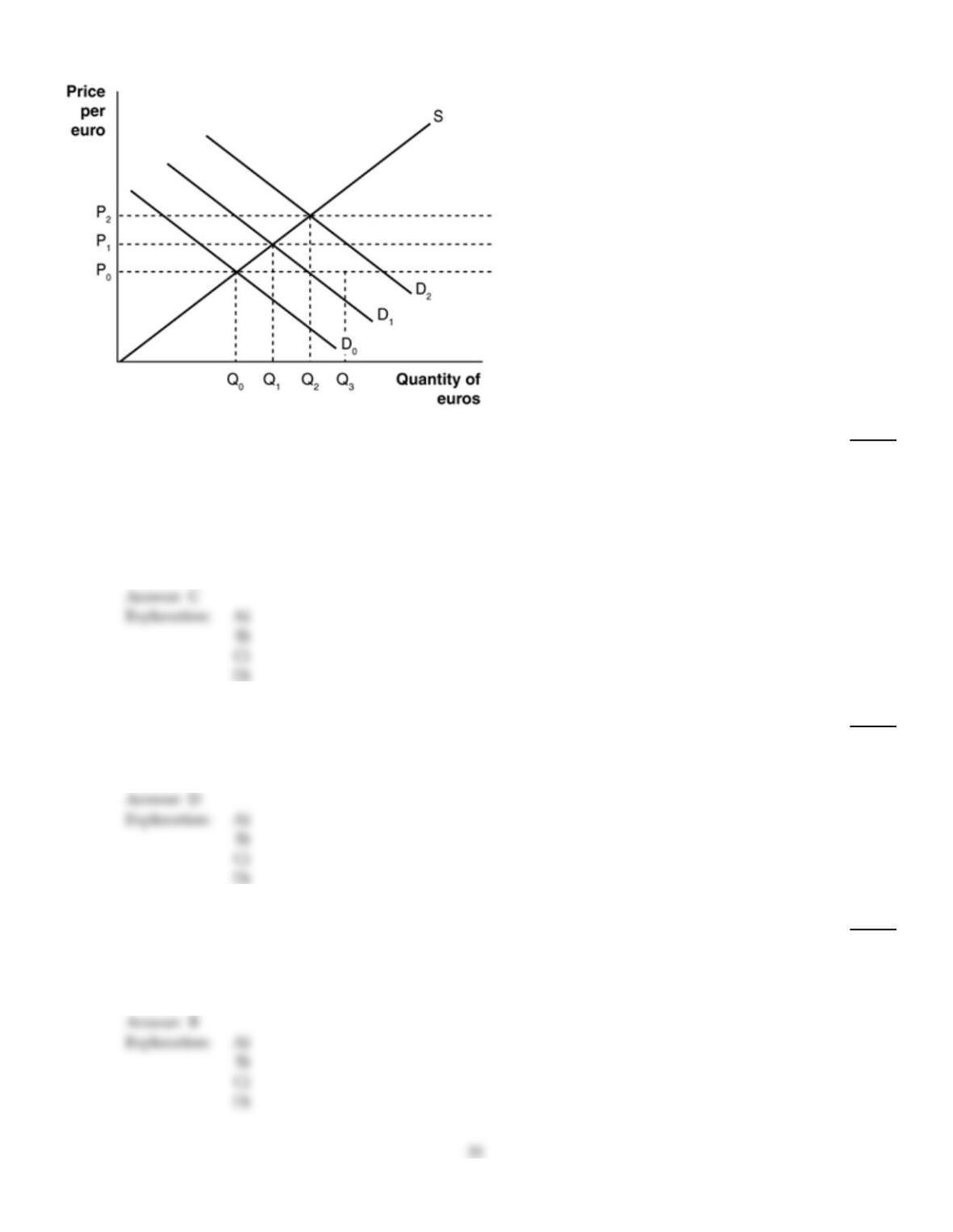
128)
In the above figure, which of the following is a possible explanation for the reduction in the
equilibrium value of the European euro from P2 to P1?
128)
A)
the European central bank’s decision to buy euros on the world market
B)
an increase in demand for French automobiles
C)
a decrease in the price of California wines, assuming that French wines and California wines
are substitutes
D)
an increase in the price of California wines, assuming that French wines and California wine
are substitutes
129)
When the supply and demand of currencies in the foreign exchange market determines their
relative values, this is known as
129)
A)
depreciation.
B)
fixed exchange rates.
C)
appreciation.
D)
flexible exchange rates.
D
130)
The demand for dollars will increase when
130)
A)
U.S. residents develop a taste for more imported products.
B)
U.S. labor productivity increases relative to the world.
C)
the world is perceived as more stable than it used to be.
D)
real interest rates in the United States fall.
B
C
131)
The balance of payments is
131)
A)
the value of merchandise goods bought and sold in the world market.
B)
a summary record of a country’s economic transactions with foreign residents and
governments.
C)
a summary record of a country‘s purchases and sales of goods and services in the world
market.
D)
the value of goods and services bought and sold in the world market.
132)
For the United States, suppose the value of exported goods is greater than the value of imported
goods. This implies that
132)
A)
the country is running a deficit in its balance of trade.
B)
the country is running a surplus in its balance of trade.
C)
the domestic currency will depreciate.
D)
the dollar price of foreign currency will increase.
133)
An accounting identity
133)
A)
applies only to plans of economic agents and not to their actual actions.
B)
is useless in analyzing balance of payments since one cannot tell from the identity whether an
equilibrium exists or not.
C)
ensures a balance but does not ensure an equilibrium.
D)
ensures that all balances will be in equilibrium.
134)
Capital account transactions occur
134)
A)
when an U.S. citizen purchases stock in an U.S. corporation.
B)
when you move money from one U.S. bank to another U.S. bank.
C)
because of cross–border flows of financial assets.
D)
when an U.S. company purchases goods from a foreign company.
135)
If the exchange rate is such that $1 equals 10 Mexican pesos, then the price of a peso is
135)
A)
$1.
B)
$0.20.
C)
$10.
D)
$0.10.
136)
Suppose the currency price of the U.S. dollar in terms of the Japanese yen starts to fall. To prevent
that from occurring, the U.S. central bank should
136)
A)
buy both U.S. dollars and yen in the foreign exchange market.
B)
sell U.S. dollars in the foreign exchange market in exchange for yen.
C)
use yen reserves to buy U.S. dollars in the foreign exchange market.
D)
use U.S. dollars to buy Japanese goods.
137)
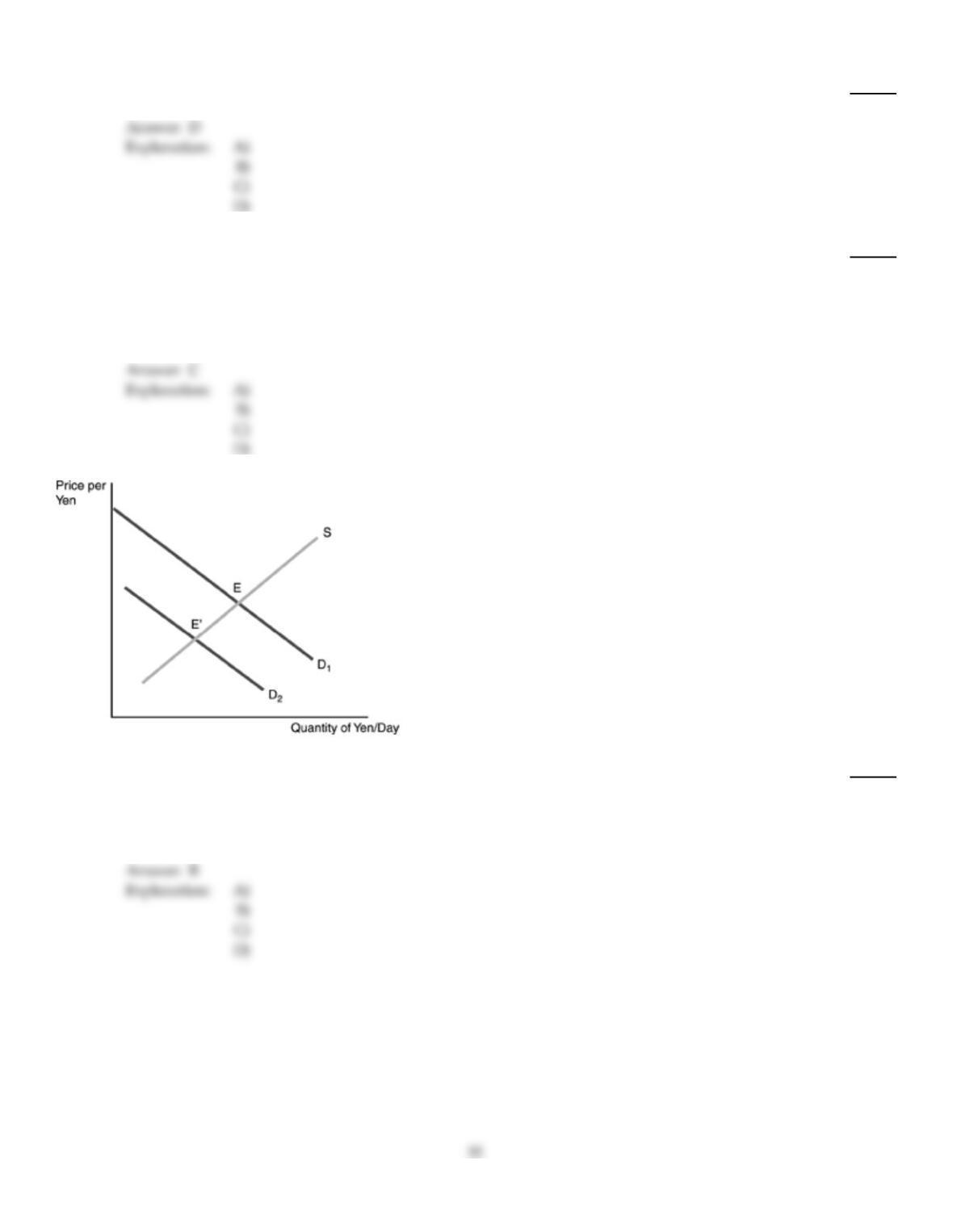
In the diagram above, which of the following could cause a movement from point E’ to point E?
137)
A)
The dollar depreciates, inducing Japanese residents to buy more U.S. goods.
B)
U.S. residents’ incomes rise, so they increase their purchases of Japanese goods.
C)
The dollar depreciates, inducing U.S. residents to buy more Japanese goods.
D)
Japanese residents’ incomes rise, so they increase their purchases of U.S. goods.
138)
If there is a negative sign in front of unilateral transfers for the United States, then
138)
A)
the United States had a negative balance of trade.
B)
the value of U.S. gifts to foreigners exceeded foreign gifts to U.S. residents.
C)
the United States imported more services than it exported.
D)
the United States imported more commercial financial assets than it exported.
139)
When there is political instability in another country, the United States can expect
139)
A)
an increase in the capital account balance due to an increase in the current account.
B)
a decrease in the balance of payments due to a decrease in the demand for goods and services.
C)
an increase in the capital account balance due to the movement of assets to the U.S.
D)
a decrease in the balance of payments due to a decrease in special drawing rights.
140)
To know whether a particular situation for a family, business, or government involves an
equilibrium or not, one must
140)
A)
understand the circumstances fully.
B)
determine whether the accounts are in balance.
C)
determine whether a particular portion of the accounts are in balance or not.
D)
determine whether the credits equal the debits.
141)
A system of accounts that measures the transactions of goods, services, income, and financial assets
between domestic households, businesses, and governments and residents of the rest of the world
during a specific time period is the
141)
A)
current account.
B)
capital account.
C)
balance of payments.
D)
balance of trade.
142)
Unilateral transfers are
142)
A)
gifts from a resident of one country to a resident in a foreign country.
B)
the payments of interest to residents of another country.
C)
government transactions that use gold and other official reserves.
D)
transactions that take place across national boundaries but in which both transactions are
citizens of the same country.
Country X2015 Transactions (billions of dollars)
Exports of goods $100
Net Unilateral Transfers –10
Imports of Services –50
Official Transactions –45
Capital Inflows 150
Imports of Goods –200
Exports of Services 125
Capital Outflows –70
143)
In the above table, the merchandise trade balance for Country X is ________ billion dollars.
143)
A)
–150
B)
+100
C)
+150
D)
–100
144)
Assume the following exchange rates for today: $1=140 yen and 1 Danish krone = $0.10. We can
conclude
144)
A)
1 kr. = 28 yen.
B)
1 yen = 280 kr.
C)
1 kr. = 14 yen.
D)
1 yen = 14 kr.
145)
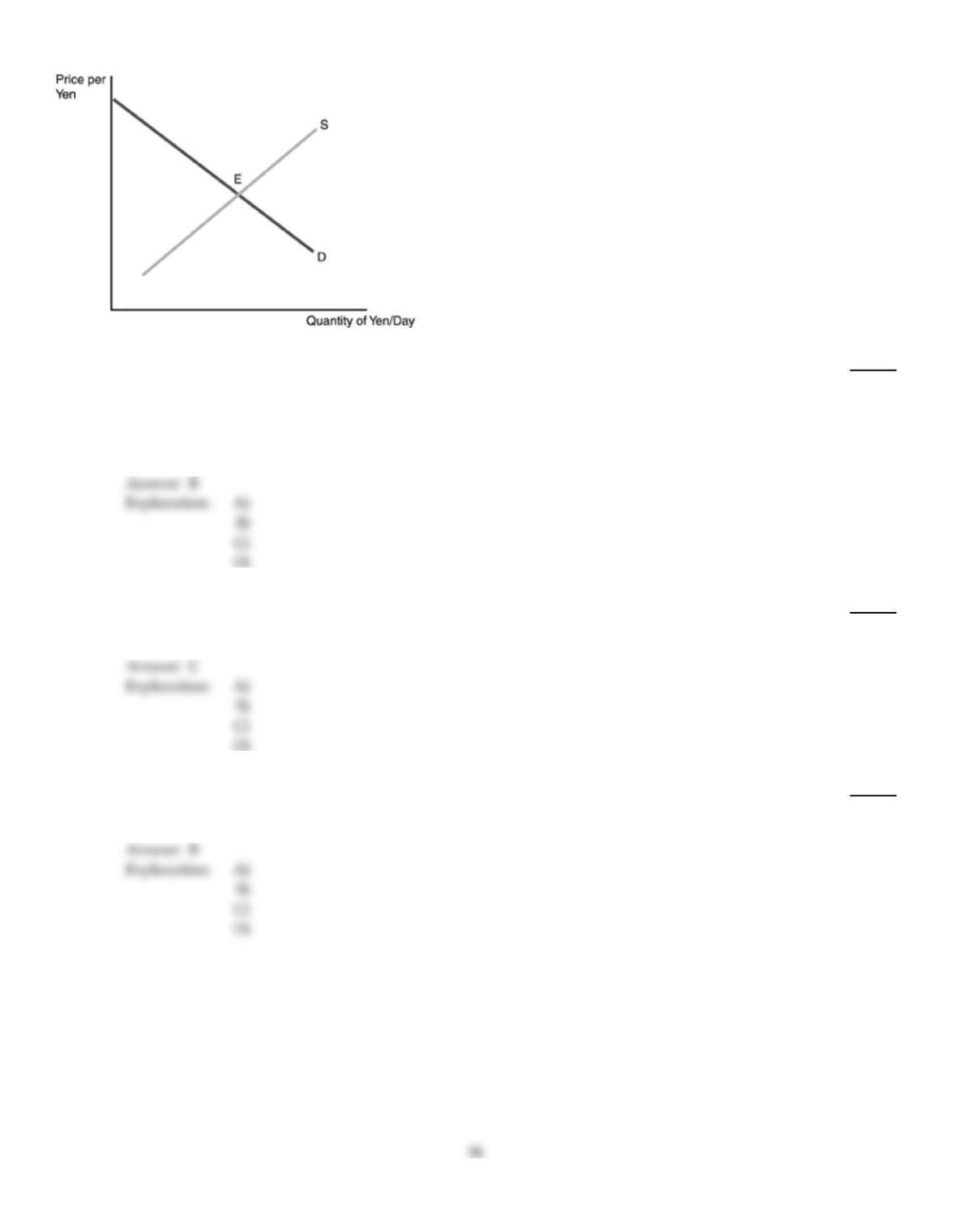
Refer to the above figure. Suppose E is the original equilibrium. An increase in the U.S. demand for
Japanese–made goods will lead to
145)
A)
an appreciation of the yen and a decrease in the quantity of yen sold per week.
B)
a depreciation of the yen and an increase in the quantity of yen sold per week.
C)
a depreciation of the yen and a decrease in the quantity of yen sold per week.
D)
an appreciation of the yen and an increase in the quantity of yen sold per week.
146)
The largest portion of any nation’s current account is typically
146)
A)
SDRs.
B)
gold sales.
C)
imports and exports.
D)
the sale of U.S. assets.
147)
An increase in the U.S. demand for Japanese yen causes
147)
A)
a decrease in the supply of yens.
B)
an increase in the dollar price of a yen.
C)
an increase in the demand for U.S. goods.
D)
an increase in the yen price of a dollar.
International Transactions
1. U.S. resident buys a Chinese camera $300
2. U.S. resident buys stock in a Chinese company 20,000
3. U.S. resident purchases insurance from a Chinese company 1,500
4. U.S. resident sends a present to someone in China 200
5. Chinese buys a U.S. car 30,000
6. Chinese family goes to Disney World in the U.S. 2,000
148)
Refer to the above table. Suppose the transactions in the table are added to a balance of payments
account that is already in balance. What will have to take place to keep the balance of payments in
balance?
148)
A)
Foreign governments will have to make official reserve transactions equal to –$10,000.
B)
Nothing will have to be done as the accounts are in equilibrium.
C)
Nothing will have to be done as the accounts are in balance.
D)
The U.S. government will have to make official reserve transactions equal to $10,000.
149)
The price of one currency in terms off another currency is called
149)
A)
foreign reserves.
B)
the foreign trade deficit.
C)
the foreign exchange rate.
D)
the balance of payments.
150)
In the market for euros, the supply of euros (€) is
150)
A)
upward sloping, because lower dollar prices of euros means that U.S. goods are cheaper to
Europeans.
B)
downward sloping, because lower dollar prices of euros mean that U.S. goods are cheaper to
Europeans.
C)
downward sloping, because higher dollar prices of euros mean that U.S. goods are cheaper to
Europeans.
D)
upward sloping, because higher dollar prices of euros means that U.S. goods are cheaper to
Europeans.
151)
If a central bank wants to keep the value of its home currency fixed in the foreign exchange market,
then an increase in the demand for its home currency will lead the central bank to
151)
A)
buy its home currency.
B)
do nothing.
C)
sell foreign currencies.
D)
sell its home currency.
152)
A market in which national currencies are traded by households, firms and governments, is
referred to as a(n)
152)
A)
gold certificate market.
B)
foreign exchange market.
C)
fed funds market.
D)
international reserves market.
Balance of Payments
Exports of Goods $1000
Imports of Goods –665
Exports of Services 410
Imports of Services –590
Net Unilateral Transfers –15
US Capital Going Abroad –600
Capital Coming into US 400
Official Transactions 60
153)
Refer to the above table. The balance of trade is
153)
A)
–$155.
B)
–$665.
C)
+$335.
D)
$1000.
154)
An appreciation of a nation’s currency is
154)
A)
the decrease in the exchange value of one nation’s currency in terms of another nation.
B)
a nation in which households, firms, and governments buy and sell national currencies.
C)
a situation in which exchange rates are allowed to fluctuate in the open market in response to
changes in supply and demand.
D)
the increase in the exchange value of one nation’s currency in terms of an other nation.