58)
The major factor affecting a nation’s balance of payments is
58)
A)
a change in the productivity of its labor.
B)
its rate of inflation relative to the rate of inflation of its trading partners.
C)
an increase in its rate of unemployment.
D)
its stock market movements.
59)
A reduction in a country’s rate of inflation should
59)
A)
increase its exports.
B)
lead to a negative trade balance.
C)
lead to an outflow of SDRs.
D)
increase its imports.
Explanation:
60)
In March 2004, $1 was worth 220 Hungarian forints and in July 2004, $1 was worth 230 Hungarian
forints. We can therefore conclude that
60)
A)
the U.S. dollar has depreciated.
B)
the Hungarian forint depreciated.
C)
the Hungarian forint appreciated.
D)
the value of the U.S. dollar has fluctuated.
Explanation:
61)
If interest rates in Sweden go up relative to the rest of the world, the
61)
A)
demand for Swedish currency will fall.
B)
supply of Swedish currency will rise.
C)
demand for Swedish currency will rise.
D)
supply of Swedish currency will fall.
Explanation:
62)
An increase in the U.S. interest rate will most likely
62)
A)
provide a stimulus to U.S. export industries.
B)
lead to an inflow of funds to the United States and an appreciation of the dollar.
C)
lead to a decrease in the value of the U.S. dollar.
D)
reduce the attractiveness of investment in the United States.
Explanation:
Explanation:
63)
Which of the following is an example of a surplus item on the balance of payments?
63)
A)
Interest receipts from foreign residents
B)
Public gifts to foreign residents
C)
Purchases of gold from foreign residents
D)
Private gifts to foreign residents
64)
The U.S. balance of payments status may improve when
64)
A)
political instability in other countries increases.
B)
the inflation rate increases in the United States relative to other countries.
C)
the world demand for U.S. products falls.
D)
the American government increases its spending on foreign aid.
A
65)
In the balance of payments, all of the following are deficit items EXCEPT
65)
A)
sales of dollars to foreigners.
B)
funds placed in foreign depository institutions.
C)
imports of merchandise.
D)
tourism expenditures abroad.
A
A
66)
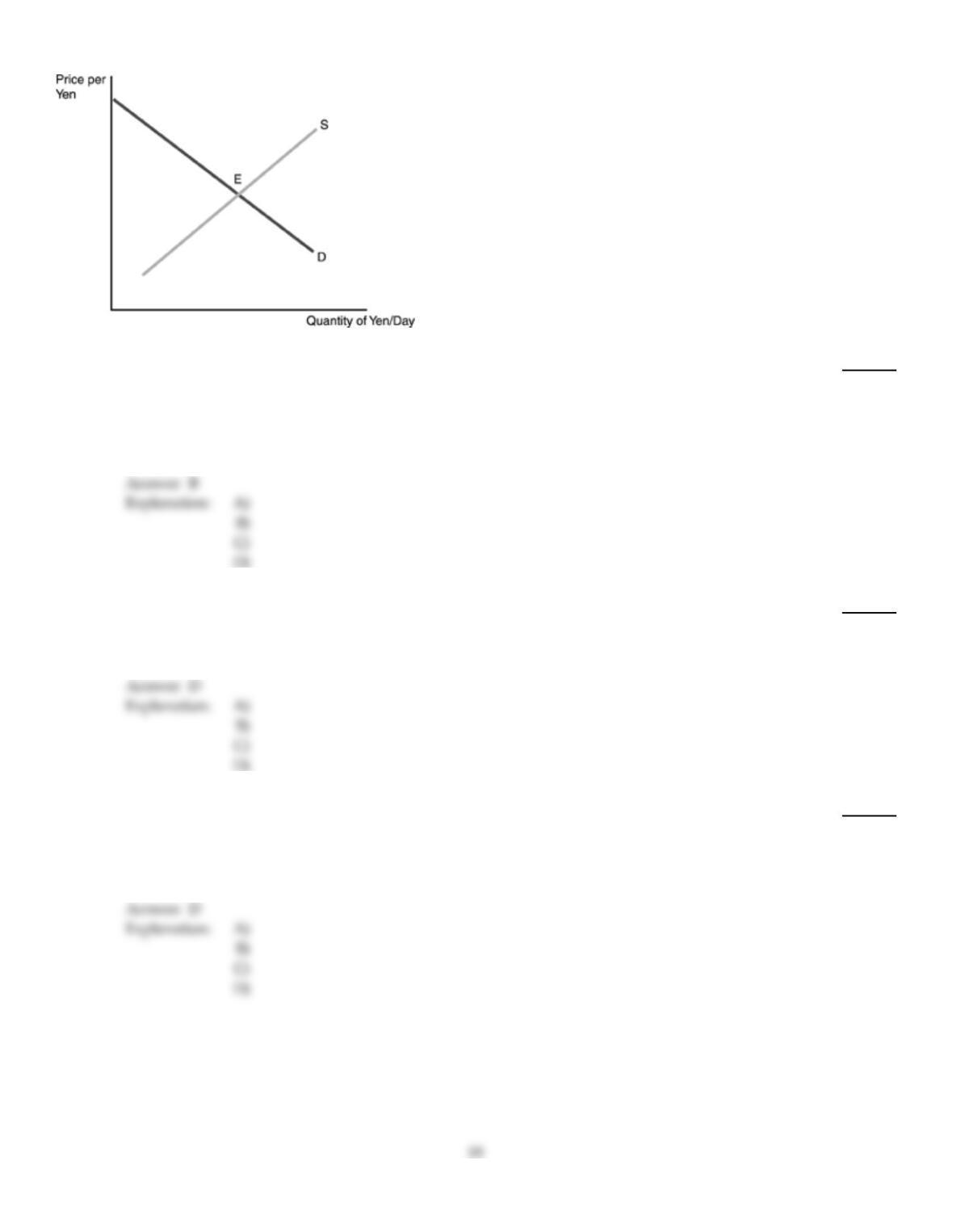
Refer to the above figure. Suppose E is the original equilibrium. Japanese residents have increased
their demand for U.S. goods. This will lead to
66)
A)
an appreciation of the yen and a decrease in the quantity of yens sold per week.
B)
an appreciation of the yen and an increase in the quantity of yens sold per week.
C)
a depreciation of the yen and an increase in the quantity of yens sold per week.
D)
a depreciation of the yen and a decrease in the quantity of yens sold per week.
67)
A financial strategy that reduces the chance of suffering losses arising from foreign exchange risk is
referred to as
67)
A)
transaction mitigation.
B)
conversion depletion.
C)
foreign exchange leverage.
D)
hedging.
68)
If the United States has a trade deficit with China, then China must have
68)
A)
a trade deficit with the United States.
B)
a trade deficit with countries other than the United States.
C)
a trade surplus with countries other than the United States.
D)
a trade surplus with the United States.
69)
The agency which functions as a “lender of last resort” for national governments is the
69)
A)
World Trade Fund.
B)
International Monetary Fund.
C)
World Trade Organization.
D)
International Trade Organization.
70)
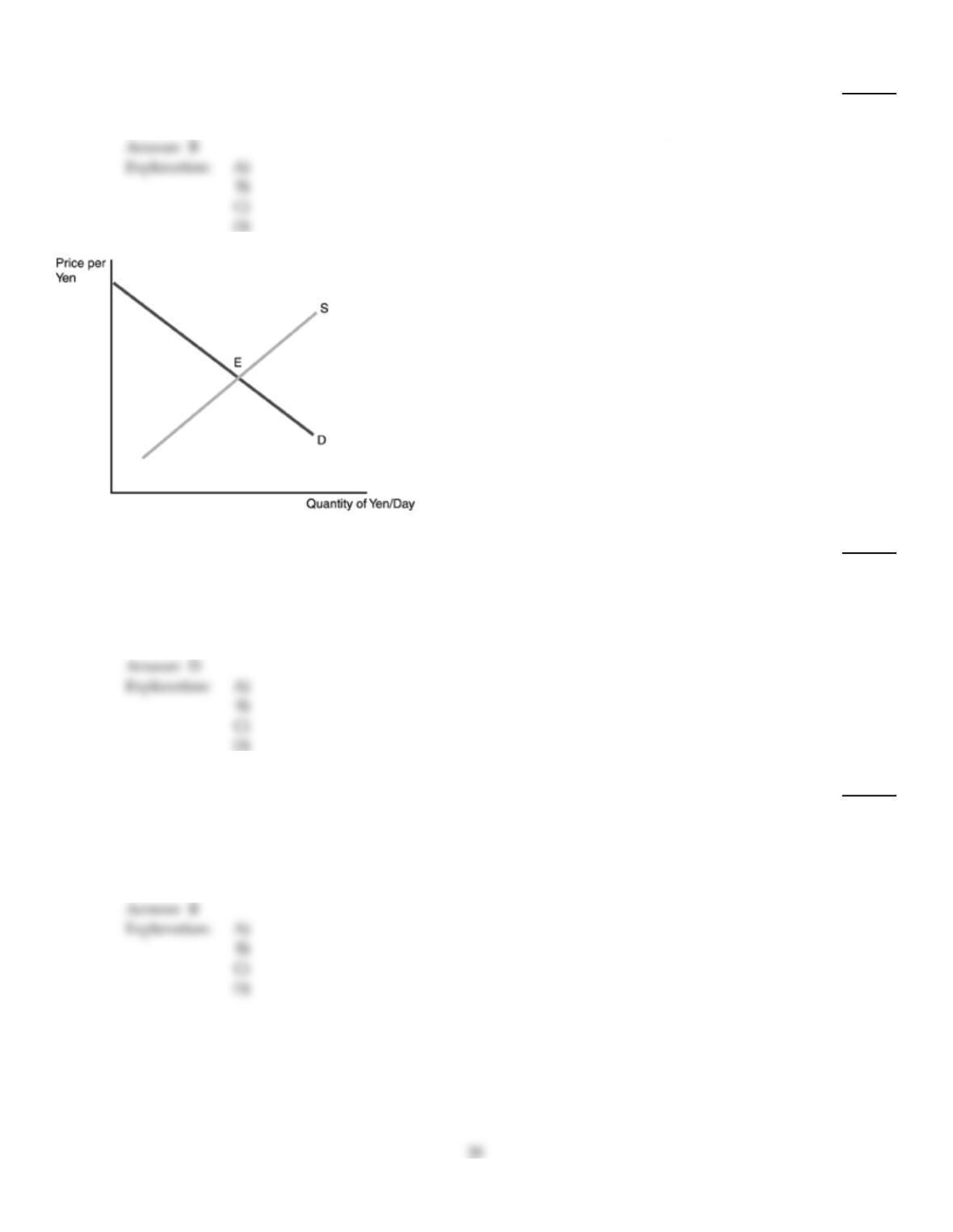
Refer to the above figure. Suppose E is the original equilibrium. An increase in the demand for
dollars will be reflected in this figure by
70)
A)
an increase in the demand for yen as both imports and exports increase.
B)
a decrease in the demand for yen as the U.S. balance of payments improves.
C)
a decrease in the supply of yen as Japan is able to pay less for U.S. goods.
D)
an increase in the supply of yen as Japan tries to buy more U.S. goods.
71)
In a nation’s balance of payments, the current account includes
71)
A)
the changes in the official reserve transaction account.
B)
the balance of the trade account, the balance of the services account, and net unilateral
transfers.
C)
the purchases of foreign assets.
D)
All of the above.
72)
Assume the U.S. government wants to hold the value of the dollar at $1.00 U.S. equals 10 Chinese
yuan, but it finds that the value of yuan is depreciating against the U.S. dollar. What would be an
appropriate policy to reverse this trend?
72)
A)
Sell U.S. dollars.
B)
Increase government spending within the U.S.
C)
Buy U.S. dollars.
D)
Increase the money supply in the U.S.
73)
The demand for dollars will increase when
73)
A)
U.S. residents develop a taste for more imported products.
B)
the world is perceived as more stable than it used to be.
C)
real interest rates in the United States fall.
D)
U.S. labor productivity increases relative to the world.
D
74)
According to the text, over 40 percent of member nations of the International Monetary Fund have
74)
A)
an independently floating exchange rate.
B)
a managed floating exchange rate.
C)
no separate legal currency.
D)
a fixed exchange rate.
D
75)
The market in which households, firms and governments buy and sell national currencies is known
as
75)
A)
standard drawing rights.
B)
the exchange rate.
C)
the foreign exchange market.
D)
flexible exchange rates.
C
A
76)
As the dollar price of a euro falls,
76)
A)
French goods will be less expensive to U.S. residents.
B)
U.S. residents will purchase fewer French imports.
C)
French residents will increase their purchases of U.S. assets.
D)
the quantity of euros supplied will increase.
77)
Which of the following statements is true about the role of gifts given to U.S. citizens from foreign
residents?
77)
A)
Gifts given to U.S. citizens are not included in the balance of payments but gifts given to
foreigners are included.
B)
Gifts are not included in the balance of payments because of the nature of the gift.
C)
Gifts are included in the balance of payments.
D)
Gifts are only included in the balance of payments if the gift is given to a government official.
78)
An example of a deficit item on the U.S. balance of payments is
78)
A)
the sale of a carburetor made in Michigan to a Honda plant in Ohio.
B)
the payment of a dividend from a Canadian firm to an American living in Maine.
C)
a U.S. resident flies from New York to Rome on British Airways.
D)
a deposit in a bank in New York by a British firm.
79)
The financing of U.S. import transactions, ceteris paribus,
79)
A)
increases the amount of foreign currency held by the Fed.
B)
reduces U.S. interest rates.
C)
decreases the amount of foreign currency held by U.S. banks.
D)
increases U.S. GDP.
80)
Suppose that the current exchange rate between the dollar and peso is $1 equals 10 pesos. If the
exchange rate changes to $1 equals 8 pesos, which of the following is true?
80)
A)
The dollar depreciates and U.S. exports become cheaper.
B)
The peso depreciates and imports from Mexico become cheaper.
C)
The peso appreciates and imports from Mexico become cheaper.
D)
The dollar appreciates and U.S. exports become cheaper.
81)
A key objective of the gold standard was to
81)
A)
allow nations to tax its citizens in gold.
B)
create a fixed exchange rate system between countries.
C)
create a flexible exchange rate system between countries.
D)
allow nations to maintain their gold reserves.
82)
Which of the following best describes exchanges rates that are determined by the demand and
supply foreign exchange in the absence of official intervention?
82)
A)
floating exchange rates.
B)
the Bretton Woods system.
C)
target zones.
D)
the gold standard.
83)
A country’s balance of payments shows a
83)
A)
detailed record of the country’s imports.
B)
summary record of international financial assistance received by the country.
C)
summary record of a country’s economic transactions with foreign residents and governments
over a year.
D)
detailed record of the import and export of services for the country.
84)
All of the following would be considered a current account transaction EXCEPT the
84)
A)
exporting of goods.
B)
importing of services.
C)
importing of capital.
D)
importing of goods.
85)
For the United States, suppose the value of exported goods is greater than the value of imported
goods. This implies that
85)
A)
the dollar price of foreign currency will increase.
B)
the domestic currency will depreciate.
C)
the country is running a deficit in its balance of trade.
D)
the country is running a surplus in its balance of trade.
86)
An increase in the inflation rate of one country relative to another country will probably cause
86)
A)
a current account surplus for the inflating country.
B)
an increase in the amount of official reserves held by the inflating country’s central bank.
C)
an increase in exports for the inflating country.
D)
a balance of trade deficit for the inflating country.
87)
If a central bank wants to keep the value of its home currency fixed in the foreign exchange market,
then an increase in the demand for its home currency will lead the central bank to
87)
A)
do nothing.
B)
buy its home currency.
C)
sell its home currency.
D)
sell foreign currencies.
88)
A system of accounts that measures the transactions of goods, services, income, and financial assets
between domestic households, businesses, and governments and residents of the rest of the world
during a specific time period is the
88)
A)
current account.
B)
balance of trade.
C)
balance of payments.
D)
capital account.
89)
Suppose the current account of a country is initially in balance. A new transaction occurs so that the
current account is now in surplus. Official reserve balance is maintained before and after the
transaction occurs. From this, we know that
89)
A)
the balance of goods and services is now in surplus.
B)
the government must make official reserve transactions.
C)
the capital account is now in deficit.
D)
the balance of trade is now in surplus.
90)
If the foreign exchange rate is one dollar for 10 South African rand, then how many dollars are
needed to purchase an item that costs 400 rand?
90)
A)
4,000
B)
400
C)
40
D)
10
91)
Checking exchange rates, you find $1 equals 0.75 euros. Then the price of 1 euro is ________.
91)
A)
$4.30
B)
$0.25
C)
$1.33
D)
$0.75
92)
The use of foreign exchange reserves to keep exchange rates constant over time is called
92)
A)
a fixed exchange rate system.
B)
a floating exchange rate system.
C)
a fiscal fix.
D)
the Bretton Woods system.
93)
Based on the U.S. historical experience with the gold standard, we can conclude that
93)
A)
the gold standard guarantees both economic and price stability.
B)
the standard guarantees economic stability but not price stability.
C)
the gold standard guarantees neither economic nor price stability.
D)
the gold standard guarantees price stability but not economic stability.
94)
Suppose the Canadian central bank wants to keep the exchange rate of the Canadian dollar with
the U.S. dollar constant over time. An increase in the demand for Canadian goods by American
residents will lead the Canadian central bank to
94)
A)
increase the demand for Canadian dollars in the foreign exchange market.
B)
increase the supply of Canadian dollars in the foreign exchange market.
C)
sell American goods in exchange for Canadian dollars.
D)
buy more Canadian goods with Canadian dollars.
B
95)
Which of the following will cause a change in the exchange rate?
95)
A)
changes in the perception of economic stability
B)
changes in real interest rates
C)
changes in consumer preferences
D)
all of the above
D
96)
Under the Bretton Woods Agreement, the goal of the IMF was to
96)
A)
lend to countries experiencing balance of payment deficits.
B)
help less developed countries advertise their goods in the developed countries.
C)
finance international transactions in gold.
D)
provide oversight to the functioning of central banks in the member countries.
A
C
97)
The difference between the exports and imports of goods in a country is referred to as the
97)
A)
balance of trade.
B)
exchange rate.
C)
balance of power.
D)
balance of payments.
98)
A depreciation of the U.S. dollar relative to the euro would tend to
98)
A)
increase both U.S. imports from Germany and U.S. exports to Germany.
B)
increase U.S. exports to Germany.
C)
decrease U.S. exports to Germany.
D)
increase U.S. imports from Germany.
99)
A market in which national currencies are traded by households, firms and governments, is
referred to as a(n)
99)
A)
gold certificate market.
B)
fed funds market.
C)
foreign exchange market.
D)
international reserves market.
100)
Special Drawing Rights are
100)
A)
a reserve asset created by the International Monetary Fund that can be used to settle
international payments.
B)
loans granted by the International Monetary Fund to countries that experience balance of
payments problems.
C)
financial assets held by the U.S. Treasury Department.
D)
the term given for official reserves taken as a whole.
SHORT ANSWER. Write the word or phrase that best completes each statement or answers the question.
101)
“When the balance of payments sums to zero is the only situation in which there is an
equilibrium.” Do you agree or disagree? Why?
101)
102)
How are deficit and surplus items determined in the balance of payments?
102)
103)
What does it mean when the dollar appreciates? What does it mean when the dollar
depreciates?
103)
104)
Suppose there was a substantial increase in political instability in the rest of the world.
What would be the effects on the U.S. current account? Explain.
104)
105)
Distinguish between the balance of payments and the balance of trade.
105)
106)
Suppose the foreign exchange market is in equilibrium. Then, the U.S. government
increases borrowing, causing American interest rates to increase. What will happen to the
price of the Japanese yen? Why?
106)
107)
Explain how the gold standard operated.
107)
108)
Explain the three categories of balance of payments transactions.
108)
109)
In foreign exchange markets, who demands dollars and who supplies dollars?
109)
110)
Why does the supply curve of Japanese yen slope up?
110)
111)
What brought about the end of the Bretton Woods Agreement?
111)
112)
Why does the demand curve for Japanese yen slope down?
112)
113)
Suppose the U.S. inflation rate falls while the inflation rate among the members of the
European Monetary Union (EMU) holds constant. Other things equal, what will happen in
the balance of payments accounts?
113)
Answer Key
Testname: C33
Answer Key
Testname: C33
Answer Key
Testname: C33
32