Exam
Name___________________________________
MULTIPLE CHOICE. Choose the one alternative that best completes the statement or answers the question.
1)
An increase in a country’s rate of inflation is apt to
1)
A)
reduce its imports and improve its trade balance.
B)
worsen its balance of trade and balance of payments.
C)
decrease demand for the country’s currency.
D)
lower its nominal rate of interest and encourage an inflow of capital.
2)
When numerous Japanese companies buy $100,000,000 worth of goods or services from U.S.
producers, ceteris paribus, there will be
2)
A)
depreciation in the value of the yen against the dollar.
B)
appreciation in the value of the yen against the dollar.
C)
no change in values of the currencies.
D)
depreciation of the dollar against the yen.
3)
Judy has just bought a car that is made in Germany. As far as the U.S. balance of payments is
concerned this purchase is a(n)
3)
A)
surplus item.
B)
deficit item.
C)
special draw.
D)
accounting identity.
4)
Under a flexible exchange rate system, one factor that does NOT directly affect rates of exchange is
4)
A)
changes in productivity in each country.
B)
changes in gold holdings in each country.
C)
changes in economic stability in each country.
D)
changes in the inflation rate in each country.
5)
Which of the following would NOT be official reserves for Germany?
5)
A)
gold
B)
U.S. dollars
C)
SDRs
D)
the official currency of Germany
6)
When the balance of trade is in balance, we know with certainty that
6)
A)
the value of exports of goods equals the value of imports of goods.
B)
the value of exports of goods and services equals the value of imports of goods and services.
C)
the value of capital exports equals the value of capital imports.
D)
the value of all debit transactions equals the value of all credit transactions.
A
7)
The gold standard is
7)
A)
a type of managed flexible exchange rate system.
B)
a purely floating exchange rate system.
C)
a type of floating exchange rate system.
D)
a type of fixed exchange rate system.
D
8)
A market in which businesses, households, and governments buy and sell national currencies is
8)
A)
the dollar exchange market.
B)
the money exchange market.
C)
the currency exchange market.
D)
the foreign exchange market.
D
9)
If the Japanese yen depreciates against the U.S. dollar
9)
A)
there is no change in the price of Japanese exports to the United States.
B)
the price of United States exports to Japan decreases.
C)
the price of Japanese imports to the United States decreases.
D)
the price of Japanese imports from the United States will decrease.
C
D
10)
If the U.S. interest rate, adjusted for people’s expectation of inflation, increases sharply relative to
the rest of the world, then
10)
A)
the dollar will depreciate.
B)
there will be no change in the demand for dollars in foreign exchange markets but there will
be an increase in demand for foreign currency.
C)
the dollar will appreciate.
D)
there will be a decrease in the demand for dollars in foreign exchange markets.
11)
The financing of U.S. import transactions, ceteris paribus
11)
A)
increases U.S. GDP.
B)
reduces U.S. interest rates.
C)
increases the amount of foreign currency held by the Fed.
D)
decreases the amount of foreign currency held by U.S. banks.
12)
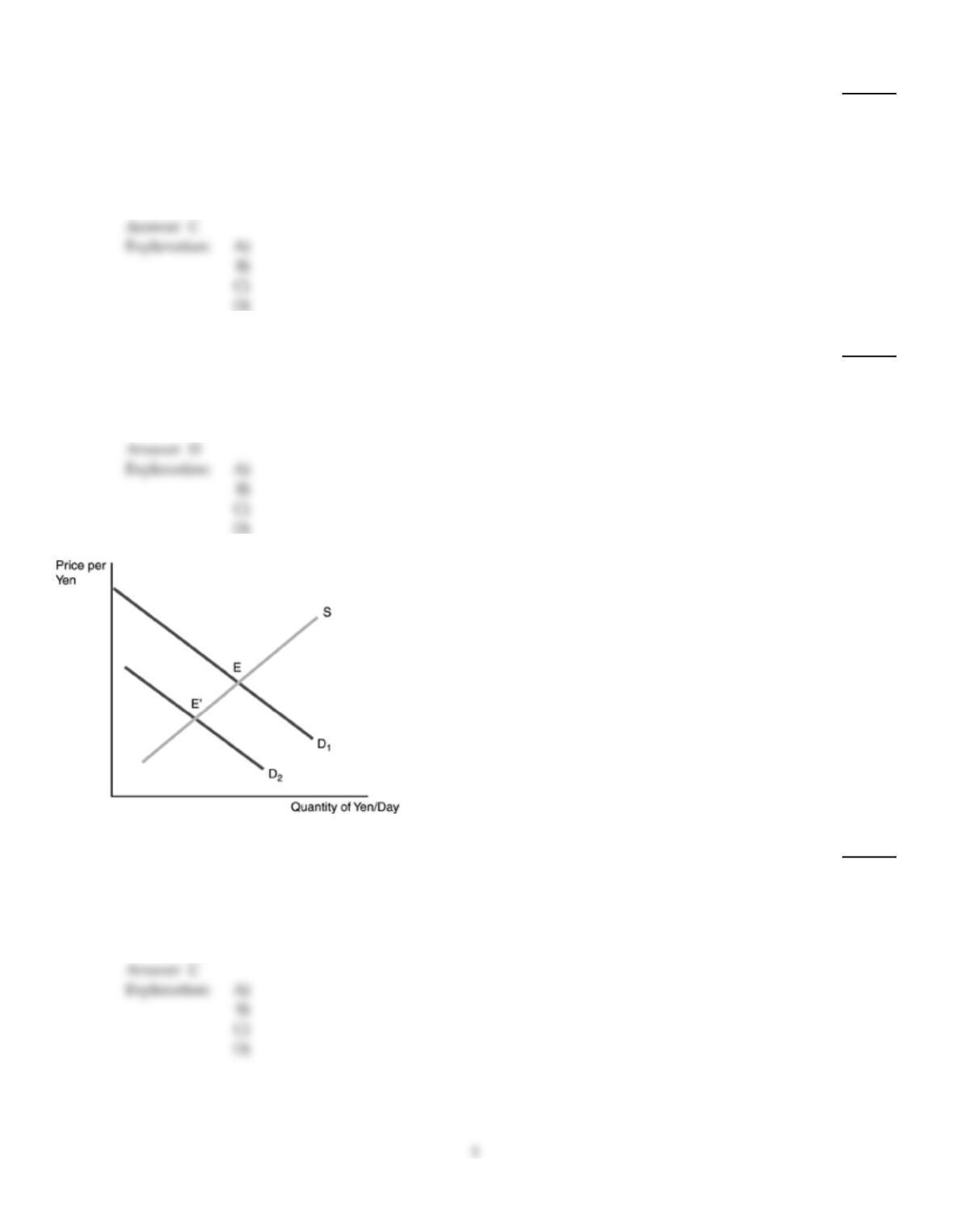
Refer to the above figure. Suppose the equilibrium moves from E’ to point E. An event that could
have caused this movement is
12)
A)
an increase in the perceived stability of the U.S. economy.
B)
an increase in the real interest rate in the United States.
C)
an increase in demand for Japanese–produced goods by U.S. residents.
D)
an increase in U.S. productivity.
Balance of Payments
Exports of Goods $1000
Imports of Goods –665
Exports of Services 410
Imports of Services –590
Net Unilateral Transfers –15
US Capital Going Abroad –600
Capital Coming into US 400
Official Transactions 60
13)
Refer to the above table. The capital account balance is
13)
A)
–$155.
B)
–$200.
C)
0.
D)
–$260.
14)
The term “flexible exchange rates” refers to
14)
A)
a situation in which exchange rates are allowed to fluctuate in the open market in response to
changes in supply and demand.
B)
a nation in which households, firms, and governments buy and sell national currencies.
C)
the decrease in the exchange value of one nation’s currency in terms of another nation.
D)
the increase in the exchange value of one nation’s currency in terms of an other nation.
15)
If there is an increase in the demand for U.S. automobiles, the
15)
A)
demand for dollars will fall.
B)
supply of dollars will fall.
C)
supply of dollars will rise.
D)
demand for dollars will rise.
16)
A problem with the operation of the gold standard in the world economy was that
16)
A)
it involved too much government intervention in the economy.
B)
a country did not have control of its domestic monetary policy.
C)
the world economy was subject to too much inflation.
D)
it caused the Great Depression.
17)
Which of the following will lead to an appreciation of the U.S. dollar against the British pound?
17)
A)
an increase in British interest rates
B)
an increase in British demand for U.S. imports
C)
a decrease in British demand for U.S. assets
D)
an increase in U.S. demand for British imports
18)
If the foreign exchange rate for 1 Hungarian forint is 0.5 cent, then
18)
A)
a hotel room renting for 40,000 forints will cost $200.
B)
a wine that sells for 600 forints will cost $3,000.
C)
a dinner priced at 400 forints will cost $20.
D)
a Big Mac hamburger priced at 50 forints will cost $1.
19)
An example of a transaction that will be a surplus item on the U.S. balance of payments is
19)
A)
a French subsidiary’s plant in New Jersey purchasing parts from the main plant in Paris.
B)
a tourist from Germany buying a ticket to fly from New York to Chicago on American
Airlines.
C)
a gift of wheat from the U.S. government to India.
D)
a U.S. resident purchasing French wine.
20)
One problem that investors in foreign countries face is the possibility of a decline in the value of
that foreign country’s currency. Which of the following would be an effective way to offset this
problem?
20)
A)
Hedge through currency swaps.
B)
Be ready to pull out at the first sign of trouble.
C)
Convert as many of your dollars into their dollars as possible.
D)
Finance your investment outside of that country.
21)
If an exporter wants to limit the effect of possible changes in the exchange rate on the value of her
exports, then she can adopt a strategy known as
21)
A)
floating.
B)
speculating.
C)
appreciating.
D)
hedging.
22)
Special Drawing Rights are
22)
A)
a category of the balance of payments transactions that measures the exchange of
merchandise, the exchange of services, and unilateral transfers.
B)
the reserve assets created by the International Monetary Fund for countries to use in settling
international payment obligations.
C)
a category of the balance of payments transactions that measures flows of real and financial
assets.
D)
the price of one nation’s currency in term of the currency of another country.
23)
When the dollar price of a British pound is $0.80, it is correct to state that an American traveling in
England will receive ________ pounds per dollar.
23)
A)
1.25
B)
8
C)
80
D)
125
24)
The United States’ balance of payments is likely to improve when
24)
A)
the American government increases its spending on foreign aid.
B)
American people want to invest more in foreign countries.
C)
there is an increase in political instability in other countries.
D)
the inflation rate in the United States rises relative to other countries.
25)
A U.S. automobile dealer has ordered a fleet of Japanese cars worth 10 million yen. The terms of
payment is C.O.D. (cash on delivery). At the time the order was placed, the exchange rate was 100
yen per U.S. dollar. When the fleet arrived the exchange rate had become 200 yen per U.S. dollar.
25)
A)
This change in the foreign exchange rate will benefit the Japanese exporter.
B)
This change in the foreign exchange rate will hurt the U.S. importer.
C)
This change in the foreign exchange rate will benefit the U.S. importer.
D)
This change in the foreign exchange rate will hurt the Japanese exporter.
26)
Suppose that there is a current account deficit of $250 billion and a capital account surplus of $260
billion. It may be concluded that the
26)
A)
overall balance of payments is +10.
B)
official reserve transaction account balance is +10.
C)
overall balance of payments is –10.
D)
official reserve transaction account balance is –10.
27)
Changes in which of the following will cause a change in exchange rates?
27)
A)
real interest rates
B)
perceptions of economic and political stability
C)
consumer preferences
D)
all of the above
28)
The demand for foreign currency in the United States is a
28)
A)
direct demand based on the demand for U.S. dollars.
B)
derived demand based on the demand for foreign products.
C)
direct demand.
D)
derived demand based on the demand for U.S. products.
29)
An increase in the value of a domestic currency in terms of other currencies is known as
29)
A)
an appreciation.
B)
a discount rate.
C)
a depreciation.
D)
a flexible exchange rate.
30)
The largest portion of any nation’s balance of payments current account is the
30)
A)
importing and exporting of gold.
B)
importing and exporting of services.
C)
importing and exporting of merchandise goods.
D)
importing and exporting of capital goods.
31)
Other things being constant, if the U.S. real rate of interest exceeds that of its trading partners, we
expect
31)
A)
a worsening of the U.S. balance of payments.
B)
that a “dirty float” will emerge.
C)
an appreciation of U.S. currency.
D)
political instability in the United States.
32)
A nation’s official reserve transaction account
32)
A)
is always a negative number.
B)
compensates for the differences in the current and capital accounts.
C)
is always a positive number.
D)
is always equal to zero.
33)
Every transaction concerning the exportation of goods from the United States constitutes a
33)
A)
supply of foreign currency with no effect on the market for the dollar.
B)
demand for foreign currencies and a supply of dollars.
C)
demand for dollars with no effect on markets for foreign currencies.
D)
supply of foreign currencies and a demand for dollars.
34)
Flexible exchange rates exist when
34)
A)
speculators bet that a currency will soon be depreciated.
B)
exchange rates are determined by forces of supply and demand.
C)
no one knows what the true value of a currency is.
D)
governments and central banks spend foreign reserves to prop up an exchange rate at a
certain level.
B
35)
Suppose U.S. interest rates fall. This reduction in U.S. interest rates will cause which of the
following to occur?
35)
A)
an increase in the value (appreciation) of the U.S. dollar
B)
an inflow of capital to the United States
C)
no change in foreign investment in the United States
D)
an outflow of capital from the United States
D
36)
If the United States looks more economically and politically stable relative to the rest of the world,
this will
36)
A)
increase the demand for dollars.
B)
stop all trading between the currencies of the United States and other countries.
C)
have no effect on the demand for dollars.
D)
decrease the demand for dollars.
A
D
37)
When there is a negative entry for unilateral transfers in the balance of payments, it means that
37)
A)
U.S. residents purchased less services from foreign countries than foreign countries purchased
from U.S. residents.
B)
U.S. residents purchased more services from foreign countries than foreign countries
purchased from U.S. residents.
C)
U.S. residents gave more to foreign residents than foreign residents gave to U.S. residents.
D)
there must be an offsetting positive sign in the capital account.
38)
Which of the following will cause an increase in the demand for the Venezuelan currency, the
Venezuelan bolivar?
38)
A)
U.S. residents change preferences in favor of goods produced in the United States
B)
real interest rates in Venezuela fall
C)
real interest rates in the United States increase
D)
none of the above
39)
Which of the following statements is TRUE about the role that service exports and imports have in
the balance of payments?
39)
A)
Service exports and imports are not included in the balance of payments because it is
impossible to transport a service to another country.
B)
Service exports and imports are included in the balance of payments in the official reserve
transactions account.
C)
Service exports and imports are included in the balance of payments in the current account.
D)
Service exports and imports are included in the balance of payments in the labor account.
40)
Under a flexible exchange rate system, an increase in the value of the U.S. dollar in terms of other
currencies is referred to as
40)
A)
a devaluation of the U.S. dollar.
B)
a monetizing of the U.S. dollar.
C)
a depreciation of the U.S. dollar.
D)
an appreciation of the U.S. dollar.
Balance of Payments
Exports of Goods $1000
Imports of Goods –665
Exports of Services 410
Imports of Services –590
Net Unilateral Transfers –15
US Capital Going Abroad –600
Capital Coming into US 400
Official Transactions 60
41)
Refer to the above table. The current account balance is
41)
A)
$155.
B)
$140.
C)
$170.
D)
–$45.
42)
Which of the following is a deficit item on the U.S. balance of payments accounts?
42)
A)
An Italian tourist in Miami purchases a beach ball.
B)
A U.S. firm sells a product to a Mexican firm.
C)
A Spaniard buys 100 shares of Ford stock.
D)
A U.S. resident buys gold from the Japanese central bank.
43)
The current account is
43)
A)
the price of one nation’s currency in term of the currency of another country.
B)
the reserve assets created by the International Monetary Fund for countries to use in settling
international payment obligations.
C)
a category of the balance of payments transactions that measures flows of real and financial
assets.
D)
a category of the balance of payments transactions that measures the exchange of
merchandise, the exchange of services, and unilateral transfers.
44)
Suppose the exchange rate was $0.50 for one British pound. If the exchange rate falls to $0.20 for
one pound, we would expect to see
44)
A)
more U.S. exports since the price of the dollar has fallen.
B)
more exports to the U.K. since the price of the pound has risen.
C)
fewer exports to the U.K. since the price of the pound has risen.
D)
more U.S. imports from the U.K. since the price of the pound has fallen.
45)
A financial strategy that reduces the chance of suffering losses arising from foreign exchange risk is
referred to as
45)
A)
foreign exchange leverage.
B)
conversion depletion.
C)
transaction mitigation.
D)
hedging.
International Transactions
1. U.S. resident buys a Chinese camera $300
2. U.S. resident buys stock in a Chinese company 20,000
3. U.S. resident purchases insurance from a Chinese company 1,500
4. U.S. resident sends a present to someone in China 200
5. Chinese buys a U.S. car 30,000
6. Chinese family goes to Disney World in the U.S. 2,000
46)
Based on the transactions in the above table, what is the change in the U.S. current account balance?
46)
A)
–$32,700
B)
$30,000
C)
–$32,500
D)
$31,000
47)
The United States dollar has NOT been officially convertible to gold by international traders since
47)
A)
1944.
B)
1995.
C)
1930.
D)
1971.
48)
In the balance of payments, any transaction that leads to a receipt by a resident of a country is a
48)
A)
surplus item.
B)
minus item.
C)
debit item.
D)
deficit item.
49)
Exchange rates that are allowed to fluctuate in the open market in response to changes in supply
and demand are known as
49)
A)
fixed exchange rates.
B)
gold exchange rates.
C)
IMF exchange rates.
D)
flexible exchange rates.
50)
Suppose a currency’s value in the foreign exchange market is determined solely by market supply
and demand without any intervention by the government authority, the currency has
50)
A)
a gold standard.
B)
a floating exchange rate.
C)
a price control in its exchange rate.
D)
a fixed exchange rate.
51)
The supply of U.S. dollars on foreign exchange markets is
51)
A)
derived from the demand for U.S. products by foreigners.
B)
derived from the demand by United States for imported goods and services.
C)
determined directly by open market operations at the Federal Reserve Bank.
D)
derived from the supply of U.S. goods.
52)
An increase in the market clearing exchange value of the home nation’s currency in terms of the
currency of another nation is a home currency
52)
A)
depreciation.
B)
appreciation.
C)
revaluation.
D)
devaluation.
53)
Which of the following is NOT a category in the U.S. balance of payments account?
53)
A)
current account
B)
official reserve transactions account
C)
capital account
D)
past–due account
54)
In a flexible exchange rate system, which of the following would NOT cause the U.S. dollar to
depreciate relative to the British pound?
54)
A)
a decrease in demand for British goods in the United States
B)
a decrease in British demand for U.S. exports
C)
a shift to the left in the supply of British goods to the United States
D)
an increase in demand for British goods in the United States
55)
If a country wants to keep its exchange rate fixed, it must
55)
A)
vary the amount of its national currency supplied at any given exchange rate in foreign
exchange markets when necessary.
B)
allow its currency value to vary with market supply and demand in foreign exchange
markets.
C)
eliminate its foreign exchange reserves.
D)
be a member of the IMF.
56)
Assume there is an increased demand in the United States for Australian wines. If all other factors
are held constant, this will result in
56)
A)
an increase in the U.S. dollar exchange rate for Australian dollars.
B)
a decrease in the par value of the Australian dollar.
C)
an appreciation of the U.S. dollar.
D)
a movement along the demand curve for Australian wine.
57)
A nation’s foreign exchange reserves consist mainly of
57)
A)
currencies of other nations.
B)
the legal currency of that nation.
C)
government securities of that nation.
D)
excess reserves held by its banks.
58)
A currency swap can
58)
A)
reduce foreign exchange risk.
B)
make domestic goods more expensive in foreign countries.
C)
make foreign goods more expensive in the domestic market.
D)
make the foreign exchange rate more volatile over time.
59)
The balance of payments consists of the
59)
A)
current account, capital account, and gold flows.
B)
current account, capital account, and official reserve transactions account.
C)
current account, official reserve transactions account, and monetary account.
D)
capital account, official reserve transactions account, and recent account.
60)
If you go to Europe to work and send funds home to your family living in the United States, this is
known as a
60)
A)
merchandise import.
B)
unilateral transfer.
C)
service import.
D)
service export.
Country X2015 Transactions (billions of dollars)
Exports of goods $100
Net Unilateral Transfers –10
Imports of Services –50
Official Transactions –45
Capital Inflows 150
Imports of Goods –200
Exports of Services 125
Capital Outflows –70
61)
In the above table, the balance on the capital account for Country X is ________ billion dollars.
61)
A)
+80
B)
–35
C)
+35
D)
–80
62)
Under the Bretton Woods system, a country could alter its exchange rate
62)
A)
by changing its value relative to gold.
B)
whenever it determined that there was a fundamental disequilibrium.
C)
only when the IMF permitted due to a fundamental disequilibrium.
D)
under no circumstances.
63)
The International Monetary System was established
63)
A)
by the United Nations.
B)
by the United States, in cooperation with Great Britain.
C)
during the Great Depression by the League of Nations.
D)
by the Bretton Woods Agreement.
64)
Which agreement was signed in 1944 with the purpose of creating a new international payment
system?
64)
A)
Bretton Woods
B)
Lake Geneva
C)
Camp David
D)
Philadelphia Accord
65)
If the foreign exchange rate is one dollar for 10 South African rand, then how many dollars are
needed to purchase an item that costs 400 rand?
65)
A)
10
B)
4,000
C)
400
D)
40
66)
If a country wants to keep the value of its currency fixed, then its central bank should
66)
A)
buy its domestic currency when there is an increase in the supply of that currency.
B)
buy domestic goods when there is an increase in the supply of its domestic currency.
C)
sell its domestic currency when there is an increase in the supply of that currency.
D)
sell domestic goods when there is an increase in the supply of its domestic currency.
67)
The difference between the exports and imports of goods in a country is referred to as the
67)
A)
exchange rate.
B)
balance of payments.
C)
balance of power.
D)
balance of trade.
International Transactions
1. U.S. resident buys a Chinese camera $300
2. U.S. resident buys stock in a Chinese company 20,000
3. U.S. resident purchases insurance from a Chinese company 1,500
4. U.S. resident sends a present to someone in China 200
5. Chinese buys a U.S. car 30,000
6. Chinese family goes to Disney World in the U.S. 2,000
68)
Based on the transactions in the above table, what is the change in the U.S. capital account?
68)
A)
–$20,200
B)
–$20,000
C)
$10,000
D)
$9,800
69)
All of the following are surplus items in the balance of payments EXCEPT
69)
A)
foreign tourist expenditures.
B)
funds deposited in this country by foreign residents.
C)
purchases of foreign assets.
D)
exports of merchandise.
70)
A depreciation of the U.S. dollar relative to the euro would tend to
70)
A)
decrease U.S. exports to Germany.
B)
increase U.S. exports to Germany.
C)
increase both U.S. imports from Germany and U.S. exports to Germany.
D)
increase U.S. imports from Germany.
71)
The sum of the current account, the capital account, and the official reserve transaction account is
71)
A)
always negative.
B)
positive when exports are greater than imports.
C)
always positive.
D)
zero.
72)
Currency reserves on account with the International Monetary Fund used to settle accounts
between countries are known as
72)
A)
special drawing rights.
B)
federal reserves.
C)
unilateral transfer.
D)
official reserve account transactions.
73)
Based on the U.S. historical experience with the gold standard, we can conclude that
73)
A)
the standard guarantees economic stability but not price stability.
B)
the gold standard guarantees both economic and price stability.
C)
the gold standard guarantees neither economic nor price stability.
D)
the gold standard guarantees price stability but not economic stability.
74)
Suppose a country has a current account surplus and that there is no intervention by finance
ministries or central banks. This current account surplus indicates that the country has
74)
A)
the official reserve transactions balance is positive.
B)
the official reserve transactions balance is negative.
C)
a deficit in its capital account.
D)
a surplus in its capital account.
C
75)
If the exchange rate measured in euros per dollar increases, then
75)
A)
neither currency appreciates or depreciates.
B)
the euro depreciates relative to the dollar.
C)
the dollar depreciates relative to the euro.
D)
the euro appreciates relative to the dollar.
B
76)
Which of the following is included in both the balance of trade and the balance of payments?
76)
A)
exports
B)
international capital movements
C)
earnings by domestic residents on assets located abroad
D)
earnings on domestic assets owned by foreign residents
A
C
77)
Someone in Germany has just ordered a U.S. car to be exported to Germany. In the U.S. balance of
payments, this purchase is a(n)
77)
A)
surplus item.
B)
deficit item.
C)
accounting identity.
D)
special draw.
78)
Suppose the U.S. dollar price of the Japanese yen decreases. Given this information, which of the
following is correct?
78)
A)
The yen price of the dollar decreased.
B)
The dollar has depreciated.
C)
The dollar has appreciated.
D)
The yen has appreciated.
79)
One source of the supply of dollars in the foreign exchange market is
79)
A)
the U.S. Mint buying dollars from the Bank of England.
B)
SDRs being converted into dollars.
C)
foreign citizens buying U.S. goods.
D)
U.S. companies importing foreign goods.
80)
Suppose the current account of a country is initially in balance. A new transaction occurs so that the
current account is now in surplus. Official reserve balance is maintained before and after the
transaction occurs. From this, we know that
80)
A)
the capital account is now in deficit.
B)
the balance of goods and services is now in surplus.
C)
the government must make official reserve transactions.
D)
the balance of trade is now in surplus.