Biology: A Guide to the Natural World, 5e (Krogh)
Chapter 32 An Amazingly Detailed Script: Animal Development
1) The process of fertilization produces a/an:
A) embryo.
B) blastula.
C) morula.
D) gastrula.
E) zygote.
2) The phase during which embryonic cells arrange themselves into three layers is called:
A) cleavage.
B) gastrulation.
C) organogenesis.
D) fertilization.
E) induction.
3) A difference between a morula and a blastula is that the:
A) morula is a solid ball of tightly packed cells, whereas the blastula has a cavity in the center.
B) blastula has fewer cells than the morula.
C) morula has a hollow center, but the blastula doesn’t.
D) morula is a well-developed embryo, and the blastula is an earlier stage of development.
4) If an organism is missing the outer layer of skin upon birth, which of the following might be
the cause?
A) improper development of the mesoderm
B) improper development of the endoderm
C) improper development of the ectoderm
D) improper development of the endoderm and the mesoderm

2
5) Which characteristic is typical of the vegetal pole of an embryo?
A) The vegetal pole is composed of a single, large cell.
B) The vegetal pole is always hollow.
C) The vegetal pole contains relatively less yolk.
D) The vegetal pole has a relatively greater proportion of yolk.
E) The vegetal pole is the site of the development of the mouth.
6) Which of the following happens first in vertebrate development?
A) development of the neural plate
B) development of the neural crest
C) development of the neural tube
D) development of the notochord
7) Which is true regarding somites in an embryo?
A) Somites will become vertebrae.
B) Somites are found inside the notochord.
C) Somites will form the skull.
D) Somites will form the lungs.
8) In sea urchin development, the archenteron becomes the:
A) ectoderm.
B) endoderm.
C) digestive tube.
D) lungs.
9) Of the choices listed, the first event that occurs during embryonic development is:
A) germ layer formation.
B) blastula formation.
C) organogenesis.
D) cleavage.
10) Which of the following is a morula?
A) a fertilized egg
B) the group of cells that form the archenteron
C) a tightly packed ball of early embryonic cells
D) a hollow sphere of cells
11) During which stage of development do cells arrange themselves into three layers?
A) morula
B) cleavage
C) gastrulation
D) organogenesis
12) Which of the following is true of the animal pole of a zygote?
A) The animal pole is closer to the nucleus than the vegetal pole.
B) The animal pole is hollow.
C) The animal pole becomes the entire embryo.
D) The animal pole produces larger cells than the vegetal pole.
13) The blastocoel is:
A) a fertilized egg.
B) the group of cells that form the archenteron.
C) a fluid-filled cavity.
D) a hollow sphere of cells.
14) Migration of which of the following to different parts of the embryo produces various tissues
and organs?
A) morula cells
B) the animal pole
C) the blastocoel
D) neural crest cells
E) notochord cells
15) Place the following steps of organogenesis in the correct order: (1) neural crest cells break
away, (2) neural folds grow into a neural tube, (3) the notochord induces development of the
neural plate.
A) 1, 2, 3
B) 1, 3, 2
C) 3, 1, 2
D) 2, 3, 1
E) 3, 2, 1
16) What is the effect of higher concentration of bicoid protein in part of a fruit fly embryo?
A) It will develop into the posterior end of the organism.
B) It will develop into the heart of the organism.
C) It will develop into the head end of the organism.
D) It lowers the chances of embryo survival.
17) A basic description of the function of morphogens is that they:
A) stimulate the formation of the ectoderm.
B) affect the course of local development.
C) kill cells during development.
D) stop all embryonic growth.
18) At which of the following levels does bicoid work in fruit flies?
A) regulation of development of the head end, middle, and posterior end
B) regulation of development of organ systems
C) regulation of development of organs only in the thorax region of the organism
D) regulation of development of wings
19) Which of the following is a process by which an initial set of genes turns on a second set of
regulatory genes, which eventually turns on a third set of genes?
A) developmental chain reaction
B) gastrulation
C) the sonic hedgehog sequence
D) the genetic cascade
E) somite production
20) Which cells are most important in initiating the production of bicoid protein?
A) limb bud cells
B) posterior portion cells
C) nurse cells
D) neural tube cells
21) ZPA cells of the chick embryo produce which morphogen?
A) sonic hedgehog
B) sonic chicken
C) bicoid
D) chicken wing factor
22) How long is the DNA in the homeobox sequence?
A) 4 base pairs
B) 68 base pairs
C) 180 base pairs
D) 362 base pairs
23) What is the significance of the homeobox sequence studied in animal species?
A) Certain genetic instructions for development have changed very little over time.
B) Certain genetic instructions for development have changed a great deal over time.
C) Certain genetic instructions vary based on structural differences.
D) Certain genetic instructions vary based on phyla.
24) Predict what would happen if a fruit fly regulatory gene that codes for a leg replaced a frog
gene in the same position.
A) The frog would produce a fruit fly leg.
B) The gene would kill the frog embryo.
C) The frog would produce a frog leg.
D) The frog would produce a leg that is part frog and part insect.
25) Two populations of cells may end up segregating themselves into different layers during
development because they have different:
A) DNA.
B) sizes.
C) apoptosis programming.
D) phospholipid molecules.
E) cell adhesion molecules.
26) What action by the individual cells involved can assist processes involving cell movement
such as gastrulation?
A) transcription factors
B) microfilament growth
C) invagination
D) evagination
E) phagocytosis
27) Without programmed cell death, your ________ might look more like a ________.
A) hand; paddle
B) head; hand
C) leg; heart
D) foot; hoof
28) Development occurs:
A) throughout the life of the organism.
B) only in non-dividing cells.
C) only during growth of the organism.
D) only in animals.
29) The end of a zygote that contains less yolk is the animal pole.
30) In general, the endoderm gives rise to tissues located deeper in the body than those from the
ectoderm.
8
31) The blastocoel is the hollow cavity in the morula.
32) Cleavage includes the stage of development between the zygote and blastula.
33) The blastula is the stage of embryonic development in which cells migrate.
34) Gastrulation begins at the sea urchin blastula’s vegetal pole.
35) The mesoderm refers to the middle layer produced during gastrulation.
36) The blastula contains an internal structure called the archenteron.
37) The mouth is the last thing produced by growth of the archenteron through the sea urchin
gastrula.
38) The archenteron is mostly made of the mesoderm.
39) The notochord induces the formation of the neural plate in vertebrates.
40) Somites are repeating blocks of ectodermal tissue.
41) Cleavage and gastrulation take place in animals such as humans and birds but not in frogs.
42) Early vertebrate embryos share a general similarity in shape in the period following somite
development.
43) Cells first arrange themselves into layers during organogenesis.
44) During cleavage, the vegetal pole of a frog egg contains larger cells than the animal pole.
45) The lenses of the eye are produced from the endoderm.
46) Bicoid mRNAs are produced by the zygote.
47) Even small concentrations of bicoid protein will cause the anterior portion of an organism to
form there.

10
48) Bicoid is only one type of morphogen.
49) In chickens, the wings develop from a zone of polarizing activity (ZPA).
50) Homeobox sequences vary widely from one species to another.
51) Versions of homeobox genes have been found in plants and fungi.
52) Without cell adhesion, the primitive gut probably wouldn’t develop during gastrulation.
53) Eye cells can become beak cells once they are committed.
54) Cell death during development will always have negative, possibly fatal, effects on normal
development.
55) Cells become more and more specialized as development progresses.
56) Different cell layers may have different cell adhesion molecules.
57) Menopause and puberty are both examples of developmental changes.

Match the following. Answers may be used more than once.
A) mesoderm
B) ectoderm
C) endoderm
58) Skeletal system
Topic: Section 32.1
Skill: Knowledge/Comprehension
59) Digestive tract lining
Topic: Section 32.1
Skill: Knowledge/Comprehension
60) Outer layer of skin
Topic: Section 32.1
Skill: Knowledge/Comprehension
61) Most muscle
Topic: Section 32.1
Skill: Knowledge/Comprehension
62) Liver and lungs
Topic: Section 32.1
Skill: Knowledge/Comprehension
Match the following. Answers may be used more than once.
A) cleavage
B) organogenesis
C) gastrulation
63) Archenteron develops
Topic: Section 32.1
Skill: Knowledge/Comprehension
64) Neural tube forms
Topic: Section 32.1
Skill: Knowledge/Comprehension
65) Morula develops
Topic: Section 32.1
Skill: Knowledge/Comprehension
66) Neural crest cells migrate
Topic: Section 32.1
Skill: Knowledge/Comprehension
67) The morula stage is part of which phase of embryonic development?
68) A zygote with animal and vegetal poles demonstrates what characteristic of some animal
zygotes?
69) What are the three germ layers produced during gastrulation?
70) You are a substitute teacher in a high school biology lab class on the day the students are
dissecting frogs. A particularly bright student happens to notice that the left adrenal gland is
malformed in her frog. She asks if a problem in embryonic development could have caused that.
Although there may be more than one reason, what might you propose as an explanation based
on embryonic development?
71) You are a substitute teacher in a high school biology lab class on the day the students are
dissecting fetal pigs. One student finds that his pig’s lungs, liver, pancreas, and digestive organs
are either missing or small and malformed. The student scratches his head with his clean hand
and says, “What went on here?” Although there may be more than one reason, what might you
propose as an explanation based on embryonic development?
72) The earliest stage of development in which cells move to particular places in the developing
embryo is ________.
73) During gastrulation in sea urchins, which forms first, the mouth or the anus?
74) The capacity of some embryonic cells to direct the development of other embryonic cells is
called ________.
75) A highly conserved sequence of 180 base pairs that controls development in many species is
a/an ________.
76) Programmed cell death is also known as ________.
77) What are the three phases of early embryonic development in animals, and what key events
occur during each phase?
78) Evaluate and explain the importance of positional information and morphogens in induction.
79) If you could stop diffusion of substances in fruit fly zygotes, could you stop normal
development? Why or why not?
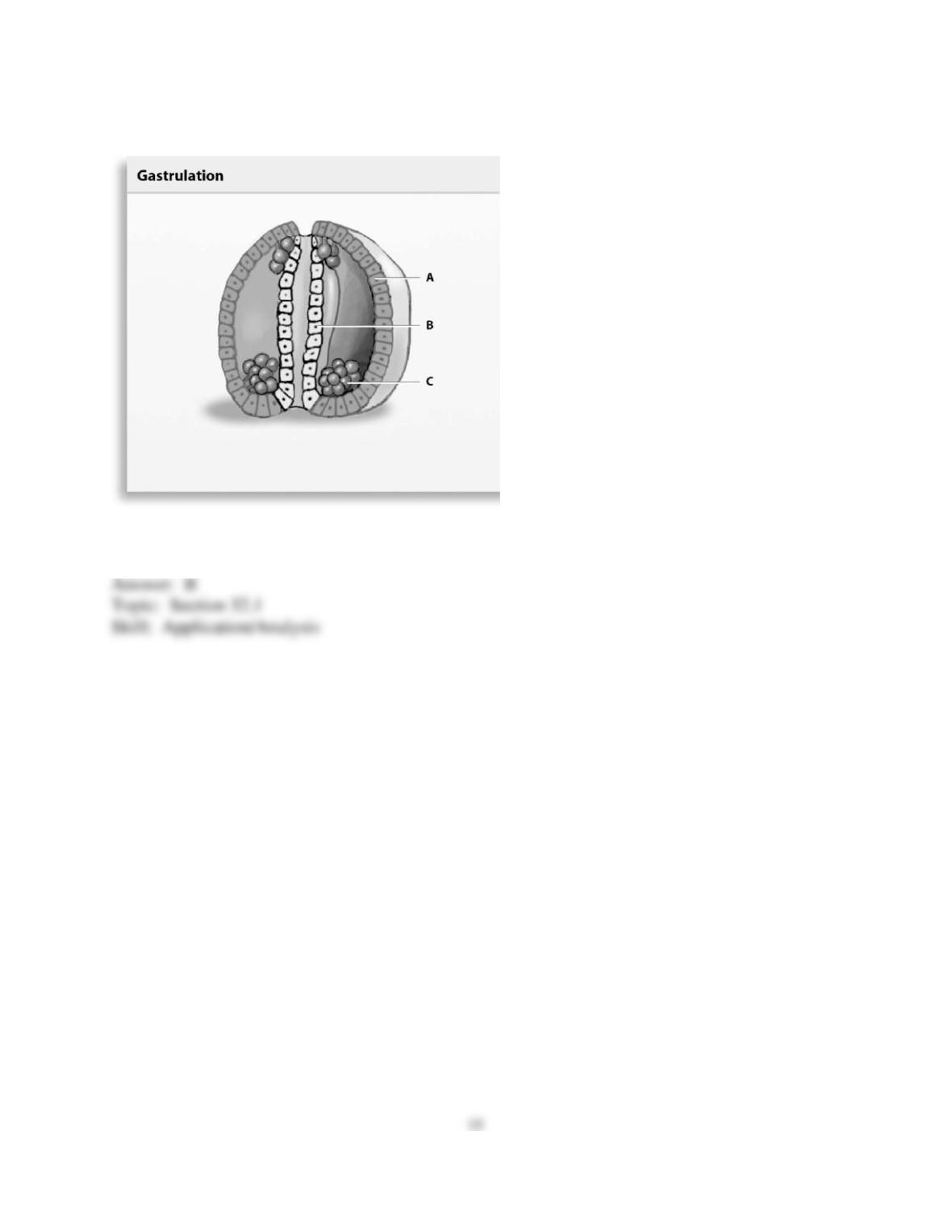
Refer to the figure below, and then answer the question that follows.
80) Which label, A, B, or C, points to a structure formed from the archenteron during
gastrulation?
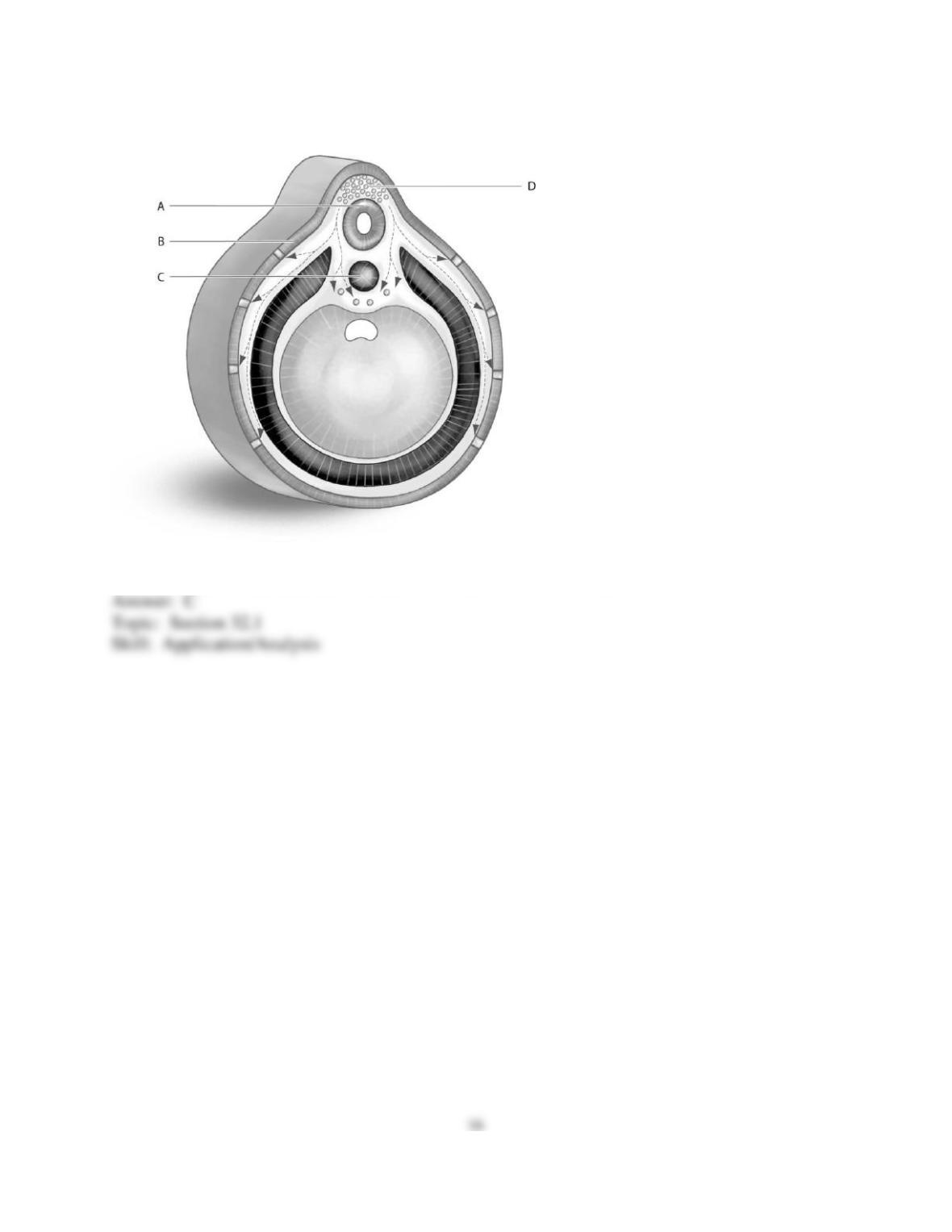
Refer to the figure below, and then answer the question that follows.
81) Which structure, A, B, C, or D, induces formation of the neural tube?