233)
Which of the following statements is FALSE?
233)
A)
Sophisticated financial systems have given U.S. productive efficiency a boost.
B)
When it comes to overall productive efficiency, compared to Japan, Germany and the rest of
the European Union, the United States lags far behind.
C)
Economic restructuring and investments in information technology have added to productive
efficiency in the United States.
D)
The United States’ international competitive position has been helped by its long history of
widespread entrepreneurship.
234)
The United States is considered by the Institute for Management Development to be the most
competitive economy because
234)
A)
of widespread entrepreneurship.
B)
of a high saving rate.
C)
of selected restrictions on imports from Japan and Europe.
D)
U.S. residents are willing to work harder than anyone else is.
235)
Some argue that U.S. workers cannot compete with cheap labor from many developing nations.
This
235)
A)
is true but the benefits of free trade are still such that tariffs should not be placed on these
industries.
B)
is true and is a justification for tariffs to protect domestic jobs.
C)
is not true, as evidenced by the fact that the United States carries on a lot of trade with
countries that have lower wages.
D)
is true and it is has been found that tariffs in these cases can save thousands of jobs and
benefit the economy.
236)
Country A can product 100 units of Good X in a day and 40 units of Good Y while Country B can
produce 50 units of Good X and 40 units of Good Y.
236)
A)
These countries should trade since Country B has a comparative advantage in the production
of Good X and Country A has a comparative advantage in the production of Good Y.
B)
These countries will not trade since Country A has a comparative advantage in the
production of both goods.
C)
These countries will not trade since Country A will always be able to take advantage of
Country B.
D)
These countries should trade since Country A has a comparative advantage in the production
of Good X and Country B has a comparative advantage in the production of Good Y.
237)
Trade restrictions tend to make domestic products
237)
A)
cheaper because they do have to compete with foreign goods.
B)
cheaper because they do not have to compete with foreign goods.
C)
more expensive because they have to compete with foreign goods.
D)
more expensive because they do not have to compete with foreign goods.
238)
The General Agreement on Tariffs and Trade is an international agreement
238)
A)
between the United States and Japan that has never been ratified, resulting in several trade
wars with Japan.
B)
to encourage world trade by lowering tariffs and other trade barriers.
C)
to encourage world trade by lending resources to developing countries.
D)
that outlaws all tariffs but permits quotas.
239)
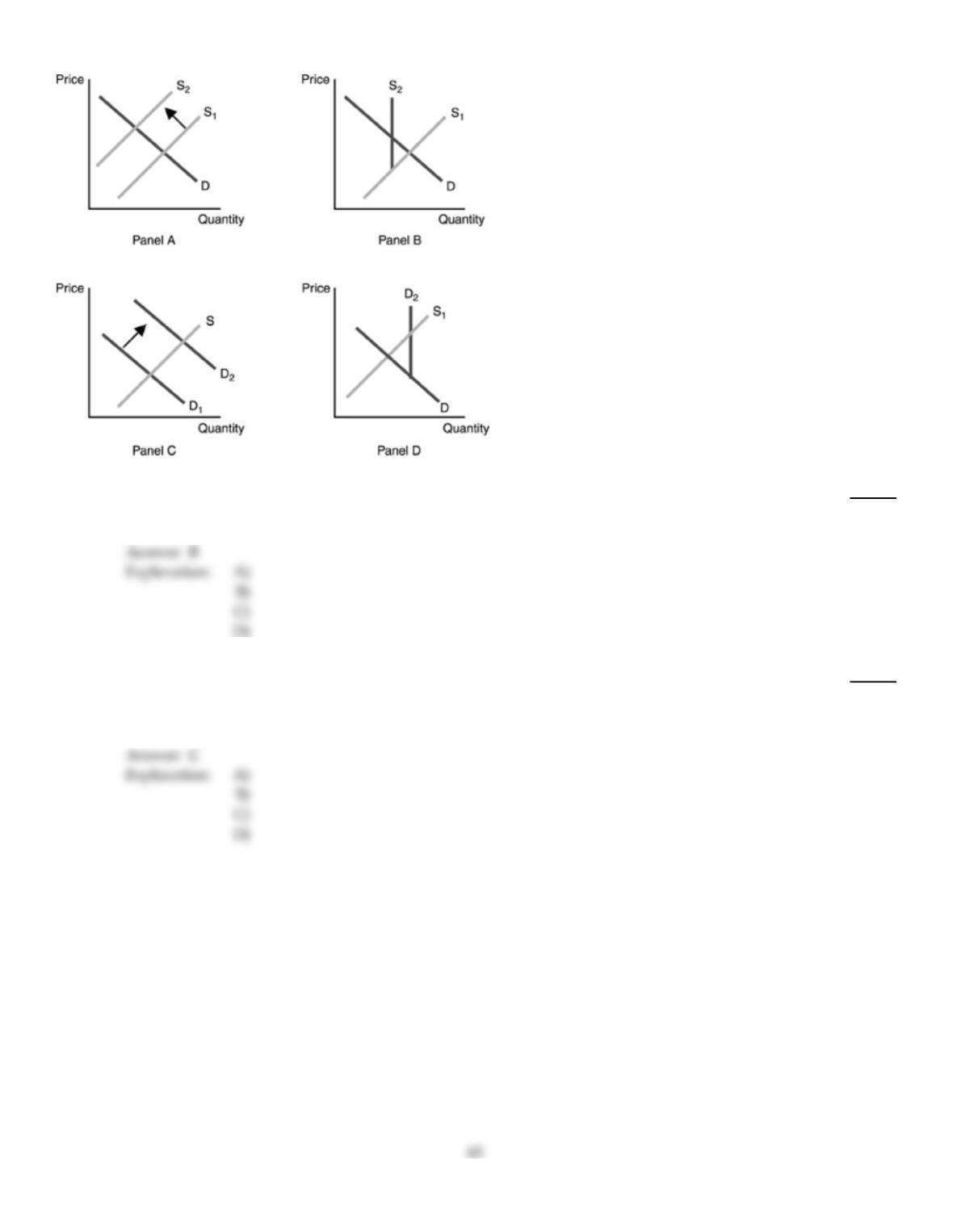
Refer to the above figures. A quota is placed on a foreign good. Which figure represents the
situation in the domestic market for a competing domestic good?
239)
A)
Panel A
B)
Panel B
C)
Panel C
D)
Panel D
240)
If it costs a firm $10 to produce a good and the same good sells for $7 abroad, then this firm is
engaging in
240)
A)
profit maximization.
B)
price differentiation.
C)
dumping.
D)
price discrimination.
Maximum Feasible Hourly Production Rates (in Tons) of Either
Knives or Forks Using All Available Resources
Product Country Alpha Country Beta
Knives 9 3
Forks 612
241)
Use the above table. Assuming constant opportunity costs, if countries Alpha and Beta specialize
based on comparative advantage, then
241)
A)
Alpha should specialize in producing both items.
B)
Alpha should specialize in knives and Beta should specialize in forks.
C)
Alpha should specialize in forks and Beta should specialize in knives.
D)
Beta should produce both items.
242)
Suppose that opportunity costs are constant and that Fred can either bake a maximum of six pies or
three cakes in a day. Ethel can produce a maximum of eight pies or two cakes in a day. Ethel has an
comparative advantage in the production of
242)
A)
cakes.
B)
pies.
C)
both cakes and pies.
D)
neither cakes nor pies.
243)
The contention that tariffs should be imposed to protect from import competition an industry that
is trying to get started is
243)
A)
the infant industry argument.
B)
a voluntary restraint agreement.
C)
a basic argument for free trade.
D)
dumping.
Maximum Feasible Hourly Production Rates of Either
Product A or Product B Using All Available Resources
Product Country X Country Y
A 4 8
B 4 4
244)
Refer to the above table. Assuming constant opportunity costs
244)
A)
Country X has a comparative advantage in the production of both goods.
B)
Country X has a comparative advantage in the production of Product A while Country Y has
a comparative advantage in the production of Product B.
C)
Country Y has a comparative advantage in the production of both goods.
D)
Country Y has a comparative advantage in the production of Product A while Country X has
a comparative advantage in the production of Product B.
245)
Benefits of free trade include all of the following EXCEPT
245)
A)
increased world production.
B)
increased international mobility of labor.
C)
higher standards of living.
D)
transmission of new ideas.
246)
All of the following are arguments against free trade EXCEPT
246)
A)
comparative advantage.
B)
dumping.
C)
the infant industry argument.
D)
the need to protect American jobs.
247)
In 1990, there were 50 bilateral agreements and regional trade agreements between countries.
Today there are
247)
A)
none of these agreements remaining.
B)
30 of these agreements.
C)
more than 230 of these agreements.
D)
more than 10,000 of these agreements.
248)
Which of the following is the situation in which a nation shifts its international trade from nations
outside a regional trade bloc to nations within the bloc?
248)
A)
trade deflection
B)
protectionism
C)
trade diversion
D)
trade retention
249)
Because of NAFTA, the U.S. shifts some of its imports from Europe to Mexico (a member of
NAFTA). This is an example of
249)
A)
trade deflection.
B)
trade diversion.
C)
protectionism.
D)
rules of origin.
250)
An official agreement with another country to restrict the quantity of its exports to the U.S. is
250)
A)
a regional trade bloc.
B)
the quota system.
C)
a voluntary restraint agreement.
D)
a voluntary import expansion.
Maximum Feasible Hourly Production Rates for either
Computers or Bicycles Using All Available Resources
Product United States Mexico
Computers 8 2
Bicycles 6 4
251)
According to the above table, if these two countries trade
251)
A)
Mexico should export computers and the United States export bicycles.
B)
the United States should export computers and Mexico should export bicycles.
C)
we cannot tell which country should export which good without knowing the amount of
labor utilized in each country.
D)
the United States should import computers and Mexico should import bicycles.
252)
One way tariffs differ from quotas is that
252)
A)
tariffs are applied only on raw materials.
B)
tariffs produce no revenues but set limits on the imported items.
C)
quotas produce revenues for the exporting country’s government.
D)
tariffs produce revenues for the importing country’s government.
253)
All of the following are reasons that trade between nations is beneficial EXCEPT
253)
A)
gains from specialization.
B)
exchange of ideas.
C)
gains from trade.
D)
protection of domestic industries.
Maximum Feasible Hourly Production Rates of Either
Computers or Bicycles Using All Available Resources
Product United States Mexico
Computers 810
Bicycles 4 2
254)
Refer to the above table. Assuming constant opportunity costs, the opportunity cost of producing a
computer in the United States is ________ while the opportunity cost of producing a computer in
Mexico is ________.
254)
A)
2 bicycles; 5 bicycles
B)
2.5 computers; 0.25 bicycle
C)
0.5 bicycle; 0.2 bicycle
D)
0.8 bicycle; 2 computers
255)
The infant industry argument suggests that
255)
A)
the industry has no potential and must be protected to survive.
B)
an industry may require temporary tariff protection until the industry matures.
C)
a country requires protection against unfair trade practices.
D)
a country requires tariff protection when it has no comparative advantage in the production
of any good.
Maximum Feasible Hourly Production Rates of Either
Cuckoo Clocks or Movies Using All Available Resources
Product United States Switzerland
Cuckoo Clocks 4 2
Movies 10 4
256)
Refer to the above table. If opportunity costs are constant, residents of the United States will gain
from specializing and trading with Switzerland if the
256)
A)
produce both clocks and films and export both to Switzerland.
B)
produce both clocks and films and export clocks to Switzerland.
C)
import films and export clocks to Switzerland.
D)
import clocks and export films.
257)
Goods that are produced domestically and then sold in other countries are called
257)
A)
exports.
B)
quotas.
C)
imports.
D)
tariffs.
A
258)
The principle of comparative advantage essentially states that
258)
A)
some goods have high opportunity costs and low absolute costs.
B)
total output of an economic system is greatest when each good is produced by those who
have the lowest opportunity cost of producing the good.
C)
there are some goods for which the opportunity costs of production are the same regardless of
who produces them.
D)
specialization can reduce output rather than increase it.
B
D
Maximum Feasible Hourly Production Rates of Either
Product A or Product B Using All Available Resources
Product Country X Country Y
A 4 8
B 4 4
259)
Refer to the above table. Assuming constant opportunity costs
259)
A)
both countries will be willing to engage in trade at a rate of exchange of 3 units of product A
for 1 unit of product B.
B)
neither country will be willing to engage in trade at any rate of exchange of product A for
product B.
C)
both countries will be willing to engage in trade at a rate of exchange of 0.3 unit of product A
for 1 unit of product B.
D)
both countries will be willing to engage in trade at a rate of exchange of 1.5 unit of product A
for 1 unit of product B.
260)
If protective import–restricting tariffs are imposed by a country, in the majority of cases that
nation’s producers end up
260)
A)
producing less of the good than they otherwise would.
B)
receiving a higher price for the good than they otherwise would.
C)
receiving a lower price for the good than they otherwise would.
D)
receiving a lower profit for the domestic good than they otherwise would.
261)
The effect of an import quota is
261)
A)
to shift the supply curve up by the amount of the quota.
B)
to lead to a decrease in demand.
C)
to make the supply curve horizontal at the amount of the quota.
D)
to make the supply curve vertical at the amount of the quota.
262)
Arguments in support of protectionism (and against free trade) include all of the following
EXCEPT
262)
A)
jobs at home should be protected from cheap foreign labor.
B)
protectionism increase total domestic consumption possibilities.
C)
new and troubled industries need to be protected until they acquire sufficient strength to
compete equally against their foreign counterparts.
D)
national security interests require that nations retain the ability to produce vital materials at
home and avoid dependence upon potential enemies.
263)
A group of nations that grants member special trade privileges is
263)
A)
European Union.
B)
North American Free Trade Agreement.
C)
General Agreement on Tariffs and Trade.
D)
World Trade Organization.
264)
The argument that many critics of free trade have suggested that genetic engineering of plants and
animals could lead to accidental production of new diseases is the
264)
A)
national security argument.
B)
infant industry argument.
C)
environmental and safety argument.
D)
protecting domestic jobs argument.
265)
The law that created the high level of tariffs in United States in the 1930s is
265)
A)
the Smoot–Hawley Act.
B)
the GATT Act.
C)
the Tariffs Agreement Act.
D)
the World Trade Act.
266)
If protective import–restricting tariffs are imposed by a country, in the majority of cases that
nation’s consumers end up
266)
A)
having a higher standard of living than they otherwise would.
B)
paying a higher price for the good than they otherwise would.
C)
consuming more of the good than they otherwise would.
D)
paying a lower price for the good than they otherwise would.
267)
A rationale used for tariff protection by some is that
267)
A)
the country wants to practice international price discrimination.
B)
imports are produced by firms that received subsidies from their governments.
C)
imports are produced by firms that are more efficient than domestic producers are.
D)
the country finds its cost of producing their products higher than in other countries.
268)
Trade deflection is an act that
268)
A)
has no impact on the amount of international trade in the world.
B)
decreases the amount of international trade in the world.
C)
is illegal among all countries in the world.
D)
increases the amount of international trade in the world.
Maximum Feasible Hourly Production Rates of Either
Computers or Bicycles Using All Available Resources
Product United States Mexico
Computers 8 3
Bicycles 2 6
269)
Refer to the above table. Assuming that opportunity costs are constant, which of the following is a
correct statement?
269)
A)
Mexico has a comparative advantage in computers.
B)
The United States has a comparative advantage in computers.
C)
Mexico has a comparative advantage in both goods.
D)
The United States has a comparative advantage in bicycles.
270)
Mary can clean 20 windows per hour or type 30 pages of paper per hour. Tom can clean 18
windows per hour or he can type 25 pages of paper per hour. Based on this
270)
A)
Mary has a comparative advantage in cleaning windows.
B)
Tom has a comparative advantage in cleaning windows.
C)
Mary has comparative advantages in activities.
D)
Tom has comparative advantages in both activities.
271)
One reason that U.S. exports of commercial services have increased steadily over the past 25 years
is that
271)
A)
the U.S. government owns and operates most of the economy’s service sector.
B)
the United States has made significant investments in new information technologies.
C)
European and Asian nations have shown little interest in developing their own commercial
services sectors.
D)
the U.S. economy operates like one big corporation.
272)
It has been suggested that in order to protect U.S. jobs we need to restrict foreign competition by
restricting imports.
272)
A)
This is not a sound economic statement since employment in the U.S. does not depend on
imports and exports.
B)
This is a sound economic statement since U.S. firms will have to increase output to make up
for the lack of imports leading to increase employment in the U.S.
C)
This is not a sound economic statement since import restrictions lead to a reduction in
employment in the export industries of the U.S.
D)
This is a sound economic statement since the U.S. will still export protecting U.S. jobs.
Maximum Feasible Hourly Production Rates of Either
Computers or Bicycles Using All Available Resources
Product United States Mexico
Computers 810
Bicycles 4 2
273)
Refer to the above table. It may be concluded that
273)
A)
The United States will import both goods.
B)
Mexico will exports computers and import bicycles.
C)
The United States will exports computers and import bicycles.
D)
The United States will export both goods.
274)
The General Agreement on Tariffs and Trade is an international agreement
274)
A)
to encourage world trade by lowering tariffs and other trade barriers.
B)
to establish the North American continent as a free trade area.
C)
to make all tariffs illegal.
D)
to encourage peaceful settlements of trade disputes, but has no particular point of view about
the desirability of higher or lower tariffs.
275)
The infant–industry argument for tariff protection is that tariffs should be imposed to protect from
competition
275)
A)
industries that can compete with foreign competitors at this point in time and are deemed
essential by the government.
B)
industries needed for national defense.
C)
industries that are essential if a country is to become an industrial nation.
D)
industries that cannot compete with foreign competitors at this point in time, but will be able
to once they gain some size and experience.
276)
Dumping typically occurs as long as the foreign producer sells its output at a price
276)
A)
below its average variable costs.
B)
below its average total costs but above its average variable costs.
C)
above its average fixed costs but below its total variable costs.
D)
above its total costs.
Maximum Feasible Hourly Production Rates of Either
Computers or Bicycles Using All Available Resources
Product United States Mexico
Computers 810
Bicycles 4 2
277)
Refer to the above table. It may be concluded that
277)
A)
The United States has a comparative advantage in producing both goods.
B)
Mexico has a comparative advantage in computer production.
C)
Mexico has a comparative advantage in bicycle production.
D)
The United States has a comparative advantage in producing neither good.
Maximum Feasible Hourly Production Rate
Chen Holly
Units of Good X 50 40
Units of Good Y 25 100
278)
According to the above table, which assumes that opportunity costs of producing goods X and Y
are constant, Chen has comparative advantage in production of
278)
A)
both goods.
B)
Good X.
C)
Good Y.
D)
neither good.
279)
Which of the following is consistent with international trade theory?
279)
A)
The United States needs trade restrictions to stay competitive.
B)
The standard of living within a country is a function of the economic strength of the economy
and not of its relative position.
C)
A country should strive for comparative advantage in manufacturing.
D)
The United States has been falling behind Europe and Japan because its economy is too open.
Maximum Feasible Hourly Production Rates of Either
Computers or Bicycles Using All Available Resources
Product United States Mexico
Computers 810
Bicycles 4 2
280)
Refer to the above table. If opportunity costs are constant, then the United States and Mexico will
produce goods in which they have a comparative advantage and trade at a rate of exchange of
280)
A)
0.1 computer for 1 bicycle.
B)
1 computer for 1 bicycle.
C)
4 computers for 1 bicycle.
D)
6 computers for 1 bicycle.