154)
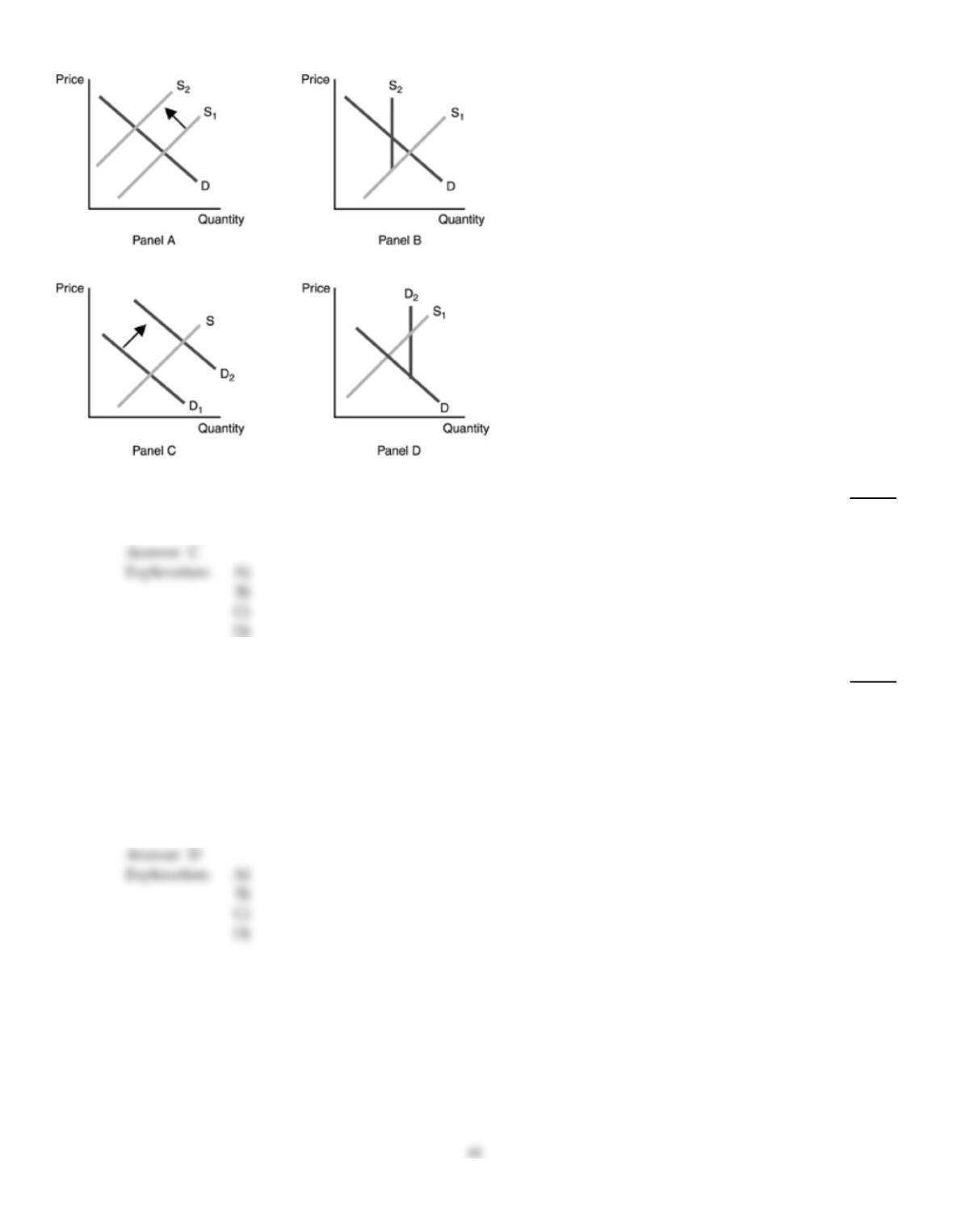
Refer to the above figures. A tariff is placed on a foreign good. Which figures represents the
situation in the domestic market for a competing domestic good?
154)
A)
Panel A
B)
Panel B
C)
Panel C
D)
Panel D
155)
Governments sometimes subsidize domestic industries. When this occurs
155)
A)
the governments will not impose tariffs.
B)
the subsidized sell less in international markets because it is more profitable to sell at home.
C)
the subsidized industries have an advantage on international markets relative to
nonsubsidized firms. However, this is not an argument for imposing tariffs and tariffs would
violate international agreements.
D)
the subsidized industries have an advantage on international markets relative to
non–subsidized firms. For this reason, other countries often impose tariffs on the subsidized
imports.
Maximum Feasible Hourly Production Rates of Either
Computers or Bicycles Using All Available Resources
Product United States Mexico
Computers 810
Bicycles 4 2
156)
Refer to the above table. Assuming constant opportunity costs, the opportunity cost of producing a
bicycle in the United States is ________ while the opportunity cost of producing a bicycle in Mexico
is ________.
156)
A)
8 computers; 10 computer
B)
5 computers; 2 computers
C)
4 computers; 10 computers
D)
2 computers; 5 computers
157)
The basic proposition in international trade is that
157)
A)
everyone is made better off by free trade.
B)
trade is determined by absolute advantage.
C)
fair trade is more important than free trade.
D)
in the long run, imports are paid for by exports.
158)
In order to obtain an efficient allocation of resources worldwide
158)
A)
countries that have a lot of resources should ship resources to countries that do not have a lot
of resources.
B)
countries that have a lot of resources should not trade since poorer countries cannot compete.
C)
no trade among countries should occur.
D)
each country should produce the good they have a comparative advantage in and then trade.
159)
For the United States since 1950, imports as a percentage of GDP has
159)
A)
decreased.
B)
increased slightly.
C)
tripled.
D)
remained constant.
Maximum Feasible Hourly Production Rates (in Tons) of Either
Wine or Beef Using All Available Resources
Product Argentina France
Wine (gallons) 30 60
Beef (pounds) 10 30
160)
Use the above table. Assuming constant opportunity costs, the opportunity cost of producing a
pound of beef in France is
160)
A)
0.33 gallons of wine.
B)
0.5 gallons of wine.
C)
3 gallons of wine.
D)
2 gallons of wine.
161)
A tariff is a tax on
161)
A)
imported goods.
B)
shipping containers.
C)
all exported goods imposed by the WTO.
D)
foreign exchange transactions.
Explanation:
162)
An effect of international trade is
162)
A)
the transmission of ideas around the world.
B)
that only countries that have absolute advantage in producing a good can participate.
C)
the increase in the average price of goods as the cost of transportation has to be included.
D)
that the United States has a trade surplus.
Explanation:
163)
Given two economic systems, A and B, if economy A has a comparative advantage in the
production of widgets, then
163)
A)
economy A would not benefit from the specialization of production.
B)
economy A must give up less of all other goods to produce widgets than economy B.
C)
economy A is less efficient in the production of some goods than economy B.
D)
the inputs necessary to produce widgets in economy A cost less than in economy B.
Explanation:
Explanation:
Maximum Feasible Hourly Production Rates of Either
Computers or Bicycles Using All Available Resources
Product United States Mexico
Computers 8 3
Bicycles 2 6
164)
Refer to the above table. Assuming that opportunity costs are constant, the opportunity cost of
producing a bicycle in the United States is equal to ________, and the opportunity cost of producing
a bicycle in Mexico is ________.
164)
A)
4 computers; 0.5 computer
B)
0.25 computer; 2 computers
C)
0.375 computer; 3 bicycles
D)
2.67 bicycles; 0.33 computers
165)
If the residents of a country specialize in a good in which they have a comparative advantage and
trade with residents in another nation, the residents in the first country
165)
A)
will have a lower standard of living.
B)
can consume more than they could without trade.
C)
can produce more than they could without trade.
D)
will be exploited by the second nation.
166)
The contention that tariffs should be imposed to when a foreign government provides financial
assistance its producers is
166)
A)
dumping.
B)
the infant industry argument.
C)
a national defense concern.
D)
to counter foreign subsidies.
167)
Assume that maximum feasible hourly productions levels if all resources are utilized in the United
States are either 8 yards of fabric or 4 bushels of wheat. Maximum feasible production levels if all
resources are utilized in Japan are either 3 yards of fabric or 6 bushels of wheat. Based on this
information
167)
A)
both nations will gain from specialization and trade, with the United States exporting wheat
and Japan exporting fabric.
B)
both nations will gain from specialization and trade, with the United States exporting fabric
and Japan exporting wheat.
C)
the United States will benefit from trading but Japan will not.
D)
beneficial trade is absolutely impossible between the two countries.
168)
If there are two goods and two countries, then one country can have
168)
A)
a comparative advantage in only one good.
B)
a higher opportunity cost of producing both goods.
C)
a comparative advantage in both goods.
D)
a lower opportunity cost of producing both goods.
169)
The ability to produce a good or service at a lower opportunity cost than other producers is
169)
A)
comparative advantage.
B)
opportunity advantage.
C)
absolute advantage.
D)
special advantage.
170)
An import quota specifies
170)
A)
the minimum amount of an item that may be imported during a specified period.
B)
the maximum amount of an item that may be imported during a specified period.
C)
the amount of funds that can be paid for any imported good.
D)
the amount of taxes that must be paid on any imported good.
171)
A legal restriction on the amount of a good that can be imported into a country is known as a
171)
A)
tariff.
B)
Domestic Protection Restraint (DPR).
C)
quota.
D)
voluntary restraint agreement.
172)
The contention that specific sensitive domestic technologies must not be traded freely is
172)
A)
dumping.
B)
to protect domestic jobs.
C)
the infant industry argument.
D)
a national defense concern.
Maximum Feasible Hourly Production Rate
Chen Holly
Units of Good X 50 40
Units of Good Y 25 100
173)
According to the above table, which assumes that opportunity costs of producing goods X and Y
are constant, the opportunity cost of producing one unit of Good X is ________ units of Good Y for
Chen and ________ units of Good Y for Holly.
173)
A)
100; 25
B)
0.5; 2.5
C)
2; 0.4
D)
25; 100
174)
Countries engaged in international trade specialize in production based on
174)
A)
comparative advantage.
B)
relative foreign exchange rates.
C)
relative price levels.
D)
the differences in transportation costs.
175)
Comparative advantage is
175)
A)
the ability to produce more output from given inputs than another producer can.
B)
the ability to produce all goods at lower costs than anyone else can.
C)
the ability to produce more output of all goods than anyone else can.
D)
the ability to produce a good at a lower opportunity cost than other producers.
176)
An import quota will make the supply curve for the imported good
176)
A)
negatively sloped.
B)
perfectly inelastic.
C)
unitary elastic.
D)
perfectly elastic.
177)
The importance of international trade in the U.S. economy
177)
A)
has been decreasing and is expected to continue to decrease.
B)
has been increasing and is expected to continue to increase.
C)
has been increasing but is expected to decrease in the future.
D)
has been decreasing but is expected to start to increase.
178)
U.S. job losses cited by anti–trade critics
178)
A)
affect only capital–intensive U.S. industries.
B)
are mostly a short–term problem in isolated industries.
C)
are non–existent.
D)
are mostly due to poor training by U.S. firms.
179)
The trend in current tariff laws is to
179)
A)
lower tariffs on foreign goods.
B)
raise tariffs on foreign goods.
C)
keep tariffs the same.
D)
abolish tariffs all together.
180)
One argument against free trade is the
180)
A)
considerate advantage argument.
B)
absolute advantage argument.
C)
comparative advantage argument.
D)
infant industry argument.
181)
A voluntary import expansion involves a
181)
A)
country agreeing to reduce its trade barriers.
B)
firm agreeing to expand output.
C)
country agreeing to an import quota.
D)
country agreeing to import more from another country.
Individual Opportunity Cost
Pramilla 2 units of good X to produce 1 unit of good Y
Sam 3 units of good X to produce 1 unit of good Y
George 4 units of good Y to produce 1 unit of good X
Lucas 5 units of good Y to produce 1 unit of good X
182)
Consider the opportunity costs of producing goods X and Y that are listed for the four individuals
above. Which person has a comparative advantage in producing good Y?
182)
A)
George
B)
Pramilla
C)
Lucas
D)
Sam
Maximum Feasible Hourly Production Rates (in Tons) of Either
Pizzas or Donuts Using All Available Resources
Product Country Alpha Country Beta
Pizzas 10 2
Donuts 10 12
183)
According to the above table, Alpha has comparative advantage in producing
183)
A)
pizzas.
B)
donuts.
C)
both pizzas and donuts.
D)
neither pizzas nor donuts.
184)
A government–imposed restriction on the quantity of a specific good that may be imported to and
sold in the United States is called a
184)
A)
tariff system.
B)
quota system.
C)
union trade system.
D)
reverse–trade system.
185)
The idea that tariffs should be imposed to protect new and developing industries is referred to as
185)
A)
the new markets theory.
B)
the infant industry argument.
C)
the incubator business theory.
D)
the start–up argument.
B
186)
Which of the following is NOT a benefit of international trade?
186)
A)
It promotes self–sufficiency.
B)
It increases overall output.
C)
It results in the transmission of new processes.
D)
It results in a transmission of ideas.
A
Maximum Feasible Hourly Production Rates (in Tons) of Either
Knives or Forks Using All Available Resources
Product Country Alpha Country Beta
Knives 9 3
Forks 612
187)
Use the above table. Assuming constant opportunity costs, the opportunity cost of producing
knives in country Alpha is ________, and the opportunity cost of producing knives in country Beta
is ________.
187)
A)
1.5 forks; 0.25 fork
B)
2 forks; 0.33 knife
C)
0.5 knife; 3 forks
D)
0.67 fork; 4 forks
D
B
188)
Suppose that opportunity costs are constant and that Fred can either bake a maximum of six pies or
three cakes in a day. Ethel can either produce a maximum of eight pies or two cakes in a day.
Ethel’s opportunity cost to produce one cake is
188)
A)
two pies.
B)
six pies.
C)
four pies.
D)
one–half pie.
189)
A quota is
189)
A)
a government–imposed restriction on the quantity of a specific good that can be imported.
B)
a tariff imposed on goods that are dumped in the country.
C)
a law that prevents ecologically damaging goods from being imported into a country.
D)
a market–imposed balancing factor that keeps prices of imports and exports in equilibrium.
190)
Voluntary restraint agreements are
190)
A)
a type of tariff in which the tax is based on the value of the good.
B)
a type of tariff in which the tax is a fixed amount per unit of good imported.
C)
a type of quota agreed to “voluntarily” in order to prevent more severe protection of another
type.
D)
a type of quota that actually benefits the firms facing the restrictions.
191)
According to economic historians, one result of international trade is that it
191)
A)
aids in the international transmission of ideas.
B)
reduces the world–wide consumption of goods.
C)
reduces the world–wide output of goods.
D)
causes persistent world–wide inflation.
192)
Which of the following is the situation in which firms outside a trade bloc shift the final assembling
process of partially assembled products into a member nation of the bloc and then export the
finished products to other nations within the bloc?
192)
A)
trade retention
B)
trade deflection
C)
trade diversion
D)
rules of origin
193)
According to the infant–industry argument, protection should be withdrawn from an infant
industry when the companies in the industry
193)
A)
become profitable.
B)
are listed on the domestic stock exchange.
C)
double their sales revenues.
D)
reach a sufficient size to compete with foreign firms.
D
194)
The maximum amount of a good that may be imported during a specified period of time is
194)
A)
an infant industry agreement.
B)
dumping.
C)
an import quota.
D)
comparative advantage.
C
195)
A tariff placed on a foreign good will
195)
A)
increase the price of a competing domestic good.
B)
reduce the quantity sold of both the foreign and competing domestic good.
C)
reduce the price of a competing domestic good.
D)
increase the quantity sold of both the foreign and competing domestic good.
A
196)
The international agreement signed in 1947 to promote world trade by reducing tariffs and other
barriers to international trade was called
196)
A)
GATT.
B)
WTO.
C)
Bretton–Woods agreement.
D)
NAFTA.
A
B
197)
The selling of a good or service abroad at a price below what is charged in the home market or
below the cost of production is referred to as
197)
A)
recycling.
B)
dumping.
C)
a tariff.
D)
a quota.
Maximum Feasible Hourly Production Rates of Either
Product A or Product B Using All Available Resources
Product Country X Country Y
A 4 8
B 4 4
198)
Refer to the above table. If opportunity costs are constant and both countries produce only the
goods for which they have comparative advantages and then trade, hourly world output would
equal
198)
A)
8 units of product A and 4 units of product B.
B)
12 units of product A and 8 units of product B.
C)
8 units of product A and 8 units of product B.
D)
4 units of product A and 4 units of product B.
199)
The ability to produce an item at a lower opportunity cost compared with other producers is
known as
199)
A)
absolute advantage.
B)
competitive dominance.
C)
comparative advantage.
D)
productive dominance.
200)
If Bob can produce completed mathematics homework assignments at a lower opportunity cost
than Jane can accomplish, then Bob has ________ in completing mathematics homework
assignments.
200)
A)
a comparative disadvantage
B)
an absolute advantage
C)
a complete advantage
D)
a relative advantage
201)
Comparative advantage is the ability, compared with another producer
201)
A)
to use fewer inputs to produce the same amount of a product.
B)
to produce an additional unit of a product at lower opportunity cost.
C)
to produce a higher–quality product with fewer resources.
D)
to produce more of a product with the same resources.
202)
A tax placed on imports is known as
202)
A)
infant industry.
B)
tariff.
C)
voluntary restraint agreement.
D)
quota.
Explanation:
203)
The World Trade Organization is a successor organization to the
203)
A)
United Nations.
B)
GATT.
C)
World Bank.
D)
International Court of Justice.
Explanation:
Maximum Feasible Hourly Production Rate
Chen Holly
Units of Good X 50 40
Units of Good Y 25 100
204)
According to the above table, which assumes that opportunity costs of producing goods X and Y
are constant, Holly has comparative advantage in production of
204)
A)
Good X.
B)
neither good.
C)
Good Y.
D)
both goods.
Explanation:
Explanation:
205)
One way to reduce exports is to
205)
A)
base trade on comparative advantage.
B)
restrict imports.
C)
trade with poor countries.
D)
base trade on opportunity costs.
206)
Dumping is
206)
A)
international monopolistic pricing.
B)
selling goods produced with government approval.
C)
international price discrimination.
D)
collusive behavior among producers in different countries.
207)
The Uruguay round of GATT (1993) talks
207)
A)
left tariffs and trade barriers unchanged.
B)
lowered some trade barriers but increased tariffs.
C)
increased trade barriers and tariffs.
D)
reduced trade barriers and tariffs.
208)
If country X can produce a unit of good 1 at a lower opportunity cost than can country Y, it is
correct to state that country X
208)
A)
will not produce good 1.
B)
will import good 1 from country Y.
C)
has a comparative advantage in producing good 1.
D)
has an absolute advantage in producing good 1.
209)
In the long run, if imports increase, then exports
209)
A)
will decrease.
B)
will become zero.
C)
will not change.
D)
will also increase.
210)
The contention that domestic unions tend to want to restrict foreign competition with tariffs is
210)
A)
to protect domestic jobs.
B)
a national defense concern.
C)
the infant industry argument.
D)
dumping.
211)
Suppose a Middle Eastern firm moves its final assembly line to Germany and then ships the final
products to other members of the EU trading bloc. This is an example of
211)
A)
trade restriction.
B)
trade diversion.
C)
trade deflection.
D)
trade detection.
212)
An official agreement with another country in which it agrees to import more from the United
States is
212)
A)
a regional trade bloc.
B)
a voluntary restraint agreement.
C)
the quota system.
D)
a voluntary import expansion.
213)
Assume that U.S. producers can manufacture cookies at a lower opportunity cost than Mexican
producers. If this is the case
213)
A)
Mexico would have the comparative advantage in all products compared to the United States.
B)
Mexico could still have the comparative advantage in cookie production.
C)
it will not be possible for Mexico to have an comparative advantage in the production of any
other products.
D)
it would still be possible for Mexico to have a comparative advantage in trade for some other
products.
214)
A significant advantage to being a member of a trade bloc is
214)
A)
reduced or eliminated tariffs among member countries.
B)
reduced tariff rates only for the largest member countries.
C)
higher tariff collections from member countries.
D)
None of the above; there is no economic advantage to a trade bloc.
215)
The ability to produce a good or service at a lower opportunity cost than other producers is called
215)
A)
absolute advantage.
B)
comparative advantage.
C)
marginal advantage.
D)
implicit advantage.
216)
U.S. automakers have an interest to make it more difficult for European competitors to locate
assembly plants in Canada or Mexico and thereby ship finished automobiles to the United States
duty–free. This is an example of
216)
A)
rules of origin.
B)
quotas.
C)
trade deflection.
D)
trade diversion.
Maximum Feasible Hourly Production Rates (in Tons) of Either
Cookies or Coffee Using All Available Resources
Product Country Alpha Country Beta
Cookies 3 8
Coffee 9 4
217)
Use the above table. If these two countries, Alpha and Beta, specialize based on comparative
advantage
217)
A)
Alpha will specialize in coffee, and Beta will specialize in cookies.
B)
Beta will specialize in producing both items.
C)
Alpha will specialize in cookies, and Beta will specialize in coffee production.
D)
Alpha will specialize in producing both items.
218)
Assume that maximum feasible hourly productions levels if all resources are utilized in the United
States are either 3 yards of fabric or 9 bushels of wheat. Maximum feasible production levels if all
resources are utilized in Japan are either 6 yards of fabric or 12 bushels of wheat. Based on this
information
218)
A)
both nations will gain from specialization and trade, with the United States exporting wheat
and Japan exporting fabric.
B)
beneficial trade is absolutely impossible between the two countries.
C)
the United States will benefit from trading but Japan will not.
D)
Japan should specialize in both products.
219)
Using trade restrictions to protect special interests such as the U.S. auto industry
219)
A)
raises the prices that U.S. consumers must pay for autos.
B)
results in lower prices for U.S. auto consumers.
C)
is a very cost–efficient way of dealing with trade problems.
D)
is the best long–term solution for threatened U.S. jobs.
A
220)
Dumping typically occurs because
220)
A)
the importing country is experiencing a recession.
B)
the importing country has assessed significant tariffs.
C)
the exporting country raises its prices to increase profits.
D)
the exporting country usually is experiencing a recession and has excess production.
D
221)
Free trade policies may lead to
221)
A)
a decrease in world output.
B)
some labor sectors experiencing some short–term job loss.
C)
price increases in world markets.
D)
none of the above.
B
A
222)
During the Great Depression, many industrial countries tried protecting domestic jobs by raising
tariffs. Economic theory would suggest that the result would be
222)
A)
increased incomes in the countries that pursued this policy.
B)
success for firms that had a comparative advantage in manufactured goods rather than
agricultural goods.
C)
reduced exports and volume of trade for everyone.
D)
success for only the countries that raised tariffs first.
223)
When a good is put onto the global market at a price below the cost to produce it, this is known as
223)
A)
protection of domestic jobs.
B)
a quota.
C)
dumping.
D)
the infant–industry argument.
224)
The effects of a tariff are
224)
A)
reduced quantity supplied overall, reduced quantity supplied by domestic producers, and a
lower price.
B)
reduced quantity supplied overall, decreased quantity supplied by domestic producers, and a
lower price.
C)
reduced quantity supplied overall, increased quantity supplied by domestic producers, and a
higher price.
D)
identical to the effects of a quota, except that the price of the good is higher.
225)
A problem with the infant industry argument is that
225)
A)
it is almost impossible to eliminate the tariff once the industry matures.
B)
it allows infant industries to mature so that tariffs can be eliminated.
C)
it is too restrictive in targeting new industries to protect.
D)
it does not protect the most important new industries in a country.
226)
When nations specialize according to their comparative advantage
226)
A)
Total world production rises but total consumption in the world declines.
B)
Consumption rises in one country but must fall in all others.
C)
Total production and consumption in the world increase.
D)
none of the above
227)
If protective import–restricting quota are imposed by a country, all of the following groups benefit
EXCEPT
227)
A)
domestic producers in the affected industry.
B)
employees of domestic producers in the affected industry.
C)
importers that are able to obtain the rights to sell imported items in the affected industry.
D)
domestic consumers in the affected industry.
228)
According to the principle of comparative advantage, a nation should specialize in economic
activities
228)
A)
for which it has an absolute advantage.
B)
that incur lower opportunity costs.
C)
that incur higher opportunity costs.
D)
for which it has no absolute advantage.
229)
Suppose that the opportunity cost of producing goods differs between two nations. We can
correctly state that
229)
A)
specialization can lead to an increase in the consumption of all goods.
B)
neither country has a comparative advantage in the production of any good.
C)
specialization can lead to an increase in the production of all goods.
D)
the two nations should not specialize in the production of goods.
230)
The North American Free Trade Agreement and the European Union are examples of
230)
A)
defense treaties.
B)
agriculturally based economies.
C)
regional trade blocs.
D)
labor agreements designed only for industrialized countries.
Maximum Feasible Hourly Production Rates (in Tons) of Either
Wine or Beef Using All Available Resources
Product Argentina France
Wine (gallons) 30 60
Beef (pounds) 10 30
231)
Use the above table. Assuming constant opportunity costs, if Argentina and France specialize based
on comparative advantage, then they will trade if the rate of exchange
231)
A)
8 pounds of beef for 1 gallon of wine, and France imports wine.
B)
0.2 pound of beef for 1 gallon of wine, and Argentina imports wine.
C)
4 gallons of wine for 1 pound of beef, and France imports beef.
D)
is 2.5 gallons of wine for 1 pound of beef, and Argentina imports beef.
Maximum Feasible Hourly Production Rates of Either
Computers or Bicycles Using All Available Resources
Product United States Mexico
Computers 8 3
Bicycles 2 6
232)
Refer to the above table. If opportunity costs are constant, the two countries will gain from trade at
a rate of exchange of
232)
A)
8 bicycles for 1 computer.
B)
0.1 computer for 1 bicycle.
C)
5 computers for 1 bicycle.
D)
1 computer for 1 bicycle.