61)
For the United States since 1950, imports as a percentage of GDP has
61)
A)
remained constant.
B)
increased slightly.
C)
decreased.
D)
tripled.
62)
The argument that with initial protection an industry will eventually become competitive is called
the
62)
A)
infant industry argument.
B)
national security argument.
C)
strategic bargaining argument.
D)
the trade adjustment assistance argument.
63)
The infant industry argument says that
63)
A)
countries should produce and trade goods according to their comparative advantage.
B)
tariffs should be imposed to allow a new industry in a country to get established.
C)
dumping should be allowed in order to establish a presence of an industry that has
previously not had a presence in another country.
D)
imports should target new products from other countries to take advantage of the
transmission of new ideas.
64)
Consider the following information, and assume that opportunity costs are constant: On one hand,
residents of Country A can produce more corn in a year than residents of Country B, but they can
produce computers at a lower opportunity cost than residents of country B. On the other hand,
residents of country B can produce more computers in a year than residents of Country A, but they
can produce corn at a lower opportunity cost than residents of country A. It can be concluded that
residents of
64)
A)
Country B should produce computers and trade them for corn produced in Country B.
B)
Country A should produce computers and trade them for corn produced in Country B.
C)
both countries should choose not to trade.
D)
Country A should produce corn and trade it for computers produced in Country B.
65)
A country will specialize in the good for which
65)
A)
it has moderate production costs.
B)
it can produce at minimum average cost.
C)
it has absolute advantage.
D)
it has comparative advantage.
66)
The infant–industry argument is often criticized because
66)
A)
it reduces government revenues in the short term.
B)
it reduces labor productivity in the short term.
C)
it is difficult to determine which industry merits protection.
D)
it reduces the employment rate.
67)
If the infant industry argument is used to protect an industry that has already matured, then
67)
A)
consumers lose because they will pay a price for a product, which is less than the world price.
B)
stockholders lose because the firm cannot compete with other firms.
C)
consumers lose because they will pay a price for a product that is above the world price.
D)
no one loses.
68)
Specialization in trade will be economically efficient if it is based upon
68)
A)
comparative advantage.
B)
national security needs.
C)
government regulations.
D)
absolute advantage.
69)
A rationale used for tariff protection by some is that
69)
A)
imports are produced by firms that received subsidies from their governments.
B)
the country wants to practice international price discrimination.
C)
the country finds its cost of producing their products higher than in other countries.
D)
imports are produced by firms that are more efficient than domestic producers are.
70)
The net effect of regional trade agreements has been
70)
A)
no change in the total amount of trade in the world.
B)
either an increase or decrease in the amount of trade in the world, depending on where trade
takes place.
C)
an increase in the total amount of trade in the world.
D)
a decrease in the total amount of trade in the world.
71)
The infant–industry argument for tariff protection is that tariffs should be imposed to protect from
competition
71)
A)
industries needed for national defense.
B)
industries that are essential if a country is to become an industrial nation.
C)
industries that can compete with foreign competitors at this point in time and are deemed
essential by the government.
D)
industries that cannot compete with foreign competitors at this point in time, but will be able
to once they gain some size and experience.
72)
A government–imposed restriction on the quantity of a specific good that may be imported to and
sold in the United States is called a
72)
A)
reverse–trade system.
B)
union trade system.
C)
tariff system.
D)
quota system.
Maximum Feasible Hourly Production Rates (in Tons) of Either
Knives or Forks Using All Available Resources
Product Country Alpha Country Beta
Knives 9 3
Forks 612
73)
Use the above table. Assuming constant opportunity costs, the opportunity cost of producing
knives in country Alpha is ________, and the opportunity cost of producing knives in country Beta
is ________.
73)
A)
1.5 forks; 0.25 fork
B)
2 forks; 0.33 knife
C)
0.67 fork; 4 forks
D)
0.5 knife; 3 forks
74)
Goods that are produced in other countries and then sold domestically are called
74)
A)
exports.
B)
quotas.
C)
tariffs.
D)
imports.
75)
It has been suggested that in order to protect U.S. jobs we need to restrict foreign competition by
restricting imports.
75)
A)
This is not a sound economic statement since import restrictions lead to a reduction in
employment in the export industries of the U.S.
B)
This is a sound economic statement since the U.S. will still export protecting U.S. jobs.
C)
This is a sound economic statement since U.S. firms will have to increase output to make up
for the lack of imports leading to increase employment in the U.S.
D)
This is not a sound economic statement since employment in the U.S. does not depend on
imports and exports.
76)
If a country voluntarily agrees to have its companies import more goods from another country, the
country has
76)
A)
a mandated agreement.
B)
a mandated tariff.
C)
a voluntary restraint agreement (VRA).
D)
a voluntary import expansion (VIE) agreement.
77)
Import restrictions due to the imposition of tariffs by the U.S. government
77)
A)
will lead to lower incomes in the economy of U.S. trade partners.
B)
will ultimately cause inefficient resource allocation in the United States.
C)
will lead to a decline in the quantity of the product consumed in the United States.
D)
all of the above are likely to occur
78)
Groups of nations that grants members trade privileges are called
78)
A)
allies.
B)
trade settlements.
C)
local trade protectionists.
D)
regional trade blocs.
79)
Country A can product 100 units of Good X in a day and 40 units of Good Y while Country B can
produce 50 units of Good X and 40 units of Good Y.
79)
A)
These countries will not trade since Country A will always be able to take advantage of
Country B.
B)
These countries should trade since Country A has a comparative advantage in the production
of Good X and Country B has a comparative advantage in the production of Good Y.
C)
These countries should trade since Country B has a comparative advantage in the production
of Good X and Country A has a comparative advantage in the production of Good Y.
D)
These countries will not trade since Country A has a comparative advantage in the
production of both goods.
80)
The importance of international trade in the U.S. economy
80)
A)
has been increasing but is expected to decrease in the future.
B)
has been decreasing but is expected to start to increase.
C)
has been increasing and is expected to continue to increase.
D)
has been decreasing and is expected to continue to decrease.
81)
Suppose that the opportunity cost of producing goods differs between two nations. We can
correctly state that
81)
A)
neither country has a comparative advantage in the production of any good.
B)
specialization can lead to an increase in the production of all goods.
C)
specialization can lead to an increase in the consumption of all goods.
D)
the two nations should not specialize in the production of goods.
82)
When the principle of comparative advantage determines trade, then a country will
82)
A)
specialize only in that good where output is less per worker hour than another country.
B)
specialize only in that good with the highest opportunity cost.
C)
specialize only in goods with the lowest opportunity costs.
D)
specialize only in that good where production costs are more than average total costs.

Maximum Feasible Hourly Production Rates of Either
Computers or Bicycles Using All Available Resources
Product United States Mexico
Computers 8 3
Bicycles 2 6
83)
Refer to the above table. If opportunity costs are constant and the two countries trade,
83)
A)
the United States should specialize in computers and Mexico in bicycles.
B)
the United States should specialize in both bicycles and computers, and Mexico should
specialize in neither.
C)
the United States should specialize in bicycles and Mexico in computers.
D)
there will be no trade because they are so different.
84)
A government imposed restriction on the quantity of a good that can be imported is
84)
A)
a protective tariff.
B)
an embargo.
C)
a quota.
D)
a health restriction.
85)
The North American Free Trade Agreement and the European Union are examples of
85)
A)
labor agreements designed only for industrialized countries.
B)
agriculturally based economies.
C)
regional trade blocs.
D)
defense treaties.
86)
One way to reduce exports is to
86)
A)
base trade on comparative advantage.
B)
restrict imports.
C)
base trade on opportunity costs.
D)
trade with poor countries.
Maximum Feasible Hourly Production Rates for either
Computers or Bicycles Using All Available Resources
Product United States Mexico
Computers 8 2
Bicycles 6 4
87)
According to the above table, if these two countries trade,
87)
A)
we cannot tell which country should export which good without knowing the amount of
labor utilized in each country.
B)
the United States should import computers and Mexico should import bicycles.
C)
the United States should export bicycles and Mexico should export computers.
D)
Mexico should import computers and the United States import bicycles.
88)
The contention that tariffs should be imposed to when a foreign government provides financial
assistance its producers is
88)
A)
a national defense concern.
B)
dumping.
C)
to counter foreign subsidies.
D)
the infant industry argument.
89)
The organization that settles trade disputes between countries is the
89)
A)
World Bank.
B)
United Nations.
C)
International Monetary Fund.
D)
World Trade Organization.
90)
In comparing tariffs and quotas, we know that
90)
A)
tariffs raise revenues for the federal government, while quotas do not.
B)
quotas raise revenues for the federal government, while tariffs do not.
C)
neither raises revenues for the federal government.
D)
both raise revenues for the federal government.
Maximum Feasible Hourly Production Rates for either
Computers or Bicycles Using All Available Resources
Product United States Mexico
Computers 8 2
Bicycles 6 4
91)
According to the above table, if these two countries trade,
91)
A)
the United States should export computers and Mexico should export bicycles.
B)
Mexico should export computers and the United States export bicycles.
C)
the United States should import computers and Mexico should import bicycles.
D)
we cannot tell which country should export which good without knowing the amount of
labor utilized in each country.
92)
A legal limit on the amount of sugar imported into the United States is
92)
A)
a voluntary import restriction.
B)
a tariff.
C)
a subsidy.
D)
a quota.
93)
The infant industry argument suggests that
93)
A)
a country requires protection against unfair trade practices.
B)
an industry may require temporary tariff protection until the industry matures.
C)
a country requires tariff protection when it has no comparative advantage in the production
of any good.
D)
the industry has no potential and must be protected to survive.
94)
The argument that trade in high–tech equipment can facilitate the implementation of advanced
military technology in countries that may become strategic opponents later on is the
94)
A)
environmental and safety argument.
B)
infant industry argument.
C)
protecting domestic jobs argument.
D)
national security argument.
95)
Since the 1930s, overall tariff rates in the United States have
95)
A)
decreased.
B)
become very unstable, changing week to week.
C)
remained unchanged.
D)
increased.
96)
The maximum amount of a good that may be imported during a specified period of time is
96)
A)
comparative advantage.
B)
dumping.
C)
an infant industry agreement.
D)
an import quota.
97)
One way tariffs differ from quotas is that
97)
A)
quotas produce revenues for the exporting country’s government.
B)
tariffs are applied only on raw materials.
C)
tariffs produce revenues for the importing country’s government.
D)
tariffs produce no revenues but set limits on the imported items.
98)
Which of the following is the situation in which a nation shifts its international trade from nations
outside a regional trade bloc to nations within the bloc?
98)
A)
trade diversion
B)
protectionism
C)
trade deflection
D)
trade retention
Maximum Feasible Hourly Production Rates (in Tons) of Either
Wine or Beef Using All Available Resources
Product Argentina France
Wine (gallons) 30 60
Beef (pounds) 10 30
99)
Use the above table. Assuming constant opportunity costs, the opportunity cost of producing a
gallon of wine in Argentina is
99)
A)
0.33 pound of beef.
B)
0.5 pound of beef.
C)
2 pounds of beef.
D)
3 pounds of beef.
100)
Which of the following is NOT an example of a regional trade bloc?
100)
A)
The European Union
B)
The North American Free Trade Agreement
C)
The Asian–Pacific Trade Agreement
D)
Mercosur
SHORT ANSWER. Write the word or phrase that best completes each statement or answers the question.
101)
Discuss the relationship between world trade and world Gross Domestic Product (GDP)
since the early 1950s.
101)
102)
What are the effects of a tariff on a good?
102)
103)
Why is it impossible to make everyone better off in the long run by imposing import
restrictions?
103)
104)
“Everybody has a comparative advantage in something.” Do you agree or disagree? Why?
104)
105)
“The United States has fallen behind Japan and most of Europe in terms of
competitiveness.” Do you agree or disagree? Why?
105)
106)
How can comparative advantage yield gains from trade?
106)
107)
Why is trade based on comparative advantage?
107)
108)
Discuss the relationship between U.S. competitiveness relative to other countries and
standards of living in the United States.
108)
109)
“It is possible to restrict imports and still maintain a fixed level of exports.” Do you agree or
disagree? Why?
109)
110)
What must a government know for the infant industry argument to be a valid reason for
imposing tariffs?
110)
111)
What is the relationship between imports and employment?
111)
112)
“International trade bestows benefits on countries through the international transmission of
ideas.” Do you agree or disagree? Explain.
112)
113)
Explain the infant industry argument.
113)
114)
What is GATT and what happened to tariff rates as a result of GATT?
114)
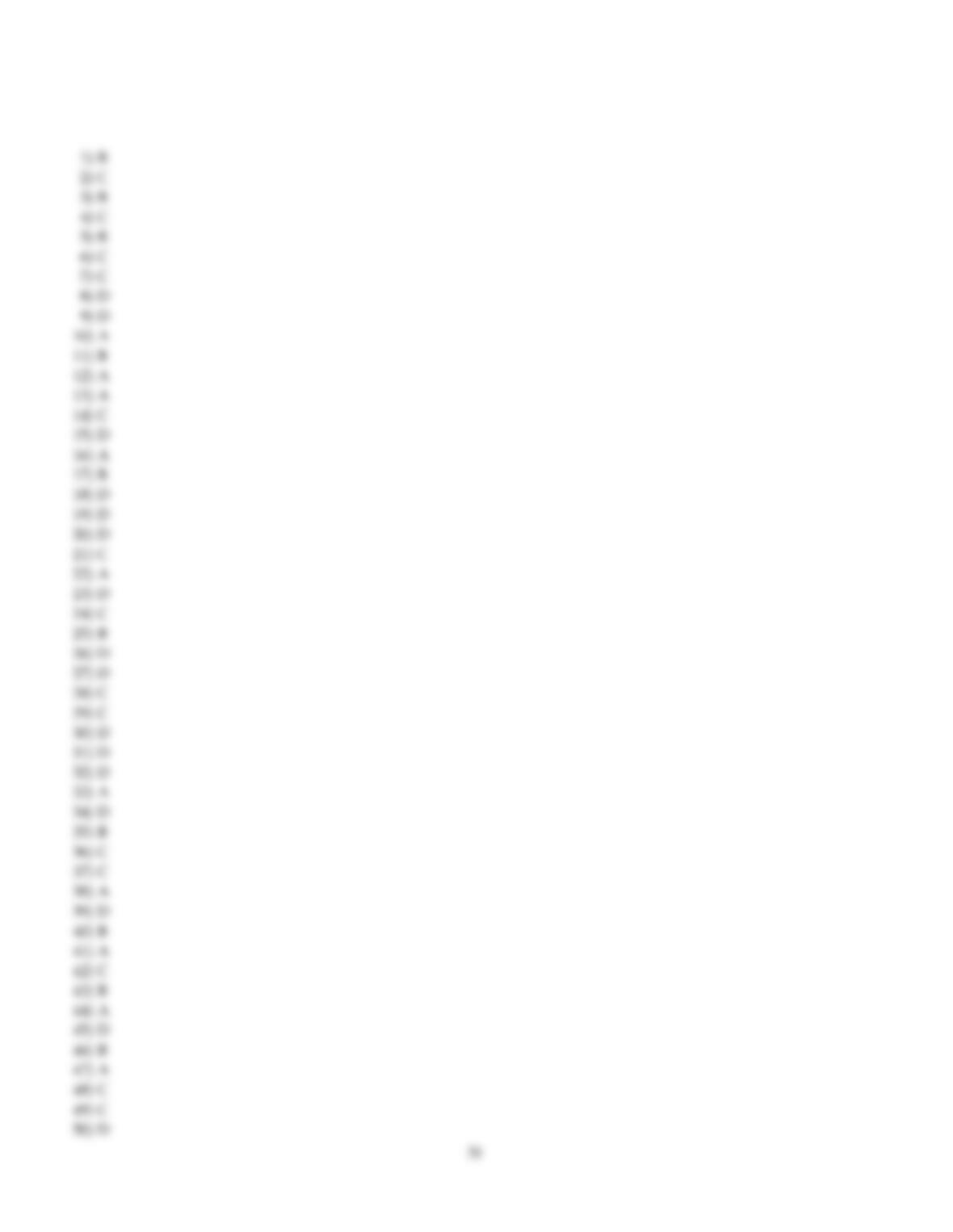
Answer Key
Testname: C32
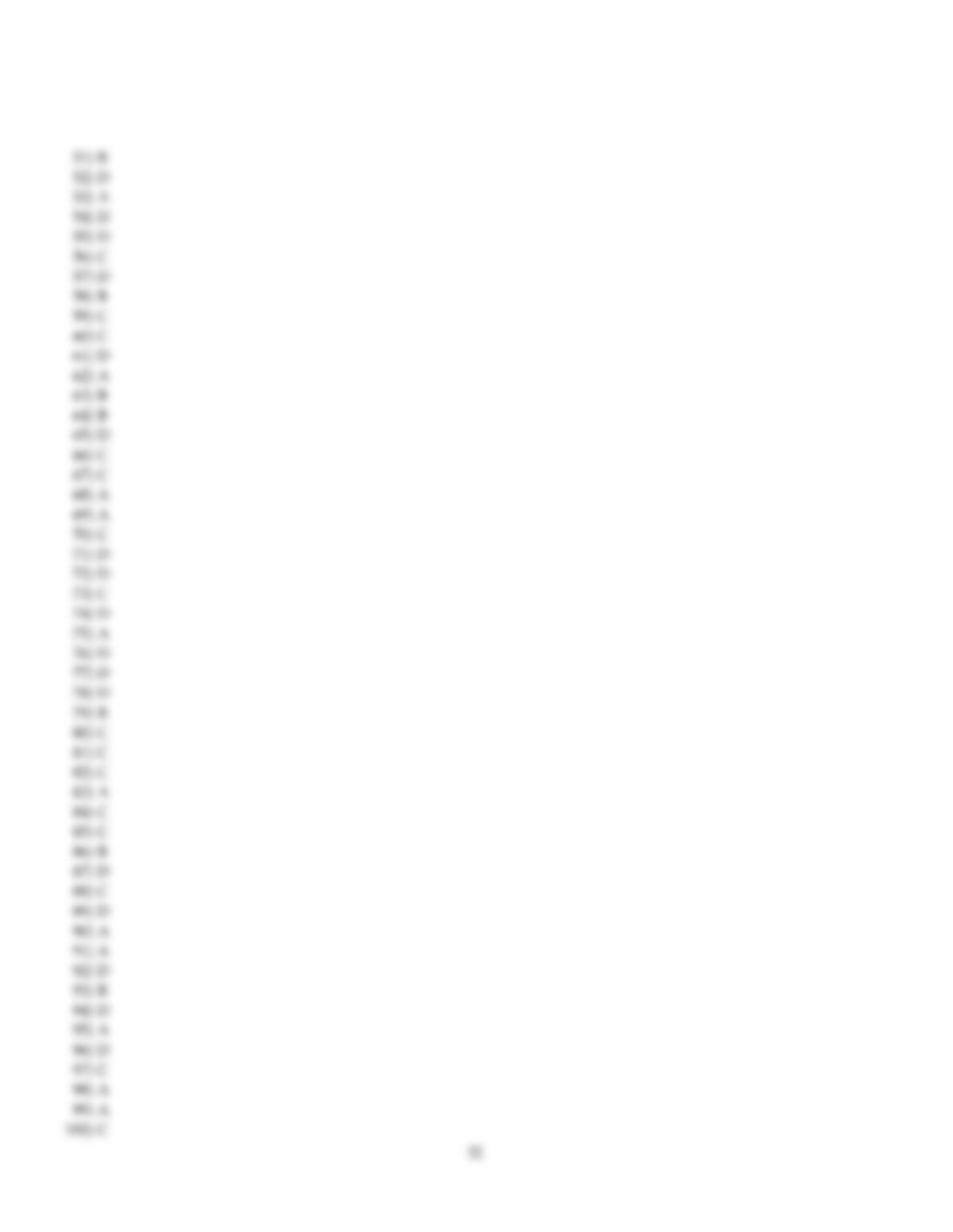
Answer Key
Testname: C32
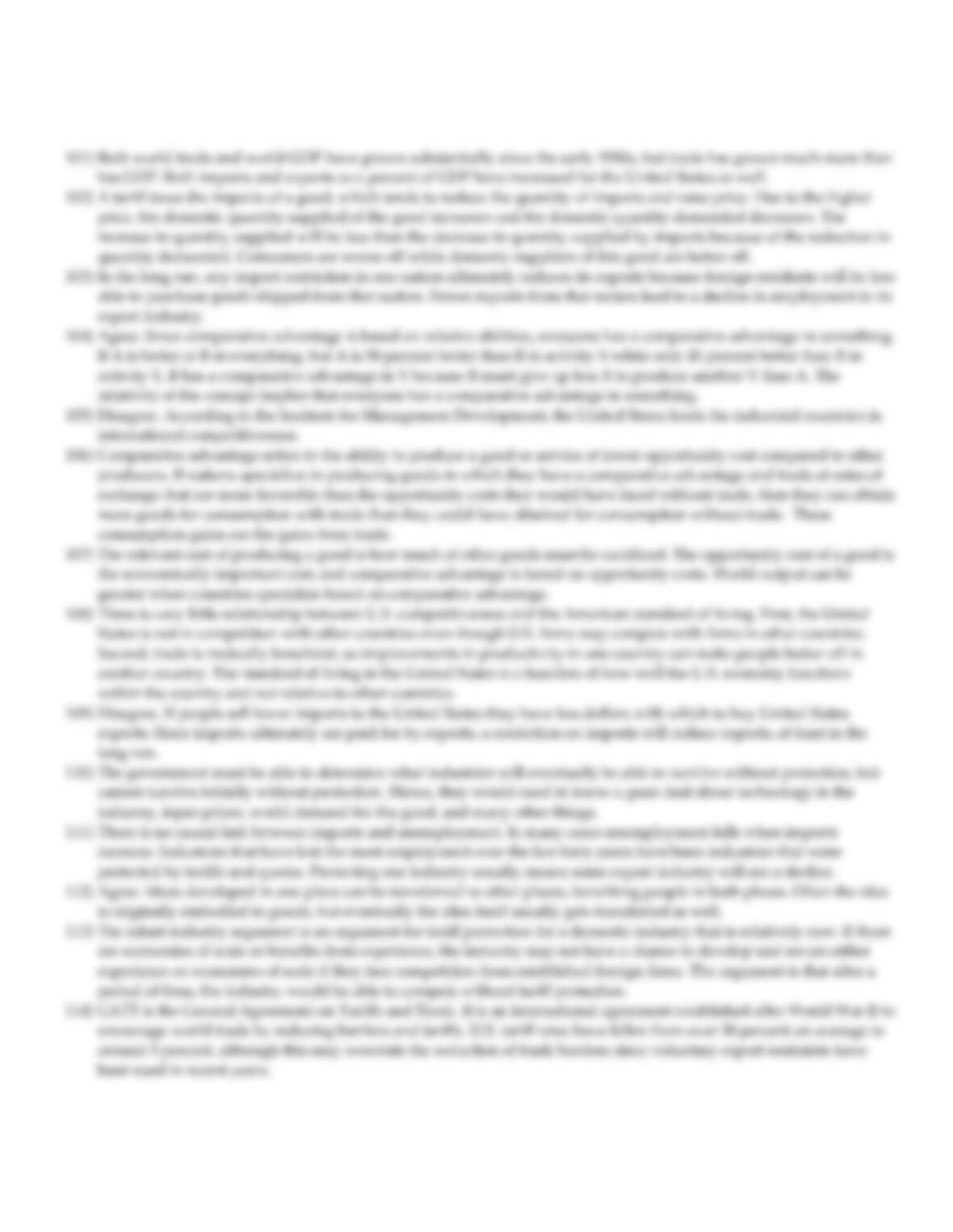
Answer Key
Testname: C32
33