Exam
Name___________________________________
MULTIPLE CHOICE. Choose the one alternative that best completes the statement or answers the question.
1)
The World Trade Organization
1)
A)
was established to settle trade disputes within the European Union.
B)
was established to resolve disputes arising under world trade rules.
C)
increases world trade by providing interest rate subsidies to foreign borrowers who buy U.S.
exports on credit.
D)
is another name for the IMF.
2)
Comparative advantage is based on the
2)
A)
concept that some countries are better endowed with natural resources.
B)
concept of absolute advantage of producing goods in different countries.
C)
concept of relative opportunity cost of producing goods in different countries.
D)
concept that some countries are superior to others.
C
Maximum Feasible Hourly Production Rates of Either
Computers or Bicycles Using All Available Resources
Product United States Mexico
Computers 810
Bicycles 4 2
3)
Refer to the above table. Assuming constant opportunity costs, the opportunity cost of producing a
computer in the United States is ________ while the opportunity cost of producing a computer in
Mexico is ________.
3)
A)
2 bicycles; 5 bicycles
B)
0.5 bicycle; 0.2 bicycle
C)
0.8 bicycle; 2 computers
D)
2.5 computers; 0.25 bicycle
B
B
4)
Suppose Mexico has a comparative advantage relative to the United States in the manufacture of
clothing and the United States has a comparative advantage in producing agricultural products.
Which of the following is most likely to occur?
4)
A)
Mexico and the United States will not trade agricultural products or clothing.
B)
Mexico will sell clothing to the United States but not buy any agricultural products from the
United States.
C)
Mexico will sell clothing to the United States and the United States will sell agricultural
products to Mexico.
D)
Mexico will sell agricultural products to the United States and Mexico will buy clothing from
the United States.
5)
One problem with the infant industry argument is that
5)
A)
it must be approved by the Federal Reserve Board.
B)
the protection is typically never removed, creating a domestic monopoly.
C)
it fails to protect domestic industries from foreign competition.
D)
it must be approved by the IMF and the World Bank.
6)
Some nations avoid the effects of trade deflection in a trade bloc by enforcing
6)
A)
trade deflection.
B)
trade diversion.
C)
rules of origin.
D)
quotas.
7)
The European Union started out as a
7)
A)
union of nations where the same language was spoken.
B)
union of nations with identical currency.
C)
regional trade agreement.
D)
union of nations with identical tariffs.
8)
The WTO
8)
A)
is an affiliate of the World Bank.
B)
provides low interest loans to member nations to help develop their export industries.
C)
is an organization created to oversee NAFTA.
D)
was established to resolve trade disputes among member nations.
9)
Restricting imports
9)
A)
can protect United States final goods and services in the protected industry and makes
consumers better off.
B)
can protect United States final goods and services in the protected industry and increase
economic welfare of the country as a whole.
C)
can protect United States jobs in the protected industry, which increases economic welfare of
the country as a whole.
D)
can protect United States jobs in the protected industry but will also lead to reductions in U.S.
output and income.
D
10)
Which of the following statements is FALSE?
10)
A)
When it comes to overall productive efficiency, compared to Japan, Germany and the rest of
the European Union, the United States lags far behind.
B)
The United States’ international competitive position has been helped by its long history of
widespread entrepreneurship.
C)
Economic restructuring and investments in information technology have added to productive
efficiency in the United States.
D)
Sophisticated financial systems have given U.S. productive efficiency a boost.
A
11)
Dumping occurs when, in a foreign market, a good is sold
11)
A)
at a price above the equilibrium price.
B)
below its cost of production or below the price in that market.
C)
at a discount below the list price.
D)
below its nominal price.
B
D

Maximum Feasible Hourly Production Rates (in Tons) of Either
Knives or Forks Using All Available Resources
Product Country Alpha Country Beta
Knives 9 3
Forks 612
12)
Use the above table. Assuming constant opportunity costs, if countries Alpha and Beta specialize
based on comparative advantage, then
12)
A)
Alpha should specialize in knives and Beta should specialize in forks.
B)
Alpha should specialize in producing both items.
C)
Alpha should specialize in forks and Beta should specialize in knives.
D)
Beta should produce both items.
13)
To avoid tariffs, a Japanese firm moves its final assembly line to Mexico and then ships the final
products to Canada. This is an example of
13)
A)
trade deflection.
B)
rules of origin.
C)
protectionism.
D)
trade diversion.
14)
Countries engaged in international trade specialize in production based on
14)
A)
relative foreign exchange rates.
B)
the differences in transportation costs.
C)
comparative advantage.
D)
relative price levels.
Maximum Feasible Hourly Production Rates for Either
Food or Cloth Using All Available Resources
Food Cloth
U.S. 4 3
Mexico 12 6
15)
Using the data in the above table and assuming constant opportunity costs, it is correct to state that
15)
A)
Mexico has an absolute advantage in producing both food and cloth.
B)
Mexico has a comparative advantage in producing cloth.
C)
the United States has a comparative advantage in producing both food and cloth.
D)
the United States has a comparative advantage in producing cloth.
16)
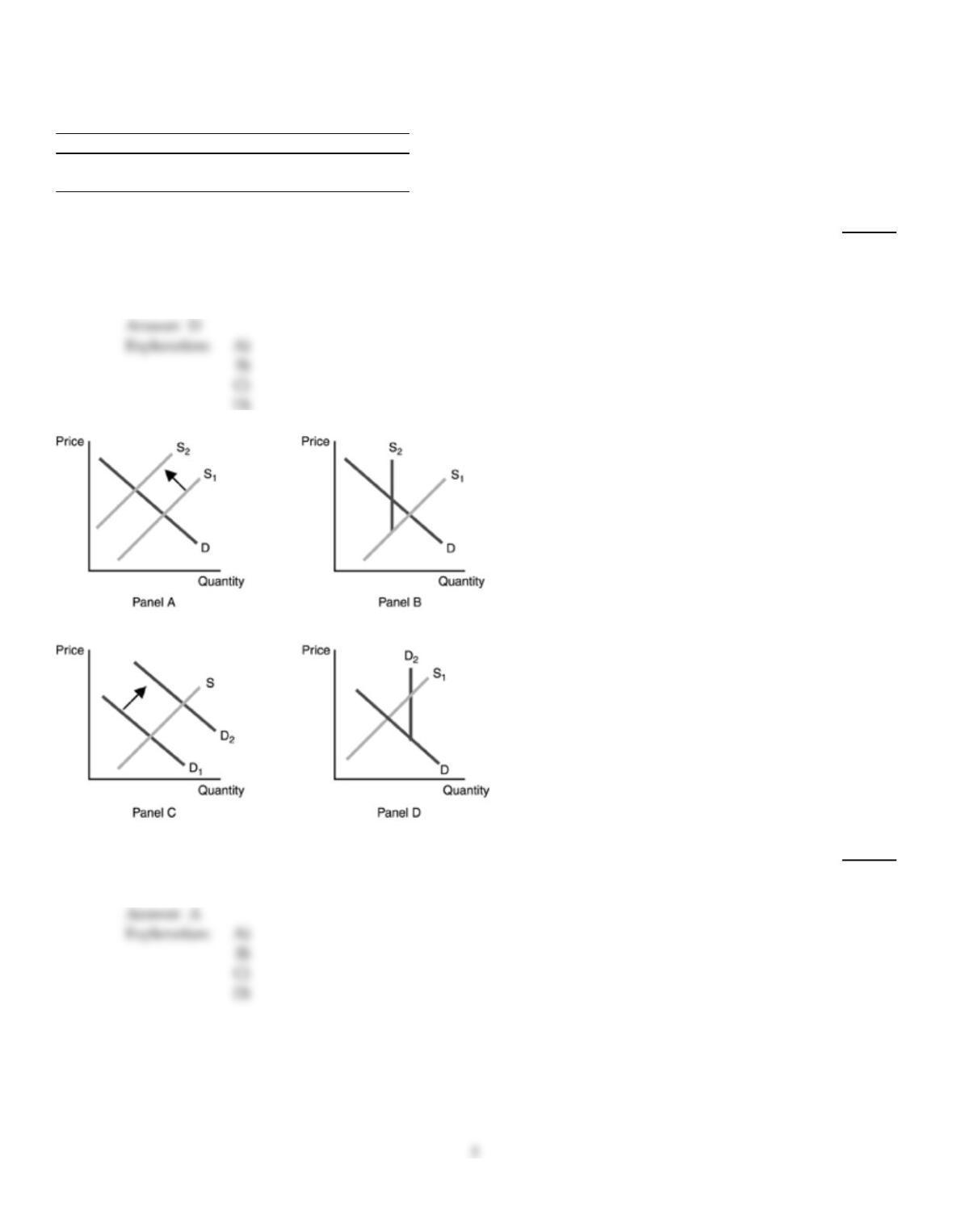
Refer to the above figures. A tariff is placed on a foreign good. Which figure represents the
situation in the domestic market for the foreign good?
16)
A)
Panel A
B)
Panel B
C)
Panel C
D)
Panel D
17)
The argument that many critics of free trade have suggested that genetic engineering of plants and
animals could lead to accidental production of new diseases is the
17)
A)
infant industry argument.
B)
environmental and safety argument.
C)
protecting domestic jobs argument.
D)
national security argument.
18)
Protection of a new industry until it becomes strong enough to compete is called
18)
A)
the government indirect tax argument.
B)
the national defense argument.
C)
the leveling–the–playing–field argument.
D)
the infant–industry argument.
Explanation:
19)
The argument that a tariff has to be imposed in order to protect any industry just getting started
until it gets large enough to be competitive internationally is the
19)
A)
start–up industry argument.
B)
fledgling industry argument.
C)
baby industry argument.
D)
infant industry argument.
Explanation:
20)
An international agreement from 1947 designed to lower tariffs was
20)
A)
the World Agreement on Tariffs and Trade.
B)
the World Trade Organization.
C)
the Trade and Tariff Agreement.
D)
the General Agreement on Tariffs and Trade.
Explanation:
21)
If in the long run, imports are paid for by exports, then
21)
A)
any restriction of imports has no impact on exports.
B)
any restriction of exports has no impact on imports.
C)
any restriction of imports ultimately reduces exports.
D)
any restriction of imports ultimately expands exports.
Explanation:
Explanation:
22)
Protection of new products from global competition is known as
22)
A)
the infant–industry argument.
B)
a quota.
C)
dumping.
D)
protection of domestic jobs.
23)
A tariff placed on a foreign good will
23)
A)
increase the quantity sold of both the foreign and competing domestic good.
B)
reduce the price of a competing domestic good.
C)
reduce the quantity sold of both the foreign and competing domestic good.
D)
increase the price of a competing domestic good.
D
24)
Import restrictions
24)
A)
can protect United States jobs in the protected industry, which increases economic welfare of
the country as a whole.
B)
cannot protect American jobs in any sector of the economy.
C)
can protect United States jobs in the protected industry but will also lead to job reductions in
other export industries.
D)
hurt people who work in importing companies, but makes consumers better off.
C
25)
The WTO replaced the GATT in
25)
A)
1960.
B)
1995.
C)
1900.
D)
1945.
B
A
Maximum Feasible Hourly Production Rates (in Tons) of Either
Wine or Beef Using All Available Resources
Product Argentina France
Wine (gallons) 30 60
Beef (pounds) 10 30
26)
Use the above table. Assuming constant opportunity costs, a comparative advantage in producing
wine is possessed by
26)
A)
both Argentina and France.
B)
neither Argentina or France.
C)
France.
D)
Argentina.
Maximum Feasible Hourly Production Rates for either
Computers or Bicycles Using All Available Resources
Product United States Mexico
Computers 8 2
Bicycles 6 4
27)
According to the above table, if these two countries trade,
27)
A)
Mexico should specialize in computers and the United States in bicycles.
B)
we cannot tell which country should specialize in which good without knowing the amount
of labor utilized in each country.
C)
the United States should specialize in both computers and bicycles.
D)
the United States should specialize in computers and Mexico should specialize in bicycles.
D
Explanation:
28)
Suppose that opportunity costs are constant and that Fred can either bake a maximum of six pies or
three cakes in a day. Ethel can produce a maximum of eight pies or two cakes in a day. Fred has an
comparative advantage in the production of
28)
A)
neither cakes nor pies.
B)
both cakes and pies.
C)
cakes.
D)
pies.
C
Explanation:
D
Explanation:
29)
Selling a good abroad below the price charged in the home market is
29)
A)
a basic argument for free trade.
B)
a voluntary restraint agreement.
C)
dumping.
D)
the infant industry argument.
30)
In an hour Jane can solder 50 connections or inspect 20 parts while Jim can solder 25 connections or
inspect 20 parts in an hour.
30)
A)
Jim has a comparative advantage over Jane in soldering while Jane has a comparative
advantage in inspecting.
B)
Jane has a comparative advantage over Jim in both soldering and inspecting.
C)
Jim had a comparative advantage over Jane in both soldering and inspecting.
D)
Jane has a comparative advantage over Jim in soldering while Jim has a comparative
advantage in inspecting.
31)
One economic truism is that any nation’s restriction of imports will ultimately lead to
31)
A)
an increase in GDP.
B)
an economic upswing.
C)
an increase in exports.
D)
a reduction in exports.
32)
Suppose a Middle Eastern firm moves its final assembly line to Germany and then ships the final
products to other members of the EU trading bloc. This is an example of
32)
A)
trade restriction.
B)
trade detection.
C)
trade diversion.
D)
trade deflection.
Maximum Feasible Hourly Production Rates (in Tons) of Either
Wine or Beef Using All Available Resources
Product Argentina France
Wine (gallons) 30 60
Beef (pounds) 10 30
33)
Use the above table. Assuming constant opportunity costs, the opportunity cost of producing a
pound of beef in Argentina is
33)
A)
3 gallons of wine.
B)
2 gallons of wine.
C)
0.33 gallons of wine.
D)
0.5 gallons of wine.
34)
Which of the following is counted as a benefit from international trade?
34)
A)
New goods have been introduced to other parts of the world.
B)
Intellectual property such as music and computer applications is introduced throughout the
world.
C)
New production processes developed in one nation are transmitted to others.
D)
All of the above are benefits from international trade.
D
35)
The ability to produce a good or service at a lower opportunity cost than other producers is
35)
A)
special advantage.
B)
comparative advantage.
C)
opportunity advantage.
D)
absolute advantage.
B
36)
A tariff is
36)
A)
a voluntary agreement to restrict exports.
B)
a subsidy on domestically produced goods.
C)
a tax on imported goods.
D)
a government–imposed restriction on the quantity of a specific good that can be imported into
the country.
C
A
Maximum Feasible Hourly Production Rates (in Tons) of Either
Wine or Beef Using All Available Resources
Product Argentina France
Wine (gallons) 30 60
Beef (pounds) 10 30
37)
Use the above table. Assuming constant opportunity costs, the opportunity cost of producing a
gallon of wine in France is
37)
A)
0.33 pound of beef.
B)
2 pounds of beef.
C)
0.5 pound of beef.
D)
3 pounds of beef.
38)
If the residents of a country specialize in a good in which they have a comparative advantage and
trade with residents in another nation, the residents in the first country
38)
A)
can consume more than they could without trade.
B)
will be exploited by the second nation.
C)
can produce more than they could without trade.
D)
will have a lower standard of living.
39)
Since World War II, the world inflation–adjusted output of goods and services has increased by a
multiple of
39)
A)
4.
B)
2.
C)
3.
D)
9.
40)
Some argue that U.S. workers cannot compete with cheap labor from many developing nations.
This
40)
A)
is true and is a justification for tariffs to protect domestic jobs.
B)
is not true, as evidenced by the fact that the United States carries on a lot of trade with
countries that have lower wages.
C)
is true and it is has been found that tariffs in these cases can save thousands of jobs and
benefit the economy.
D)
is true but the benefits of free trade are still such that tariffs should not be placed on these
industries.
41)
Comparative advantage is defined as
41)
A)
producing one good at a lower opportunity cost than another country can.
B)
producing more output of all goods than anyone else can.
C)
the ability to produce more output from given inputs than anyone else can.
D)
producing all goods at lower opportunity costs than other countries can.
A
42)
A tariff is
42)
A)
the difference between the world market price and the domestic price when a group of firms
in an industry collude successfully.
B)
a subsidy on domestically produced goods.
C)
a tax on imported goods.
D)
a government imposed restriction on the quantity of a specific good that can be imported into
the country and sold.
C
43)
Suppose that opportunity costs are constant and that Fred can either bake a maximum of six pies or
three cakes in a day. Ethel can either produce a maximum of eight pies or two cakes in a day.
Ethel’s opportunity cost to produce one cake is
43)
A)
two pies.
B)
four pies.
C)
one–half pie.
D)
six pies.
B
B
44)
Dumping is
44)
A)
selling a good abroad at a price below cost or below the price charged in the domestic market.
B)
exporting goods that are sources of pollution.
C)
exporting goods that are of inferior quality relative to the goods sold in the domestic market.
D)
selling a good abroad in huge quantities at a very low price.
45)
In 1990, there were 50 bilateral agreements and regional trade agreements between countries.
Today there are
45)
A)
more than 10,000 of these agreements.
B)
30 of these agreements.
C)
none of these agreements remaining.
D)
more than 230 of these agreements.
46)
A legal restriction on the amount of a good that can be imported into a country is known as a
46)
A)
voluntary restraint agreement.
B)
quota.
C)
tariff.
D)
Domestic Protection Restraint (DPR).
47)
Governments sometimes subsidize domestic industries. When this occurs,
47)
A)
the subsidized industries have an advantage on international markets relative to
non–subsidized firms. For this reason, other countries often impose tariffs on the subsidized
imports.
B)
the subsidized sell less in international markets because it is more profitable to sell at home.
C)
the subsidized industries have an advantage on international markets relative to
nonsubsidized firms. However, this is not an argument for imposing tariffs and tariffs would
violate international agreements.
D)
the governments will not impose tariffs.
48)
If country X can produce a unit of good 1 at a lower opportunity cost than can country Y, it is
correct to state that country X
48)
A)
will not produce good 1.
B)
has an absolute advantage in producing good 1.
C)
has a comparative advantage in producing good 1.
D)
will import good 1 from country Y.
Maximum Feasible Hourly Production Rates (in Tons) of Either
Knives or Forks Using All Available Resources
Product Country Alpha Country Beta
Knives 9 3
Forks 612
49)
Use the above table. Assuming constant opportunity costs, if countries Alpha and Beta specialize
based on comparative advantage, then they will trade if the rate of exchange is
49)
A)
5 knives for 1 fork, and Alpha imports forks.
B)
0.5 fork for 1 knife, and Beta imports knives.
C)
0.5 knives for 1 fork, and Alpha imports forks.
D)
6 forks for 1 knife, and Beta imports knives.
50)
Since World War II, world trade has
50)
A)
increased in relative importance for most nations, but not for the United States.
B)
decreased in importance as nations turn inward due to security concerns.
C)
increased, but not as dramatically as annual world real GDP has climbed.
D)
risen sharply, outpacing gains in annual world real GDP.
51)
Assume that U.S. producers can manufacture cookies at a lower opportunity cost than Canadian
producers. If this is the case,
51)
A)
it will not be possible for Canada to have an comparative advantage in the production of any
other products.
B)
it would still be possible for Canada to have a comparative advantage in trade for some other
products.
C)
Canada could still have the comparative advantage in cookie production.
D)
Canada would have the comparative advantage in all products compared to the United
States.
52)
If Kamilah can produce 4 computers or 3 radios during a month’s time, while Sally can produce 1
computer or 2 radios during the same period, then it is correct to state that
52)
A)
Kamilah has an absolute advantage in producing computers but not radios.
B)
Kamilah has a comparative advantage in producing radios.
C)
Sally has an absolute advantage in radios.
D)
Sally has a comparative advantage in radios.
Maximum Feasible Hourly Production Rates for Either
Food or Cloth Using All Available Resources
Food Cloth
U.S. 4 3
Mexico 12 6
53)
Using the data in the above table, and assuming constant opportunity costs, it is likely that
53)
A)
Mexico will import cloth.
B)
the United States will import both cloth and food.
C)
the United States will export food.
D)
Mexico will import both cloth and food.
54)
The argument a tariff on imported goods produced by an unlimited industry could benefit the
members of the domestic union is
54)
A)
the dumping argument.
B)
the infant industry argument.
C)
the national defense argument.
D)
the protect domestic jobs argument.
55)
The Uruguay round of GATT (1993) talks
55)
A)
left tariffs and trade barriers unchanged.
B)
lowered some trade barriers but increased tariffs.
C)
increased trade barriers and tariffs.
D)
reduced trade barriers and tariffs.
Maximum Feasible Hourly Production Rates of Either
Product A or Product B Using All Available Resources
Product Country X Country Y
A 4 8
B 4 4
56)
Refer to the above table. If opportunity costs are constant, each nation produces only the one good
for which it has a comparative advantage, and trade can occur between the two countries,
56)
A)
country X will refuse to trade with country Y since country X has a comparative advantage in
both products.
B)
country X will produce product A and country Y will produce product B.
C)
country X will produce product B and country Y will produce product A.
D)
country Y will refuse to trade with country X since country Y has a comparative advantage in
both products.

57)
U.S. job losses cited by anti–trade critics
57)
A)
are mostly due to poor training by U.S. firms.
B)
affect only capital–intensive U.S. industries.
C)
are non–existent.
D)
are mostly a short–term problem in isolated industries.
58)
All of the following are cited as factors in explaining U.S. competitiveness EXCEPT
58)
A)
widespread entrepreneurship.
B)
reducing the federal deficit.
C)
economic restructuring.
D)
large investments in scientific research.
Maximum Feasible Hourly Production Rates for Either
Food or Cloth Using All Available Resources
Food Cloth
U.S. 4 3
Mexico 12 6
59)
Using the data in the above table and assuming constant opportunity costs, it is correct to state that
59)
A)
the United States has a comparative advantage in producing both food and cloth.
B)
the United States has an absolute advantage in producing cloth.
C)
Mexico has a comparative advantage in producing food.
D)
Mexico has an absolute advantage in producing both food and cloth.
60)
An international agreement established in 1947 to further world trade by reducing barriers and
tariffs is the
60)
A)
North American Free Trade Agreement.
B)
European Union.
C)
General Agreement on Tariffs and Trade.
D)
World Trade Organization.