Exam
Name___________________________________
MULTIPLE CHOICE. Choose the one alternative that best completes the statement or answers the question.
1)
Suppose an industry receives protection from the government in the form of tariffs. A number of
years later, it is observed that the quantity supplied by domestic firms had decreased and that the
domestic price was substantially greater than the world price. We could conclude that
1)
A)
removal of the tariff would actually cause domestic output to increase and price to fall.
B)
the tariff had been imposed to protect an infant industry and that the industry still needed
protection.
C)
the tariff had been imposed to counteract dumping and had been successful.
D)
removal of the tariff would cause domestic output to fall even further and the price to fall to
consumers.
2)
Specialization in trade will be economically efficient if it is based upon
2)
A)
national security needs.
B)
comparative advantage.
C)
absolute advantage.
D)
government regulations.
Maximum Feasible Hourly Production Rate
Chen Holly
Units of Good X 50 40
Units of Good Y 25 100
3)
According to the above table, which assumes that opportunity costs of producing goods X and Y
are constant, which of the following statements is TRUE?
3)
A)
Holly will be willing to produce only good Y and trade units of that good to Chen as long as
she receives less than 0.4 unit of good X in exchange.
B)
Chen will be willing to produce only good Y and trade units of that good to Holly as long has
he receives less than 2 units of good X from her in exchange.
C)
Holly will be willing to produce only good X and trade units of that good to Chen as long as
she receives less than 2.5 units of good Y in exchange.
D)
Chen will be willing to produce only good X and trade units of that good to Holly as long as
he receives more than 0.5 units of good Y from her in exchange.
4)
Selling a good abroad below the price charged in the home market, or at a price below the cost of
production is called
4)
A)
a quota.
B)
a tariff.
C)
import substitution.
D)
dumping.
5)
Specialization allows for
5)
A)
more consumption for the trading partner with the comparative advantage.
B)
more consumption for the trading partner with the absolute advantage.
C)
equal consumption among trading partners.
D)
more consumption for all trading partners.
6)
During the past 40 years, U.S. exports as a percent of GDP and U.S. imports as a percent of GDP
6)
A)
both rose, but U.S. imports as a percent of GDP rose at a faster pace.
B)
both fell at the same pace.
C)
both rose at the same pace.
D)
both rose, but U.S. exports as a percent of GDP rose at a faster pace.
7)
Trade diversion results in
7)
A)
an increase in the total amount of trade in the world.
B)
a decrease in the total amount of trade in the world.
C)
either an increase or decrease in the amount of trade in the world, depending on where trade
takes place.
D)
no change in the total amount of trade in the world.
8)
The WTO
8)
A)
was established to resolve trade disputes among member nations.
B)
is an affiliate of the World Bank.
C)
is an organization created to oversee NAFTA.
D)
provides low interest loans to member nations to help develop their export industries.
9)
When a tariff is imposed, the supply curve for the imported good
9)
A)
shifts upward and to the left.
B)
becomes perfectly inelastic.
C)
does not change.
D)
shifts downward and to the right.
10)
Consider a world with two countries and two goods. Under which of the following conditions does
comparative advantage NOT exist?
10)
A)
One country can produce both goods more cheaply than the other country.
B)
The opportunity cost of producing each good is the same in each country.
C)
One country has an absolute advantage in producing one good while the other country has an
absolute advantage in producing the other good.
D)
One country has more productive resources or inputs than another country.
11)
A tariff is a
11)
A)
regulation of the quality of a foreign product sold in the domestic market.
B)
legal limit on sales of a foreign product in the domestic market.
C)
tax on sales of a foreign product in the domestic market.
D)
voluntary limit on sales of a foreign product in the domestic market.
12)
In the long run, imports will most likely be paid for with
12)
A)
the extension of credit.
B)
exports.
C)
the sale of real and financial assets.
D)
higher domestic unemployment.
13)
The net effect of regional trade agreements has been
13)
A)
either an increase or decrease in the amount of trade in the world, depending on where trade
takes place.
B)
a decrease in the total amount of trade in the world.
C)
no change in the total amount of trade in the world.
D)
an increase in the total amount of trade in the world.
14)
If in the long run, imports are paid for by exports, then
14)
A)
any restriction of imports ultimately expands exports.
B)
any restriction of imports has no impact on exports.
C)
any restriction of exports has no impact on imports.
D)
any restriction of imports ultimately reduces exports.
15)
When one country “dumps” some of its products in another country, it
15)
A)
also exports pollution–causing technologies and thereby creates environmental hazards in the
receiving country.
B)
sells its products abroad at a price lower than the price in the home market or lower than the
cost of production.
C)
increases the aggregate level of employment in the importing country, thereby depressing
that nation‘s market wages.
D)
also exports new technology to the importing nation and thereby indirectly boosts the
importing nation’s real GDP.
16)
When a tariff is imposed, the demand curve for the domestic good
16)
A)
shifts upward and to the left.
B)
shifts downward and to the left.
C)
shifts upward and to the right.
D)
shifts downward and to the right.
17)
The World Trade Organization
17)
A)
was set up to decrease tariffs among nations.
B)
was set up to negotiate exchange rates between countries.
C)
was set up to increase tariffs among nations.
D)
handles trade disputes among its member nations.
18)
A VRA is an example of
18)
A)
a tariff.
B)
an illegal foreign tariff.
C)
an illegal foreign good.
D)
a “voluntary” quota.
19)
Since 1950, the volume of world trade and the volume of world real GDP
19)
A)
have both increased at roughly the same rate.
B)
have both decreased at roughly the same rate.
C)
have both increased, but the volume of world trade has increased faster than the volume of
world real GDP.
D)
have both increased, but the volume of world trade has increased more slowly than the
volume of world real GDP.
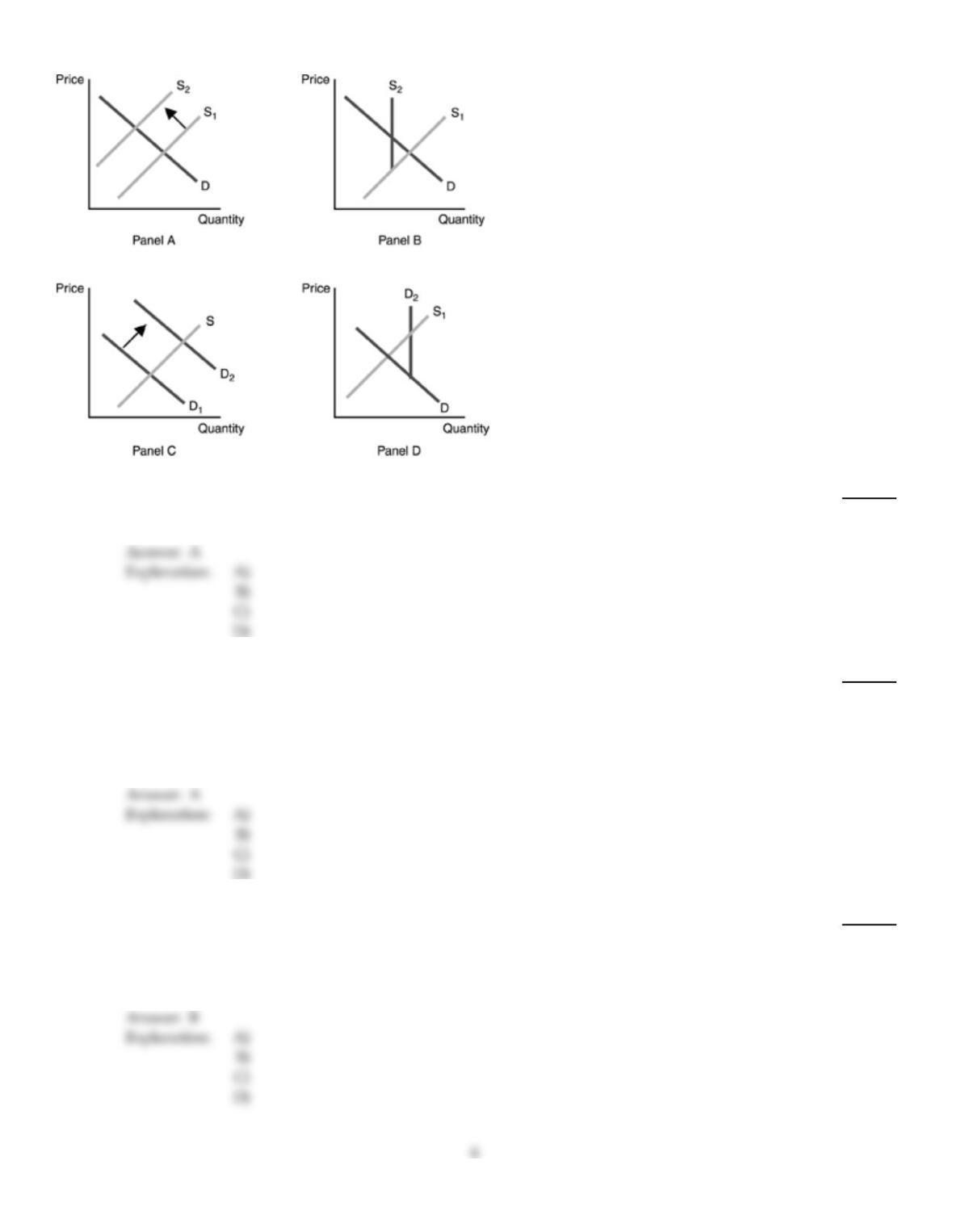
20)
Refer to the above figures. A tariff is placed on a foreign good. Which figure represents the
situation in the domestic market for the foreign good?
20)
A)
Panel A
B)
Panel B
C)
Panel C
D)
Panel D
21)
Comparative advantage is defined as
21)
A)
the ability to produce more output of one good relative to another good than another country
can.
B)
the ability to produce more output from given inputs of resources than others can.
C)
having a lower average fixed cost in the production of a good than does someone else.
D)
the ability to use more input of resources than others can.
22)
If the infant industry argument is used to protect an industry that has already matured, then
22)
A)
no one loses.
B)
consumers lose because they will pay a price for a product that is above the world price.
C)
consumers lose because they will pay a price for a product, which is less than the world price.
D)
stockholders lose because the firm cannot compete with other firms.
Maximum Feasible Hourly Production Rates (in Tons) of Either
Wine or Beef Using All Available Resources
Product Argentina France
Wine (gallons) 30 60
Beef (pounds) 10 30
23)
Use the above table. Assuming constant opportunity costs, the opportunity cost of producing a
gallon of wine in Argentina is
23)
A)
0.33 pound of beef.
B)
0.5 pound of beef.
C)
2 pounds of beef.
D)
3 pounds of beef.
24)
In the long run, imports are paid for by
24)
A)
dollars.
B)
exports.
C)
investment.
D)
gold or other universally accepted monies.
25)
Which of the following would increase the total amount of trade in the world?
25)
A)
rules of origin
B)
trade retention
C)
trade diversion
D)
trade deflection
26)
According to the Swiss Institute for Management Development, the top country in terms of
productive efficiency is
26)
A)
Switzerland.
B)
Japan.
C)
Germany.
D)
the United States.
27)
A tariff is
27)
A)
a government imposed restriction on the quantity of a specific good that can be imported into
the country and sold.
B)
the difference between the world market price and the domestic price when a group of firms
in an industry collude successfully.
C)
a tax on imported goods.
D)
a subsidy on domestically produced goods.
28)
Which of the following is counted as a benefit from international trade?
28)
A)
Intellectual property such as music and computer applications is introduced throughout the
world.
B)
New production processes developed in one nation are transmitted to others.
C)
New goods have been introduced to other parts of the world.
D)
All of the above are benefits from international trade.
D
29)
Suppose that opportunity costs are constant and that Fred can either bake a maximum of six pies or
three cakes in a day. Ethel can either produce a maximum of eight pies or two cakes in a day. Fred’s
opportunity cost to produce one cake is
29)
A)
one–half pie.
B)
four pies.
C)
six pies.
D)
two pies.
D
30)
The ability to produce a good at lower opportunity costs than another producer is known as
30)
A)
economies of scale.
B)
marginal cost production.
C)
comparative advantage.
D)
absolute advantage.
C
C
31)
The standard of living in a nation depends on
31)
A)
whether or not its currency is adopted as the world’s monetary standard.
B)
how well its economy functions relative to other countries.
C)
the size of the country, with larger nations always doing better than smaller ones.
D)
how well the economy functions within that country.
32)
The successor organization to GATT that handles trade disputes among its member nations is the
32)
A)
General Agreement on Tariffs and Trade.
B)
North American Free Trade Agreement.
C)
World Trade Organization.
D)
European Union.
33)
The organization that settles trade disputes between countries is the
33)
A)
International Monetary Fund.
B)
World Trade Organization.
C)
World Bank.
D)
United Nations.
34)
That each individual should engage in economic activities in which he or she is relatively more
efficient is an application of the concept of
34)
A)
competition.
B)
absolute advantage.
C)
comparative advantage.
D)
scarcity.
35)
International trade is based on the existence of
35)
A)
comparative advantage.
B)
productivity advantage.
C)
perfect advantage.
D)
absolute advantage.
Maximum Feasible Hourly Production Rates (in Tons) of Either
Cookies or Coffee Using All Available Resources
Product Country Alpha Country Beta
Cookies 3 8
Coffee 9 4
36)
Use the above table. Assuming constant opportunity costs, the opportunity cost of producing coffee
in country Alpha is ________, and the opportunity cost of producing coffee in country Beta is
________.
36)
A)
2.67 tons of cookies; 0.44 ton of coffee
B)
0.375 ton of coffee; 2.25 tons of cookies
C)
3 tons of cookies; 0.5 ton of cookies
D)
0.33 ton of cookies; 2 tons of cookies
Maximum Feasible Hourly Production Rates (in Tons) of Either
Wine or Beef Using All Available Resources
Product Argentina France
Wine (gallons) 30 60
Beef (pounds) 10 30
37)
Use the above table. Assuming constant opportunity costs, a comparative advantage in producing
beef is possessed by
37)
A)
neither Argentina or France.
B)
France.
C)
both Argentina and France.
D)
Argentina.
B
Explanation:
38)
Which of the following is a TRUE statement?
38)
A)
Consumers benefit from trade and producers do not.
B)
Exporters benefit from trade and importers do not.
C)
Everyone benefits from free trade.
D)
Free trade harms domestic producers of goods that face import competition.
D
Explanation:
D
Explanation:
39)
Import restrictions due to the imposition of tariffs by the U.S. government
39)
A)
will ultimately cause inefficient resource allocation in the United States.
B)
will lead to a decline in the quantity of the product consumed in the United States.
C)
will lead to lower incomes in the economy of U.S. trade partners.
D)
all of the above are likely to occur
40)
People who focus on the “competitiveness” of the United States are
40)
A)
treating the United States as if it is a business firm.
B)
correctly recognizing that trade is a zero–sum game.
C)
also focusing on the importance of education.
D)
focusing on the right thing if the United States is to stay a leading economic power.
41)
A new industry develops, and our government wants to protect it from foreign competition. Which
one of the following arguments would appropriately describe this type of protection?
41)
A)
protecting American jobs
B)
cartelization
C)
national security
D)
infant industry
42)
The concept of “global competitiveness“
42)
A)
means that the economic well–being of each nation must be compared with nations with
same size population.
B)
is not practical because economic well–being is evaluated within each country.
C)
means that the export–import ratio of each nation must be compared.
D)
means that the economic well–being of each nation must be compared with nations on the
same continent.
43)
Which of the following is NOT an argument against free trade?
43)
A)
protecting domestic job argument
B)
infant–industry argument
C)
countering foreign subsidies argument
D)
comparative advantage argument
44)
Since 1950, the balance of trade for United States has
44)
A)
gone from a surplus to a deficit.
B)
gone from a small deficit to a larger deficit.
C)
remained constant.
D)
gone from a deficit to a surplus.
Explanation:
45)
A legal limit on the amount of sugar imported into the United States is
45)
A)
a tariff.
B)
a subsidy.
C)
a voluntary import restriction.
D)
a quota.
Explanation:
46)
Dumping is
46)
A)
selling a good abroad in huge quantities at a very low price.
B)
exporting goods that are of inferior quality relative to the goods sold in the domestic market.
C)
selling a good abroad at a price below cost or below the price charged in the domestic market.
D)
exporting goods that are sources of pollution.
Explanation:
47)
Dumping is defined as
47)
A)
selling a good abroad at prices above the costs of the firms in the foreign countries.
B)
selling a good abroad at prices below its cost of production or below the price charged in the
home market.
C)
exporting goods that are of inferior quality.
D)
exporting goods that are sources of pollution.
Explanation:
Explanation:
48)
Some nations avoid the effects of trade deflection in a trade bloc by enforcing
48)
A)
rules of origin.
B)
trade deflection.
C)
trade diversion.
D)
quotas.
Maximum Feasible Hourly Production Rates for Either
Food or Cloth Using All Available Resources
Food Cloth
U.S. 4 3
Mexico 12 6
49)
Using the data in the above table, and assuming constant opportunity costs, it is likely that
49)
A)
Mexico will export cloth.
B)
the United States will import food.
C)
the United States will export both cloth and food.
D)
Mexico will export both cloth and food.
50)
Why do free trade proponents applaud successful trade deflection?
50)
A)
It increases trade restrictions within regional trade blocs.
B)
It promotes more rules of origin laws.
C)
It decreases incentives for trade diversion.
D)
It circumvents trade restrictions within regional trade blocs.
51)
A difference between a quota and a tariff is that
51)
A)
a quota increases profits of domestic producers more than a tariff does.
B)
a tariff generates a greater reduction in exports.
C)
the government collects revenues from a tariff, which does not happen with a quota.
D)
a tariff generates a higher price than a quota does.
52)
According to international trade theory
52)
A)
every country has a comparative advantage in something.
B)
comparative advantage is based on absolute advantage.
C)
trade is based on absolute advantage.
D)
less developed countries cannot trade successfully with developed countries.
53)
Why do free trade proponents dislike rules of origin in trade agreements?
53)
A)
It decreases the amount of international trade in the world.
B)
It decreases incentives for trade diversion.
C)
It increases the amount of international trade in the world.
D)
It increases incentives for trade deflection.
54)
The World Trade Organization
54)
A)
was established to resolve disputes arising under world trade rules.
B)
increases world trade by providing interest rate subsidies to foreign borrowers who buy U.S.
exports on credit.
C)
was established to settle trade disputes within the European Union.
D)
is another name for the IMF.
Maximum Feasible Hourly Production Rates (in Tons) of Either
Pizzas or Donuts Using All Available Resources
Product Country Alpha Country Beta
Pizzas 10 2
Donuts 10 12
55)
Use the above table. Assuming constant opportunity costs, the opportunity cost of producing
donuts in country Alpha is ________, and the opportunity cost of producing donuts in country Beta
is ________.
55)
A)
1 donut; 0.17 donut
B)
0.2 pizza; 1.67 donuts
C)
1 donut; 6 donuts
D)
10 donuts; 12 pizzas
56)
An international agreement established in 1947 to further world trade by reducing barriers and
tariffs is the
56)
A)
General Agreement on Tariffs and Trade.
B)
North American Free Trade Agreement.
C)
European Union.
D)
World Trade Organization.
57)
Restricting imports usually leads to
57)
A)
a higher per capita level of real consumption.
B)
a country producing beyond its production possibilities frontier.
C)
a country consuming even further beyond its production possibilities frontier.
D)
a reduction in exports and employment.
Maximum Feasible Hourly Production Rates (in Tons) of Either
Cookies or Coffee Using All Available Resources
Product Country Alpha Country Beta
Cookies 3 8
Coffee 9 4
58)
Use the above table. Assuming constant opportunity costs, the opportunity cost of producing
cookies in country Alpha is ________, and the opportunity cost of producing cookies in country
Beta is ________.
58)
A)
2.67 tons of coffee; 0.44 ton of cookies
B)
3 tons of coffee; 0.5 ton of coffee
C)
0.33 ton of coffee; 2 tons of coffee
D)
0.375 ton of cookies; 2.25 tons of coffee
59)
In comparing tariffs and quotas, we know that
59)
A)
tariffs raise revenues for the federal government, while quotas do not.
B)
neither raises revenues for the federal government.
C)
both raise revenues for the federal government.
D)
quotas raise revenues for the federal government, while tariffs do not.
60)
The argument that a tariff has to be imposed in order to protect any industry just getting started
until it gets large enough to be competitive internationally is the
60)
A)
fledgling industry argument.
B)
start–up industry argument.
C)
baby industry argument.
D)
infant industry argument.
61)
All of the following are arguments in favor of restricting trade EXCEPT
61)
A)
protecting domestic jobs.
B)
protecting emerging industries.
C)
dumping.
D)
comparative advantage.
D
62)
The infant–industry argument is often criticized because
62)
A)
it reduces government revenues in the short term.
B)
it is difficult to determine which industry merits protection.
C)
it reduces labor productivity in the short term.
D)
it reduces the employment rate.
B
63)
For the infant–industry argument for tariffs to be appropriate, it is necessary that
63)
A)
the industry be deemed essential by the government.
B)
only industries that currently are operating efficiently will be protected.
C)
the country has access to the most modern production techniques.
D)
the government can identify which industries will eventually be able to compete with more
established foreign producers.
D
D
64)
Which of the reasons given for tariff protection make consumers better off by generating lower
prices?
64)
A)
infant industry argument
B)
protecting U.S. jobs argument
C)
anti–dumping argument
D)
None provides lower prices for domestic consumers.
65)
During the 1960s, U.S. steel firms argued they needed tariff protection because Germany and Japan
were using new mills to make steel since their old mills were destroyed in World War II.
Essentially, this argument is a form of the
65)
A)
national defense argument.
B)
anti–dumping argument.
C)
infant–industry argument.
D)
countering foreign subsidies argument.
Explanation:
66)
Import restrictions
66)
A)
can protect United States jobs in the protected industry but will also lead to job reductions in
other export industries.
B)
cannot protect American jobs in any sector of the economy.
C)
hurt people who work in importing companies, but makes consumers better off.
D)
can protect United States jobs in the protected industry, which increases economic welfare of
the country as a whole.
Explanation:
67)
The successor organization to GATT, created in 1995, is the
67)
A)
EU.
B)
WTO.
C)
FDIC.
D)
NAFTA.
Explanation:
Explanation:
Maximum Feasible Hourly Production Rates (in Tons) of Either
Knives or Forks Using All Available Resources
Product Country Alpha Country Beta
Knives 9 3
Forks 612
68)
Use the above table. Assuming constant opportunity costs, if countries Alpha and Beta specialize
based on comparative advantage, then they will trade if the rate of exchange is
68)
A)
5 knives for 1 fork, and Alpha imports forks.
B)
0.5 fork for 1 knife, and Beta imports knives.
C)
0.5 knives for 1 fork, and Alpha imports forks.
D)
6 forks for 1 knife, and Beta imports knives.
69)
Today, in the United States, exports are about
69)
A)
14 percent of GDP.
B)
4 percent of GDP.
C)
28 percent of GDP.
D)
90 percent of GDP.
A
70)
The successor to GATT in 1995 is
70)
A)
the World Trade and Tariff Organization.
B)
the World Agreement on Tariff and Trade.
C)
the World Trade Organization.
D)
the World Trade Agreement.
C
71)
When U.S. residents buy products that were made in Japan, then ultimately the Japanese want
71)
A)
yen.
B)
goods, including U.S.–made goods.
C)
dollars.
D)
Japanese goods.
B
C
72)
Since World War II, world trade has
72)
A)
risen sharply, outpacing gains in annual world real GDP.
B)
increased, but not as dramatically as annual world real GDP has climbed.
C)
increased in relative importance for most nations, but not for the United States.
D)
decreased in importance as nations turn inward due to security concerns.
73)
When a firm sells its good abroad below the cost of producing the good the firm is
73)
A)
taking advantage of the infant industry argument.
B)
dumping.
C)
taking advantage of absolute advantage.
D)
using the concept of comparative advantage.
74)
If there are two goods and two countries, then one country can have
74)
A)
a lower opportunity cost of producing both goods.
B)
an absolute advantage in only one good.
C)
an absolute advantage in both goods.
D)
a higher opportunity cost of producing both goods.
75)
Governments sometimes subsidize domestic industries. When this occurs
75)
A)
firms cannot be guilty of dumping because their prices are not below their costs.
B)
the governments also impose tariffs on imports to protect the industries even more.
C)
the subsidized industries have an advantage in international markets relative to
non–subsidized industries.
D)
the subsidized industries sell less in international markets because it is more profitable to sell
domestically.
76)
The WTO replaced the GATT in
76)
A)
1960.
B)
1945.
C)
1995.
D)
1900.
77)
For infant industry tariff protection to be valid requires that
77)
A)
the tariff must be allowed to last forever.
B)
the industries protected must have substantial monopoly power in the absence of foreign
competition.
C)
government officials must predict which industries will eventually be able to compete with
more established foreign producers.
D)
only industries that currently are producing efficiently should be protected.
78)
The European Union started out as a
78)
A)
union of nations with identical currency.
B)
union of nations with identical tariffs.
C)
regional trade agreement.
D)
union of nations where the same language was spoken.
79)
The ability to produce a good or service at a lower opportunity cost than other producers is
79)
A)
the quota system.
B)
intellectual property.
C)
absolute advantage.
D)
comparative advantage.
80)
A government–imposed restriction on the quantity of a specific good that another country is
allowed to sell in the U.S. is
80)
A)
a regional trade bloc.
B)
an import quota.
C)
a voluntary restraint agreement.
D)
a voluntary import expansion.