Corporate Finance, 3e (Berk/DeMarzo)
Chapter 31 International Corporate Finance
31.1 Internationally Integrated Capital Markets
Use the following information to answer the question(s) below.
Rearden Metal, a U.S. manufacturer, has made a purchase of from d’Anconia Copper and is
expecting a cash outflow of 2 million ARS (Argentine Pesos) in six months. The currency spot
rate is $0.2500/ARS and the six-month forward rate is F6months = $0.2470/ARS. The
appropriate annual discount rate for the Argentine Peso is 6.5% and the annual discount rate for
the U.S. dollar is 4%.
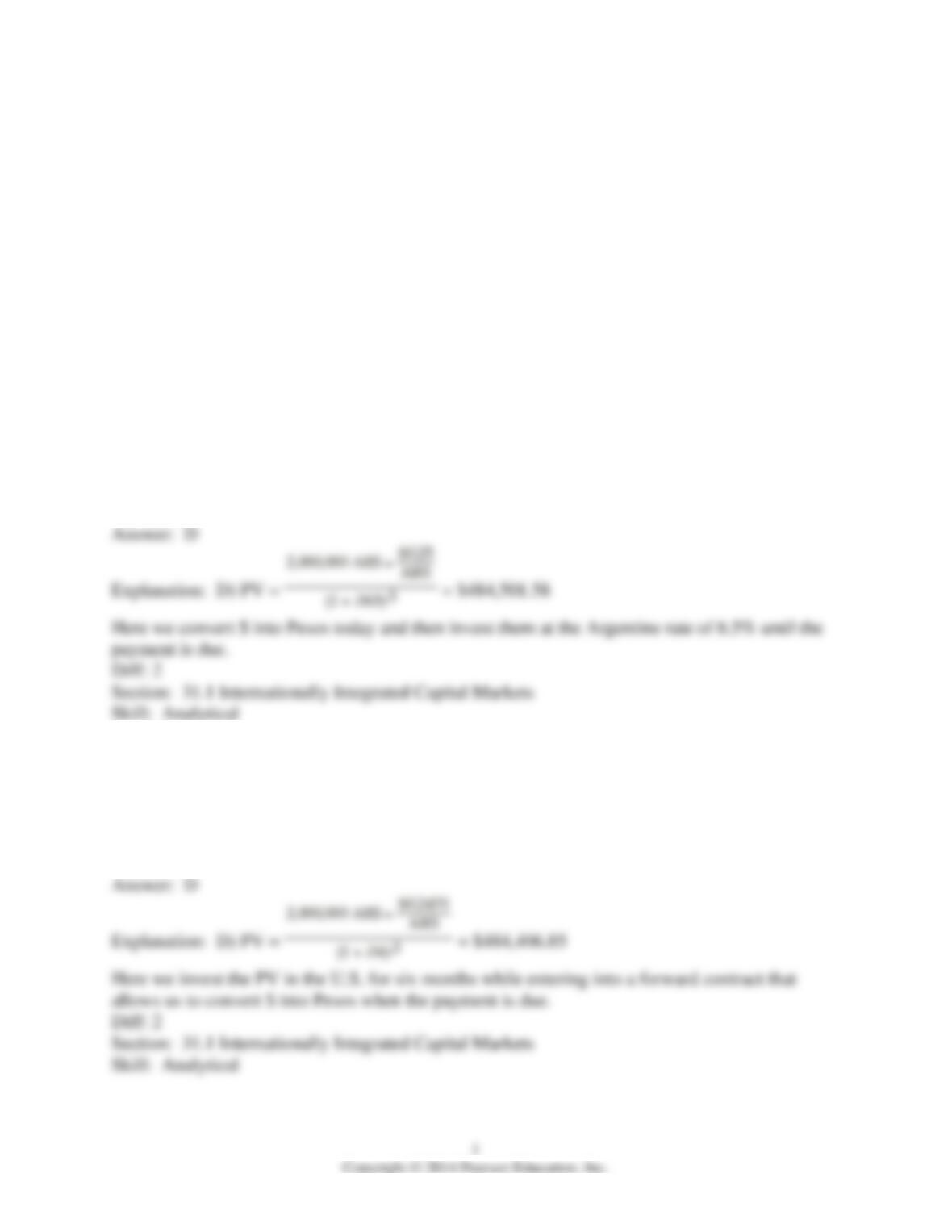
1) The present value of Rearden Metal’s cash outflow computed by first discounting the cash
flow at the appropriate Argentine Peso rate and then converting to dollars is closest to:
A) $469,500
B) $475,000
C) $481,000
D) $484,500
2) The present value of Rearden Metal’s cash outflow computed by first converting to dollars and
then discounting the cash flow at the appropriate Argentine Peso rate is closest to:
A) $469,500
B) $475,000
C) $481,000
D) $484,500
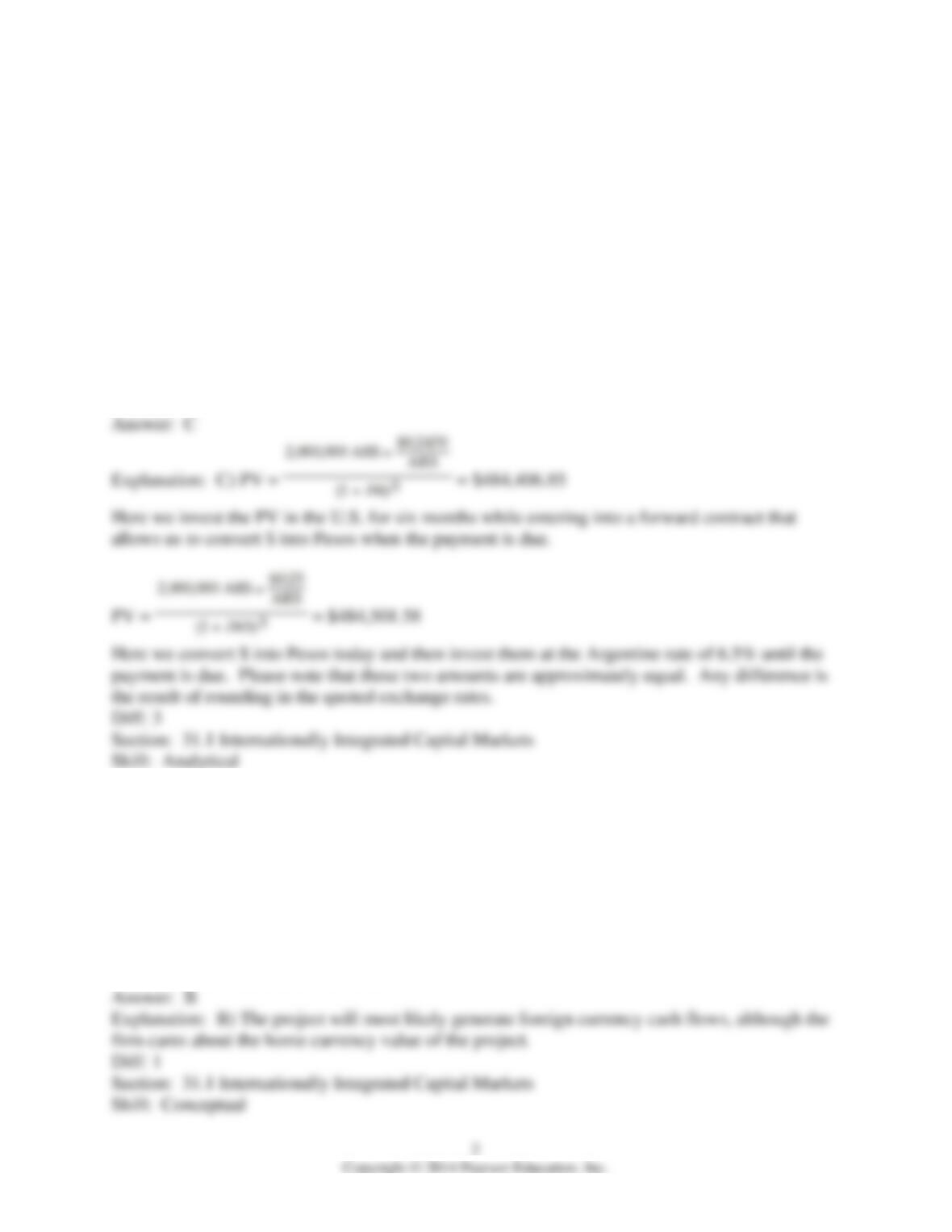
3) What conclusions can you make about the degree of international integration between the U.S.
and Argentine markets?
A) The markets are integrated since the PV of investing dollars today and converting them with a
forward contract is significantly less than converting into Pesos today and investing those Pesos
for six months.
B) The markets are integrated since the PV of investing dollars today and converting them with a
forward contract is significantly greater than converting into Pesos today and investing those
Pesos for six months.
C) The markets are integrated since the PV of investing dollars today and converting them with a
forward contract is approximately equal to converting into Pesos today and investing those Pesos
for six months.
D) The markets are not integrated since the PV of investing dollars today and converting them
with a forward contract is greater than converting into Pesos today and investing those Pesos for
six months.
4) Which of the following statements regarding international projects is FALSE?
A) Interest rates and costs of capital will likely be different in the foreign country as a result of
the macroeconomic environment.
B) The project will most likely generate foreign currency cash flows, although the firm cares
about the foreign currency value of the project.
C) Under internationally integrated capital markets, the value of an investment does not depend
on the currency we use in the analysis.
D) The firm will probably face a different tax rate in the foreign country and will be subject to
both foreign and domestic tax codes.
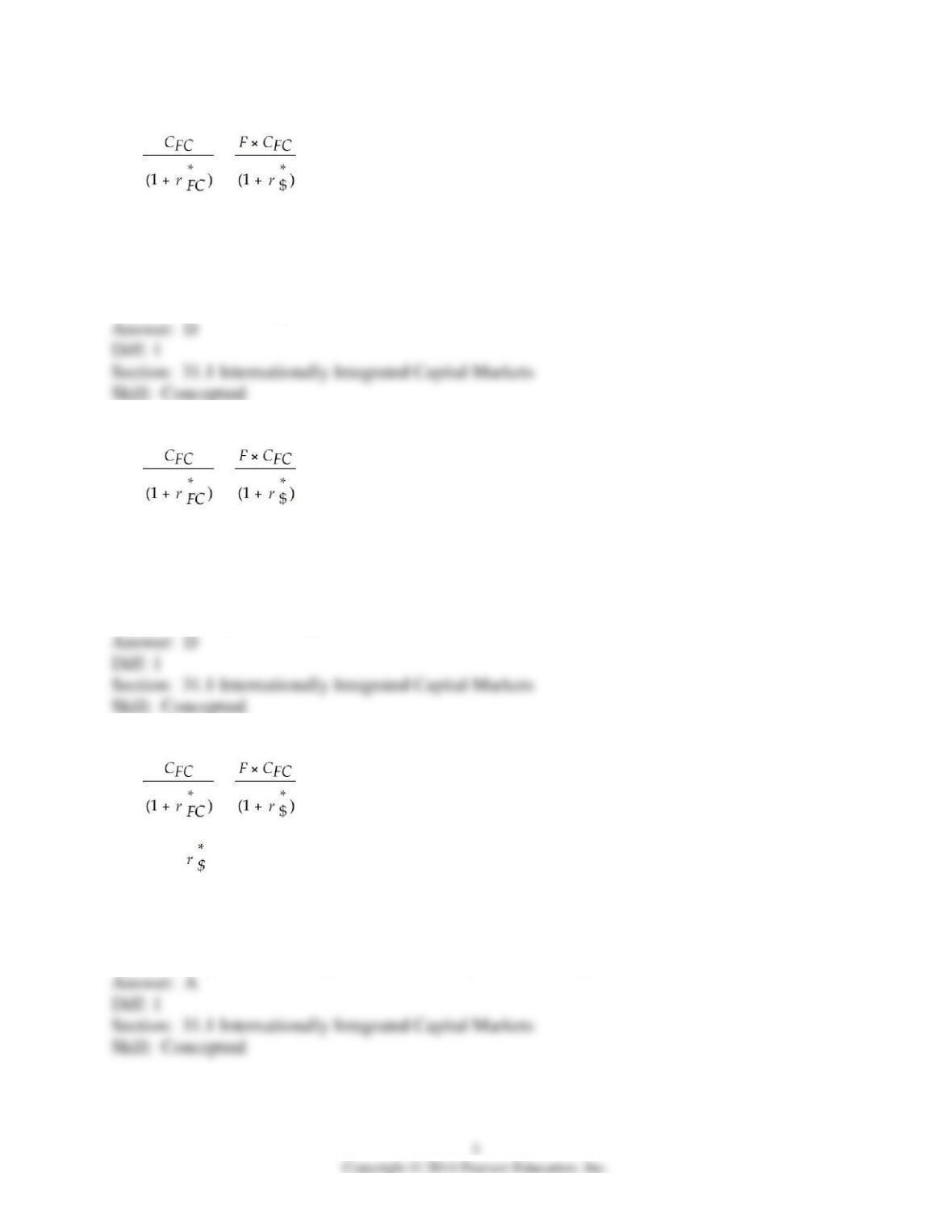
5) Consider the following equation:
S × =
The term F in this equation is:
A) the future spot exchange rate.
B) the current spot exchange rate.
C) the amount of foreign currency.
D) the forward exchange rate.
6) Consider the following equation:
S × =
The term S in this equation is:
A) the forward exchange rate.
B) the amount of foreign currency.
C) the future spot exchange rate.
D) the current spot exchange rate.
7) Consider the following equation:
S × =
The term in this equation is:
A) the appropriate cost of capital from the standpoint of a U.S. investor.
B) the risk-free rate for a foreign investor.
C) the risk-free rate for a U.S. investor.
D) the appropriate cost of capital from the standpoint of a foreign investor.
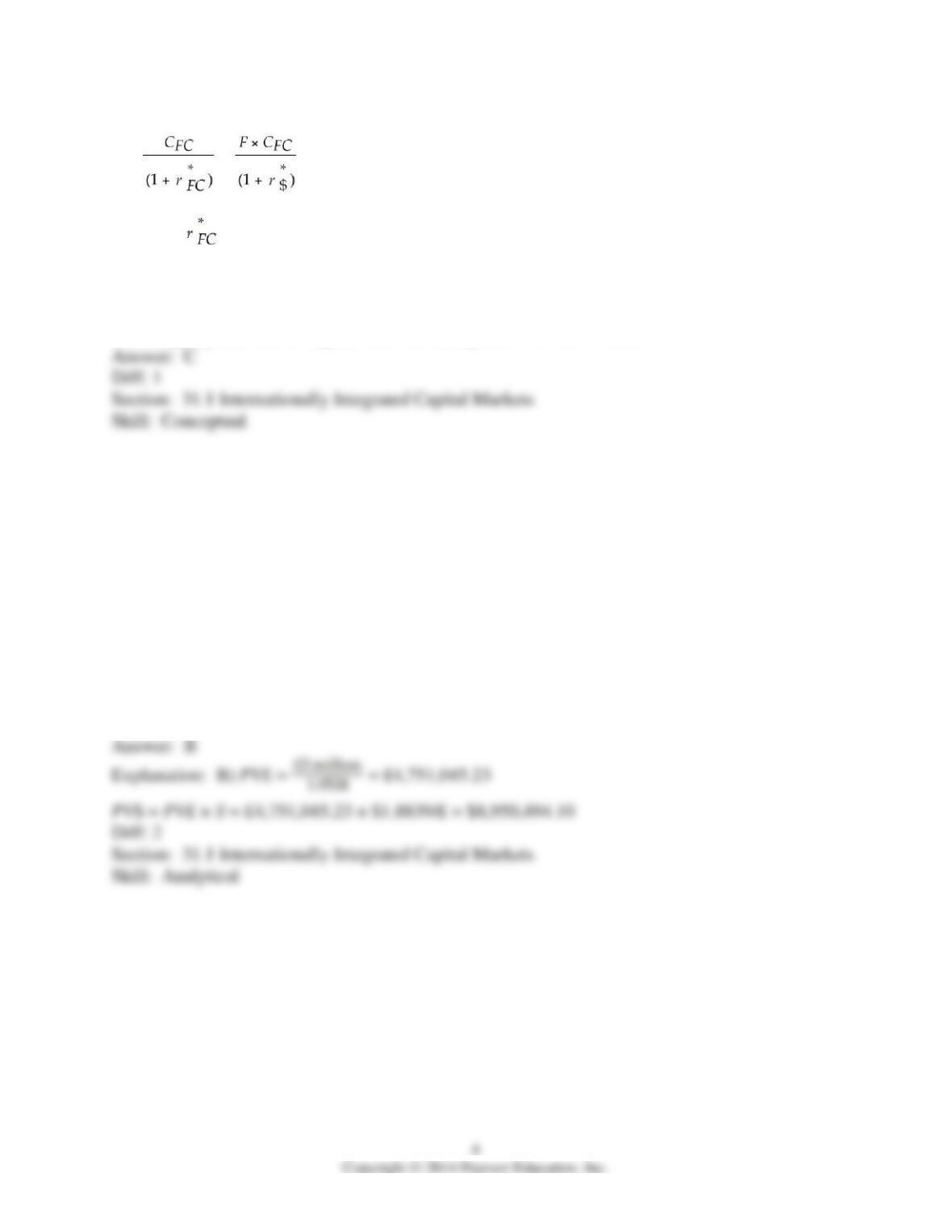
8) Consider the following equation:
S × =
The term in this equation is:
A) the risk-free rate for a foreign investor.
B) the risk-free rate for a U.S. investor.
C) the appropriate cost of capital from the standpoint of a foreign investor.
D) the appropriate cost of capital from the standpoint of a U.S. investor.
Use the information for the question(s) below.
You are a U.S. investor who is trying to calculate the present value of £5 million cash inflow that
will occur one year in the future. The spot exchange rate is S = $1.8839/£ and the forward rate is
F1 = $1.8862/£. The appropriate dollar discount rate for this cash flow is 5.32% and the
appropriate £ discount rate is 5.24%.
9) The present value of the £5 million cash inflow computed by first discounting the £s and then
converting into dollars is closest to:
A) $8,961,420
B) $8,950,495
C) $8,954,615
D) $8,943,695
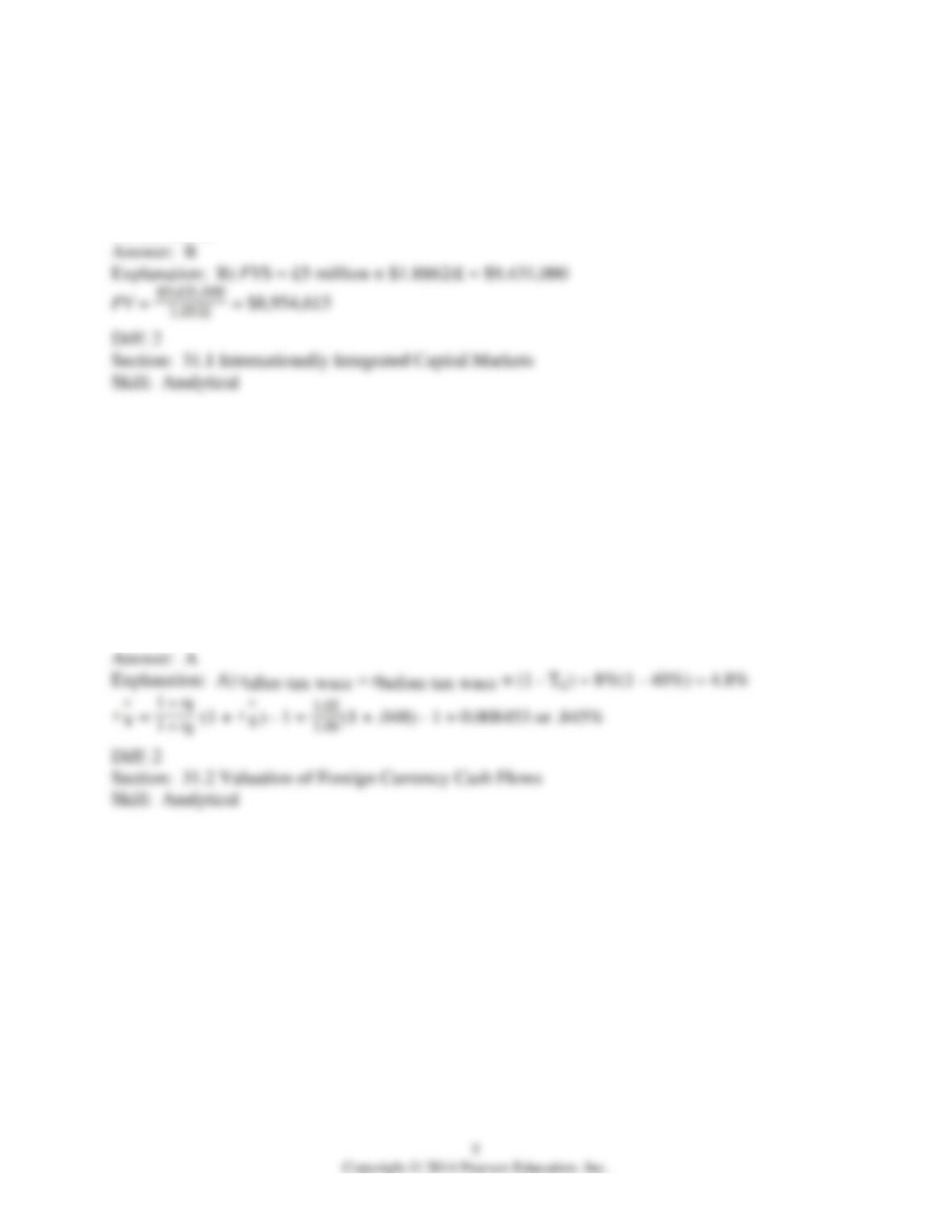
10) The present value of the £5 million cash inflow computed by first converting into dollars and
then discounting is closest to:
A) $8,950,495
B) $8,954,615
C) $8,943,695
D) $8,961,420
31.2 Valuation of Foreign Currency Cash Flows
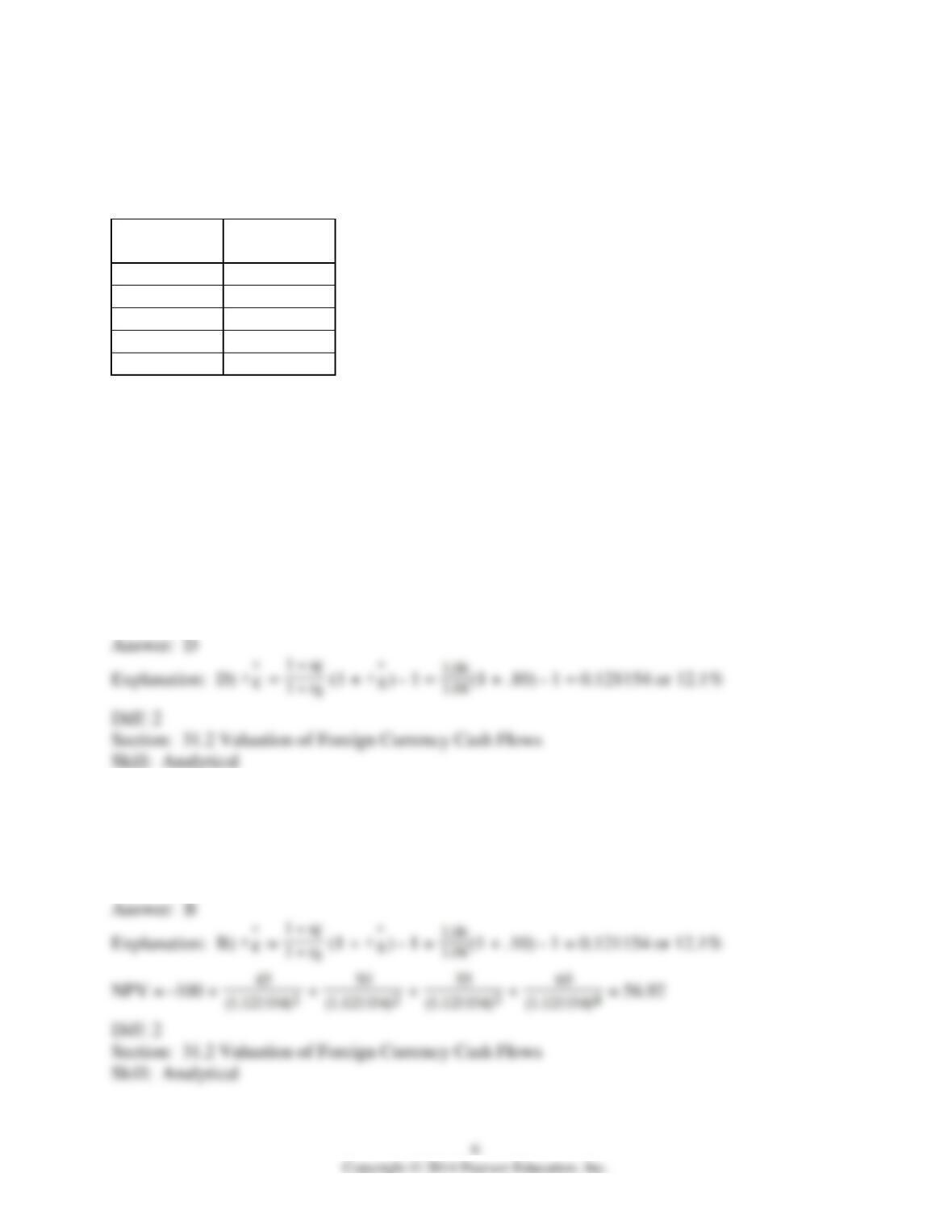
1) The dollar cost of debt for John Galt Industries is 8.0%. The firm faces a tax rate of 40% on
all income, no matter where it is earned. Galt needs to know its Yen cost of debt. The risk-free
interest rates on dollars and yen are r% = 6% and r¥ = 2%, respectively. Galt is willing to
assume that capital markets are internationally integrated and that its free cash flows are
uncorrelated with the yen-dollar spot rate. Galt’s after-tax cost of debt in yen is closest to:
A) 0.9%
B) 2.0%
C) 3.9%
D) 4.8%
Use the following information to answer the question(s) below.
Hammond Motors is considering an investment in the euro area. The expected free cash flows,
in Euros, are uncorrelated with the spot exchange rate and are as follows:
Year
FCF
(€ millions)
0
-100
1
45
2
50
3
55
4
60
The new project, which Hammond is considering, has similar dollar risk to Hammond’s other
projects. Hammond knows that its overall dollar WACC is 10%, so it feels comfortable using
this WACC for the project. The risk-free interest rate on dollars is 4% and the risk-free interest
rate on Euros is 6%. Hammond is willing to assume that capital markets in the United States and
the Euro area are internationally integrated.
2) Hammond’s Euro WACC is closest to:
A) 7.9%
B) 8.7%
C) 10.2%
D) 12.1%
3) The NPV of this project in Euros is closest to:
A) €54 million
B) €57 million
C) €62 million
D) €65 million
4) Which of the following statements is FALSE?
A) If the foreign project is owned by a domestic corporation, managers and shareholders need to
determine the home currency value of the foreign currency cash flows.
B) The most obvious difference between a domestic project and a foreign project is that the
foreign project will most likely generate cash flows in a foreign currency.
C) The risk of the foreign project is unlikely to be exactly the same as the risk of domestic
projects (or the firm as a whole), because the foreign project contains residual exchange rate risk
that the domestic projects often do not contain.
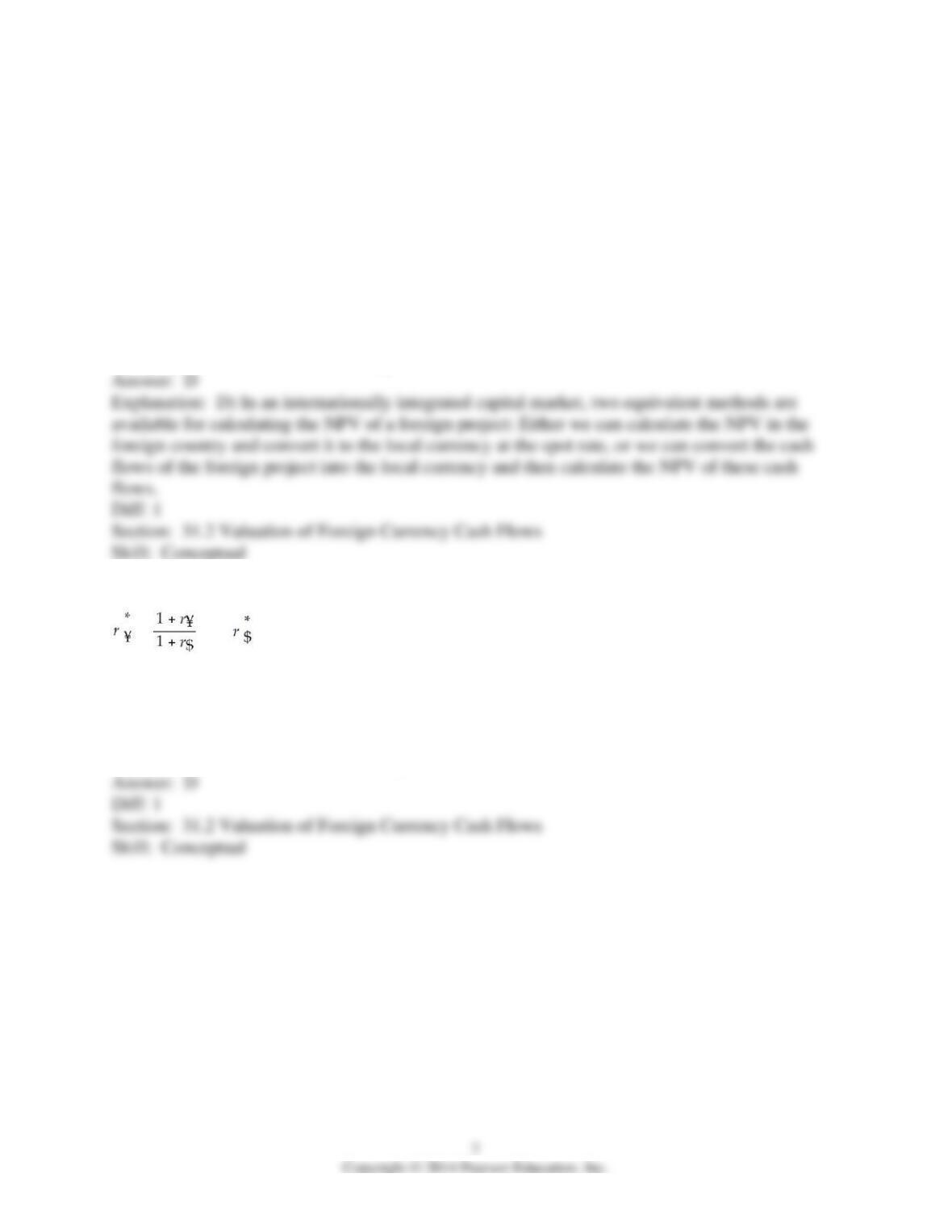
D) In an internationally integrated capital market, two equivalent methods are available for
calculating the NPV of a foreign project: Either we can calculate the NPV in the foreign country
and convert it to the local currency at the forward rate, or we can convert the cash flows of the
foreign project into the local currency and then calculate the NPV of these cash flows.
5) Consider the following equation:
= (1 + ) – 1
the term r¥ in this equation refers to:
A) the cost of capital for the firm in terms of yen.
B) the risk-free rate of interest on the dollar.
C) the cost of capital in terms of dollars.
D) the risk-free rate of interest on the yen.

6) Consider the following equation:
= (1 + ) – 1
the term in this equation refers to:
A) the cost of capital in terms of dollars.
B) the risk-free rate of interest on the yen.
C) the risk-free rate of interest on the dollar.
D) the cost of capital for the firm in terms of yen.
7) Consider the following equation:
= (1 + ) – 1
the term in this equation refers to:
A) the risk-free rate of interest on the dollar.
B) the risk-free rate of interest on the yen.
C) the cost of capital for the firm in terms of yen.
D) the cost of capital in terms of dollars.
8) Consider the following equation:
= (1 + ) – 1
the term r$ in this equation refers to:
A) the cost of capital for the firm in terms of yen.
B) the cost of capital in terms of dollars.
C) the risk-free rate of interest on the dollar.
D) the risk-free rate of interest on the yen.
Use the information for the question(s) below.
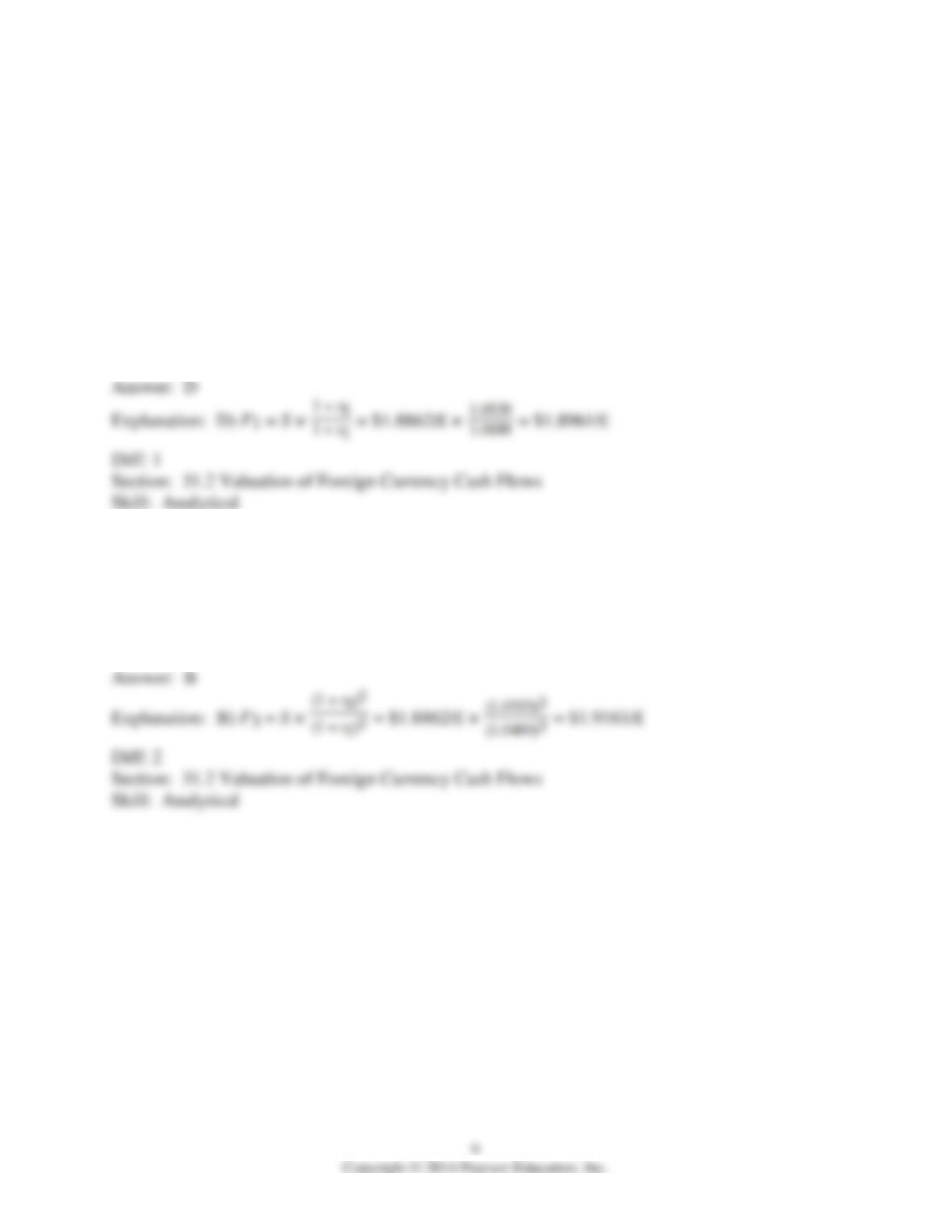
The current spot exchange rate, S, is $1.8862/£. Suppose that the yield curve in both countries is
flat. The risk-free rate on dollars, r$, is 5.35% and the risk-free interest rat on pounds, r£, is
4.80%.
9) Using the covered interest parity condition, the calculated one-year forward rate F1 is closest
to:
A) $1.8568/£
B) $1.8764/£
C) $1.9161/£
D) $1.8961/£
10) Using the covered interest parity condition, the calculated three-year forward rate F3 is
closest to:
A) $1.8568/£
B) $1.9161/£
C) $1.8961/£
D) $1.8764/£

10
11) Luther Industries, a U.S. firm, is considering an investment in Japan. The dollar cost of
equity for Luther is 12%. The risk-free interest rates on dollars and yen are r$ = 5.5% and r¥ =
1.5% respectively. Luther industries is willing to assume that capital markets are internationally
integrated. Luther Industries needs to know the comparable cost of equity in Japanese yen for a
project with free cash flows that are uncorrelated with spot exchange rates. The yen cost of
equity for Luther Industries is closest to:
A) 14.0%
B) 12.3%
C) 7.8%
D) 18.5%
Use the information for the question(s) below.
Luther Industries, a U.S. Corporation, is considering a new project located in Great Britain. The
expected free cash flows from the project are detailed below:
Year
Free Cash Flow
(£ millions)
0
-20
1
10
2
14
3
18
You know that the spot exchange rate is S = 1.8862/£. In addition, the risk-free interest rate on
dollars and pounds is 5.4% and 4.6% respectively. Assume that these markets are internationally
integrated and the uncertainty in the free cash flow is not correlated with uncertainty in the
exchange rate. You have determined that the dollar WACC for these cash flows is 10.2%.
12) Calculate the pound denominated cost of capital for Luther’s project.
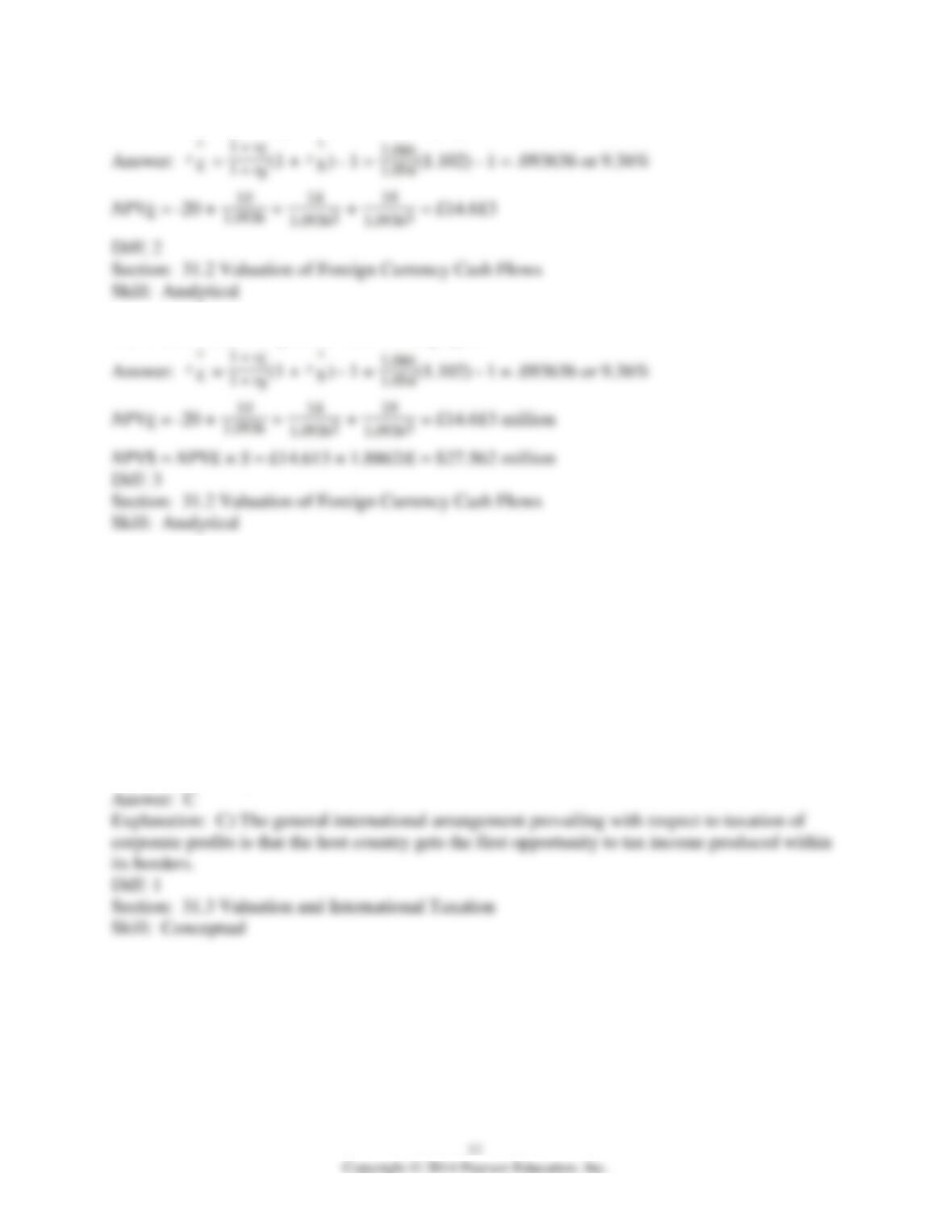
13) What is the pound present value of the project?
14) What is the dollar present value of the project?
31.3 Valuation and International Taxation
1) Which of the following statements is FALSE?
A) U.S. tax policy requires U.S. corporations to pay taxes on their foreign income at the same
rate as profits earned in the United States.
B) The home government gets an opportunity to tax the income from a foreign project to the
domestic firm.
C) The general international arrangement prevailing with respect to taxation of corporate profits
is that the home country gets the first opportunity to tax income.
D) The home government must establish a tax policy specifying its treatment of foreign income
and foreign taxes paid on that income.
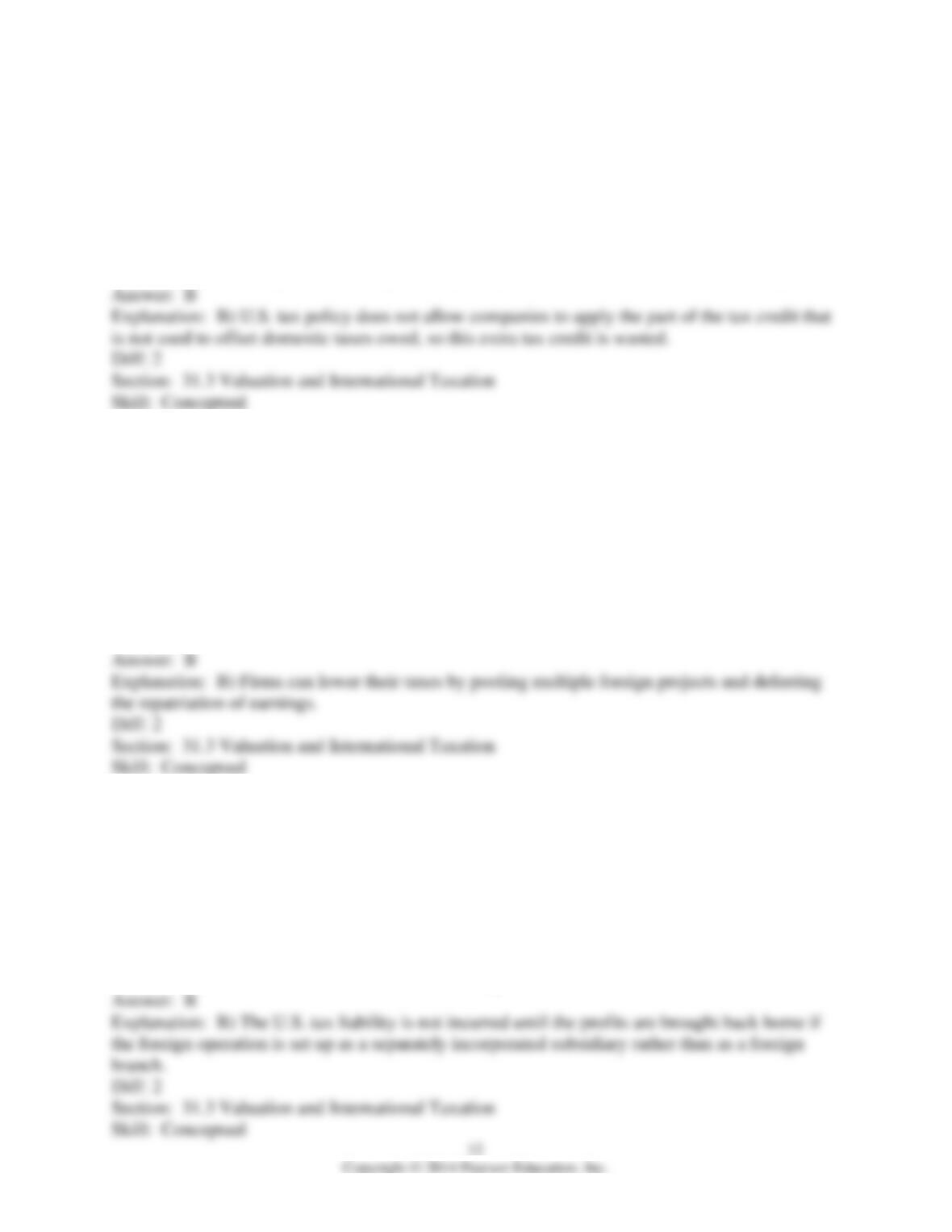
2) Which of the following statements is FALSE?
A) If the foreign tax rate exceeds the U.S. tax rate, companies must pay this higher rate on
foreign earnings.
B) U.S. tax policy allows companies to apply the part of the tax credit that is not used to offset
domestic taxes owed, so this extra tax credit is not wasted.
C) If the foreign tax rate is less than the U.S. tax rate, the company pays total taxes equal to the
U.S. tax rate on its foreign earnings.
D) A full tax credit is given for foreign taxes paid up to the amount of the U.S. tax liability.
3) Which of the following statements is FALSE?
A) If the U.S. tax rate exceeds the combined tax rate on all foreign income, it is valid to assume
that the firm pays the same tax rate on all income no matter where it is earned.
B) Firms can lower their taxes by pooling multiple foreign projects and accelerating the
repatriation of earnings.
C) Under U.S. tax law, multinational corporations may use any excess tax credits generated in
high-tax foreign countries to offset their net U.S. tax liabilities on earnings in low-tax foreign
countries.
D) If the foreign tax rate exceeds the U.S. tax rate, because the U.S. tax credit exceeds the
amount of U.S. taxes owed, no tax is owed in the United States.
4) Which of the following statements is FALSE?
A) When the foreign tax rate is less than the U.S. tax rate, deferral can provide significant
benefits.
B) The U.S. tax liability is not incurred until the profits are brought back home if the foreign
operation is set up as a foreign branch rather than as a separately incorporated subsidiary.
C) If a company chooses not to repatriate £12.5 million in pre-tax earnings, for example, it
effectively reinvests those earnings abroad and defers its U.S. tax liability.
D) When the foreign tax rates exceed the U.S. tax rates, there are no benefits to deferral because
in such a case there is no additional U.S. tax liability.

5) Which of the following statements is FALSE?
A) Other benefits from deferral arise because the firm effectively gains a real option to repatriate
income at times when repatriation might be cheaper.
B) By pooling foreign income, the firm effectively pays the combined tax rate on all foreign
income.
C) In years in which the U.S. tax rate exceeds the combined tax rate on all foreign income, the
repatriation of additional income does not incur an additional U.S. tax liability, so the earnings
can be repatriated tax free.
D) Deferring repatriation of earnings lowers the overall tax burden in much the same way as
deferring capital gains lowers the tax burden imposed by the capital gains tax.
Use the information for the question(s) below.
KT Enterprises, a U.S. import-export trading, is considering its international tax situation.
Currently KT is U.S. tax rate is 35%. KT has significant operations in both Japan and Ireland.
In Japan the current exchange rate is ¥118.4/$ and earnings in Japan are taxed at 41%. In Ireland
the current exchange rate is $1.27/€ and earnings in Ireland are taxed at 12.5%. KT’s profits,
which are fully and immediately repatriated, and foreign taxes paid for the current year are
shown here (in millions):
Japan
Ireland
Earnings before interest and taxes (EBIT)
¥5,920
€32
Host country taxes paid
¥2,427
€4
Earnings before interest after taxes
¥3,493
€28
6) After the Japanese taxes are paid, the amount of the earnings before interest and after taxes in
dollars from the Japanese operations is closest to:
A) $20.5 million
B) $29.5 million
C) $5.1 million
D) $50.0 million
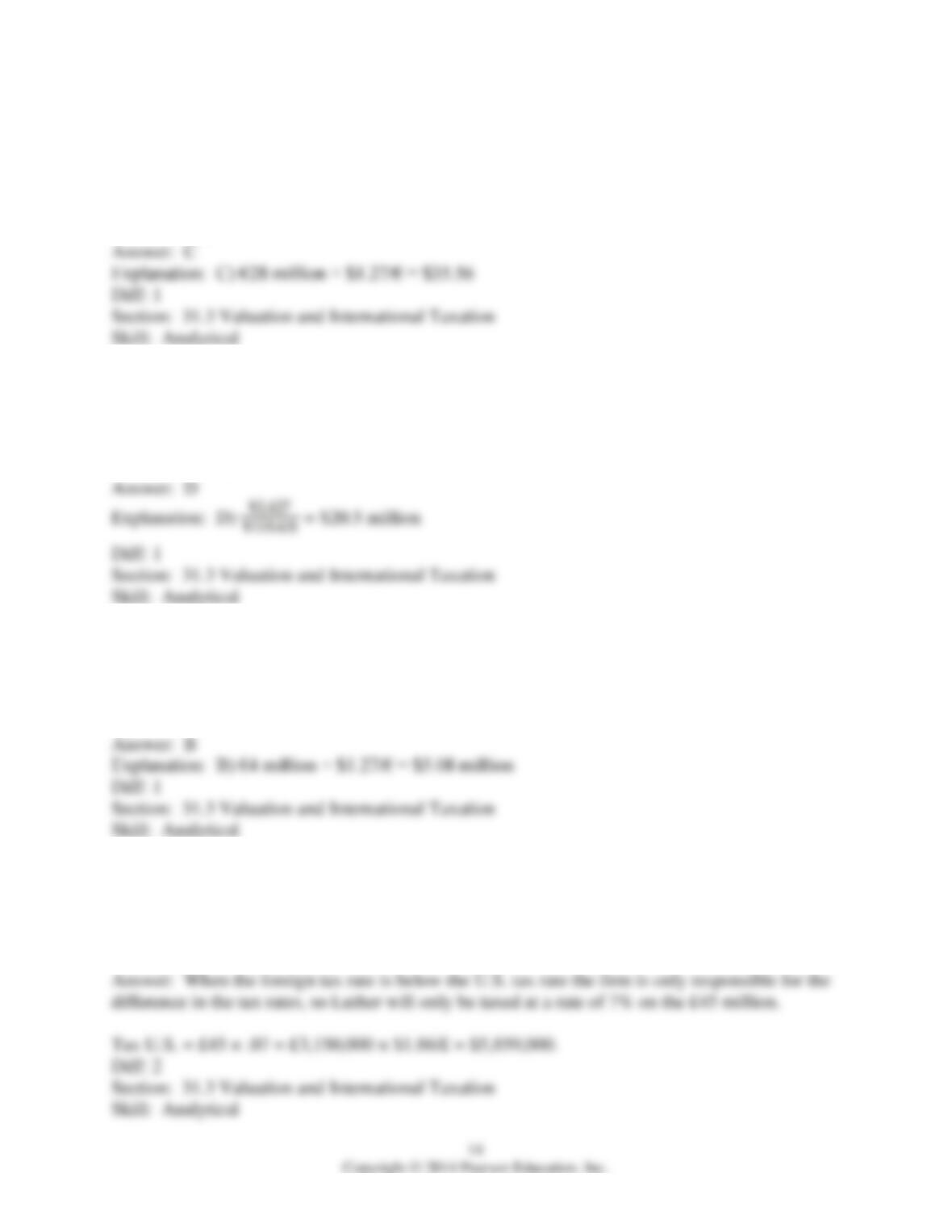
7) After the Irish taxes are paid, the amount of the earnings before interest and after taxes in
dollars from the Ireland operations is closest to:
A) $5.1 million
B) $20.5 million
C) $35.6 million
D) $29.5 million
8) The amount of the taxes paid in dollars for the Japanese operations is closest to:
A) $29.5 million
B) $5.1 million
C) $50.0 million
D) $20.5 million
9) The amount of the taxes paid in dollars for the Irish operations is closest to:
A) $20.5 million
B) $5.1 million
C) $29.5 million
D) $50.0 million
10) Luther Industries, a U.S. firm. has a subsidiary in the United Kingdom. This year, the
subsidiary reported and repatriated earnings before interest and taxes (EBIT) of £45 million. The
current exchange rate is $1.86/£. The tax rate in the U.K. for this activity is 28%. Under U.S.
tax codes, Luther is facing a 35% corporate tax rate on their earnings. What is Luther’s U.S. tax
liability on its U.K. subsidiary?

31.4 Internationally Segmented Capital Markets
Use the following information to answer the question(s) below.
Incorporated Tool, a U.S. firm, is considering its international tax situation. The corporate tax
rate in the U.S. is currently 39%. Incorporated Tool has major operations in Ireland, where the
tax rate is 12.5%, Japan where the tax rate is 40.7%, and Mexico, where the tax rate is 30.0%.
Incorporated Tool’s profits, which are fully and immediately repatriated, and foreign taxes paid
for the current year are as follows:
Ireland
Japan
Mexico
Earnings before interest and taxes (EBIT)
$400.0
$200.0
$100
Host country taxes paid
$50.0
$81.4
$30.0
Earnings before interest after taxes
$350.0
$118.6
$70.0
1) Assuming that the Japanese and Mexican subsidiaries did not exist, the U.S. tax liability on
the Irish subsidiary would be closest to:
A) $81 million
B) $103 million
C) $106 million
D) $156 million
2) Assuming that the Irish and Mexican subsidiaries did not exist, the U.S. tax liability on the
Japanese subsidiary would be closest to:
A) $0
B) $81 million
C) $103 million
D) $106 million
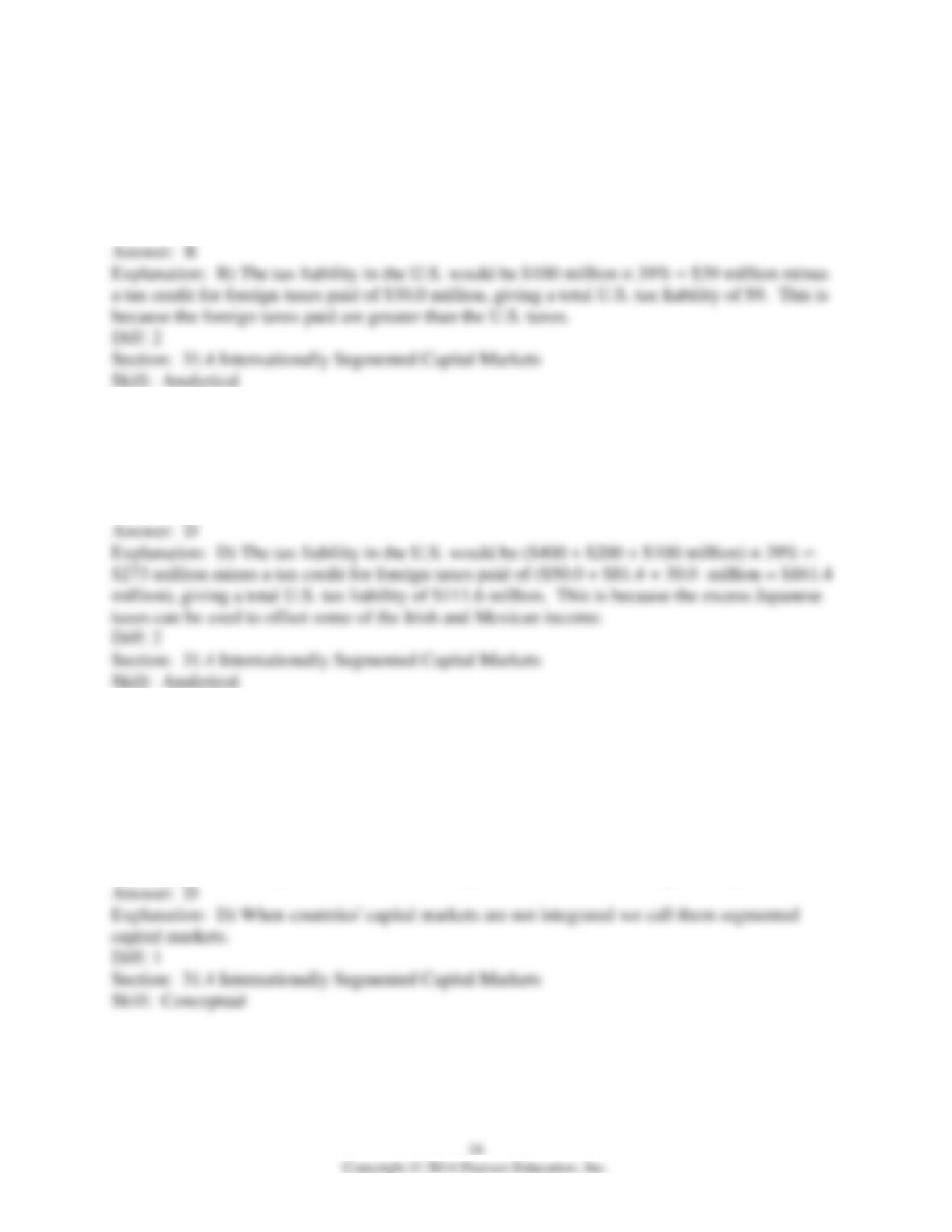
3) Assuming that the Irish and Japanese subsidiaries did not exist, the U.S. tax liability on the
Mexican subsidiary would be closest to:
A) $0
B) $9 million
C) $39 million
D) $106 million
4) Incorporated Tools total U.S. tax liability on its foreign earnings is closest to:
A) $0
B) $81 million
C) $106 million
D) $112 million
5) Which of the following statements is FALSE?
A) In some countries, especially in the developing world, all investors do not have equal access
to financial securities.
B) Firms may face differential access to markets if there is any kind of asymmetry with respect
to information about them.
C) In some cases, a country’s risk-free securities are internationally integrated but markets for a
specific firm’s securities are not.
D) When countries’ capital markets are not integrated we call them disintegrated capital markets.
6) Which of the following statements is FALSE?
A) Differential access to national capital markets is common enough that it provides the best
explanation for the existence of currency swaps, which are like the interest rate swap contracts,
but with the holder receiving coupons in one currency and paying coupons denominated in a
different currency.
B) Currency swaps generally also have final face value payments, also in different currencies.
C) Using a currency swap, a firm can borrow in the market where it has the best access to
capital, and then “swap” the coupon and principal payments to whichever currency it would
prefer to make payments in.
D) With differential access to national markets, to maximize shareholder value, the firm should
raise capital in the foreign market; the method of valuing the foreign project as if it were a
domestic project would then provide the correct NPV.
7) Which of the following statements is FALSE?
A) Many countries regulate or limit capital inflows or outflows, and many do not allow their
currencies to be freely converted into dollars, thereby creating capital market segmentation.
B) The existence of internationally integrated capital markets makes many decisions in
international corporate finance more complicated but potentially more lucrative for a firm that is
well positioned to exploit the market segmentation.
C) Political, legal, social, and cultural characteristics that differ across countries may require
compensation in the form of a country risk premium.
D) Swaps allow firms to mitigate their exchange rate risk exposure between assets and liabilities,
while still making investments and raising funds in the most attractive locales.

18
8) Which of the following statements is FALSE?
A) The rate of interest paid on government bonds or other securities in a country with a tradition
of weak enforcement of property rights is likely not really a risk-free rate. Instead, interest rates
in the country will reflect a risk premium for the possibility of default, so relations such as
covered interest rate parity will likely not hold exactly.
B) If the return difference in a segmented financial market results from a market friction such as
capital controls, corporations can exploit this friction by setting up projects and raising capital in
the high-return country/currency.
C) Important macroeconomic reasons for segmented capital markets include capital controls and
foreign exchange controls that create barriers to international capital flows and thus segment
national markets.
D) A segmented financial market has an important implication for international corporate
finance: One country or currency has a higher rate of return than another country or currency,
when the two rates are compared in the same currency.
9) Suppose the interest rate on Russian government bonds is 7.8%, and the current exchange rate
is 26.8 rubles per dollar. If the forward exchange rate is 27.2 rubles per dollar, and the current
U.S. risk-free interest rate is 4.6%, what is the implied credit spread for the Russian government
bonds?

31.5 Capital Budgeting with Exchange Risk
1) What conditions cause the cash flows of a foreign project to be affected by exchange rate risk?
2) How do we make adjustments when a project has inputs and outputs in different currencies?