Biology: A Guide to the Natural World, 5e (Krogh)
Chapter 31 Transport and Exchange 2: Digestion, Nutrition, and Elimination
1) Which of the following is an accessory organ in the digestive system?
A) the skin
B) the lungs
C) the pancreas
D) the kidneys
2) Blood carries most nutrients straight from the small intestine to which organ?
A) the heart
B) the liver
C) the kidneys
D) the stomach
E) the pancreas
3) Digestion of which organic molecule takes a somewhat more complicated route than most
nutrients?
A) carbohydrate
B) fat
C) protein
D) nucleic acid
4) The outermost layer of the digestive tract is the:
A) muscularis externa.
B) submucosa.
C) serosa.
D) mucosa.
2
5) Which layer of the digestive tract is actually in contact with the food?
A) muscularis externa
B) submucosa
C) serosa
D) mucosa
6) Most of the blood vessels and nerves in the digestive tract are located in the layer of:
A) muscularis externa.
B) submucosa.
C) serosa.
D) mucosa.
7) Which type of muscle is involved in peristalsis in the intestine?
A) cardiac
B) skeletal
C) smooth
D) voluntary
8) In the digestive system, the villi are:
A) muscles in the digestive system that push the food along.
B) finger-like projections of the mucosa.
C) glands that release digestive enzymes.
D) blood vessels that pick up nutrients from the digestive system.
9) How do fats leave the digestive system and enter the bloodstream?
A) in the veins
B) in the capillaries
C) in the arteries
D) in the lymphatic vessels
10) Chemical digestion begins in the:
A) mouth.
B) stomach.
C) large intestine.
D) small intestine.
11) What problem might result from damage to the epiglottis?
A) A person would no longer be able to taste food.
B) Food would be able to enter the respiratory passageway.
C) Food would not be digested properly.
D) A person would no longer be able to swallow.
12) The upper throat may be referred to as the:
A) pharynx.
B) epiglottis.
C) larynx.
D) trachea.
13) How does food move from the pharynx to the stomach?
A) Gravity alone pushes food through the trachea.
B) Gravity alone pushes food through the esophagus.
C) Peristalsis and gravity push food through the trachea.
D) Peristalsis and gravity push food through the esophagus.
14) Which is the main organic molecule that is digested by the secretions of the stomach?
A) carbohydrate
B) lipid
C) nucleic acid
D) protein
15) What is the function of the rugae, or folds in the stomach?
A) The rugae push food down toward the intestine.
B) The rugae allow the stomach to expand when food enters.
C) The rugae neutralize excess acid.
D) The rugae manufacture bile.
16) The mixture of food and digestive juices that leaves the stomach is called:
A) cud.
B) chyme.
C) pepsin.
D) trypsin.
17) Which of the following best describes the stomach’s role in absorption?
A) The stomach absorbs most nutrients.
B) The stomach absorbs mostly large proteins.
C) The stomach absorbs some drugs and alcohol but few nutrients.
D) The stomach absorbs acids.
18) Which structure regulates the passage of food from the stomach into the small intestine?
A) the pharynx
B) the epiglottis
C) the stomach submucosa
D) the pyloric sphincter
19) Why doesn’t the hydrochloric acid produced by the stomach digest its own lining cells?
A) The stomach has a dense connective tissue lining.
B) Lining cells produce a protective mucus layer.
C) The cells make chemicals that quickly neutralize all the acid.
D) The acid is specific to proteins, not cells.
20) In addition to breaking down food, what other valuable function does stomach acid perform?
A) Stomach acid kills bacteria and other pathogens in food.
B) Stomach acid activates enzymes in the small intestine.
C) Stomach acid recycles chlorine.
D) Stomach acid converts waste molecules into bile.
5
21) Most digestion occurs in the:
A) large intestine.
B) mouth.
C) stomach.
D) small intestine.
22) Most of the absorption of digested food takes place in the:
A) stomach.
B) esophagus.
C) large intestine.
D) small intestine.
23) Roughly how long is the small intestine?
A) 6 feet
B) 14 feet
C) 20 feet
D) 30 feet
24) What is the first part of the small intestine that receives food from the stomach?
A) duodenum
B) ileum
C) jejunum
D) cecum
25) How would blockage of the pancreatic duct affect the digestive system?
A) The food in the small intestine would be more basic (alkaline).
B) It would have little effect because liver enzymes would take over.
C) The small intestine would contain acidic, mostly undigested chyme.
D) The stomach would be unable to function.
26) Gallstones are a problem when they:
A) get stuck in the folds of the small intestine.
B) block the cystic duct or common bile duct.
C) break and release enzymes.
D) break and release cholesterol.
27) The main function of the gallbladder is to:
A) make bile.
B) make gallstones.
C) store and concentrate digestive enzymes.
D) store and concentrate bile.
28) Which organ is central to the body’s metabolism of nutrients?
A) the stomach
B) the kidneys
C) the liver
D) the small intestine
29) What is the main function of the colon?
A) to complete the digestion of lipids
B) to absorb water and vitamin K
C) to control nutrients it will send to the rest of the body
D) to digest and absorb carbohydrates
30) The appendix is attached to which portion of the large intestine?
A) the cecum
B) the colon
C) the rectum
D) the ileocecal valve
31) Which of the following is an example of a nutrient that helps to regulate bodily processes?
A) protein
B) water
C) lipid
D) potassium
32) Which of the following is a trace mineral?
A) sodium
B) sulfur
C) phosphorus
D) iodine
33) Which category of nutrient would be best described as compounds needed in small amounts
in the diet to facilitate chemical reactions in the body?
A) lipids
B) trace minerals
C) vitamins
D) enzymes
34) Deficiency of which nutrient can cause muscle cramps, irregular heartbeat, or paralysis?
A) potassium
B) sulfur
C) iron
D) copper
35) Calories are a measure of the:
A) nutritional value of food.
B) amount of energy the food contains.
C) weight of the food.
D) amount of minerals and vitamins a food contains.
36) Which of the following has the most stored energy per gram?
A) minerals
B) proteins
C) carbohydrates
D) lipids
8
37) In what way are the essential amino acids different from nonessential amino acids?
A) Nonessential amino acids are not necessary for any proteins we make.
B) Nonessential amino acids are not absorbed by the digestive tract.
C) Essential amino acids cannot be made and must be obtained from food.
D) Essential amino acids are the ones exclusively used to make enzymes.
38) What is unusual about soy protein as opposed to other plant protein sources?
A) Soy protein has all essential amino acids in the proper proportions.
B) Soy protein has the same saturated fat levels as animal fat.
C) Soy protein has more energy per gram than lipids.
D) Soy protein has only one-tenth the energy per gram of other proteins.
39) Which of the following is a complex carbohydrate that cannot be digested?
A) disaccharides
B) starches
C) high fructose corn syrup
D) fibers
40) The measure of how blood glucose levels are affected by a given amount of carbohydrate is:
A) sugar input.
B) glycemic load.
C) monosaccharide ratio.
D) insulin index.
41) What is the difference between fats and oils?
A) Oils are mostly made of saturated fat.
B) Fats are mostly made of unsaturated fat.
C) Oils are liquids and fats are solid at room temperature.
D) Fats are always healthier as long as they are mostly saturated.
42) Which of the following types of fat are the least healthy?
A) trans fat
B) polyunsaturated fat
9
C) saturated fat
D) monounsaturated fat
43) Why are large amounts of red meat and butter not healthy choices in the diet?
A) They contain too much protein.
B) They contain a lot of saturated fat.
C) Most people cannot digest them.
D) They contain excessive amounts of fiber.
44) Why are saturated fats considered a less healthy nutrient?
A) Because saturated fats are from animal sources, they can produce allergic reactions.
B) Saturated fats cannot be used for energy as the other fats can.
C) Saturated fats raise HDL levels, which contributes to heart disease.
D) Saturated fats raise LDL levels, which contributes to heart disease.
45) In a traditional food pyramid, which type of food would be closest to the base?
A) dairy products
B) fish and poultry
C) whole grain foods
D) vegetables
E) fruits
46) Place the following in order of the movement of urine through the urinary system: (1)
urethra, (2) ureter, (3) kidney, (4) urinary bladder.
A) 1, 2, 3, 4
B) 3, 4, 1, 2
C) 1, 3, 2, 4
D) 2, 3, 4, 1
E) 3, 2, 4, 1
47) The knot of capillaries in a nephron, where filtration of blood occurs, is the:
A) glomerulus.
B) bowman’s capsule.
C) proximal tubule.
D) distal tubule.
E) collecting duct.
48) What affect does ADH secretion have on the kidneys?
A) Water stays trapped in the kidney tubules.
B) Urine output increases.
C) The filtration rate increases.
D) Water moves out of the kidney tubules.
E) Blood pressure to the kidneys decreases.
49) Why does alcohol ingestion increase urine output?
A) The alcohol increases blood pressure.
B) The alcohol suppresses ADH production.
C) The alcohol stimulates ADH production.
D) The alcohol redirects blood flow away from the skin and to the kidneys.
E) The alcohol is converted to excess water by the liver.
50) Voluntary control of urination is accomplished by:
A) an external sphincter made of skeletal muscle.
B) an internal sphincter of smooth muscle.
C) the skeletal muscle of the bladder.
D) contraction of the ureters.
51) Digestion is a process of mechanical and chemical breakdown of larger food molecules into
smaller ones that can be absorbed.
52) Most digested food is absorbed into the blood by the villi of the small intestine.
53) Sodium is a nutrient because it provides us with energy.
54) Minerals are always chemical elements, not compounds.
55) A “nutritional” calorie is actually 1,000 of the energy unit calories.
56) Soy protein and nearly all animal protein sources provide all the essential amino acids
needed in the diet.
57) Fiber is defined as a complex carbohydrate that is digestible.
58) About 99 percent of the fluid the kidney processes is recycled back into the body.
59) The tube leading from the bladder that carries urine out of the body is the ureter.
60) The urethra is different lengths in men and women.
Match the following.
A) water and vitamin K absorbed
B) secretes enzymes and chemical buffers
C) most digestion and absorption
D) transport of food only
61) Stomach
Topic: Section 31.3
Skill: Knowledge/Comprehension
62) Large intestine
Topic: Section 31.3
Skill: Knowledge/Comprehension
63) Esophagus
Topic: Section 31.3 E) turns food to chyme
Skill: Knowledge/Comprehension
64) Pancreas
Topic: Section 31.3
Skill: Knowledge/Comprehension
65) Small intestine
Topic: Section 31.3
Skill: Knowledge/Comprehension
Match the following.
A) tube sensitive to ADH
B) contraction forces urine out the body
C) carries urine to the bladder
D) carries urine from the bladder out of the body
66) Urethra
Topic: Section 31.9
Skill: Knowledge/Comprehension
67) Ureter
Topic: Section 31.9
Skill: Knowledge/Comprehension
68) Urinary bladder
Topic: Section 31.9
Skill: Knowledge/Comprehension
69) Collecting duct
Topic: Section 31.9
Skill: Knowledge/Comprehension
70) The layer of the digestive tract that contains smooth muscle is the ________.
71) A classmate tells you that his mother had her gallbladder removed, and he says she wants to
cut down on fat in her diet. He comments that he’s not sure why because lipase is the enzyme
that breaks down fats, and bile stored in the gallbladder isn’t an enzyme. Although his last
statement is factually true, how would you help your classmate understand this connection?
72) What are the two main chemicals secreted by the gastric pits in the stomach?
73) Chemical elements that are needed to help form bodily structures and to facilitate chemical
reactions in the body are ________.
74) Which nutrient has the highest caloric content?
75) A friend tells you that she wants to try to be a strict vegetarian or vegan, but her parents are
discouraging her from doing so. Her parents say she will not get enough protein or vitamins.
What advice can you offer your friend to help her convince her parents she will get enough
protein and vitamins on a vegetarian or vegan diet?
76) Complex carbohydrates that are digestible are known as ________.
77) The functional units of the kidneys are the ________.
78) Which part of the brain is responsible for producing and controlling the release of the
hormone ADH?
79) Formulate reasons in support of why the duodenum could be described both structurally and
functionally as the “crossroads” of the digestive tract.
80) Could someone add body fat by eating a diet low in fat but high in carbohydrates? Defend
your answer.
81) Propose an argument for why the urinary system is much more than just a waste filtration
site and is also a major player in the game of homeostasis.
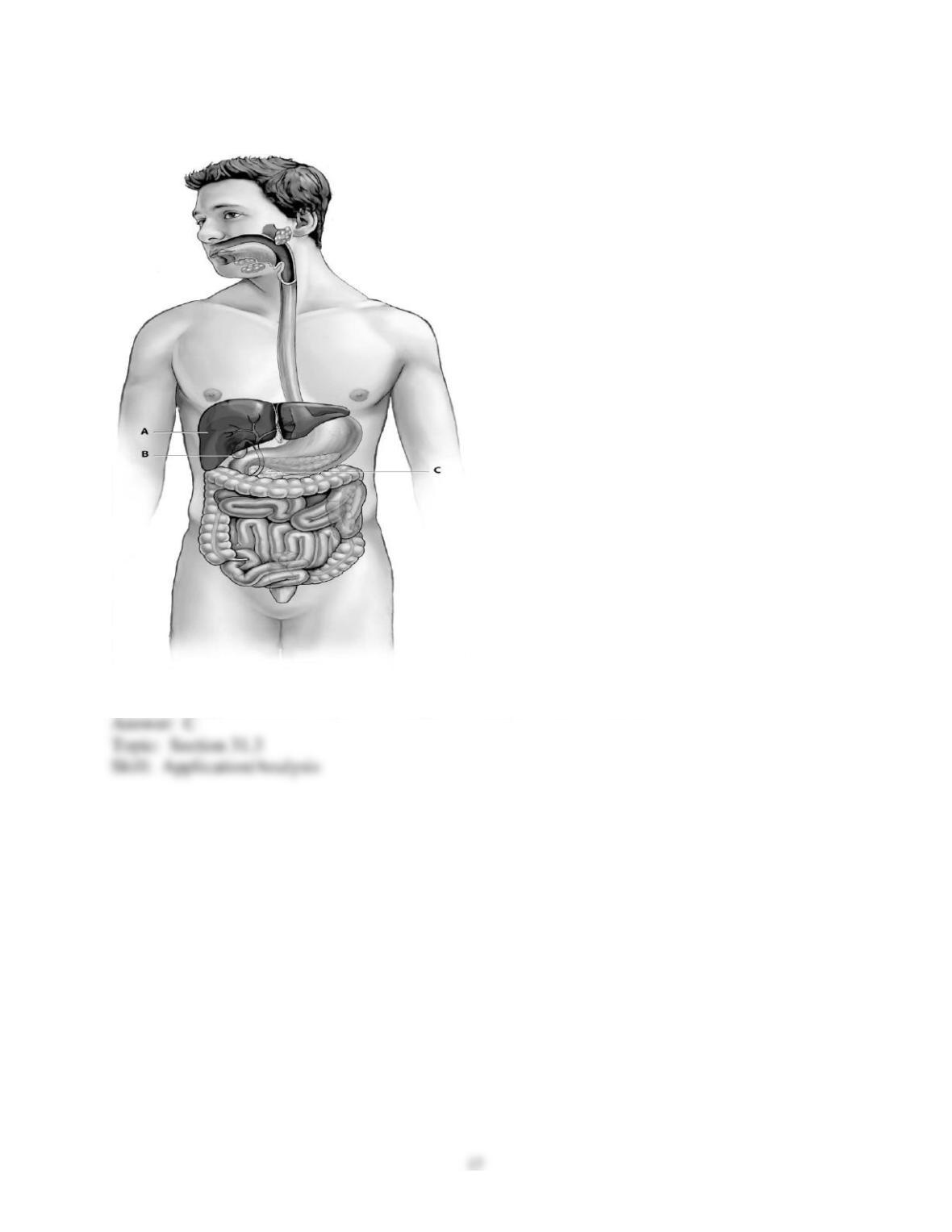
Refer to the figure below, and then answer the question that follows.
82) Which organ, A, B, or C, produces digestive enzymes and chemical buffers?
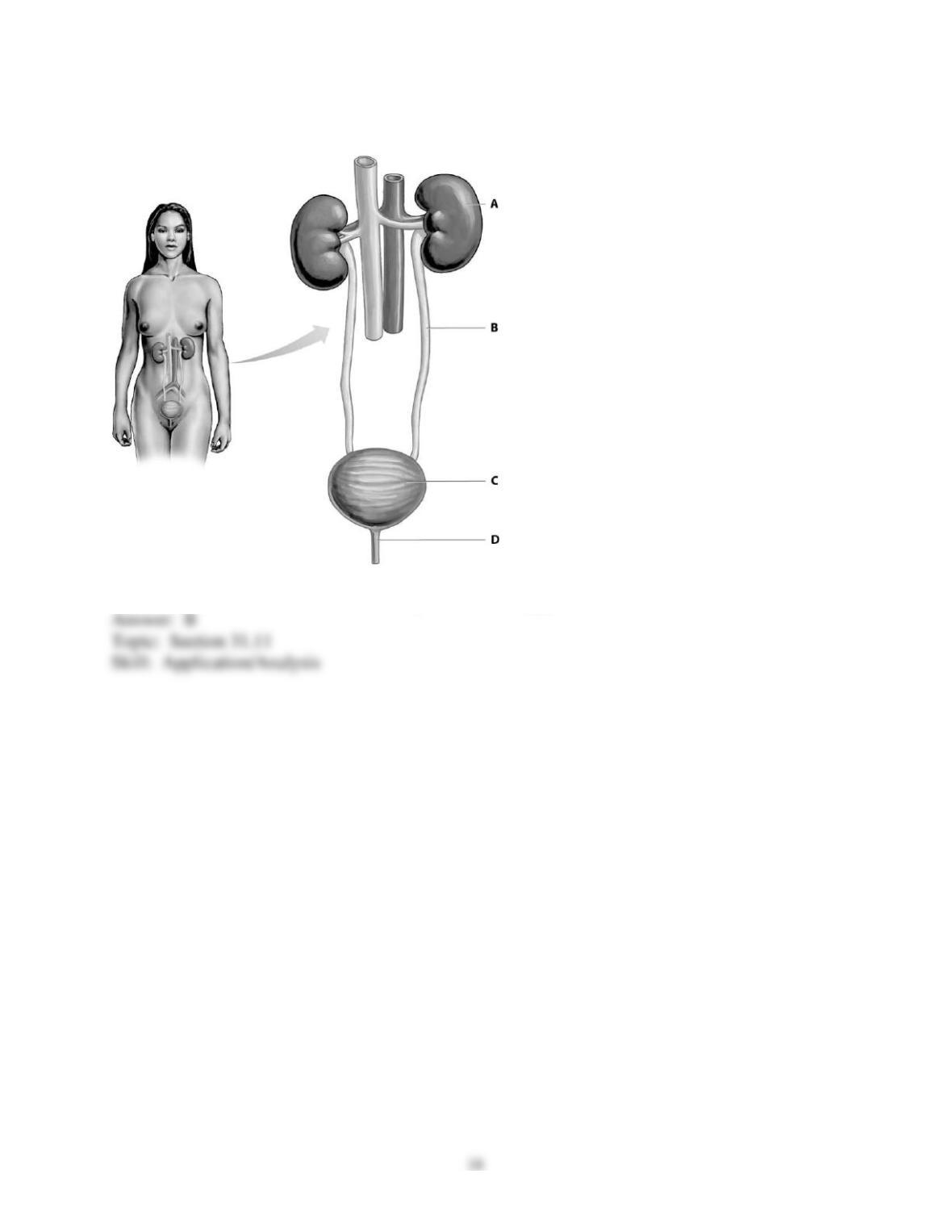
Refer to the figure below, and then answer the question that follows.
83) Which structure, A, B, C, or D, transports urine using peristalsis?