272)
A good that has social costs that exceed private costs has a quantity that is
272)
A)
too high.
B)
the best society can do.
C)
too low.
D)
just right.
273)
To correct for the social impact of pollution, the government should levy a per–unit tax
273)
A)
according to the economic damage of the pollution.
B)
according to the business activity of the polluter.
C)
only to those polluters that can afford to pay for the tax.
D)
that is the same for all polluters regardless of their locations or sizes.
274)
Suppose there are two factories on a river, and both need clean water for their production
processes. The upstream factory takes in clean water and dumps dirty water back into the river.
The downstream firm must clean up the water it gets from the river before using it. In this situation
274)
A)
the internal costs of the upstream factory are externalized by the downstream factory, which
then passes them on to its customers.
B)
the private costs of the downstream factory are more than the private costs of the upstream
factory, but for both factories private costs and social costs are the same.
C)
the upstream factory’s private costs are less than its social costs, and its external costs are
borne by the downstream factory.
D)
the social costs are greater than the private costs for the upstream firm, while the social costs
are less than the private costs for the downstream firm.
275)
The inclusion of external benefits in the decision making process determining equilibrium price
and quantity leads to
275)
A)
higher priced items and increased quantity.
B)
higher priced items and a decline in quantity.
C)
lower priced items and a decline in quantity.
D)
lower priced items and increased quantity.
276)
Suppose there are two identical factories on a river. Both require clean water for their production
processes. The upstream firm gets clean water from the river and dumps dirty water into the river.
The downstream firm must clean the water it gets from the river before it can use the water and
later it dumps dirty water into the river. In this situation
276)
A)
the upstream factory’s private costs are lower than its social costs since it passes the costs of
the dirty water on to the downstream firm. For the downstream firms, private costs equal
social costs.
B)
the private costs of the downstream firm are greater than the private costs of the upstream
firm and the social costs are less than the private costs for both firms.
C)
the private costs of the upstream firm are less than its social costs while the social costs of the
downstream firm are less than its private costs.
D)
the private costs of the two firms are the same since both dump dirty water into the river.
277)
If coal–burning electrical utility companies fully internalized pollution costs, then we could expect
277)
A)
no change in electricity prices.
B)
a decrease in electricity prices.
C)
a greater use of coal to produce electricity.
D)
an increase in electricity prices.
278)
Which of the following constitutes an external cost of driving an automobile?
278)
A)
fuel
B)
pollution
C)
wear and tear
D)
insurance
279)
When a person can pass some of her costs of using a resource on to someone else,
279)
A)
the internal costs of using the resource exceed the private costs.
B)
she uses too much of the resource.
C)
she uses too little of the resource.
D)
the use of the resource is not affected by her actions.
280)
When both internal and external costs for using a scarce resource are included, then there is
280)
A)
an increase in the production of the good.
B)
an increase in the price of the good.
C)
a negative externality.
D)
a positive externality.
ESSAY. Write your answer in the space provided or on a separate sheet of paper.
281)
Explain how the optimal quantity of air pollution is determined.
282)
Why are externalities associated with common property rather than private property?
283)
What are the private costs of driving an automobile? What are the external costs?
284)
Why don’t people take into consideration the external costs of their actions and reduce the amount of
externalities?
285)
What is an externality?
286)
Suppose that the nation wide average cost of air pollution generated by a car is $1,000. Would a tax of $1,000 on
every car induce people to take external costs into consideration and bring about the optimal price and output
for autos? Explain.
287)
“The number of species on earth is decreasing drastically and economic development is the main factor for the
problem.” Do you agree or disagree? Why?
288)
What is common property? What does common property have to do with externalities?
289)
Why do economists believe that it is socially optimal to have some amount of pollution?
290)
Suppose people value clean air more as their incomes increase. What would happen to the optimal amount of
clean air as a country develops economically? Is there an economic prediction we can make from this?
291)
What are social costs? How do they differ from private costs?
292)
Why are most endangered species belong to common property?
293)
Explain why the buffalo almost became extinct while cattle did not, even though both provide similar goods for
people.
294)
“Creating a free market for carbon–dioxide emission permits would only encourage firms to pollute more.” Do
you agree or disagree? Why?
295)
“The optimal level of pollution is zero.” Do you agree or disagree? Why?
296)
Is a uniform per–unit tax on firms that cause an externality an optimal policy for correcting the externality?
Explain.
297)
Explain how a market for pollutant emission allowances can induce firms to reduce the amount of emissions.
298)
“Private costs are borne by individuals while social costs are borne by society.” Do you agree or disagree? Why?
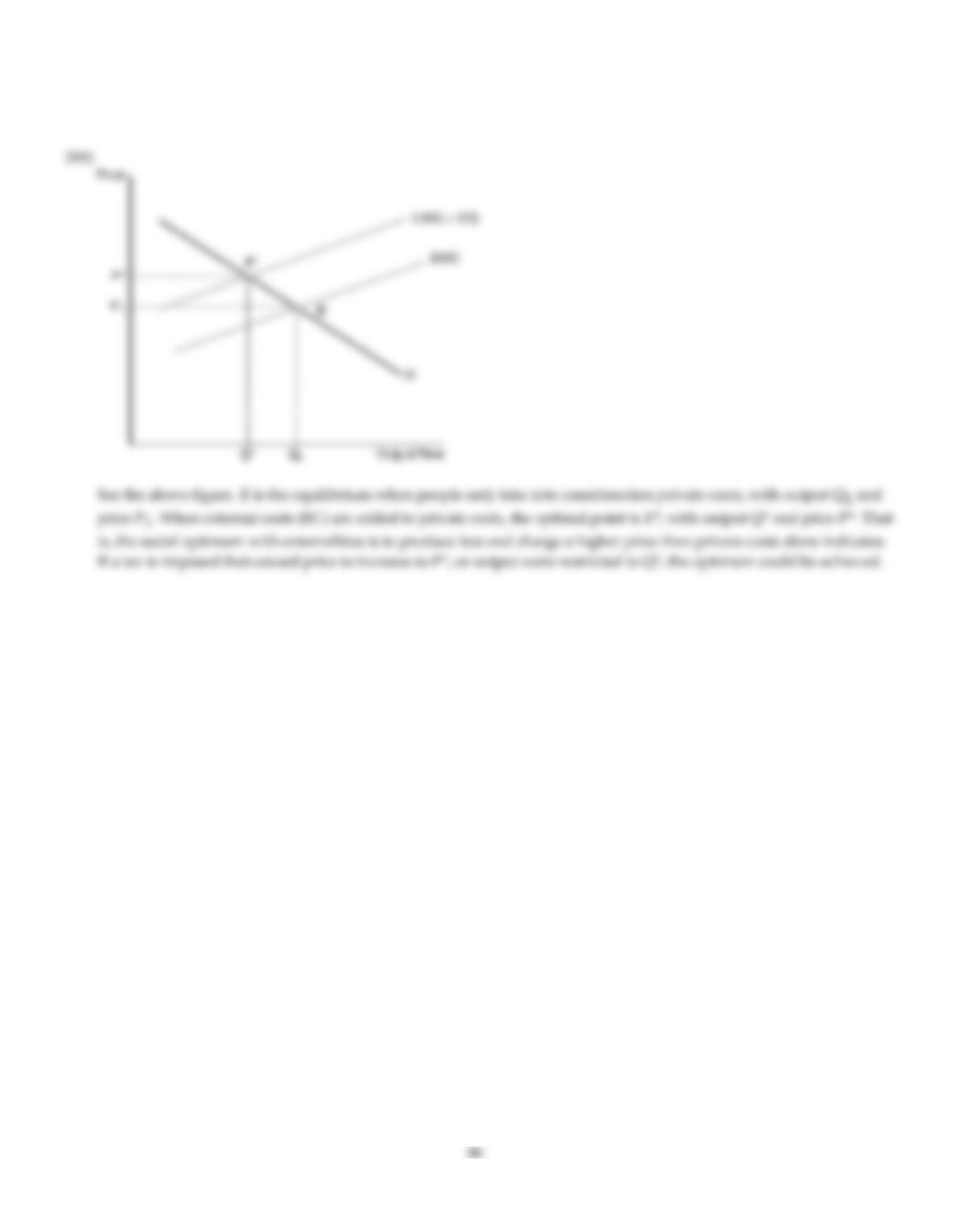
299)
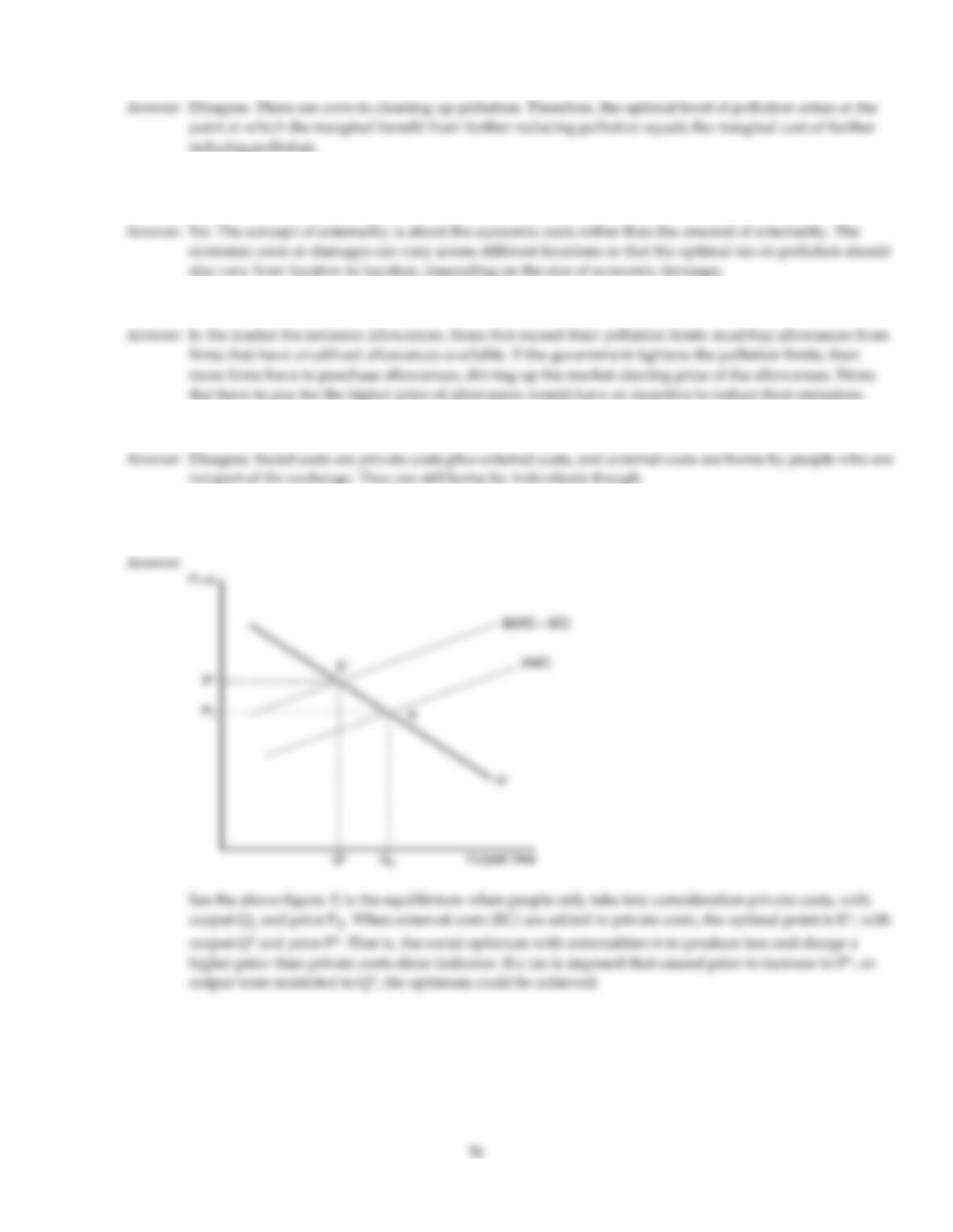
Using a graph, show the effects of a negative externality. Where is the socially optimum point of output? How
can it be achieved?

Answer Key
Testname: C31
79
Answer Key
Testname: C31
Answer Key
Testname: C31
Answer Key
Testname: C31
Answer Key
Testname: C31
Answer Key
Testname: C31
84
Answer Key
Testname: C31
Answer Key
Testname: C31