218)
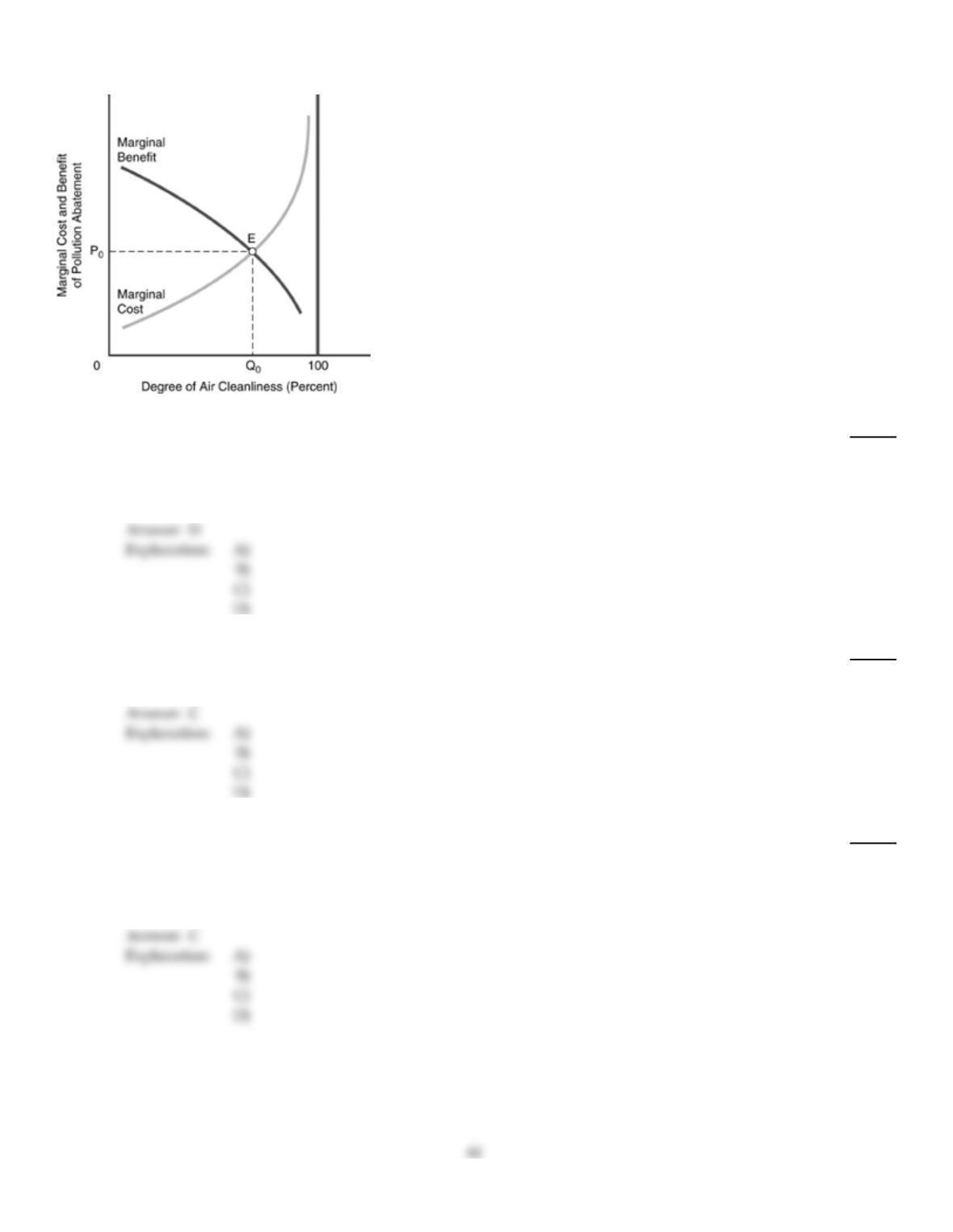
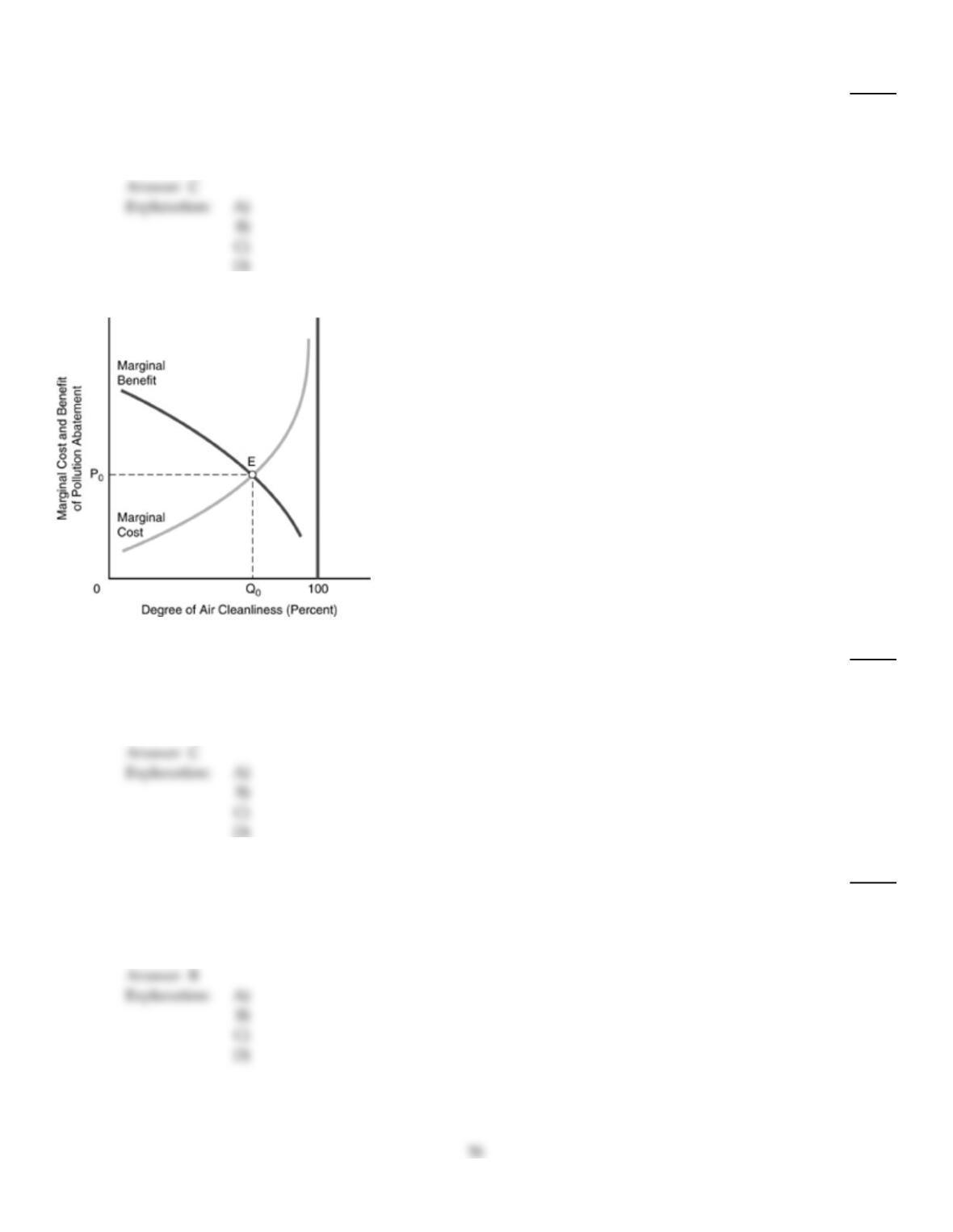
In the above figure
218)
A)
the optimal degree of air cleanliness is less than 100 percent.
B)
the marginal cost curve slopes up because of the law of diminishing returns.
C)
Neither A nor B are correct.
D)
Both A and B are correct.
219)
The marginal cost of pollution abatement is represented by
219)
A)
a downward sloping curve.
B)
a horizontal curve.
C)
an upward sloping curve.
D)
a vertical curve.
C
220)
An externality
220)
A)
means a rapidly rising cost borne by consumers.
B)
is the indirect cost, the overhead, of producing a product.
C)
may be positive or negative.
D)
is the cost of producing a good outside the United States.
C
D
221)
Technological change that makes it easier to produce in a “cleaner” fashion would cause
221)
A)
the marginal cost curve of pollution abatement to shift right, increasing the degree of air
quality.
B)
the marginal benefit curve of pollution abatement to shift right, increasing the degree of air
quality.
C)
the marginal cost curve of pollution abatement to shift left, increasing the degree of air
quality.
D)
the marginal benefit curve of pollution abatement to shift left, increasing the degree of air
quality.
222)
Social costs are
222)
A)
costs incurred in governmental welfare programs.
B)
costs borne by society whenever a resource–using action takes place.
C)
external costs minus internal costs.
D)
costs incurred by government and borne by all taxpayers.
B
223)
Private property rights are
223)
A)
property that is owned by everyone and therefore by no one.
B)
an externality.
C)
a social cost.
D)
exclusive rights of ownership.
D
224)
According to economic analysis, the optimal quantity of pollution exists at the point at which the
224)
A)
level of pollution is at zero.
B)
level of pollution is acceptable to the society.
C)
total benefit of pollution control is equal to the total cost.
D)
marginal benefit of pollution control is equal to the marginal cost.
D
A
225)
The costs associated with the negotiation and enforcement of an agreement are
225)
A)
resource factor costs.
B)
property costs.
C)
attorney fees.
D)
transaction costs.
226)
When no one owns a particular resource
226)
A)
no one has any incentive to consider externality spillovers associated with that resource.
B)
positive externalities will arise.
C)
property rights are clearly defined.
D)
individuals have legal recourse for any damages caused to their resource.
227)
Assuming that pollution cannot be removed from the environment at zero cost, the optimal level of
pollution
227)
A)
will be positive.
B)
will be zero.
C)
cannot be determined.
D)
will be negative.
228)
Which of the following is most likely to be private property?
228)
A)
bees
B)
winds
C)
farm raised chickens
D)
house flies
229)
Which of the following statements is TRUE for the U.S. economy?
229)
A)
Social benefits are always emphasized in advertising.
B)
Supply of services always reflects all social costs.
C)
Demand for services always reflects all social costs.
D)
Private costs are not always equal to social costs.
230)
Economists typically suggest three choices that allow a polluter to decide how to absorb most, or
perhaps all, of the social costs of its actions, which are
230)
A)
paying a pollution tax, continuing to use existing production techniques, or continuing the
polluting behavior without regard to the social implications.
B)
installing pollution abatement equipment, paying to pollute, or just ignoring the issue.
C)
reducing the pollution–causing activity, changing production techniques, or paying a price to
pollute.
D)
continuing to overproduce the good, lowering the price of the good, or cutting output.
231)
The Kyoto Protocol was signed by participating nations in
231)
A)
2007.
B)
1972.
C)
1872.
D)
1997.
232)
Which of the following is NOT an example of common property?
232)
A)
sunshine
B)
air
C)
a trampoline
D)
gravity
233)
If firms were forced to take into account the full social costs of production, then
233)
A)
output would be unaffected but pollution levels would come down.
B)
output and pollution levels would decrease.
C)
output could be increased and pollution levels would decrease.
D)
output would decrease but pollution levels would probably remain at the same levels.
234)
The 1997 Kyoto Protocol was signed by
234)
A)
all nations in the world.
B)
only nations in Asia.
C)
more than three dozen nations.
D)
only the United States and the European Union.
235)
Which one of the following is an example of an external cost?
235)
A)
a house payment owed by a friend
B)
labor costs to a firm
C)
emissions from a factory
D)
the cost to attend college
236)
The exclusive rights of ownership of property are generally referred to as
236)
A)
public property rights.
B)
level property rights.
C)
private property rights.
D)
common property rights.
237)
The optimal amount of air pollution is
237)
A)
found by equating the marginal benefits from reducing pollution by one more unit with the
marginal costs of reducing pollution by an additional unit.
B)
found by setting the marginal benefits from reducing pollution by one more unit equal to
zero.
C)
found by equating the total benefits from reducing pollution by one more unit with the total
costs of reducing pollution by an additional unit.
D)
a meaningless concept since we cannot monetize the environment.
238)
Suppose people value clean air more as their incomes increase, then
238)
A)
the marginal cost curve of pollution abatement to shift right, increasing the degree of air
quality.
B)
the marginal cost curve of pollution abatement to shift left, increasing the degree of air
quality.
C)
the marginal benefit curve of pollution abatement to shift right, increasing the degree of air
quality.
D)
the marginal benefit curve of pollution abatement to shift left, increasing the degree of air
quality.
239)
When the total external and internal costs of a transaction are taken into consideration, this is
known as
239)
A)
social costs.
B)
marginal costs.
C)
average total costs.
D)
public costs.
Output/Hour Private MC Marginal Benefit External Marginal Costs
1$10 $20 0.20
210.40 18.50 0.40
310.90 17 0.70
411.50 16.50 1.20
512.20 14.00 1.80
613.00 13.00 2.80
714.40 12.00 4.00
240)
Use the above table. What will the price be before external costs are internalized with a tax?
240)
A)
$14
B)
$1.80
C)
$13
D)
$12.20
C
241)
The crux of the problem of pollution is
241)
A)
poorly defined property rights are expensive to enforce.
B)
greed on the part of consumers.
C)
greed on the part of producers.
D)
a poorly run Environmental Protection Agency.
A
242)
The social costs of an activity are greater than the private costs of the activity when
242)
A)
a person does not pay all costs associated with a particular resource–using activity.
B)
the internal costs of the resource–using activity are positive.
C)
the external costs of the resource–using activity are zero.
D)
the internal costs of the resource–using activity are less than the external costs of the activity.
A
A
243)
Another name for internal cost is
243)
A)
private cost.
B)
marginal cost.
C)
psychological cost.
D)
social cost.
244)
An externality is a situation in which
244)
A)
there are no social costs.
B)
the cost borne by the consumer is greater than the monetary price.
C)
private costs diverge from social costs.
D)
internal costs diverge from private costs.
245)
When no property rights exist
245)
A)
externalities will be internalized by voluntary arrangements among a small group of parties.
B)
no one has an economic incentive to care for common property, and an externality may well
occur.
C)
there will be no production.
D)
society will produce beyond the production possibilities frontier, but the allocation of
resources is not apt to be optimal.
246)
Common property is
246)
A)
exclusive rights of ownership.
B)
an externality.
C)
a social cost.
D)
property that is owned by everyone and therefore by no one.
247)
When there are no externalities
247)
A)
social costs are less than private costs.
B)
private costs are greater than social costs.
C)
social costs are greater than private costs.
D)
private costs equal social costs.
248)
A good that has external costs associated with its production will be
248)
A)
not produced.
B)
underproduced.
C)
overproduced.
D)
produced at the optimal level.
C
249)
An example of the external costs due to automobile driving is
249)
A)
the opportunity cost of the driver’s time.
B)
the cost of washing dirty cars.
C)
air pollution due to exhaust fumes.
D)
wear and tear on toll roads.
C
250)
As we approach total pollution abatement
250)
A)
the marginal cost to society declines.
B)
the marginal benefit to society increases, but at a decreasing rate.
C)
the marginal benefit to society declines.
D)
the marginal benefit to society increases.
C
251)
An externality that is not fully paid by the individual using an automobile is
251)
A)
gasoline for the vehicle.
B)
operation of the vehicle.
C)
insurance for the vehicle.
D)
air pollution from the vehicle.
D
D
252)
Government intervention will not be necessary when voluntary contracting internalizes an
externality. Which of the following is NOT a necessary condition for this to occur?
252)
A)
well–defined private property rights
B)
low contract enforcement costs
C)
low transaction costs
D)
large numbers of individuals involved in the transactions
253)
Internal costs are
253)
A)
costs borne by people in the same society as those who incur them.
B)
costs borne solely by the individuals who incur them.
C)
costs borne by people working in the firm that incurs them.
D)
all costs incurred in the marketplace.
B
254)
Which of the following is NOT a possible solution to the problem of pollution?
254)
A)
imposing a pollution tax on producers
B)
subsidizing the costs of production of activities that generate pollution
C)
regulating the quantity of pollution that can be generated
D)
converting a resource that is communally owned into a privately owned resource
B
255)
Protecting endangered species are likely to be
255)
A)
a private cost.
B)
a public cost.
C)
both private and public costs.
D)
neither a private nor public cost.
B
D
256)
Which of the following is TRUE of the European Union’s cap–and–trade program?
256)
A)
Firms are taxed based on the their pollution levels.
B)
Firms are forced to shut down when they exceed their pollution limits.
C)
Firms can trade pollution permits to meet their pollution limits.
D)
Governments subsidize firms to develop devices to reduce pollution.
257)
The optimal quantity of pollution in the above figure
257)
A)
is defined as the level where the marginal benefit is at a maximum.
B)
cannot be determined.
C)
is the level of pollution at which the marginal benefit equals the marginal cost.
D)
is where the optimal degree of air cleanliness is 100 percent.
258)
Which of the following is NOT a possible solution to the problem of pollution?
258)
A)
converting a resource that is communally owned into a privately owned resource
B)
subsidizing the costs of production of activities that generate pollution
C)
imposing a tax on polluters that is related to the amount of pollution
D)
regulating the amount of pollution that a firm can produce
259)
You enter a classroom, which is littered with newspapers. This is because
259)
A)
students do not pay for littering.
B)
maintenance people only clean once a day.
C)
students are too lazy to clean up.
D)
it is a way to protest against the tuition rates.
260)
Generally, as levels of pollution are reduced
260)
A)
marginal benefits from the reduction increase.
B)
marginal costs from the reduction decrease.
C)
marginal costs from the reduction increase.
D)
marginal costs from the reduction stay the same.
261)
Common property often results in
261)
A)
a negative externality.
B)
exclusive rights of ownership.
C)
a social benefit.
D)
a private cost.
262)
If all firms had to bear all the social costs of their actions, we should observe marginal cost curves
262)
A)
of some firms shifting up and of the rest shifting down.
B)
of some firms shifting up, of some others shifting down, and of the rest not shifting at all.
C)
of all firms that had generated externalities shifting up while there would be no change for
the rest of the firms.
D)
of all firms shifting up.
263)
A good that has social costs that are equal to private costs has a price that is
263)
A)
too high.
B)
just right.
C)
too low.
D)
equal to marginal cost.
264)
To totally internalize an externality, a government can levy a tax related only to the physical
quantity of pollution if
264)
A)
the economic damages are too large to be determined.
B)
the economic damages associated with the pollution are the same across different locations.
C)
the economic damages are zero.
D)
the economic damages associated with the pollution are different across different locations.
265)
If external costs are included and added to a firm’s private costs, then
265)
A)
the demand curve will shift to the right.
B)
the supply curve will shift to the right.
C)
the supply curve will shift to the left.
D)
the demand curve will shift to the left.
266)
Which of the following is TRUE of the cap–and–trade program in the United States?
266)
A)
The state of Texas is currently the only state in the U.S. that has not implemented a
cap–and–trade program.
B)
The United States is a participant of the Kyoto Protocol that implemented the cap–and–trade
program in 2005.
C)
The state of California began a cap–and–trade program in 2013.
D)
All states in the U.S. have implemented a cap–and–trade program before the Kyoto Protocol
in 2005.
267)
Common property ownership most likely leads to
267)
A)
production at a rate at which price is less than social cost.
B)
an increase in pollution.
C)
an efficient allocation of resources.
D)
a decrease of externalities.
268)
The marginal benefit from pollution abatement
268)
A)
increases as pollution abatement increases because people learn to want an even cleaner
environment as the environment gets cleaner.
B)
decreases as pollution abatement increases because of the law of diminishing marginal utility.
C)
is constant as pollution abatement increases because pollution abatement is valued for its own
sake and not for the utility it provides.
D)
decreases as pollution abatement increases because of the law of diminishing marginal
product.
269)
The problem associated with endangered populations of migratory birds is the
269)
A)
free rider problem.
B)
common property problem.
C)
deadweight loss problem.
D)
inefficient production problem.
270)
It is assumed that the marginal benefit of air cleanliness falls with the degree of cleanliness since
270)
A)
the generation of pollution should be considered an externality.
B)
air cleanliness is a public good and not a private good.
C)
the marginal cost of air cleanliness increases.
D)
the marginal utility of air cleanliness falls with the degree of cleanliness.
271)
Approximately what percentage of the world’s extinct species became extinct before humans
appeared on earth?
271)
A)
1 percent
B)
10 percent
C)
20 percent
D)
more than 99 percent