142)
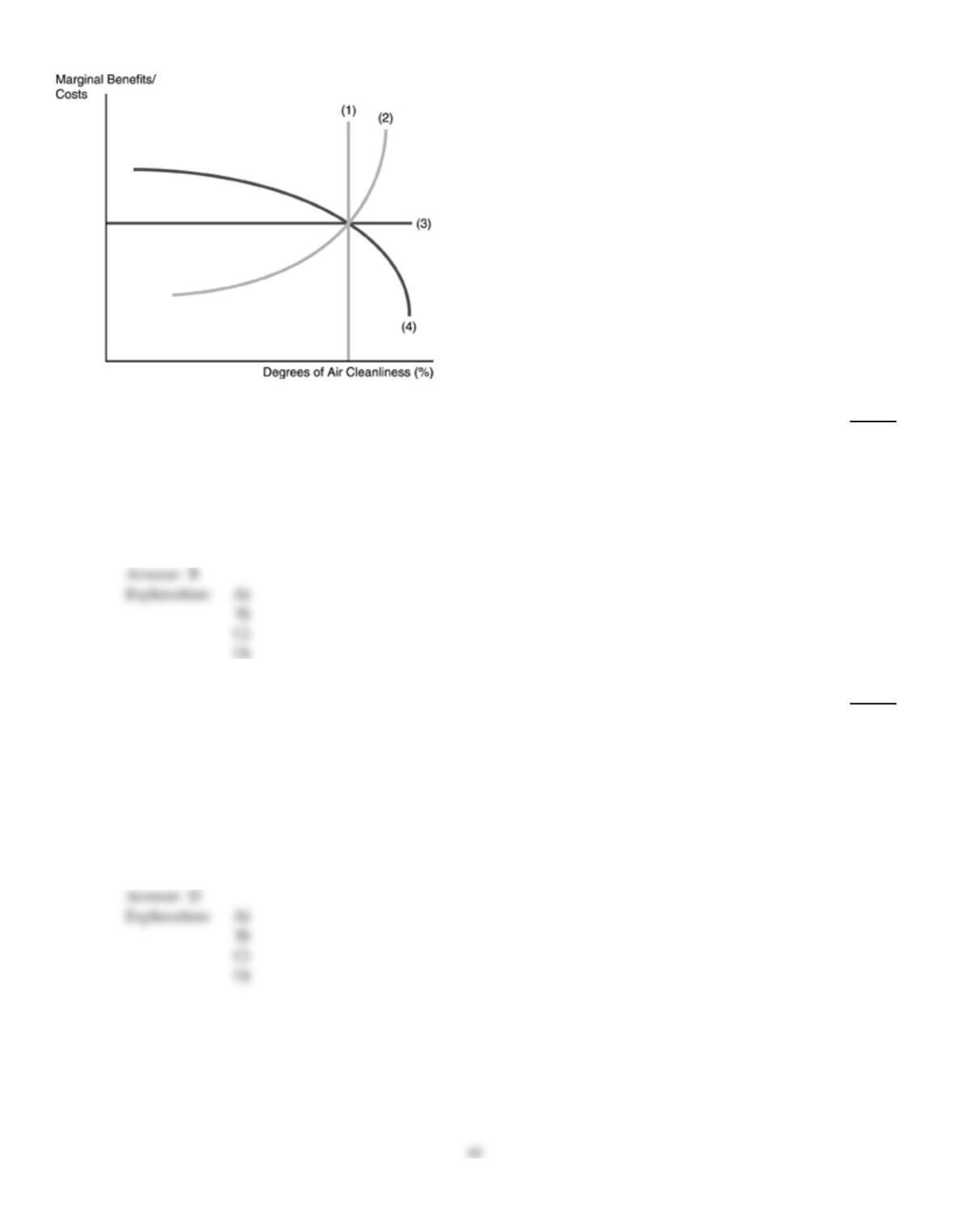
Refer to the above figure. Suppose the marginal benefit and the marginal cost curves of pollution
abatement are normally shaped. Technological change that made it easier to produce in a “cleaner”
fashion would cause
142)
A)
curve (1) to shift out, increasing the optimal amount of pollution abatement.
B)
curve (2) to shift out, increasing the optimal amount of pollution abatement.
C)
curve (4) to shift out, increasing the optimal amount of pollution abatement.
D)
curve (3) to shift up, raising the marginal benefits and costs and reducing the amount of
pollution abatement.
143)
A farmer notices that a neighboring rancher’s cattle are wandering and destroying some of his
crops. The farmer decides to offer a payment to the rancher if the rancher will reduce the size of his
herd. By doing so, the farmer
143)
A)
inadvertently bears the costs of the externality when the rancher should be liable for the costs.
B)
can be sure that the size of the herd will be reduced and the size of his own harvest will be
increased.
C)
informs the rancher that the cattle have destroyed crops, which should induce the farmer to
build a fence in order to maintain good relations.
D)
indicates to the rancher that there is an opportunity cost to the wandering of the cattle, and
thereby internalizes the externality.
144)
If the external costs of production are not taken into account, then production will
144)
A)
be more than socially desirable.
B)
be the same since only prices are affected by externalities.
C)
cease.
D)
be less than socially desirable.
145)
When social costs of an activity exceed private costs
145)
A)
there is a tendency for resources to be over–utilized.
B)
this means that resources are being efficiently used.
C)
there is a tendency for resources to be under–utilized.
D)
None of the above is correct.
146)
Which of the following are most likely to become an endangered species?
146)
A)
animals that people like to keep at home as pets
B)
animals that people have property rights to own
C)
animals in the wild
D)
domesticated animals
147)
The marginal cost to society of reducing pollution increases with the increased use of pollution
abatement because
147)
A)
of the diminishing marginal utility of abatement.
B)
of the diminishing returns from abatement.
C)
of the high cost of abatement.
D)
of the reduced demand for abatement.
148)
The Black Ash Steel Company’s plant belches large quantities of noxious fumes and black ash into
the air. Residents in the surrounding area have higher medical bills because of Black Ash’s
pollution. These additional medical costs represent
148)
A)
the neighboring families‘ external costs.
B)
a negative externality.
C)
the company’s private costs.
D)
a positive externality.
149)
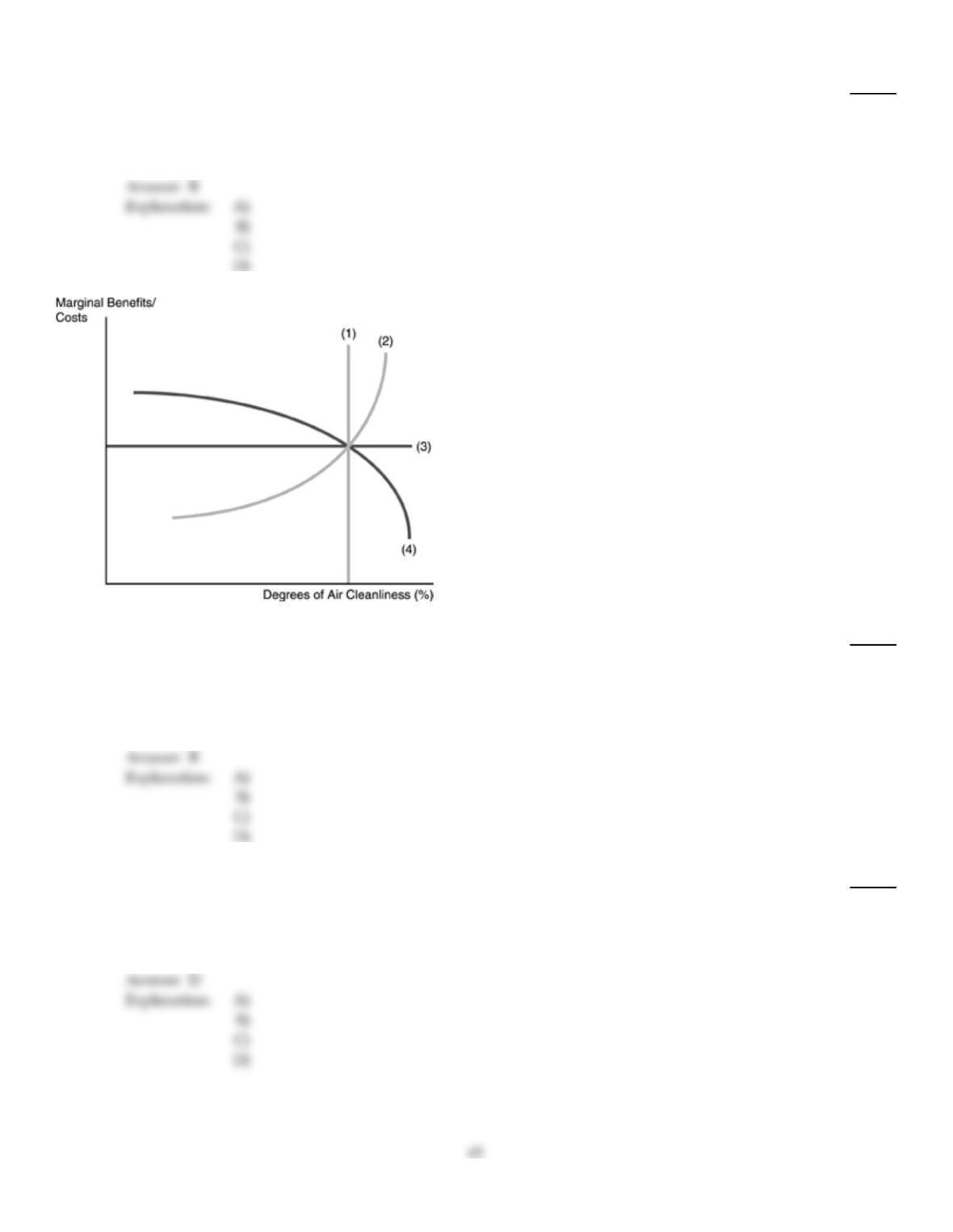
Refer to the above figure. If the marginal cost curve for pollution abatement shifts to the right,
everything considered, the
149)
A)
the degree of air quality or cleanliness will stay unchanged.
B)
the degree of air quality will improve.
C)
the marginal cost of pollution abatement has nothing to do with air quality.
D)
degree of air quality or cleanliness will also decrease.
150)
The Endangered Species Act has
150)
A)
saved all endangered species without affecting anyone.
B)
further reduced the number of endangered species.
C)
had no impact on either the number of endangered species or other economic activities.
D)
caused a loss of economic activities on some private land.
151)
Changing the ownership of the ocean from common property to private property would
151)
A)
not be economically desirable.
B)
ensure that this resource would be allocated in a less efficient manner than under common
property rights.
C)
result in no appreciable change in efficiency of utilization of this resource.
D)
ensure that this resource would be allocated in a more efficient manner.
152)
Buffalo in the United States almost became extinct while cattle have never been close to extinction.
The difference is due to
152)
A)
the greater marginal value of a buffalo relative to a head of cattle, leading to greater
“harvesting” of buffalo.
B)
the greater marginal value of a head of cattle relative to buffalo, leading to over–hunting of
buffalo.
C)
the differences in size between the two animals, and the effect of size differences on the costs
of hunting them.
D)
the use of private property rights on cattle and common property rights on buffalo.
Output/Hour Private MC Marginal Benefit External Marginal Costs
1$10 $20 0.20
210.40 18.50 0.40
310.90 17 0.70
411.50 16.50 1.20
512.20 14.00 1.80
613.00 13.00 2.80
714.40 12.00 4.00
153)
Use the above table. What will the output level be when external costs are internalized with a tax?
153)
A)
4
B)
5
C)
6
D)
7
154)
In order to correct the problems associated with external costs,
154)
A)
the prices of all goods must be raised so people will consume less of the world’s resources.
B)
the government must take over production of industries that are responsible for most of the
pollution.
C)
standards must be established that make it illegal to pollute.
D)
the signals given to the economy must change so that decision–makers will take into account
all the costs of their actions.
155)
When social and private costs differ, economists state that
155)
A)
there is not an efficiency problem but an equity problem.
B)
there is an externality.
C)
there will be economic profit in the society.
D)
the society will produce inside the production possibilities frontier.
B
156)
The marginal benefit of the pollution abatement curve
156)
A)
has a zero slope.
B)
slopes downward.
C)
has a positive slope.
D)
slopes upward.
B
157)
When negative externalities exist, a voluntary agreement can be negotiated. Which of the following
statements is TRUE?
157)
A)
Voluntary agreements always leave the owner worse off.
B)
Voluntary agreements usually do not work since the owner has no incentive to negotiate.
C)
Transactions costs must be low relative to the expected benefits of reaching an agreement.
D)
Voluntary agreements are difficult to negotiate because they usually involve government
intervention.
C
D
158)
The Endangered Species Act is an attempt to
158)
A)
protect endangered species against greedy loggers, farmers, and business people.
B)
protect endangered species from the overzealousness of many environmentalists.
C)
prevent some people from earning a good living.
D)
protect species endangered because there are no private property rights on them.
159)
Externalities exist because
159)
A)
government has created them.
B)
private costs are equal to social costs.
C)
private costs differ from social costs.
D)
they are a function of socialism.
C
160)
An individual who pays for personal auto repair has incurred a
160)
A)
social cost.
B)
positive externality.
C)
private cost.
D)
negative externality.
C
161)
All of the following are examples of goods for which external costs commonly exist EXCEPT
161)
A)
automobiles.
B)
vaccinations.
C)
cigarettes.
D)
oil transportation.
B
162)
Society must pay the full opportunity cost of any activity
162)
A)
that uses scarce resources.
B)
that increases revenues.
C)
that causes costs to rise.
D)
none of the above.
A
D
163)
Pollution
163)
A)
exists because air and water are privately owned resources.
B)
creates a negative externality.
C)
is increased when property rights are defined.
D)
is the result of capitalism.
164)
Joe has broken the mirror of my car. I have legal recourse to sue for damages because of
164)
A)
social costs.
B)
common property rights.
C)
transactions costs.
D)
private property rights.
165)
Buffalo in the United States almost became extinct while cattle, an animal that provides similar
products, never has been close to extinction. The difference is due to
165)
A)
the greater marginal value of a head of cattle relative to buffalo, leading to over–hunting of
buffalo.
B)
the use of private property rights on cattle and common property rights on buffalo.
C)
cattle existing in Europe also while buffalo were specific to North America.
D)
the greater marginal value of a buffalo relative to a steer, leading to the overharvesting of
buffalo.
166)
Costs borne solely by the individuals who incur them are
166)
A)
social costs.
B)
common property.
C)
internality.
D)
private costs.
167)
When an external cost exists that is NOT taken into account in the production of a product,
167)
A)
the level of output is optimal, and there should be no change in the supply curve.
B)
the level of output is too high, and the supply curve should shift to the left to account for the
externality.
C)
the price of the product is too high, and production should be expanded to lower the price.
D)
the level of output is too low, and the supply curve should shift to the right to account for the
externality.
168)
All of the following are choices for the polluter when faced with additional costs to abate the
externality EXCEPT
168)
A)
install pollution abatement equipment.
B)
pay the price to pollute.
C)
reduce the pollution–causing activity.
D)
ignore the government regulations.
D
169)
Which of the following might be a way that an automobile driver’s pollution costs could be
internalized?
169)
A)
The state could eliminate the gas tax.
B)
The driver could purchase abatement equipment for her car.
C)
The state could pay a gas subsidy for everyone who drives.
D)
The state could allow her to drive in the HOV lane.
B
170)
A method of forcing a company to internalize the total cost of production is
170)
A)
to impose a tax on the company to reduce production.
B)
to force the company to reduce the wages it pays to its employees.
C)
for government not to interfere in the company’s activities.
D)
to provide a subsidy to encourage production.
A
B
171)
When the social costs exceed the private costs, economists state that there is
171)
A)
a negative externality.
B)
an underproduction of output.
C)
social appreciation of resources.
D)
a positive externality.
172)
In general, we would expect the marginal cost of pollution abatement to be
172)
A)
increasing.
B)
constant.
C)
zero.
D)
decreasing.
173)
Which of the following is most likely to be common property?
173)
A)
a cat in a house
B)
tuna in the Pacific Ocean
C)
farm raised catfish in Alabama
D)
cattle in a Texas ranch
174)
The inclusion of external costs in the decision making process determining equilibrium price and
quantity leads to
174)
A)
higher priced items and increased quantity.
B)
lower priced items and increased quantity.
C)
higher priced items and a decline in quantity.
D)
lower priced items and a decline in quantity.
175)
The marginal benefit of pollution abatement is the
175)
A)
additional cost to clean up an additional unit of pollution.
B)
total social costs of pollution clean–up divided by the total units of clean–up.
C)
additional benefit from cleaning up an additional unit of pollution.
D)
total social costs of pollution clean–up divided by total social benefits.
176)
Private property rights involve
176)
A)
rights to enjoy the property in any way desired but not to transfer or exchange the property.
B)
rights granted by the government for renewable terms of 100 years or more.
C)
exclusive rights to use, transfer, and exchange the property.
D)
exclusive rights to use property, but not to exchange the property.
177)
When social costs for using a scarce resource are included, then there is
177)
A)
a negative externality.
B)
a decrease in the production of the good.
C)
a positive externality.
D)
a decrease in the price of the good.
178)
If social cost exceeds private cost, there is
178)
A)
underproduction of a good.
B)
too little economic profit in the activity.
C)
a negative externality.
D)
a positive externality.
179)
The optimal amount of pollution is not zero because
179)
A)
we don’t have the political structure that could accomplish the goal.
B)
zero pollution would be too costly.
C)
it has been found that pollution in moderate amounts actually has positive benefits.
D)
there are no benefits to anyone from having zero pollution.
180)
Which of the following statements is TRUE about the relationship among external, internal and
social costs?
180)
A)
External cost is the difference between social and internal costs.
B)
Social cost is the difference between internal and external costs.
C)
Internal cost is the sum of social and external costs.
D)
none of the above
181)
A difficulty with using a uniform per–unit tax to address a negative externality is that
181)
A)
the social cost of pollution might vary across geographic regions.
B)
the tax will reduce output.
C)
the social cost of pollution should not be assessed on the consumers, but should be assessed
on the firms.
D)
the tax will increase price.
182)
John raises bees to pollinate his apple trees. One of the bees just stung him. This is a(n)
182)
A)
common property.
B)
internality.
C)
private cost.
D)
social cost.
183)
Pollution created by auto exhaust fumes is an example of a situation in which
183)
A)
social costs are equal to private costs.
B)
social costs are approaching the shutdown point.
C)
social costs are greater than private costs.
D)
social costs are less than private costs.
184)
When a person does not have to pay the full costs for using a scarce resource, then there is
184)
A)
a negative externality.
B)
an underproduction of a good.
C)
too little economic profit in the activity.
D)
a positive externality.
185)
All of the following are private costs of operating an automobile EXCEPT
185)
A)
car insurance.
B)
harm to the environment from emissions.
C)
depreciation of the vehicle.
D)
gasoline for the car.
186)
If pollution is bad, why do we still use pollution–causing resources such as coal and oil to generate
electricity?
186)
A)
The transaction costs of pollution is too low.
B)
The cost of using pollution free resources to generate power in many circumstances is much
higher than generating that same power through conventional pollution–causing means.
C)
Pollution is only a private cost.
D)
Governments lack the political will to enforce the use of pollution free resources.
187)
Under a cap–and–trade program, what would happen if governments reduce firms’ pollution caps?
187)
A)
The marketing clearing price of pollution permits will cease to exist.
B)
The marketing cleaning price of pollution permits will not change.
C)
The market cleaning price of pollution permits will decrease.
D)
The market clearing price of pollution permits will increase.
188)
Today, the earth has ________ of all of the species that have ever lived.
188)
A)
less than 1 percent
B)
about 50 percent
C)
about 99 percent
D)
100 percent
189)
The Black Ash Steel Company’s plant belches large quantities of noxious fumes and black ash into
the air. Residents in the surrounding area have higher medical bills because of Black Ash’s
pollution. As long as Black Ash is allowed to emit pollution and ignore any externalities, the firm
will
189)
A)
overproduce.
B)
charge too high a price for its output.
C)
under produce.
D)
be absorbing the full value of its social costs.
190)
A resource that is a common property is
190)
A)
oil on land owned by a drilling and refining company.
B)
water in a publicly owned river.
C)
natural gas on land owned by an energy producer.
D)
timber on land owned by a lumber company.
191)
With defined property rights, an externality
191)
A)
may be internalized with voluntary contracting, under certain circumstances.
B)
can only be corrected with government intervention.
C)
will not lead to a misallocation of resources.
D)
must lead to society producing inside its production possibilities frontier.
192)
An example of a situation in which the social costs are greater than the private costs would be
192)
A)
a new restaurant takes business away from an established restaurant.
B)
a physician who cannot examine patients with a stethoscope in an examination room adjacent
to an airport.
C)
hand–held calculators putting slide rule manufacturers out of business.
D)
when a member of a rock band’s ability to hear deteriorates from performing in so many loud
concerts.
193)
Which of the following statements best defines private costs?
193)
A)
They are synonymous with social costs.
B)
They are costs borne by people other than those who commit the action.
C)
They represent explicit costs incurred by business firms in the private sector.
D)
They are internal in the sense that the firm or household must explicitly take them into
account.
194)
A uniform tax according to the physical quantities of pollution may not be the appropriate way to
correct for an externality because
194)
A)
a uniform tax can only account for social costs and not external costs.
B)
it places a unfair burden on small producers.
C)
a firm will reduce production.
D)
it may not adequately account for economic damages.
195)
In a market for emission permits, firms that emit below their allowed limits
195)
A)
are taxed by the government for the amount of emissions.
B)
will sell their excess allowances through a trading system.
C)
will buy even more allowances through a trading system.
D)
receive a subsidy for the amount of emissions.
196)
Participating nations in the 1997 Kyoto Protocol agreed to reduce overall greenhouse gases
emission
196)
A)
to as much as 50 percent below the levels of the 1990s through 2100.
B)
to as much as 10 percent below the levels of the 1990s through 2010.
C)
to as much as 100 percent below the levels of the 1990s through 2007.
D)
to as much as 20 percent below the levels of the 1990s through 2020.
197)
All the costs associated with making, reaching, and enforcing agreements are called
197)
A)
social costs.
B)
internal costs.
C)
transaction costs.
D)
private costs.
198)
The marginal benefit of pollution abatement is represented by
198)
A)
an upward sloping curve.
B)
a horizontal curve.
C)
a downward sloping curve.
D)
a vertical curve.
199)
All of following are commonly considered to be common property EXCEPT
199)
A)
chickens raised in a farm.
B)
fish in an ocean.
C)
wild salmon in a river.
D)
spotted owls in the wild.
A
200)
In general, pollution exists in situations in which
200)
A)
there exists public property.
B)
people refuse to take social responsibility seriously.
C)
people are selfish.
D)
there are poorly defined private property rights.
D
201)
One difficulty in using voluntary transactions to internalize externalities is that
201)
A)
people are motivated by self–interest and are often unwilling to engage in a transaction that
might make another person better off.
B)
transaction costs of coming to an agreement can be very large when numerous people are
involved.
C)
the government usually will not enforce contracts of this type.
D)
people usually don’t understand what the real opportunity costs are that they face.
B
C
202)
The costs of pollution abatement
202)
A)
decrease at a decreasing rate with the increase in pollution abatement.
B)
increase at an increasing rate with the increase in pollution abatement.
C)
increase at a decreasing rate with the increase in pollution abatement.
D)
decrease at an increasing rate with the increase in pollution abatement.
203)
Exclusive rights of ownership that allow the use, transfer, and exchange of property are called
203)
A)
common property rights.
B)
private property rights.
C)
nonexclusive property rights.
D)
public property rights.
B
204)
When the private costs and the social costs are NOT the same, there is a(n)
204)
A)
internality.
B)
externality.
C)
monopoly.
D)
public good.
B
205)
Common property is
205)
A)
property that belongs to both spouses in a marriage.
B)
property owned by a group such as a club or a church.
C)
a resource that everyone is free to use as much as they want.
D)
generic property as opposed to specific property.
C
206)
Social costs of a good are equal to
206)
A)
external costs divided by the private costs.
B)
private costs plus external costs.
C)
external costs minus private costs.
D)
private costs minus external costs.
B
B
207)
By 2006, the market price of European Union emissions allowances dropped because
207)
A)
the market did not clear.
B)
firms underreport their emission amounts.
C)
firms had drastically reduced their emissions.
D)
governments set their overall emission caps too high.
208)
The marginal benefit of pollution abatement
208)
A)
increases as pollution abatement increases because of the law of increasing marginal returns.
B)
increases at an increasing rate as abatement increases.
C)
decreases as pollution abatement increases because of the law of diminishing marginal utility.
D)
is constant as pollution abatement increases.
C
209)
Social costs are
209)
A)
the costs associated with reaching and enforcing agreements.
B)
costs incurred when common property is used.
C)
the costs of the externality only.
D)
private costs plus any external costs.
D
210)
Which of the following best describes the impact of the Emissions Trading Scheme in the European
Union between 2005 and the late 2000s?
210)
A)
Overall greenhouse gas emissions were totally eliminated.
B)
Overall greenhouse gas emissions were constant.
C)
Overall greenhouse gas emissions decreased.
D)
Overall greenhouse gas emissions increased.
D
D
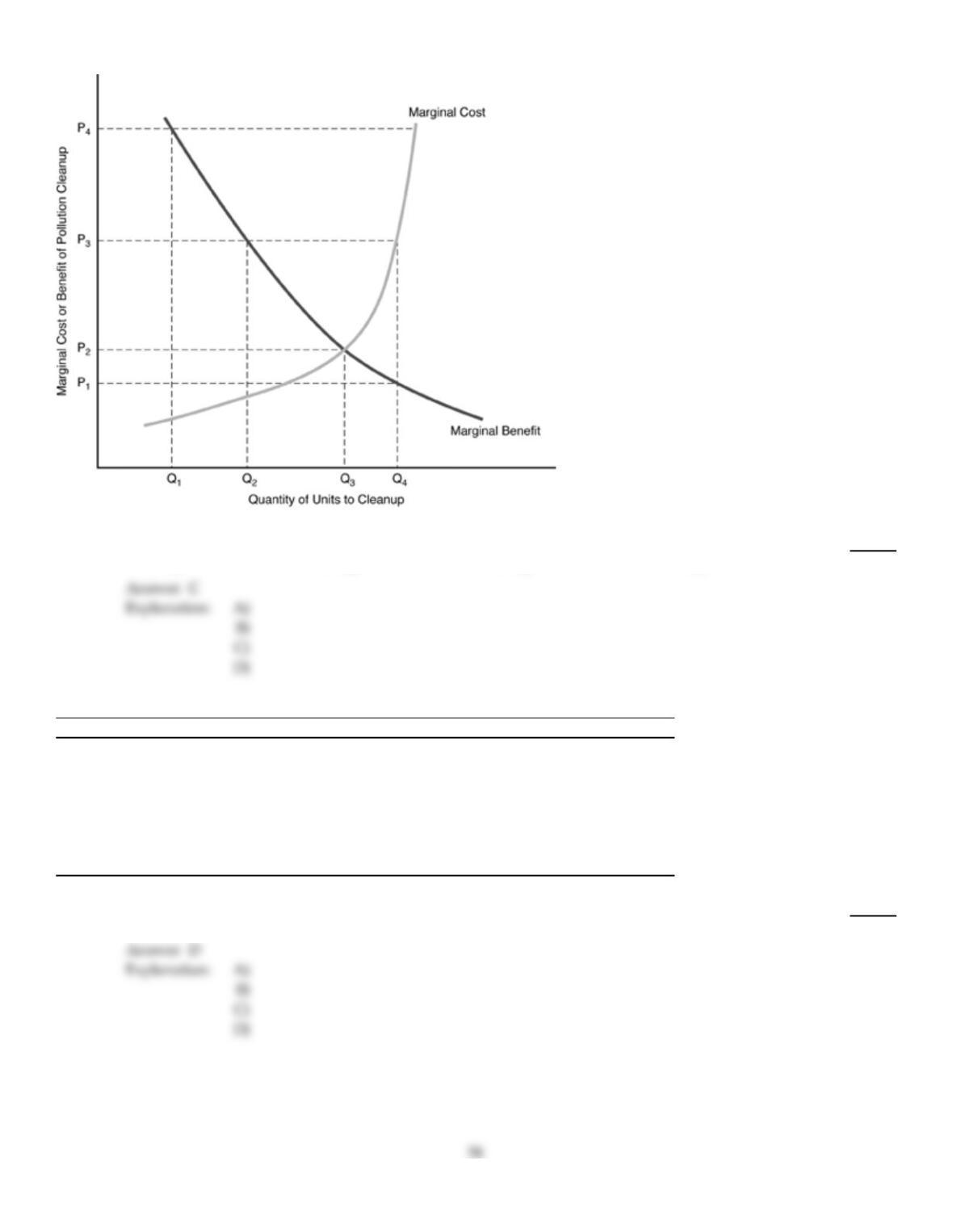
211)
In the above figure, the optimal level of pollution cleanup is
211)
A)
Q1.
B)
Q2.
C)
Q3.
D)
Q4.
Output/Hour Private MC Marginal Benefit External Marginal Costs
1$10 $20 0.20
210.40 18.50 0.40
310.90 17 0.70
411.50 16.50 1.20
512.20 14.00 1.80
613.00 13.00 2.80
714.40 12.00 4.00
212)
Use the above table. What will the tax be when external costs are internalized?
212)
A)
$12.20
B)
$14
C)
$13
D)
$1.80
213)
Economic theory suggests that if natural resources can be held as private property, then
213)
A)
people will simply hold them and refuse to make them available.
B)
owners will have an incentive not to abuse them.
C)
natural resources will be sold off for immediate use.
D)
conservation will be nonexistent.
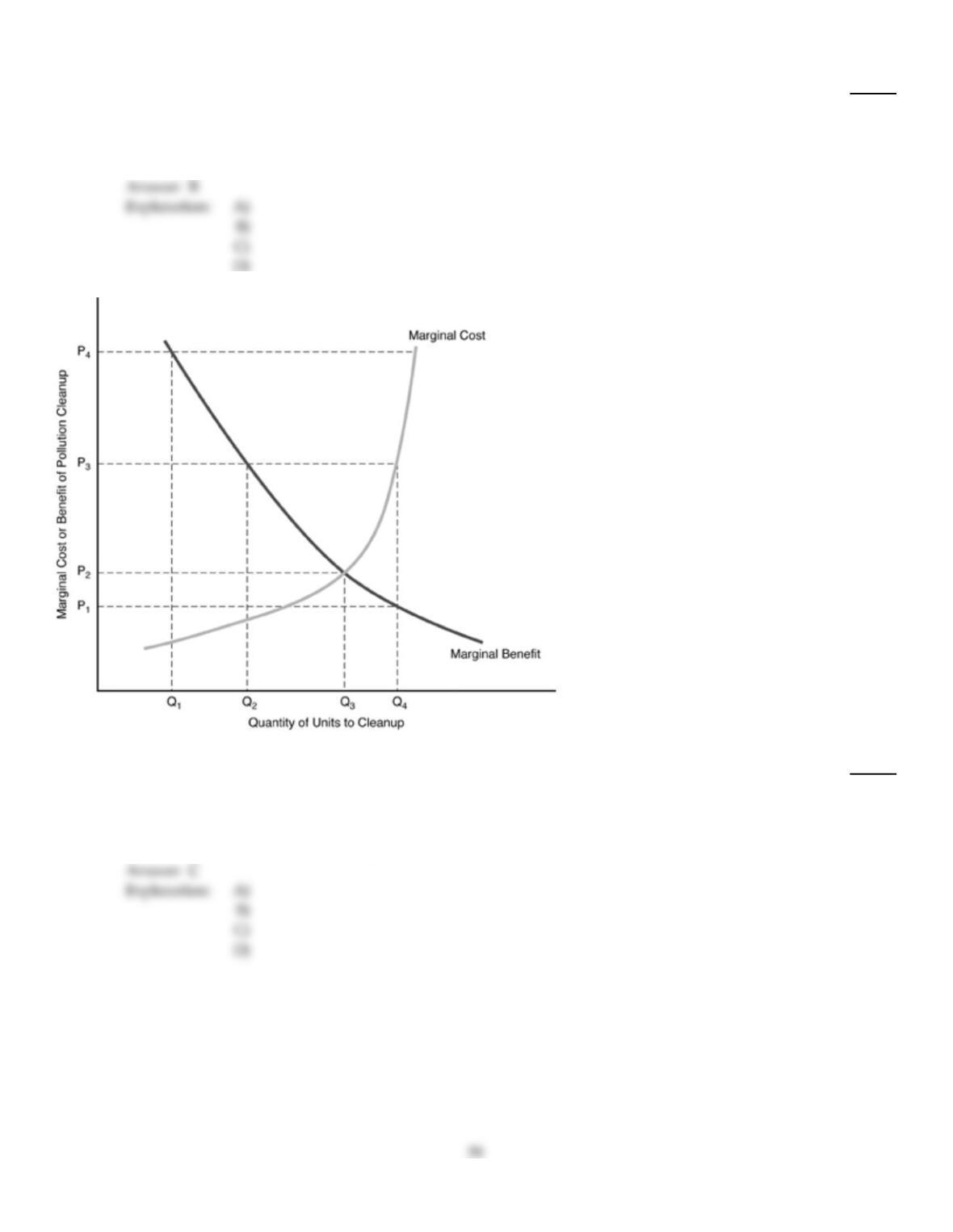
214)
In the above figure, if a firm is cleaning up Q4 units of pollution, it is an
214)
A)
inefficient solution, because marginal social benefits are greater than marginal social costs.
B)
efficient solution, because marginal social benefits are equal to marginal social costs.
C)
inefficient solution, because marginal social costs are greater than marginal social benefits.
D)
efficient solution, because marginal social benefits are greater than marginal social costs.
C
B
215)
Which of the following statements is TRUE about the optimal quantity of pollution?
215)
A)
Firms should be allowed to determine the profit–maximizing amount of pollution abatement.
B)
It equals zero.
C)
Pollution abatement should continue up to the point where marginal cost equals the average
total cost.
D)
Trade–offs exist between producing a cleaner environment and producing other goods and
services.
216)
The most efficient way to get firms to reduce pollution is to
216)
A)
make them pay for the social costs of production and let them decide how to respond to the
higher costs.
B)
set uniform emission standards and require all firms to meet the standards.
C)
make the worst polluters shut down and go out of business.
D)
provide firms and consumers with the information about the effects of their actions and
encourage them to behave responsibly.
217)
Which of the following is a TRUE statement?
217)
A)
Voluntary agreements can always yield a situation in which all externalities are internalized.
B)
Opportunity costs always exist with whoever has property rights.
C)
Opportunity costs turn external costs into social costs.
D)
Any property right system will yield a situation in which all externalities are internalized.