58)
Generally, as levels of pollution are reduced,
58)
A)
marginal benefits from the reduction decrease.
B)
marginal cost from the reduction are constant.
C)
marginal costs from the reduction decrease.
D)
marginal benefits from the reduction increase.
59)
Which of the following statements is true for the U.S. economy?
59)
A)
Demand for services always reflects all social costs.
B)
Social benefits are always emphasized in advertising.
C)
Private costs are not always equal to social costs.
D)
Supply of services always reflects all social costs.
60)
If the social costs of refining oil are greater than the private costs of oil refining, then
60)
A)
users of products that use refined oil are paying too much for the products.
B)
the amount of oil refining needs to increase in order to bring social costs and private costs in
line with each other.
C)
there is too much oil refining.
D)
the external costs of oil refining are greater than the social costs of oil refining.
61)
Buffalo in the United States almost became extinct while cattle have never been close to extinction.
The difference is due to
61)
A)
the use of private property rights on cattle and common property rights on buffalo.
B)
the differences in size between the two animals, and the effect of size differences on the costs
of hunting them.
C)
the greater marginal value of a head of cattle relative to buffalo, leading to over–hunting of
buffalo.
D)
the greater marginal value of a buffalo relative to a head of cattle, leading to greater
“harvesting” of buffalo.
62)
Which of the following was signed in the Kyoto Protocol?
62)
A)
The Zero Greenhouse Gas Agreement
B)
The Framework Convention on Climate Change
C)
The Treaty on Global Warming
D)
The Emission Trading Scheme
63)
When there is a resource for which property rights are not well defined and there is a difference
between private costs and social costs, then all but which of the following is a way to close the
difference?
63)
A)
The free market system
B)
Regulation
C)
Subsidization
D)
Taxation
64)
When a polluter has to bear the full social cost of their actions, they will
64)
A)
will always decide to reduce the amount of pollution by reducing the quantity they produce.
B)
go out of business since pollution abatement is expensive.
C)
increase the price of the product and the quantity produced to pay for the additional costs.
D)
weigh the costs and benefits of each potential action and might decide to not stop polluting by
paying a fine.
65)
As we approach total pollution abatement
65)
A)
the marginal cost to society equals the marginal benefit to society.
B)
the marginal cost to society falls but then rises.
C)
the marginal cost to society falls.
D)
the marginal cost to society rises.
66)
When the private costs and the social costs are NOT the same, there is a(n)
66)
A)
externality.
B)
public good.
C)
internality.
D)
monopoly.
67)
The marginal cost curve of pollution abatement
67)
A)
slopes downward because of the law of diminishing marginal utility.
B)
slopes upward because of the law of diminishing product.
C)
slopes downward because of the law of diminishing returns.
D)
slopes upward because firms will maximize profits.
B
68)
Voluntary agreements about cleaning up pollution attempt to
68)
A)
internalize externalities.
B)
externalize private costs.
C)
internalize private costs.
D)
externalize social costs.
A
69)
Social costs are
69)
A)
costs incurred when common property is used.
B)
the costs associated with reaching and enforcing agreements.
C)
private costs plus any external costs.
D)
the costs of the externality only.
C
70)
If a person does not pay all costs associated with a particular resource–using activity, then
70)
A)
the social costs of the activity are greater than the private costs of the activity.
B)
the external costs of the activity are greater than the private costs of the activity.
C)
the full costs of the activity are the sum of private costs plus internal costs.
D)
the external costs of the activity are greater than the internal costs of the activity.
A
A
71)
Which type of property would be the most likely to experience pollution?
71)
A)
common property
B)
corporate property
C)
private property
D)
property held in partnership
72)
When no one owns a particular resource,
72)
A)
positive externalities will arise.
B)
no one has any incentive to consider externality spillovers associated with that resource.
C)
property rights are clearly defined.
D)
individuals have legal recourse for any damages caused to their resource.
B
73)
The trade–off of saving the spotted owls in the Pacific Northwest was
73)
A)
the loss of salmon in the region.
B)
the loss of logging activities by lumber companies.
C)
the increase in the number of marbled murrelets.
D)
none.
B
74)
The marginal cost of pollution abatement is represented by
74)
A)
a horizontal curve.
B)
an upward sloping curve.
C)
a vertical curve.
D)
a downward sloping curve.
B
A
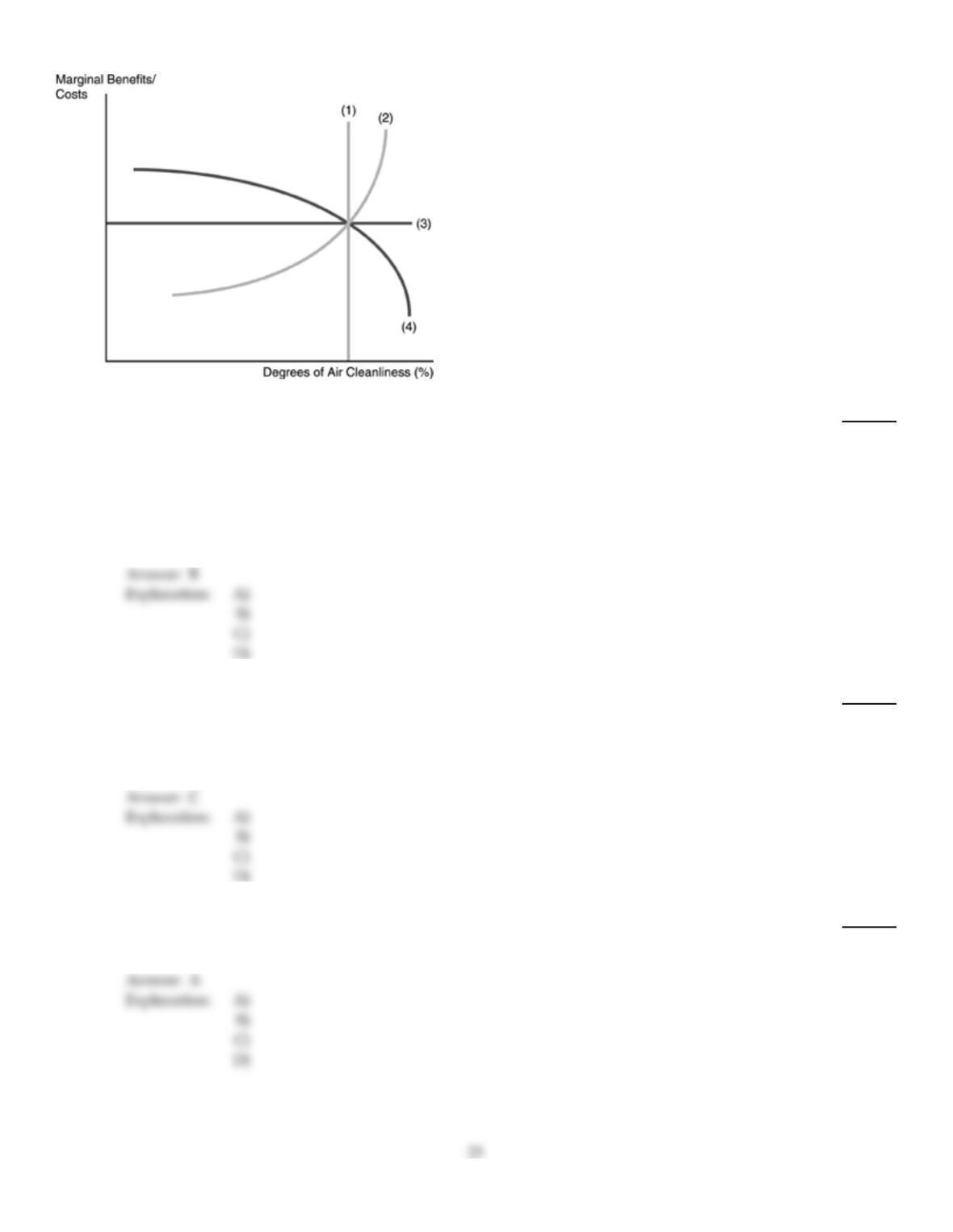
75)
Refer to the above figure. Suppose the marginal benefit and the marginal cost curves of pollution
abatement are normally shaped. Technological change that made it easier to produce in a “cleaner”
fashion would cause
75)
A)
curve (1) to shift out, increasing the optimal amount of pollution abatement.
B)
curve (2) to shift out, increasing the optimal amount of pollution abatement.
C)
curve (4) to shift out, increasing the optimal amount of pollution abatement.
D)
curve (3) to shift up, raising the marginal benefits and costs and reducing the amount of
pollution abatement.
76)
Which of the following is NOT a possible solution to the problem of pollution?
76)
A)
Regulating the quantity of pollution that can be generated
B)
Imposing a pollution tax on producers
C)
Subsidizing the costs of production of activities that generate pollution
D)
Converting a resource that is communally owned into a privately owned resource
77)
Today, the earth has ________ of all of the species that have ever lived.
77)
A)
less than 1 percent
B)
about 50 percent
C)
about 99 percent
D)
100 percent
78)
Another name for internal cost is
78)
A)
social cost.
B)
private cost.
C)
marginal cost.
D)
psychological cost.
79)
When social costs of an activity exceed private costs
79)
A)
this means that resources are being efficiently used.
B)
the actual price is above the efficient price.
C)
there is a tendency for resources to be under–utilized.
D)
a market failure exists.
D
80)
If the market price of a good does NOT include all of the costs and benefits that arise from the
production or consumption of the good, then
80)
A)
resources are properly allocated.
B)
an externality is present.
C)
society is consuming and producing the optimal amount of the good.
D)
the market is perfectly competitive.
B
81)
Which one of the following is an example of an external cost?
81)
A)
a house payment owed by a friend
B)
emissions from a factory
C)
labor costs to a firm
D)
the cost to attend college
B
82)
Which of the following is a true statement?
82)
A)
Any property right system will yield a situation in which all externalities are internalized.
B)
Opportunity costs always exist with whoever has property rights.
C)
Voluntary agreements can always yield a situation in which all externalities are internalized.
D)
Opportunity costs turn external costs into social costs.
B
B
83)
The marginal cost of pollution abatement is the
83)
A)
additional cost to clean up an additional unit of pollution.
B)
total social costs of pollution clean–up divided by the total units of clean–up.
C)
additional benefit from cleaning up an additional unit of pollution.
D)
total social costs of pollution clean–up divided by total social benefits.
84)
Which of the following is the main reason for externalities?
84)
A)
the lack of organized exchanges for all goods and services
B)
The full cost of a transaction is not borne by the buyer/seller of the product.
C)
Police enforcement of scalping is not uniformly enforced.
D)
The production of public goods uses up scarce resources.
85)
To find social costs,
85)
A)
internal and private costs have to be added together.
B)
internal and production costs have to be added together.
C)
internal and external costs have to be added together.
D)
internal and implicit costs have to be added together.
86)
Which of the following is FALSE?
86)
A)
If social costs are greater than private costs, “too much” of a good is being produced.
B)
Private costs do not include external costs.
C)
Pollution is a social cost.
D)
Social costs do not include private costs.
87)
With defined property rights, an externality
87)
A)
will not lead to a misallocation of resources.
B)
can only be corrected with government intervention.
C)
may be internalized with voluntary contracting, under certain circumstances.
D)
must lead to society producing inside its production possibilities frontier.
88)
The 1997 Kyoto Protocol was signed by
88)
A)
only nations in Asia.
B)
all nations in the world.
C)
only the United States and the European Union.
D)
more than three dozen nations.
89)
In a situation in which property rights are not well–defined and social costs exceed private costs,
government can use all of the following to induce producers to bring private costs into alignment
with social costs EXCEPT
89)
A)
regulation of production.
B)
coercive limits on production.
C)
subsidization of production.
D)
taxing production.
90)
The Black Ash Steel Company’s plant belches large quantities of noxious fumes and black ash into
the air. Residents in the surrounding area have higher medical bills because of Black Ash’s
pollution. If the firm is forced to pay the social costs of its production,
90)
A)
it will produce less and charge more for its steel.
B)
the price it charges for its steel will decrease.
C)
its supply curve will shift to the right.
D)
the amount of steel it produces will increase in order to pay the additional costs.
91)
All of the following are examples of goods for which external costs commonly exist EXCEPT
91)
A)
cigarettes.
B)
vaccinations.
C)
automobiles.
D)
oil transportation.
92)
If firms were forced to take into account the full social costs of production, then
92)
A)
output and pollution levels would decrease.
B)
output would be unaffected but pollution levels would come down.
C)
output could be increased and pollution levels would decrease.
D)
output would decrease but pollution levels would probably remain at the same levels.
93)
Many ecologists argue that several species of whales are close to extinction. If this is true, the
reason is
93)
A)
whale–killing technology is too productive.
B)
whales are a type of common property.
C)
inadequate enforcement of international laws.
D)
the marginal benefit of hunting and killing a whale is greater than zero.
94)
Suppose there are two firms on a river and the production processes of both require clean water.
The upstream firm’s process dirties the water, which it dumps back into the river. The downstream
firm must clean the water before using it in its production process. If the two firms would merge,
94)
A)
the external costs of the merged firm would equal the external costs of the upstream firm,
which would then be passed on to its customers.
B)
the external costs of the upstream firm are private costs after the merger.
C)
the total costs of production fall since the external costs disappear.
D)
the internal costs of the downstream firm become external costs of the merged firm.
95)
The problem of overfishing in waters that are commonly owned can be solved by
95)
A)
allowing the market to ration fish.
B)
the use of the Coase Theorem.
C)
establishing property rights for fishing in the waters.
D)
subsidizing fishing.
96)
If a good is produced by firms that incur all private and external costs, the price consumers pay
96)
A)
will be efficient since it includes all social costs.
B)
will be too high because the consumers end up paying all of the costs instead of the firm.
C)
will be too low.
D)
will be the correct price, but inefficient.
97)
The marginal benefit of pollution abatement
97)
A)
decreases as pollution abatement increases because of the law of diminishing marginal utility.
B)
increases at an increasing rate as abatement increases.
C)
is constant as pollution abatement increases.
D)
increases as pollution abatement increases because of the law of increasing marginal returns.
98)
Which of the following is most likely to be common property?
98)
A)
farm raised catfish in Alabama
B)
tuna in the Pacific Ocean
C)
a cat in a house
D)
cattle in a Texas ranch
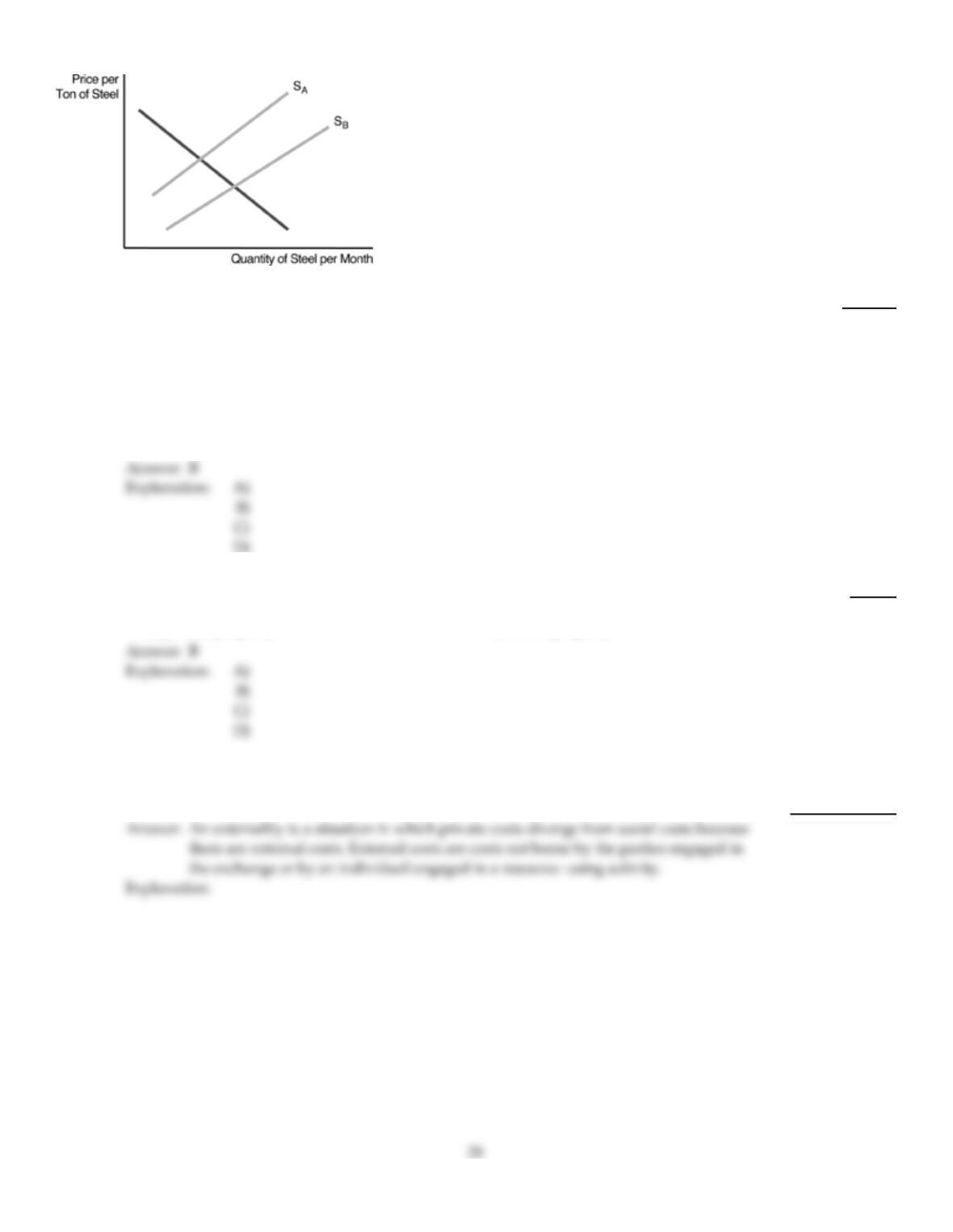
99)
Refer to the above figure. It represents supply and demand for The Black Ash Steel Company’s
output. The firm’s plant belches large quantities of smelly fumes and black ash into the air.
Residents in the surrounding area have higher medical bills as a result. If the firm is forced to pay
the full social cost of its production, what will occur?
99)
A)
Black Ash will increase its own output to cover the cost increase.
B)
The company’s supply curve will shift from SB to SA.
C)
Black Ash’s supply curve will shift from SA to SB.
D)
Demand for the firm‘s steel will shift to the left.
100)
Property owned by everyone (and thus no one in particular) is generally referred to as
100)
A)
natural property.
B)
common property.
C)
private property.
D)
social property.
SHORT ANSWER. Write the word or phrase that best completes each statement or answers the question.
101)
What is an externality?
101)
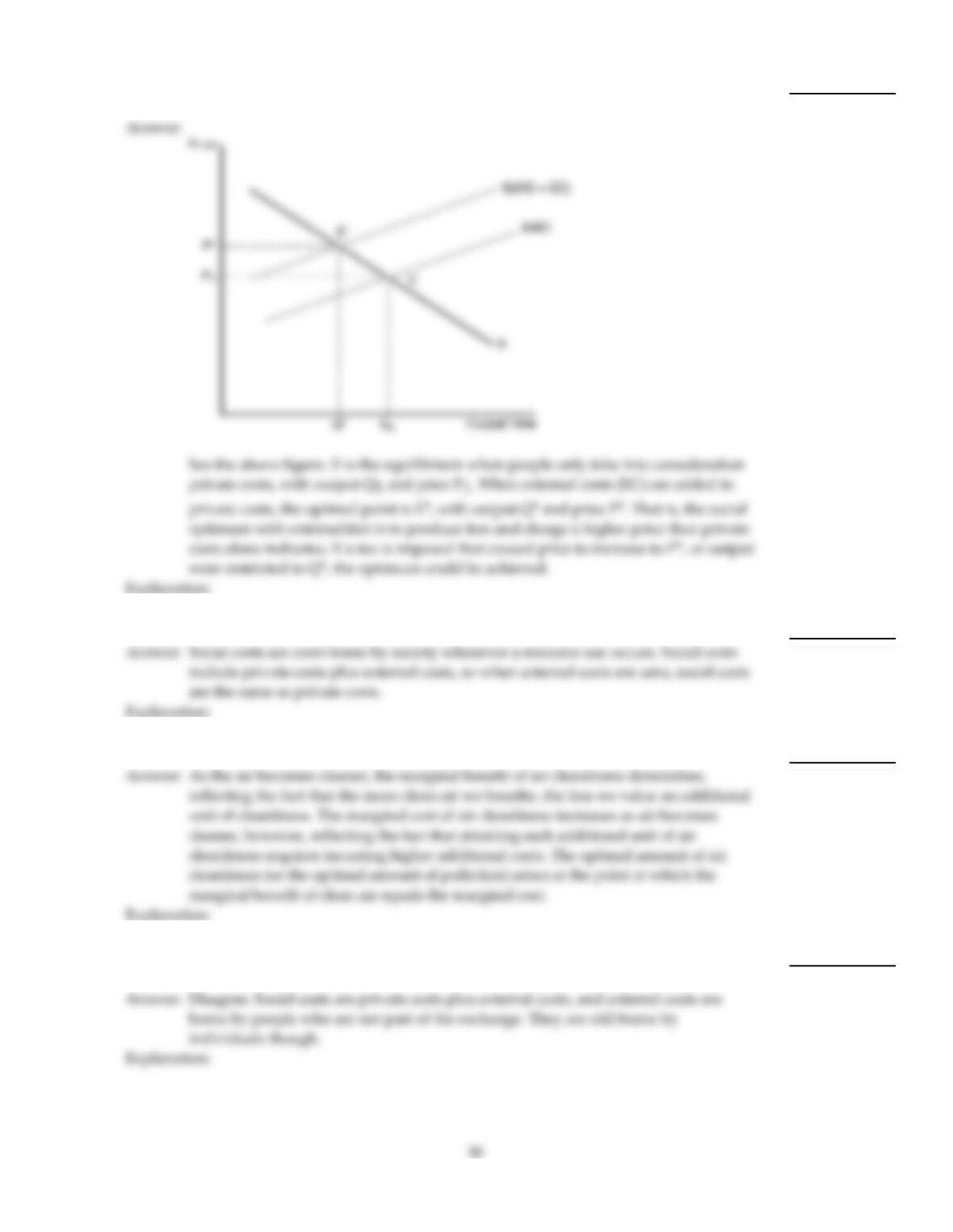
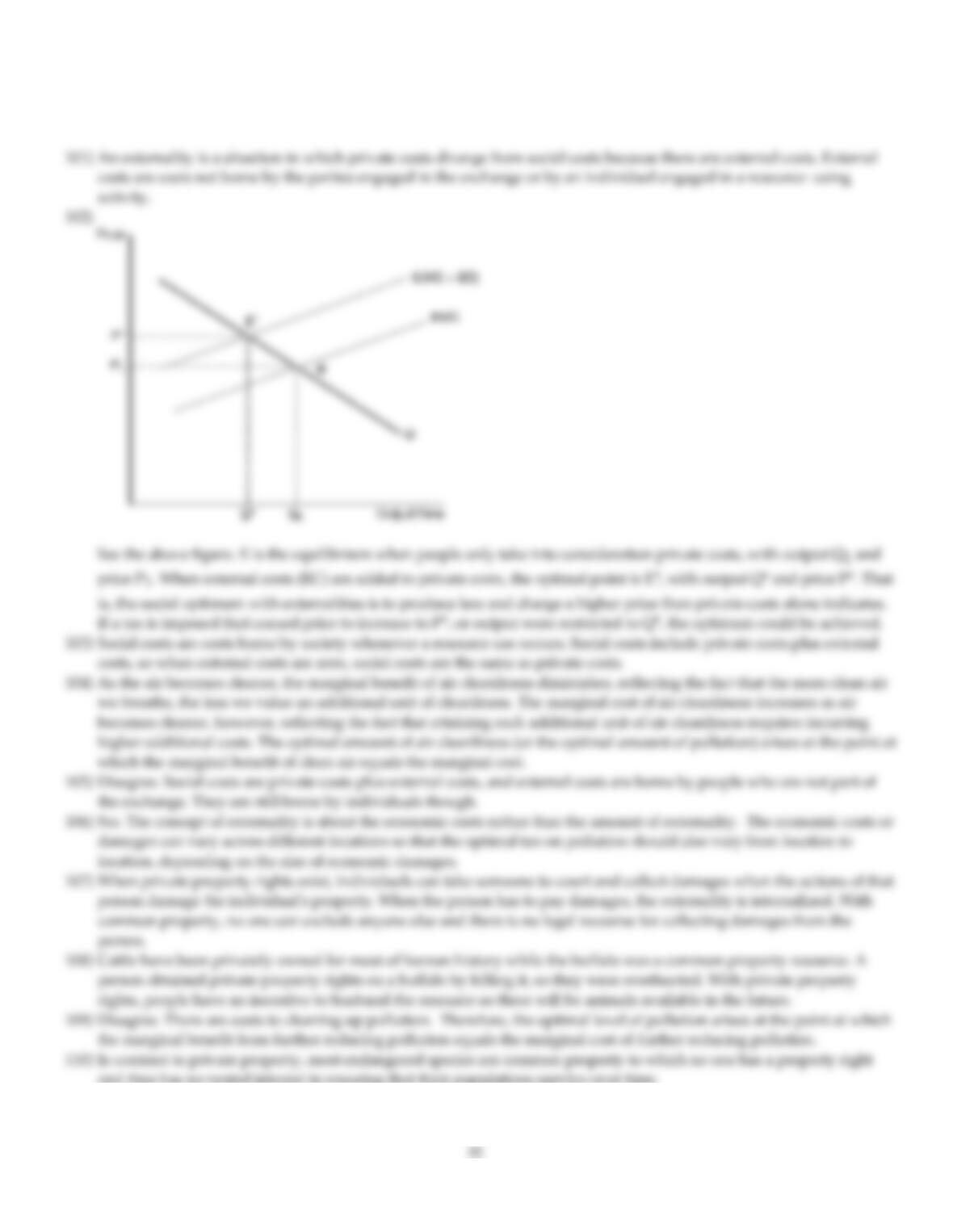
102)
Using a graph, show the effects of a negative externality. Where is the socially optimum
point of output? How can it be achieved?
102)
103)
What are social costs? How do they differ from private costs?
103)
104)
Explain how the optimal quantity of air pollution is determined.
104)
105)
“Private costs are borne by individuals while social costs are borne by society.” Do you
agree or disagree? Why?
105)
106)
Is a uniform per–unit tax on firms that cause an externality an optimal policy for correcting
the externality? Explain.
106)
107)
Why are externalities associated with common property rather than private property?
107)
108)
Explain why the buffalo almost became extinct while cattle did not, even though both
provide similar goods for people.
108)
109)
“The optimal level of pollution is zero.” Do you agree or disagree? Why?
109)
110)
Why are most endangered species belong to common property?
110)
111)
“Creating a free market for carbon–dioxide emission permits would only encourage firms
to pollute more.” Do you agree or disagree? Why?
111)
112)
Why don’t people take into consideration the external costs of their actions and reduce the
amount of externalities?
112)
113)
Why do economists believe that it is socially optimal to have some amount of pollution?
113)
114)
What is common property? What does common property have to do with externalities?
114)
Answer Key
Testname: C31
Answer Key
Testname: C31
Answer Key
Testname: C31
and thus has no vested interest in ensuring that their populations survive over time.
Answer Key
Testname: C31
36