67)
To correct for a negative externality, a government might impose a uniform tax related only to the
physical quantity of pollution if
67)
A)
the cost of ascertaining the actual economic costs are relatively small.
B)
the economic damages are zero.
C)
the economic damages associated with the pollution are different across different locations.
D)
the administrative costs are high.
68)
If the market price of a good does NOT include all of the costs and benefits that arise from the
production or consumption of the good, then
68)
A)
the market is perfectly competitive.
B)
an externality is present.
C)
resources are properly allocated.
D)
society is consuming and producing the optimal amount of the good.
B
Explanation:
69)
Costs that are borne solely by the individuals who incur them are called
69)
A)
private costs.
B)
social costs.
C)
public costs.
D)
external costs.
A
Explanation:
70)
In a market for emission permits, firms that emit over their allowed limits
70)
A)
receive a subsidy for the amount of emissions.
B)
are taxed by the government for the amount of emissions.
C)
are forced to shut down.
D)
pay a price of these emissions.
D
Explanation:
D
Explanation:
71)
The trade–off of saving the spotted owls in the Pacific Northwest was
71)
A)
the loss of salmon in the region.
B)
the loss of logging activities by lumber companies.
C)
the increase in the number of marbled murrelets.
D)
none.
72)
Many ecologists argue that several species of whales are close to extinction. If this is TRUE, the
reason is
72)
A)
inadequate enforcement of international laws.
B)
whales are a type of common property.
C)
whale–killing technology is too productive.
D)
the marginal benefit of hunting and killing a whale is greater than zero.
73)
The marginal cost curve of a firm measures
73)
A)
social costs.
B)
private costs.
C)
pollution costs.
D)
external costs.
74)
Which of the following is an example of an external cost?
74)
A)
the cost of tires for your car
B)
the cost of labor to a firm
C)
the pollution caused by automobile exhaust
D)
the opportunity cost of getting a college education
75)
In a situation in which internal costs differ from social costs, we say that there exists a(n)
75)
A)
welfare loss.
B)
welfare benefit.
C)
externality.
D)
internality.
76)
There is “too much” steel production if the
76)
A)
social costs of steel production are significantly higher than the private costs.
B)
social costs of steel production are significantly lower than the private costs.
C)
social benefits of steel production are declining.
D)
social costs of steel production are declining.
Output/Hour Private MC Marginal Benefit External Marginal Costs
1$10 $20 0.20
210.40 18.50 0.40
310.90 17 0.70
411.50 16.50 1.20
512.20 14.00 1.80
613.00 13.00 2.80
714.40 12.00 4.00
77)
Use the above table. What will the price be when external costs are internalized with a tax?
77)
A)
$12.20
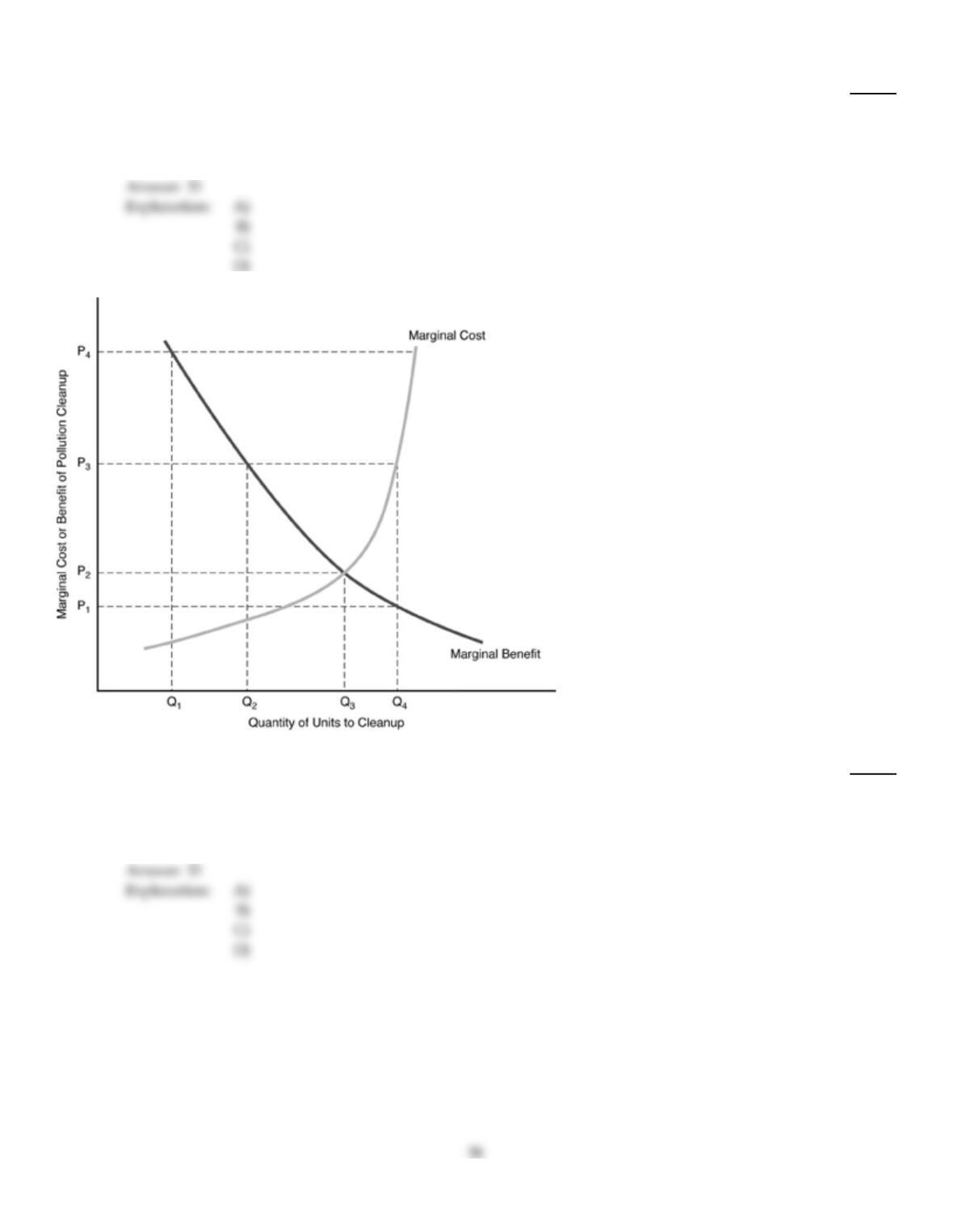
B)
$14
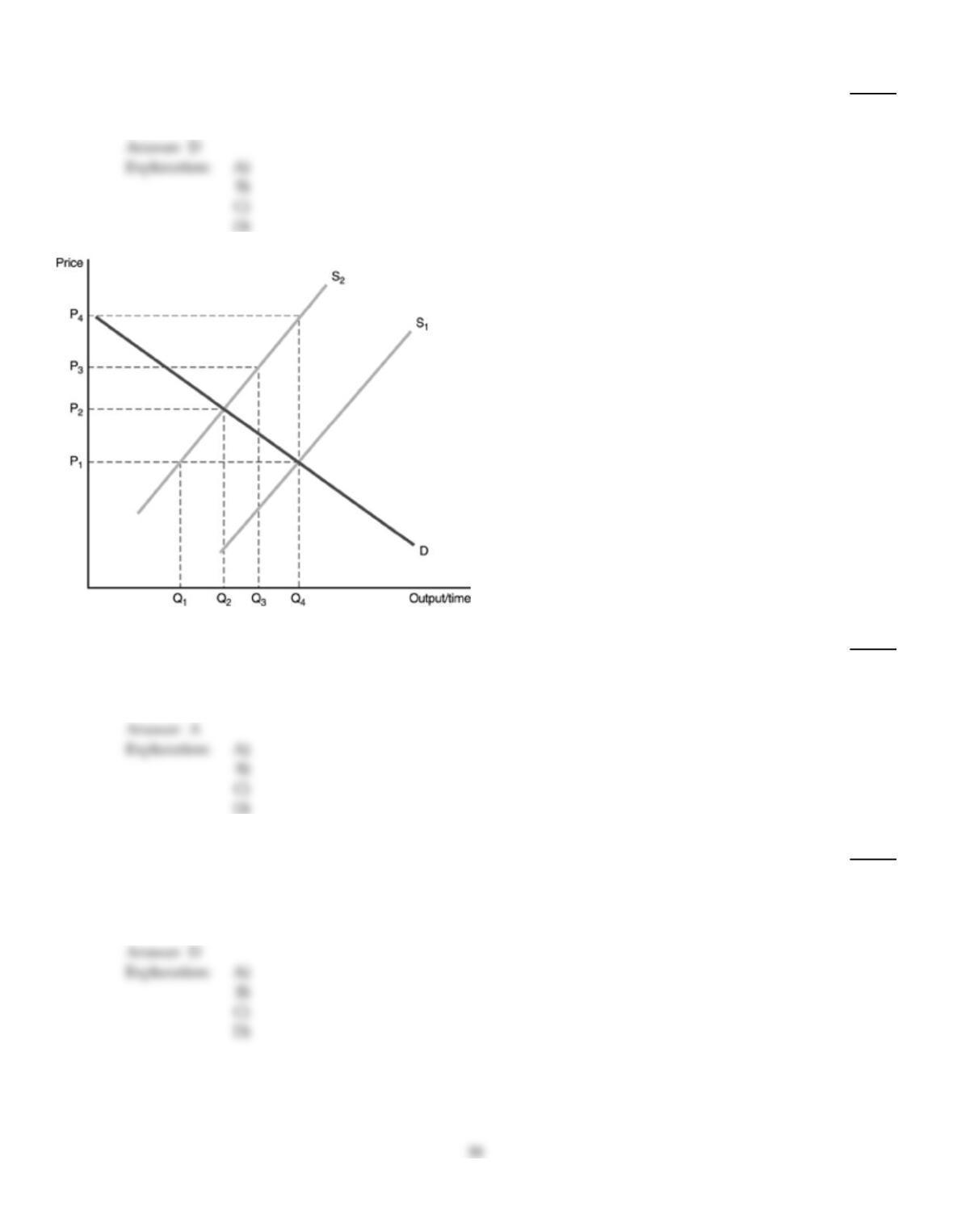
C)
$13
D)
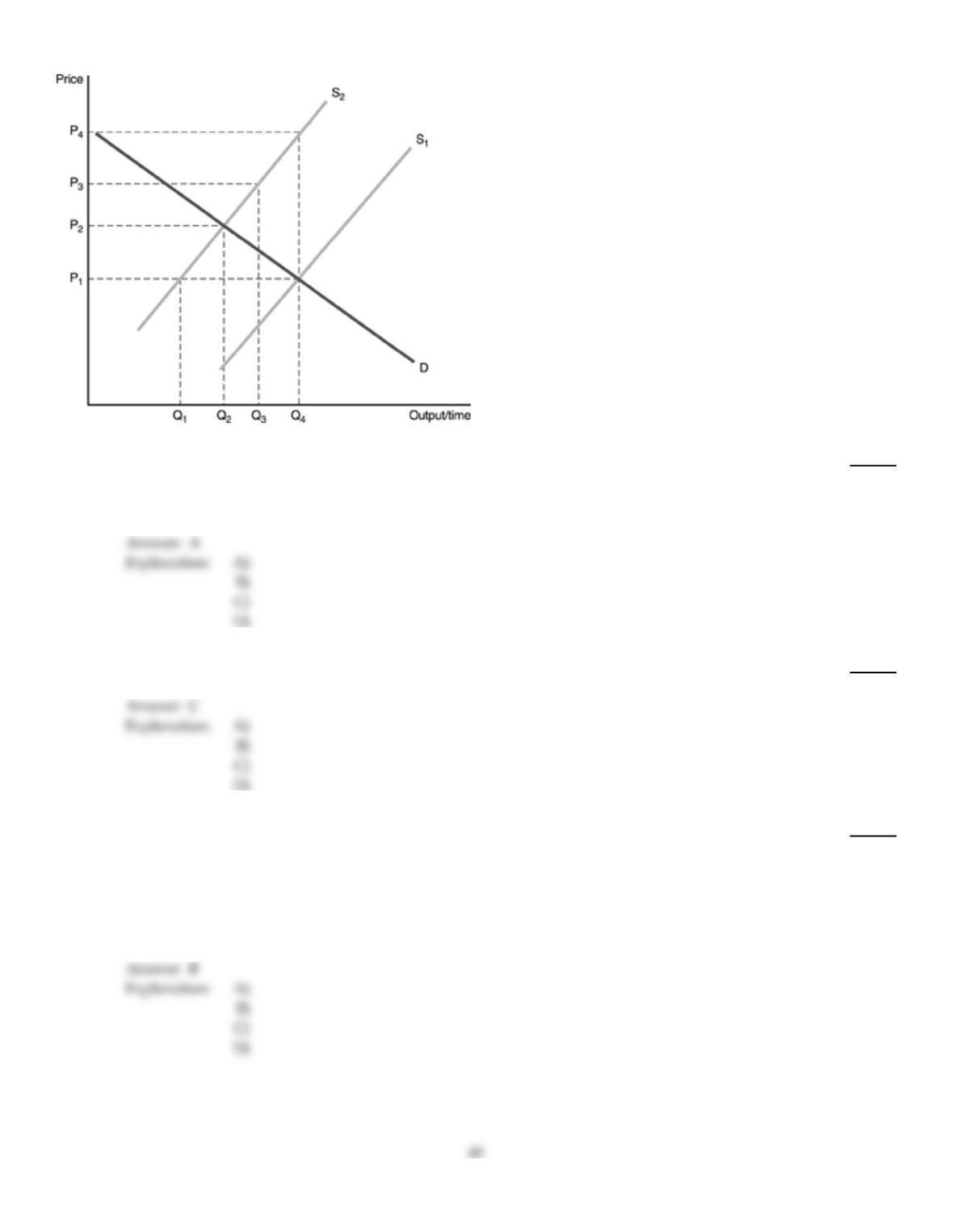
$1.80
78)
Transaction costs are
78)
A)
the costs associated with making a transaction that is required by the government.
B)
the costs associated with making, reaching and enforcing agreements.
C)
the costs associated with exchanges in the service area.
D)
not true costs since they are often not paid.
79)
A situation in which a private cost diverges from a social cost is
79)
A)
an externality.
B)
internal costs.
C)
a transactions cost.
D)
an internality.
80)
Property that is owned by everyone and therefore by no one in particular is referred to as
80)
A)
common property.
B)
private property.
C)
social property.
D)
commercial property.
81)
In a situation in which property rights are not well–defined and social costs exceed private costs,
government can use all of the following to induce producers to bring private costs into alignment
with social costs EXCEPT
81)
A)
regulation of production.
B)
subsidization of production.
C)
taxing production.
D)
coercive limits on production.
B
82)
A good which has social costs that exceed private costs has a price
82)
A)
that is too high.
B)
equal to marginal social cost.
C)
that is inefficient because price exceeds marginal social cost.
D)
that is too low.
D
83)
According to economic analysis, the optimal level of pollution is
83)
A)
at the point at which the marginal benefits from pollution control are equal to the marginal
cost.
B)
at the point at which the marginal benefits of pollution control are less than the marginal cost.
C)
always zero.
D)
at the point at which the marginal benefits of pollution control exceed the marginal cost.
A
A
84)
The government imposes a tax on an industry that produces goods creating a negative externality.
Yet the industry produces more than the optimum quantity of output. This means
84)
A)
the tax is more than the external cost associated with the product.
B)
the company should increase the production of the product.
C)
the company should advertise the product more.
D)
the tax is less than the external cost associated with the product.
85)
Voluntary agreements about cleaning up pollution attempt to
85)
A)
internalize externalities.
B)
externalize social costs.
C)
externalize private costs.
D)
internalize private costs.
86)
In order for a voluntary agreement to be reached in general, transaction costs should be
86)
A)
high relative to expected marginal benefits of the agreement.
B)
infinite.
C)
low relative to expected marginal benefits of the agreement.
D)
determined by the Environmental Protection Agency.
87)
A large farm uses fertilizer that nearby landowners complain may contaminate their water. Tests
are conducted and contaminants are found. The costs resulting from this decision are referred to as
87)
A)
factor costs.
B)
external costs.
C)
opportunity costs.
D)
implicit costs.
88)
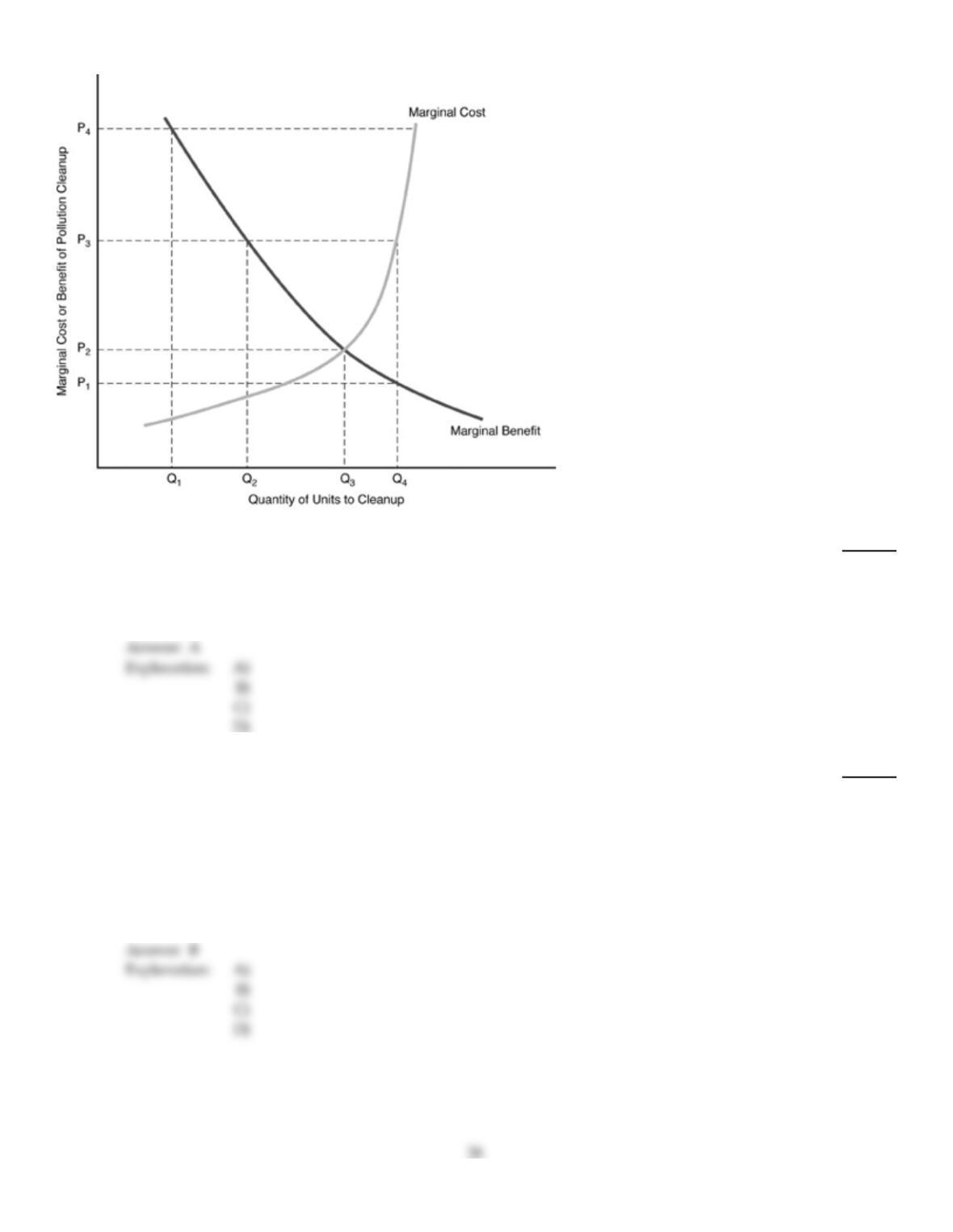
In the above figure, if a firm is cleaning up Q3 units of pollution, it is an
88)
A)
efficient solution because marginal social benefits are equal to marginal social costs.
B)
inefficient solution because marginal social costs are greater than marginal social benefits.
C)
inefficient solution because marginal social benefits are greater than marginal social costs.
D)
efficient solution because marginal social benefits are greater than marginal social costs.
89)
Your neighbor in an apartment complex plays his music very loudly late at night, which makes it
difficult for you to get to sleep. You offer the neighbor $50, the monetary value you put on your
sleep, to never play his music between midnight and 7 AM. By doing so
89)
A)
you have failed to bring about an efficient solution since you should have complained to the
police.
B)
you have indicated the cost of the externality, which internalizes the externality.
C)
you have indicated a willingness to make the external cost a social cost.
D)
you have indicated the cost of the externality. The externality is not internalized even if he
accepts your offer.
90)
Attaining higher and higher levels of air cleanliness causes
90)
A)
larger and larger marginal benefits to society.
B)
additional costs to rise to increasingly high levels.
C)
additional costs to fall to lower and lower levels.
D)
larger and larger increases in per capita incomes.
91)
A situation in where the costs of an action are not fully borne by the two parties engaged in
exchange is
91)
A)
internal costs.
B)
a transactions cost.
C)
an internality.
D)
an externality.
92)
To find social costs
92)
A)
internal and external costs have to be added together.
B)
internal and private costs have to be added together.
C)
internal and implicit costs have to be added together.
D)
internal and production costs have to be added together.
Output/Hour Private MC Marginal Benefit External Marginal Costs
1$10 $20 0.20
210.40 18.50 0.40
310.90 17 0.70
411.50 16.50 1.20
512.20 14.00 1.80
613.00 13.00 2.80
714.40 12.00 4.00
93)
Use the above table. If the level of production was determined by the market, it would be
93)
A)
4.
B)
5.
C)
6.
D)
7.
Quantity of Marginal Marginal
Clean Air (%) Cost ($) Benefit ($)
0 10,000 100,000
25 25,000 50,000
50 37,500 37,500
75 75,000 25,000
100 Infinite 0
94)
The above table shows marginal costs and marginal benefits of clean air in a particular industrial
area. In the table, when the quantity of clean air is at 25 percent
94)
A)
the marginal benefit of clean air exceeds the marginal cost.
B)
the marginal benefit of clean air is less than the marginal cost.
C)
the quantity of clean air is optimal.
D)
the quantity of polluted air is 25 percent.
95)
Wild animals are likely to be
95)
A)
endangered species.
B)
domesticated by humans.
C)
private property.
D)
all of the above.
96)
Voluntary agreements may not be a feasible method to internalize an externality when
96)
A)
there are high taxes on the firms that cause the externalities.
B)
the externality is negative rather than positive.
C)
there are significant transaction costs.
D)
the dollar value of the externality is large.
97)
In 2005, the European Union began a program to
97)
A)
subsidize firms that pollute more than a given limit.
B)
allow the trading of carbon–dioxide permits among firms.
C)
reduce greenhouse gas emissions by 10 percent within 5 years.
D)
eliminate greenhouse gas emissions by 50 percent within 15 years.
98)
Air pollution is a problem because
98)
A)
a market economy does not provide as strong an incentive for environmental cleanup as a
socialist economy.
B)
people are not environmentally conscious.
C)
people make use of air without having to bear all the costs of their actions.
D)
people are greedy.
99)
An externality occurs whenever
99)
A)
private costs plus internal costs equal social costs.
B)
private costs diverge from social costs.
C)
private costs are the same as internal costs.
D)
private costs are the same as social costs.
B
100)
When a polluter has to bear the full social cost of their actions, they will
100)
A)
go out of business since pollution abatement is expensive.
B)
will always decide to reduce the amount of pollution by reducing the quantity they produce.
C)
weigh the costs and benefits of each potential action and might decide to not stop polluting by
paying a fine.
D)
increase the price of the product and the quantity produced to pay for the additional costs.
C
101)
When property rights are clearly defined, there is generally a
101)
A)
voluntary agreement that can be reached.
B)
common property problem.
C)
regulatory agency that handles externalities.
D)
law that must be passed to ensure fairness.
A
C
102)
For voluntary action to correct an externality
102)
A)
transaction costs have to be low.
B)
transaction costs have to be split evenly between all of the parties involved.
C)
transaction costs are irrelevant.
D)
transaction costs have to be high.
103)
Endangered species are likely to be
103)
A)
common property.
B)
private property.
C)
both private and common property.
D)
neither private nor common property.
A
104)
Common property is
104)
A)
property owned by a group such as a club.
B)
property that has mineral or oil deposits.
C)
property that has little economic value.
D)
a resource that everyone is free to use as much as they want.
D
105)
When a person drives an automobile, that individual is creating
105)
A)
social costs.
B)
private costs only because the individual pays for the insurance, gas etc.
C)
internal costs only.
D)
external costs only.
A
106)
In economic analysis, air pollution, water pollution, and scenery destruction are considered to be
106)
A)
externalities.
B)
internalities.
C)
marginal benefits.
D)
private costs.
A
A
107)
The optimal quantity of air pollution is
107)
A)
found by equating the marginal benefits from further reductions in pollution and the
marginal costs of further reductions in pollution.
B)
whatever amount of pollution is produced by the profit maximizing firm.
C)
found by setting the quantity of air pollution equal to the quantity of water pollution.
D)
a meaningless concept since monetary values cannot be attached to problems associated with
pollution.
108)
Suppose there are two firms on a river and the production processes of both require clean water.
The upstream firm’s process dirties the water, which it dumps back into the river. The downstream
firm must clean the water before using it in its production process. If the two firms would merge
108)
A)
the external costs of the upstream firm are private costs after the merger.
B)
the internal costs of the downstream firm become external costs of the merged firm.
C)
the total costs of production fall since the external costs disappear.
D)
the external costs of the merged firm would equal the external costs of the upstream firm,
which would then be passed on to its customers.
A
109)
The idea that it takes 90 percent of your time to clean up the last 10 percent of your house illustrates
that
109)
A)
the marginal cost of cleaning up slopes upward.
B)
the marginal cost of cleaning up slopes downward.
C)
the marginal benefit of cleaning up is constant.
D)
the marginal benefit of cleaning up slopes upward.
A
110)
If pollutants from smoke stacks in a city such as Newark causes people to paint their homes and
cars more frequently, this implies
110)
A)
internal cost to home and car owners.
B)
external benefits to the home and car owners.
C)
external costs on home and car owners.
D)
none of the above.
C
A
111)
In the Kyoto Protocol, participating nations agreed to
111)
A)
buy greenhouse gas emission permits from developing nations.
B)
trade carbon–dioxide permits.
C)
eliminate all emissions of greenhouse gases by 2020.
D)
reduce their overall emissions of greenhouse gases between 1997 and 2020 to as much as 20
percent below 1990 levels.
112)
The government is considering levying a tax on the pollution generated from two electric power
plants (Plant A and Plant B). Plant A is located in a city with a high density of population, and
Plant B is located in the rural area with a low density of population. The government should
112)
A)
tax only Plant A but not Plant B because Plant B generates less revenue.
B)
levy a higher tax per unit of pollution on Plant A because of its higher economic damage.
C)
levy the same tax per unit of pollution on both plants.
D)
levy a higher tax per unit of pollution on Plant B because of its lower economic damage.
B
Quantity of Marginal Marginal
Clean Air (%) Cost ($) Benefit ($)
0 10,000 100,000
25 25,000 50,000
50 37,500 37,500
75 75,000 25,000
100 Infinite 0
113)
In the above table, the optimal quantity of clean air is
113)
A)
100 percent.
B)
25 percent.
C)
75 percent.
D)
50 percent.
D
D
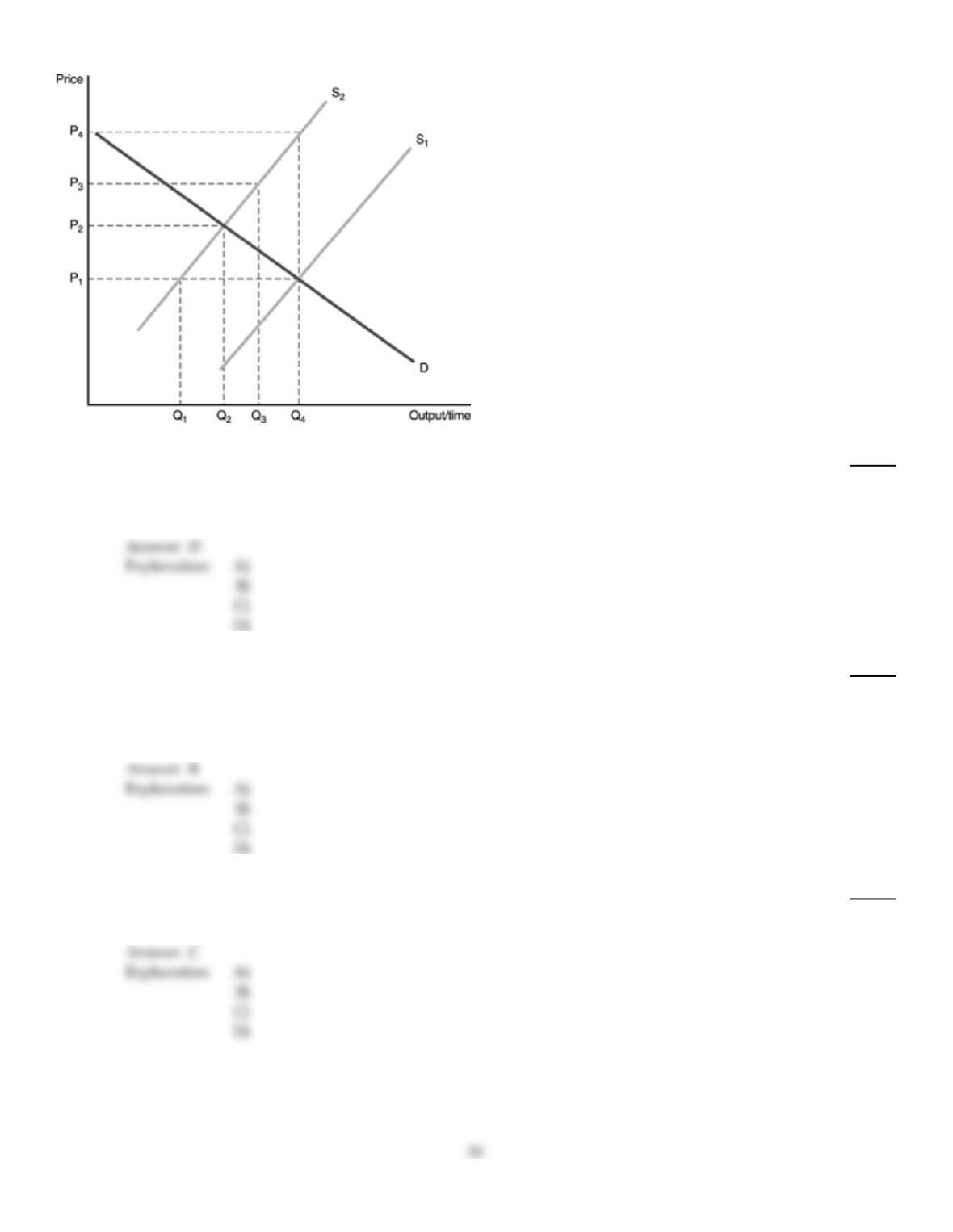
114)
Refer to the above figure. S1 is the supply curve that includes only private costs. S2 is the supply
curve that includes social costs. The free market rate of output is ________ and the corrected,
socially optimal amount of output is ________.
114)
A)
Q2; Q4
B)
Q2; Q1
C)
Q4; Q1
D)
Q4; Q2
115)
To find the social cost of an action, add together
115)
A)
the external and accounting costs.
B)
the external costs and the internal costs.
C)
the private costs and the internal costs.
D)
the internal costs and the private opportunity costs.
116)
When a person smokes a cigarette in his car and throws the butt out of the window, this is a(n)
116)
A)
public cost.
B)
marginal cost.
C)
external cost.
D)
average total cost.
117)
As we approach total pollution abatement
117)
A)
the marginal cost to society equals the marginal benefit to society.
B)
the marginal cost to society falls.
C)
the marginal cost to society falls but then rises.
D)
the marginal cost to society rises.
118)
In a market for emission permits, firms that emit over their allowed limits
118)
A)
must buy more allowances through a trading system.
B)
are forced to shut down.
C)
are taxed by the government for the amount of emissions.
D)
will sell their excess allowances through a trading system.
Explanation:
119)
The marginal cost curve of pollution abatement
119)
A)
slopes downward because of the law of diminishing returns.
B)
slopes upward because firms will maximize profits.
C)
slopes downward because of the law of diminishing marginal utility.
D)
slopes upward because of the law of diminishing product.
Explanation:
120)
The level of pollution at which the marginal benefits equal the marginal cost of cleaning up is
always
120)
A)
the pollution minimum.
B)
the pollution maximum.
C)
the zero pollution level.
D)
the optimal quantity of pollution.
Explanation:
Explanation:
121)
Transaction costs are
121)
A)
equal to the hourly cost of a lawyer used to write a contract.
B)
not true costs because they relate to time rather than real resources.
C)
the costs, such as sales taxes, that are imposed by the government.
D)
the costs associated with making, reaching, and enforcing agreements.
122)
Where pollution is concerned, if an automobile driver considers only the internal costs of his
actions, he is apt to
122)
A)
be making a positive contribution to the greater community.
B)
drive too much and use up more scarce resources than he would if he had to cover all his
costs.
C)
garage his car and drive very seldom.
D)
use resources very carefully and in small quantities.
B
123)
Which of the following methods could be used to correct for external costs?
123)
A)
Require firms in the industry to install pollution control devices.
B)
Impose a tax or an effluent fee on the offenders.
C)
Have the offender clean up the pollution it caused.
D)
All of the above would be appropriate.
D
124)
If the social costs of driving an automobile are greater than the private costs of driving an
automobile, then
124)
A)
the external costs of auto driving exceed the social costs of auto driving.
B)
either people drive their autos too much or more funds should be spent on reducing air
pollution.
C)
the price of automobile driving is too high.
D)
the external costs of auto driving exceed the internal costs.
B
D
125)
The total benefits to society from pollution abatement
125)
A)
increase at a decreasing rate with the increase of pollution abatement.
B)
decrease at a decreasing rate with the increase of pollution abatement.
C)
increase at an increasing rate with the increase of pollution abatement.
D)
decrease at an increasing rate with the increase of pollution abatement.
126)
Costs that are borne solely by the individuals who incur them are
126)
A)
transaction costs.
B)
external costs.
C)
social costs.
D)
private costs.
127)
There are two coal–burning electrical utilitiesone in tiny, rural Wanunu, Montana, and another in
metropolitan Detroit, Michiganand each produces the same amount of pollution per unit of
output. If a permit tax is going to be used to force these firms to internalize pollution costs, the tax
levied should be
127)
A)
less than zero in each city.
B)
higher in Wanunu than in Detroit.
C)
the same in each city.
D)
higher in Detroit than in Wanunu.
128)
If a good is produced by firms that generate external costs, the price consumers pay
128)
A)
will be too high because the consumers end up paying the costs instead of the firm.
B)
will be the correct price, but the quantity sold of the good will be too large.
C)
will be too low.
D)
will be efficient as long as it equals the marginal costs of the firms.
129)
When a person does not have to pay the full costs for using a scarce resource, then
129)
A)
more of the resource will be used.
B)
the social costs of the resource are less than they would be if the “correct” amount of the
resource were being used.
C)
the internal costs of using the resource are too high.
D)
the use of the resource is not affected since society pays for the resource.
130)
Private costs are the same as
130)
A)
implicit costs.
B)
external costs.
C)
internal costs.
D)
public costs.
Explanation:
131)
An externality exists when
131)
A)
there are internal costs.
B)
there are private costs.
C)
there are opportunity costs.
D)
there are external costs.
Explanation:
132)
Suppose a large tree on Adam’s property blocks Eve‘s view of the ocean. Adam accepts Eve’s offer
of $15,000 to cut down the tree. This is an example of
132)
A)
internalizing externalities via voluntary agreements.
B)
a consequence of private costs exceeding social costs.
C)
a result of logrolling.
D)
a consequence of a positive externality.
Explanation:
133)
The exclusive rights of ownership that allow the use, transfer, and exchange of property are called
133)
A)
externalities.
B)
private property rights.
C)
common property rights.
D)
social benefits.
Explanation:
Explanation:
134)
In the process of reducing pollutants in our environment, we are
134)
A)
achieving a cleaner environment at no real cost.
B)
reallocating resources in an inefficient manner.
C)
causing higher levels of unemployment.
D)
trading off less of other goods and services for a cleaner environment.
135)
In the above figure, if a firm is cleaning up Q2 units of pollution, it is an
135)
A)
inefficient solution, because marginal social costs are greater than marginal social benefits.
B)
efficient solution, because marginal social benefits are greater than marginal social costs.
C)
efficient solution, because marginal social benefits are equal to marginal social costs.
D)
inefficient solution, because marginal social benefits are greater than marginal social costs.
136)
Common property
136)
A)
is owned by everyone.
B)
is owned by no one.
C)
Neither A nor B are correct.
D)
Both A and B are correct.
137)
Refer to the above figure. S1 is the supply curve that includes only private costs. S2 is the supply
curve that includes social costs. If the firm sets output by focusing on private costs, the per–unit
external cost will equal
137)
A)
P4– P1.
B)
P2– P1.
C)
P4– P2.
D)
P2.
138)
The problem of overfishing in waters that are commonly owned can be solved by
138)
A)
subsidizing fishing.
B)
the use of the Coase Theorem.
C)
allowing the market to ration fish.
D)
establishing property rights for fishing in the waters.
139)
Refer to the above figure. S1 is the supply curve that includes only private costs. S2 is the supply
curve that includes social costs. From this figure we know that
139)
A)
private costs are less than social costs.
B)
private costs equal social costs.
C)
private costs are greater than social costs.
D)
an external benefit exists.
140)
A good that has social costs that are less than private costs has a quantity that is
140)
A)
equal to zero.
B)
too high.
C)
too low.
D)
just right.
141)
The problem of overfishing in waters that are commonly owned can be solved when the
government determines the total amount of fish can be removed from a given area during each
fishing season. Then the fishermen
141)
A)
will lower their private costs to fish.
B)
can trade their rights (shares) to fish or not.
C)
will not be able to fish.
D)
will externalize their private costs to the government.