Exam
Name___________________________________
MULTIPLE CHOICE. Choose the one alternative that best completes the statement or answers the question.
1)
Which of the following statements best defines private costs?
1)
A)
They represent explicit costs incurred by business firms in the private sector.
B)
They are synonymous with social costs.
C)
They are costs borne by people other than those who commit the action.
D)
They are internal in the sense that the firm or household must explicitly take them into
account.
2)
When the social costs exceed the private costs, economists state that there is
2)
A)
an underproduction of output.
B)
a positive externality.
C)
a negative externality.
D)
social appreciation of resources.
3)
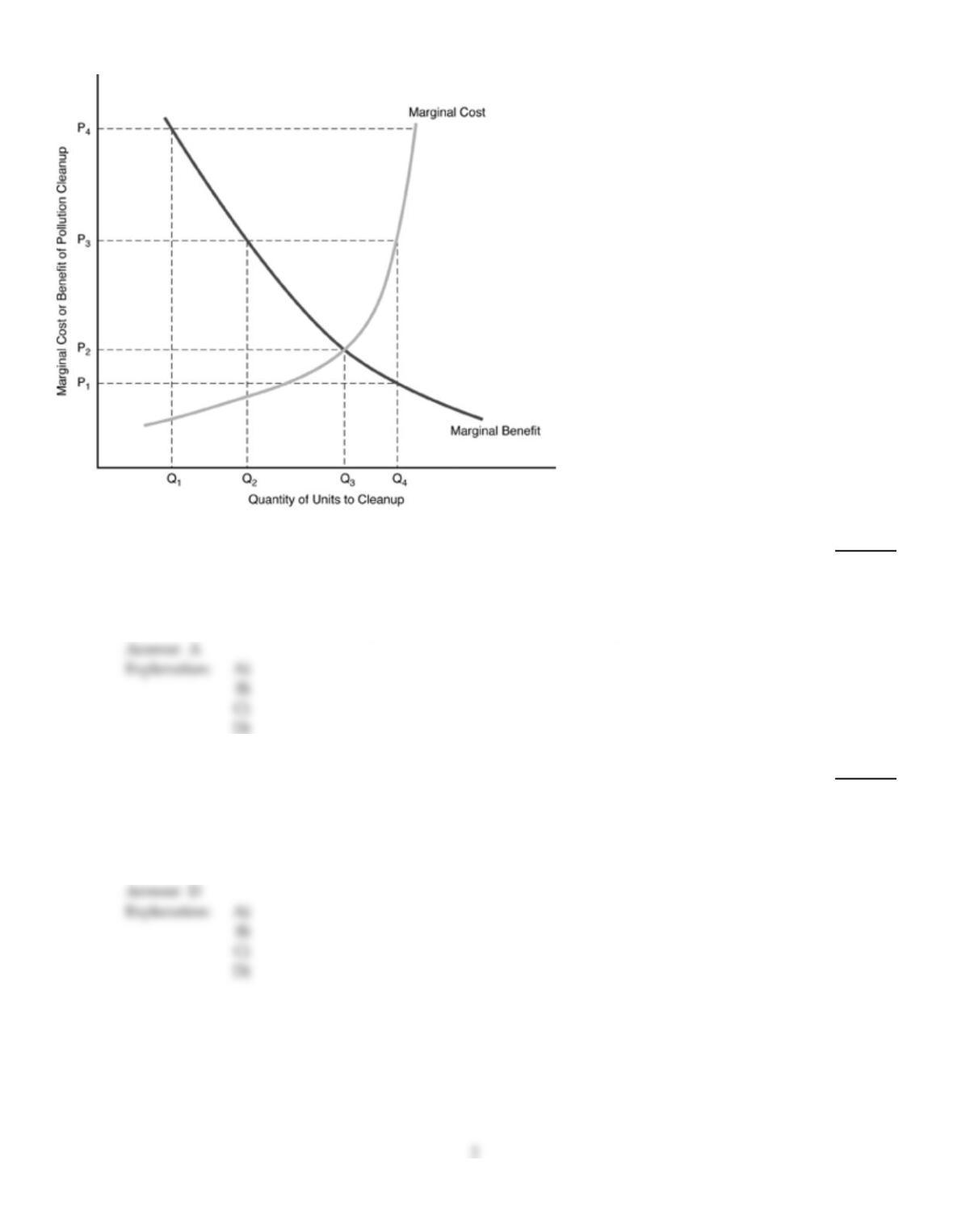
In the above figure, if a firm is cleaning up Q2 units of pollution, it is an
3)
A)
inefficient solution, because marginal social benefits are greater than marginal social costs.
B)
efficient solution, because marginal social benefits are greater than marginal social costs.
C)
inefficient solution, because marginal social costs are greater than marginal social benefits.
D)
efficient solution, because marginal social benefits are equal to marginal social costs.
4)
To totally internalize an externality, a government can levy a tax related only to the physical
quantity of pollution if
4)
A)
the economic damages are zero.
B)
the economic damages associated with the pollution are different across different locations.
C)
the economic damages are too large to be determined.
D)
the economic damages associated with the pollution are the same across different locations.
5)
A situation in which a private cost diverges from a social cost is
5)
A)
a transactions cost.
B)
an externality.
C)
internal costs.
D)
an internality.
6)
The total benefits to society from pollution abatement
6)
A)
decrease at a decreasing rate with the increase of pollution abatement.
B)
increase at an increasing rate with the increase of pollution abatement.
C)
decrease at an increasing rate with the increase of pollution abatement.
D)
increase at a decreasing rate with the increase of pollution abatement.
7)
The marginal cost curve of pollution abatement is
7)
A)
vertical.
B)
upward sloping.
C)
downward sloping.
D)
horizontal.
8)
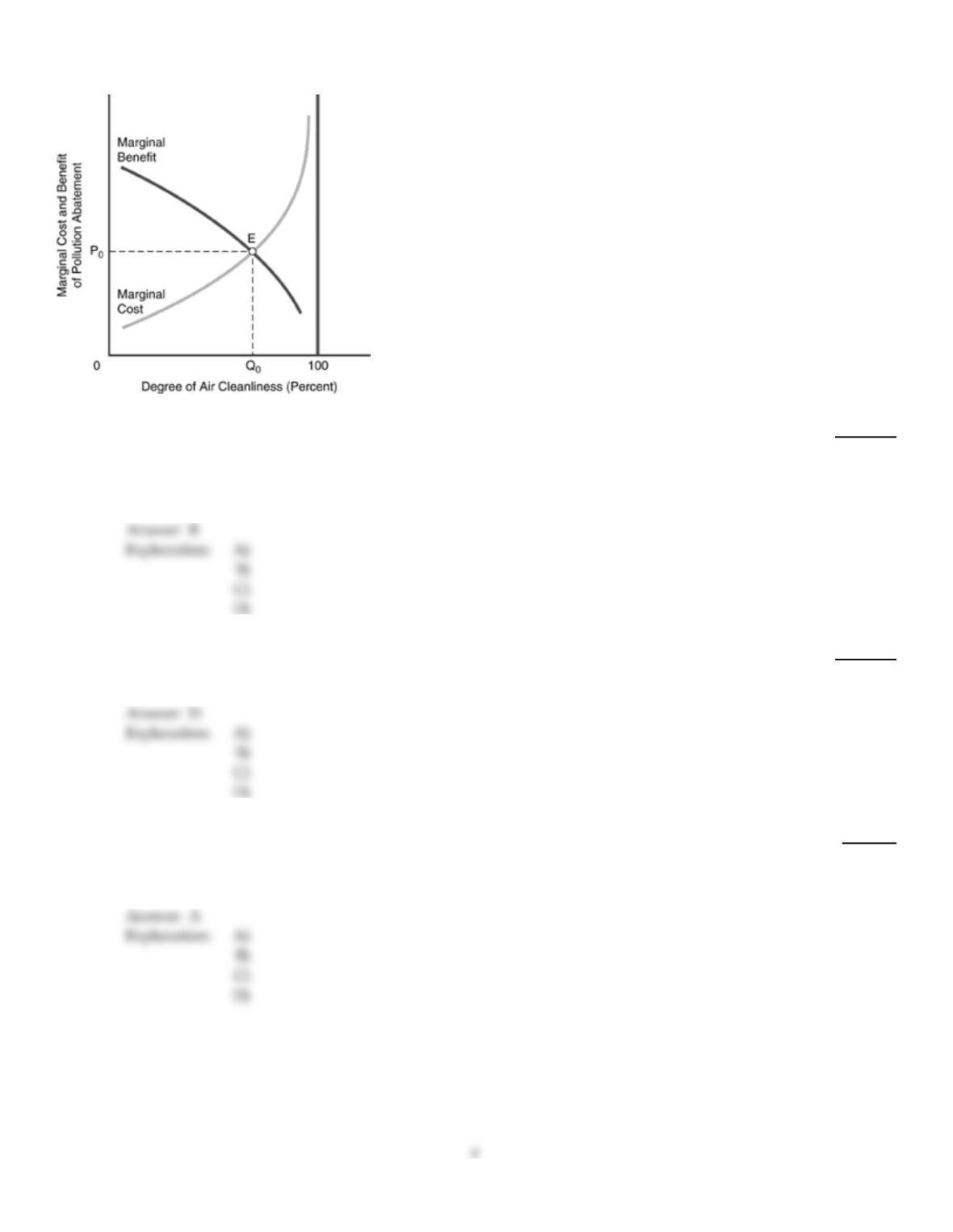
The optimal quantity of pollution in the above figure
8)
A)
is defined as the level where the marginal benefit is at a maximum.
B)
is the level of pollution at which the marginal benefit equals the marginal cost.
C)
is where the optimal degree of air cleanliness is 100 percent.
D)
cannot be determined.
9)
An externality that is not fully paid by the individual using an automobile is
9)
A)
operation of the vehicle.
B)
insurance for the vehicle.
C)
gasoline for the vehicle.
D)
air pollution from the vehicle.
10)
Assuming that pollution cannot be removed from the environment at zero cost, the optimal level of
pollution
10)
A)
will be positive.
B)
will be zero.
C)
cannot be determined.
D)
will be negative.
11)
An externality refers to the idea that
11)
A)
private and internal costs differ.
B)
explicit costs differ from implicit costs.
C)
decision–makers do not internalize all the costs.
D)
we cannot do anything that does not affect other people.
12)
In theory, the Emissions Trading Scheme would
12)
A)
lower the production costs of all firms.
B)
cause firms to generate less pollution than their allowed limits.
C)
raise the production costs of all firms.
D)
cause firms to generate more pollution than their allowed limits.
13)
In 2005, the European Union began a program to
13)
A)
allow the trading of carbon–dioxide permits among firms.
B)
subsidize firms that pollute more than a given limit.
C)
reduce greenhouse gas emissions by 10 percent within 5 years.
D)
eliminate greenhouse gas emissions by 50 percent within 15 years.
14)
Which of the following is TRUE of the European Union’s Emissions Trading Scheme?
14)
A)
Firms are forced to shut down when they exceed their pollution limits.
B)
Firms can trade pollution permits to meet their pollution limits.
C)
Firms are taxed based on the their pollution levels.
D)
Governments subsidize firms to develop devices to reduce pollution.
15)
Exclusive rights of ownership that allow the use, transfer, and exchange of property are called
15)
A)
private property rights.
B)
public property rights.
C)
nonexclusive property rights.
D)
common property rights.
16)
All of the following are choices for the polluter when faced with additional costs to abate the
externality EXCEPT
16)
A)
reduce the pollution–causing activity.
B)
ignore the government regulations.
C)
pay the price to pollute.
D)
install pollution abatement equipment.
B
Explanation:
17)
Protecting endangered species are likely to be
17)
A)
a private cost.
B)
a public cost.
C)
both private and public costs.
D)
neither a private nor public cost.
B
Explanation:
18)
The sum of internal and external costs is
18)
A)
private costs.
B)
internalities.
C)
social costs.
D)
externalities.
C
Explanation:
19)
The Black Ash Steel Company’s plant belches large quantities of noxious fumes and black ash into
the air. Residents in the surrounding area have higher medical bills because of Black Ash’s
pollution. As long as Black Ash is allowed to emit pollution and ignore any externalities, the firm
will
19)
A)
overproduce.
B)
under produce.
C)
be absorbing the full value of its social costs.
D)
charge too high a price for its output.
A
Explanation:
A
Explanation:
20)
Private property rights are
20)
A)
exclusive rights of ownership.
B)
property that is owned by everyone and therefore by no one.
C)
a social cost.
D)
an externality.
21)
The problem of overfishing in waters that are commonly owned can be solved when the
government determines the total amount of fish can be removed from a given area during each
fishing season. Then the fishermen
21)
A)
will lower their private costs to fish.
B)
can trade their rights (shares) to fish or not.
C)
will not be able to fish.
D)
will externalize their private costs to the government.
22)
The most efficient way to get firms to reduce pollution is to
22)
A)
make them pay for the social costs of production and let them decide how to respond to the
higher costs.
B)
provide firms and consumers with the information about the effects of their actions and
encourage them to behave responsibly.
C)
make the worst polluters shut down and go out of business.
D)
set uniform emission standards and require all firms to meet the standards.
23)
All of following are commonly considered to be common property EXCEPT
23)
A)
fish in an ocean.
B)
wild salmon in a river.
C)
chickens raised in a farm.
D)
spotted owls in the wild.
24)
Pollution
24)
A)
creates a negative externality.
B)
is increased when property rights are defined.
C)
exists because air and water are privately owned resources.
D)
is the result of capitalism.
25)
Air pollution is a problem because
25)
A)
people are not environmentally conscious.
B)
people are greedy.
C)
a market economy does not provide as strong an incentive for environmental cleanup as a
socialist economy.
D)
people make use of air without having to bear all the costs of their actions.
D
26)
Social costs are
26)
A)
costs borne by society whenever a resource–using action takes place.
B)
external costs minus internal costs.
C)
costs incurred by government and borne by all taxpayers.
D)
costs incurred in governmental welfare programs.
A
A
27)
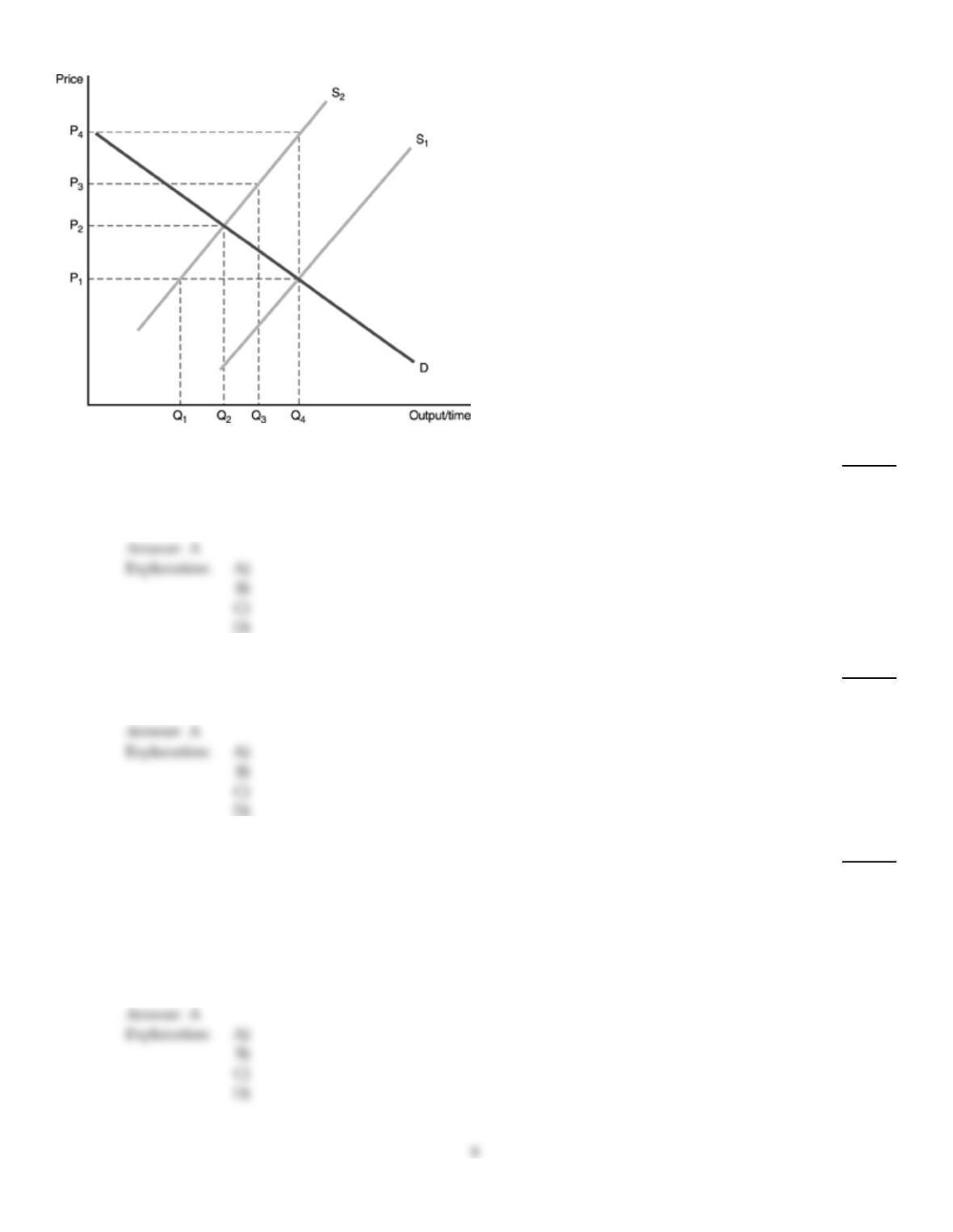
Refer to the above figure. S1 is the supply curve that includes only private costs. S2 is the supply
curve that includes social costs. If the firm sets output by focusing on private costs, the per–unit
external cost will equal
27)
A)
P4–P1.
B)
P4–P2.
C)
P2.
D)
P2–P1.
28)
A social cost that is not fully paid by the individual using an automobile is
28)
A)
traffic congestion.
B)
insurance.
C)
gasoline and oil.
D)
depreciation of the vehicle.
Explanation:
29)
Why is the optimal quantity of pollution not less than the point at which the marginal benefit
equals the marginal cost?
29)
A)
Below that point the value that people place on less pollution is less than the cost of reducing
the pollution.
B)
The point of intersection occurs at a low level of pollution.
C)
There are no external costs below that level.
D)
Below that point firms will have to reduce the quantity that they are currently producing and
lower the price.
Explanation:
Explanation:
30)
Social costs are
30)
A)
costs that are borne by the government.
B)
borne by individuals who incur them.
C)
another term for external costs.
D)
the full cost borne by society whenever a resource use occurs.
31)
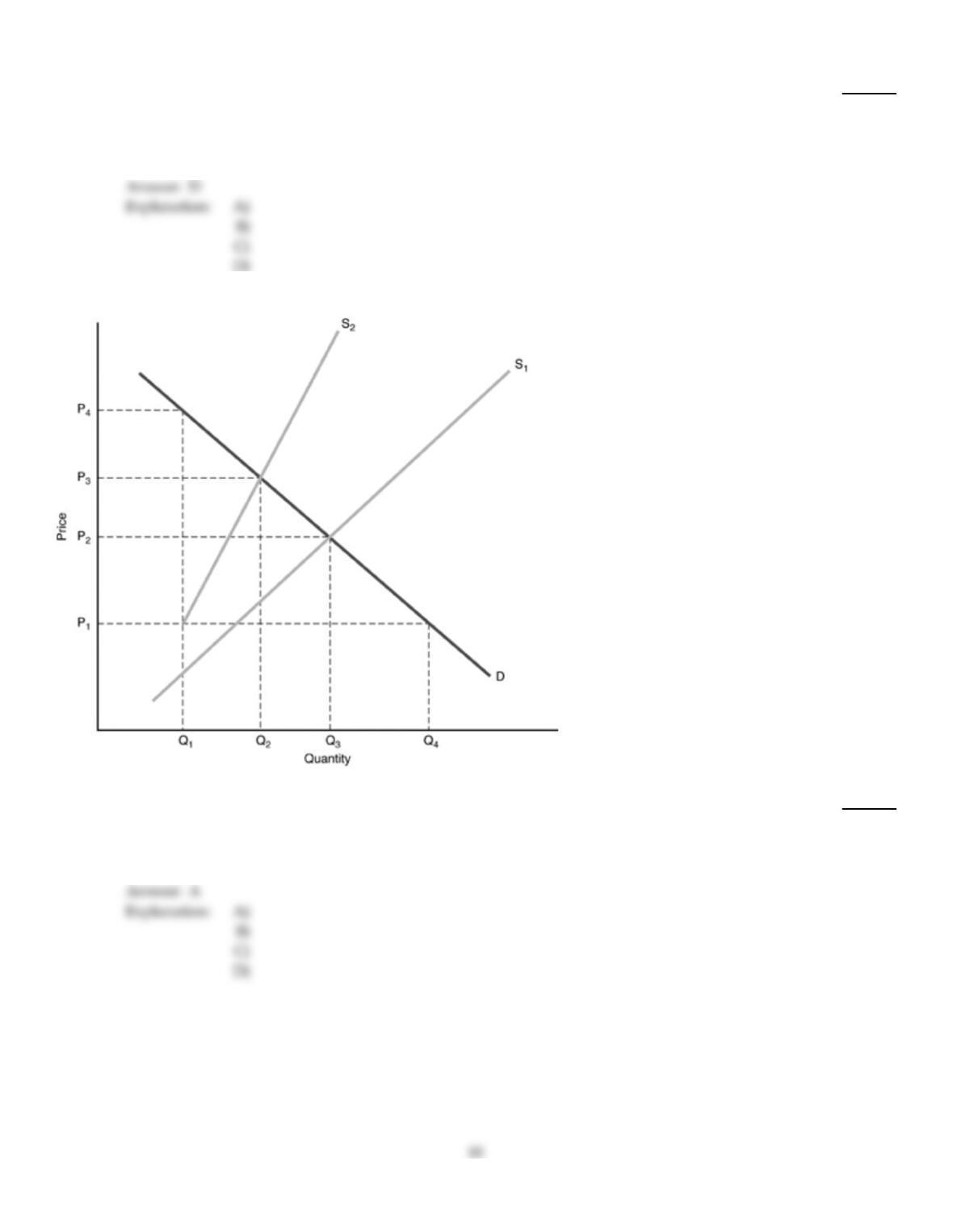
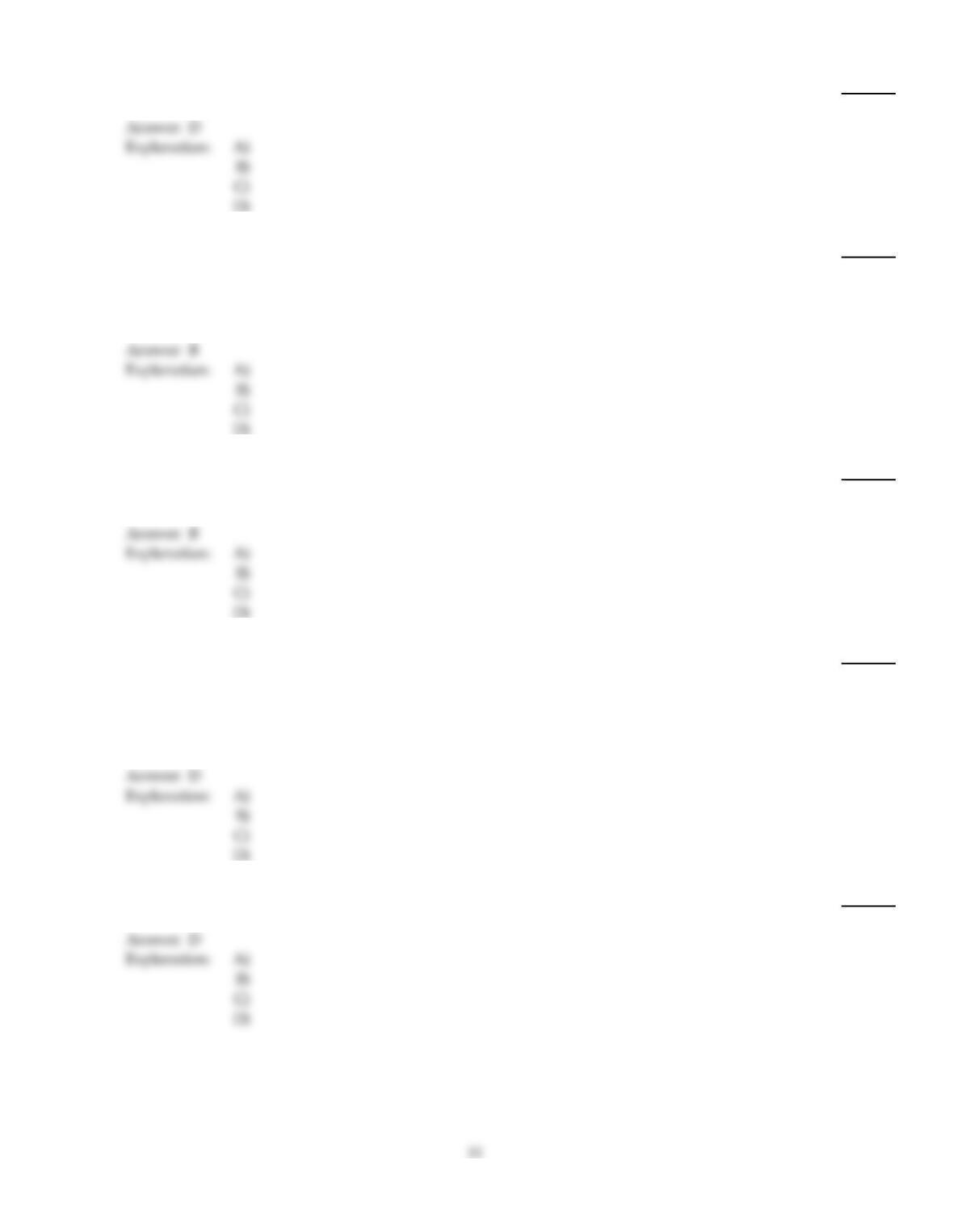
In the above figure, S1 represents the supply curve which includes private costs, and S2 is the
supply curve which includes social costs. If the firm is producing a product that has external costs
that the firm does NOT have to pay, what will be the equilibrium price and quantity?
31)
A)
P2, Q3
B)
P4, Q1
C)
P1, Q4
D)
P3, Q2
32)
The marginal cost curve of a firm measures
32)
A)
social costs.
B)
external costs.
C)
pollution costs.
D)
private costs.
33)
Which of the following is not a private cost?
33)
A)
The coffee pot that Jan dropped and broke this morning.
B)
The pollution caused by a firm dumping its wastes into the river.
C)
The amount that a firm must pay for raw materials to make its product.
D)
The health insurance costs a firm must pay for its employees.
34)
Property that is owned by everyone and therefore by no one in particular is referred to as
34)
A)
commercial property.
B)
common property.
C)
social property.
D)
private property.
35)
The marginal cost to society of reducing pollution increases with the increased use of pollution
abatement because
35)
A)
of the high cost of abatement.
B)
of the reduced demand for abatement.
C)
of the diminishing marginal utility of abatement.
D)
of the diminishing returns from abatement.
36)
A good that has social costs that are less than private costs has a quantity that is
36)
A)
equal to zero.
B)
just right.
C)
too high.
D)
too low.
37)
Which of the following statements is true about the relationship among external, internal and social
costs?
37)
A)
Internal costs will always be higher than external costs.
B)
Social costs will always be higher than external costs.
C)
Internal costs will never equal external costs.
D)
Social costs will always be higher than internal costs.
38)
In order to correct the problems associated with external costs,
38)
A)
the government must take over production of industries that are responsible for most of the
pollution.
B)
standards must be established that make it illegal to pollute.
C)
the prices of all goods must be raised so people will consume less of the world’s resources.
D)
the signals given to the economy must change so that decision–makers will take into account
all the costs of their actions.
Explanation:
39)
In a market for emission permits, firms that emit over their allowed limits
39)
A)
are forced to shut down.
B)
are taxed by the government for the amount of emissions.
C)
must buy more allowances through a trading system.
D)
will sell their excess allowances through a trading system.
Explanation:
Explanation:
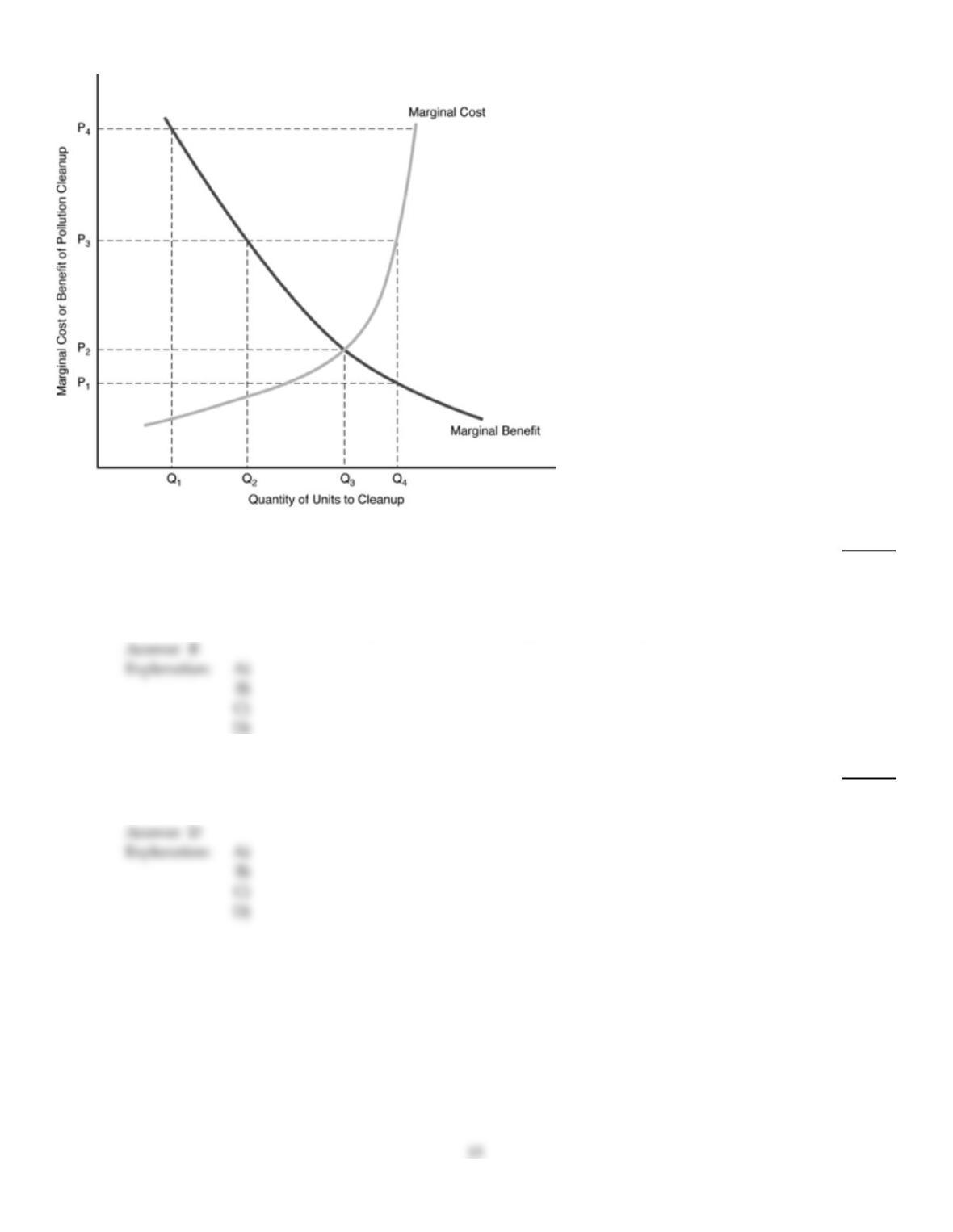
40)
In the above figure, if a firm is cleaning up Q4 units of pollution, it is an
40)
A)
inefficient solution, because marginal social benefits are greater than marginal social costs.
B)
inefficient solution, because marginal social costs are greater than marginal social benefits.
C)
efficient solution, because marginal social benefits are equal to marginal social costs.
D)
efficient solution, because marginal social benefits are greater than marginal social costs.
41)
Common property
41)
A)
is owned by no one.
B)
is owned by everyone.
C)
Neither A nor B are correct.
D)
Both A and B are correct.
42)
When social costs of an activity exceed private costs
42)
A)
this means that resources are being efficiently used.
B)
there is a tendency for resources to be over–utilized.
C)
there is a tendency for resources to be under–utilized.
D)
None of the above is correct.
43)
The Emission Trading Scheme of the European Union
43)
A)
sets a cap on the amount of pollutants in each country.
B)
allowed firms to benefit from emitting pollutants.
C)
sets the amount of per–unit tax on each pollutant.
D)
created a market for pollutants.
44)
An externality is a situation in which
44)
A)
there are no social costs.
B)
internal costs diverge from private costs.
C)
the cost borne by the consumer is greater than the monetary price.
D)
private costs diverge from social costs.
45)
Which of the following statements is true about the relationship among external, internal and social
costs?
45)
A)
External cost is the difference between social and internal costs.
B)
Social cost is the difference between internal and external costs.
C)
Internal cost is the sum of social and external costs.
D)
None of the above.
46)
Common property is
46)
A)
generic property as opposed to specific property.
B)
a resource that everyone is free to use as much as they want.
C)
property owned by a group such as a club or a church.
D)
property that belongs to both spouses in a marriage.
47)
When social and private costs differ, economists state that
47)
A)
there is not an efficiency problem but an equity problem.
B)
the society will produce inside the production possibilities frontier.
C)
there is an externality.
D)
there will be economic profit in the society.
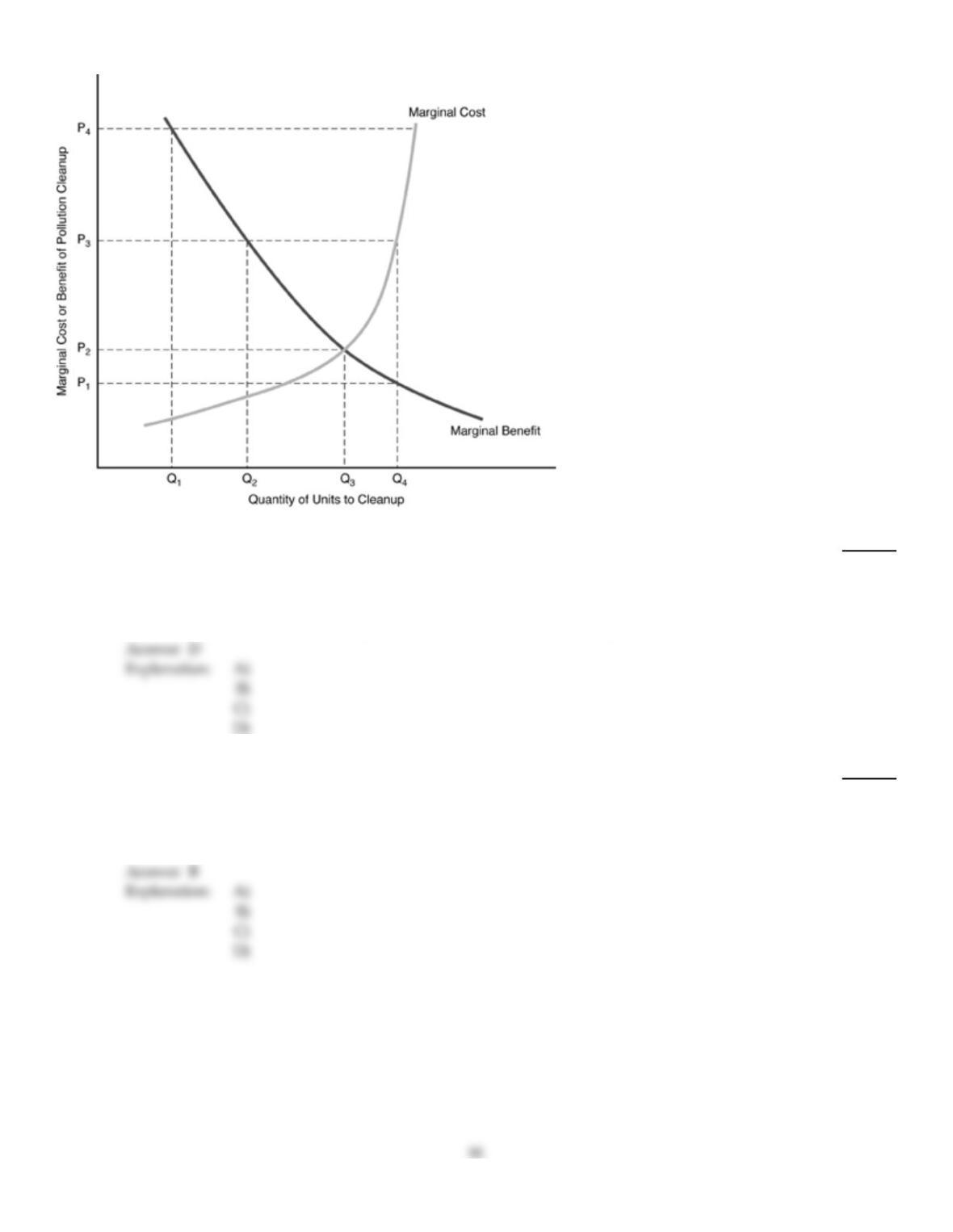
48)
In the above figure, if a firm is cleaning up Q3 units of pollution, it is an
48)
A)
inefficient solution because marginal social costs are greater than marginal social benefits.
B)
inefficient solution because marginal social benefits are greater than marginal social costs.
C)
efficient solution because marginal social benefits are greater than marginal social costs.
D)
efficient solution because marginal social benefits are equal to marginal social costs.
49)
Private costs are
49)
A)
external costs borne by private firms.
B)
costs borne solely by the individuals who incur them.
C)
explicit costs rather than implicit costs.
D)
costs borne by private members of society rather than governmental bodies.
50)
When property rights are clearly defined, there is generally a
50)
A)
voluntary agreement that can be reached.
B)
law that must be passed to ensure fairness.
C)
regulatory agency that handles externalities.
D)
common property problem.
51)
The costs associated with reaching and enforcing agreements are called
51)
A)
private property costs.
B)
common property costs.
C)
public costs.
D)
transaction costs.
D
52)
To correct for a negative externality, a government might impose a uniform tax related only to the
physical quantity of pollution if
52)
A)
the economic damages are zero.
B)
the cost of ascertaining the actual economic costs are relatively small.
C)
the administrative costs are high.
D)
the economic damages associated with the pollution are different across different locations.
C
53)
Suppose there are two factories on a river, and both need clean water for their production
processes. The upstream factory takes in clean water and dumps dirty water back into the river.
The downstream firm must clean up the water it gets from the river before using it. In this
situation,
53)
A)
the private costs of the downstream factory are more than the private costs of the upstream
factory, but for both factories private costs and social costs are the same.
B)
the internal costs of the upstream factory are externalized by the downstream factory, which
then passes them on to its customers.
C)
the social costs are greater than the private costs for the upstream firm, while the social costs
are less than the private costs for the downstream firm.
D)
the upstream factory’s private costs are less than its social costs, and its external costs are
borne by the downstream factory.
D
A
54)
The optimal amount of air pollution is
54)
A)
found by equating the total benefits from reducing pollution by one more unit with the total
costs of reducing pollution by an additional unit.
B)
found by setting the marginal benefits from reducing pollution by one more unit equal to
zero.
C)
found by equating the marginal benefits from reducing pollution by one more unit with the
marginal costs of reducing pollution by an additional unit.
D)
a meaningless concept since we cannot monetize the environment.
55)
The Endangered Species Act is an attempt to
55)
A)
protect endangered species against greedy loggers, farmers, and business people.
B)
protect species endangered because there are no private property rights on them.
C)
prevent some people from earning a good living.
D)
protect endangered species from the overzealousness of many environmentalists.
B
56)
If a good is produced by firms that generate external costs, the price consumers pay
56)
A)
will be the correct price, but the quantity sold of the good will be too large.
B)
will be efficient as long as it equals the marginal costs of the firms.
C)
will be too low.
D)
will be too high because the consumers end up paying the costs instead of the firm.
C
57)
The total costs of using a resource are made up of
57)
A)
private costs only.
B)
social costs only.
C)
external costs only.
D)
internal and private costs only.
B
C