Exam
Name___________________________________
MULTIPLE CHOICE. Choose the one alternative that best completes the statement or answers the question.
1)
The marginal cost curve of pollution abatement is
1)
A)
vertical.
B)
downward sloping.
C)
upward sloping.
D)
horizontal.
2)
When social costs of an activity exceed private costs
2)
A)
the actual price is above the efficient price.
B)
there is a tendency for resources to be under–utilized.
C)
a market failure exists.
D)
this means that resources are being efficiently used.
C
3)
Saving endangered species
3)
A)
benefits all people in society without any trade–off.
B)
may involve a trade–off in terms of the loss of other economic activities.
C)
requires the government to list those species as common property.
D)
must involve the loss of another species.
B
4)
The costs associated with reaching and enforcing agreements are called
4)
A)
public costs.
B)
transaction costs.
C)
private property costs.
D)
common property costs.
B
C
5)
The sum of internal and external costs is
5)
A)
social costs.
B)
externalities.
C)
internalities.
D)
private costs.
6)
External costs are
6)
A)
another term for implicit costs.
B)
borne by individuals other than those who incurred them.
C)
borne by the public but incurred by the government.
D)
borne by the government but incurred by the public.
7)
When the costs of an action are not fully borne by the two parties engaged in a transaction, this is
called a(n)
7)
A)
equilibrium.
B)
externality.
C)
property right.
D)
internal cost.
8)
There is an externality present only when
8)
A)
private costs equal social costs.
B)
private costs equal social benefits.
C)
private benefits equal social benefits.
D)
private costs or benefits diverge from social costs or benefits.
9)
The Emission Trading Scheme of the European Union
9)
A)
sets a cap on the amount of pollutants in each country.
B)
allowed firms to benefit from emitting pollutants.
C)
sets the amount of per–unit tax on each pollutant.
D)
created a market for pollutants.
10)
The sum of internal and external costs is
10)
A)
common property.
B)
private costs.
C)
internality.
D)
social costs.
11)
Your neighbor has just planted some fragrant flowers. The wonderful scent drifts into your room
and makes you happy.
11)
A)
This cannot be an externality since you are enjoying the scent.
B)
The social cost of this activity is entirely borne by you neighbor.
C)
This scent is an internal cost to you.
D)
This is an externality since you get a benefit from your neighbor’s flowers.
12)
The marginal cost of pollution abatement is the
12)
A)
total social costs of pollution clean–up divided by total social benefits.
B)
additional cost to clean up an additional unit of pollution.
C)
additional benefit from cleaning up an additional unit of pollution.
D)
total social costs of pollution clean–up divided by the total units of clean–up.
13)
If a firm is forced to take external costs into account, it will
13)
A)
reduce production and charge a higher market price.
B)
increase production and charge a lower market price.
C)
reduce prices and hire fewer workers.
D)
reduce prices and hire more workers.
14)
Which of the following is a TRUE statement?
14)
A)
Externalities would never be a problem if people were willing to comply with government
regulations.
B)
Externalities can only be handled by government regulation and emission taxes cannot work
effectively.
C)
Voluntary agreements can solve externality situations by making the party incurring the costs
bear the costs of his or her actions.
D)
Externalities cannot be solved by market solutions and always require government action.
15)
Why is the optimal quantity of pollution not less than the point at which the marginal benefit
equals the marginal cost?
15)
A)
There are no external costs below that level.
B)
Below that point the value that people place on less pollution is less than the cost of reducing
the pollution.
C)
The point of intersection occurs at a low level of pollution.
D)
Below that point firms will have to reduce the quantity that they are currently producing and
lower the price.
16)
From an economic standpoint, the amount of pollution should be
16)
A)
the amount that allows firms to maximize profits.
B)
zero.
C)
at the point at which the marginal benefit from further reduction equals the marginal cost of
further reduction.
D)
the amount where firms are earning a normal rate of return on investment.
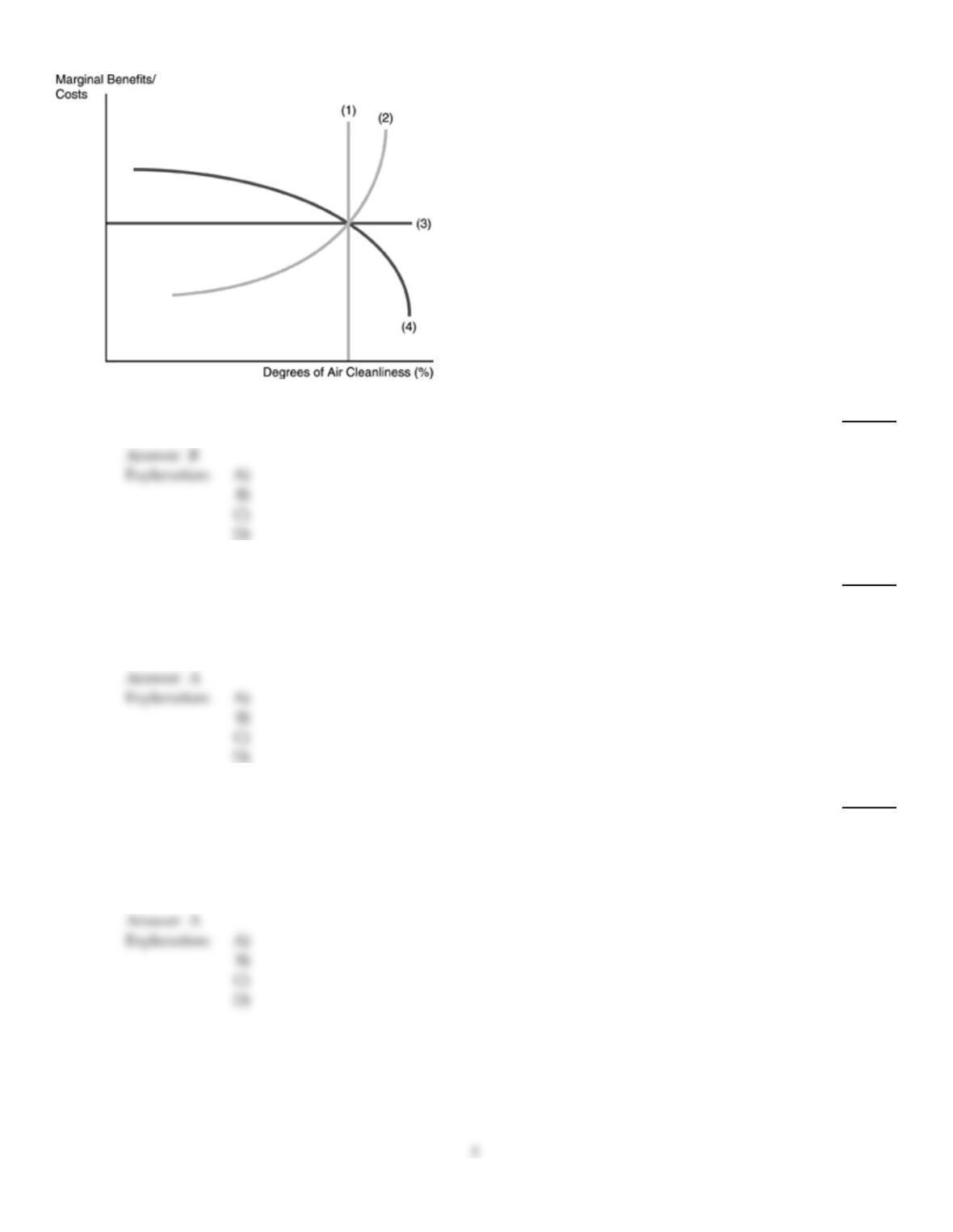
17)
Refer to the above figure. The marginal cost of pollution abatement is curve
17)
A)
(1).
B)
(2).
C)
(3).
D)
(4).
18)
When there is a resource for which property rights are not well defined and there is a difference
between private costs and social costs, then all but which of the following is a way to close the
difference?
18)
A)
the free market system
B)
regulation
C)
subsidization
D)
taxation
19)
Which of the following statements is TRUE about the relationship among external, internal and
social costs?
19)
A)
Social costs will always be higher than external costs.
B)
Internal costs will always be higher than external costs.
C)
Internal costs will never equal external costs.
D)
Social costs will always be higher than internal costs.
20)
If a good is produced by firms that incur all private and external costs, the price consumers pay
20)
A)
will be too high because the consumers end up paying all of the costs instead of the firm.
B)
will be efficient since it includes all social costs.
C)
will be the correct price, but inefficient.
D)
will be too low.
21)
The total social cost of production is equal to
21)
A)
external cost minus internal cost.
B)
internal cost plus opportunity cost.
C)
internal cost minus external cost.
D)
external cost plus internal cost.
22)
For endangered species, the federal government
22)
A)
will capture a pair of animals so that the species does not become extinct.
B)
turns over the protection of an endangered species to the state authorities where the species
lives.
C)
has the right to regulate activities on private land to save the species from extinction.
D)
can only protect the animal on federal property because of common property issues.
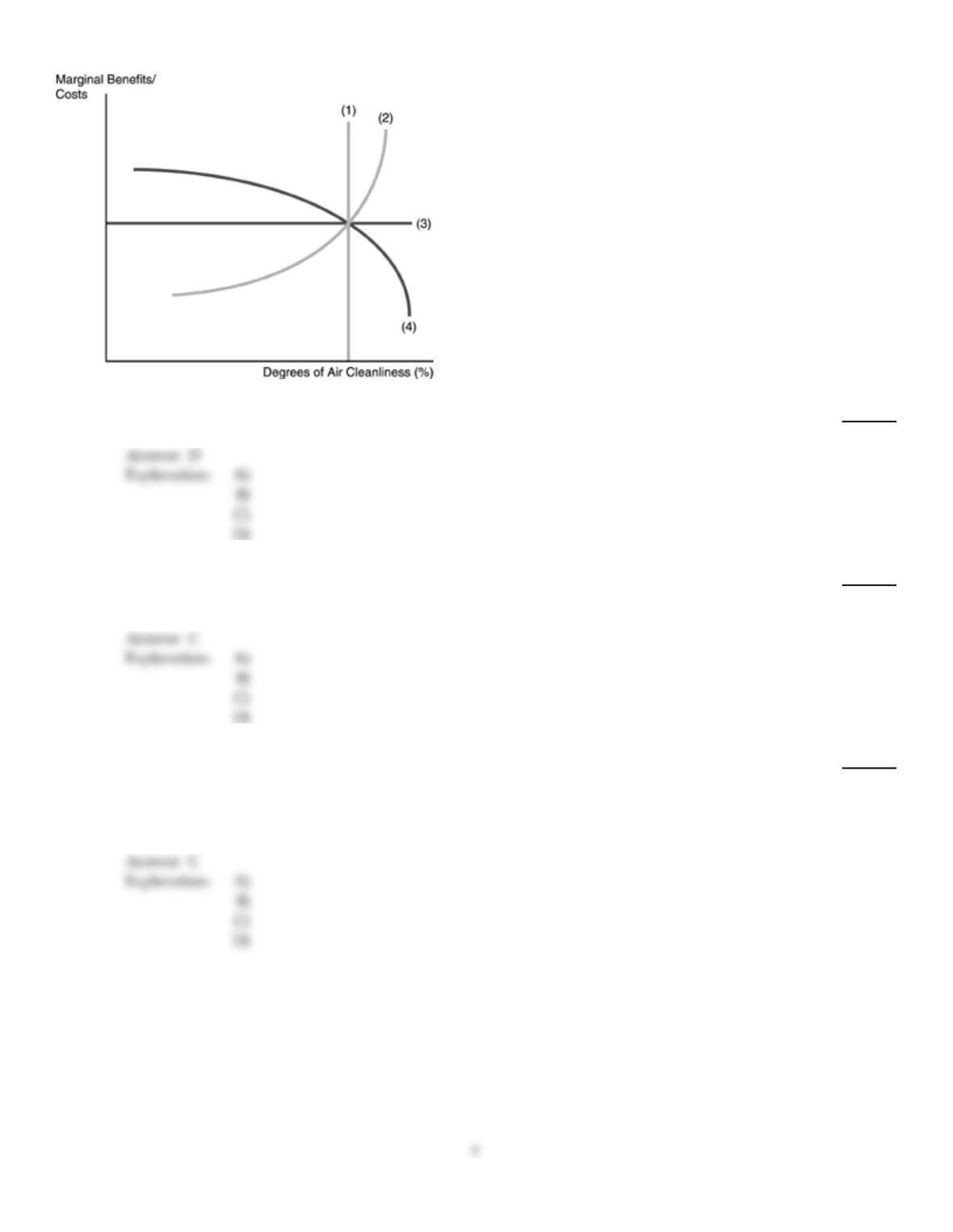
23)
Refer to the above figure. The marginal benefit of pollution abatement is curve
23)
A)
(1).
B)
(2).
C)
(3).
D)
(4).
24)
If a firm is not forced to pay for external costs, it will
24)
A)
request a subsidy from the government.
B)
raise prices.
C)
continue to overproduce the good.
D)
continue to under produce the good.
25)
Which of the following is TRUE about species in the world?
25)
A)
Most extinct species became extinct within the past 30 years.
B)
Extinct species became extinct only after human appeared.
C)
The majority of extinct species became extinct before humans appeared.
D)
No species has ever become extinct.
26)
Which of the following statements about pollution or pollution control is TRUE?
26)
A)
A tax to reduce pollution levels should be based on the economic damages rather than on the
absolute amount of pollution.
B)
The optimum amount of pollution abatement is where the total benefits of pollution
abatement equal the total costs of pollution abatement.
C)
A nationwide uniform tax on emissions is the appropriate way to reduce pollution levels.
D)
Private costs of pollution usually exceed social costs.
27)
A good that has external benefits associated with its production will be
27)
A)
overproduced.
B)
not produced.
C)
underproduced.
D)
produced at the optimal level.
28)
To efficiently improve environmental quality, it is usually
28)
A)
better to focus on the hardest areas to clean up first since these usually are the biggest
problems.
B)
best to set up stringent emission standards that must be followed by everyone.
C)
better to focus on economic damages rather than physical quantities of pollution.
D)
more appropriate to concentrate on the physical quantities of pollution rather than on
economic costs.
29)
Which type of property would be the most likely to experience pollution?
29)
A)
private property
B)
corporate property
C)
property held in partnership
D)
common property
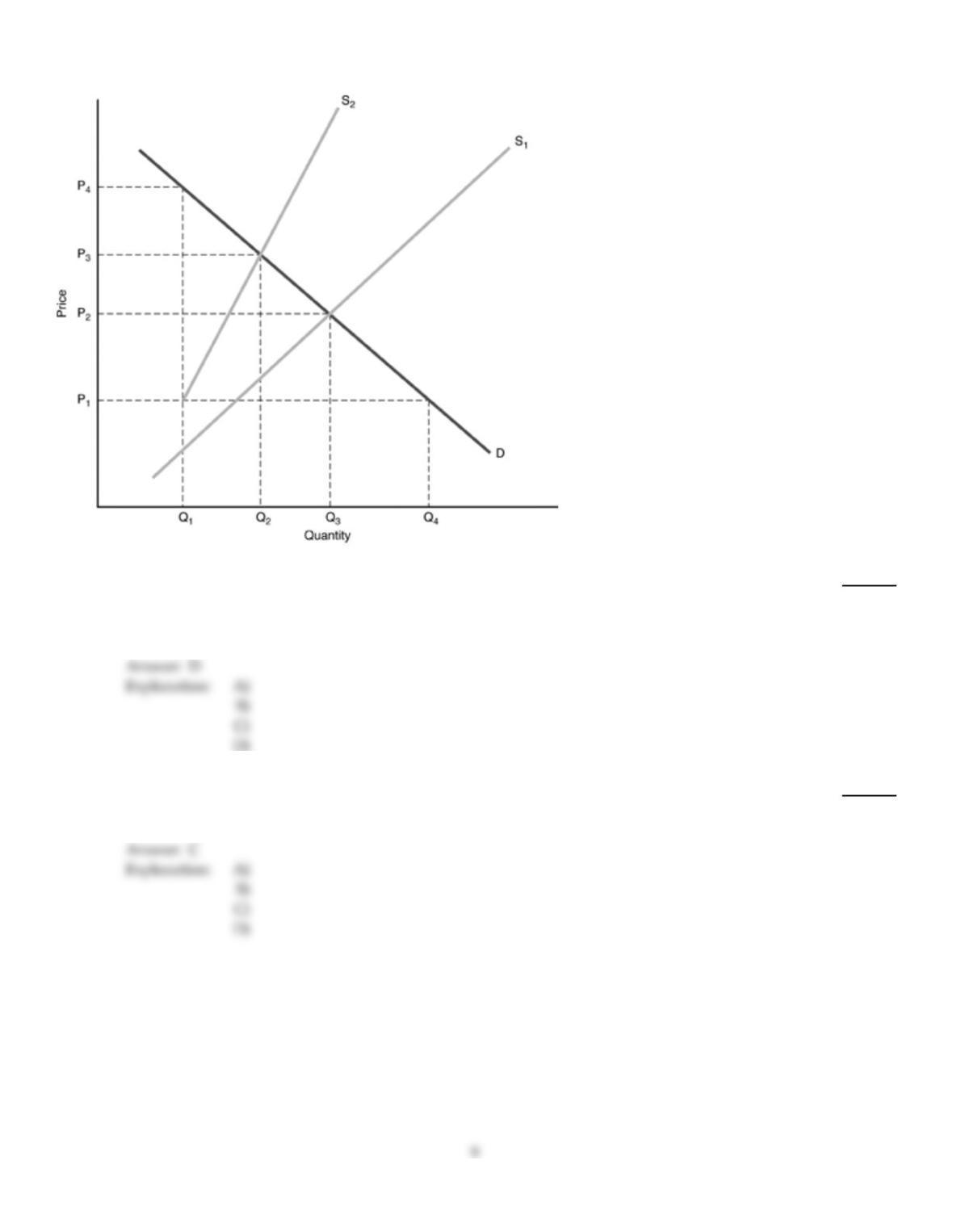
30)
In the above figure, S1 represents the supply curve which includes private costs, and S2 is the
supply curve which includes social costs. If the firm is producing a product that has external costs
that the firm does NOT have to pay, what will be the equilibrium price and quantity?
30)
A)
P1, Q4
B)
P3, Q2
C)
P4, Q1
D)
P2, Q3
31)
The Framework Convention on Climate Change took place in
31)
A)
the 2001 Doha Round.
B)
the 1987–1993 Uruguay Round.
C)
the 1997 Kyoto Protocol.
D)
the 1973–1979 Tokyo Round.
32)
Which of the following statements concerning pollution is correct?
32)
A)
Pollution should be reduced to the extent necessary to return production to the production
possibilities frontier.
B)
Economic efficiency requires that pollution be completely eliminated.
C)
Pollution should be reduced to the point at which the marginal benefit from further reduction
equals the marginal cost of further reduction.
D)
Economic efficiency dictates that the optimal amount of pollution arises at the point at which
price equals private marginal cost.
33)
If the social costs of refining oil are greater than the private costs of oil refining, then
33)
A)
the amount of oil refining needs to increase in order to bring social costs and private costs in
line with each other.
B)
there is too much oil refining.
C)
users of products that use refined oil are paying too much for the products.
D)
the external costs of oil refining are greater than the social costs of oil refining.
B
34)
If a person does not pay all costs associated with a particular resource–using activity, then
34)
A)
the external costs of the activity are greater than the internal costs of the activity.
B)
the full costs of the activity are the sum of private costs plus internal costs.
C)
the external costs of the activity are greater than the private costs of the activity.
D)
the social costs of the activity are greater than the private costs of the activity.
D
35)
The total costs of using a resource are made up of
35)
A)
social costs only.
B)
external costs only.
C)
internal and private costs only.
D)
private costs only.
A
C
36)
Suppose cars are taxed according to the amount of pollution they emit per gallon of gasoline
consumed. We would expect to observe all of the following EXCEPT
36)
A)
an increase in quantity demanded of more fuel–efficient cars.
B)
an increase in production of automobiles that were less polluting.
C)
an increase in quantity demanded of less–polluting automobiles and a reduction in quantity
demanded of more–polluting automobiles.
D)
an increase in the miles driven.
37)
Property owned by everyone (and thus no one in particular) is generally referred to as
37)
A)
natural property.
B)
social property.
C)
common property.
D)
private property.
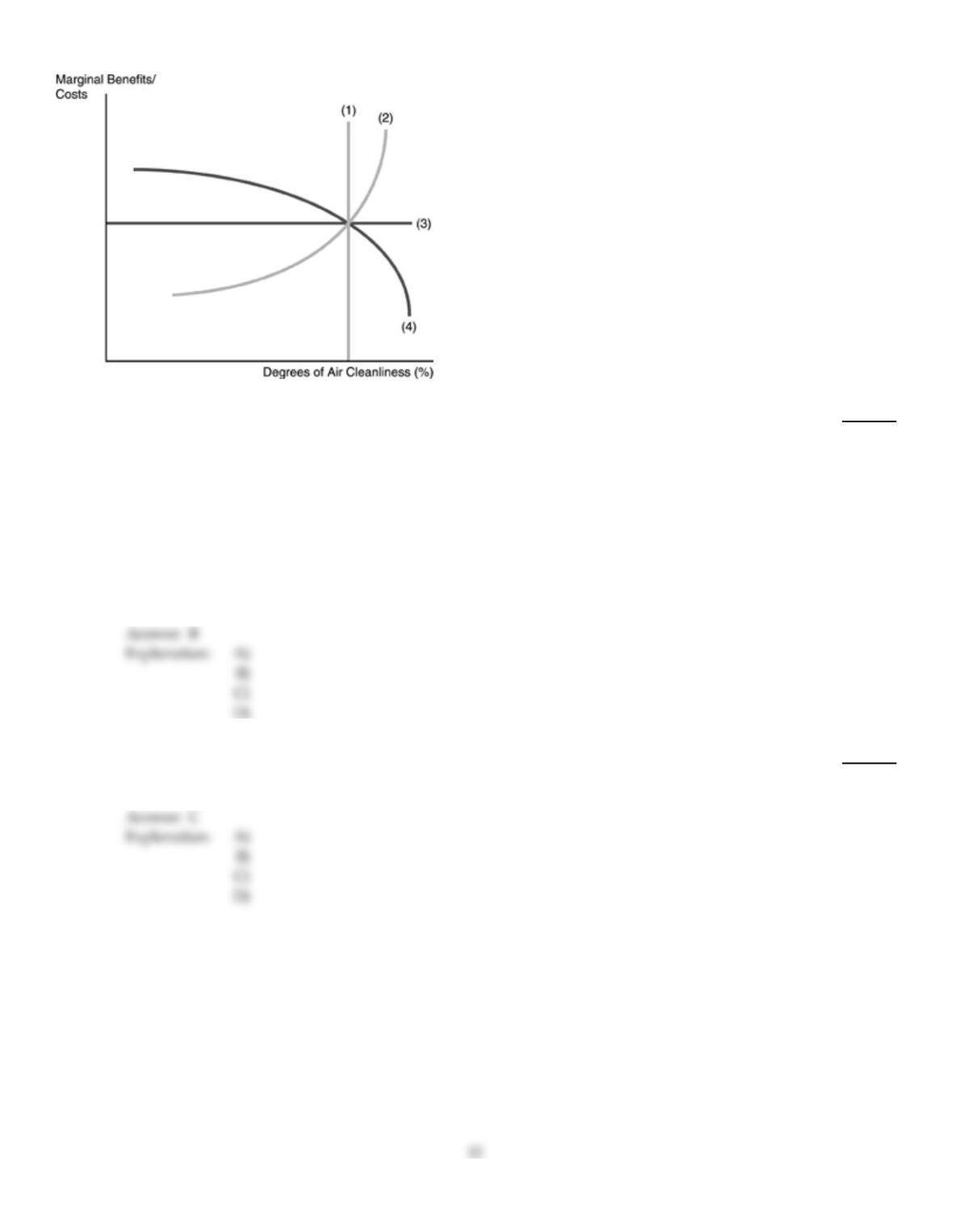
38)
Refer to the above figure. Suppose the marginal benefit and the marginal cost curves of pollution
abatement are normally shaped. Suppose the equilibrium is for a factory in Los Angeles. What
would happen if the same factory were in the middle of Nevada?
38)
A)
The marginal cost curve (2) would shift to the left and there would be less abatement in
Nevada.
B)
The marginal benefit curve (4) would shift to the left and there would be less abatement in
Nevada.
C)
The marginal benefit curve (2) would shift to the right and there would be more abatement in
Nevada.
D)
The marginal cost curve (1) would shift to (2) and there would be no difference in the level of
abatement.
39)
A social cost that is not fully paid by the individual using an automobile is
39)
A)
insurance.
B)
depreciation of the vehicle.
C)
traffic congestion.
D)
gasoline and oil.
40)
Which of the following is the main reason for externalities?
40)
A)
The production of public goods uses up scarce resources.
B)
the lack of organized exchanges for all goods and services
C)
The full cost of a transaction is not borne by the buyer/seller of the product.
D)
Police enforcement of scalping is not uniformly enforced.
41)
An externality refers to the idea that
41)
A)
explicit costs differ from implicit costs.
B)
we cannot do anything that does not affect other people.
C)
private and internal costs differ.
D)
decision–makers do not internalize all the costs.
42)
Participating nations in the 1997 Kyoto Protocol agreed to reduce overall greenhouse gases
emission through 2020 to
42)
A)
as much as 50 percent below the levels in the 1990s.
B)
as much as 50 percent below the levels in the 1960s.
C)
as much as 20 percent below the levels in the 1990s.
D)
as much as 5 percent below the levels in the 1990s.
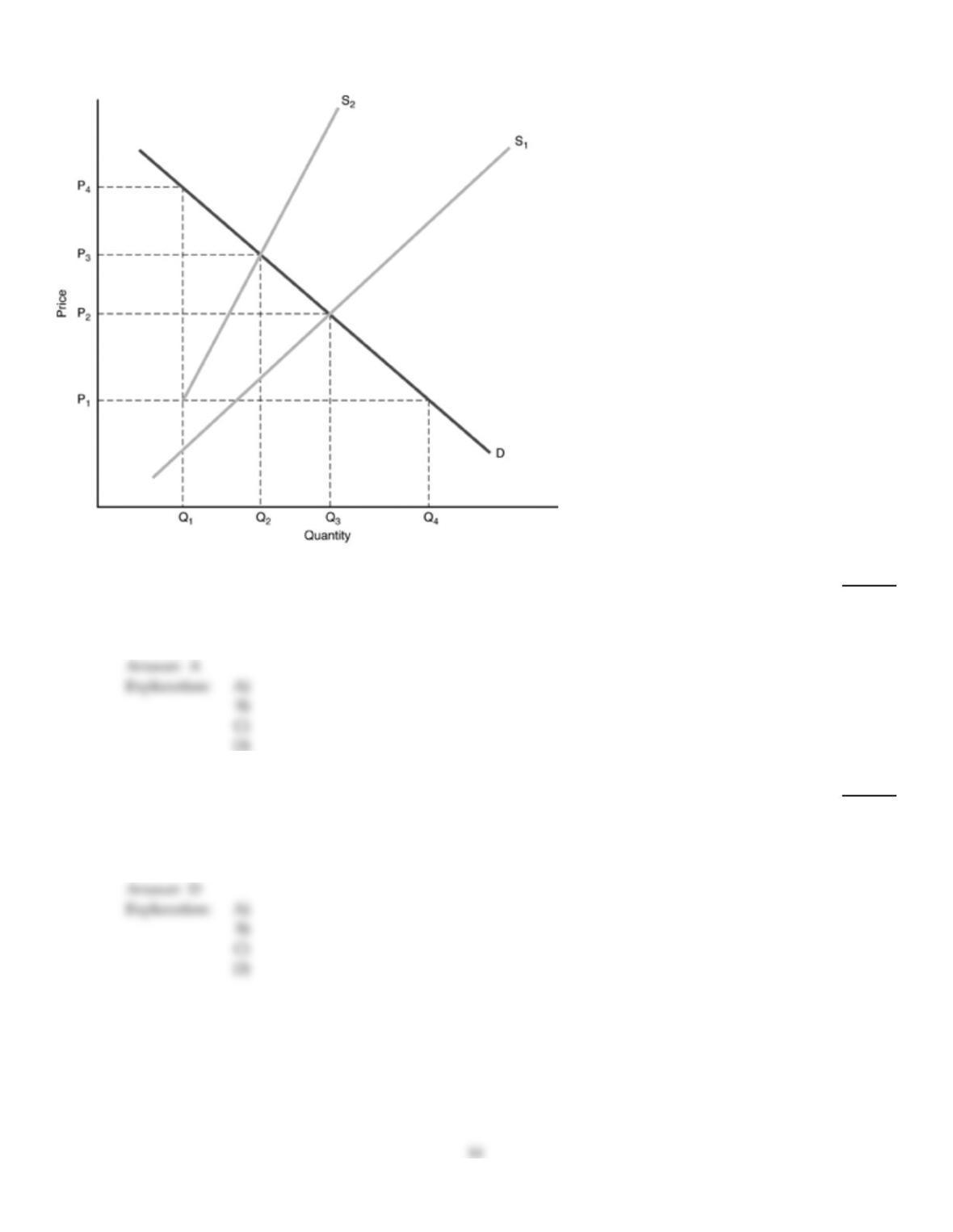
43)
In the above figure, S1 represents the supply curve which includes private costs, and S2 is the
supply curve which includes social costs. If the firm is producing a product that has external costs
that the firm does have to pay, what will be the equilibrium price and quantity?
43)
A)
P3, Q2
B)
P2, Q3
C)
P1, Q4
D)
P4, Q1
44)
Which of the following is FALSE?
44)
A)
Pollution is a social cost.
B)
If social costs are greater than private costs, “too much” of a good is being produced.
C)
Private costs do not include external costs.
D)
Social costs do not include private costs.
45)
In principle, a cap–and–trade program would
45)
A)
raise the production costs of all firms.
B)
cause firms to generate less pollution than their allowed limits.
C)
lower the production costs of all firms.
D)
cause firms to generate more pollution than their allowed limits.
46)
Social costs are
46)
A)
borne by individuals who incur them.
B)
costs that are borne by the government.
C)
the full cost borne by society whenever a resource use occurs.
D)
another term for external costs.
47)
Which of the following was signed in the Kyoto Protocol?
47)
A)
the Treaty on Global Warming
B)
the Framework Convention on Climate Change
C)
the Zero Greenhouse Gas Agreement
D)
the Emission Trading Scheme
48)
All of the costs associated with making and enforcing contracts are referred to as
48)
A)
alternative costs.
B)
opportunity costs.
C)
transactions costs.
D)
marginal costs.
49)
In which of the following externality situations would it be most likely that voluntary agreements
could be used to internalize an externality?
49)
A)
overharvesting of alligators in Louisiana
B)
littering on highways
C)
poaching of elephants in Africa
D)
trees of one neighbor blocking a view of another
50)
In order to internalize the externality due to pollution, the government should impose a tax based
on
50)
A)
the physical amount of pollution.
B)
the value of the pollution–causing business activity.
C)
the economic damage associated with the pollution.
D)
the size of the firm causing the pollution.
51)
Private costs are
51)
A)
costs borne solely by the individuals who incur them.
B)
external costs borne by private firms.
C)
costs borne by private members of society rather than governmental bodies.
D)
explicit costs rather than implicit costs.
52)
Which of the following is NOT a private cost?
52)
A)
the coffee pot that Jan dropped and broke this morning
B)
the pollution caused by a firm dumping its wastes into the river
C)
the amount that a firm must pay for raw materials to make its product
D)
the health insurance costs a firm must pay for its employees
53)
If crop dusting on your farm causes your neighbors to have sore throats, then crop dusting is
creating
53)
A)
only explicit costs.
B)
internal costs.
C)
external costs.
D)
opportunity costs.
54)
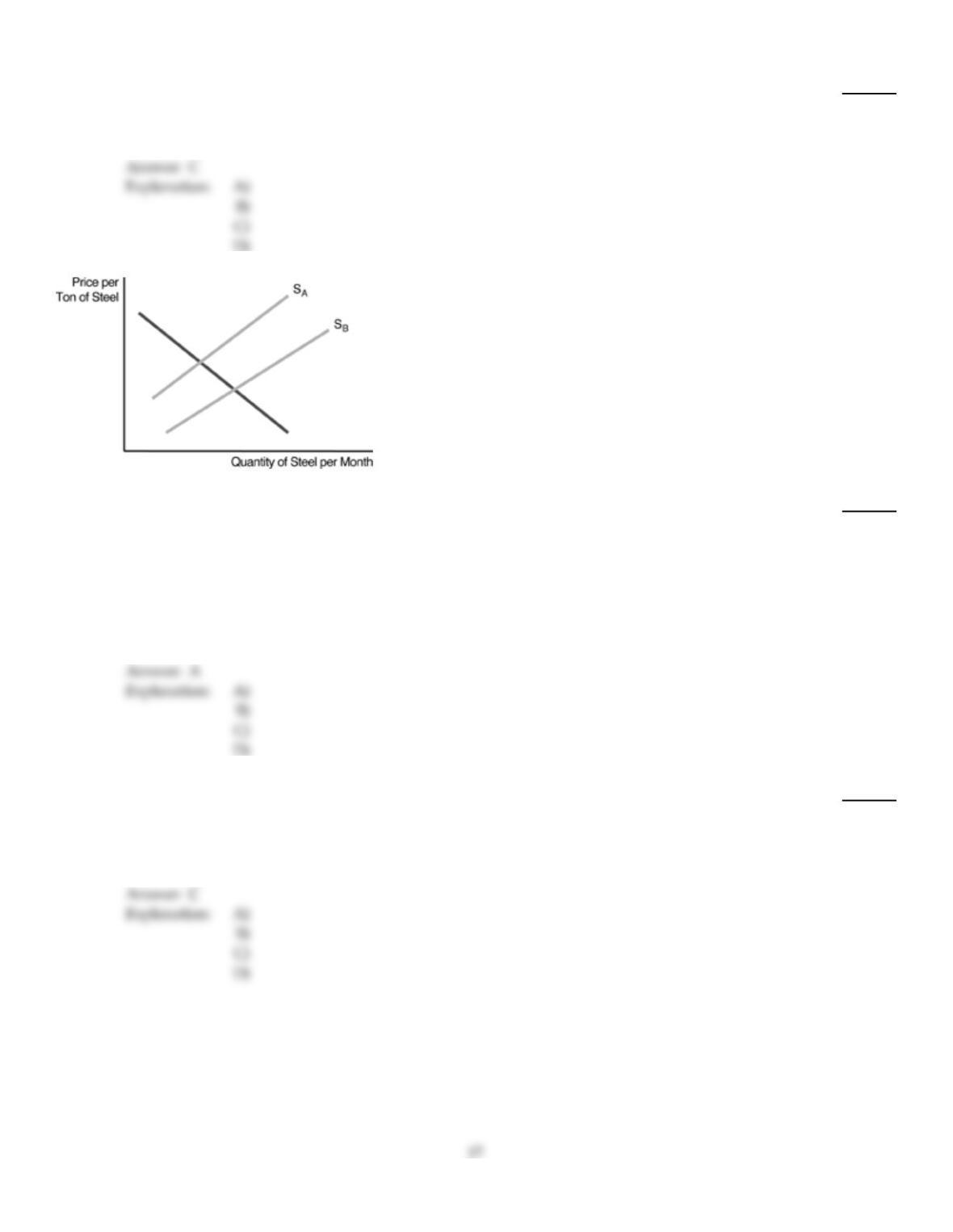
Refer to the above figure. It represents supply and demand for The Black Ash Steel Company’s
output. The firm’s plant belches large quantities of smelly fumes and black ash into the air.
Residents in the surrounding area have higher medical bills as a result. If the firm is forced to pay
the full social cost of its production, what will occur?
54)
A)
The company’s supply curve will shift from SB to SA.
B)
Black Ash will increase its own output to cover the cost increase.
C)
Black Ash’s supply curve will shift from SA to SB.
D)
Demand for the firm‘s steel will shift to the left.
55)
Generally, as levels of pollution are reduced
55)
A)
marginal costs from the reduction decrease.
B)
marginal benefits from the reduction increase.
C)
marginal benefits from the reduction decrease.
D)
marginal cost from the reduction are constant.
56)
A person removes the anti–pollution devices on his automobile. An external cost associated with
this is
56)
A)
the man buys less gasoline, reducing the income of local gas stations.
B)
the ticket he gets when a highway patrol officer pulls him over.
C)
the man’s neighbor washes his car more often because of increasing smog.
D)
the feeling of guilt the person feels for violating the law.
57)
Which of the following would be viewed as a common property problem?
57)
A)
To be safe you must lock your door at night.
B)
Vandals damage your property.
C)
Your property is burglarized.
D)
People pick all of the flowers in a public park.
58)
The Black Ash Steel Company’s plant belches large quantities of noxious fumes and black ash into
the air. Residents in the surrounding area have higher medical bills because of Black Ash’s
pollution. If the firm is forced to pay the social costs of its production
58)
A)
it will produce less and charge more for its steel.
B)
the amount of steel it produces will increase in order to pay the additional costs.
C)
the price it charges for its steel will decrease.
D)
its supply curve will shift to the right.
59)
The best method to reduce pollution is
59)
A)
to establish private property rights.
B)
dependent upon the characteristics of the resources and the transaction costs.
C)
dependent upon the quality of government bureaucrats and the level of greed in the society.
D)
to never start polluting.
60)
In general, pollution exists if
60)
A)
there are poorly defined common property rights.
B)
people are unconcerned about the hazards associated with pollution.
C)
there are poorly defined private property rights.
D)
profit–making activity is taken to an extreme.
Output/Hour Private MC Marginal Benefit External Marginal Costs
1$10 $20 0.20
210.40 18.50 0.40
310.90 17 0.70
411.50 16.50 1.20
512.20 14.00 1.80
613.00 13.00 2.80
714.40 12.00 4.00
61)
Use the information in the above table. The external marginal costs are
61)
A)
decreasing.
B)
inverse to quantity produced.
C)
increasing.
D)
constant.
Quantity of Marginal Marginal
Clean Air (%) Cost ($) Benefit ($)
0 10,000 100,000
25 25,000 50,000
50 37,500 37,500
75 75,000 25,000
100 Infinite 0
62)
The above table shows marginal costs and marginal benefits of clean air in a particular industrial
area. In the table, when the quantity of clean air is at 75 percent
62)
A)
the quantity of clean air is optimal.
B)
the marginal benefit of clean air is less than the marginal cost.
C)
the marginal benefit of clean air exceeds the marginal cost.
D)
the quantity of polluted air is 75 percent.
63)
The EU Emission Trading Scheme created a market for
63)
A)
marijuana.
B)
devices that lower the global temperature.
C)
permits to emit greenhouse gases.
D)
cigarettes.
64)
John raises bees to pollinate his orchard. A couple of bees which escaped ended up pollinating his
neighbor’s orchard, so
64)
A)
John’s neighbor has received an external cost of John’s bee–keeping.
B)
John’s neighbor has received an external benefit of John’s bee–keeping.
C)
John’s neighbor has received an internal cost of John’s bee–keeping.
D)
None of the above is correct.
65)
By adding internal costs to external costs, we determine the total
65)
A)
marginal cost.
B)
social cost.
C)
psychological cost.
D)
private cost.
66)
In economic analysis, the optimal level of pollution
66)
A)
occurs at the point at which demand crosses the private cost supply curve.
B)
arises at the point at which the marginal benefit from further reduction equals the marginal
cost of further reduction.
C)
should be determined by the private market without any government intervention.
D)
is always zero.