283)
Which of the following is NOT considered a determinant of income differences?
283)
A)
equity or fairness
B)
productivity
C)
age
D)
discrimination
284)
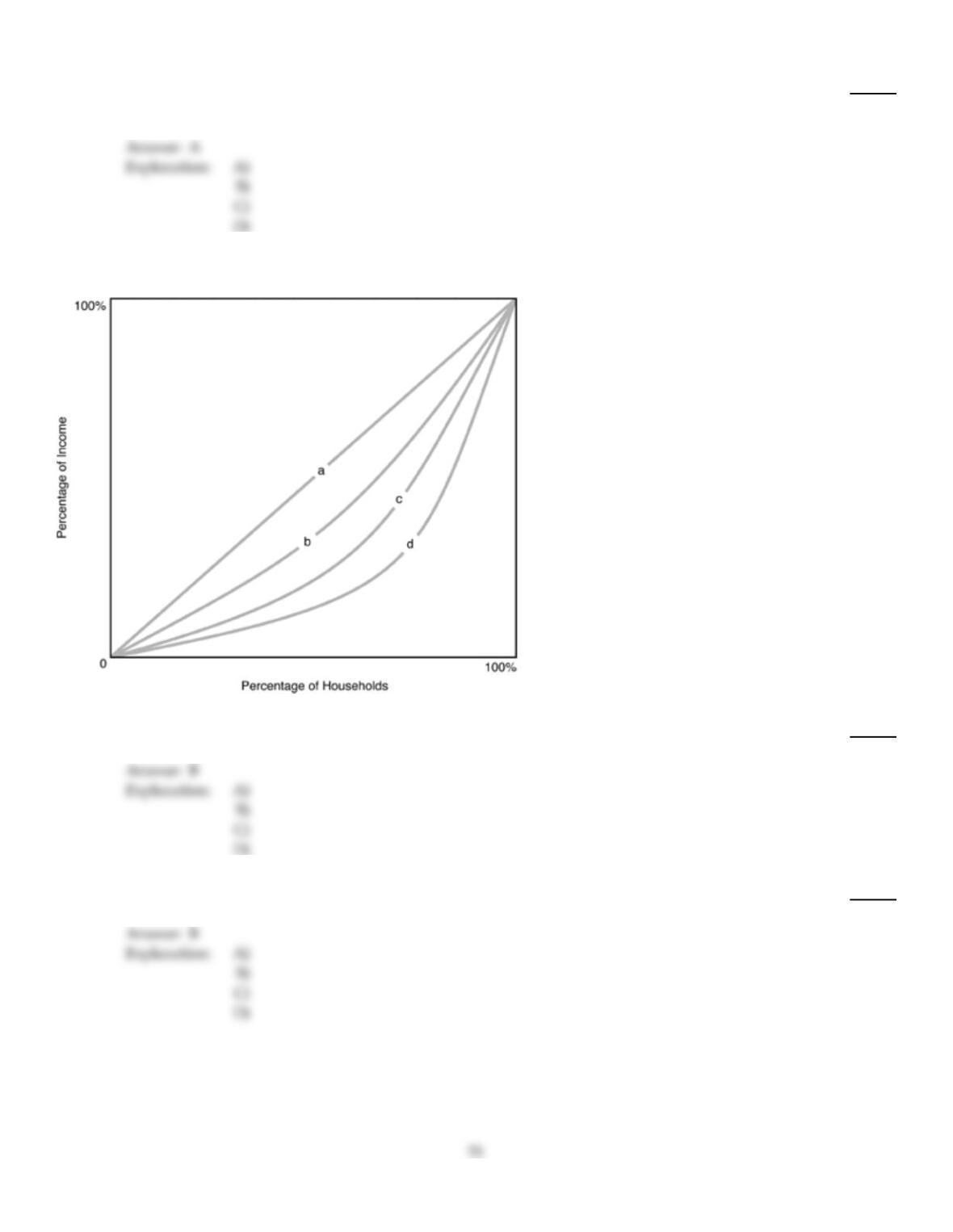
In the above figure, the curve that represents the second most income equality is
284)
A)
a.
B)
b.
C)
c.
D)
d.
285)
Which of the following does NOT contribute to the marginal productivity of workers?
285)
A)
experience
B)
discrimination
C)
talent
D)
education
286)
In an attempt to reduce the poverty rate, there has recently been a movement away from income
maintenance programs to
286)
A)
encouraging people to get jobs.
B)
reducing the age a person can retire at.
C)
incorporating the Lorenz policy in decisions.
D)
Supplemental Security Income programs.
ESSAY. Write your answer in the space provided or on a separate sheet of paper.
287)
Earnings usually reflect a person’s productivity. What are factors that cause differences in productivity across
people so that earnings differ too?
288)
Some economists argue that the official poverty figures overstate poverty in this country. Why?
289)
Describe four of the five major income maintenance programs in the United States that were discussed in the
text.
290)
How can absolute poverty be eliminated? How can relative poverty be eliminated? Does the elimination of one
lead to the elimination of the other? Explain.
291)
Why doesn’t the age–earning cycle continuously increase until retirement age?
292)
What are the major criticisms of the Lorenz curve?
293)
Suppose there is a high inequality in household income between the highest and the lowest income groups in
one country. In response, the government raises the income tax for the highest income group and provides
subsidies to the lowest–income group. What would happen to the Lorenz curve as a result of the government
programs? Explain.
294)
Why have health care costs risen so much in recent years?
295)
How is moral hazard related to health care?
296)
“The typical age–earning cycle provides evidence of economic discrimination by age.” Do you agree or
disagree? Why?
297)
Compare and contrast the two normative standards to income distribution discussed in the text: The
productivity standard and the egalitarian principle.
298)
How does the distribution of wealth differ from the distribution of income in the United States?
299)
What is the age–earnings cycle? What is the typical age–earnings profile for a U.S. resident?
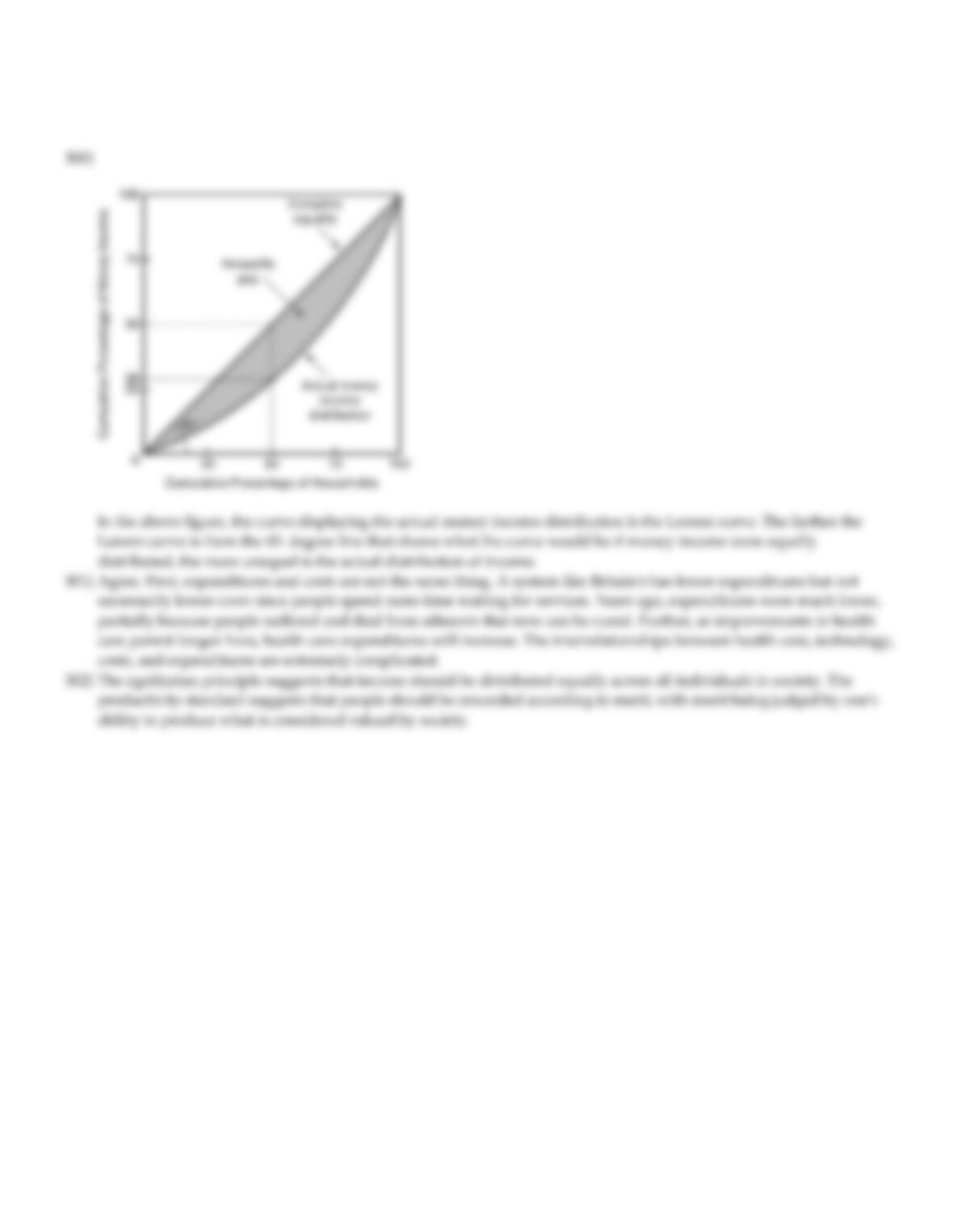
300)
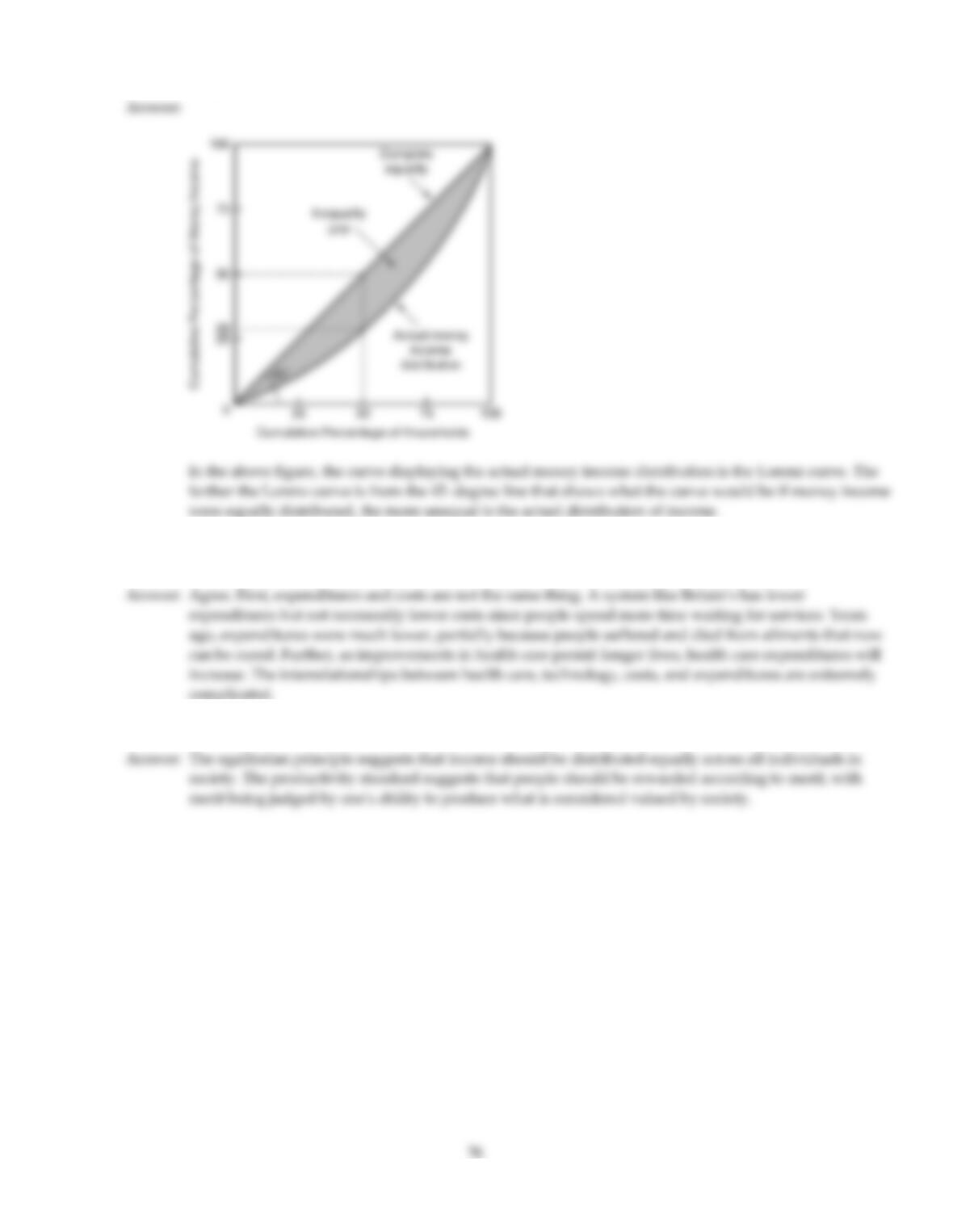
Draw and explain a Lorenz curve.
301)
“It is difficult to compare over time health care expenditures, costs, and output.” Do you agree or disagree?
Why?
302)
Explain the two theories of desired income distribution: the egalitarian principle and the productivity standard.

Answer Key
Testname: C30

78

Answer Key
Testname: C30

Answer Key
Testname: C30

Answer Key
Testname: C30
Answer Key
Testname: C30
82
Answer Key
Testname: C30
83
Answer Key
Testname: C30
84