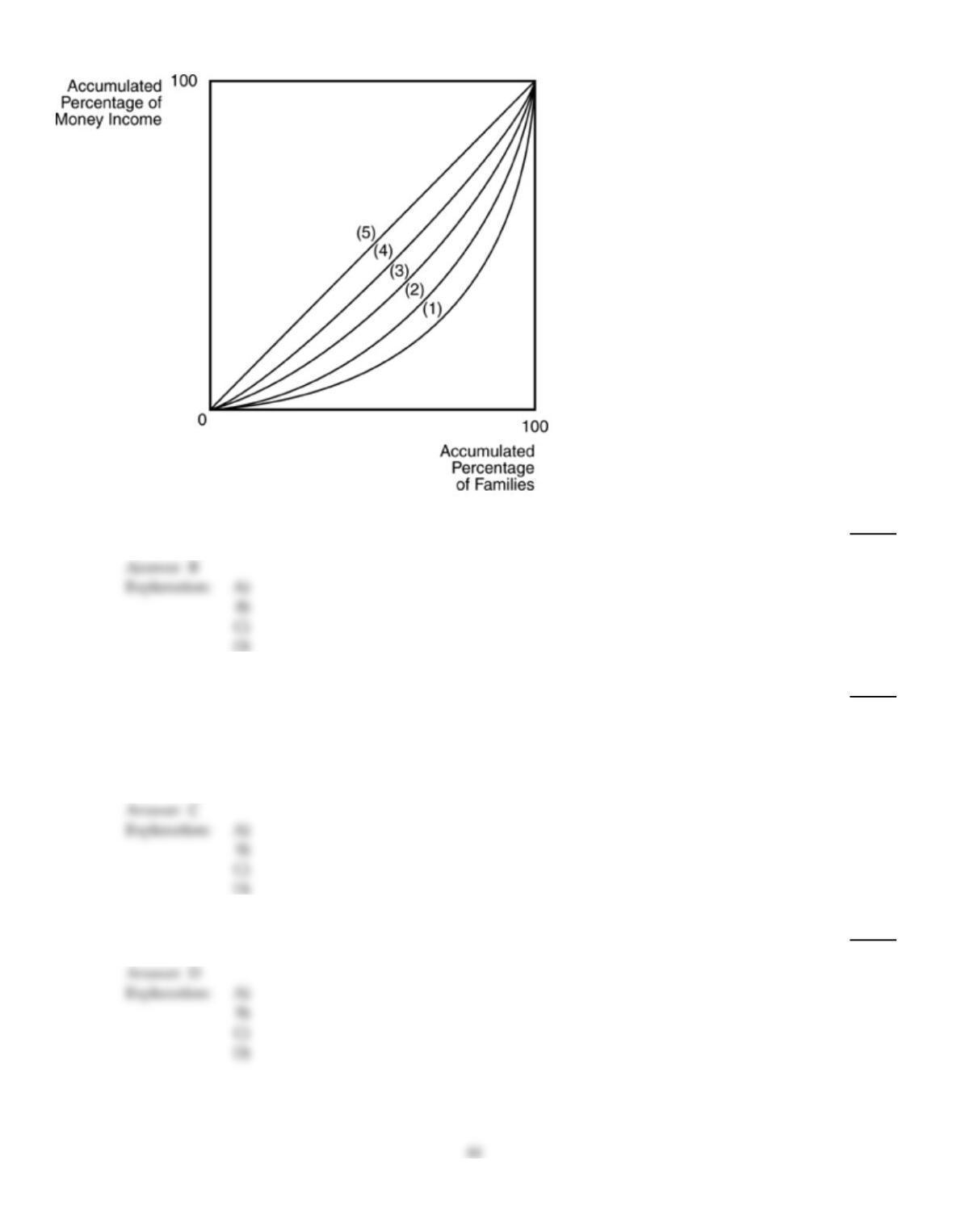
240)
The country reflecting perfect income equality in the above figure is
240)
A)
country 3.
B)
country 5.
C)
country 1.
D)
country 4.
241)
Which of the following income maintenance programs is designed to establish nationwide
minimum incomes for the aged, the blind, and the disabled?
241)
A)
the food stamps program
B)
the Temporary Assistance to Needy Families (TANF) program
C)
the Supplemental Security Income (SSI) program
D)
the Old–Age Survivors’ and Disability Insurance (OASDI) program
242)
On average the productivity of an individual usually peaks when the individual is about
242)
A)
20.
B)
60.
C)
30.
D)
50.
243)
In the absence of discrimination, as human capital investments increase, wages will generally
243)
A)
not change.
B)
increase.
C)
decrease.
D)
increase or decrease.
244)
Marginal productivity theory would suggest that
244)
A)
all workers should be paid the same wage.
B)
workers cannot do anything to improve their wage prospects for the future.
C)
labor demand will have no impact on the wage paid.
D)
higher productivity will increase the market wage of an individual.
245)
Since the 1930s, out–of–pocket payments for health care have
245)
A)
declined from about 95 to 20 percent of total payments.
B)
not changed and remain at 70 percent of total payments.
C)
declined from about 70 to 30 percent of total payments.
D)
declined from about 50 to 30 percent of total payments.
246)
All of the following contribute to income inequality EXCEPT
246)
A)
government transfer programs.
B)
differences in job tastes.
C)
differences in education and training.
D)
differences in talent.
247)
One problem with third–party financing of health care is that
247)
A)
demand falls so that suppliers cannot take advantage of economies of scale.
B)
people have more incentive to utilize health care.
C)
it discourages people from relying on their physicians’ advice in making health care
decisions.
D)
it reduces the quality of health care people receive.
248)
The purpose of the Supplemental Security Income program is
248)
A)
to provide a guaranteed minimum income for all Americans.
B)
to provide a minimum income for all households with children.
C)
to provide a minimum income for the aged, blind, and the disabled.
D)
to supplement Social Security for the elderly with medical problems.
249)
Which of the following statements about the Social Security (OASDI) program is FALSE?
249)
A)
Benefits are paid to individuals who would be financially secure in their absence.
B)
When an insured worker dies, benefits continue for widows or other dependents.
C)
Benefits are an intergenerational transfer program from those who work to those who don’t
work.
D)
Benefits are based on need.
250)
The productivity standard for the distribution of income can be thought of as
250)
A)
rewarding people according to their ability to produce useful goods.
B)
benefiting only the least productive worker.
C)
rewarding only the wealthy.
D)
proving that egalitarians are correct.
251)
The main cost of a college education is
251)
A)
tuition if one goes to a private college and room and board if one goes to a public college.
B)
the lack of practical experience from spending time in college.
C)
the opportunity cost of not working.
D)
dependent upon whether one’s parents pay for the college or not.
252)
The age–earning cycle
252)
A)
is an earnings profile of an individual throughout his or her lifetime.
B)
depicts differences in the relationship between age and earnings across countries.
C)
shows the earnings differences by age and by gender.
D)
shows the average incomes of people broken down by age categories.
253)
Other things being equal, a national health insurance program would
253)
A)
increase the quality of life.
B)
generate higher life expectancies and lower infant mortality rates.
C)
generate lower life expectancies and higher infant mortality rates.
D)
increase total health care expenditures.
254)
The egalitarian principle refers to
254)
A)
“To each exactly the same.”
B)
“To each according to her need.”
C)
“To each according to her productivity.”
D)
“To each according to his ability.“
255)
In insurance markets, moral hazard occurs when the behavior of
255)
A)
the insurer changes in a way that raises costs for the insured person, since the insurer no
longer bears the full costs of that behavior.
B)
the insured person changes in a way that eliminates rising health care costs for the insurer,
since the insured person no longer bears the full costs of that behavior.
C)
the insured person has an incentive to under consume medical services, simply because the
insured person no longer bears the full cost of medical services.
D)
the insured person changes in a way that raises costs for the insurer, since the insured person
no longer bears the full costs of that behavior.
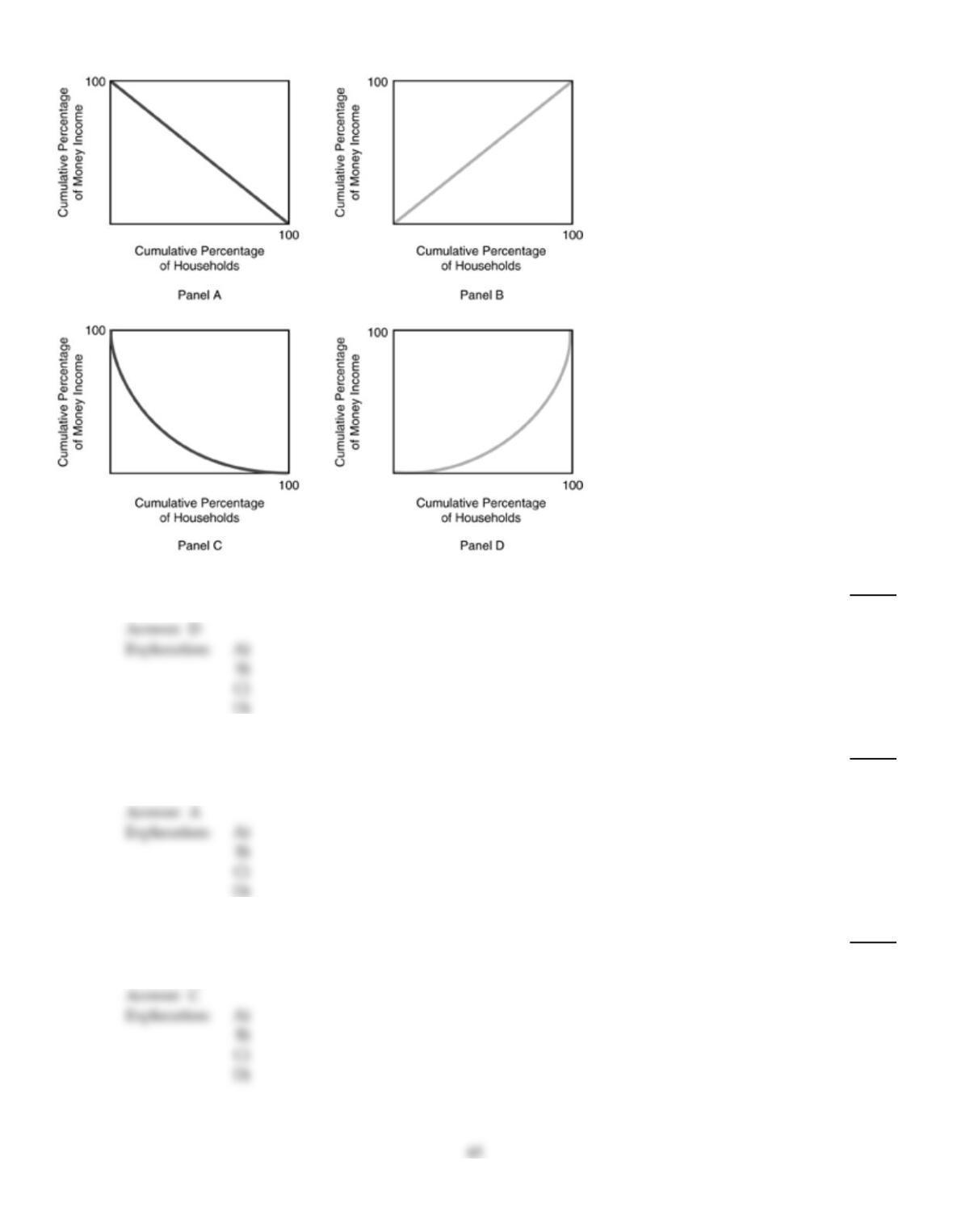
256)
Refer to the above figure. Which of the above graphs represents an unequal income distribution?
256)
A)
Panel A
B)
Panel B
C)
Panel C
D)
Panel D
257)
The way income is allocated among the population is called the
257)
A)
distribution of income.
B)
income spread.
C)
Gini allocation.
D)
income curve.
258)
The 45° line on a Lorenz curve represents
258)
A)
complete wealth equality.
B)
complete income inequality.
C)
complete income equality.
D)
complete wealth inequality.
259)
Income is considered to be a
259)
A)
nontaxable stream of funds.
B)
stock.
C)
flow.
D)
resource.
260)
An important contributor to rising U.S. health care costs in recent years is
260)
A)
an easing of standards at medical schools that has permitted unqualified people to become
physicians.
B)
the aging of the population.
C)
less interest on the part of Americans to stay physically fit.
D)
the increasing proportion of the population that smokes.
B
261)
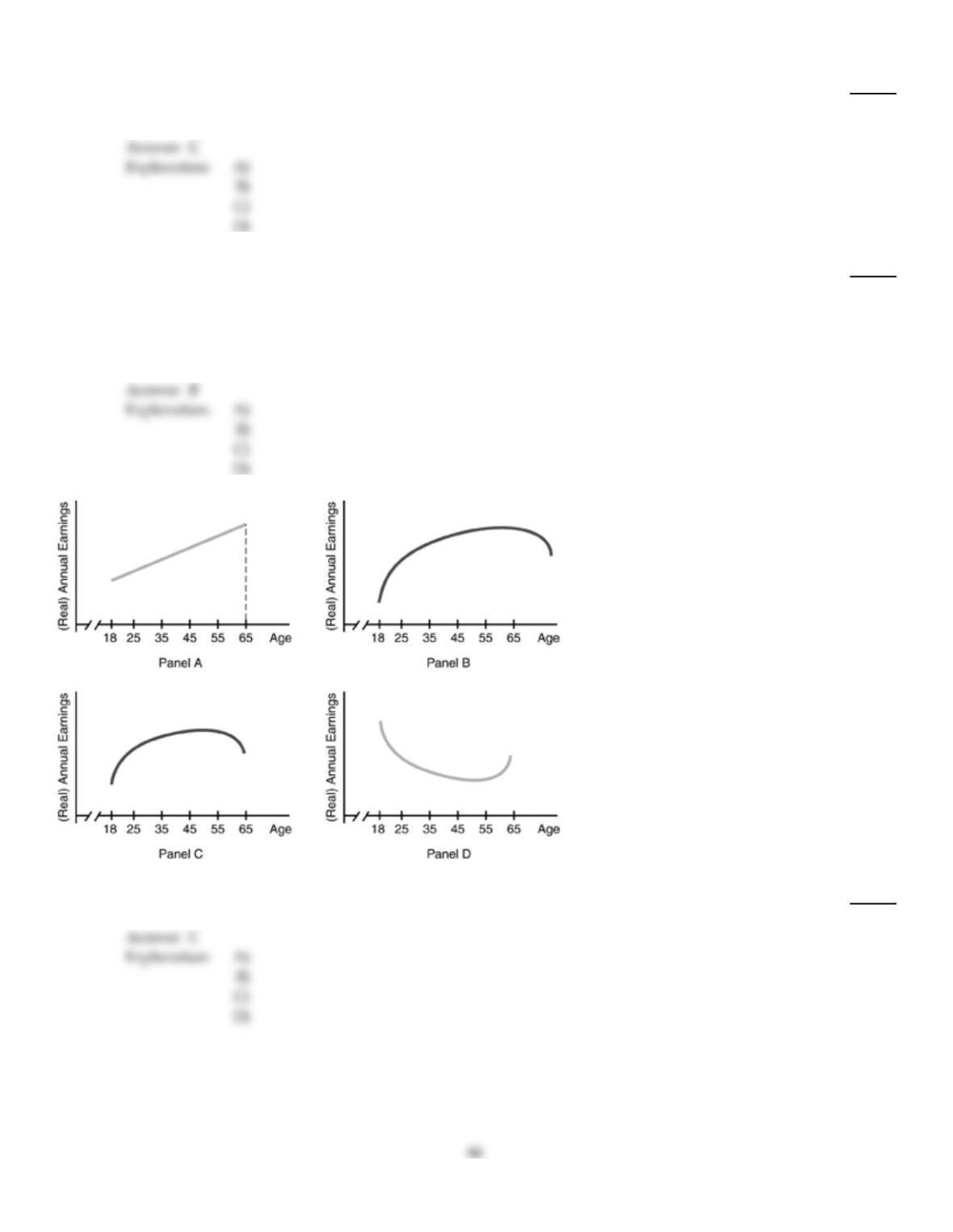
Refer to the above figure. Which of the graphs are consistent with the age–earnings profile?
261)
A)
Panel A
B)
Panel B
C)
Panel C
D)
Panel D
C
C
262)
The Lorenz curve is a geometric representation of
262)
A)
the profile of earnings for a “typical” family over time.
B)
the distribution of income.
C)
the standard of living experienced by the poor in a country.
D)
the difference between pre–tax and post–tax income.
263)
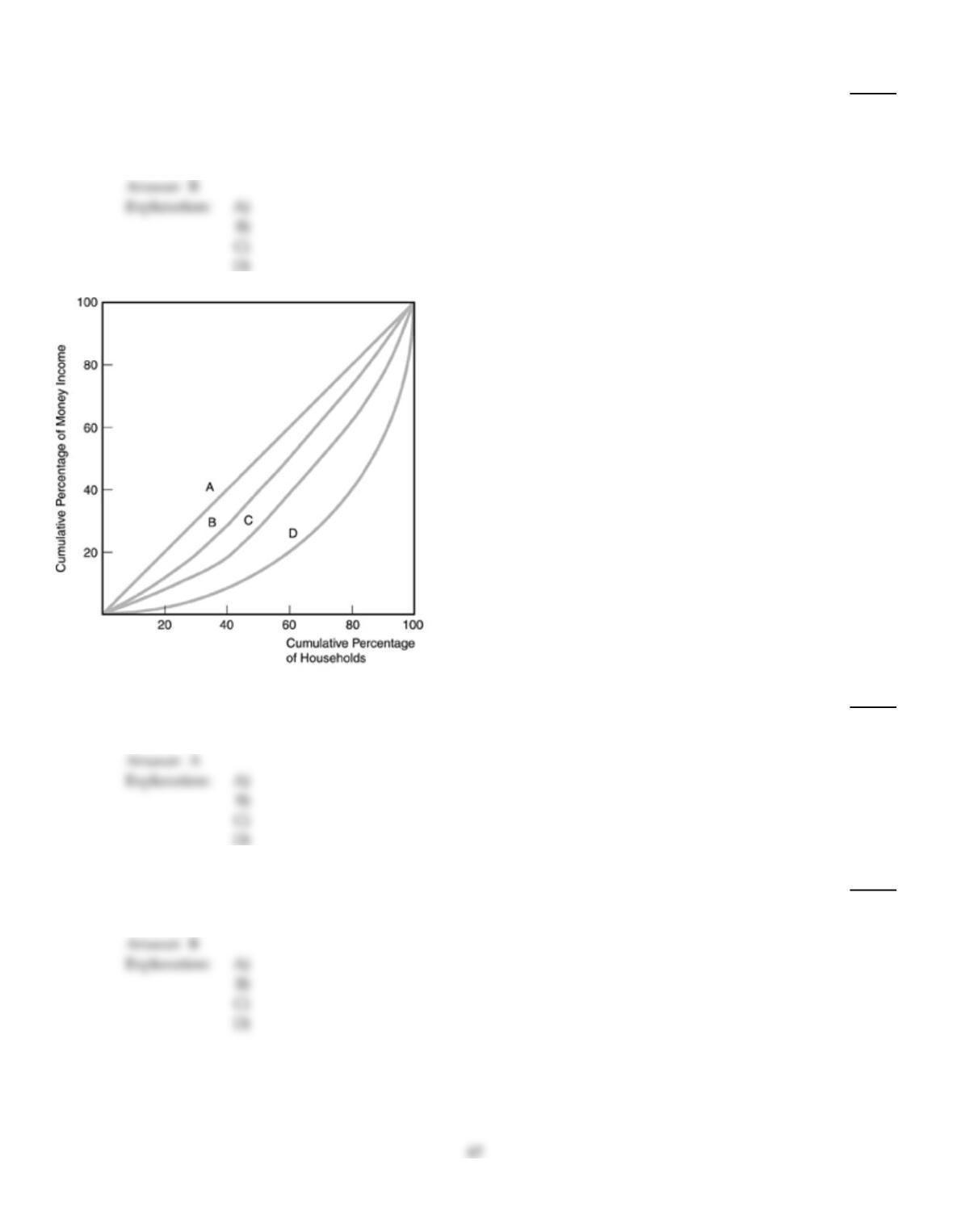
The above figure displays
263)
A)
Lorenz curves.
B)
Laffer curves.
C)
Gini Coefficients.
D)
income–inequality curves.
264)
All of the following are income in kind EXCEPT
264)
A)
government provided medical aid.
B)
income received from family members.
C)
services produced in the home.
D)
government provided food stamps.

265)
The impact of technology on health care has
265)
A)
increased health care costs.
B)
provided for a higher quality of life.
C)
contributed to increased life expectancy.
D)
All of the above are correct.
266)
Which country has the highest per capita health care expenditures in the world?
266)
A)
United States
B)
Canada
C)
France
D)
Japan
267)
The funds paid to the government today for Social Security taxes are
267)
A)
used to pay the benefits of those who are currently retired.
B)
invested to provide for the future benefits of the taxpayers.
C)
used by the government to purchase goods and services that will enhance the future
productivity of business in the country.
D)
saved to ensure sufficient resources in the future to pay the benefits of workers today when
they reach retirement age.
268)
Determinants of the marginal productivity of labor include all of the following EXCEPT
268)
A)
education.
B)
experience.
C)
location.
D)
talent.
269)
Which of the following statements are correct about the age–earnings cycle?
269)
A)
Earnings increase throughout a prison’s lifetime until they reach retirement.
B)
Earnings generally increase up till age 30 and then steadily decrease.
C)
Since every person is different we can reach no general conclusions about the age–earnings
cycle.
D)
Earnings increase with age because workers become more productive as they age until
around 50 years. Around 50 the effects of aging outweighs the further increases in
productivity.
270)
Official poverty rates in the last 40 years have
270)
A)
fallen dramatically.
B)
stayed roughly the same.
C)
been eliminated.
D)
risen dramatically.
271)
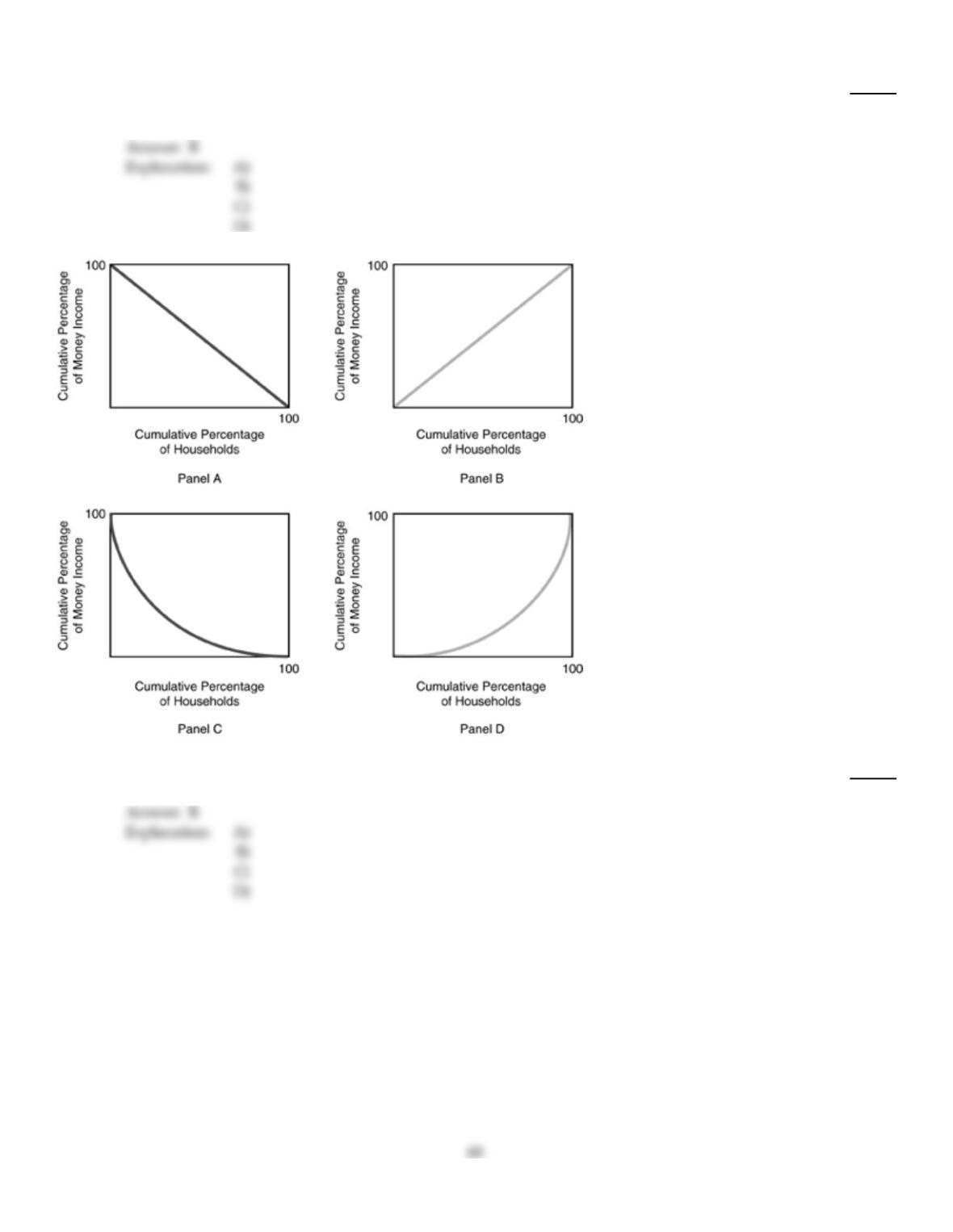
Refer to the above figure. Which of the above panels represents complete income equality?
271)
A)
Panel A
B)
Panel B
C)
Panel C
D)
Panel D
272)
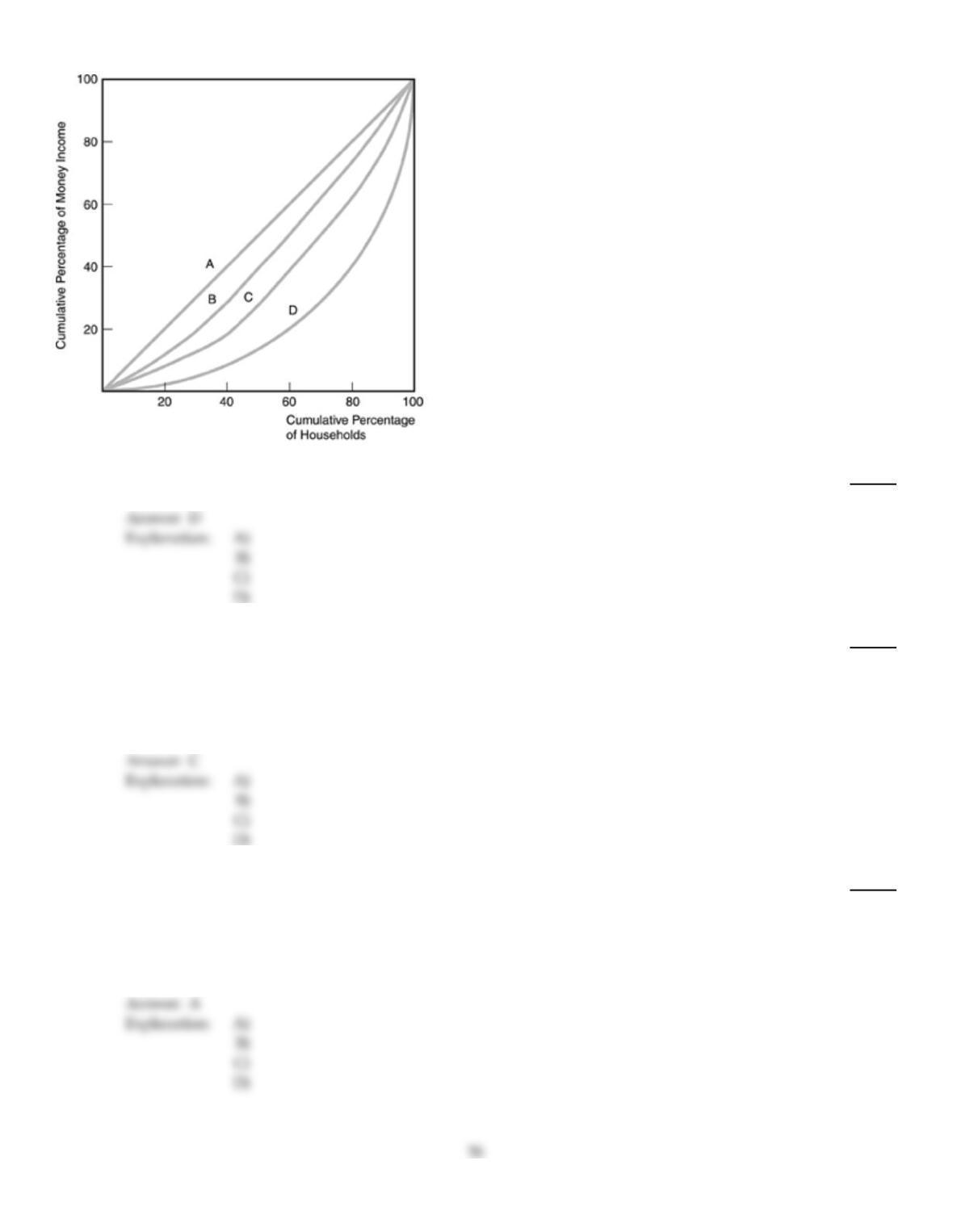
Refer to the above figure. Which curve shows the most unequal distribution of income?
272)
A)
A
B)
B
C)
C
D)
D
273)
Suppose 10 percent of the families receive 10 percent of the income, 20 percent of the families
receive 20 percent of the income, and so forth. The Lorenz curve would be
273)
A)
the horizontal axis.
B)
a straight line at a 30–degree angle from the origin.
C)
a straight line at a 45–degree angle from the origin.
D)
the most bowed curve possible.
274)
Current income maintenance programs
274)
A)
reduce the incentive of recipients to work.
B)
fail to make the income distribution more equal.
C)
have safeguards to ensure that recipients work whenever physically able.
D)
often provide benefits to people who are working and earning substantially more than the
poverty level.
275)
When comparing the distribution of wealth to the distribution of income, it can be noted that
275)
A)
the measurement of income is much less accurate than the measurement of wealth.
B)
the distributions are about the same.
C)
wealth does not generate income.
D)
the measurement of wealth is much less accurate than the measurement of income.
276)
Wealth is considered to be a
276)
A)
nontaxable stream of funds.
B)
stock.
C)
flow.
D)
resource.
B
277)
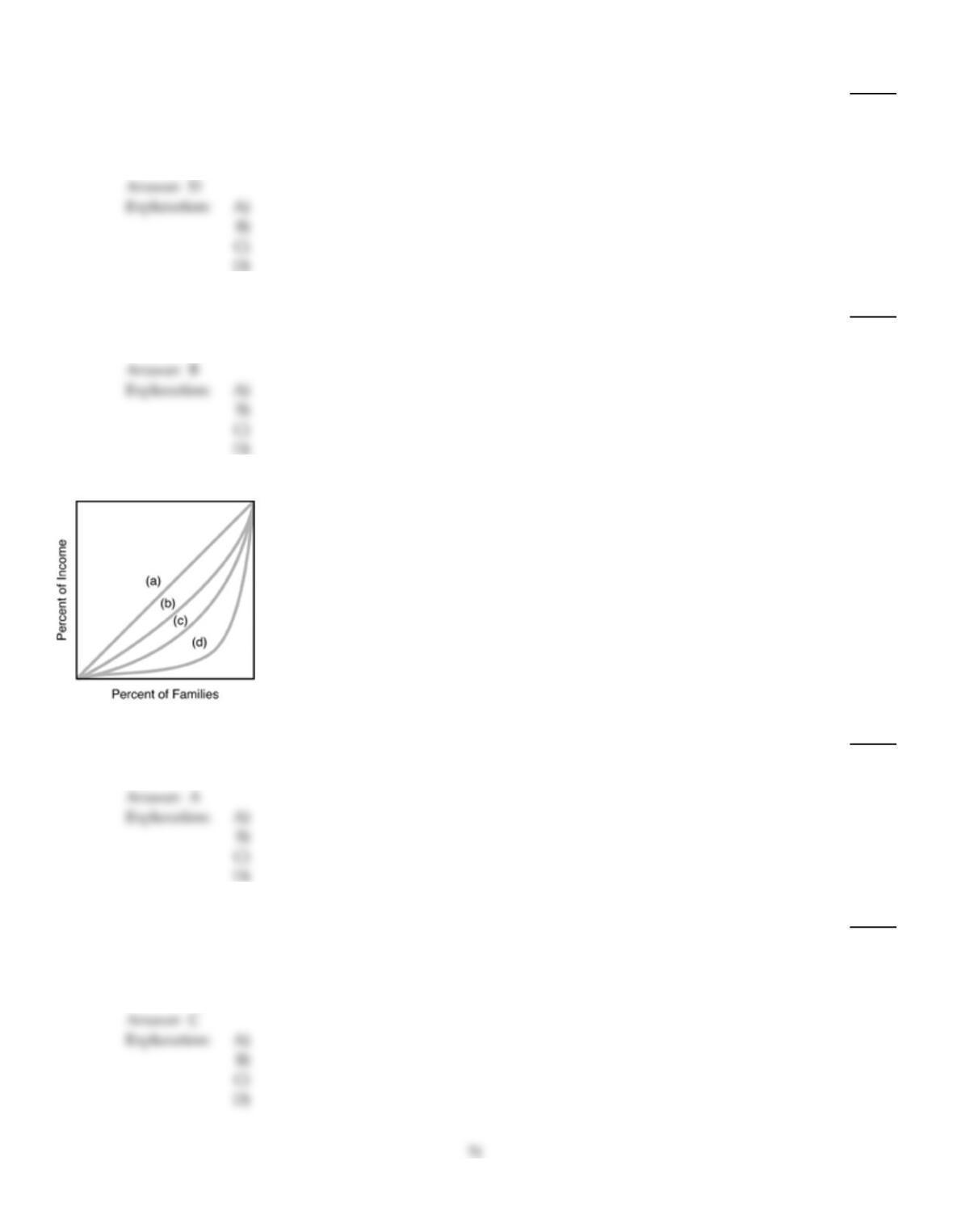
Use the above figure. Refer to the above diagram where curves (a) through (d) are for four different
countries. Income is equally distributed in
277)
A)
Country A.
B)
Country B.
C)
Country C.
D)
Country D.
A
278)
The percentage of total national income spent on health care in the United States has
278)
A)
remained below the level of inflation.
B)
remained constant over the last few years.
C)
risen steadily since 1965.
D)
declined rapidly since 1965.
C
D

279)
Based on most observations, what are the effects on government budgets from the national health
care program?
279)
A)
the federal government ultimately will lower taxes since the program’s cost will decline over
time.
B)
Tax revenues will not flow into the new program immediately.
C)
The federal government ultimately will have to search for ways to reduce its health care
expenditures.
D)
Federal government expenditures on the program are being phased in immediately.
280)
One reason earnings tend to fall before retirement age is that
280)
A)
the experience of people is no longer valuable after they are 50 or 55.
B)
firms discriminate against older workers.
C)
people tend to reduce the number of hours they work after age 50.
D)
people are retiring earlier.
281)
Once the national health care program goes into effect, we can expect
281)
A)
total expenditures on health care will increase.
B)
more individuals will have more incentives to make decisions that promote better health.
C)
moral hazard will decrease.
D)
total expenditures on health care will decrease.
282)
The official definition of poverty is
282)
A)
an absolute measure.
B)
exactly the 20 percent of U.S. residents with the lowest incomes.
C)
a relative measure.
D)
exactly the 12 percent of U.S. residents with the lowest incomes.