163)
The Social Security system is financed by
163)
A)
a payroll tax paid only by employers.
B)
a tax on luxury goods.
C)
a tax on individual retirement accounts.
D)
a payroll tax paid by both employers and employees.
164)
Economic discrimination exists when
164)
A)
both income and wealth are unequally distributed in a country.
B)
there is unequal access to education.
C)
workers with the same marginal revenue products are paid different wages.
D)
there is an unequal distribution of income in a country.
165)
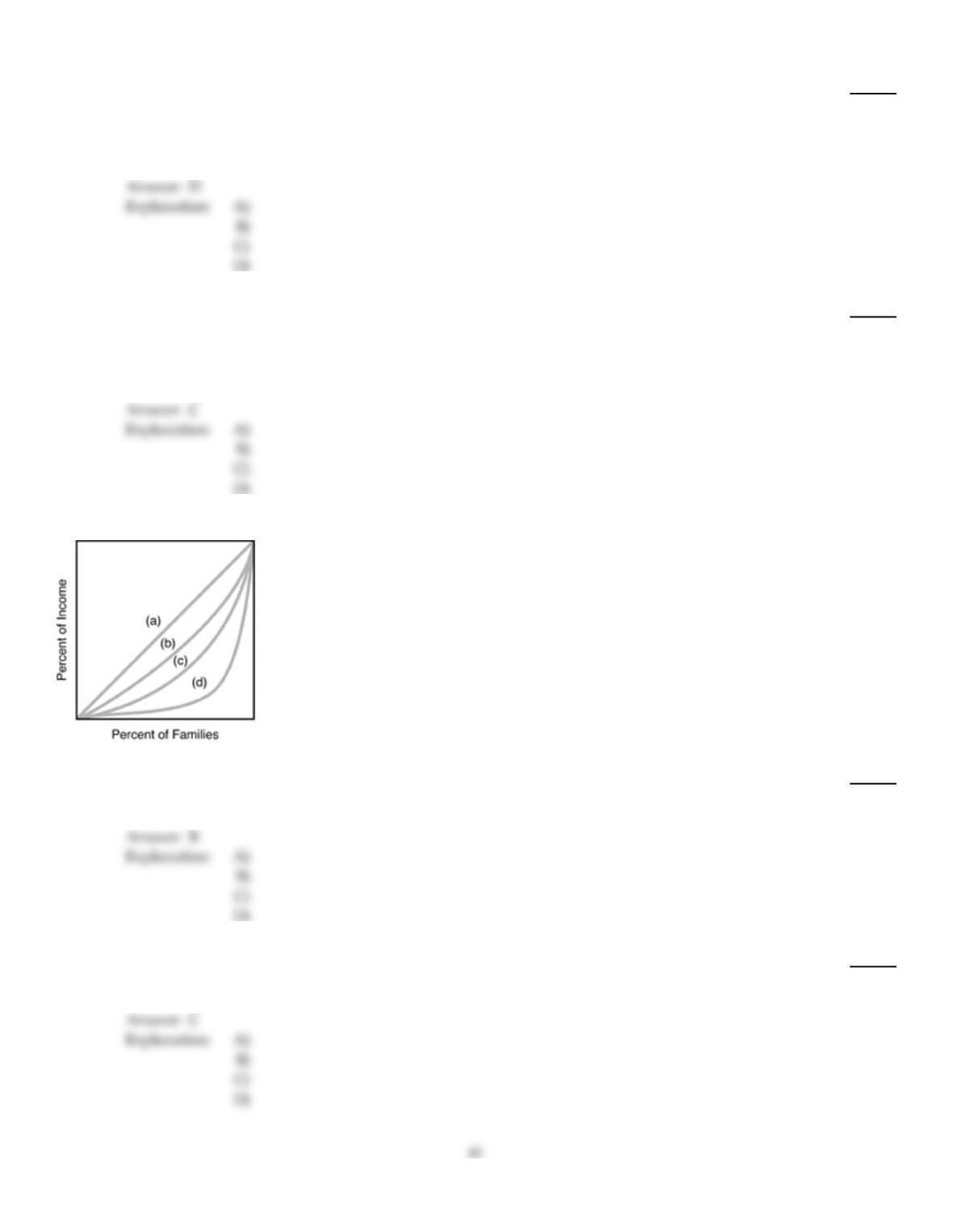
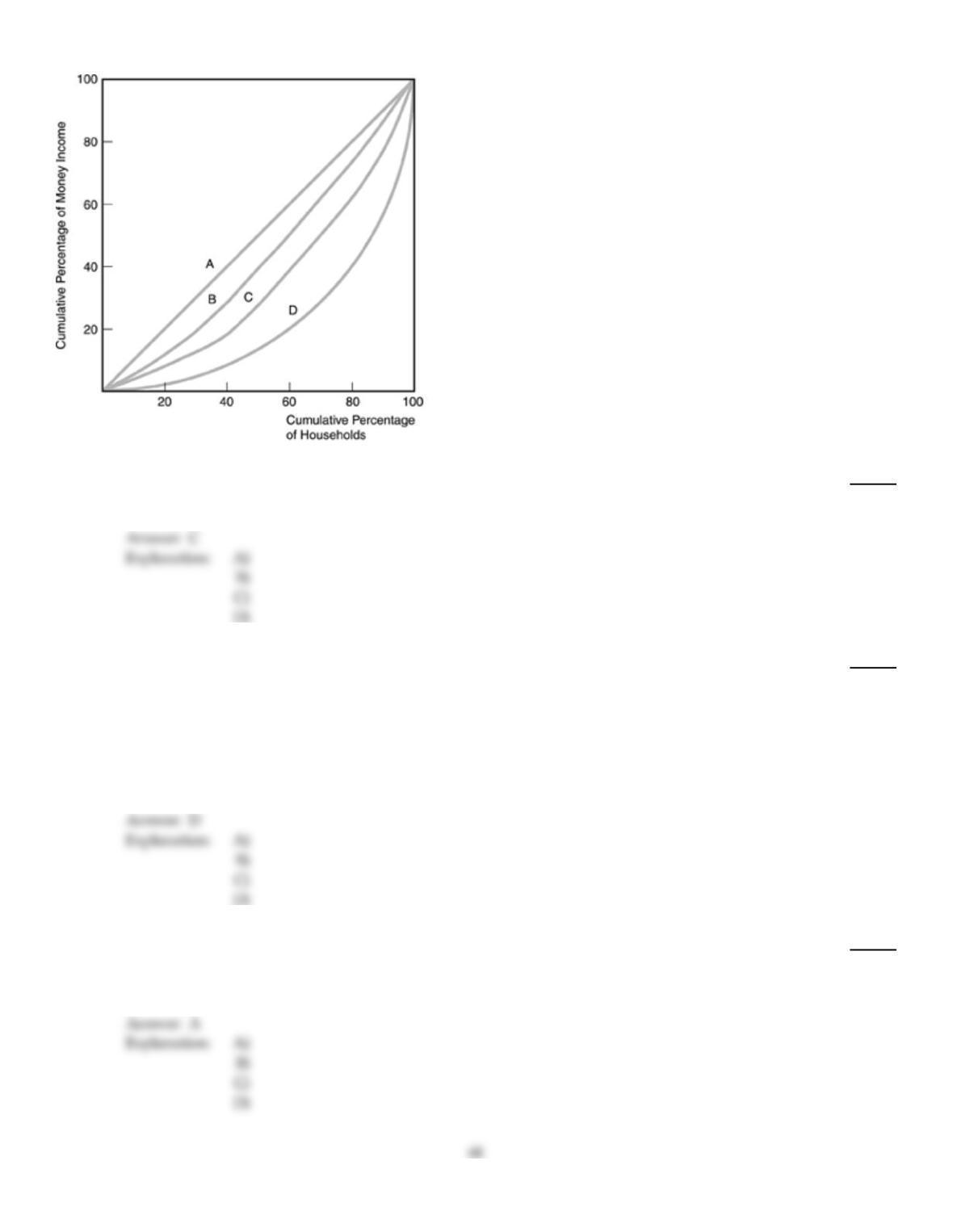
Use the above figure. Refer to the above diagram where curves (a) through (d) are for four different
countries. Income is third most unequally distributed in
165)
A)
Country A.
B)
Country B.
C)
Country C.
D)
Country D.
166)
Inheritance accounts for about
166)
A)
30 percent of income inequality.
B)
15 percent of income inequality.
C)
10 percent of income inequality.
D)
5 percent of income inequality.
167)
The program that was created to provide rebates of Social Security taxes to low–income workers is
167)
A)
TANF.
B)
Earned Income Tax Credit program.
C)
food stamps.
D)
Supplemental Security Income.
168)
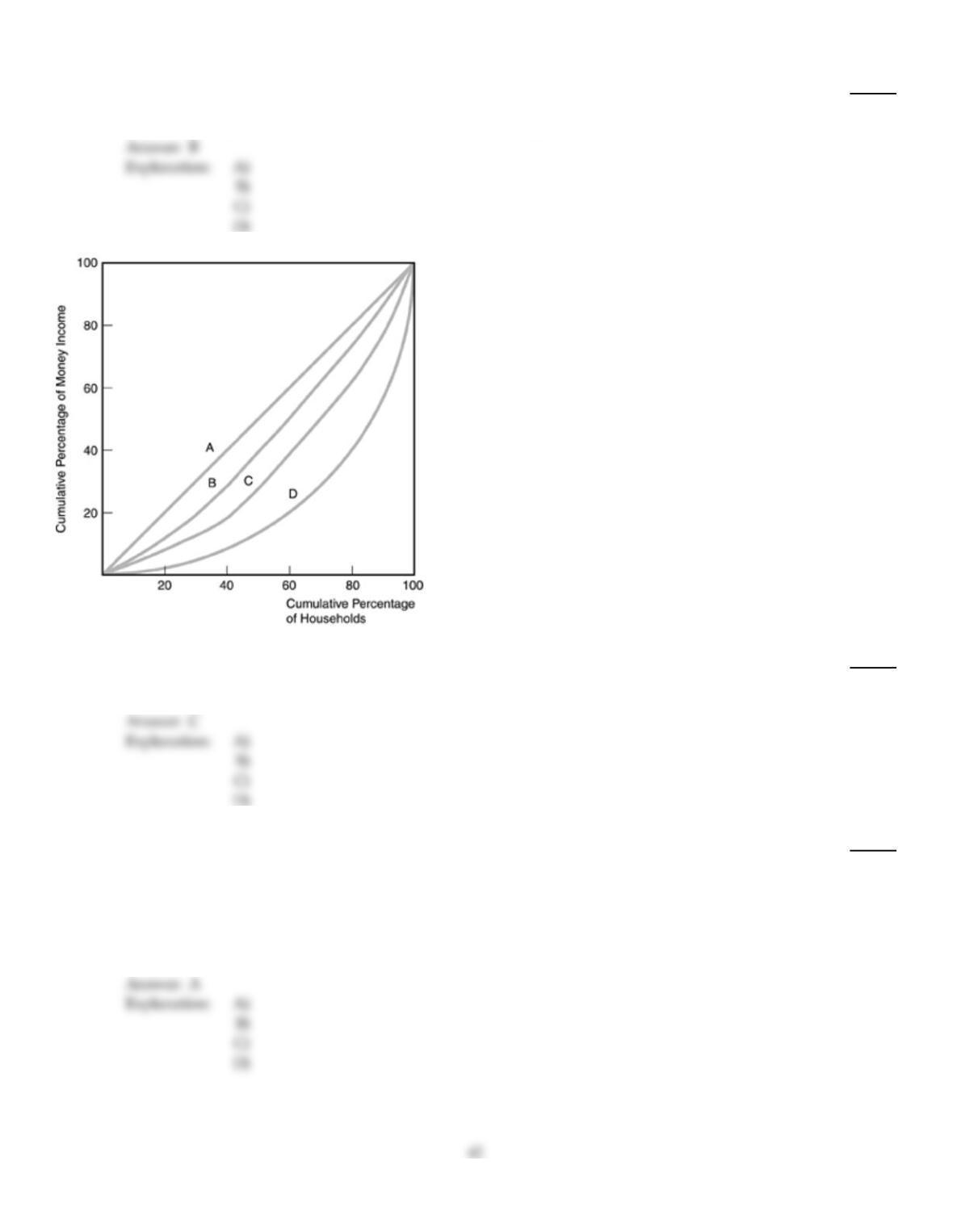
Refer to the above figure. Perfect income equality is shown by
168)
A)
the vertical axis.
B)
the horizontal axis.
C)
curve A.
D)
curve D.
169)
Which of the following statements about the Earned Income Tax Credit Program (EITC) program is
FALSE?
169)
A)
Recipients who receive benefit payments under Social Security are also eligible for SSI.
B)
It provides rebates of Social Security taxes to low–income workers.
C)
It is the largest poverty reduction program in the U.S..
D)
On net the EITC discourages work by low– or moderate– income earners more than it
rewards work.
170)
Wealth is measured as
170)
A)
nonhuman and human wealth.
B)
only nonhuman wealth.
C)
only tangible objects.
D)
only buildings, machinery, land, cars, stocks and bonds.
171)
Which of the following is NOT a normative standard for income distribution?
171)
A)
the productivity standard
B)
rewarding people according to merit
C)
the egalitarian principle
D)
All of the above are normative standards.
D
172)
“To each exactly the same” refers to
172)
A)
the Lorenz curve.
B)
the productivity standard.
C)
the free market doctrine.
D)
the egalitarian principle.
D
173)
If an individual receives in–kind transfers from the government in the form of food stamps, public
housing, and so on, his money income is
173)
A)
less than his total income.
B)
the same as his total income.
C)
equal to his in–kind income plus his wages.
D)
greater than his total income.
A
174)
When measuring the benefits from investing in human capital
174)
A)
the only benefits come from the increase in salary because of going to school.
B)
we must include the costs of tuition and books but not the money made from part–time jobs.
C)
we must include the foregone earnings in the benefit calculation.
D)
in addition to the monetary benefits, the benefit from expanding horizons should be included.
D
A
175)
The top 5 percent of health care users in the United States account for
175)
A)
30 percent of all health costs.
B)
over 75 percent of all health costs.
C)
over 50 percent of all health costs.
D)
almost 90 percent of all health costs.
176)
The distribution of money income can be represented graphically using
176)
A)
a Lorenz curve.
B)
supply and demand diagrams.
C)
a Keynesian curve.
D)
a Distribution curve.
Explanation:
177)
Which of the following is NOT a reason for rising health care expenditures in the United States
over the last 40 years?
177)
A)
aging of the population
B)
discovery of new diseases
C)
third–party financing of health care expenditures
D)
technological change
Explanation:
178)
Going to college to get more knowledge and skills is considered to be an increase in
178)
A)
human capital.
B)
consumption.
C)
physical capital.
D)
net exports.
Explanation:
179)
The effects of the national health care program on labor markets will
179)
A)
move upward along their downward–sloping marginal–product–of–labor curve.
B)
increase the marginal revenue product of labor.
C)
lower the effective wage rate that they must pay for each unit of labor.
D)
decrease the marginal revenue product of labor.
Explanation:
Explanation:
180)
In a competitive economy, workers will be paid according to their
180)
A)
need.
B)
age.
C)
status.
D)
marginal productivity.
181)
A person‘s productive contribution in a capitalist society is measured by determining the
181)
A)
comparable output of other workers in similar jobs.
B)
total number of goods produced by the individual.
C)
index of occupational values.
D)
market value of the individual’s output.
D
182)
The age–earning cycle usually begins
182)
A)
at relatively high income levels.
B)
only when a worker is employed full time.
C)
at relatively low income levels.
D)
once a worker reaches 25 years of age.
C
183)
The USDA threshold income level was originally based on the cost of
183)
A)
transportation.
B)
basic clothing.
C)
housing.
D)
a nutritionally adequate food plan.
D
184)
The belief that everyone should have exactly the same amount of income is
184)
A)
merit standard.
B)
egalitarian principle.
C)
comparable–worth doctrine.
D)
Lorenz principle.
B
D
185)
Since the War on Poverty was started in 1965, the United States has spent more than $12 trillion on
income maintenance programs. The effect has been to
185)
A)
increase poverty substantially.
B)
reduce poverty levels substantially.
C)
reduce poverty levels moderately.
D)
have virtually no effect on poverty levels.
186)
Which of the distributive standards does NOT involve a value judgment?
186)
A)
merit standard
B)
productivity standard
C)
egalitarian standard
D)
All of the standards involve value judgments.
187)
The purpose of the Temporary Assistance to Needy Families program is
187)
A)
to provide rebates of Social Security taxes to low–income workers.
B)
to provide cash assistance and supportive services to assist the family, helping them achieve
economic self–sufficiency.
C)
to supplement Social Security for the elderly with medical problems.
D)
to provide a minimum income for the aged, blind, and the disabled.
188)
Many argue the poor are getting poorer, at least in a relative sense. Evidence that contradicts this is
that
188)
A)
the pretax distribution of income is more equal than the after–tax distribution of income.
B)
household spending of the lowest twenty percent of households relative to the highest twenty
percent of households has held constant over the last thirty years.
C)
the official poverty level of income has increased over the years.
D)
household income of the lowest twenty percent of households relative to the highest twenty
percent of households has fallen over the last thirty years.
189)
Which of the following statements is FALSE?
189)
A)
The official absolute poverty level in the United States is far above the average income of
many countries in the world.
B)
An equal distribution of income would eliminate relative poverty.
C)
In a relative sense, the problem of poverty will always exist.
D)
An equal distribution of income would eliminate absolute poverty.
190)
Since Social Security is a pay–as–you–go program, the funds for the people retiring today
190)
A)
come from foreign sales of gold.
B)
come from import taxes.
C)
come from those of us working today and in the future.
D)
come from the Federal Reserve.
191)
Which of the following are determinants of differences in income?
191)
A)
age
B)
discrimination
C)
marginal productivity
D)
all of the above
192)
Refer to the above figure. For which Lorenz curve does the richest 25 percent make 50 percent of
the nation’s money income?
192)
A)
A
B)
B
C)
C
D)
D
193)
The official poverty level is based on pretax income including cash. Which of the following
statements is correct regarding this official specification of poverty?
193)
A)
This is not a good definition of poverty because our tax structure consists of different tax
brackets based on income.
B)
This is a good definition of poverty because it is easy to measure.
C)
This is a good definition of poverty since it is made up of the income from productive
resources.
D)
This is not a good definition of poverty because it does not include in–kind subsidies.
194)
Attempts to alleviate poverty have included all of the following income–maintenance programs
EXCEPT
194)
A)
401(k) plans.
B)
food stamps.
C)
Social Security.
D)
temporary assistance to needy families.
195)
Which of the following is NOT considered to be a factor in the determination of a person’s marginal
productivity?
195)
A)
investment in human capital such as education
B)
innate abilities such as high intelligence
C)
the elasticity of supply of labor
D)
on–the–job training
196)
Relative poverty
196)
A)
can be eliminated in the next 20 years.
B)
has never existed in the United States.
C)
will always be with us.
D)
has been eliminated in the United States.
C
197)
Rising healthcare costs are attributable to
197)
A)
reliance on expensive technology to support and prolong life.
B)
people living longer and desiring more care.
C)
third–party financing of healthcare costs.
D)
all of the above
D
198)
The following are all determinants of income differences examined in the text EXCEPT
198)
A)
inheritance.
B)
age.
C)
height.
D)
marginal productivity.
C
199)
If you believe that a worker should be paid on the basis of what he or she produced, you believe in
199)
A)
the benefits standard.
B)
the egalitarian principle.
C)
the comparative worth principle.
D)
the productivity standard.
D
C

Name(s) Income/Person
Al, Bert $3,000
David, Jamal $2,000
Eve, Eric, Lucy, Cecil $1,500
Fran, George $1,000
200)
Use the information in the above table. If Income was evenly distributed, each person would
receive
200)
A)
$1,800.
B)
$1,000.
C)
$2,500.
D)
$9,000.
201)
All of the following are key features of the new the federal government’s national health care
program EXCEPT
201)
A)
firms with at least 50 employees must either provide health insurance or pay fines when
uninsured employees receive tax subsidies to purchase insurance.
B)
people must either purchase health insurance or pay a fine to the federal government.
C)
government–directed exchanges will assist in matching individuals and small businesses
with health insurance policies that satisfy government requirements.
D)
a young person in good health can opt not to purchase health insurance without penalty.
202)
The productivity standard says
202)
A)
that people should be compensated on the basis of their need.
B)
that the age–earnings cycle should determine income.
C)
that people should be compensated on the basis of what they produce.
D)
that everyone should have exactly the same income.
203)
The merit standard refers to
203)
A)
“To each according to his ability.“
B)
“To each according to her productivity.”
C)
“To each according to her need.”
D)
“To each exactly the same.”
204)
Determinants of income differences include all of the following EXCEPT
204)
A)
age.
B)
moral hazard.
C)
marginal productivity.
D)
discrimination.
205)
The return on wealth (both human and nonhuman) is
205)
A)
income.
B)
measured in the form of bonds.
C)
a stock variable.
D)
a stock or flow variable depending upon whether the wealth is in the form of bonds or other
financial assets.
A
206)
The age–earnings profile predicts that earnings will peak at
206)
A)
the 35–40 age level.
B)
the 45–50 age level.
C)
the 60–65 age level.
D)
retirement.
B
207)
With respect to wealth in the United States, we presently find that the richest one percent of
Americans own approximately how much of the nation’s wealth?
207)
A)
10 percent
B)
70 percent
C)
35 percent
D)
85 percent
C
208)
The contributive standard (merit standard) for distributing income implies that
208)
A)
a transfer should be contributed to an individual above his or her contribution to net output.
B)
income should be distributed according to the marginal productivity of workers.
C)
income should be distributed according to need.
D)
income should be distributed equally.
B
B
209)
Social Security is
209)
A)
a social insurance program that guarantees that an elderly person will never fall below the
poverty level.
B)
an intergenerational transfer program that only vaguely relates to past earnings.
C)
a retirement program that invests the person’s contributions into interest–earning financial
assets so the proceeds can fund the person’s retirement.
D)
an insurance program operated by the federal government.
210)
Once the national health care program goes into effect and more people will pay fewer of their
health care expenses out of their own pockets than they did previously, we can expect
210)
A)
the quantity of health care services demanded will decrease.
B)
the quantity of health care services supplied will increase.
C)
the quantity of health care services supplied will decrease.
D)
the quantity of health care services demanded will increase.
Explanation:
211)
The original impetus for Social Security was
211)
A)
the result of social engineering by politicians.
B)
to prevent future depressions.
C)
to provide retirement fund for all persons.
D)
a proper response to the stock market crash of 1929.
Explanation:
212)
Which of the following does NOT affect a worker’s marginal productivity?
212)
A)
education
B)
training
C)
inheritance of money
D)
talent
Explanation:
Explanation:
213)
The egalitarian principle says
213)
A)
that people should be compensated on the basis of what they produce.
B)
that everyone should have exactly the same income.
C)
that the age–earnings cycle should determine income.
D)
that people should be compensated on the basis of their need.
214)
A problem with third–party financing of so much of health care is that
214)
A)
it discourages physicians from getting second opinions and running enough tests to be sure
the right procedure is followed.
B)
it discourages people from relying on the judgments of physicians in making decisions about
health care.
C)
it causes the demand for medical services to increase, which causes health care costs to
increase.
D)
it reduces the quality of health care received by most people.
215)
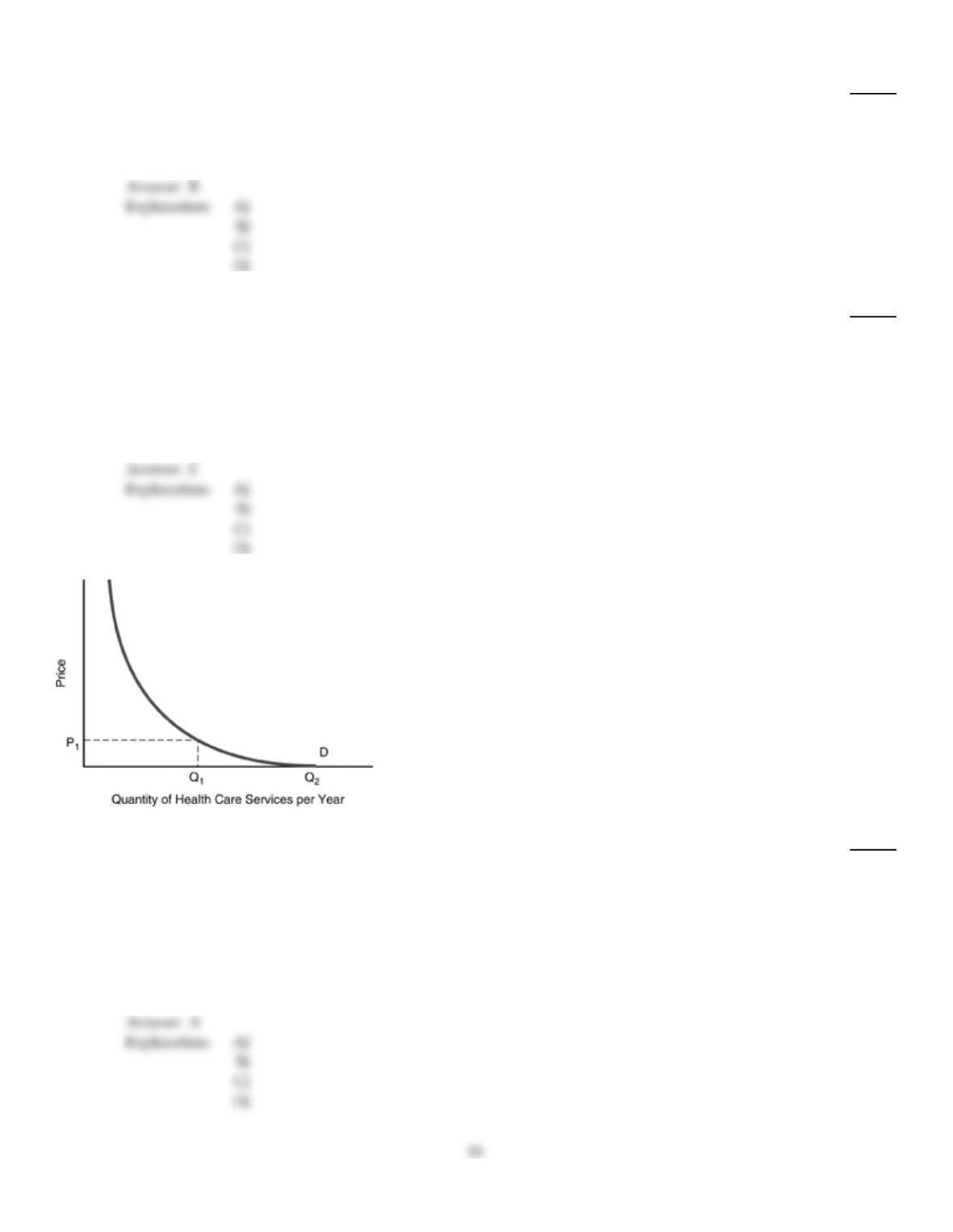
The above figure supports all of the following statements regarding health care EXCEPT
215)
A)
the demand for health care is insensitive to price changes; as the price goes up, so does the
quantity demanded.
B)
due to third party payments, patients demand a higher quantity of health care services per
year.
C)
the lower the deductible, the greater is the quantity demanded of health care services per
year.
D)
if all medical expenses were paid for by third parties, the quantity demanded would increase
tremendously.
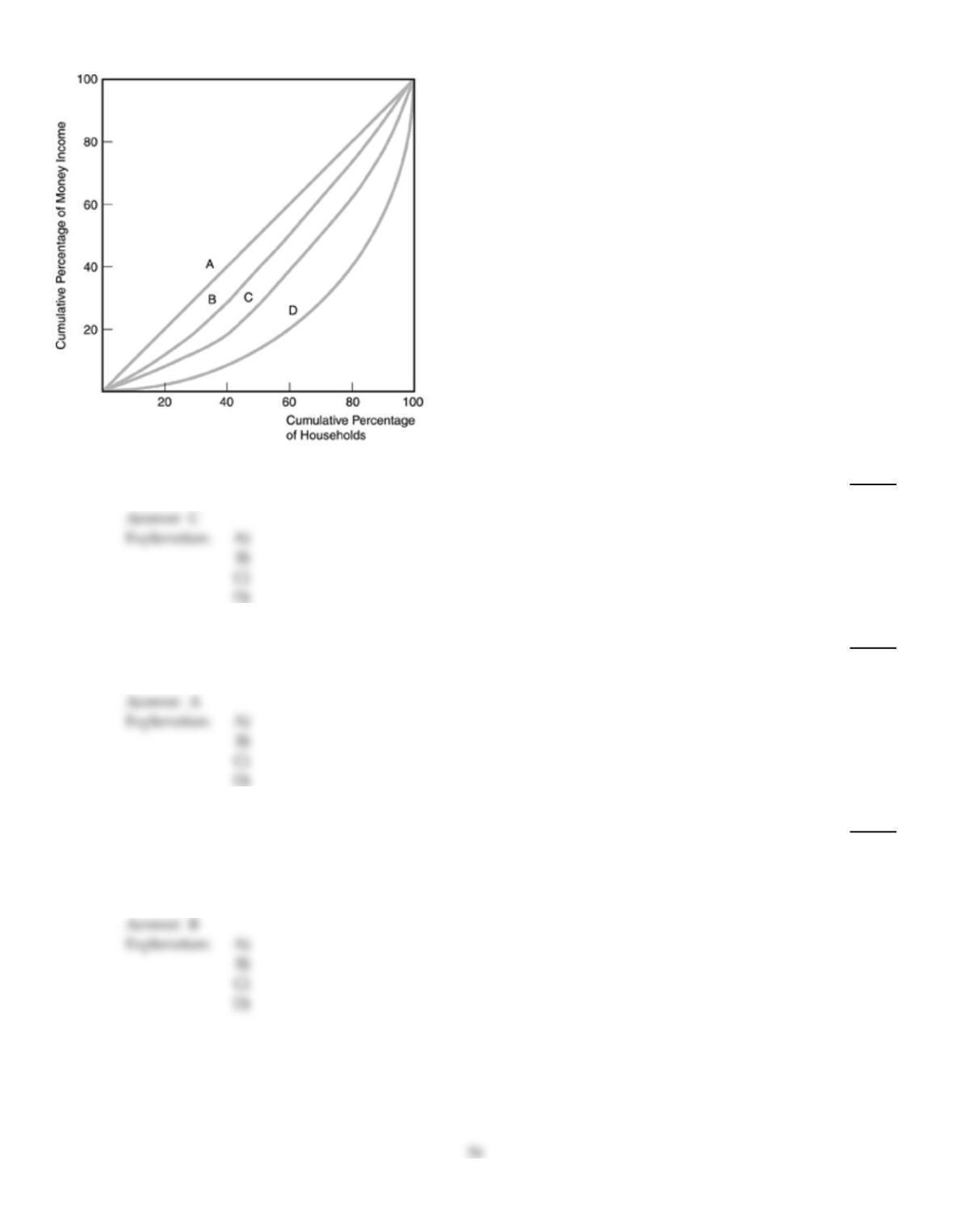
216)
Refer to the above figure. Which curve shows the second most unequal distribution of income?
216)
A)
A
B)
B
C)
C
D)
D
217)
Which of the following would be considered income in kind?
217)
A)
food stamps
B)
tax refunds
C)
yard sales
D)
reduction in the tax rates
218)
A major benefit of a health savings account is that it
218)
A)
eliminates rising health care costs.
B)
combats moral hazard.
C)
means more health care services will be demanded.
D)
creates the incentive to see a doctor regularly.
219)
The age–earning cycle predicts that a typical person will
219)
A)
be earning the highest income at about the age 45–50.
B)
be earning the lowest income right before retirement.
C)
be earning the highest income right before retirement.
D)
be earning $50,000 in the year 2010.
220)
Which of the following statements is FALSE regarding the definition of poverty?
220)
A)
Adjustments to the poverty level are made on the basis of changes in the Consumer Price
Index.
B)
Real incomes in the United States have been growing at a compounded annual rate of almost
2 percent per capita.
C)
Poverty cannot be defined in relative terms.
D)
A threshold income level is used to define poverty.
221)
In the year 2015, the United States spent about
221)
A)
2 percent of GDP on health care.
B)
6 percent of GDP on health care.
C)
17 percent of GDP on health care.
D)
100 percent of GDP on health care.
222)
The new federal government’s national health care program imposes the following regulations on
health care insurers EXCEPT
222)
A)
all new plans must cover certain preventive services such as mammograms and
colonoscopies but must be paid 100% by patients.
B)
insurance companies will be prohibited from imposing lifetime dollar limits on essential
benefits, like hospital stays.
C)
a ceiling is imposed on the rate of increase in health insurance prices charged to elderly
people.
D)
health insurers must cover all who apply, including people who already have health
problems.
223)
The egalitarian principle of income refers to
223)
A)
each person receiving tax breaks.
B)
each person receiving the same income.
C)
each person being paid differently.
D)
each person working the same number of hours.
224)
The Social Security Fund is designed as
224)
A)
an investment portfolio that individual contributors can make periodic payments into.
B)
an individual account with a federal reserve bank.
C)
an account that allows periodic withdrawals by contributors.
D)
a pay–as–you–go system.
225)
Which of the following is the best definition of what economists define as total income?
225)
A)
payment for labor services
B)
payment for labor services and for ownership of other factors of production
C)
inheritance
D)
payment for labor services, for use of other factors of production, and gifts and government
transfers
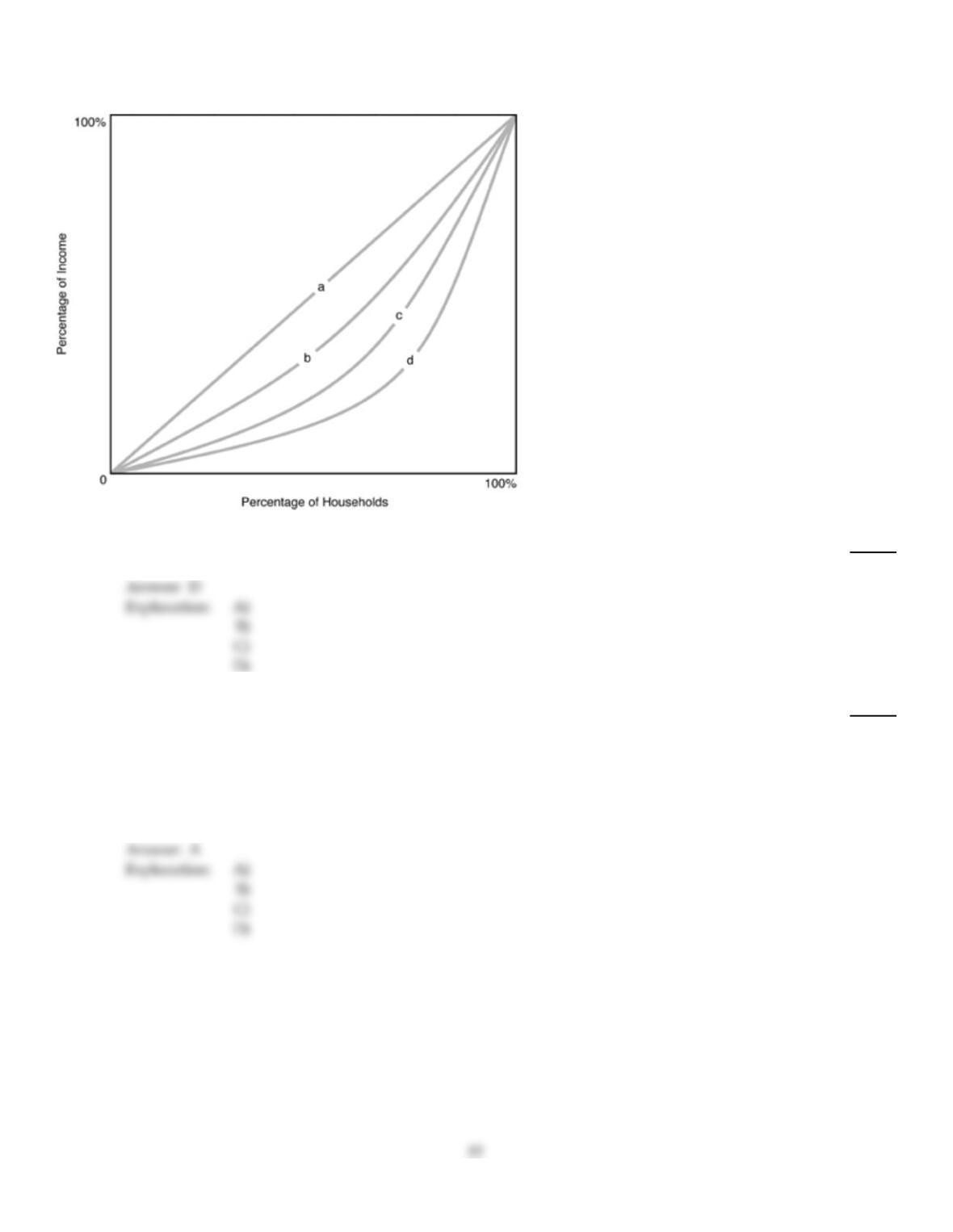
226)
In the above figure, the curve that represents the most income inequality is
226)
A)
a.
B)
b.
C)
c.
D)
d.
227)
If income were distributed according to the egalitarian principle of “to each exactly the same,” then
one problem would be that
227)
A)
there would be little or no incentive for individuals to take risky, hazardous, or unpleasant
jobs.
B)
individuals would have an excess desire to invest in their own human capital.
C)
productivity levels would probably become too high.
D)
too many individuals would want to take risky jobs.
228)
The opportunity cost of going to college for a student receiving a scholarship
228)
A)
is zero because she does not have to pay tuition.
B)
is the income that she would have earned if she did not go to college.
C)
is the risk of dropping out.
D)
is the food and living expenses that she has to purchase while in college.
229)
Which of the following statements is TRUE?
229)
A)
A growing economy should see a decline in both absolute and relative poverty.
B)
A growing economy should see a decline in absolute poverty but not in relative poverty.
C)
A growing economy should see a decline in relative poverty but not in absolute poverty.
D)
A growing economy is usually unrelated to changes in either absolute or relative poverty.
B
230)
One productivity standard for income distribution stated in the text is
230)
A)
the poor should contribute more to society.
B)
poor people pay too much in taxes.
C)
income distribution should be based on contribution to society’s total output.
D)
tax payments are higher for higher income people.
C
231)
Inheritance is responsible for about ________ percent of the income inequality in the United States.
231)
A)
40
B)
25
C)
10
D)
60
C
B
232)
The official poverty level is based on
232)
A)
wages and salaries, plus any unreported amounts of income from the underground economy.
B)
pretax income, and includes cash subsidies but does not include in–kind subsidies such as
food stamps.
C)
after–tax income, and includes both cash and in–kind government subsidies.
D)
total net worth.
233)
All of the following are criticisms of the Lorenz curve analysis EXCEPT
233)
A)
the inequality gap is not an issue that economists study.
B)
it does not take into consideration lifetime earnings.
C)
income–in–kind is not figured in.
D)
different sizes of households are ignored.
A
234)
The Lorenz curve shows
234)
A)
the demand for jobs.
B)
the distribution of income.
C)
the elasticity of jobs.
D)
the supply of jobs.
B
235)
Recent income distribution figures in the United States show
235)
A)
greater equity.
B)
less inequality.
C)
slightly more inequality.
D)
less equity.
C
B
236)
Which of the following statements is an accurate statement about the Social Security (OASDI)
program?
236)
A)
The program transfers income from those who work to those who do not work.
B)
The program is financed by voluntary contributions.
C)
Only 50 percent of workers are covered by OASDI.
D)
Benefits are based on financial need.
237)
Which of the following is NOT a correct criticism of the Lorenz curve?
237)
A)
It ignores the impact of age distribution on income distribution.
B)
It refers to money income after taxes.
C)
It does not include payments in kind.
D)
It does not deal with differences in family size.
238)
Compared to the distribution of money income, the distribution of wealth is
238)
A)
much less equal.
B)
much more equal.
C)
about the same.
D)
a little more equal.
239)
Most individual’s income peaks when they are about
239)
A)
30.
B)
40.
C)
60.
D)
50.