
69)
All of the following aim to reduce income inequality EXCEPT
69)
A)
regressive taxes.
B)
Social Security payments.
C)
earned income tax credits.
D)
food stamp programs.
70)
The new federal government’s national health care program imposes the following regulations on
health care insurers EXCEPT
70)
A)
a ceiling is imposed on the rate of increase in health insurance prices charged to elderly
people.
B)
health insurers must cover all who apply, including people who already have health
problems.
C)
all new plans must cover certain preventive services such as mammograms and
colonoscopies but must be paid 100% by patients.
D)
insurance companies will be prohibited from imposing lifetime dollar limits on essential
benefits, like hospital stays.
71)
When poverty is defined by an absolute real income level, what will happen to the poverty rate if
income per capita in a country continues to grow?
71)
A)
The poverty rate will increase forever.
B)
The poverty rate will never change.
C)
The poverty rate will increase and then decrease.
D)
The poverty rate will eventually be zero.
72)
Compared to the distribution of money income, the distribution of wealth is
72)
A)
much more equal.
B)
about the same.
C)
a little more equal.
D)
much less equal.
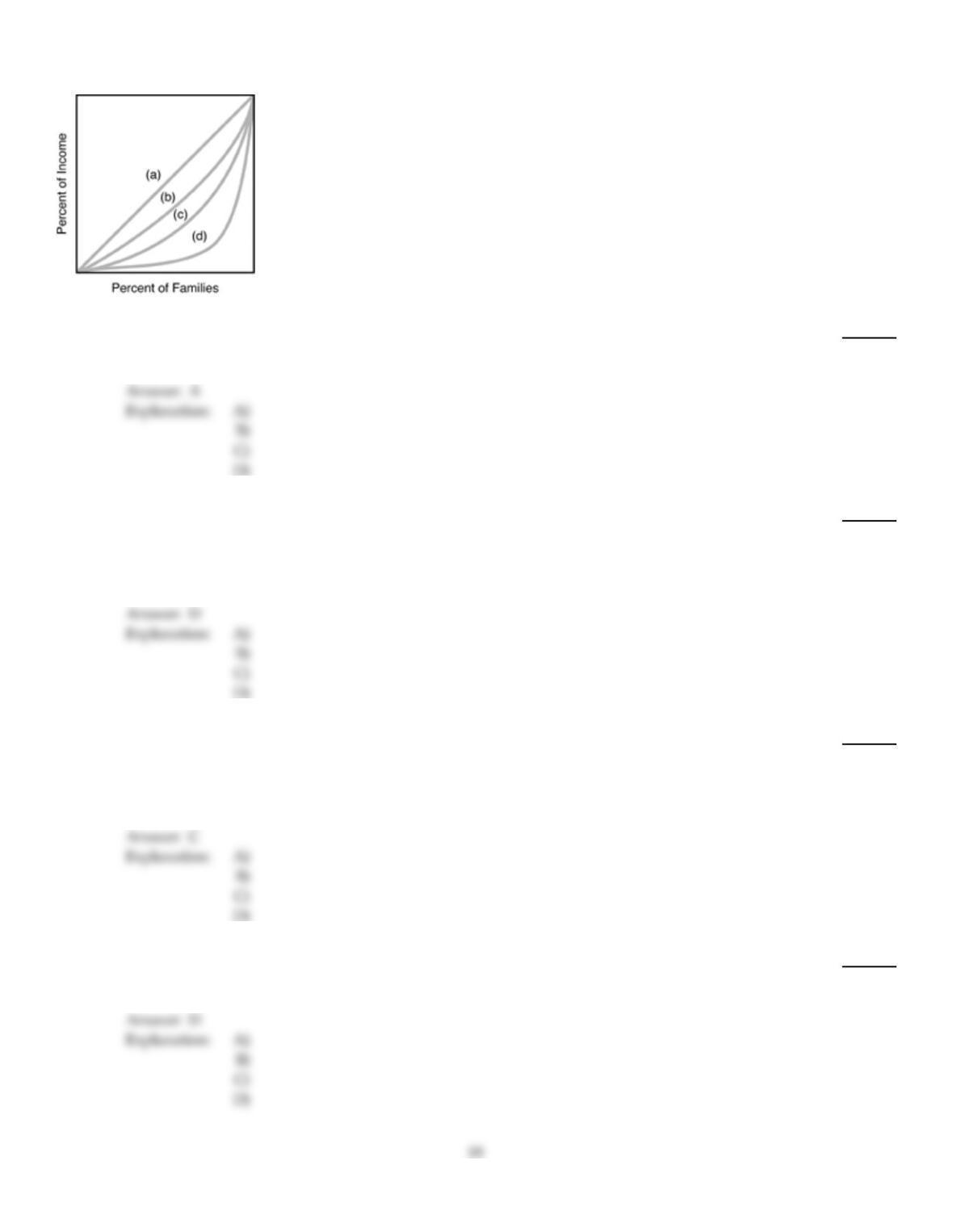
73)
Use the above figure. Refer to the above diagram where curves (a) through (d) are for four different
countries. Income is equally distributed in
73)
A)
Country A.
B)
Country B.
C)
Country C.
D)
Country D.
74)
Wealth is measured as
74)
A)
only tangible objects.
B)
only nonhuman wealth.
C)
only buildings, machinery, land, cars, stocks and bonds.
D)
nonhuman and human wealth.
75)
The effects of the national health care program on goods and services markets will
75)
A)
decrease the quantity demanded for all goods and services.
B)
consumers will pay lower prices for many goods and services.
C)
increase the marginal cost of the firm.
D)
increase the quantity produced of the firm.
76)
The graph which represents the distribution of income in an economy is called the
76)
A)
distribution curve.
B)
Laffer curve.
C)
aggregate demand curve.
D)
Lorenz curve.
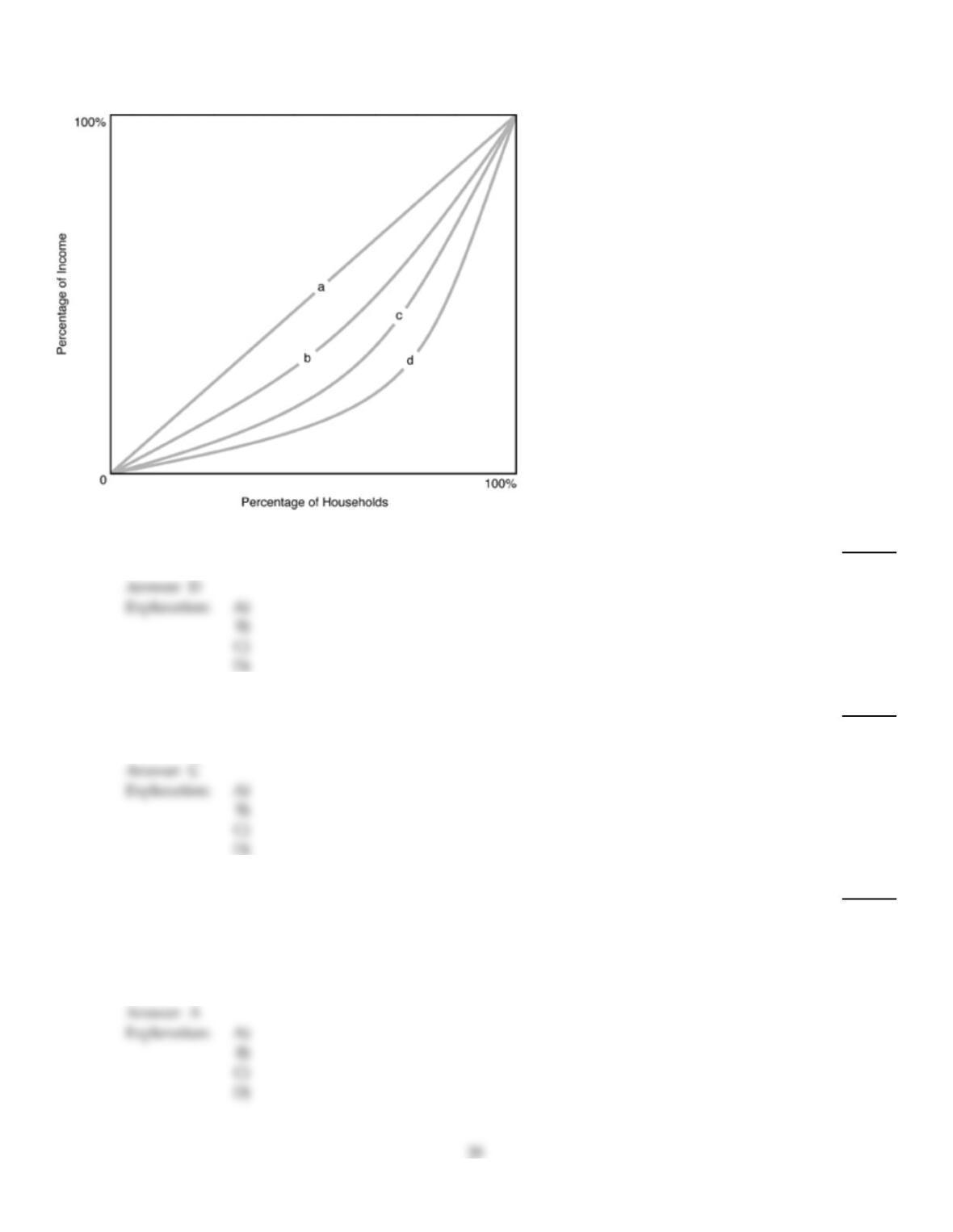
77)
In the above figure, the curve that represents the most income inequality is
77)
A)
a.
B)
b.
C)
c.
D)
d.
78)
In a growing economy, it is possible to eliminate
78)
A)
either absolute nor relative poverty.
B)
both absolute and relative poverty.
C)
absolute poverty.
D)
relative poverty.
79)
The threshold income level originally used to determine official poverty statistics was based on
79)
A)
an income three times the amount of money needed to purchase a nutritionally adequate diet.
B)
a per capita income of $1,000 in 1958 prices.
C)
the highest income of the lowest one–fifth of families in the country.
D)
standards provided by the United Nations based on studies done in poor countries around
the world.

80)
If an individual receives in–kind transfers from the government in the form of food stamps, public
housing, and so on, his money income is
80)
A)
less than his total income.
B)
the same as his total income.
C)
equal to his in–kind income plus his wages.
D)
greater than his total income.
81)
Which of the following statements are correct about the age–earnings cycle?
81)
A)
Earnings increase throughout a prison’s lifetime until they reach retirement.
B)
Earnings generally increase up till age 30 and then steadily decrease.
C)
Earnings increase with age because workers become more productive as they age until
around 50 years. Around 50 the effects of aging outweighs the further increases in
productivity.
D)
Since every person is different we can reach no general conclusions about the age–earnings
cycle.
82)
A Lorenz curve measures the ________ on the vertical axis.
82)
A)
cumulative percentage of family wealth
B)
cumulative percentage of families
C)
demand of families on welfare
D)
cumulative percentage of money income
83)
The return on human capital
83)
A)
tends to be much lower than the return on physical capital.
B)
cannot be related to the return on physical capital since human capital and physical capital
are so different.
C)
is similar to the return on physical capital.
D)
tends to be much greater than the return on physical capital.

84)
Which of the following statements regarding the Lorenz curve is FALSE?
84)
A)
A Lorenz curve is a geometric representation of the distribution of income.
B)
The less bowed is a Lorenz curve, the less equally income is distributed.
C)
The more bowed is a Lorenz curve, the more unequally income is distributed.
D)
A Lorenz curve that is perfectly straight represents complete income equality.
85)
We measure a person’s productive contribution in a market system by
85)
A)
the egalitarian theory of wage determination.
B)
the marginal factor cost theory of the firm.
C)
the marginal revenue product theory of wage determination.
D)
the profit maximization theory of the firm.
86)
The more bowed out the Lorenz curve is, the
86)
A)
richer the society.
B)
poorer the society.
C)
less equal the distribution of income.
D)
more equal the distribution of income.
87)
When comparing the distribution of wealth to the distribution of income, it can be noted that
87)
A)
the measurement of income is much less accurate than the measurement of wealth.
B)
the distributions are about the same.
C)
the measurement of wealth is much less accurate than the measurement of income.
D)
wealth does not generate income.

88)
Some economists criticize the Lorenz curve because it
88)
A)
does not account for the effect of age on a family’s income.
B)
measures unreported income earned in the underground economy.
C)
uses after–tax income when pre–tax income is more appropriate.
D)
includes too many things in measuring income, such as food stamps, housing aid, and other
government programs.
89)
Which of the following is not a reason for rising health care expenditures in the United States over
the last 40 years?
89)
A)
Discovery of new diseases
B)
Technological change
C)
Third–party financing of health care expenditures
D)
Aging of the population
A
A
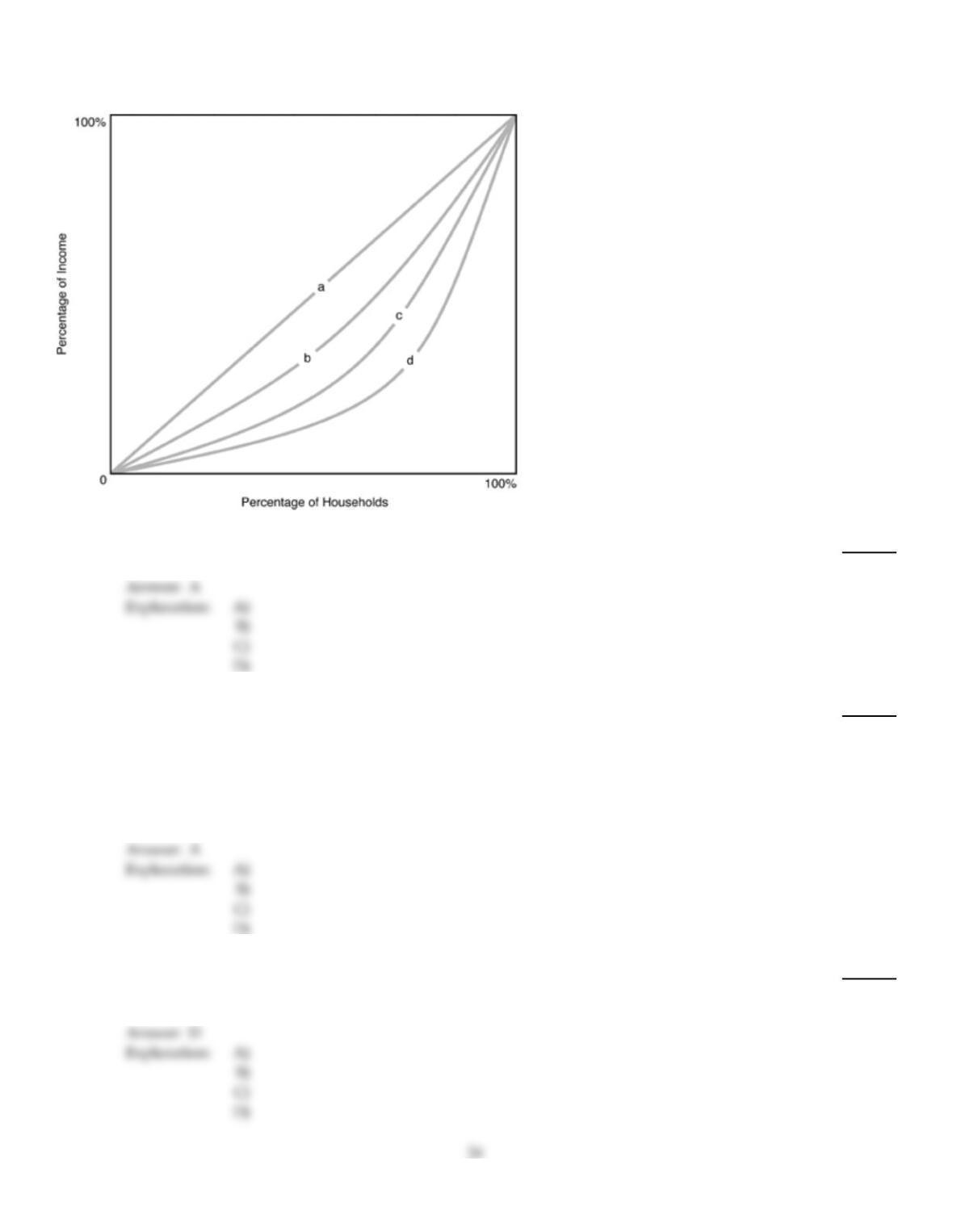
90)
In the above figure, the curve that represents the most income equality is
90)
A)
a.
B)
b.
C)
c.
D)
d.
91)
If a nation’s Lorenz curve lies on the 45 degree line of income equality, then
91)
A)
the income received by each 20 percent of families is 20 percent of the total income.
B)
income is unequally distributed.
C)
more of the nation’s income is received by the highest 20 percent of families than by the
lowest percent.
D)
more of the nation’s income is received by the lowest 20 percent of families than by the
highest 20 percent.
92)
The government finances Social Security through
92)
A)
the sale of goods and services.
B)
state taxes.
C)
excise taxes.
D)
payroll taxes.

93)
A Lorenz curve that represents an unequal income distribution is
93)
A)
a line that has a kink in the middle of it.
B)
a straight line starting at 100%
C)
a bowed curved.
D)
a straight line starting at the origin.
94)
Approximately how much of aggregate national income in the United States is spent on health care
every year since 2000?
94)
A)
30 percent
B)
15 percent
C)
10 percent
D)
5 percent
B
95)
The following are all determinants of income differences examined in the text EXCEPT
95)
A)
marginal productivity.
B)
inheritance.
C)
age.
D)
height.
D
96)
The age–earnings profile for most people indicates
96)
A)
earnings rise until the age of about 50 and then begin to fall until retirement.
B)
that when you adjust for inflation, earnings are constant throughout the entire workplace
experience.
C)
earnings initially decline and then rise continually until retirement.
D)
earnings rise continually until a person retires.
A
97)
The impact of technology on health care has
97)
A)
increased health care costs.
B)
contributed to increased life expectancy.
C)
provided for a higher quality of life.
D)
All of the above are correct.
D
C

98)
Which of the following is an individual mandate in the new the federal government‘s new national
health
care program?
98)
A)
Nearly all U.S. residents must either purchase health insurance coverage or pay a fine of up to
$750 per year for an individual (up to $2,250 per year for a family).
B)
Firms with at least 50 employees must either provide health insurance or pay fines when
uninsured employees receive tax subsidies to purchase insurance.
C)
Under the new program, the federal government will coordinate the establishment of health
insurance exchanges.
D)
A tax rate of 3.8 percent will be assessed on nearly all earnings above $200,000 per year for
individuals and above $250,000 per year for married couples.
99)
Health care costs have been rising due to
99)
A)
new technologies.
B)
an aging population.
C)
third–party financing.
D)
All of the above are correct.
100)
What is typically the main cost of pursuing a college education?
100)
A)
Income forgone by not working
B)
Tuition
C)
Room and board
D)
Books and supplies
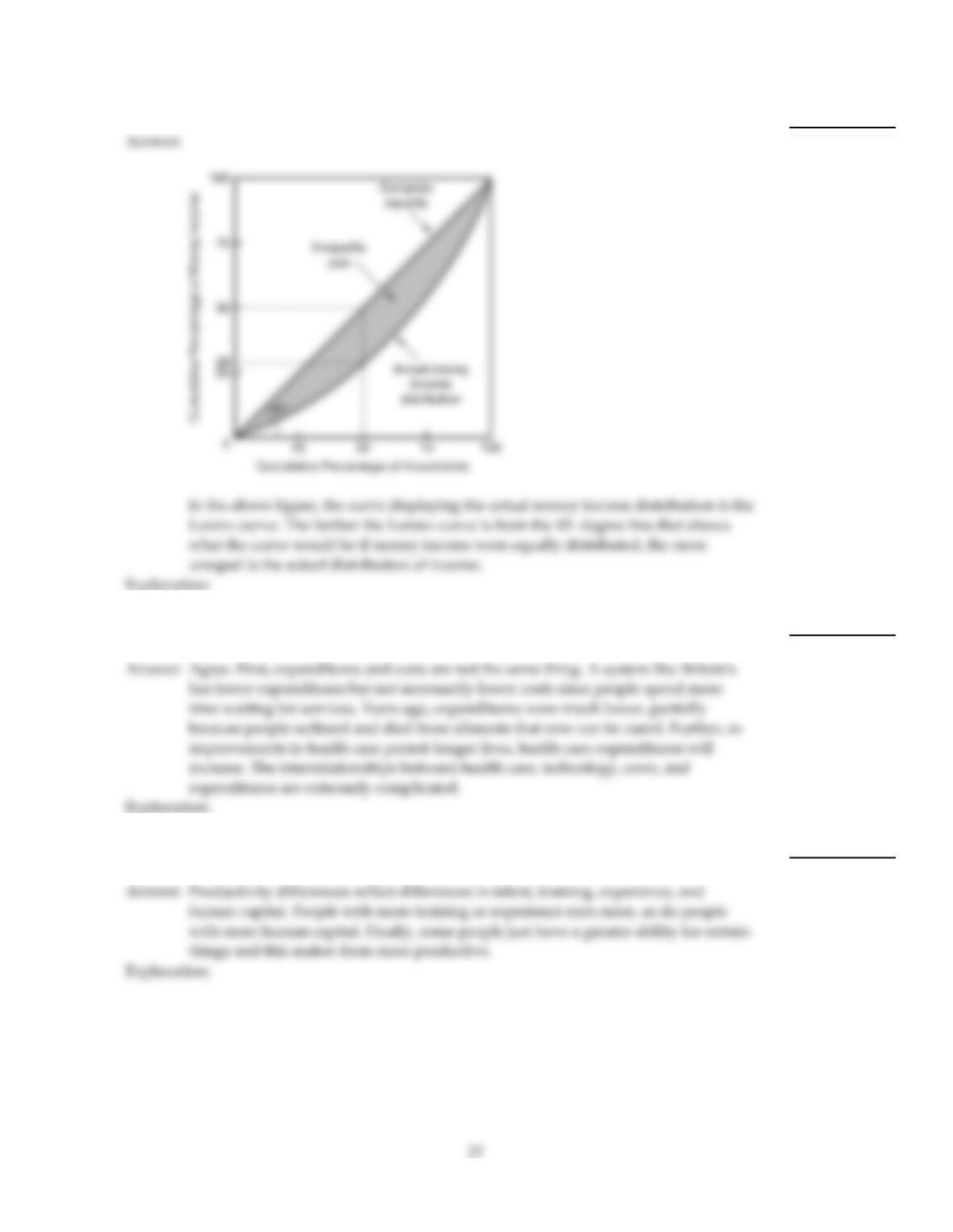
SHORT ANSWER. Write the word or phrase that best completes each statement or answers the question.
101)
Draw and explain a Lorenz curve.
101)
102)
“It is difficult to compare over time health care expenditures, costs, and output.” Do you
agree or disagree? Why?
102)
103)
Earnings usually reflect a person’s productivity. What are factors that cause differences in
productivity across people so that earnings differ too?
103)
104)
Why have health care costs risen so much in recent years?
104)
105)
How does the distribution of wealth differ from the distribution of income in the United
States?
105)
106)
Why doesn’t the age–earning cycle continuously increase until retirement age?
106)
107)
Some economists argue that the official poverty figures overstate poverty in this country.
Why?
107)
108)
Compare and contrast the two normative standards to income distribution discussed in the
text: The productivity standard and the egalitarian principle.
108)
109)
What are the major criticisms of the Lorenz curve?
109)
110)
Suppose there is a high inequality in household income between the highest and the lowest
income groups in one country. In response, the government raises the income tax for the
highest income group and provides subsidies to the lowest–income group. What would
happen to the Lorenz curve as a result of the government programs? Explain.
110)
111)
How can absolute poverty be eliminated? How can relative poverty be eliminated? Does
the elimination of one lead to the elimination of the other? Explain.
111)
112)
Describe four of the five major income maintenance programs in the United States that
were discussed in the text.
112)
113)
How is moral hazard related to health care?
113)
114)
Explain the two theories of desired income distribution: the egalitarian principle and the
productivity standard.
114)

Answer Key
Testname: C30
Answer Key
Testname: C30
Answer Key
Testname: C30
32
Answer Key
Testname: C30
33