84)
The age–earnings cycle is
84)
A)
the distribution of money income by age.
B)
the relationship between earnings while working and retirement benefits for an individual.
C)
the distribution of wealth by age.
D)
the regular earnings profile of an individual throughout his or her lifetime.
85)
The impact of technological change in the health–care area has been to
85)
A)
increase the monetary costs of health care and decrease the quality of health care.
B)
increase both the quality of health care and the monetary costs of health care.
C)
decrease the monetary costs of health care while decreasing the quality of health care.
D)
increase longevity but decrease quality of life.
B
86)
The percentage of national income spent on health care
86)
A)
decreased until the end of the 1970s and then increased in the 1980s and 2000s.
B)
has steadily decreased since 1965.
C)
increased until the end of the 1970s and then decreased in the 1980s and 2000s.
D)
has steadily increased since 1965.
D
87)
In a Lorenz curve, perfect income equality is represented by
87)
A)
a 45–degree line originating from the origin.
B)
a rectangular hyperbola.
C)
a horizontal line.
D)
a vertical line.
A
D

88)
All of the following are social insurance programs designed to attack poverty EXCEPT
88)
A)
food stamps.
B)
Social Security.
C)
temporary assistance to needy families.
D)
tuition assistance.
89)
Once the national health care program goes into effect, we can expect
89)
A)
moral hazard will increase.
B)
more individuals will pay more out of pocket expenses.
C)
the quantity of health care services supplied will increase.
D)
total expenditures on health care will decrease.
90)
The use of hospitals today is dominated by
90)
A)
obstetrical care.
B)
the wealthy.
C)
the elderly.
D)
immigrants.
91)
Which of the following statements regarding the Lorenz curve is FALSE?
91)
A)
A Lorenz curve that is perfectly straight represents complete income equality.
B)
The less bowed is a Lorenz curve, the less equally income is distributed.
C)
The more bowed is a Lorenz curve, the more unequally income is distributed.
D)
A Lorenz curve is a geometric representation of the distribution of income.
92)
Currently, about ________ of all health care spending is paid by individuals.
92)
A)
5 percent.
B)
60 percent.
C)
35 percent.
D)
15 percent.

93)
The government program that provides aid to families in need is
93)
A)
Social Security program.
B)
Supplemental Security Income program.
C)
Earned Income Tax Credit.
D)
TANF.
Name(s) Income/Person
Al, Bert $3,000
David, Jamal $2,000
Eve, Eric, Lucy, Cecil $1,500
Fran, George $1,000
94)
Use the above table. What percentage of income is received by the poorest 60% of the population?
94)
A)
27.78 percent
B)
33.33 percent
C)
55.56 percent
D)
44.44 percent
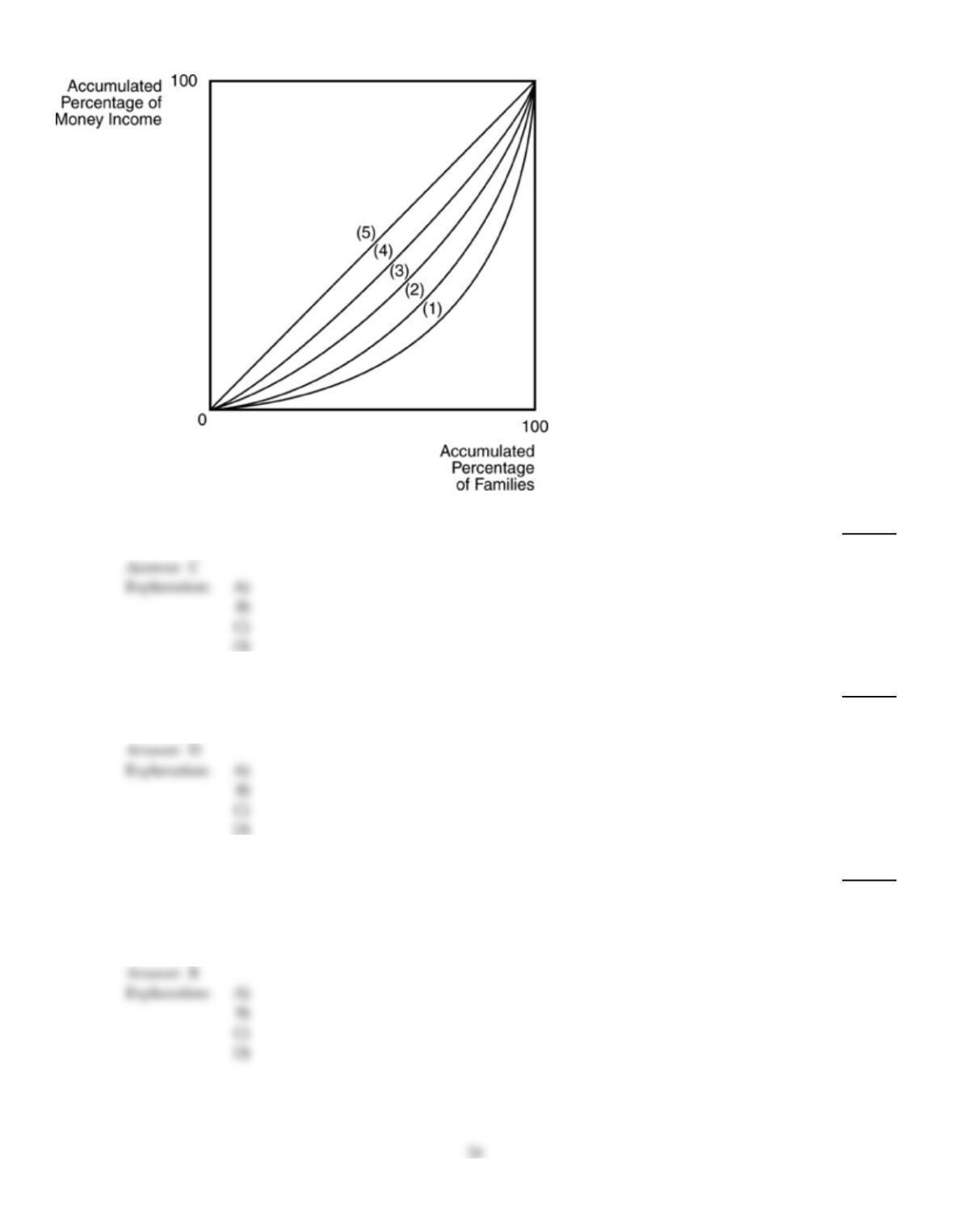
95)
The most unequal distribution of income in the above figure exists in
95)
A)
country 5.
B)
country 3.
C)
country 1.
D)
country 4.
96)
Income in the form of goods and services is
96)
A)
not considered income by economists.
B)
known as money income.
C)
not part of wealth.
D)
known as income in kind.
97)
The Lorenz curve is criticized for all of the following EXCEPT
97)
A)
that it does not account for age differences of households.
B)
that it does not account for the impact of trade on the standard of living.
C)
that it excludes transfers–in–kind income.
D)
that it does not account for the size differences of households.
98)
Some economists criticize the Lorenz curve because it
98)
A)
does not include unreported income earned in the underground economy.
B)
does not include the cumulative percentage of households.
C)
represents the inequality of lifetime income when it should just look at a specific time period.
D)
accounts for differences in the size of households when it should not.
99)
Which of the following is NOT a true statement about the Lorenz curve?
99)
A)
The Lorenz curve includes both money income and income in kind.
B)
The Lorenz curve does not include unreported income obtained from the underground
economy.
C)
The Lorenz curve does not consider age differences among wage earners.
D)
The Lorenz curve does not consider different sizes of households.
100)
All of the following are income in kind EXCEPT
100)
A)
goods produced in the home.
B)
government provided education.
C)
tips received by a waitress.
D)
government provided housing.
101)
Which of the following determinants of marginal productivity cannot be acquired by someone who
wants to increase future productivity?
101)
A)
training
B)
education
C)
experience
D)
talent
102)
Health care costs have been rising due to
102)
A)
new technologies.
B)
third–party financing.
C)
an aging population.
D)
All of the above are correct.
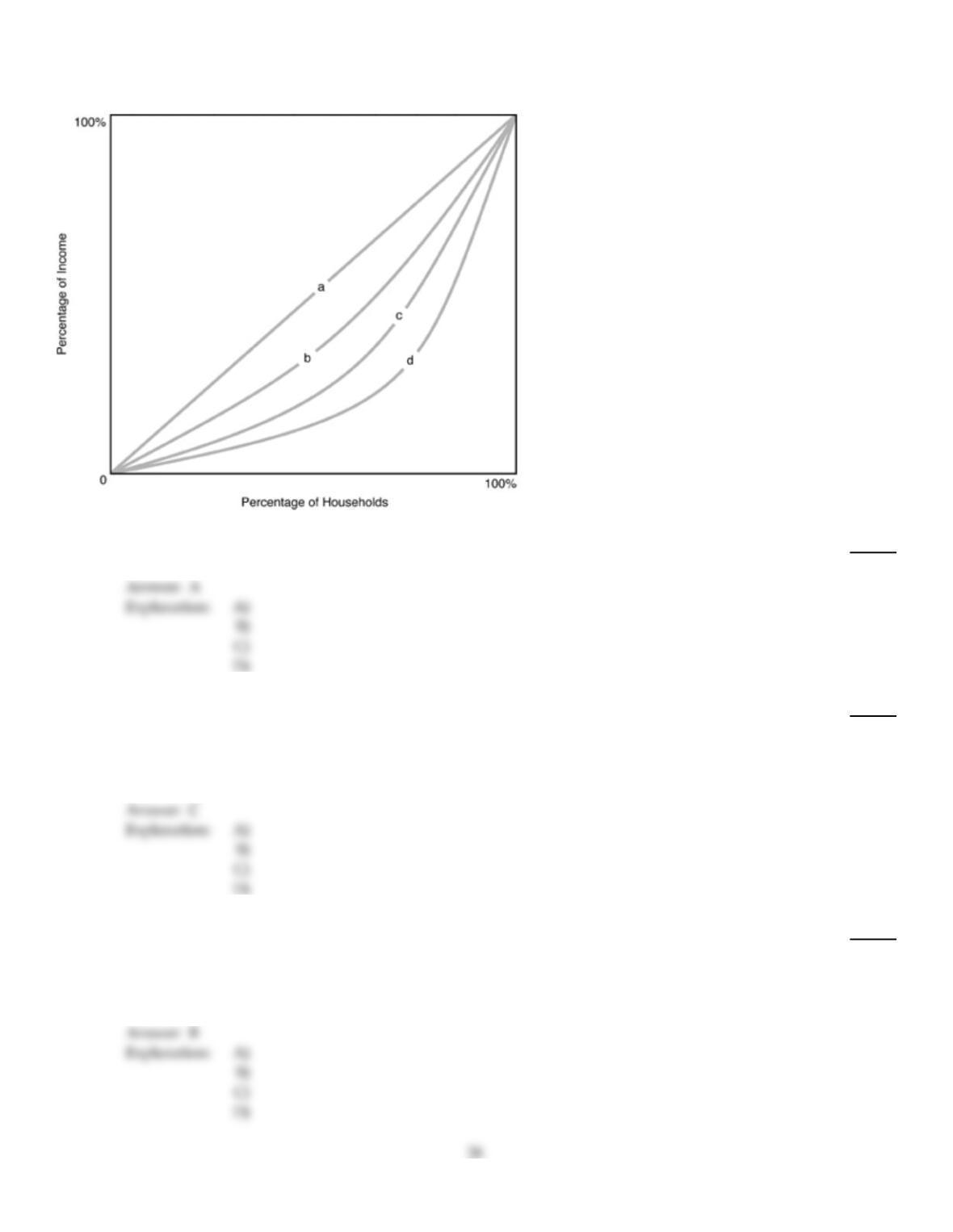
103)
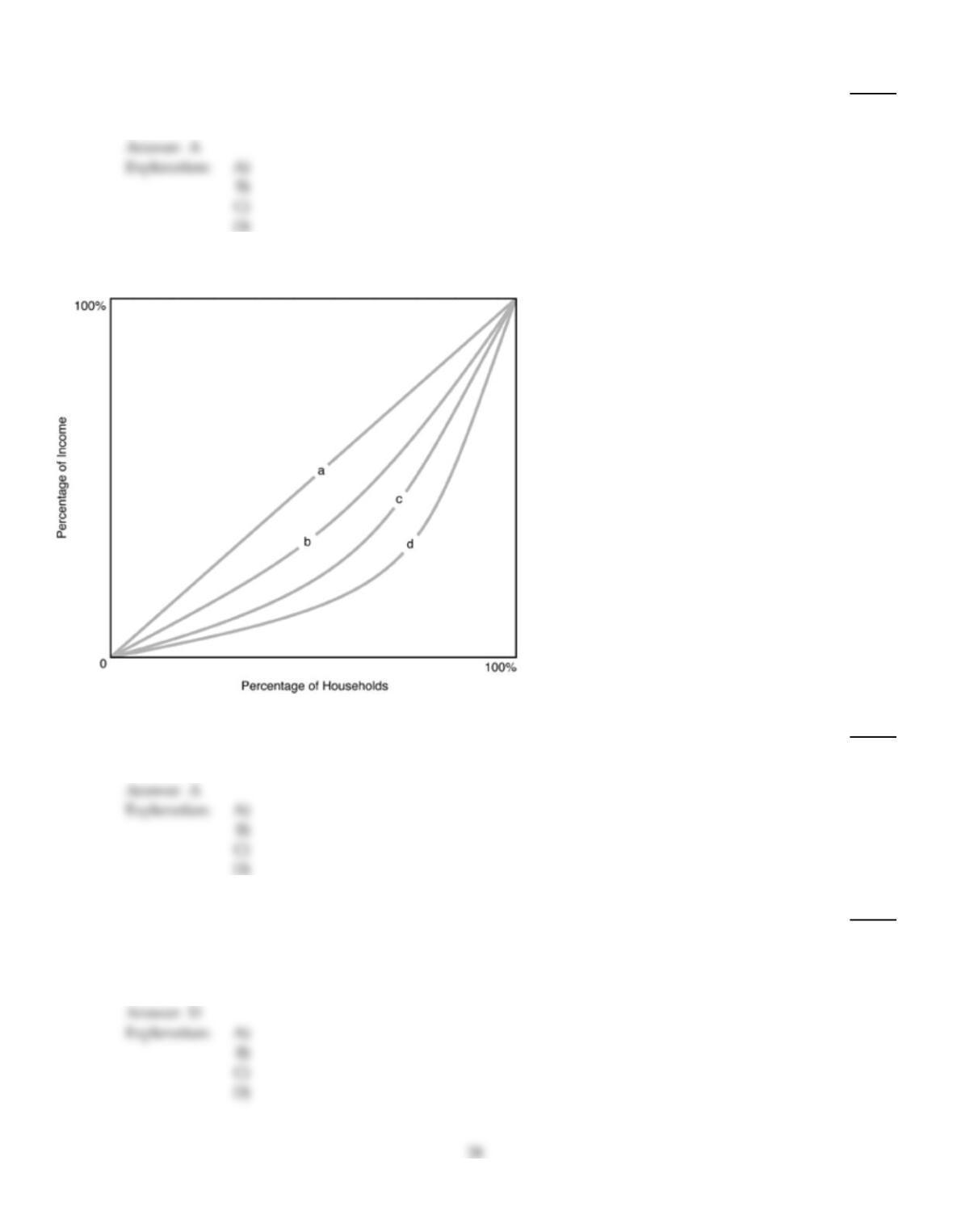
In the above figure, the curve that represents the most income equality is
103)
A)
a.
B)
b.
C)
c.
D)
d.
104)
Changes in the Lorenz curve since 1929 in the United States indicate that
104)
A)
the distribution of income is slightly less equal today than in 1929.
B)
the distribution of income is much more equal today than it was in 1929.
C)
the distribution of income is slightly more equal today than in 1929.
D)
the distribution of income today is identical to what it was in 1929.
105)
The twin economic problems of the U.S. health care industry are the
105)
A)
rising health care costs and the declining quality of health care services.
B)
rising health care costs and the moral hazard problem in health care services.
C)
rising health care costs and the rising malpractice insurance costs.
D)
declining rate of immunization rates and the rising malpractice insurance costs.
106)
Under the Social Security program currently in existence
106)
A)
benefits are based on need.
B)
benefits are guaranteed to be no lower for future retirees than for current retirees.
C)
benefits are determined by whether or not one contributed to the system.
D)
benefits are provided to everyone who contributed to the system EXCEPT those under private
retirement programs that provide an annual income in excess of $13,500.
107)
In calculating income for the Lorenz curve, one factor that is omitted, is
107)
A)
capital gains income.
B)
in–kind transfer payments from the government.
C)
dividend payments.
D)
pure economic rent.
108)
We measure a person’s productive contribution in a market system by
108)
A)
the marginal revenue product theory of wage determination.
B)
the profit maximization theory of the firm.
C)
the marginal factor cost theory of the firm.
D)
the egalitarian theory of wage determination.
109)
Which of the following is considered a “third party” within the medical services industry?
109)
A)
the medical provider, i.e., physician
B)
the private insurance company
C)
the patient
D)
the for–profit hospital
110)
Which of the following is NOT a program designed to attack poverty?
110)
A)
Supplementary Security Income
B)
federal corporate income tax
C)
Social Security
D)
food stamps
111)
The graph which represents the distribution of income in an economy is called the
111)
A)
Lorenz curve.
B)
aggregate demand curve.
C)
Laffer curve.
D)
distribution curve.
112)
Each of the curves plotted in the graph shown in the above figure is known as a
112)
A)
Lorenz curve.
B)
Phillips curve.
C)
Keynesian curve.
D)
Laffer curve.
113)
Which of the following is a reason for economic discrimination to occur?
113)
A)
differences in access to education
B)
differences in the quality of education
C)
barriers to entry in higher–paying occupations
D)
differences in gender
114)
All of the following are criticisms of the Lorenz curve EXCEPT
114)
A)
The Lorenz curve does not account for differences in the sizes of families.
B)
The Lorenz curve does not account for differences in education levels.
C)
The Lorenz curve does not account for age differences.
D)
The Lorenz curve does not include in–kind transfers.
115)
The Lorenz curve shows
115)
A)
the percentage of population below the poverty line.
B)
the degree of inequality in the income distribution.
C)
the ratio of cash income to payments–in–kind.
D)
how poverty rates change over time.
B
116)
Which income maintenance program was started to support the nation’s farmers?
116)
A)
food stamps
B)
Earned Income Tax Credit program
C)
AFDC
D)
Supplemental Security Income
A
117)
The purpose of the Earned Income Tax Credit Program (EITC) is to
117)
A)
encourage low– and moderate–income workers to take second jobs to increase their income.
B)
give tax credits to low–income individuals who do volunteer work in their communities.
C)
provide in–kind services such as food stamps and public housing to those individuals who
have poor credit.
D)
provide rebates of Social Security taxes to low–income workers.
D
B

118)
Which of the following is NOT a subsidy in the new the federal government’s new national health
care program?
118)
A)
Families with incomes up to 133% of the federal poverty level are eligible for federal
Medicaid coverage.
B)
A special subsidy rate of 3.8% is applied to nearly all income earnings above $200,000 for
individuals or $250,000 for married couples.
C)
Tax credits are available to businesses providing health insurance to 25 or fewer workers and
paying annual salaries averaging no more than $50,000.
D)
Families with incomes up to 400% of the federal poverty level are eligible for thousands of
dollars in tax subsidies per year (amounts vary with family incomes).
119)
Since World War II, the share of total income going to the bottom 20 percent of U.S. households has
119)
A)
more than doubled.
B)
remained constant.
C)
increased by 10 percent.
D)
fallen by 20 percent.
120)
The learning curve suggests that an individual will
120)
A)
receive the same income throughout a career.
B)
gain experience and increase productivity over time.
C)
have an income that falls over time.
D)
be subject to frequent spells of unemployment.
121)
Regarding income distribution and the distribution of wealth
121)
A)
a stock is evaluated at a given moment in time; a flow is evaluated during a period of time.
B)
income, a flow, can be viewed as a return on wealth.
C)
wealth is a stock concept and income a flow concept.
D)
All of the above are correct.

122)
Other things being equal, a national health insurance program would
122)
A)
decrease the demand for health care.
B)
decrease total health care expenditures.
C)
decrease moral hazard.
D)
reduce individuals’ incentives to make decisions that promote better health.
123)
Investment in human capital
123)
A)
is just like investment in physical capital and has a return similar to that earned from other
investments.
B)
is quite different from and has a much lower return than investment in physical capital.
C)
is not comparable to other investments in any way since human capital is embodied in the
person.
D)
is just like investment in physical capital but has a much greater return than do other
investments.
124)
A Lorenz curve that represents an unequal income distribution is
124)
A)
a bowed curved.
B)
a straight line starting at the origin.
C)
a straight line starting at 100%
D)
a line that has a kink in the middle of it.
125)
The less bowed the Lorenz Curve, the
125)
A)
greater the number of high–income people.
B)
more equal the income distribution.
C)
less equal the income distribution.
D)
greater the number of low–income people.
126)
Compared to a sampling of other developed nations, the U.S. income distribution is more unequal
than many others. What accounts for this?
126)
A)
Marginal income tax rates are much higher in the United States than in any other nation.
B)
The lowest–income families in the United States earn much less than the lowest–income
households in other nations.
C)
Other nations manipulate their data to look better.
D)
The highest–income families in the United States earn much more than the highest–income
households in other nations.
127)
When poverty is defined by an absolute real income level, what will happen to the poverty rate if
income per capita in a country continues to grow?
127)
A)
The poverty rate will never change.
B)
The poverty rate will increase and then decrease.
C)
The poverty rate will eventually be zero.
D)
The poverty rate will increase forever.
C
128)
Relative poverty refers to
128)
A)
the number of poor in one state relative to another.
B)
how a family’s income compares to the incomes of those around them.
C)
poverty levels at a stated income cutoff.
D)
none of the above.
B
129)
What is typically the main cost of pursuing a college education?
129)
A)
room and board
B)
tuition
C)
income forgone by not working
D)
books and supplies
C
D

130)
According to the text, government spending accounts for about ________ percent of all U.S. health
care expenditures.
130)
A)
70
B)
30
C)
10
D)
40
131)
The typical age–earnings cycle shows that
131)
A)
there is a constant negative relationship between age and earnings.
B)
there is a constant positive relationship between age and earnings.
C)
there is no relationship between age and earnings.
D)
there is a positive relationship between age and earnings that eventually turns into a negative
relationship.
D
Name(s) Income/Person
Al, Bert $3,000
David, Jamal $2,000
Eve, Eric, Lucy, Cecil $1,500
Fran, George $1,000
132)
Use the information in the above table. The top 40 percent of the population earn
132)
A)
66.7 percent of the income.
B)
50.0 percent of the income.
C)
55.5 percent of the income.
D)
44.4 percent of the income.
C
133)
The lowest percentage of the U.S. population in poverty is found when using which measurement
of household resources?
133)
A)
private income only
B)
private income with Social Security payments subtracted
C)
private income with cash and in–kind benefits
D)
private income plus cash benefits
C
D

Name(s) Income/Person
Al, Bert $3,000
David, Jamal $2,000
Eve, Eric, Lucy, Cecil $1,500
Fran, George $1,000
134)
Use the above table. What percentage of income is received by the richest 20% of the population?
134)
A)
16.67 percent
B)
33.33 percent
C)
11.11 percent
D)
40.00 percent
135)
The income transfers that a person receives from Social Security
135)
A)
is not related to the amount that they have contributed.
B)
is the same for everyone whether they contributed to the system or not.
C)
is a yearly proportion of the amount contributed.
D)
depends entirely on the amount received from private pensions.
Explanation:
136)
If an employer pays employees according to the volume of business revenue they individually
generate, then the employer is applying the
136)
A)
productivity standard.
B)
contributive standard.
C)
merit standard.
D)
all of the above.
Explanation:
137)
A straight–line Lorenz curve shows
137)
A)
an equal distribution of money income.
B)
a highly unequal distribution of income.
C)
a greater than proportionate share of income going to middle–income households.
D)
a high incidence of absolute poverty.
Explanation:
Explanation:
138)
The most widely used measure of income inequality is
138)
A)
the Bureau of Labor Statistics’ cost–of–living index.
B)
the Laffer curve.
C)
the Gemini coefficient.
D)
the Lorenz curve.
139)
Approximately how much of aggregate national income in the United States is spent on health care
today?
139)
A)
17 percent
B)
34 percent
C)
2 percent
D)
7 percent
Explanation:
140)
Social Security is a pure transfer program because
140)
A)
the government transfers funds from middle–income workers to welfare recipients.
B)
it transfers funds from current workers to the poor.
C)
current payroll taxes are used to pay the eligible retirees.
D)
the government subsidizes the medical bill of the poor.
Explanation:
141)
Much of a person’s increased productivity can be linked to
141)
A)
the income elasticity of demand for the product.
B)
on–the–job training.
C)
the prevalent marginal tax rate.
D)
the price elasticity of demand for the product.
Explanation:
142)
Which of the following is not a determinant of an individual‘s marginal product?
142)
A)
money income
B)
talent
C)
experience
D)
educational level
Explanation:
Explanation:

143)
Some economists criticize the Lorenz curve because it
143)
A)
does not account for the effect of age on a family‘s income.
B)
measures unreported income earned in the underground economy.
C)
uses after–tax income when pre–tax income is more appropriate.
D)
includes too many things in measuring income, such as food stamps, housing aid, and other
government programs.
144)
Which of the following groups of U.S. residents would likely qualify for SSI benefits?
144)
A)
college students
B)
new federal retirees
C)
the disabled
D)
incarcerated murderers
C
145)
The age–earning cycle shows declining income as a person approaches retirement age because
145)
A)
worker and hours worked diminish.
B)
worker productivity is increasing rapidly.
C)
companies add–in Social Security payments as a supplement.
D)
companies choose to promote these workers faster.
A
146)
Income in kind is defined as
146)
A)
tips.
B)
income received in the form of goods and services.
C)
payment for services in the form of cash.
D)
income received in the form of a paycheck.
B
A
147)
Which of the following is an employer mandate in the new the federal government’s new national
health
care program?
147)
A)
Firms with at least 50 employees must either provide health insurance or pay fines when
uninsured employees receive tax subsidies to purchase insurance.
B)
Under the new program, the federal government will coordinate the establishment of health
insurance exchanges.
C)
Nearly all U.S. residents must either purchase health insurance coverage or pay a fine of up to
$750 per year for an individual (up to $2,250 per year for a family).
D)
A tax rate of 3.8 percent will be assessed on nearly all earnings above $200,000 per year for
individuals and above $250,000 per year for married couples.
148)
Unequal pay that is caused by economic discrimination will be due to
148)
A)
a noneconomic factor.
B)
differences in the marginal revenue product.
C)
difference in human capital.
D)
a monopolistic labor market.
149)
Among the reasons that health care expenditures have grown so rapidly in the United States over
the last two decades are all of the following EXCEPT
149)
A)
an emphasis on wellness programs and preventive medicine.
B)
third–party financing.
C)
expensive new medical technologies.
D)
the aging of the U.S. population.
150)
If you believe that all workers should be paid the same, you believe in the
150)
A)
comparative worth principle.
B)
productivity standard.
C)
egalitarian principle.
D)
benefits standard.
151)
Which of the following statements is correct?
151)
A)
Social Security benefits are received by people who had contributed to the fund during their
active work years.
B)
Social Security is an entitlement which is available to everyone, including those who have not
contributed to the fund during their active work years.
C)
The Social Security program funnels transfers from retired individuals to the youngest
children of low–income families.
D)
As a public transfer payment, Social Security benefit is available only to the poor.
152)
With a human capital investment (such as the investment in going to college), the most important
cost tends to be
152)
A)
the opportunity cost of not working.
B)
foregone leisure.
C)
taxes.
D)
books and equipment.
153)
Which of the following statements about the Supplemental Security Income (SSI) program is
FALSE?
153)
A)
Benefits are based on need.
B)
Recipients who receive benefit payments under Social Security are also eligible for SSI.
C)
It covers children and individuals with mental disabilities, including drug addicts and
alcoholics.
D)
It is designed to establish nationwide minimum incomes for the aged, the blind, and the
disabled
154)
The ________ program was created in 1975 to provide rebates of Social Security taxes to
low–income workers.
154)
A)
SSI
B)
EITC
C)
TANF
D)
food stamp

155)
All of the following are governmental efforts to decrease poverty EXCEPT
155)
A)
the earned income program.
B)
tariffs.
C)
transfer payments.
D)
Supplemental Security Income.
156)
Which of the following is an individual mandate in the new the federal government’s new national
health
care program?
156)
A)
A tax rate of 3.8 percent will be assessed on nearly all earnings above $200,000 per year for
individuals and above $250,000 per year for married couples.
B)
Nearly all U.S. residents must either purchase health insurance coverage or pay a fine of up to
$750 per year for an individual (up to $2,250 per year for a family).
C)
Firms with at least 50 employees must either provide health insurance or pay fines when
uninsured employees receive tax subsidies to purchase insurance.
D)
Under the new program, the federal government will coordinate the establishment of health
insurance exchanges.
B
157)
Which of the following is NOT a reason for the increase in health care costs?
157)
A)
the aging of the population
B)
the decrease in the fertility rate
C)
the implementation of new technologies
D)
the increase in third party payments
B
158)
The effects of the national health care program on labor markets will
158)
A)
increase the quantity supplied of labor.
B)
increase the quantity demanded for labor.
C)
decrease the quantity demanded for labor.
D)
decrease the quantity supplied of labor.
C
B
159)
The more bowed the Lorenz curve, the
159)
A)
poorer the society.
B)
more unequal the distribution of money income.
C)
more equal the distribution of income.
D)
richer the society.
160)
The official poverty rate in the United States includes
160)
A)
between 20 to 25 percent of the population.
B)
over 35 percent of the population.
C)
between 10 and 15 percent of the population.
D)
less than 5 percent of the population.
161)
The more bowed (skewed) the Lorenz curve
161)
A)
the more equal the distribution of income.
B)
the more unequal the distribution of money income.
C)
the greater the number of households in the society.
D)
the greater the total income of the society.
162)
The poverty income threshold in the United States was originally calculated by
162)
A)
multiplying a nutritionally adequate food plan for emergency use by 2.
B)
multiplying a nutritionally adequate food plan for emergency use by 4.
C)
multiplying a nutritionally adequate food plan for emergency use by 3.
D)
multiplying a nutritionally adequate food plan for emergency use by 5.