
Exam
Name___________________________________
MULTIPLE CHOICE. Choose the one alternative that best completes the statement or answers the question.
1)
Many argue the poor are getting poorer, at least in a relative sense. Evidence that contradicts this is
that
1)
A)
household spending of the lowest twenty percent of households relative to the highest twenty
percent of households has held constant over the last thirty years.
B)
the pretax distribution of income is more equal than the after–tax distribution of income.
C)
household income of the lowest twenty percent of households relative to the highest twenty
percent of households has fallen over the last thirty years.
D)
the official poverty level of income has increased over the years.
2)
Which of the following is an employer mandate in the new the federal government‘s new national
health
care program?
2)
A)
A tax rate of 3.8 percent will be assessed on nearly all earnings above $200,000 per year for
individuals and above $250,000 per year for married couples.
B)
Nearly all U.S. residents must either purchase health insurance coverage or pay a fine of up to
$750 per year for an individual (up to $2,250 per year for a family).
C)
Under the new program, the federal government will coordinate the establishment of health
insurance exchanges.
D)
Firms with at least 50 employees must either provide health insurance or pay fines when
uninsured employees receive tax subsidies to purchase insurance.
D
3)
The idea that the Lorenz curve should be along the 45 degree line is consistent with
3)
A)
the conservative principle.
B)
the productivity standard.
C)
the egalitarian principle.
D)
none of the above.
C
A
4)
All of the following are governmental efforts to decrease poverty EXCEPT
4)
A)
transfer payments.
B)
the earned income program.
C)
Supplemental Security Income
D)
tariffs.
5)
The official poverty rate in the United States includes
5)
A)
less than 5 percent of the population.
B)
between 10 and 15 percent of the population.
C)
over 35 percent of the population.
D)
between 20 to 25 percent of the population.
6)
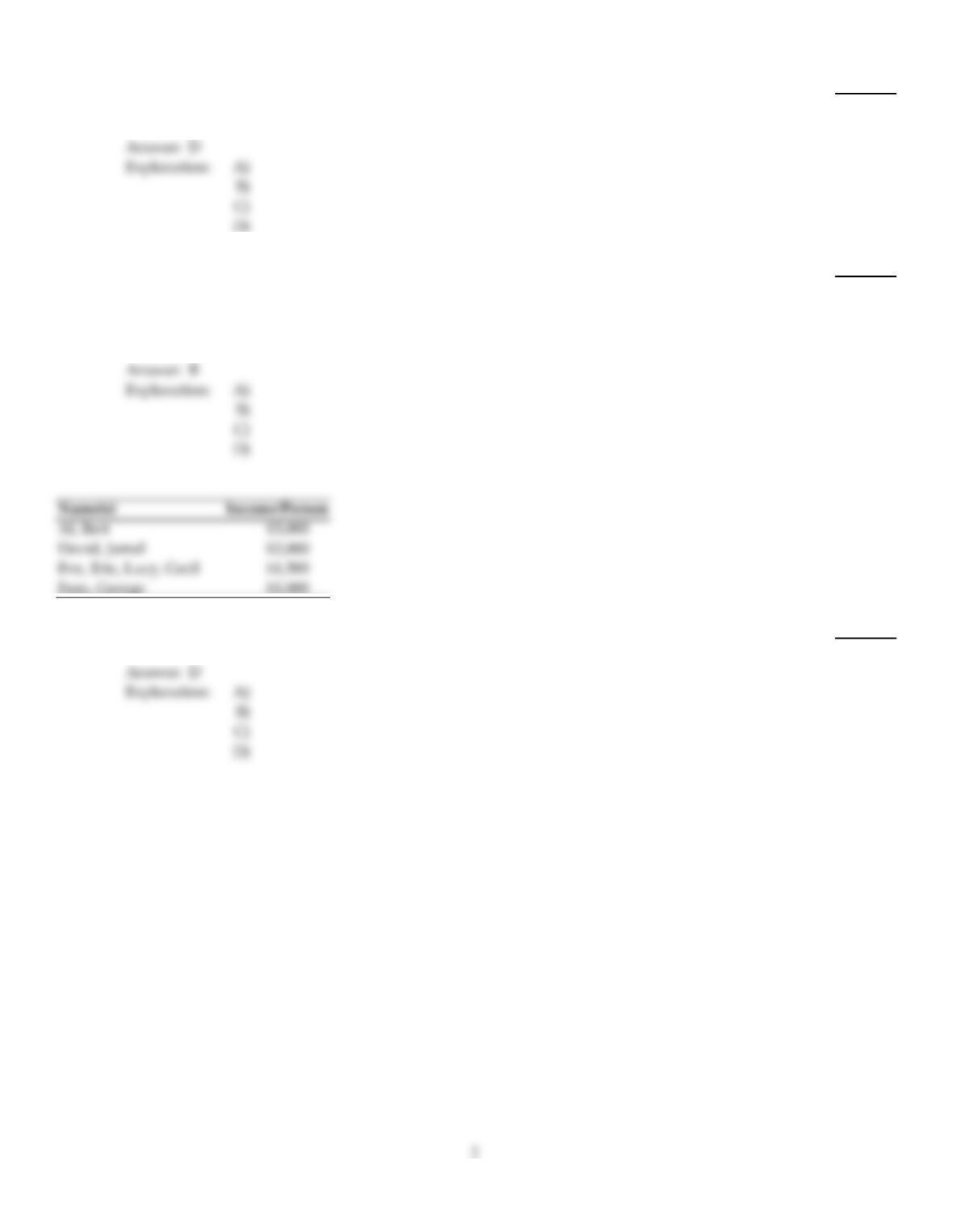
Use the above table. What percentage of income is received by the richest 20% of the population?
6)
A)
16.67 percent
B)
40.00 percent
C)
11.11 percent
D)
33.33 percent
7)
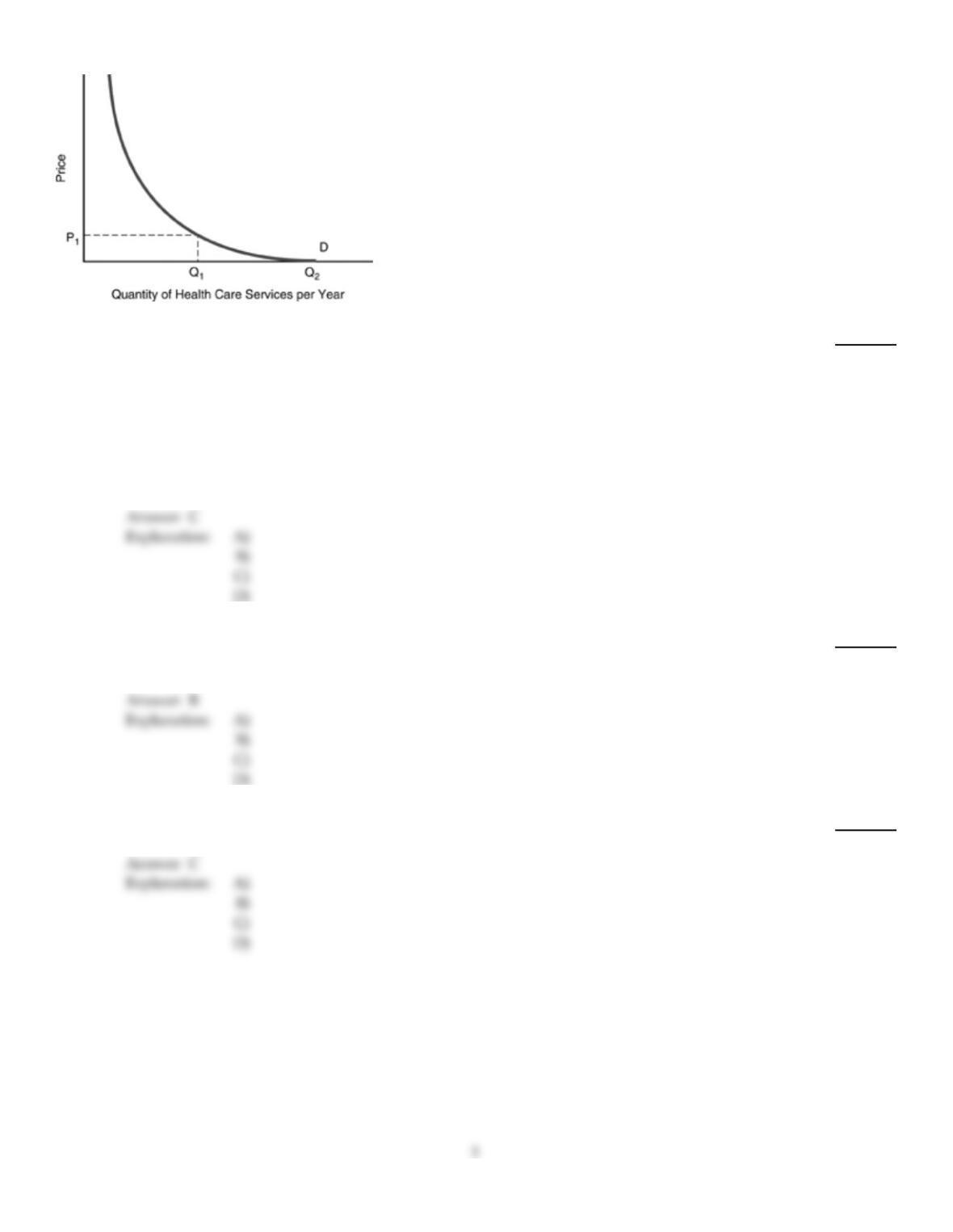
The above figure supports all of the following statements regarding health care EXCEPT
7)
A)
if all medical expenses were paid for by third parties, the quantity demanded would increase
tremendously.
B)
the lower the deductible, the greater is the quantity demanded of health care services per
year.
C)
the demand for health care is insensitive to price changes; as the price goes up, so does the
quantity demanded.
D)
due to third party payments, patients demand a higher quantity of health care services per
year.
8)
“To each according to what he or she produces” describes the ________ theory of income
determination.
8)
A)
egalitarian
B)
productivity
C)
needs
D)
equity
9)
On average the productivity of an individual usually peaks when the individual is about
9)
A)
20.
B)
60.
C)
50.
D)
30.

10)
Which of the following statements is correct?
10)
A)
The Social Security program funnels transfers from retired individuals to the youngest
children of low–income families.
B)
Social Security benefits are received by people who had contributed to the fund during their
active work years.
C)
As a public transfer payment, Social Security benefit is available only to the poor.
D)
Social Security is an entitlement which is available to everyone, including those who have not
contributed to the fund during their active work years.
11)
Social Security is
11)
A)
a social insurance program that guarantees that an elderly person will never fall below the
poverty level.
B)
an insurance program operated by the federal government.
C)
an intergenerational transfer program that only vaguely relates to past earnings.
D)
a retirement program that invests the person’s contributions into interest–earning financial
assets so the proceeds can fund the person’s retirement.
12)
Which of the following is not a true statement about the Lorenz curve?
12)
A)
The Lorenz curve includes both money income and income in kind.
B)
The Lorenz curve does not consider age differences among wage earners.
C)
The Lorenz curve does not include unreported income obtained from the underground
economy.
D)
The Lorenz curve does not consider different sizes of households.
13)
When poverty is defined by an relative real income level, what will happen to the poverty rate if
the distribution of income is not perfectly equal?
13)
A)
The poverty rate will change, but always exist.
B)
The poverty rate will always remain constant.
C)
The poverty rate will eventually be zero.
D)
The poverty rate will increase forever.

14)
When examining the financial status of households, wealth is
14)
A)
a stock variable and includes both tangible assets and human capital.
B)
not as important as income because wealth does not change over time.
C)
synonymous with income.
D)
a flow variable whereas income is a stock variable.
15)
Which of the following is NOT correct regarding the theories of income distribution?
15)
A)
Dealing with how income ought to be distributed is a normative issue.
B)
The egalitarian principle of income distribution is “to each exactly the same.“
C)
The productivity standard for the distribution of income is stated “to each according to what
they produce.”
D)
Dealing with how income should be distributed is a positive economic issue.
D
16)
The Lorenz curve shows
16)
A)
the supply of jobs.
B)
the distribution of income.
C)
the demand for jobs.
D)
the elasticity of jobs.
B
17)
The official poverty level is based on
17)
A)
after–tax income, and includes both cash and in–kind government subsidies.
B)
wages and salaries, plus any unreported amounts of income from the underground economy.
C)
pretax income, and includes cash subsidies but does not include in–kind subsidies such as
food stamps.
D)
total net worth.
C
A

18)
The official number of poor in the United States
18)
A)
is higher today than at any other time in our history.
B)
was lowest in the late 1960s.
C)
is lowest today.
D)
has risen steadily since 1981.
19)
The typical age–earnings cycle shows that
19)
A)
there is a constant positive relationship between age and earnings.
B)
there is no relationship between age and earnings.
C)
there is a constant negative relationship between age and earnings.
D)
there is a positive relationship between age and earnings that eventually turns into a negative
relationship.
D
20)
Income in kind is defined as
20)
A)
income received in the form of a paycheck.
B)
income received in the form of goods and services.
C)
tips.
D)
payment for services in the form of cash.
B
21)
The wealthiest 10 percent of the population owns about
21)
A)
90 percent of all the wealth in the United States.
B)
50 percent of all the wealth in the United States.
C)
70 percent of all the wealth in the United States.
D)
30 percent of all the wealth in the United States.
C
B

22)
If we were to pay everyone exactly the same income
22)
A)
productivity would increase.
B)
there would be a large amount of economic growth.
C)
more people would seek an education.
D)
there would be no incentive to invest in human capital.
23)
If we include cash benefits and in–kind benefits available to low–income people, the share of the
U.S. population in poverty
23)
A)
does not change.
B)
increases dramatically.
C)
increases somewhat.
D)
drops dramatically.
Explanation:
24)
The most common type of investment in human capital is
24)
A)
expanded years of schooling.
B)
improved health care and maintenance.
C)
having more children per family.
D)
the migration of labor in search of better jobs.
Explanation:
25)
The age–earnings cycle is an earnings profile of an individual throughout the person’s lifetime. The
profile shows that
25)
A)
earnings and age have no particular correlation.
B)
earnings gradually rise until they peak around age 50.
C)
younger workers have the most productivity.
D)
earnings usually peak at age 25 and then decline.
Explanation:
26)
Currently less than ________ of all health care spending is paid by individuals.
26)
A)
35 percent.
B)
20 percent.
C)
60 percent.
D)
5 percent.
Explanation:
Explanation:

27)
All of the following would show a more equal distribution than the distribution of money income
EXCEPT
27)
A)
lifetime earnings.
B)
total income.
C)
wealth.
D)
after–tax income.
28)
Originally, the threshold income level used to determine official poverty statistics was based on
28)
A)
the lowest income of the second quartile of families in the country.
B)
an income three times greater than necessary to purchase a nutritionally adequate diet.
C)
figures developed by a committee in the American Economic Association.
D)
a per capita income of $3000 in 1955 prices.
B
Explanation:
29)
Most individual’s income peaks when they are about
29)
A)
50.
B)
60.
C)
30.
D)
40.
A
Explanation:
30)
In general, as individuals undertake additional years of schooling,
30)
A)
the marginal productivity of individuals as workers becomes negative.
B)
the marginal benefit to society of the extra years of education increases.
C)
their stock of human capital increases.
D)
the marginal productivity of individuals as workers declines.
C
Explanation:
C
Explanation:

31)
A problem with third–party financing of so much of health care is that
31)
A)
it reduces the quality of health care received by most people.
B)
it causes the demand for medical services to increase, which causes health care costs to
increase.
C)
it discourages people from relying on the judgments of physicians in making decisions about
health care.
D)
it discourages physicians from getting second opinions and running enough tests to be sure
the right procedure is followed.
32)
The income transfers that a person receives from Social Security
32)
A)
is the same for everyone whether they contributed to the system or not.
B)
depends entirely on the amount received from private pensions.
C)
is not related to the amount that they have contributed.
D)
is a yearly proportion of the amount contributed.
33)
Once the national health care program goes into effect and more people will pay fewer of their
health care expenses out of their own pockets than they did previously, we can expect
33)
A)
the quantity of health care services supplied will decrease.
B)
the quantity of health care services demanded will decrease.
C)
the quantity of health care services demanded will increase.
D)
the quantity of health care services supplied will increase.
34)
The purpose of the Supplemental Security Income program is
34)
A)
to supplement Social Security for the elderly with medical problems.
B)
to provide a minimum income for the aged, blind, and the disabled.
C)
to provide a guaranteed minimum income for all Americans.
D)
to provide a minimum income for all households with children.

35)
The belief that everyone should have exactly the same amount of income is
35)
A)
egalitarian principle.
B)
comparable–worth doctrine.
C)
Lorenz principle.
D)
merit standard.
36)
The poverty income threshold in the United States was originally calculated by
36)
A)
multiplying a nutritionally adequate food plan for emergency use by 3.
B)
multiplying a nutritionally adequate food plan for emergency use by 4.
C)
multiplying a nutritionally adequate food plan for emergency use by 2.
D)
multiplying a nutritionally adequate food plan for emergency use by 5.
37)
In calculating income for the Lorenz curve, one factor that is omitted, is
37)
A)
in–kind transfer payments from the government.
B)
capital gains income.
C)
dividend payments.
D)
pure economic rent.
38)
In the year 2010, the United States spent about
38)
A)
16 percent of GDP on health care.
B)
100 percent of GDP on health care.
C)
2 percent of GDP on health care.
D)
6 percent of GDP on health care.
39)
Since Social Security is a pay–as–you–go program, the funds for the people retiring today
39)
A)
come from the Federal Reserve.
B)
come from those of us working today and in the future.
C)
come from import taxes.
D)
come from foreign sales of gold.

40)
If income were distributed according to the egalitarian principle of “to each exactly the same,” then
one problem would be that
40)
A)
individuals would have an excess desire to invest in their own human capital.
B)
productivity levels would probably become too high.
C)
there would be little or no incentive for individuals to take risky, hazardous, or unpleasant
jobs.
D)
too many individuals would want to take risky jobs.
41)
An individual with no deductible on his or her health insurance policy will tend to engage in a
lifestyle that is less healthy than a person with a $2,000 insurance deductible. This is said to be a
problem of
41)
A)
blue–zoning.
B)
healthy selection.
C)
wellness training.
D)
moral hazard.
42)
If you believe that all workers should be paid the same, you believe in the
42)
A)
benefits standard.
B)
productivity standard.
C)
comparative worth principle.
D)
egalitarian principle.
43)
The egalitarian principle refers to:
43)
A)
“To each according to her need.”
B)
“To each according to his ability.“
C)
“To each according to her productivity.”
D)
“To each exactly the same.”
44)
All of the following are income in kind EXCEPT
44)
A)
government provided food stamps.
B)
government provided medical aid.
C)
income received from family members.
D)
services produced in the home.

45)
One problem with third–party financing of health care is that
45)
A)
it reduces the quality of health care people receive.
B)
demand falls so that suppliers cannot take advantage of economies of scale.
C)
people have more incentive to utilize health care.
D)
it discourages people from relying on their physicians’ advice in making health care
decisions.
46)
Much of a person’s increased productivity can be linked to
46)
A)
the income elasticity of demand for the product.
B)
the prevalent marginal tax rate.
C)
the price elasticity of demand for the product.
D)
on–the–job training.
Explanation:
47)
Which of the following is not a determinant of an individual’s marginal product?
47)
A)
educational level
B)
money income
C)
talent
D)
experience
Explanation:
48)
Unequal pay that is caused by economic discrimination will be due to
48)
A)
difference in human capital.
B)
a noneconomic factor.
C)
differences in the marginal revenue product.
D)
a monopolistic labor market.
Explanation:
49)
The top 5 percent of health care users in the United States account for
49)
A)
over 50 percent of all health costs.
B)
over 75 percent of all health costs.
C)
almost 90 percent of all health costs.
D)
30 percent of all health costs.
Explanation:
Explanation:
50)
All of the following are criticisms of the Lorenz curve analysis EXCEPT
50)
A)
different sizes of households are ignored.
B)
income–in–kind is not figured in.
C)
the inequality gap is not an issue that economists study.
D)
it does not take into consideration lifetime earnings.
51)
Which of the following is NOT a subsidy in the new the federal government’s new national health
care program?
51)
A)
Families with incomes up to 400% of the federal poverty level are eligible for thousands of
dollars in tax subsidies per year (amounts vary with family incomes).
B)
A special subsidy rate of 3.8% is applied to nearly all income earnings above $200,000 for
individuals or $250,000 for married couples.
C)
Families with incomes up to 133% of the federal poverty level are eligible for federal
Medicaid coverage.
D)
Tax credits are available to businesses providing health insurance to 25 or fewer workers and
paying annual salaries averaging no more than $50,000.
52)
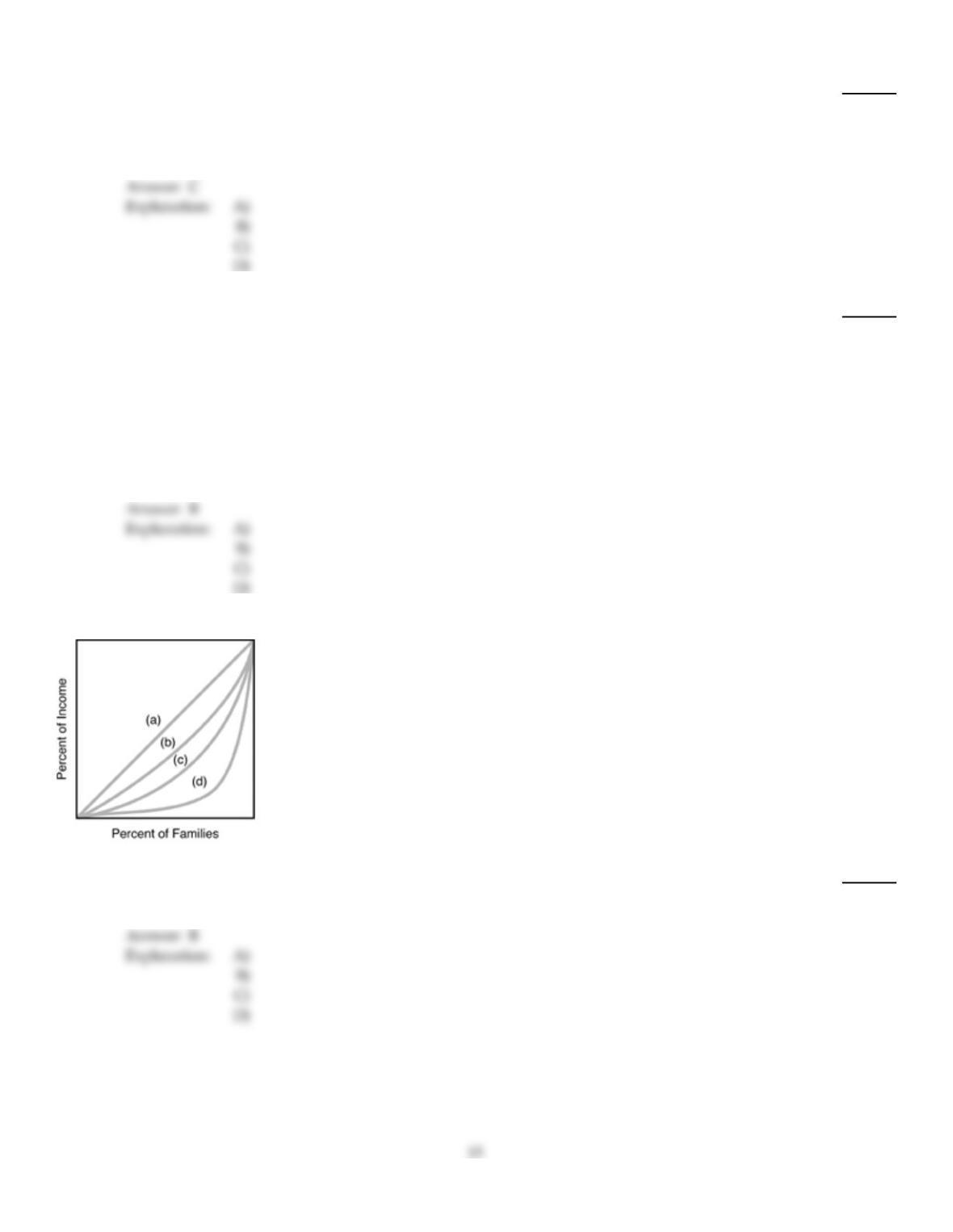
Use the above figure. Refer to the above diagram where curves (a) through (d) are for four different
countries. Income is third most unequally distributed in
52)
A)
Country A.
B)
Country B.
C)
Country C.
D)
Country D.
53)
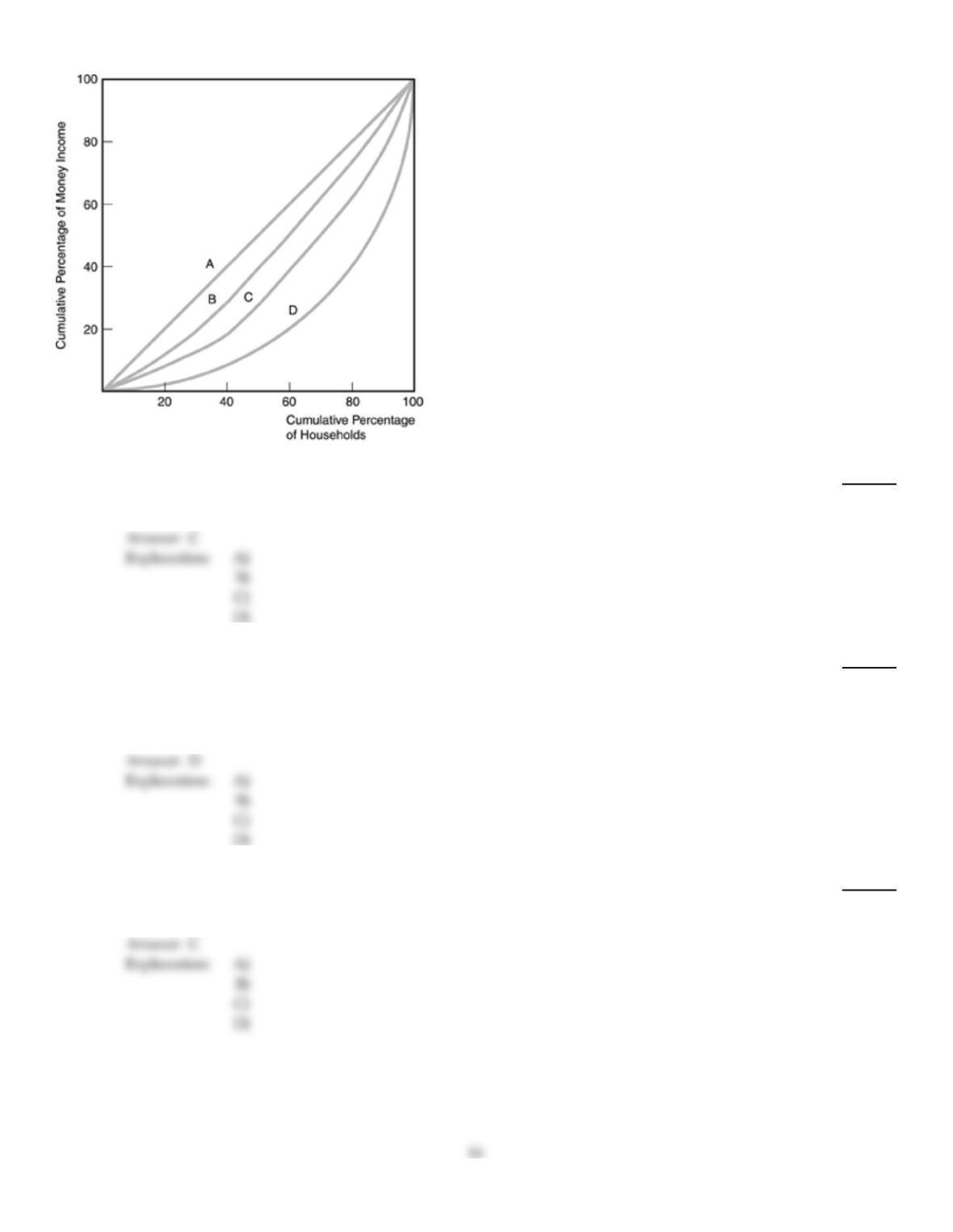
Refer to the above figure. For which Lorenz curve does the richest 25 percent make 50 percent of
the nation’s money income?
53)
A)
A
B)
B
C)
C
D)
D
54)
The Lorenz curve shows what portion of total money income is accounted for by
54)
A)
taxpaying citizens only.
B)
only poor people.
C)
only the wealthiest citizens.
D)
different proportions of a country’s households.
55)
The government program that provides aid to families in need is
55)
A)
Supplemental Security Income program.
B)
Earned Income Tax Credit.
C)
TANF.
D)
Social Security program.

56)
A benefit of deductibles and health savings accounts is that they
56)
A)
increase the quality of health care.
B)
reduce the use of expensive techniques for hopeless cases.
C)
reduce the incomes of physicians.
D)
reduce the moral hazard problem associated with third–party payers.
57)
The age–earning cycle predicts that a typical person will
57)
A)
be earning the highest income at about the age 45–50.
B)
be earning the lowest income right before retirement.
C)
be earning the highest income right before retirement.
D)
be earning $50,000 in the year 2010.
A
58)
Some economists criticize the Lorenz curve because it
58)
A)
does not include unreported income earned in the underground economy.
B)
does not include the cumulative percentage of households.
C)
represents the inequality of lifetime income when it should just look at a specific time period.
D)
accounts for differences in the size of households when it should not.
A
59)
One reason some economists are critical of the Lorenz curve is because
59)
A)
it reflects income after taxes.
B)
it reflects only the top bracket of taxpayers.
C)
it reflects only the poor in the country.
D)
it reflects income before taxes.
D
D

60)
A diagonal straight line on a Lorenz curve represents
60)
A)
a perfectly unequal distribution of income (one person has everything).
B)
a perfectly equal distribution of income.
C)
an oblique distribution of income.
D)
a high level of inequality in the distribution of income.
61)
What impact do private insurance companies and Medicare have on national medical costs?
61)
A)
Medical costs go up because insurance leads to an increase in the quantity demanded of
medical services.
B)
Medical cost are unaffected by insurance companies.
C)
Medical costs go up because insurance will lead to the reduction in the supply of medical
services due to the amount of paperwork required.
D)
Medical costs go down because the insurance company pays the bill.
62)
Which of the following are determinants of differences in income?
62)
A)
discrimination
B)
marginal productivity
C)
age
D)
all of the above
63)
A major problem with using the egalitarian principle to distribute income is that
63)
A)
it would not be fair to the wealthy.
B)
it is difficult to know when an equal distribution of income has been achieved.
C)
it would eliminate the incentives that rewards provide in an economic system.
D)
there exist no mechanisms to carry out such a scheme.

64)
The program that was created to provide rebates of Social Security taxes to low–income workers is
64)
A)
TANF.
B)
Supplemental Security Income.
C)
Earned Income Tax Credit Program.
D)
Food Stamps.
65)
The most widely used measure of income inequality is
65)
A)
the Bureau of Labor Statistics’ cost–of–living index.
B)
the Laffer curve.
C)
the Gemini coefficient.
D)
the Lorenz curve.
D
66)
Which of the following groups of U.S. residents would likely qualify for SSI benefits?
66)
A)
new federal retirees
B)
the disabled
C)
incarcerated murderers
D)
college students
B
67)
Determinants of income differences include all of the following EXCEPT
67)
A)
moral hazard.
B)
age.
C)
marginal productivity.
D)
discrimination.
A
68)
All of the following are reasons that health care costs have risen so much in the past few decades
EXCEPT
68)
A)
the aging population.
B)
higher imports.
C)
third party payments.
D)
new technologies.
B
C