
Exam
Name___________________________________
MULTIPLE CHOICE. Choose the one alternative that best completes the statement or answers the question.
1)
The more bowed out the Lorenz curve is, the
1)
A)
richer the society.
B)
less equal the distribution of income.
C)
more equal the distribution of income.
D)
poorer the society.
2)
As a result of moral hazard
2)
A)
physicians and hospital administrators have no incentive to raise costs.
B)
patients increasingly have to worry about the expense of operations and other medical
procedures.
C)
both physicians and hospitals order more procedures.
D)
both physicians and hospitals have a financial interest in trying to keep hospital costs down.
3)
Rising health care spending is a problem confronting the federal government because
3)
A)
it is the government’s job to make sure everyone receives the health care they need.
B)
federal spending on health care has increased rapidly over the last thirty years.
C)
the medical expenses of federal employees has been rising at a rate much faster than for
non–federal workers.
D)
the federal–funded VA hospitals have been expanding faster than government revenues can
provide for.
4)
According to the text, today’s Lorenz curve is
4)
A)
a straight line.
B)
more bowed than in 1929.
C)
a vertical line.
D)
less bowed than in 1929.
5)
The effects of the national health care program on goods and services markets will
5)
A)
consumers will pay lower prices for many goods and services.
B)
increase the quantity produced of the firm.
C)
increase the marginal cost of the firm.
D)
decrease the quantity demanded for all goods and services.
6)
“To each according to what he or she produces” describes the ________ theory of income
determination.
6)
A)
needs
B)
egalitarian
C)
productivity
D)
equity
7)
The Lorenz curve shows what portion of total money income is accounted for by
7)
A)
only the wealthiest citizens.
B)
only poor people.
C)
taxpaying citizens only.
D)
different proportions of a country’s households.
8)
Which of the following sources of productivity is the most difficult to acquire?
8)
A)
experience
B)
talent
C)
education
D)
training
9)
A geometric representation of the distribution of income is referred to as
9)
A)
the Lorenz curve.
B)
the Phillips curve.
C)
the Keynesian cross.
D)
the labor supply curve.

10)
A major problem with using the egalitarian principle to distribute income is that
10)
A)
there exist no mechanisms to carry out such a scheme.
B)
it would not be fair to the wealthy.
C)
it would eliminate the incentives that rewards provide in an economic system.
D)
it is difficult to know when an equal distribution of income has been achieved.
11)
The return on human capital
11)
A)
tends to be much lower than the return on physical capital.
B)
cannot be related to the return on physical capital since human capital and physical capital
are so different.
C)
is similar to the return on physical capital.
D)
tends to be much greater than the return on physical capital.
C
12)
All of the following aim to reduce income inequality EXCEPT
12)
A)
earned income tax credits.
B)
food stamp programs.
C)
Social Security payments.
D)
regressive taxes.
D
13)
Originally, the threshold income level used to determine official poverty statistics was based on
13)
A)
figures developed by a committee in the American Economic Association.
B)
an income three times greater than necessary to purchase a nutritionally adequate diet.
C)
a per capita income of $3000 in 1955 prices.
D)
the lowest income of the second quartile of families in the country.
B
C

14)
The threshold income level originally used to determine official poverty statistics was based on
14)
A)
standards provided by the United Nations based on studies done in poor countries around
the world.
B)
the highest income of the lowest one–fifth of families in the country.
C)
an income three times the amount of money needed to purchase a nutritionally adequate diet.
D)
a per capita income of $1,000 in 1958 prices.
15)
Age is a determinant of income because
15)
A)
older workers have accumulated more wealth.
B)
older workers have accumulated less wealth.
C)
age contributes to costs as medical expenses increase.
D)
with age typically come experience, education, and training that can increase income.
16)
Which program provides assistance to the aged, blind and disabled?
16)
A)
TANF
B)
Earned Income Tax Credit
C)
Social Security Program
D)
Supplemental Security Income program
17)
If a goal of a nation’s residents is to increase marginal productivity, they should increase
17)
A)
expenditures on education.
B)
exports.
C)
the marginal propensity to consume.
D)
the inheritance tax.
18)
If we were to pay everyone exactly the same income
18)
A)
productivity would increase.
B)
more people would seek an education.
C)
there would be no incentive to invest in human capital.
D)
there would be a large amount of economic growth.
19)
The regular earnings profile of an individual throughout his or her lifetime is
19)
A)
the age–earnings cycle.
B)
wealth.
C)
income–in–kind.
D)
the Lorenz curve.
20)
The age–earnings profile for most people indicates
20)
A)
earnings rise continually until a person retires.
B)
earnings rise until the age of about 50 and then begin to fall until retirement.
C)
earnings initially decline and then rise continually until retirement.
D)
that when you adjust for inflation, earnings are constant throughout the entire workplace
experience.
B
Explanation:
21)
The federal government and insurance companies are examples of third party
21)
A)
providers of health care.
B)
observers of health care.
C)
payers for health care.
D)
users of health care.
C
Explanation:
22)
When examining the financial status of households, wealth is
22)
A)
not as important as income because wealth does not change over time.
B)
a stock variable and includes both tangible assets and human capital.
C)
synonymous with income.
D)
a flow variable whereas income is a stock variable.
B
Explanation:
23)
Economic discrimination against minorities exists when
23)
A)
minorities are in different occupations than whites.
B)
minorities are paid less than whites with the same education, experience, and training.
C)
minorities have less education and training than whites.
D)
minorities are paid less than whites on average.
B
Explanation:
A
Explanation:

24)
The richest 10 percent of U.S. houses hold more than two–thirds of all wealth. The problem with
this statement is that
24)
A)
it is based entirely on nonhuman wealth.
B)
it does not consider an individual’s current income.
C)
it is based entirely on human wealth.
D)
it does not consider private and public pension plans.
25)
The Social Security system is a(n)
25)
A)
ability to pay system.
B)
progressive tax system.
C)
ad valorem system.
D)
pay–as–you–go system.
26)
In a growing economy, it is possible to eliminate
26)
A)
either absolute nor relative poverty.
B)
relative poverty.
C)
both absolute and relative poverty.
D)
absolute poverty.
27)
The age–earning cycle shows an individual typically earning
27)
A)
a constant income (adjusted for inflation) over the entire working life of the worker.
B)
an income that declines until age 30–35 and then increases rapidly.
C)
an income that cycles upward and downward as an individual ages.
D)
an income that increases with age, peaks, and then falls as retirement approaches.

28)
Suppose all people have the same age–earnings profile and the percent of the population in each
age category is the same. The distribution of income at any point in time will be
28)
A)
unequal because other sources of income will differ.
B)
unequal because incomes differ by age.
C)
equal because incomes and wealth levels must then be the same.
D)
equal because all have the same profile.
29)
In general, as individuals undertake additional years of schooling,
29)
A)
the marginal productivity of individuals as workers declines.
B)
the marginal productivity of individuals as workers becomes negative.
C)
their stock of human capital increases.
D)
the marginal benefit to society of the extra years of education increases.
C
30)
According to the text, the highest 20 percent of U.S. income households earn about what percentage
of total income today?
30)
A)
50 percent
B)
20 percent
C)
10 percent
D)
99 percent
A
31)
If a nation’s Lorenz curve lies on the 45 degree line of income equality, then
31)
A)
income is unequally distributed.
B)
more of the nation’s income is received by the highest 20 percent of families than by the
lowest percent.
C)
the income received by each 20 percent of families is 20 percent of the total income.
D)
more of the nation’s income is received by the lowest 20 percent of families than by the
highest 20 percent.
C
B

32)
In the United States, the distribution of wealth
32)
A)
is more equal than the distribution of income.
B)
is the same as the distribution of income.
C)
is more unequal than the distribution of income.
D)
is equal for all families.
33)
All of the following lead to a difference in income EXCEPT
33)
A)
sales tax.
B)
marginal productivity.
C)
discrimination.
D)
the age–earnings cycle.
A
34)
Joseph decides to join the Big State University’s football team when he learns that his health
insurance will pay for any subsequent injury. This illustrates
34)
A)
oligopolistic behavior.
B)
a symmetric information problem.
C)
monopolistic behavior.
D)
a moral hazard problem.
D
35)
Which of the following statements about Social Security is FALSE?
35)
A)
Benefit payments under Social Security are based on the recipient’s need.
B)
Over 90 percent of all employed workers in the United States are covered by Social Security.
C)
Benefit payments under Social Security redistribute income from young to old.
D)
Social Security is an intergenerational transfer where the benefits paid are only roughly
related to past earnings.
A
C
36)
If everyone earned the same income, the Lorenz curve would be
36)
A)
a straight line from the origin at a 45–degree angle.
B)
a rectangular hyperbola.
C)
the horizontal axis.
D)
very bowed from the diagonal.
37)
A benefit of deductibles and health savings accounts is that they
37)
A)
reduce the use of expensive techniques for hopeless cases.
B)
increase the quality of health care.
C)
reduce the moral hazard problem associated with third–party payers.
D)
reduce the incomes of physicians.
Explanation:
38)
When poverty is defined by an relative real income level, what will happen to the poverty rate if
the distribution of income is not perfectly equal?
38)
A)
The poverty rate will change, but always exist.
B)
The poverty rate will always remain constant.
C)
The poverty rate will increase forever.
D)
The poverty rate will eventually be zero.
Explanation:
39)
All of the following would show a more equal distribution than the distribution of money income
EXCEPT
39)
A)
lifetime earnings.
B)
wealth.
C)
after–tax income.
D)
total income.
Explanation:
Explanation:

40)
One reason some economists are critical of the Lorenz curve is because
40)
A)
it reflects only the poor in the country.
B)
it reflects only the top bracket of taxpayers.
C)
it reflects income before taxes.
D)
it reflects income after taxes.
41)
If we include cash benefits and in–kind benefits available to low–income people, the share of the
U.S. population in poverty
41)
A)
does not change.
B)
increases somewhat.
C)
increases dramatically.
D)
drops dramatically.
D
42)
The incidence of absolute poverty is reduced by
42)
A)
annual recalculations of the poverty line.
B)
government welfare programs.
C)
the size of the budget deficit.
D)
economic growth.
D
43)
The earnings of most people
43)
A)
increase steadily until retirement.
B)
increase with age until around age 40 due to increased experience and hours worked.
C)
increase with age until around age 60 due to increased experience, training, and hours
worked, then level off as hours worked levels off.
D)
increase with age until around age 50 due to increased experience, training, and hours
worked.
D
C
44)
Which of the following statements is TRUE about income and wealth?
44)
A)
Both income and wealth are flow measures.
B)
Income is a flow measure and wealth is a stock measure.
C)
Income is a stock measure and wealth is a flow measure.
D)
Both income and wealth are stock measures.
45)
An individual with no deductible on his or her health insurance policy will tend to engage in a
lifestyle that is less healthy than a person with a $2,000 insurance deductible. This is said to be a
problem of
45)
A)
blue–zoning.
B)
wellness training.
C)
healthy selection.
D)
moral hazard.
46)
The age–earnings cycle is an earnings profile of an individual throughout the person’s lifetime. The
profile shows that
46)
A)
earnings and age have no particular correlation.
B)
younger workers have the most productivity.
C)
earnings gradually rise until they peak around age 50.
D)
earnings usually peak at age 25 and then decline.
47)
The federal government began officially measuring poverty in the
47)
A)
1900s.
B)
1930s.
C)
1860s.
D)
1960s.
48)
How will the new federal government’s new national health care program be funded?
48)
A)
A tax rate of 3.8 percent will be assessed on nearly all earnings above $200,000 per year for
individuals and above $250,000 per year for married couples.
B)
The federal government will charge all participants of health insurance exchanges 3.8%.
C)
Nearly all U.S. residents will pay a fine of up to $750 per year for an individual (up to $2,250
per year for a family) regardless of coverage.
D)
Firms with at least 50 employees must pay an annual fine of up to $750 per employee
regardless of coverage.
49)
Merit is judged by one’s ability to produce
49)
A)
what is considered useful by society.
B)
what is considered beneficial to society.
C)
what is considered valuable by society.
D)
all of the above.
50)
Which of the following CANNOT be eliminated in a growing economy such as the U.S. economy?
50)
A)
absolute poverty
B)
relative poverty
C)
both absolute and relative poverty
D)
Neither absolute nor relative poverty can be eliminated.
51)
A Lorenz curve measures the ________ on the horizontal axis.
51)
A)
demand of families on welfare
B)
cumulative percentage of families
C)
cumulative percentage of family wealth
D)
cumulative percentage of family income
52)
The government finances Social Security through
52)
A)
payroll taxes.
B)
excise taxes.
C)
state taxes.
D)
the sale of goods and services.

53)
The wealthiest 10 percent of the population owns about
53)
A)
30 percent of all the wealth in the United States.
B)
70 percent of all the wealth in the United States.
C)
90 percent of all the wealth in the United States.
D)
50 percent of all the wealth in the United States.
54)
The common measure of wealth used in calculating the distribution of wealth includes
54)
A)
human capital.
B)
workers’ claims on private pension funds.
C)
workers’ claims on the Social Security system.
D)
financial assets.
Name(s) Income/Person
Al, Bert $3,000
David, Jamal $2,000
Eve, Eric, Lucy, Cecil $1,500
Fran, George $1,000
55)
Use the above table. What percentage of income is received by the poorest 20% of the population?
55)
A)
20 percent
B)
7.0 percent
C)
11.1 percent
D)
13.3 percent
56)
Government agencies to which the national health care program assigns the task of assisting
individuals, families, and small businesses in identifying health insurance policies to purchase are
known as
56)
A)
markets for health care.
B)
health insurance regulations.
C)
health insurance mandates.
D)
health care exchanges.
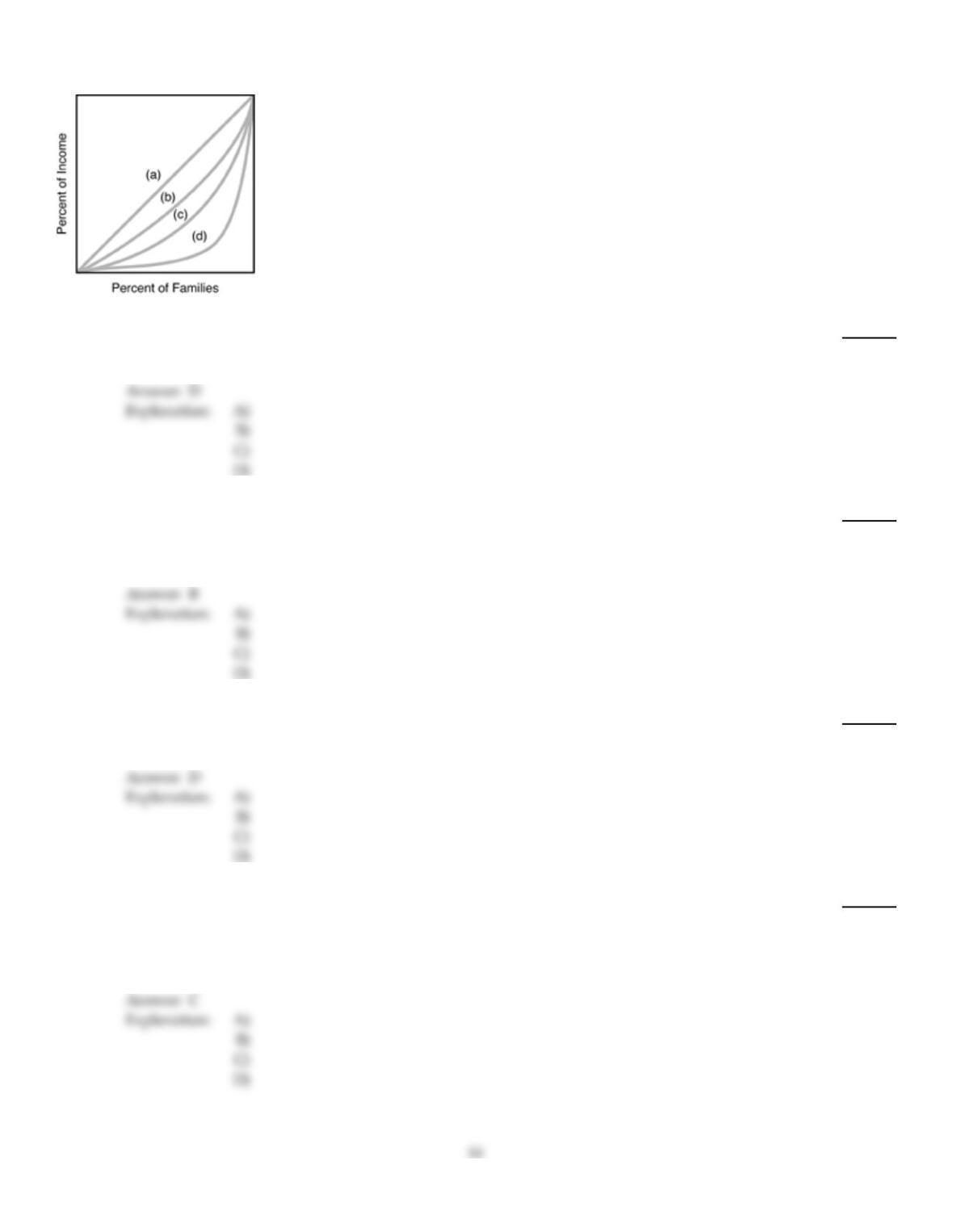
57)
Use the above figure. Refer to the above diagram where curves (a) through (d) are for four different
countries. Income is most unequally distributed in
57)
A)
Country A.
B)
Country B.
C)
Country C.
D)
Country D.
58)
The idea that some people engage in risky behavior due to the fact that they have good health care
is known as
58)
A)
risk aversion.
B)
moral hazard.
C)
zero–sum game.
D)
risk–taking behavior.
59)
Which factor listed below does NOT help account for the age–earning cycle?
59)
A)
number of hours worked each week
B)
productivity
C)
effects of aging
D)
racial discrimination
60)
The more bowed out the Lorenz curve, the
60)
A)
greater the overall wealth in the economy.
B)
less the overall wealth in the economy.
C)
less equal the income distribution.
D)
more equal the income distribution.

61)
The idea that the Lorenz curve should be along the 45 degree line is consistent with
61)
A)
the productivity standard.
B)
the conservative principle.
C)
the egalitarian principle.
D)
none of the above.
62)
The most common type of investment in human capital is
62)
A)
expanded years of schooling.
B)
improved health care and maintenance.
C)
the migration of labor in search of better jobs.
D)
having more children per family.
A
63)
A Lorenz curve measures the ________ on the vertical axis.
63)
A)
cumulative percentage of family wealth
B)
demand of families on welfare
C)
cumulative percentage of families
D)
cumulative percentage of money income
D
64)
All of the following are reasons that health care costs have risen so much in the past few decades
EXCEPT
64)
A)
third party payments.
B)
new technologies.
C)
higher imports.
D)
the aging population.
C
C

65)
The Lorenz curve
65)
A)
breaks down the income levels of each group in the economy.
B)
shows what portion of the population are living in poverty and what portion are living in
wealth.
C)
shows what portion of the population is working as professionals, white– and blue–collar,
workers and workers at menial tasks.
D)
shows what portion of total money income is accounted for by different proportions of the
nation’s households.
66)
The official number of poor in the United States
66)
A)
is higher today than at any other time in our history.
B)
is lowest today.
C)
was lowest in the late 1960s.
D)
has risen steadily since 1981.
C
67)
Which of the following would NOT be considered a determinant of marginal productivity?
67)
A)
experience
B)
gender
C)
training
D)
talent
B
68)
Which of the following is NOT correct regarding the theories of income distribution?
68)
A)
The egalitarian principle of income distribution is “to each exactly the same.“
B)
Dealing with how income should be distributed is a positive economic issue.
C)
Dealing with how income ought to be distributed is a normative issue.
D)
The productivity standard for the distribution of income is stated “to each according to what
they produce.”
B
D

69)
Since 1929, the distribution of money income in the United States has
69)
A)
become more equal.
B)
shifted toward the poorer 20 percent away from the richer 20 percent.
C)
become slightly more unequal.
D)
not dramatically changed.
70)
A Lorenz curve that is perfectly straight indicates
70)
A)
that a small portion of the population accounts for most of the income.
B)
that a large portion of the population accounts for most of the income.
C)
that society is very rich.
D)
complete income equality.
71)
Which of the following is considered a contributive standard for the distribution of income?
71)
A)
rewarding workers according to their needs
B)
rewarding workers according to the number of their dependents
C)
rewarding workers according to their productivity
D)
all of the above
72)
The impact of technological change in the health care area has been to
72)
A)
increase both the quality of health care and the costs of health care.
B)
reduce the cost of health care.
C)
increase the quality of health care while decreasing the costs.
D)
reduce the quality of health care while raising the costs.
73)
The health care market in the United States is characterized by
73)
A)
third–party payment of health care costs.
B)
considerable government involvement.
C)
asymmetric information between providers and consumers.
D)
all of the above
74)
Wealth
74)
A)
is the same as income.
B)
includes assets such as houses, stocks, and bonds.
C)
is a flow and not a stock.
D)
does not include tangible objects.
B
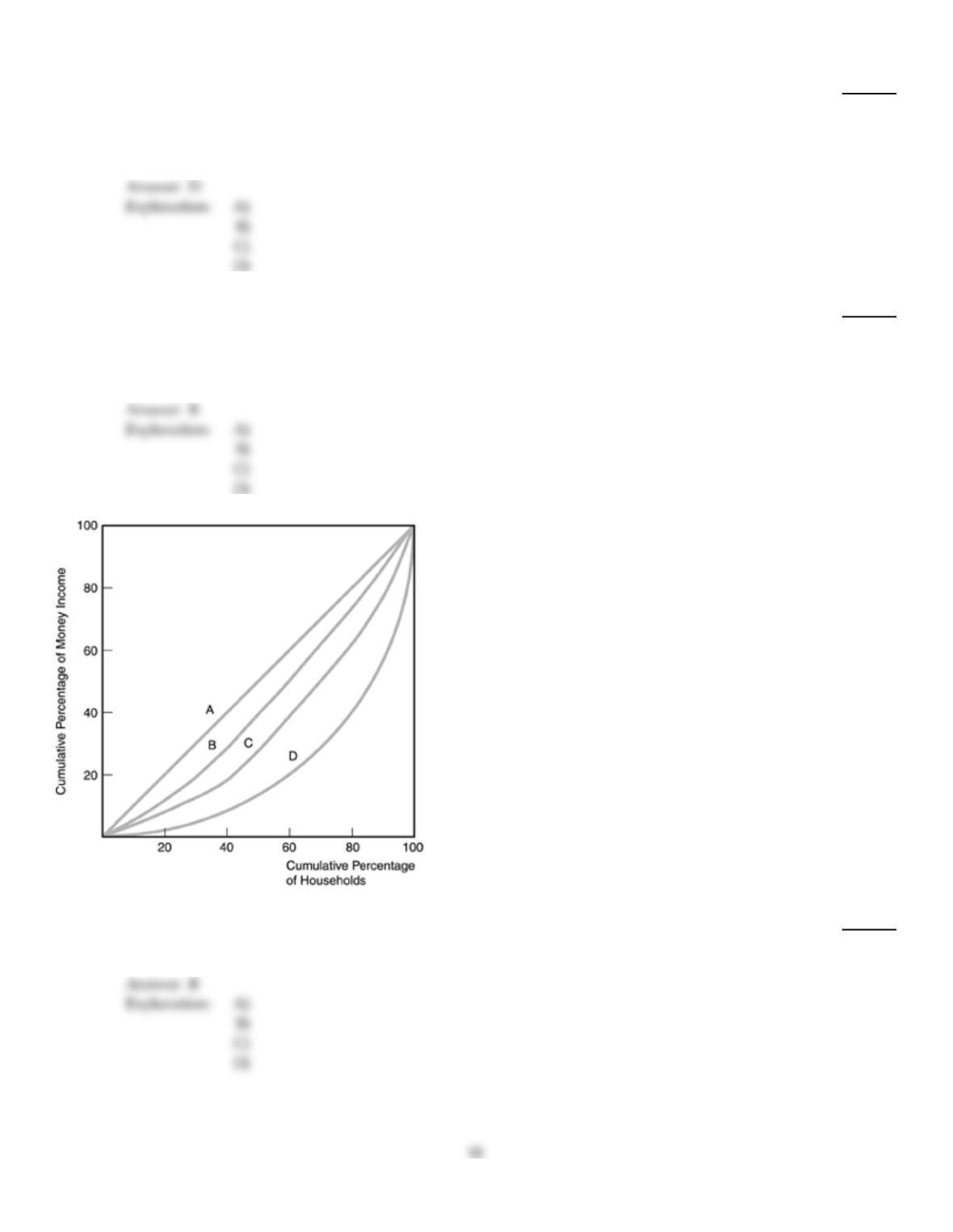
75)
Refer to the above figure. For which Lorenz curve does the richest 40 percent make 50 percent of
the nation’s money income?
75)
A)
A
B)
B
C)
C
D)
D
B
D

76)
In the United States, inheritance accounts for roughly ________ of income inequality.
76)
A)
30 percent
B)
50 percent
C)
10 percent
D)
20 percent
77)
Income–in–kind is
77)
A)
received in the form of goods and services.
B)
income in dollars.
C)
used to buy goods and services.
D)
money income.
78)
What impact do private insurance companies and Medicare have on national medical costs?
78)
A)
Medical costs go up because insurance will lead to the reduction in the supply of medical
services due to the amount of paperwork required.
B)
Medical cost are unaffected by insurance companies.
C)
Medical costs go up because insurance leads to an increase in the quantity demanded of
medical services.
D)
Medical costs go down because the insurance company pays the bill.
79)
Typically, the major cost of a college education is
79)
A)
tuition.
B)
housing.
C)
books.
D)
foregone income.
80)
An example of third–party financing of health care is
80)
A)
a patient going to another doctor for a second or a third opinion.
B)
patients paying for their visit to the doctor.
C)
Medicare.
D)
patients not going to the doctor in order to save money.
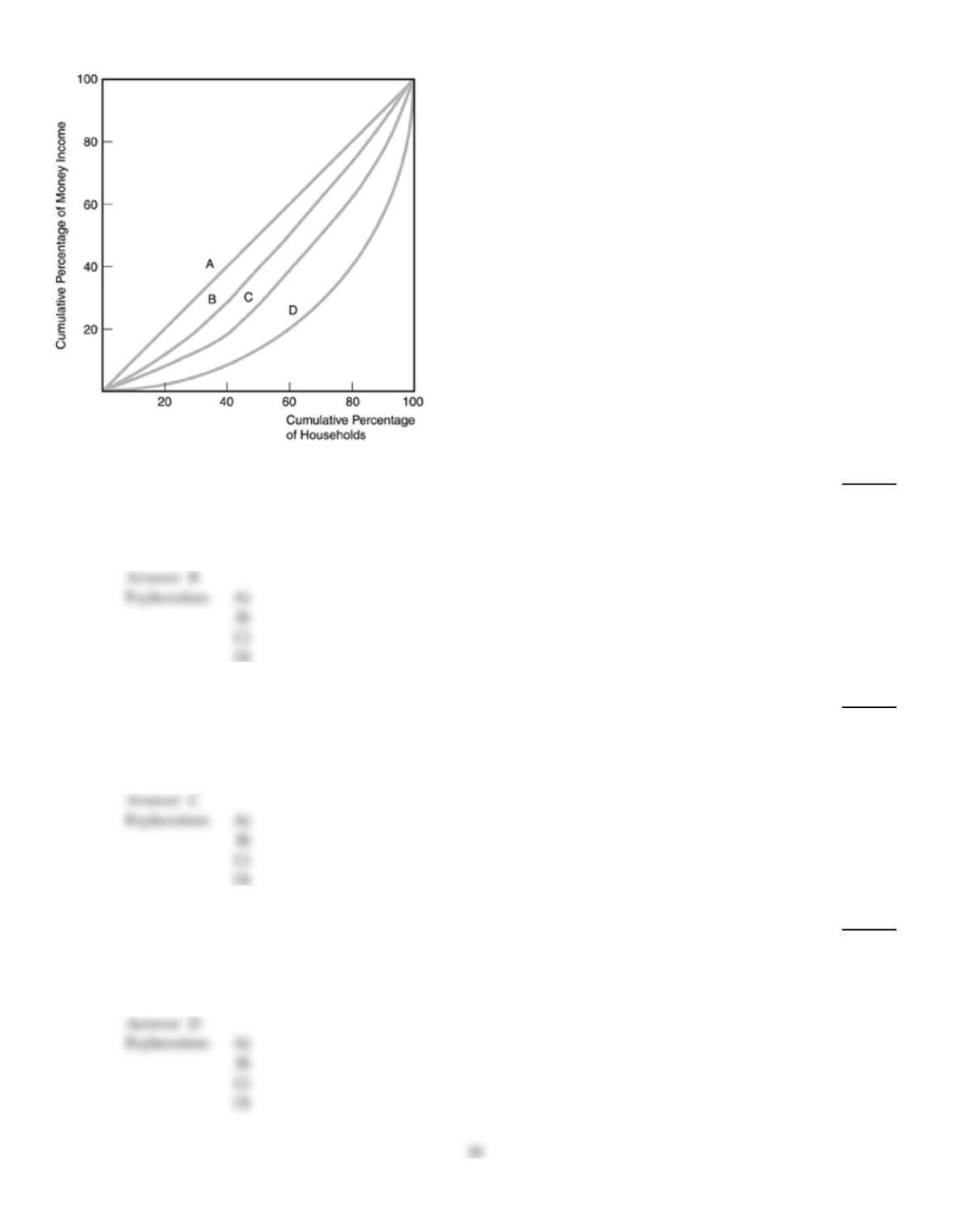
81)
Refer to the above figure. Where are the poorest households represented on the graph?
81)
A)
The poorest households are concentrated in the middle.
B)
The poorest households are to the left along the horizontal axis.
C)
The poorest households are all along the horizontal axis.
D)
The poorest households are to the right along the horizontal axis.
82)
The contributive standard of income distribution is met by
82)
A)
using local committees to determine the needs of families in the area.
B)
having the government determine all wages.
C)
setting wages according to marginal productivity.
D)
having a highly progressive income tax.
83)
A diagonal straight line on a Lorenz curve represents
83)
A)
an oblique distribution of income.
B)
a perfectly unequal distribution of income (one person has everything).
C)
a high level of inequality in the distribution of income.
D)
a perfectly equal distribution of income.