2) Which of the following statements regarding the Law of One Price is INCORRECT?
A) At any point in time, the price of two equivalent goods trading in different competitive
markets will be the same.
B) One useful consequence of the Law of One Price is that when evaluating costs and benefits to
compute a net present value, we can use any competitive price to determine a cash value, without
checking the price in all possible markets.
C) If equivalent goods or securities trade simultaneously in different competitive markets, then
they will trade for the same price in both markets.
D) An important property of the Law of One Price is that it holds even in markets where
arbitrage is not possible.
Use the table for the question(s) below.
Consider the following prices from a McDonald’s Restaurant:
Big Mac Sandwich
$2.99
Large Coke
$1.39
Large Fry
$1.09
3) A McDonald’s Big Mac value meal consists of a Big Mac Sandwich, Large Coke, and a Large
Fry. Assuming that there is a competitive market for McDonald’s food items, at what price must
a Big Mac value meal sell to insure the absence of an arbitrage opportunity and uphold the law of
one price?
A) $4.08
B) $4.38
C) $5.47
D) $5.77
4) A McDonald’s Big Mac value meal consists of a Big Mac Sandwich, Large Coke, and a Large
Fry. Assume that there is a competitive market for McDonald’s food items and that McDonald’s
sells the Big Mac value meal for $4.79. Does an arbitrage opportunity exists and if so how
would you exploit it and how much would you make on one extra value meal?
A) Yes, buy extra value meal and then sell Big Mac, Coke, and Fries to make arbitrage profit of
$0.68.
B) No, no arbitrage opportunity exists.
C) Yes, buy Big Mac, Coke, and Fries then sell value meal to make arbitrage profit of $1.09.
D) Yes, buy Big Mac, Coke, and Fries then sell value meal to make arbitrage profit of $0.68.
5) Walgreen Company (NYSE: WAG) is currently trading at $48.75 on the NYSE. Walgreen
Company is also listed on NASDAQ and assume it is currently trading on NASDAQ at $48.50.
Does an arbitrage opportunity exists and if so how would you exploit it and how much would
you make on a block trade of 100 shares?
A) No, no arbitrage opportunity exists.
B) Yes, buy on NASDAQ and sell on NYSE, make $25.
C) Yes, buy on NYSE and sell on NASDAQ, make $25.
D) Yes, buy on NASDAQ and sell on NYSE, make $250.
6) You are up late watching TV one night and see an ad from Ronco for the Dial-o-matic food
slicer. You learn that the Dial-o-matic sells for $29.95. But wait, there is more. Ronco is also
including in this deal a set of Ginsu steak knives worth $10.95 and another free gift worth $7.95.
Assuming that there is a competitive market for Ronco items, at what price must Ronco be
selling this three item Dial-o-matic deal to insure the absence of an arbitrage opportunity and
uphold the law of one price?
7) Advanced Micro Devices (NYSE: AMD) is currently trading at $20.75 on the NYSE.
Advanced Micro Devices is also listed on NASDAQ and assume it is currently trading on
NASDAQ at $20.50. Does an arbitrage opportunity exists and if so how would you exploit it
and how much would you make on a block trade of 1000 shares?
3.5 No-Arbitrage and Security Prices
1) Which of the following statements regarding arbitrage and security prices is INCORRECT?
A) We call the price of a security in a normal market the no-arbitrage price for the security.
B) In financial markets it is possible to sell a security you do not own by doing a short sale.
C) When a bond is underpriced, the arbitrage strategy involves selling the bond and investing
some of the proceeds.
D) The general formula for the no-arbitrage price of a security is Price(security) = PV(All cash
flows paid by the security).
2) Consider two securities, A & B. Suppose a third security, C, has the same cash flows as A
and B combined. Given this information about securities A,B, & C, which of the following
statements is INCORRECT?
A) If the total price of A and B is cheaper than the price of C, then we could make a profit selling
A and B and buying C.
B) Price(C) = Price(A) + Price(B)
C) Because security C is equivalent to the portfolio of A and B, by the law of one price they
must have the same price.
D) The relationship known as value additivity says that the value of a portfolio is equal to the
sum of the values of its parts.
3) Which of the following statements regarding value additivity is FALSE?
A) The value of a portfolio is equal to the sum of the values of its parts.
B) The price or value of the entire firm is equal to the sum of the values of all projects and
investments within the firm.
C) To maximize the value of the entire firm, managers should make decisions that maximize
NPV.
D) Value additivity does not have important consequences for the value of the entire firm, only
on portfolios of firms.
4) Which of the following statements is FALSE?
A) Financial transactions are not sources of value, but merely serve to adjust the timing and risk
of the cash flows to best suit the needs of the firm or its investors.
B) The NPV of trading a security in a normal market is zero.
C) We cannot separate a firm’s investment decision from the decision of how to finance the
investment.
D) In normal markets, trading securities neither creates nor destroys value.
5) Suppose that Bondi Inc. is a holding company that owns both Pizza Hut and Kentucky Fried
Chicken Franchised Restaurants. If the value of Bondi is $130 million, and the Pizza Hut
Franchises are worth $70 million, then what is the value of the Kentucky Fried Chicken
Franchises?
A) $60 million
B) $70 million
C) $130 million
D) Unable to determine with the information provided
Use the information for the question(s) below.
An independent film maker is considering producing a new movie. The initial cost for making
this movie will be $20 million today. Once the movie is completed, in one year, the movie will
be sold to a major studio for $25 million. Rather than paying for the $20 million investment
entirely using its own cash, the film maker is considering raising additional funds by issuing a
security that will pay investors $11 million in one year. Suppose the risk-free rate of interest is
10%.
6) Without issuing the new security, the NPV for this project is closest to what amount? Should
the film maker make the investment?
A) $1.7 million; Yes
B) $1.7 million; No
C) $2.7 million; Yes
D) $2.7 million; No
7) Assuming that the film maker issues the new security, the NPV for this project is closest to
what amount? Should the film maker make the investment?
A) $1.7 million; Yes
B) $1.7 million; No
C) $2.7 million; Yes
D) $2.7 million; No
8) What is the NPV of this project if the film maker invests his own money and does not issue
the new security? What is the NPV if the film maker issues the new security?
A) $1.7 million; $1.7 million
B) $1.7 million; $2.7 million
C) $2.7 million; $1.7 million
D) $2.7 million; $2.7 million
Use the table for the question(s) below.
Security
Cash flow
today
Cash flow
in one year
A
0
100
B
100
0
C
100
100
9) If the risk-free rate of interest is 7.5%, then the value of security “A” is closest to:
A) $91.00
B) $92.50
C) $93.00
D) $100.00
10) If the risk-free rate of interest is 7.5%, then the value of security “B” is closest to:
A) $91.00
B) $92.50
C) $93.00
D) $100.00
11) If the value of security “C” is $180, then what must be the value of security “A”?
A) $80
B) $90
C) $100
D) Unable to determine without the risk-free rate.
Use the information for the question(s) below.
An exchange traded fund (ETF) is a security that represents a portfolio of individual stocks.
Consider an ETF for which each share represents a portfolio of two shares of International
Business Machines (IBM), three shares of Merck (MRK), and three shares of Citigroup Inc. (C).
Suppose the current market price of each individual stock are shown below:
Stock
Current Price
IBM
$121.57
MRK
$36.59
C
$3.15
12) The price per share of the ETF in a normal market is closest to:
A) $161.31
B) $322.62
C) $362.36
D) $483.93
13) Suppose that the ETF is trading for $362.36; you should
A) sell the EFT and buy 2 shares of IBM, 3 shares of MRK, and 3 shares of C.
B) sell the EFT and buy 3 shares of IBM, 2 shares of MRK, and 3 shares of C.
C) buy the EFT and sell 2 shares of IBM, 3 shares of MRK, and 3 shares of C.
D) do nothing, no arbitrage opportunity exists.
14) Suppose a security with a risk-free cash flow of $1000 in one year trades for $909 today. If
there are no arbitrage opportunities, then the current risk-free interest rate is closest to:
A) 8%
B) 10%
C) 11%
D) 12%
15) An American Depository Receipt (ADR) is a security issued by a U.S. bank and traded on a
U.S. stock exchange that represents a specific number of shares of a foreign stock. Siemens AG
has an ADR that trades on the NYSE and is equivalent to one share of Seimens AG trading on
the Frankfurt Stock Exchange in Germany. If Seimens trades for $95.19 on the NYSE and for
€64.10 on the Frankfurt Stock Exchange, then under the law of one price, the current exchange
rate is closest to:
A) $0.6744/€
B) €0.6734/$
C) €1.4850/$
D) $1.5274/€
Use the following information to answer the question(s) below.
An exchange traded fund (ETF) is a security that represents a portfolio of individual stocks.
Consider an ETF for which each share represents a portfolio of two shares of Apple Inc. (APPL),
one share of Google (GOOG), and ten shares of Microsoft (MSFT). Suppose the current stock
prices of each individual stock are as shown below:
Stock
Price
APPL
$200.23
GOOG
$570.51
MSFT
$29.61
16) The price per share of this ETF in a normal market is closest to:
A) $800
B) $1,001
C) $1,067
D) $1,267
17) Suppose that a security with a risk-free cash flow of $1000 in one year trades for $930 today.
If there are no arbitrage opportunities, then the current risk-free rate is closest to:
A) 6.0%
B) 6.5%
C) 7.0%
D) 7.5%
Use the information for the question(s) below.
An exchange traded fund (ETF) is a security that represents a portfolio of individual stocks.
Consider an ETF for which each share represents a portfolio of two shares of International
Business Machines (IBM), three shares of Merck (MRK), and three shares of Citigroup Inc. (C).
Suppose the current market price of each individual stock are shown below:
Stock
Current Price
IBM
$121.57
MRK
$36.59
C
$3.15
18) Assume that the ETF is trading for $366.00, what (if any) arbitrage opportunity exists? What
(if any) trades would you make?
19) The price per share of the ETF in a normal market is:
Use the following information to answer the question(s) below.
An exchange traded fund (ETF) is a security that represents a portfolio of individual stocks.
Consider an ETF for which each share represents a portfolio of two shares of Apple Inc. (APPL),
one share of Google (GOOG), and ten shares of Microsoft (MSFT). Suppose the current stock
prices of each individual stock are as shown below:
Stock
Price
APPL
$200.23
GOOG
$570.51
MSFT
$29.61
20) If the ETF is currently trading for $1,200, what arbitrage opportunity is available? What
trades would you make?
21) If the ETF is currently trading for $1,300, what arbitrage opportunity is available? What
trades would you make?
3.6 Appendix: The Price of Risk
1) Which one of the following statements is FALSE?
A) When we compute the return of a security based on the average payoff we expect to receive,
we call it the expected return.
B) The notion that investors prefer to have a safe income rather than a risky one of the same
average amount is call risk aversion.
C) Because investors are risk averse, the risk-free interest rate is not the right rate to use when
converting risky cash flows across time.
D) The more risk averse investors are, the higher the current price of a risky asset will be
compared to a risk-free bond.
2) Pfizer Inc. (PFE) stock is currently trading on the NYSE with a quoted bid of $18.35 and an
ask price of $18.40. At the same time NASDAQ dealers are posting for following bid and ask
prices for PHE:
Dealer
Bid
Ask
1
$18.38
$18.43
2
$18.30
$18.34
3
$18.36
$18.39
Which of these NASDAQ represents an arbitrage opportunity when compared to the NYSE
quotes?
A) Only NASDAQ dealer #1
B) Only NASDAQ dealer #2
C) Only NASDAQ dealer #3
D) Both NASDAQ dealer #1 and dealer #3
E) None of the above
Use the table for the question(s) below.
Market Price
Cash Flow in One Year
Security
Today
Poor
Economy
Good Economy
A
200
840
0
B
600
0
840
C
???
840
4200
3) Based upon the information provided about securities A, B, and C, the risk-free rate of interest
is closest to:
A) 4%
B) 5%
C) 8%
D) 10%
4) What is the no-arbitrage price for security C?
A) $800
B) $1600
C) $3200
D) $4000
5) Suppose a risky security pays an average cash flow of $100 in one year. The risk-free rate is
5%, and the expected return on the market index is 13%. If the returns on this security are high
when the economy is strong and low when the economy is weak, but the returns vary by only
half as much as the market index, what risk premium is appropriate for this security?
A) 4%
B) 6.5%
C) 9%
D) 11%
6) Suppose a risky security pays an average cash flow of $100 in one year. The risk-free rate is
5%, and the expected return on the market index is 13%. If the returns on this security are high
when the economy is strong and low when the economy is weak, but the returns vary by only
half as much as the market index, then the price for this risky security is closest to:
A) $88
B) $92
C) $93
D) $95
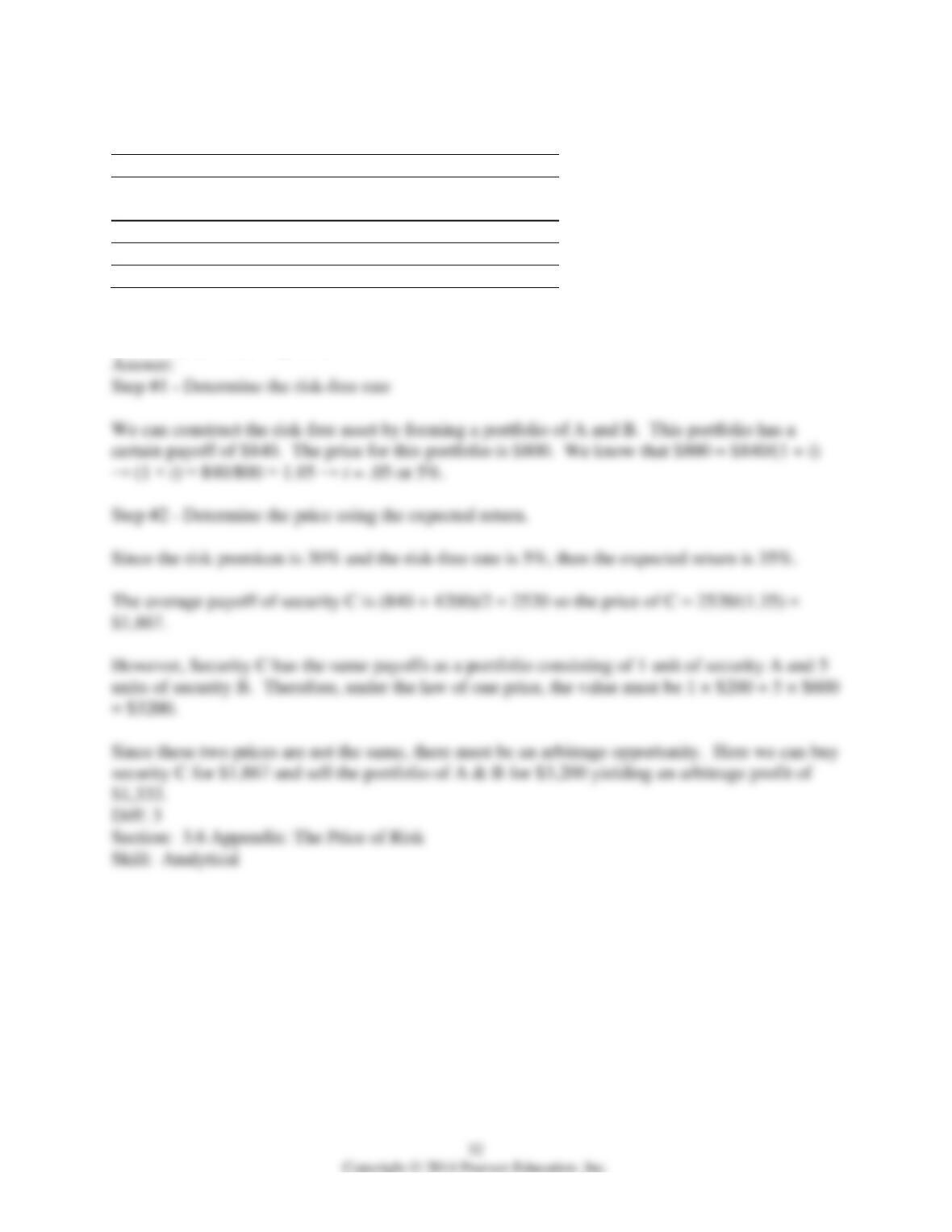
Use the table for the question(s) below.
Market Price
Cash Flow in One Year
Security
Today
Poor
Economy
Good Economy
A
200
840
0
B
600
0
840
C
???
840
4200
7) Suppose that security C had a risk premium of 30%, describe what arbitrage opportunity exists
and how you would exploit it.
3.7 Appendix: Arbitrage with Transaction Costs
1) Which of the following statements is FALSE?
A) No arbitrage opportunities will exist until the underlying prices diverge by more than the
amount of the transaction costs.
B) Because you will generally pay a slightly lower price when you buy a security (the ask price)
than you receive when you sell (the bid price) you will pay the bid-ask spread.
C) The price of a security should equal the present value of its cash flows, up to the transaction
costs of trading the security and the cash flows.
D) In most markets, you must pay transactions costs to trade securities.
2) Consider a bond that pays $1000 in one year. Suppose that the market interest rate for savings
is 8%, but the interest rate for borrowing is 10%. The price range that this bond must trade in a
normal market if no arbitrage opportunities exist is closest to:
A) $909 to $917
B) $909 to $926
C) $917 to $926
D) $909 to $1000
Use the table for the question(s) below.
Security
Bid
Ask
IBM
123.20
123.25
MRK
36.50
36.55
C
3.15
3.20
3) Consider an ETF that is made up of one share each of IBM, MRK, and C. The minimum bid
price for this ETF in a normal market is closest to:
A) $162.85
B) $163.00
C) $168.00
D) $168.10
4) Consider an ETF that is made up of one share each of IBM, MRK, and C. The minimum ask
price for this ETF in a normal market is closest to:
A) $162.85
B) $163.00
C) $168.00
D) $168.10
5) In a normal market with transactions costs, is it possible for different investors to place
different values on an investment opportunity? Are there any limits on the amount that their
values can differ?
Use the table for the question(s) below.
Security
Bid
Ask
IBM
123.20
123.25
MRK
36.50
36.55
C
3.15
3.20
6) Consider an ETF that is made up of one share each of IBM, MRK, and C. The current quote
for this ETF currently is $162.75 (bid) $162.80 (ask). What should you do?
7) Consider an ETF that is made up of one share each of IBM, MRK, and C. The current quote
for this ETF currently is $162.85 (bid) $163.00 (ask). What should you do?
8) Consider an ETF that is made up of one share each of IBM, MRK, and C. The current quote
for this ETF currently is 163.15 (bid) $163.20 (ask). What should you do?