Chapter 3 – The Adjusting Process
71. Which of the following is an example of accrued revenue?
a.
snow removal services that have been paid for three months in advance
b.
snow removal services that have been provided but have not been billed or paid
c.
an agreement that has been signed for snow removal services for the next three months
d.
snow removal services that have been provided and paid on the same day
72. Which of the following is considered to be an accrued expense?
a.
a computer technician has installed the latest software updates and was paid on the same day
b.
a computer technician has been paid in advance to install software updates as they become available
c.
a computer technician has just signed an agreement with you regarding pricing for future work
d.
a computer technician has installed the latest software updates, but you have not received an invoice or made
payment
73. Which one of the accounts below would likely be included in an accrual adjusting entry?
a.
Insurance Expense
b.
Prepaid Rent
c.
Interest Expense
d.
Unearned Rent
Chapter 3 – The Adjusting Process
74. Which of the following accounts would likely be included in a deferral adjusting entry?
a.
Interest Revenue
b.
Unearned Revenue
c.
Salaries Payable
d.
Accounts Receivable
75. If there is a balance in the prepaid rent account after adjusting entries are made, it represents a(n)
a.
deferral
b.
accrual
c.
revenue
d.
liability
76. If there is a balance in the unearned subscriptions account after adjusting entries are made, it represents a(n)
a.
deferral
b.
accrual
c.
dividend
d.
revenue
Chapter 3 – The Adjusting Process
77. The unexpired insurance at the end of the fiscal period represents
a.
an accrued asset
b.
an accrued liability
c.
an accrued expense
d.
a deferred expense
78. The general term used to indicate delaying the recognition of an expense already paid or of a revenue already received
is
a.
depreciation
b.
deferral
c.
accrual
d.
inventory
79. Which account would normally not require an adjusting entry?
a.
Wages Expense
b.
Accounts Receivable
c.
Accumulated Depreciation
d.
Cash
Chapter 3 – The Adjusting Process
80. The balance in the prepaid rent account before adjustment at the end of the year is $32,000, which represents four
months’ rent paid on December 1. The adjusting entry required on December 31 is
a.
debit Rent Expense, $8,000; credit Prepaid Rent, $8,000
b.
debit Prepaid Rent, $24,000; credit Rent Expense, $8,000
c.
debit Rent Expense, $24,000; credit Prepaid Rent, $8,000
d.
debit Prepaid Rent, $8,000; credit Rent Expense, $8,000
81. The balance in the office supplies account on January 1 was $7,000, supplies purchased during January were $3,000,
and the supplies on hand at January 31 were $2,000. The amount to be used for the appropriate adjusting entry is
a.
$4,300
b.
$12,000
c.
$5,000
d.
$8,000
Chapter 3 – The Adjusting Process
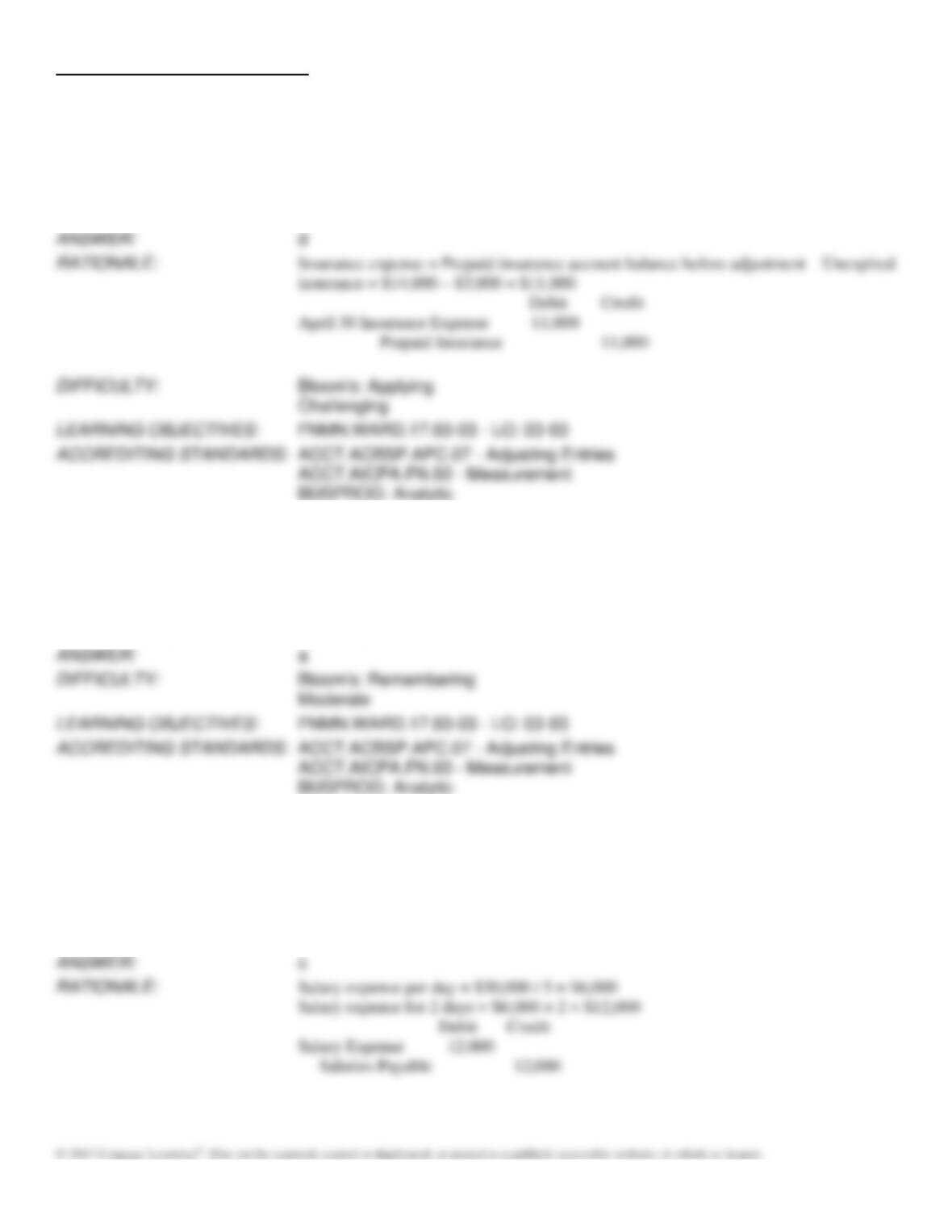
82. Which of the following is the proper adjusting entry, based on a prepaid insurance account balance before adjustment
of $14,000 and unexpired insurance of $3,000, for the fiscal year ending on April 30?
a.
debit Insurance Expense, $3,000; credit Prepaid Insurance, $3,000
b.
debit Insurance Expense, $14,000; credit Prepaid Insurance, $14,000
c.
debit Prepaid Insurance, $11,000; credit Insurance Expense, $11,000
d.
debit Insurance Expense, $11,000; credit Prepaid Insurance, $11,000
83. The entry to adjust for the cost of supplies used during the accounting period is
a.
debit Supplies Expense; credit Supplies
b.
debit Stockholders’ Equity; credit Supplies
c.
debit Accounts Payable; credit Supplies
d.
debit Supplies; credit Stockholders’ Equity
84. Buster Industries pays weekly salaries of $30,000 on Friday for a five-day week ending on that day. The adjusting
entry necessary at the end of the fiscal period ending on Tuesday is
a.
debit Salaries Payable, $12,000; credit Cash, $12,000
b.
debit Salary Expense, $12,000; credit Dividends, $12,000
c.
debit Salary Expense, $12,000; credit Salaries Payable, $12,000
d.
debit Dividends, $12,000; credit Cash, $12,000
Chapter 3 – The Adjusting Process
85. The difference between the balance of a fixed asset account and the related accumulated depreciation account is
termed
a.
historical cost
b.
contra asset
c.
book value
d.
market value
86. The adjusting entry to record the depreciation of a building for the fiscal period is
a.
debit Depreciation Expense; credit Building.
b.
debit Depreciation Expense; credit Accumulated Depreciation.
c.
debit Accumulated Depreciation; credit Depreciation Expense.
d.
debit Building; credit Depreciation Expense.
87. As time passes, fixed assets other than land lose their capacity to provide useful services. To account for this decrease
in usefulness, the cost of fixed assets is systematically allocated to expense through a process called
a.
equipment allocation
b.
depreciation
c.
accumulation
d.
matching
Chapter 3 – The Adjusting Process
88. The entry to adjust the accounts for salaries accrued at the end of the accounting period is
a.
debit Salaries Payable; credit Cash
b.
debit Cash; credit Salaries Payable
c.
debit Salaries Payable; credit Salaries Expense
d.
debit Salaries Expense; credit Salaries Payable
89. The supplies account had a balance of $4,400 at the beginning of the year and was debited during the year for $2,400,
representing the total of supplies purchased during the year. If $400 of supplies are on hand at the end of the year, the
supplies expense to be reported on the income statement for the year is
a.
$400
b.
$2,000
c.
$6,800
d.
$6,400
Supplies on hand at the end of the year = $4,400 + $2,400 – $400 = $6,400
90. Smokey Company purchases a one-year insurance policy on July 1 for $3,600. The adjusting entry on December 31 is
a.
debit Insurance Expense, $1,800; credit Prepaid Insurance, $1,800
b.
debit Insurance Expense, $1,500; credit Prepaid Insurance, $1,500
c.
debit Insurance Expense, $2,100; credit Prepaid Insurance, $2,100
d.
debit Prepaid Insurance, $1,800; credit Cash, $1,800
Chapter 3 – The Adjusting Process
91. Gracie, Inc. made a prepaid rent payment of $2,800 on January 1. The company’s monthly rent is $700. The amount
of prepaid rent that would appear on the January 31 balance sheet after adjustment is
a.
$2,100
b.
$700
c.
$2,800
d.
$1,400
$2,100
92. Accumulated Depreciation and Depreciation Expense are classified, respectively, as
a.
expense, contra asset
b.
asset, contra liability
c.
revenue, asset
d.
contra asset, expense
93. The type of account and normal balance of Prepaid Insurance is
a.
asset, credit
b.
asset, debit
c.
contra asset, credit
d.
contra asset, debit
Chapter 3 – The Adjusting Process
94. The type of account and normal balance of Unearned Consulting Fees is
a.
revenue, credit
b.
expense, debit
c.
liability, credit
d.
liability, debit
95. Data for an adjusting entry described as “accrued wages, $2,020″ requires a
a.
debit to Wages Expense and a credit to Wages Payable
b.
debit to Wages Payable and a credit to Wages Expense
c.
debit to Accounts Receivable and a credit to Wages Expense
d.
debit to Dividends and a credit to Wages Payable
96. Supplies are recorded as assets when purchased. Therefore, the credit to Supplies in the adjusting entry is for the
amount of supplies
a.
still on hand
b.
purchased
c.
used
d.
required for the next accounting period
Chapter 3 – The Adjusting Process
97. The cost of office supplies to be used in future periods is ordinarily shown on the balance sheet as a(n)
a.
stockholders’ equity
b.
asset
c.
contra asset
d.
liability
98. Which of the following is an example of a prepaid expense?
a.
Supplies
b.
Accounts Receivable
c.
Unearned Subscriptions
d.
Unearned Fees
99. Accrued revenues would appear on the balance sheet as
a.
assets
b.
liabilities
c.
common stock
d.
prepaid expenses
Chapter 3 – The Adjusting Process
100. Prepaid advertising, representing payment for the next quarter, would be reported on the balance sheet as a(n)
a.
asset
b.
liability
c.
contra asset
d.
stockholders’ equity
101. Prepaid rent, representing rent for the next six months’ occupancy, would be reported on the tenant’s balance sheet as
a(n)
a.
asset
b.
liability
c.
stockholders’ equity account
d.
contra liability
102. Accrued expenses are ordinarily reported on the balance sheet as
a.
assets
b.
liabilities
c.
fixed assets
d.
prepaid expenses
Chapter 3 – The Adjusting Process
103. Fees payable would appear on the balance sheet as a(n)
a.
asset
b.
liability
c.
fixed asset
d.
unearned revenue
104. The adjusting entry for gym memberships earned that were previously recorded in the unearned gym memberships
account is
a.
debit Unearned Gym Memberships; credit Gym Memberships Revenue
b.
debit Gym Memberships Revenue; credit Unearned Gym Memberships
c.
debit Unearned Gym Memberships; credit Prepaid Gym Memberships
d.
debit Gym Memberships Expense; credit Unearned Gym Memberships
105. Which of the following pairs of accounts could not appear in the same adjusting entry?
a.
Fees Earned and Unearned Fees
b.
Interest Income and Interest Expense
c.
Rent Expense and Prepaid Rent
d.
Salaries Payable and Salaries Expense
Chapter 3 – The Adjusting Process
106. The unearned rent account has a balance of $72,000. If $18,000 of the $72,000 is unearned at the end of the
accounting period, the amount of the adjusting entry is
a.
$18,000
b.
$90,000
c.
$54,000
d.
$36,000
$18,000 = $54,000
107. The following adjusting journal entry does not include an explanation. Select the best explanation for the entry.
Unearned Revenue
7,500
Fees Earned
7,500
????????????????
a.
Record payment of fees earned.
b.
Record fees earned at the end of the month.
c.
Record fees that have not been earned at the end of the month.
d.
Record payment of fees to be earned.
Chapter 3 – The Adjusting Process
108. The following adjusting journal entry does not include an explanation. Select the best explanation for the entry.
Supplies Expense
730
Supplies
730
????????????????
a.
Adjust supplies inventory to actual.
b.
Record purchase of supplies.
c.
Reduce supplies expense.
d.
Record sale of supplies.
109. The following adjusting journal entry found in the journal is missing an explanation. Select the best explanation for
the entry.
Wages Expense
4,500
Wages Payable
4,500
????????????????
a.
Record payment of wages.
b.
Record wages paid last month.
c.
Record wages paid in advance.
d.
Record wages expense incurred and to be paid next month.
Chapter 3 – The Adjusting Process
110. What effect will this adjustment have on the accounting records?
Unearned Fees
6,375
Fees Earned
6,375
a.
increase net income
b.
increase revenues reported for the period
c.
decrease liabilities
d.
all of these are true
111. What effect will this adjusting journal entry have on the accounting records?
Supplies Expense
760
Supplies
760
a.
increase income
b.
decrease net income
c.
decrease expenses
d.
increase assets
112. What effect will the following adjusting journal entry have on the accounting records?
Depreciation Expense
2,150
Accumulated Depreciation
2,150
a.
increase net income
b.
increase revenues
c.
decrease expenses
d.
decrease net book value
Chapter 3 – The Adjusting Process
113. How will the following adjusting journal entry affect the accounting equation?
Unearned Subscriptions
11,500
Subscriptions Earned
11,500
a.
increase assets, increase revenues
b.
increase liabilities, increase revenues
c.
decrease liabilities, increase revenues
d.
decrease liabilities, decrease revenues
114. Which of the following is not true regarding depreciation?
a.
depreciation allocates the cost of a fixed asset over its estimated life.
b.
depreciation expense reflects the decrease in market value each year.
c.
depreciation is an allocation not a valuation method.
d.
depreciation expense does not measure changes in market value.
115. The account type and normal balance of Prepaid Expense is
a.
revenue, credit
b.
expense, debit
c.
liability, credit
d.
asset, debit
Chapter 3 – The Adjusting Process
116. The account type and normal balance of Unearned Revenue is
a.
revenue, credit
b.
expense, debit
c.
liability, credit
d.
asset, debit
117. Which of the following is an example of an accrued expense?
a.
salary owed but not yet paid
b.
fees received but not yet earned
c.
supplies on hand
d.
a two-year premium paid on a fire insurance policy
118. The net book value of a fixed asset is determined by the original cost
a.
less accumulated depreciation
b.
less market value
c.
less accumulated depreciation plus depreciation expense
d.
plus accumulated depreciation
Chapter 3 – The Adjusting Process
119. The balance in the supplies account before adjustment at the end of the year is $6,250. The proper adjusting entry if
the amount of supplies on hand at the end of the year is $1,500 would be
a.
debit Supplies, $1,500; credit Supplies Expense, $1,500
b.
debit Supplies Expense, $4,750; credit Supplies, $4,750
c.
debit Supplies Expense, $1,500; credit Supplies, $1,500
d.
debit Supplies, $4,750; credit Supplies Expense, $4,750
Supplies 4,750
120. For the year ending December 31, Orion, Inc. mistakenly omitted adjusting entries for $1,500 of supplies that were
used, (2) unearned revenue of $4,200 that was earned, and (3) insurance of $5,000 that expired. For the year ending
December 31, what is the effect of these errors on revenues, expenses, and net income?
a.
revenues are overstated by $4,200
b.
net income is overstated by $2,300
c.
expenses are overstated by $6,500
d.
expenses are understated by $3,500
Chapter 3 – The Adjusting Process
121. A business pays biweekly salaries of $20,000 every other Friday for a ten-day period ending on that day. The
adjusting entry necessary at the end of the fiscal period ending on the second Wednesday of the pay period includes a
a.
debit to Salary Expense of $8,000
b.
debit to Salaries Payable of $8,000
c.
credit to Salary Expense of $16,000
d.
credit to Salaries Payable of $16,000
122. A business pays biweekly salaries of $20,000 every other Friday for a ten-day period ending on that day. The last
payday of December is Friday, December 27. Assume the next pay period begins on Monday, December 30, and the
proper adjusting entry is journalized at the end of the fiscal period (December 31). The entry for the payment of the
payroll on Friday, January 10, includes a
a.
debit to Salary Expense of $16,000
b.
debit to Salary Expense of $4,000
c.
credit to Salaries Payable of $16,000
d.
credit to Salaries Payable of $4,000
Chapter 3 – The Adjusting Process
123. The net income reported on the income statement is $58,000. However, adjusting entries have not been made at the
end of the period for supplies expense of $2,200 and accrued salaries of $1,300. Net income, as corrected, is
a.
$56,700
b.
$58,000
c.
$55,800
d.
$54,500
$58,000 – $2,200 – $1,300 = $54,500
LEARNING OBJECTIVES:
124. At the end of the fiscal year, the usual adjusting entry to prepaid insurance to record expired insurance was
omitted. Which of the following statements is true?
a.
total assets at the end of the year will be understated.
b.
stockholders’ equity at the end of the year will be understated.
c.
net income for the year will be overstated.
d.
insurance expense will be overstated
LEARNING OBJECTIVES:
125. At the end of the fiscal year, the usual adjusting entry for depreciation on equipment was omitted. Which of the
following is true?
a.
total assets will be understated at the end of the current year
b.
the balance sheet and income statement will be misstated but the statement of stockholders’ equity will be
correct for the current year
c.
net income will be overstated for the current year
d.
total liabilities and total assets will be understated