Chapter 3 – Internal Control Over Financial Reporting: Responsibilities of Management and the
External Auditors
b.
Reconciling the accounts receivable subsidiary file with the control account.
c.
Using batch totals.
d.
Preparing bank reconciliations.
1
United States – BUSPORG: Analytic
United States – AK – AICPA BB-Critical thinking
Auditor Evaluation of Internal Controls
64. Which of the following is an inherent limitation of internal controls?
a.
Lack of auditor independence.
b.
Collusion.
c.
Separation of duties.
d.
Employee peer review.
b
1
United States – BUSPORG: Analytic
United States – AK – AICPA BB-Critical thinking
65. In an Integrated Audit, what is the independent external auditor primary concerned with?
a.
Detecting all errors.
b.
Determining the effectiveness of operations.
c.
Determining whether the internal controls are effective.
d.
Determining whether the controls promote efficiency.
1
AUDT.JOHN.16.03-01 – LO: 03-01
United States – BUSPORG: Analytic
United States – AK – AICPA BB-Critical thinking
Importance of Internal Control Over Financial Reporting
66. The COSO principle that an organization should identify and assess changes that significantly impact the
system of internal control is related to which COSO component?
a.
Control Environment
b.
Risk Assessment
c.
Control Activities
d.
Monitoring
67. Which of the following is considered to be an entity-wide control?
a.
Segregation of duties.
b.
Controls over management override.
c.
Authorization procedures for purchasing.
d.
Adequately documented transaction trails.
b
1
AUDT.JOHN.16.03-02 – LO: 03-02
United States – BUSPORG: Analytic
United States – AK – AICPA BB-Critical thinking
Defining Internal Control
68. Which of the following is considered to be a transaction control?
a.
Controls to monitor other controls.
b.
Policies that address significant business control practices.
c.
Centralized processing controls.
d.
Physical controls to safeguard assets.
d
1
AUDT.JOHN.16.03-02 – LO: 03-02
United States – BUSPORG: Analytic
United States – AK – AICPA BB-Critical thinking
Defining Internal Control
69. Requiring the mail clerk to prepare a listing of all checks received, with copies of the list going to the
cashier and to accounting, is an example of which type of control?
a.
Preventive.
b.
Corrective.
c.
Detective.
d.
Directive.
1
United States – BUSPORG: Analytic
AUDT.JOHN.16.03-03 – LO: 03-03
United States – BUSPORG: Analytic
United States – AK – AICPA BB-Critical thinking
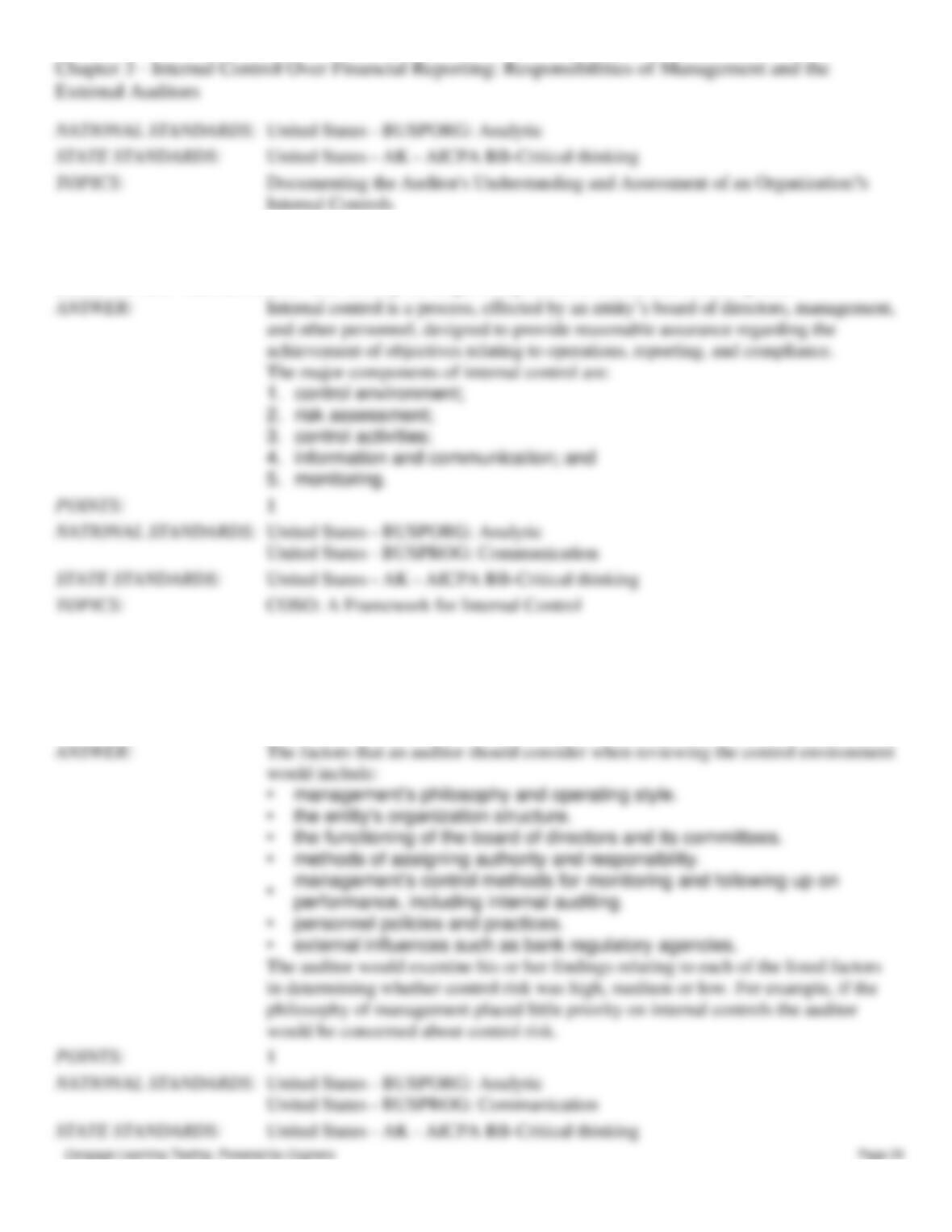
Chapter 3 – Internal Control Over Financial Reporting: Responsibilities of Management and the
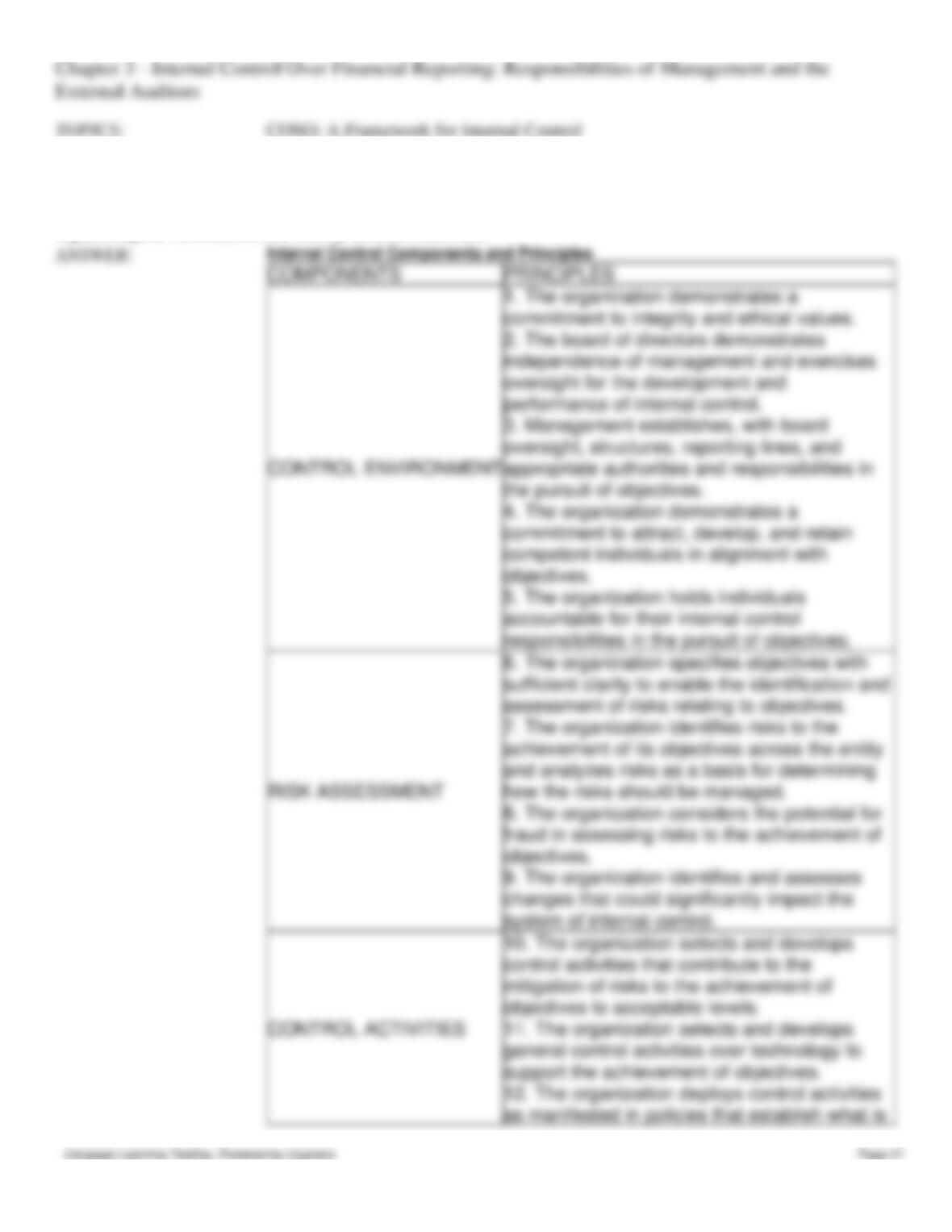
External Auditors
70. Which of the following best represents a walkthrough?
a.
The controller reviews the bank reconciliation prepared by the accountant and its resulting journal
entries.
b.
The auditor walks the production line to find inefficiencies in the inventory process and reports them
to management.
c.
The controller takes a sample of recorded write-offs to ensure they have been properly approved.
d.
The auditor traces three purchasing transactions from the purchase order to the financial statement
for observation and understanding.
d
1
United States – BUSPORG: Analytic
United States – AK – AICPA BB-Critical thinking
Auditor Evaluation of Internal Controls
71. Which one of the following is an example of an internal risk for an organization?
a.
Changes in internal information technology.
b.
Increases in substitute services or products.
c.
Changes in the reliability of source goods.
d.
Changes in regulation that make the business model unsustainable.
1
AUDT.JOHN.16.03-04 – LO: 03-04
United States – BUSPORG: Analytic
United States – AK – AICPA BB-Critical thinking
COSO Component: Risk Assessment
72. Which of the following is another name for transaction controls?:
a.
Entity-wide controls.
b.
Application controls.
c.
Supporting controls.
d.
Detail controls.
b
1
AUDT.JOHN.16.03-05 – LO: 03-05
United States – BUSPORG: Analytic
United States – AK – AICPA BB-Critical thinking
COSO Component: Control Activities
73. Which of the following is an example of a physical control to safeguard assets?
a.
Hiring only trustworthy cashiers.
b.
Separation of duties.
Chapter 3 – Internal Control Over Financial Reporting: Responsibilities of Management and the
External Auditors
c.
Locks on the warehouse doors.
d.
Safety audits on the production-line.
United States – BUSPORG: Analytic
United States – AK – AICPA BB-Critical thinking
Examples of Common Internal Control Activities
74. A control designed to ensure that no employee is paid for more than 80 hours of sick pay is an example of
which type of control?
a.
Entity-wide control.
b.
Processing control.
c.
Output control.
d.
Input control.
AUDT.JOHN.16.03-05 – LO: 03-05
United States – BUSPORG: Analytic
United States – AK – AICPA BB-Critical thinking
COSO Component: Control Activities
75. Which one of the following is not a control activity implemented in most accounting systems?
a.
Segregation of duties.
b.
Competent, trustworthy employees.
c.
Authorization procedures.
d.
All of these activities are normally implemented.
United States – BUSPORG: Analytic
United States – AK – AICPA BB-Critical thinking
Auditor Evaluation of Internal Controls
76. An edit test is considered to be which type of control?
a.
An input control.
b.
A processing control.
c.
An output control
d.
A supporting control.
77. Which of the following is not a way management obtains evidence regarding the effectiveness of internal
control over the accounting system?
a.
Performing a walkthrough of the accounting system.
b.
Making inquiries of banks and attorneys.
c.
Reviewing system flowcharts.
d.
Taking plant and operational tours.
United States – BUSPORG: Analytic
United States – AK – AICPA BB-Critical thinking
Auditor Evaluation of Internal Controls
78. A control designed to ensure that sales transactions are generated using the company’s most current prices
would be considered to be which type of control?
a.
An input control.
b.
A processing control.
c.
An output control.
d.
A physical control.
AUDT.JOHN.16.03-05 – LO: 03-05
United States – BUSPORG: Analytic
United States – AK – AICPA BB-Critical thinking
COSO Component: Control Activities
79. Internal control is a process affected by the organization’s board of directors, management, and other
personnel to provide reasonable assurance of achieving certain objectives. Which of the following does not fit
into one of these categories of objectives?
a.
Reliability of financial reporting.
b.
Compliance with laws and regulations.
c.
Continuing existence.
d.
Effectiveness and efficiency of operations.
United States – BUSPORG: Analytic
United States – AK – AICPA BB-Critical thinking
COSO Component: Control Activities
Chapter 3 – Internal Control Over Financial Reporting: Responsibilities of Management and the
External Auditors
80. A control designed to ensure that the number of sales transactions recorded in the accounting records
matches the number of sales invoices entered during processing is known as which type of control?
a.
Input control.
b.
Processing control.
c.
Output control.
d.
Edit control.
AUDT.JOHN.16.03-05 – LO: 03-05
United States – BUSPORG: Analytic
United States – AK – AICPA BB-Critical thinking
COSO Component: Control Activities
81. Requiring two signatures on any check in excess of $10,000 is an example of which type of control?
a.
Input control.
b.
Preventive control.
c.
Detective control.
d.
Processing control.
AUDT.JOHN.16.03-05 – LO: 03-05
United States – BUSPORG: Analytic
United States – AK – AICPA BB-Critical thinking
COSO Component: Control Activities
82. Which of the following is an example of a control environment deficiency??
a.
A low level of control consciousness within the organization.
b.
An audit committee that does not have independent members.
c.
An audit committee that is not viewed as the client of the external auditor.
d.
All of the above.
United States – BUSPORG: Analytic
United States – AK – AICPA BB-Critical thinking
Auditor Evaluation of Internal Controls
83. A bank reconciliation is an example of which type of control?
a.
An input control.
b.
An output control.
c.
A preventive control.
Chapter 3 – Internal Control Over Financial Reporting: Responsibilities of Management and the
External Auditors
d.
A detective control.
d
1
United States – BUSPORG: Analytic
United States – AK – AICPA BB-Critical thinking
COSO Component: Control Activities
84. Security management practices which limit access to technologies is a function included in which COSO
component of internal control structure?
a.
Control Environment.
b.
Risk Assessment.
c.
Control Activities.
d.
Monitoring.
1
AUDT.JOHN.16.03-05 – LO: 03-05
United States – BUSPORG: Analytic
United States – AK – AICPA BB-Critical thinking
COSO Component: Control Activities
85. In a large company, who usually monitors the internal control?
a.
Internal auditors.
b.
PCAOB.
c.
CFO.
d.
External auditors.
1
United States – BUSPORG: Analytic
United States – AK – AICPA BB-Critical thinking
COSO: A Framework for Internal Control
86. Which of the following is not true of internal control as defined by COSO?
a.
It is narrower than internal control over financial reporting.
b.
It is a process that includes all elements of internal control working together.
c.
It includes all the people in the organization.
d.
It starts at the top of the organization in setting a tone.
87. Which of the following is not true of the concepts that are embodied in the COSO framework of internal
controls?
a.
Internal controls relate to the organization’s objectives.
b.
The six components of internal control are logically and operationally intertwined.
c.
Internal controls apply across all activities of the organization.
d.
All of the above are true.
United States – BUSPORG: Analytic
United States – AK – AICPA BB-Critical thinking
COSO: A Framework for Internal Control
88. Which of the following is not a major component of an organization’s internal controls?
a.
Risk assessment.
b.
Control environment.
c.
Control activities.
d.
Control risk.
United States – BUSPORG: Analytic
United States – AK – AICPA BB-Critical thinking
COSO: A Framework for Internal Control
89. Which of the following is not part of the control environment of an organization?
a.
Management’s philosophy and operating style.
b.
Organizational structure.
c.
Human resources.
d.
Both A and B.
e.
All of the above are part of the control environment.
United States – BUSPORG: Analytic
United States – AK – AICPA BB-Critical thinking
COSO: A Framework for Internal Control
90. Which of the following is an example of a detective control in an information system?
a.
Automated reports to management that specifically identify delinquent receivables.
b.
A requirement that salaried employees submit written requests to work overtime.
United States – AK – AICPA BB-Critical thinking
COSO: A Framework for Internal Control
Chapter 3 – Internal Control Over Financial Reporting: Responsibilities of Management and the
External Auditors
c.
Assurance from top management that computer centers are kept locked.
d.
The employment of trustworthy people to enter data into the information system.
United States – BUSPORG: Analytic
United States – AK – AICPA BB-Critical thinking
Auditor Evaluation of Internal Controls
91. Which statement is true concerning the documentation of internal control?
a.
Documentation should be sufficient to support the design and operating effectiveness of internal
controls.
b.
Documentation requirements are standardized by the PCAOB.
c.
Documentation of disbursements require paper and electronic documentation.
d.
Documentation of all transaction controls should be tested on an annual basis.
1
AUDT.JOHN.16.03-08 – LO: 03-08
United States – BUSPORG: Analytic
United States – AK – AICPA BB-Critical thinking
Management’s Responsibilities Related to Internal Control Over Financial
Reporting
92. Which component of COSO’s internal control system concerns the process that provides feedback on the
effectiveness of the other four components of internal control?
a.
Information and communication.
b.
Monitoring.
c.
Control activities.
d.
Risk assessment.
b
1
United States – BUSPORG: Analytic
United States – AK – AICPA BB-Critical thinking
COSO: A Framework for Internal Control
93. Which of the following is the most severe?
a.
Material weaknesses in internal control.
b.
Significant deficiencies in internal control.
c.
Operational deficiencies in internal control.
d.
Each is equally severe because it could result in inaccuracies in financial reporting.
1
94. Internal control
Define the term “internal control” and identify the major components of an internal control system.
95. Control environment
One of the elements of an organization’s control system is the “control environment.” Identify at least four
factors that the auditor should consider when reviewing the control environment and discuss how the auditor
would relate this review to the assessment of control risk.
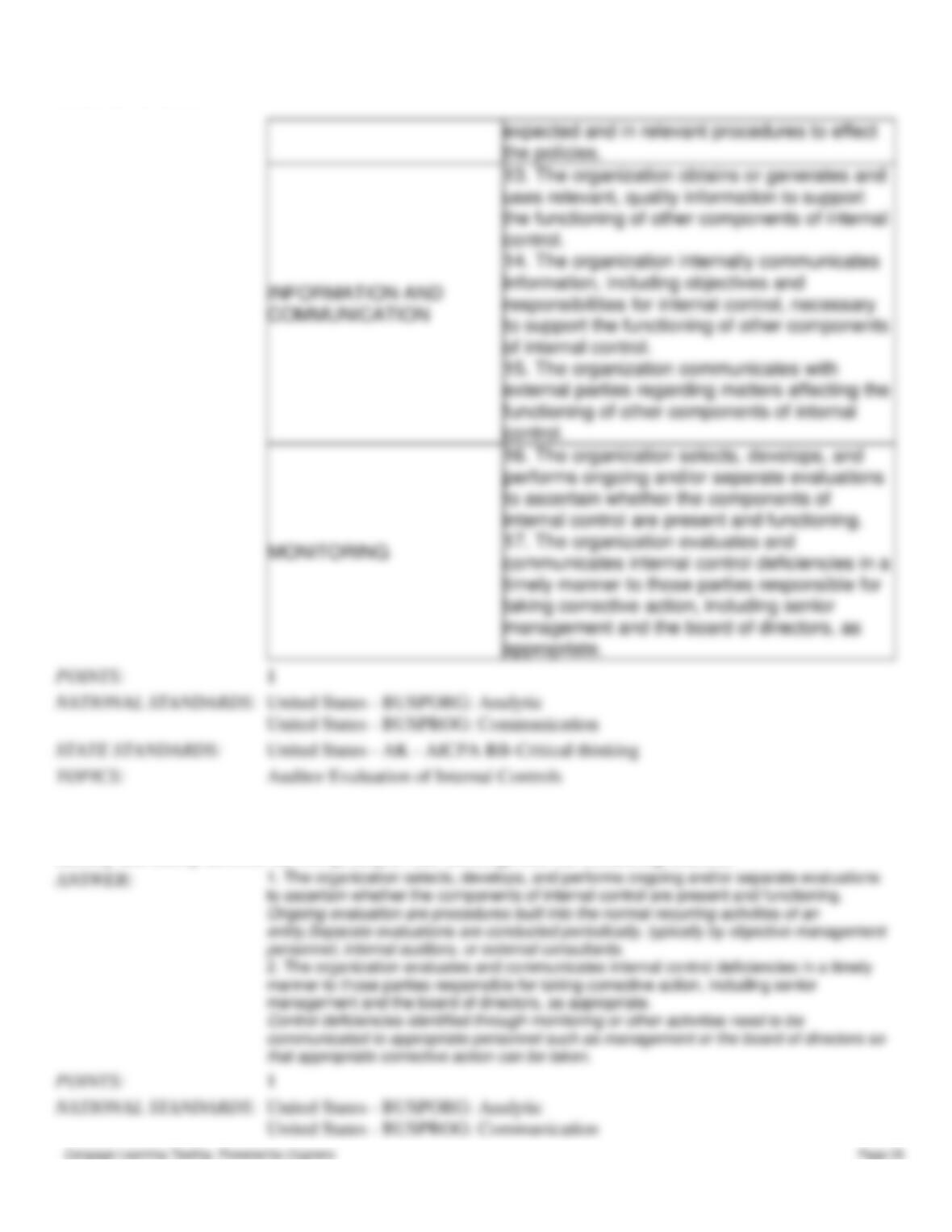
96. Internal control components and principles
For each of the five components of internal control, list at least two related principles of internal control.
n gathering the information and briefly describe each one.
Chapter 3 – Internal Control Over Financial Reporting: Responsibilities of Management and the
External Auditors
97. Internal Control Principles
Identify and briefly describe the two principles that should govern the monitoring function.
98. Integrated audit
Explain the application of an integrated audit as it relates to regulation. Discuss the reasons that this integrated
approach may occur.
99. Internal Control Principles
One of the COSO principles of internal control requires organizations to demonstrate a commitment to attract,
develop, and retain competent individuals in alignment with objectives. Discuss how this can be done.
100. COSO: A Framework for Internal Control
What is internal control as defined by COSO? Also explain, the other elements of the definition that are
important to internal control
101. Pervasive control activities
Discuss what pervasive control activities are and provide an example of at least three.
102. Management Evaluation of Internal Controls
What are the steps in management’s evaluation of internal control over financial reporting?
Chapter 3 – Internal Control Over Financial Reporting: Responsibilities of Management and the
External Auditors
1
United States – BUSPROG: Communication
United States – AK – AICPA BB-Critical thinking
Auditor Evaluation of Internal Controls
103. IT Controls Integrated into Internal Control Evaluations
Explain input controls.
1
United States – BUSPROG: Communication
United States – AK – AICPA BB-Critical thinking
104. Relationship of the five internal control components
The five components of the COSO internal control system are conceptually and logically integrated. List the
five components of the model and describe how they are integrated with each other in the internal control
process.
Use the following format:
Components
Description
1
2
3
4
5
the risks that may affect an organization from achieving its objectives.
Chapter 3 – Internal Control Over Financial Reporting: Responsibilities of Management and the
External Auditors