Chapter 3—REVIEW OF FINANCIAL STATEMENTS
MULTIPLE CHOICE
1. Major components of a firm’s balance sheet include:
a.
Sales
b.
Cost of goods sold
c.
Current assets
d.
a and b
2. Which of the following are not part of “current assets?”
a.
Inventories
b.
Receivables
c.
Prepaid expenses
d.
Accounts payable
3. Which of the following are not part of a firm’s income statement?
a.
Cost of operations
b.
Property, plant, and equipment
c.
Selling, general, and administrative expenses
d.
Interest expense
4. Noncash expenses that firms may report in their income statement include:
a.
depreciation
b.
amortization
c.
a and b
d.
Neither a nor b
5. Extraordinary expense items include costs associated with:
a.
plant closings
b.
corporate restructurings
c.
a and b
d.
none of the above
6. The diluted earnings per share calculation takes into account the potential dilutive effect of ____.
a.
convertible bonds
b.
convertible preferred stock
c.
a and b
d.
neither a nor b
7. The work of the external independent auditor includes a letter that states that the financial information
represents fairly the financial position of the company and that these statements were:
a.
an accurate picture of the company’s market position
b.
based on the company’s accounting information system (AIS)
c.
constructed in conformity with generally accepted accounting principles
d.
developed using management’s choice of accounting enhancement techniques
8. ____ is defined as the systematic allocation of the cost of an asset over more than one time period.
a.
Deferral
b.
Expensing
c.
Optimization
d.
Depreciation
9. Deferred taxes may occur due to the use of
a.
different tax schedules
b.
different depreciation methods for taxes and financial reporting
c.
long-term equipment
d.
different cash flow methods
10. The financial statement that shows the effects of a company’s operating, investing, and financing
activities on its cash balance is known as the
a.
cash budget statement
b.
pro forma financial statement
c.
statement of cash flows
d.
breakeven analysis
11. The Financial Accounting Standard Board (FASB) requires companies to prepare their statement of
cash flows using the
a.
indirect method
b.
direct method
c.
reconciliation method
d.
none of the above
12. The ____ shows the effects of a company’s operating, investing, and financing activities on its ____.
a.
income statement; cash flows
b.
balance sheet; cash flows
c.
statement of cash flows; cash flows
d.
none of the above
13. In preparing a statement of cash flows, the ____ method involves adjusting net income to reconcile it
to net cash flows from operating activities.
a.
direct
b.
indirect
c.
accrual
d.
none of the above
14. Companies can avoid paying income taxes on inventory profits by using the ____ inventory valuation
method.
a.
LIFO
b.
FIFO
c.
Priced out
d.
Priced in
15. Intercompany dividends, or dividends paid by one corporation to another, are normally entitled to a
____ percent exclusion from Federal income taxes.
a.
15
b.
30
c.
50
d.
70
16. A corporation’s net operating loss may be carried ____ years and ____ years to offset taxable income
in those years.
a.
back 20, forward 2
b.
back 3, forward 5
c.
back 5, forward 15
d.
back 2, forward 20
17. For most large U.S. corporations, the maximum capital gain tax rate is
a.
14%
b.
35%
c.
50%
d.
28%
18. The marginal tax rate for a firm with taxable income of $105,000 is
a.
30%
b.
39%
c.
15%
d.
34%
19. Capital losses are
a.
taxed at the same marginal rate as ordinary income
b.
taxed at the 20% rate
c.
deductible only against capital gains
d.
used to reduce interest payments
20. ____ received by corporations are normally entitled to a 70 percent exclusion from federal income
taxes.
a.
Capital gains income
b.
Dividend income
c.
Loss carrybacks and carryforwards
d.
none of these answers are correct
21. Corporate capital gains income is currently taxed at ____ ordinary income.
a.
80 percent of the marginal tax rate on
b.
the same marginal rate as
c.
50 percent of the marginal tax rate on
d.
none of these answers are correct
22. The Ragin Cajun had an operating income (EBIT) of $260,000 last year. The firm had $18,000 in
depreciation expenses, $15,000 in interest expenses, and $60,000 in selling, general, and
administrative expenses. If the Cajun has a marginal tax rate of 40 percent, what was its after-tax cash
flow for last year?
a.
$165,000
b.
$129,000
c.
$174,000
d.
$147,000
23. Last year, Monroe Products had $25,000 net cash provided by its operating activities. Its investing
activities used $30,000, and its financing activities provided $10,000. Its cash and cash equivalents
balance at the beginning of the year was $15,000. By how much did Monroe’s cash and cash
equivalents increase?
a.
-$10,000
b.
$0
c.
$5,000
d.
None of these answers are correct
24. Triangle Systems had earnings after tax of $1,000,000 last year. Included in its expenses were $50,000
of interest, $100,000 of deferred taxes, and $150,000 of depreciation. In addition, the company paid
dividends of $200,000 to its stockholders last year. What was Triangle’s after-tax cash flow last year?
a.
$1,500,000
b.
$1,300,000
c.
$1,150,000
d.
None of these are correct
25. AMX corporation had operating income of $420,000 in 2004; received $12,000 in interest income;
paid $22,000 in interest; received $20,000 in dividends; and paid $50,000 in dividends. What is the tax
liability for AMX?
a.
$141,440
b.
$146,200
c.
$148,920
d.
two of these answers are correct
26. BET had a taxable income of $135,000 in 2004. What is its tax liability?
a.
$22,500
b.
$52,650
c.
$35,900
d.
$15,900
27. What is the tax liability in 2004 for a corporation with taxable income of $425,000?
a.
$144,500
b.
$132,750
c.
$150,250
d.
$122,700
28. For a corporation with ordinary taxable income of $425,000, what is the additional tax liability if
$30,000 in dividends is received from shares it holds in another corporation?
a.
$7,140
b.
$10,200
c.
$11,700
d.
$3,060
29.
Taxable Income
Tax Rate
Not over $50,000
15%
$50,001 – $75,000
25%
$75,001 – $100,000
34%
$100,001 – $335,000
39%*
$335,001 – $10,000,000
34%
$10,000,001 – $15,000,000
35%
$15,000,001 – $18,333,333
38%**
Over $18,333,333
35%
*5% of this rate represents a phaseout of the benefits of the lower tax rates on the first $75,000 of
taxable income.
**3% of this rate represents a phaseout of the benefit of the lower tax rate (34% rather than 35%) on
the first $10 million of taxable income.
Using the rates above, determine the tax liability of Coastal Inc. in 2004 if the firm had the following
stream of taxable income:
Year
Taxable Income
2000
($450,000)
2001
(80,000)
2002
60,000
2003
145,000
2004
360,000
a.
$83,450
b.
$ 5,250
c.
$95,200
d.
none of the above
30. Keegan Company had operating income of $740,000 in 2004, received $120,000 in preferred stock
dividends, $20,000 in interest income and paid $15,000 in interest expenses. What is the tax liability
for Keegan?
a.
$265,540
b.
$294,100
c.
$299,200
d.
$270,640
31. Last year Cell 2 had a net operating loss of $120,000 and a capital loss of $80,000. This year the firm
has an operating income of $230,000 and a capital gain of $40,000. What is Cell 2’s tax liability this
year? Assume there are no other tax loss carry backs or carry forwards.
a.
$4,500
b.
$72,950
c.
$26,150
d.
$12,500
32. Last year Curative Technologies Inc. reported earnings after-tax of $23 million. Included in the
expenses were depreciation of $3.7 million and interest expenses of $2.9 million. The year-end balance
sheets shows an increase in deferred taxes of $2.6 million to a total of $14.2 million. What is Curative
Technologies’ after-tax cash flow for last year? Assume a marginal tax rate of 40%.
a.
$20.1 million
b.
$32.2 million
c.
$29.3 million
d.
$26.4 million
33. Last year Molex’s net cash provided by operating activities was $14.1 million and its net cash used by
investing activities was $20.7 million. If net cash provided by financing activities was $9.8 million,
what was the net increase (or decrease) in cash and cash equivalents during the year? Molex started the
year with $2.1 million in cash.
a.
$44.6 million
b.
$ 3.2 million
c.
$25.0 million
d.
$ 5.3 million
34. All of the following are methods of valuing inventory EXCEPT:
a.
LIFO
b.
ABM
c.
FIFO
d.
LCM
35. How does a firm obtain goodwill?
a.
Good public works
b.
Acquisition of companies for more than book value.
c.
Environmentally friendly product production
d.
Global sales in underprivileged countries.
36. All of the following are intangible assets listed on the balance sheet EXCEPT:
a.
goodwill
b.
trademarks
c.
plant, property & equipment
d.
patents
37. Another name for long-term debt is:
a.
bank debt
b.
funded debt
c.
cautionary debt
d.
accrued debt
38. Shaggy Dog Leash Mfg. bought a piece of equipment that should last for 20 years. It cost $8,000 and
is expected to have a salvage value of $1500. How much straight-line depreciation could the company
write off each year?
a.
$450
b.
$525
c.
$400
d.
$325
39. Vroom Vroom Motors has the following income statement information.
Revenue
$52 000
Cost of Goods Sold
$ 9 600
Wages
$16 000
Supplies
$ 7 500
Insurance Expense
$ 400
Depreciation Expense
$ 2 000
Interest Expense
$ 7 330
Vroom Vroom Motors is in the 40% tax bracket and has preferred stock dividends due of $3,000 and
15,000 common stock shares outstanding. Based on this information, what are Vroom Vroom Motors’
earnings per share?
a.
$.17
b.
$.25
c.
$.37
d.
$.55
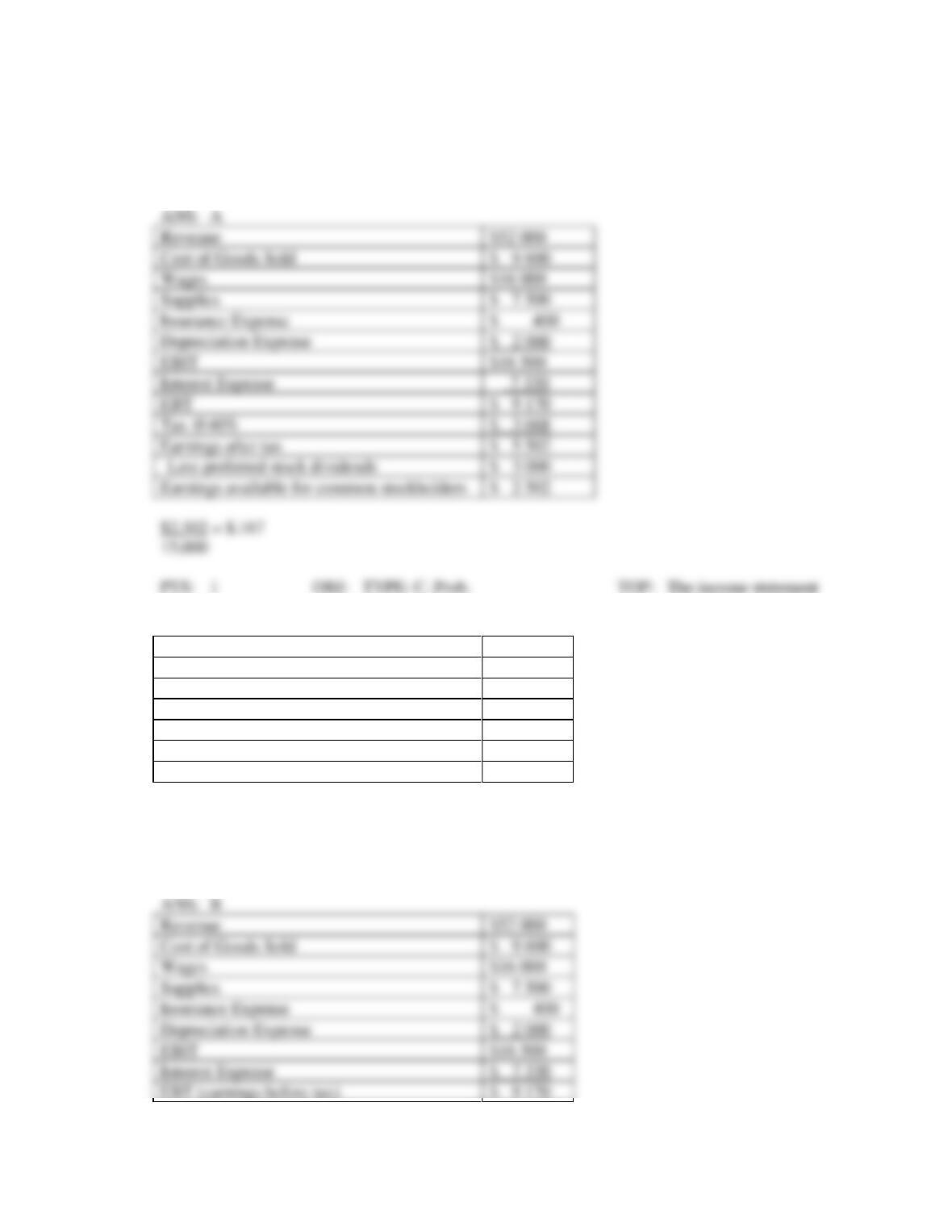
Revenue
$52 000
Cost of Goods Sold
$ 9 600
Wages
$16 000
Supplies
$ 7 500
Insurance Expense
$ 400
Depreciation Expense
$ 2 000
EBIT
$16 500
EBT
$ 9 170
Tax @40%
$ 3 668
Earnings after tax
$ 5 502
Less preferred stock dividends
$ 3 000
Earnings available for common stockholders
$ 2 502
40. Vroom Vroom Motors has the following income statement information.
Revenue
$52 000
Cost of Goods Sold
$ 9 600
Wages
$16 000
Supplies
$ 7 500
Insurance Expense
$ 400
Depreciation Expense
$ 2 000
Interest Expense
$ 7 330
Vroom Vroom Motors is in the 40% tax bracket and has preferred stock dividends due of $3,000 and
15,000 common stock shares outstanding. Based on this information, what is Vroom Vroom Motors’
tax liability?
a.
$5,775
c.
$7,257
b.
$3,668
d.
$2,150
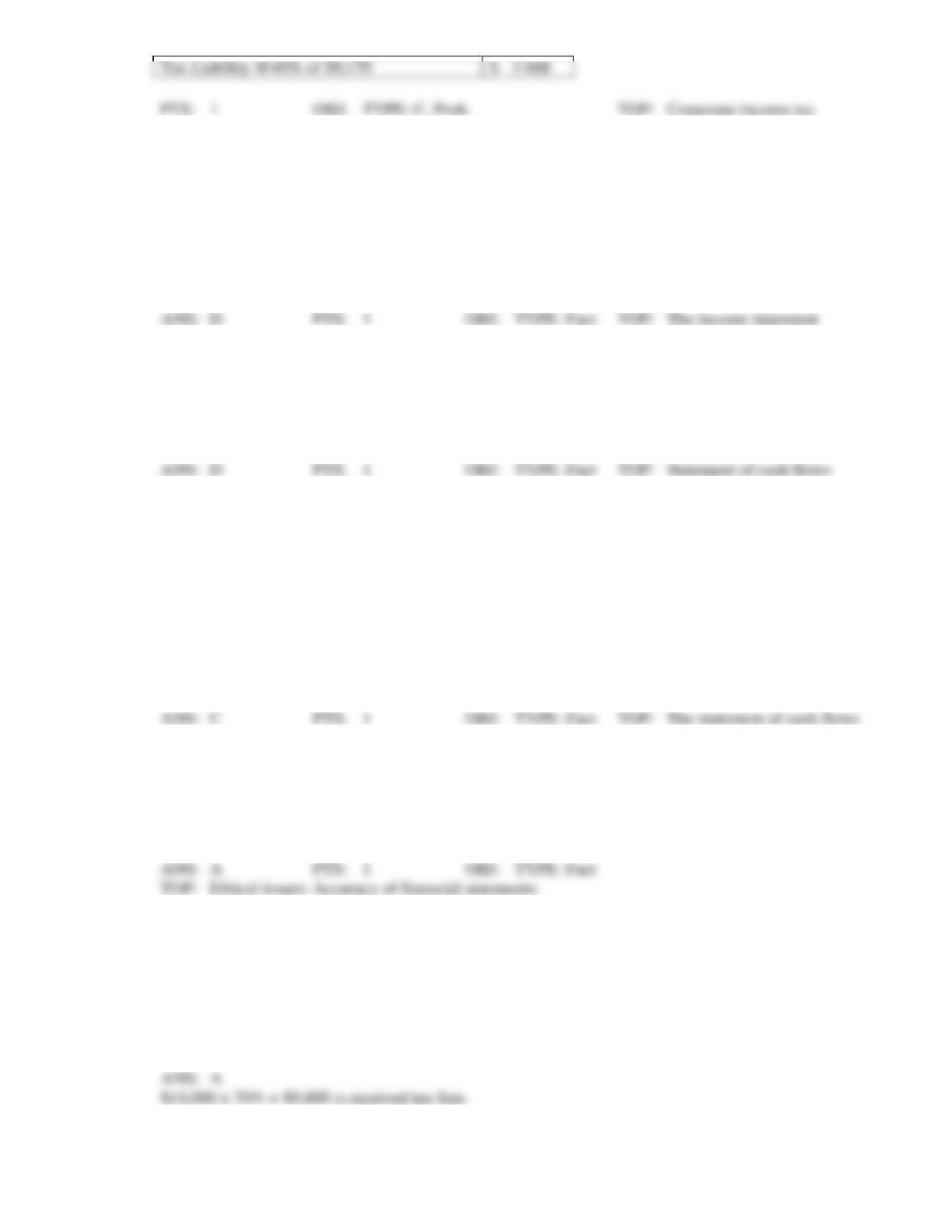
Revenue
$52 000
Cost of Goods Sold
$ 9 600
Wages
$16 000
Supplies
$ 7 500
Insurance Expense
$ 400
Depreciation Expense
$ 2 000
EBIT
$16 500
Interest Expense
$ 7 330
EBT (earnings before tax)
$ 9 170
41. Corporations are required to report two types of earnings per share on the income statement. Which of
the following statements is/are correct?
I. One type of earnings per share is preferred stock earnings per share.
II. One type of earnings per share is deferred earnings per share.
a.
I only
b.
II only
c.
Both I and II
d.
Neither I nor II
42. Which of the following is an accurate description of operating cash flows?
a.
It refers to a method of valuing inventory.
b.
It refers to cash received on an accrual basis.
c.
It refers to cash received through bank loans.
d.
It refers to cash generated from or used by business operations of the firm.
43. Which of the following statements is/are correct about the Statement of Cash Flows?
I. The indirect method of determining operating cash flows begins with net income and adjusts if by
transactions that affect the reported income.
II. The direct method of determining operation cash flows requires the firm to report cash inflows
and cash outflows from operating activities. The resulting sum is the net cash from operating
activities.
a.
I only
b.
II only
c.
Both I and II
d.
Neither I nor II
44. All of the following are limitations of financial statements EXCEPT:
a.
recording of realized sales
b.
balance sheet quality
c.
aggressive reporting policy
d.
income statement quality
45. Big Bubba Burgers Corp. owns stock in Skinny Minnie Exercise Centers. Big Bubba will receive
dividends of $14,000 from Skinny Minnie. What is Big Bubba’s tax liability upon receipt of these
dividends if Big Bubba is in the 40% tax bracket?
a.
$9,800
b.
$3,920
c.
$1,680
d.
$5,600
ESSAY
1. What is the difference between the marginal tax rate and the average tax rate?
2. What is a loss carryback?
3. What is the impact on fixed assets when firms use accelerated depreciation?
4. Explain the terms common stock at par and paid-in capital which are found on the balance sheet.
5. What is the difference between amortization expense and depreciation expense?