
Name:
Class:
Date:
Chapter 03: Economic Decision Makers
101. The Salvation Army is an example of a(n):
a. military organization.
b. not-for-profit organization.
c. partnership.
d. S corporation.
e. U.S. government agency.
102. One thing that is not true about cooperatives is that they:
a. put out raw materials, like wool and cotton, to rural households that turn it into finished products.
b. pool resources to buy and sell more efficiently.
c. try to minimize costs.
d. operate with limited liability of members.
e. enjoy tax-exempt status.
103. Which of the following is not an example of a business operated by a consumer cooperative?
a. A grocery store
b. An apartment building
c. Sunkist, a farm cooperative owned and operated by citrus growers
d. A health plan
e. An electric power facility
104. A group of farmers in southwestern Pennsylvania bought a pesticide-free pasture. They sold their locally raised
organic beef in the butcher shop they owned together. This group of farmers would be identified as a(n):
a. not-for-profit organization.
b. S corporation.
c. producer cooperative.
d. sole proprietorship.
e. cottage industry.
105. Household production is more likely to occur when:
a. it requires many specialized resources.
b. technology makes it more costly than market production.
c. tax avoidance is undesirable.
d. more control over the final product is desirable.
e. it has a very high opportunity cost.
106. Household production is more likely to occur when:
a. it requires many specialized resources.
b. technology makes it more costly than market production.
c. tax avoidance is undesirable.
d. less control over the final product is desirable.
e. the opportunity cost of household work is relatively small.

Name:
Class:
Date:
Chapter 03: Economic Decision Makers
107. Despite specialization and comparative advantage, household production still exists because for some households:
a. the opportunity cost of production at home is greater than the cost of purchasing the good in the market.
b. production at home is less costly than purchasing the good in the market.
c. the value of home production exceeds the sunk cost of home production.
d. the value of home production is ignored.
e. the expenditure on food and clothing represents a small portion of their total budget.
108. Household production is more likely to occur when:
a. it requires few specialized resources.
b. technology makes it more costly than market production.
c. tax avoidance is undesirable.
d. less control over the final product is desirable.
e. the opportunity cost of household production is high.
109. Which of the following is not a reason why some production continues in households?
a. Some household production requires many specialized resources.
b. The opportunity cost of household production has decreased over time.
c. Household production avoids taxes.
d. There have been important technological advances in household production.
e. Some households prefer the ability to control production.
110. You are more likely to hire a plumber to repair a leaky drainpipe:
a. as the tax rate on your earned income rises.
b. if you already own the specialized tools required to complete the plumbing repair work.
c. following an increase in the opportunity cost of your time.
d. the more knowledge and experience in plumbing repair work you possess.
e. as the transaction cost of entering into a plumbing contract increases due to government regulations.
111. You are more likely to repair a leaky drainpipe yourself than hire a plumber:
a. as the tax rate on your earned income dramatically decreases.
b. if the opportunity cost of your time decreases.
c. the less knowledge and experience in plumbing repair work you possess.
d. if you need to purchase the specialized tools required to complete the repair work.
e. as the transaction cost of the do-it-yourself repair increases.
112. You are more likely to hire your teenage child than a landscaping firm to mow your lawn:
a. since the teenager is paid more than the landscaping firm.
b. if the teenager has a lower opportunity cost of mowing the lawn than the landscaping firm does.
c. because the teenager is less likely to have the specialized tools necessary to complete the job quickly.
d. due to the bounded rationality of the diversified landscaping firm.
Name:
Class:
Date:
Chapter 03: Economic Decision Makers
e. when it does not take a substantial amount of time and effort to find a reputed landscaping firm to do the job.
113. Which of the following is the best example of a public good?
a. Food stamps
b. Police services
c. Trash removal
d. A restaurant meal
e. An iPad
114. Which of the following is not primarily a function of the federal government?
a. National security
b. Higher education
c. Economic stability
d. Market competition
e. Dealing with externalities
115. Contracts are enforced by:
a. the firms that make the contracts through buy-out clauses.
b. law firms that specialize in contract enforcement.
c. corporations specializing in contract writing and enforcement.
d. government through the judicial system.
e. both households and firms through customer relations departments.
116. Which of the following is a reason why government is a participant in a market-oriented economy?
a. To enforce contracts and protect private property
b. To promote collusion
c. To promote the growth of natural monopolies
d. To provide more inequality in the distribution of income
e. To promote externalities
117. Government antitrust laws were designed to:
a. encourage the production of public goods.
b. prevent natural monopolies.
c. prevent collusion among firms.
d. regulate natural monopolies.
e. correct the outcomes of positive and negative externalities in private markets.
118. Natural monopolies occur when:
a. government antitrust laws are too weak or not enforced.
b. negative externalities are present.
c. firms collude to set prices and divide the market among themselves.

Name:
Class:
Date:
Chapter 03: Economic Decision Makers
d. one firm can service the market more cheaply than two or more firms can.
e. a public good is produced by a private firm.
119. Which of the following is a defining characteristic of a public good?
a. It is produced and distributed by the government.
b. The decision to produce it is made by the public through a voting process.
c. It is produced and distributed by private firms according to government regulations.
d. It is freely available to everyone once it is produced.
e. It is purchased by one government agency from another government agency.
120. The funds to pay for police protection are usually raised through taxation because:
a. police protection would be hard to provide exclusively to those who voluntarily pay for it.
b. people would not voluntarily pay salaries to officials who might arrest them.
c. police protection is a basic necessity.
d. goods financed through taxation can be guaranteed to all who pay for it.
e. the government believes that those who receive the benefits from the service should pay for it.
121. Which of the following is true of public goods?
a. The market mechanism helps to signal the quantity that is demanded by the public.
b. Payment for consumption is efficiently provided by market prices.
c. Consumption by one person does not preclude consumption of the same good by another person.
d. The public sector is guided to produce the correct quantity by market prices.
e. Voluntary contributions will be sufficient to finance the production of public goods.
122. Some people have argued that government should provide only those goods that we would truly define as public
goods. If so, which of the following should government provide?
a. National defense
b. Daycare centers for children of working mothers
c. Mail delivery
d. Unemployment benefits
e. Subsidies for agricultural products
123. A public good is one that is supplied to:
a. only people who pay for it.
b. only people who do not pay for it.
c. all people, regardless of whether they pay for it or not.
d. the government by private firms.
e. foreign governments by our federal government.
124. What is the rationale for government provision of education?
a. Not all incomes are equal, but everyone has the right to education regardless of wealth.

Name:
Class:
Date:
Chapter 03: Economic Decision Makers
b. Potential students consider only their personal benefits gained from education, but the rest of society benefits, too.
c. No education would be provided in the absence of government provision because everyone would consume it
without paying.
d. The cost of providing education for the entire public is too large.
e. The government can provide education at a much lower cost than the private sector.
125. Externalities are defined as:
a. any transaction external to the firm.
b. costs or benefits that fall on third parties.
c. policies that firms adopt to sell products outside the country.
d. managers’ dealings with stockholders outside the firm.
e. costs of maintaining plant and equipment to avoid the scrutiny of external auditors.
126. When you throw trash out your car window you are creating:
a. a positive externality.
b. a negative externality.
c. a private good.
d. a public good.
e. both a private and a public good.
127. Which of the following would not be considered a role of government?
a. Promoting competition
b. Providing public goods
c. Providing externalities
d. Regulating natural monopolies
e. Safeguarding private property and enforcing contracts
128. An example of a positive externality is:
a. pollution because it affects people not directly involved with producing it.
b. a homeowner’s maintenance of a beautiful lawn because this creates a benefit for neighbors.
c. monopoly creation.
d. driving a car that emits pollution.
e. cigarette smoking because this imposes an indirect cost on people around the smoker.
129. Which of the following is not a government transfer program?
a. Unemployment compensation
b. Social Security
c. Food stamps
d. Medicare
e. Income taxes

Name:
Class:
Date:
Chapter 03: Economic Decision Makers
130. The term fiscal policy refers to:
a. the amount of physical output produced by firms.
b. the means by which government policy makes firms more productive.
c. the avenue by which government influences credit markets.
d. spending and taxing by governments.
e. a tool of government that works in the opposite direction of monetary policy.
131. The difference between fiscal policy and monetary policy is that:
a. fiscal policy is a macroeconomic policy but monetary policy is a microeconomic policy.
b. monetary policy is a macroeconomic policy but fiscal policy is a microeconomic policy.
c. fiscal policy involves regulation of natural monopolies but monetary policy involves the provision of public
goods.
d. monetary policy involves regulation of the money supply but fiscal policy involves government spending and
taxing.
e. fiscal policy involves the promotion of competition but monetary policy involves collecting money to pay for
taxes.
132. Which of the following is not a function of government?
a. Promotion of competition
b. Stabilization to achieve the macroeconomic goals
c. Redistribution of income through taxation and transfer payments
d. Production of public goods
e. Providing the economy’s private goods
133. Which of the following is not a goal of government programs?
a. To enforce private property rights
b. To prohibit natural monopolies
c. To reduce pollution
d. To transfer money from higher-income households to the poorest households
e. To maintain price stability
134. Which of the following is true about government activity in the United States?
a. Macroeconomic policy is handled mainly at the state level.
b. Higher education is handled mainly at the national level.
c. Primary and secondary education is handled mainly at the local level.
d. Primary and secondary education is handled mainly at the national level.
e. Police and fire protection are handled mainly at the state level.
135. Of the three levels of government in the United States:
a. only the federal government provides public goods.
b. only the federal government has the power to tax.
c. local governments are primarily responsible for primary and secondary education.
d. the federal government is primarily responsible for higher education.

Name:
Class:
Date:
Chapter 03: Economic Decision Makers
e. state governments are primarily responsible for economic stability.
136. A common assumption that economists make about the behavior of elected officials is that they try to:
a. maximize the size of their government salaries.
b. maximize their control over the budget process.
c. maximize the number of votes they receive in the next election.
d. minimize the government’s expenditures in order to balance the budget.
e. conform to the wishes of special interest groups so that the government behaves as a single, consistent decision
maker.
137. Market activity differs from government activity because:
a. markets generally force prices to below-cost levels.
b. governments never charge for the services they provide.
c. markets do not use voluntary exchange mechanisms.
d. markets provide a direct link between benefits and costs.
e. governments have strong incentives to keep costs under strict control.
138. When the government sells something it produces, _____.
a. revenue received must be greater than cost to justify government production
b. revenue received must equal cost because government is a nonprofit organization
c. the price does not always reflect the cost of producing the good
d. the price charged is an accurate measure of the benefits generated
e. it prices the good the same way a natural monopolist would
139. Gross Domestic Product is the market value of:
a. all exchanges made during the course of a year.
b. all final goods produced during the course of a year.
c. all monetary transactions during the course of a year.
d. all the goods produced during the course of a year over and above what is required to maintain the population and
the stock of capital.
e. all final goods sold during the course of a year.
140. Since 1930, U.S. government spending as a percent of GDP has:
a. increased.
b. decreased.
c. stayed the same.
d. showed no particular trend.
e. increased by the same percent each year.
141. The main source of revenue for the U.S. federal government is:
a. personal income taxes.

Name:
Class:
Date:
Chapter 03: Economic Decision Makers
b. corporate income taxes.
c. sales taxes.
d. borrowing in financial markets.
e. revenue from the sale of government goods and services.
142. The second largest source of tax revenue for the federal government is:
a. payroll taxes.
b. the personal income tax.
c. the corporate income tax.
d. excise taxes.
e. the sales tax.
143. Which of the following is a justification for taxes?
a. The ability-to-pay principle
b. The progressive tax principle
c. The proportional tax principle
d. The regressive tax principle
e. The desire of government to spend more funds
144. Which of the following taxes is most clearly based on the benefits-received principle of taxation?
a. Corporate income tax
b. Gasoline tax
c. Personal income tax
d. Payroll tax
e. Value added tax
145. Which of the following is not based on the benefits-received principle of taxation?
a. Charging a fee for use of public golf courses
b. Differences between residential and out-of-state college tuition
c. The excise tax on gasoline
d. Toll booths on a highway
e. Charging a fee per bag to haul away garbage
146. Which of the following taxes is based on the ability-to-pay principle?
a. Toll on a bridge
b. Income taxes
c. Gasoline excise taxes
d. Property taxes
e. User fees that collect the same amount from each person
147. Taxes collected on the basis of the benefits-received principle:
Name:
Class:
Date:
Chapter 03: Economic Decision Makers
a. provide states with their main sources of revenue.
b. tend to redistribute income from rich to poor.
c. collect the same total amount from each individual.
d. connect the revenue side of the budget with the spending side of the budget.
e. make it possible for government to spend money on activities that markets can’t provide.
148. The incidence of a tax refers to:
a. who receives the benefits from the revenue generated by the tax.
b. the changes in the marginal tax rate as income increases.
c. whether the tax is regressive, proportional, or progressive.
d. who bears the burden of the tax.
e. whether the tax is based on the ability-to–pay principle.
149. Which of the following is true of progressive tax?
a. People who make more money pay less total taxes.
b. The marginal tax rate increases as income increases.
c. The percentage of income paid out decreases as income increases.
d. People who are poor receive the proceeds of the tax.
e. The percentage of income paid out increases as income decreases
150. A tax is said to be progressive if:
a. the absolute size of the tax (in dollars) increases as income increases.
b. the wealthy pay a smaller percentage of their income than the poor.
c. the average tax rate falls as income rises.
d. the proportion of income paid as taxes increases as income increases.
e. the proceeds are used to pay for liberal political programs.
151. Consider a system in which a person earning $10,000 pays $1,000 in taxes, a person earning $25,000 pays $2,000,
and someone earning $60,000 pays $4,000. This is an example of:
a. progressive taxation.
b. proportional taxation.
c. regressive taxation.
d. a property tax.
e. a tax based on the benefits-principle of taxation
152. Chris had a before-tax income of $20,000 and paid taxes of $3,000. Pat had a before-tax income of $10,000 and paid
taxes of $1,000. Based on this information, which of the following is correct?
a. The tax system is regressive.
b. The tax system is proportional.
c. The tax system is progressive.
d. The tax system is based on the benefits received.
e. There is insufficient information to answer the question.
Name:
Class:
Date:
Chapter 03: Economic Decision Makers
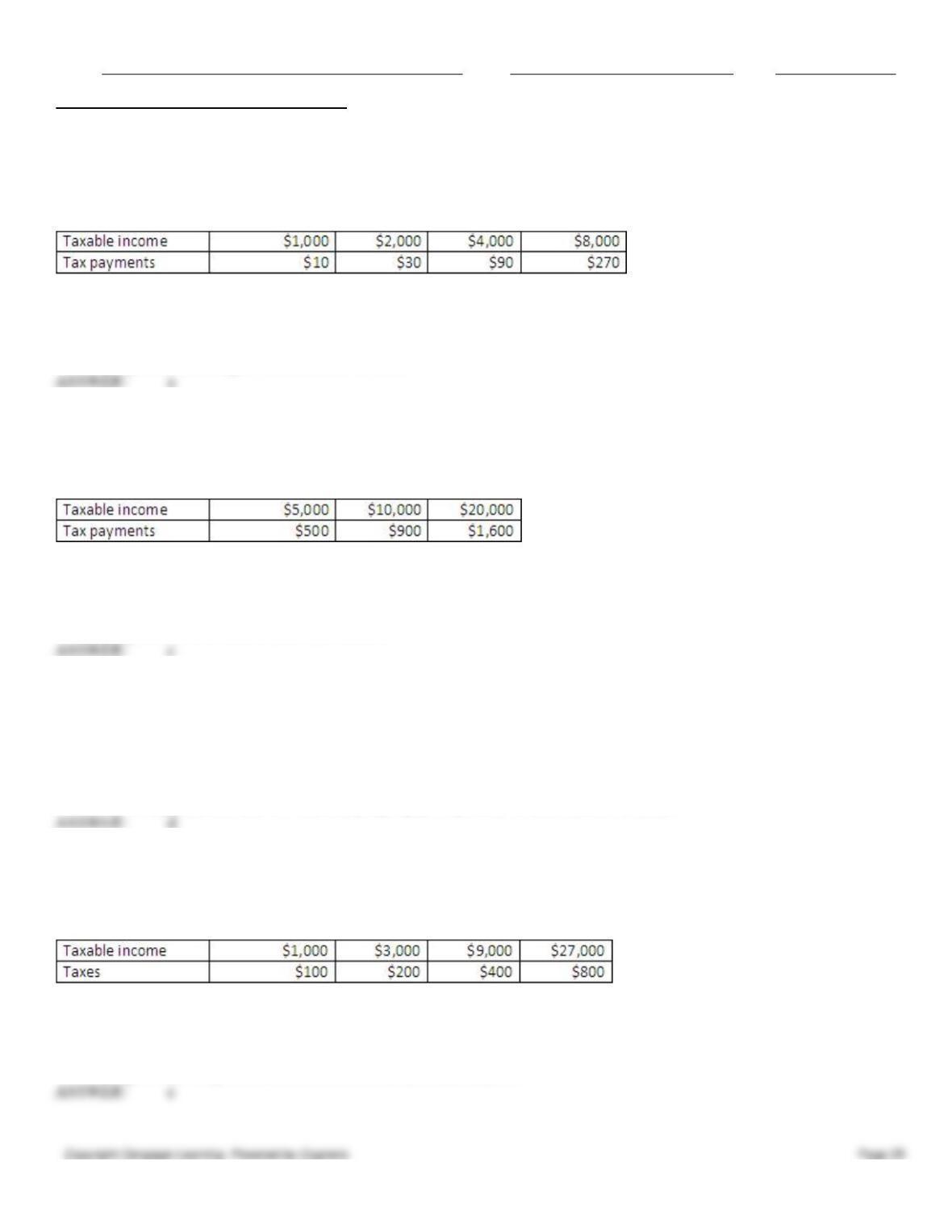
153. The following table shows tax payments made for various incomes. According to the information in the table below,
the tax system is:
Table 3.1
a. progressive throughout all levels of income.
b. progressive between $1,000 and $2,000 of income but regressive above $2,000.
c. regressive throughout all levels of income.
d. regressive between $1,000 and $2,000 of income but progressive above $2,000.
e. proportional throughout all levels of income.
154. The table below shows tax payments made for various incomes. According to the information in the table below, the
tax system is:
Table 3.2
a. progressive at all levels of income.
b. proportional.
c. regressive.
d. based on the benefits received.
e. proportional between $5,000 and $10,000.
155. Which of the following would indicate that income tax is progressive?
a. High-income people pay $3,000 in taxes; low-income people pay $1,000.
b. Low-income people pay $3,000 in taxes; high-income people pay $1,000.
c. Both high-income and low-income people pay $1,000 each in taxes.
d. High-income people pay 20 percent of their income in taxes; low-income people pay 10 percent.
e. Both high-income and low-income people pay 10 percent of their income in taxes.
156. The table below shows taxes paid for various incomes. According to the information in the table below, the tax
system is:
Table3.3
a. progressive through all levels of income.
b. proportional throughout all levels of income.
c. regressive throughout all levels of income.
d. based on the benefits-received principle.
e. proportional only between income levels $1,000 and $3,000.

Name:
Class:
Date:
Chapter 03: Economic Decision Makers
157. A family with an income of $25,000 pays taxes of $3,000 per year and a family with an income of $50,000 pays
taxes of $4,000 per year. The tax plan is:
a. regressive.
b. proportional for all income levels.
c. progressive.
d. based on the ability-to-pay principle.
e. proportional for income levels between $25,000 and $50,000.
158. Katie had a before-tax income of $40,000 and paid taxes of $6,000. Rinji had a before-tax income of $35,000 and
paid taxes of $5,250. Based on this information, the tax system is:
a. regressive for all income levels.
b. proportional.
c. progressive.
d. based on the ability-to-pay principle.
e. regressive for income levels between $35,000 and $40,000.
159. Consider a system in which a person earning $10,000 pays $1,000 in taxes, a person earning $25,000 pays $1,000 in
taxes, and a person earning $60,000 pays $1,000 in taxes. What type of tax is this?
a. Regressive
b. Proportional
c. Progressive
d. A tax based on the ability-to-pay principle
e. A tax impossible to determine with the information provided.
160. Mr. Thomson had a before-tax income of $20,000 and paid taxes of $2,000. Ms. Lynch had a before-tax income of
$10,000 and paid taxes of $1,500. Based on this information, which of the following is correct?
a. The tax system is progressive for incomes below $10,000.
b. The tax system is proportional.
c. The tax system is regressive.
d. The tax system is based on the benefits received.
e. The tax system is progressive for incomes above $20,000.
161. During recent elections, consumer groups in various states attempted to get the sales tax on all medicines and drugs
removed. They argued that such a tax is severely regressive. What is the economic interpretation of their statement?
a. The poor get ill more often than do the rich.
b. The poor pay higher prices for medicine and drugs than do the rich.
c. The poor pay a higher percentage of their income in taxes on medicine and drugs than do the rich.
d. All consumers pay too much money for medicine and drugs.
e. The sales tax discourages the poor from seeking medical treatment.
162. Which of the following would indicate that a tax is regressive?
a. High-income people pay $5,000 in taxes; low-income people pay $2,000.
b. Both high-income and low-income people pay $200 each.

Name:
Class:
Date:
Chapter 03: Economic Decision Makers
c. High-income people pay 20 percent of their income in taxes; low-income people pay 10 percent.
d. Both high-income and low-income people pay 10 percent of their income in taxes.
e. Low-income people are exempt from the tax.
163. In recent decades, international trade has been:
a. a constant percentage of U.S. GDP.
b. a declining fraction of U.S. GDP.
c. an increasing fraction of U.S. GDP.
d. declining as measured by total dollars spent.
e. constant as measured by total dollars spent.
164. International trade occurs because the opportunity cost of producing specific goods differs across:
a. firms.
b. individuals.
c. regions of the U.S.
d. countries.
e. households.
165. The overall U.S. balance of payments:
a. shows a deficit.
b. shows a surplus.
c. is the merchandise trade balance.
d. equals exports minus imports.
e. shows how deficits in one account are exactly offset by surpluses in other accounts.
166. Which of the following best defines foreign exchange?
a. A trade between two countries
b. The market where exporting and importing activities take place
c. The price of a currency relative to another currency
d. The currency of another country used for trading
e. The currency that the United States uses to buy goods from other countries
167. If one dollar is initially equal in value to one euro and demand for euros increases, then each dollar will be worth:
a. more than one euro and European imports will be cheaper in the United States.
b. less than one euro and European imports will be more expensive in the United States.
c. more than one euro and European imports will be more expensive in the United States.
d. less than one euro and European imports will be cheaper in the United States.
e. the same as the euro and there will be no change in the values of imports or exports.
168. If one US dollar costs 0.8 Euros, then 1 Euro must cost _____ US dollars.
a. 0.5

Name:
Class:
Date:
Chapter 03: Economic Decision Makers
b. 0.8
c. 1.0
d. 1.25
e. 1.5
169. If one euro exchanges for $1.12, then buying a German car selling for 100,000 euros will cost:
a. $95,000
b. $100,000
c. $112,000
d. $125,000
e. $142,000
170. A tariff is:
a. a tax on imports.
b. a legal limit on quantities of goods that can be imported.
c. a voluntary limit on quantities of goods that can be imported.
d. a quality restriction on imports.
e. a subsidy for exports.
171. Which of the following is true of import tariffs and quotas?
a. They benefit domestic producers.
b. Domestic consumers gain because they purchase the output of domestic firms.
c. Specialization and comparative advantage are advanced by tariffs and quotas.
d. They tend to expand the volume of world trade.
e. Because they increase the output levels of domestic firms, they tend to lower domestic prices.
172. Restricting imports of Brazilian shoes will:
a. raise the price of both Brazilian and domestically produced shoes.
b. raise the price of Brazilian shoes but lower the price of domestically produced shoes.
c. lower the price of Brazilian shoes but raise the price of domestically produced shoes.
d. lower the price of both Brazilian and domestically produced shoes.
e. benefit the producers of shoes in Brazil.
173. Trade restrictions result in all of the following except one. Which is the exception?
a. Higher prices
b. Fewer choices
c. Improved quality
d. Misallocation of resources
e. Reduced competition
174. Trade restrictions can take any of the following forms except one. Which is the exception?

Name:
Class:
Date:
Chapter 03: Economic Decision Makers
a. Tariffs
b. Free trade agreements
c. Quotas
d. Voluntary trade restrictions
e. Health and safety restrictions