84. Golf Company paid a $5,000 cash dividend to its stockholders. The transaction would be posted as
85. Gorbac Corporation issued stock to John Gorbac for $7,000 cash. This transaction would be posted to the
ledger accounts of Gorbac Corporation as
86. Valenzuala Company purchased a truck for $38,000 cash. This transaction would be posted to the ledger
accounts of Valenzuala Company as
87. Perez Company received and immediately paid a $500 utility bill. Payment of the utility bill would be
posted to the ledger accounts as
88. Derby Inc. sold merchandise to a customer for $16,000 cash. The sale would be posted to the ledger
accounts as
89. Mila Company paid $900 for merchandise previously purchased on credit. The payment would be posted to
90. During July 2013, Hasan Corporation incurred but did NOT pay a $500 utility expense. This transaction
would be posted as
91. During July 2013, Gutierrez Corporation sold $9,000 of merchandise on account. The revenue portion of
this transaction would be posted as
92. During January 2013, Westburg Corporation paid off $9,000 of wages payable that were incurred in the
prior year. This transaction would be posted as
93. When Jim was preparing the trial balance, he accidentally recorded a $300 debit as a credit instead. By how
much will this cause the trial balance columns to differ?
94. When Jim was preparing the trial balance, he accidentally recorded a $550 payment of accounts payable
twice. By how much will this cause the trial balance columns to differ?
95. Computers can NOT do which of the following?
96. Which of the following is NOT an advantage of using computers?
97. List the four steps, in order, of the sequence of the accounting cycle. Be sure to include any sub-steps.
1.
Analyze transactions.
2.
Record the effects of transactions.
3.
Summarize the effects of transactions.
1.
2.
4.
Prepare reports.
1.
Adjusting entries.
2.
3.
98. The basic accounting equation can be used to show the changes in assets, liabilities, and owners’ equity.
Reynolds Corporation recently had the following transactions:
a.
Owners invested $80,000.
b.
Purchased equipment for $50,000 on credit.
c.
Borrowed $60,000 from the bank.
d.
Purchased $25,000 of inventory for cash.
e.
Paid for the equipment purchased above.
Record the monetary consequences of these transactions under the appropriate columns shown below. Also indicate the column totals.
Transaction
Assets
=
Liabilities
+
Owners’ Equity
99. The basic accounting equation can be broken into accounts that represent a firm’s assets, liabilities, and
owners’ equity. Desler Company had the following transactions during a recent week:
a.
Received $60,000 cash from the issuance of capital stock.
b.
Purchased equipment for $48,000. Paid $12,000 down and signed a note for the balance.
c.
Purchased $1,200 of supplies, 20 percent cash and 80 percent on credit.
d.
Paid $7,200 on the note payable.
Record these transactions in the appropriate columns shown below. Also, include account balances.
Accounts
Notes
Capital
Transaction
Cash
Supplies
Equipment
Payable
Payable
Stock
Accounts
Notes
Capital
Transaction
Cash
Supplies
Equipment
Payable
Payable
Stock
a.
+60,000
+60,000
b.
-12,000
+48,000
+36,000
c.
– 240
+1,200
+960
– 7,200
_____
______
____
– 7,200
______
+40,560
+1,200
+48,000
+960
+28,800
+60,000
Transaction
Assets
=
Liabilities
+
Owners’ Equity
a.
+80,000
+80,000
b.
+50,000
+50,000
c.
+60,000
+60,000
d.
+25,000
-25,000
e.
-50,000
-50,000
______
+140,000
+60,000
+80,000
100. Give the effect the following transactions would have on EACH side of the accounting equation. Be
specific in the description of the accounts. The first transaction’s effect is noted as an example for you to follow.
Transaction
Effect
Payment of account owed with cash
Decrease in assets (Cash), decrease in liabilities (Accounts
Payable)
a.
Borrowing money from a bank
b.
Purchase of a truck for cash and a note
c.
Receipt of interest revenue
d.
Sale of stock
e.
Payment of dividends to shareholders
f.
Payment of electric bill
g.
Sale of merchandise for cash
101. Using the format provided, for each account identify (a) whether the account would be reported on a
balance sheet or on an income statement; (b) whether it is an asset, a liability, owners’ equity, a revenue, or an
expense; and (c) whether the account has a debit or a credit balance. An example is provided.
(a)
(b)
(c)
Asset, Liability,
Balance Sheet or
Owners’ Equity,
Debit/
Account Title
Income Statement
Revenue, or Expense
Credit
Ex.:
Cash
Balance Sheet
Asset
Debit
1.
Sales Revenue
2.
Dividends
3.
Cost of Goods Sold
4.
Utilities Expense
5.
Notes Payable
6.
Accounts Receivable
7.
Capital Stock
8.
Supplies
a.
Increase in assets (Cash), increase in liabilities (Note Payable)
b.
Increase in assets (Truck), decrease in assets (Cash), increase in liabilities (Note Payable)
Increase in assets (Cash), increase in owners’ equity (Interest Revenue)
d.
Increase in assets (Cash), increase in owners’ equity (Stock)
e.
Decrease in assets (Cash), decrease in owners’ equity (Dividends)
Decrease in assets (Cash), decrease in owners’ equity (Utilities Expense)
Increase in assets (Cash), decrease in assets (Inventory), increase in owners’ equity (Sales Revenue), decrease in owners’ equity (Cost of
102. The balances in the General Ledger accounts of Courtney Company resulted in the following totals:
Assets
$1,019,000
Liabilities
720,000
Owners’ equity
325,000
Total assets do not equal total liabilities plus owners’ equity because the following errors were made:
·
Supplies of $3,500 that were purchased on account were posted to Accounts Receivable as a $4,500 purchase. No error was made in the
Supplies account.
·
Credit sales of $35,000 were posted to the Sales Revenue account and Accounts Receivable account as $53,000.
·
Equipment purchased on credit for $127,000 was incorrectly posted to Notes Payable as $172,000. No error was made in the Equipment
account.
·
Rent expense of $24,500 was incorrectly posted as an expense of $42,500. Cash was posted correctly.
·
$50,000 of inventory bought on account was purchased but not recorded.
·
When $250,000 was borrowed from the bank, retained earnings was debited and accounts receivable was credited.
Using the appropriate columns shown below, compute the correct balances in the asset, liability, and owners’ equity accounts.
Assets
Liabilities
Owners’ Equity
Assets
Liabilities
Owners’ Equity
Beginning Balance
$1,019,000
$720,000
$325,000
(1,000)
(45,000)
(18,000)
(18,000)
50,000
18,000
50,000
250,000
250,000
500,000
Correct Ending Balance
$1,550,000
$975,000
$575,000
(a)
(b)
(c)
Asset, Liability,
Balance Sheet or
Owners’ Equity,
Debit/
Account Title
Income Statement
Revenue, or Expense
Credit
Ex:
Cash
Balance Sheet
Asset
Debit
Sales Revenue
Income Statement
Revenue
Credit
Dividends
Balance Sheet
Owners’ Equity
Debit
Cost of Goods Sold
Income Statement
Expense
Debit
Utilities Expense
Income Statement
Expense
Debit
Notes Payable
Balance Sheet
Liability
Credit
Accounts Receivable
Balance Sheet
Asset
Debit
Capital Stock
Balance Sheet
Owners’ Equity
Credit
Supplies
Balance Sheet
Asset
Debit
103. Record the following transactions in journal entry form (omit explanations).
a.
Sold merchandise for $3,200 on account; cost of merchandise sold was $1,600.
b.
Borrowed $32,000 from a bank.
c.
Issued stock for $7,200.
d.
Purchased equipment costing $120,000; with cash of $32,000 and a note for the remainder.
e.
Paid off the loan of $32,000 plus $400 interest.
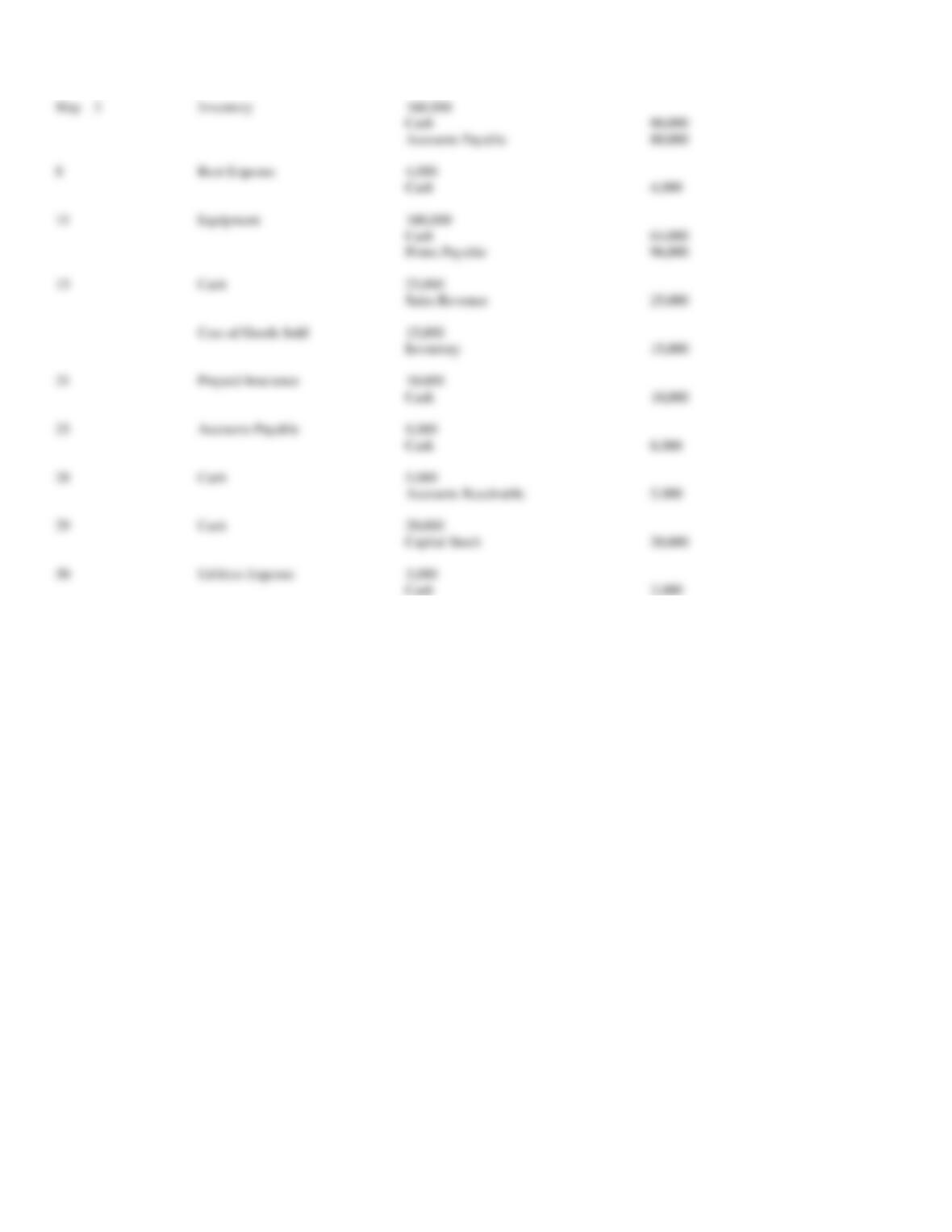
104. Telecon, Inc., experienced the following transactions during May 2013. Prepare the appropriate journal
entries to record these transactions (omit explanations).
May 3
Purchased $160,000 of inventory, paying 50% in cash and the balance on account.
8
Paid monthly rent of $4,000.
11
Purchased equipment for $160,000, paying 40% in cash and signing a note for the balance.
15
Sold inventory costing $15,000 for $25,000 cash.
21
Purchased a 2-year insurance policy for $10,000.
25
Paid $8,000 on account.
28
Collected $5,000 in accounts receivable.
29
Sold an additional 500 shares of capital stock for $20,000.
30
Paid utilities of $3,000.
a.
Accounts Receivable
3,200
Sales Revenue
3,200
Cost of Goods Sold
1,600
Inventory
1,600
b.
Cash
32,000
Notes Payable
32,000
c.
Cash
7,200
Capital Stock
7,200
d.
Equipment
120,000
Cash
32,000
Notes Payable
88,000
e.
Notes Payable
32,000
Interest Expense
400
Cash
32,400
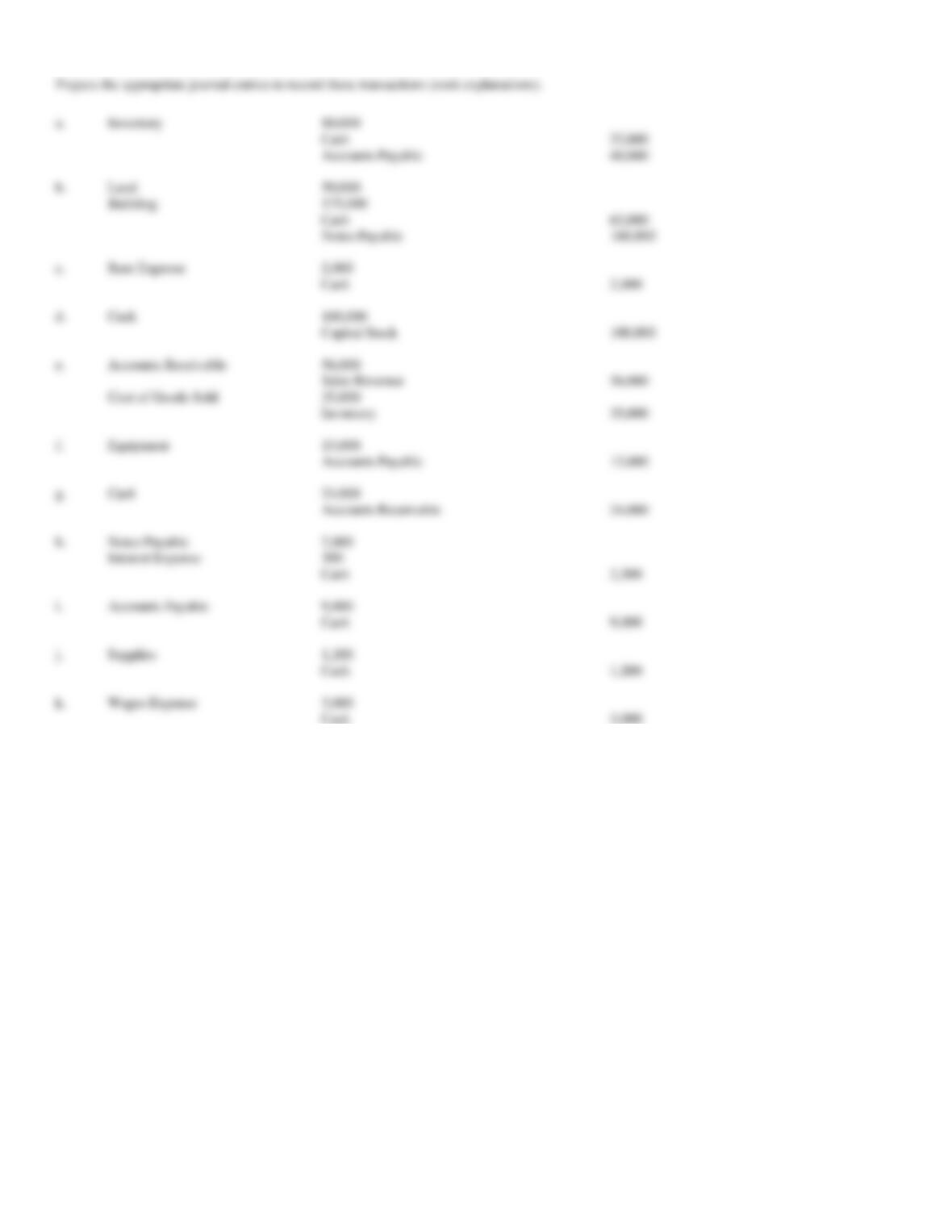
105. Marbletop, Inc. had the following transactions during a recent month:
a.
Purchased $80,000 of inventory, paying 40% in cash and the balance on account.
b.
Purchased land and a building for $50,000 and $175,000, respectively, for $65,000 cash and signed a note for the balance.
c.
Paid monthly rent of $2,000.
d.
Issued stock for $100,000.
e.
Sold merchandise on account for $56,000; cost of goods sold was $35,000.
f.
Purchased $15,000 of equipment on account.
g.
Collected $24,000 from customers who had previously purchased inventory on account.
h.
Made a payment of $2,000 plus $300 interest on the notes payable.
i.
Paid $9,000 on accounts payable.
j.
Purchased supplies of $1,200
k.
Paid monthly wages of $3,000
May 3
Inventory
160,000
Accounts Payable
80,000
8
Rent Expense
4,000
Cash
4,000
11
Equipment
160,000
Cash
64,000
Notes Payable
96,000
15
Cash
25,000
Sales Revenue
25,000
Cost of Goods Sold
15,000
Inventory
15,000
21
Prepaid Insurance
10,000
Cash
10,000
25
Accounts Payable
8,000
Cash
8,000
28
Cash
5,000
Accounts Receivable
5,000
29
Cash
20,000
Capital Stock
20,000
30
Utilities Expense
3,000
Cash
3,000
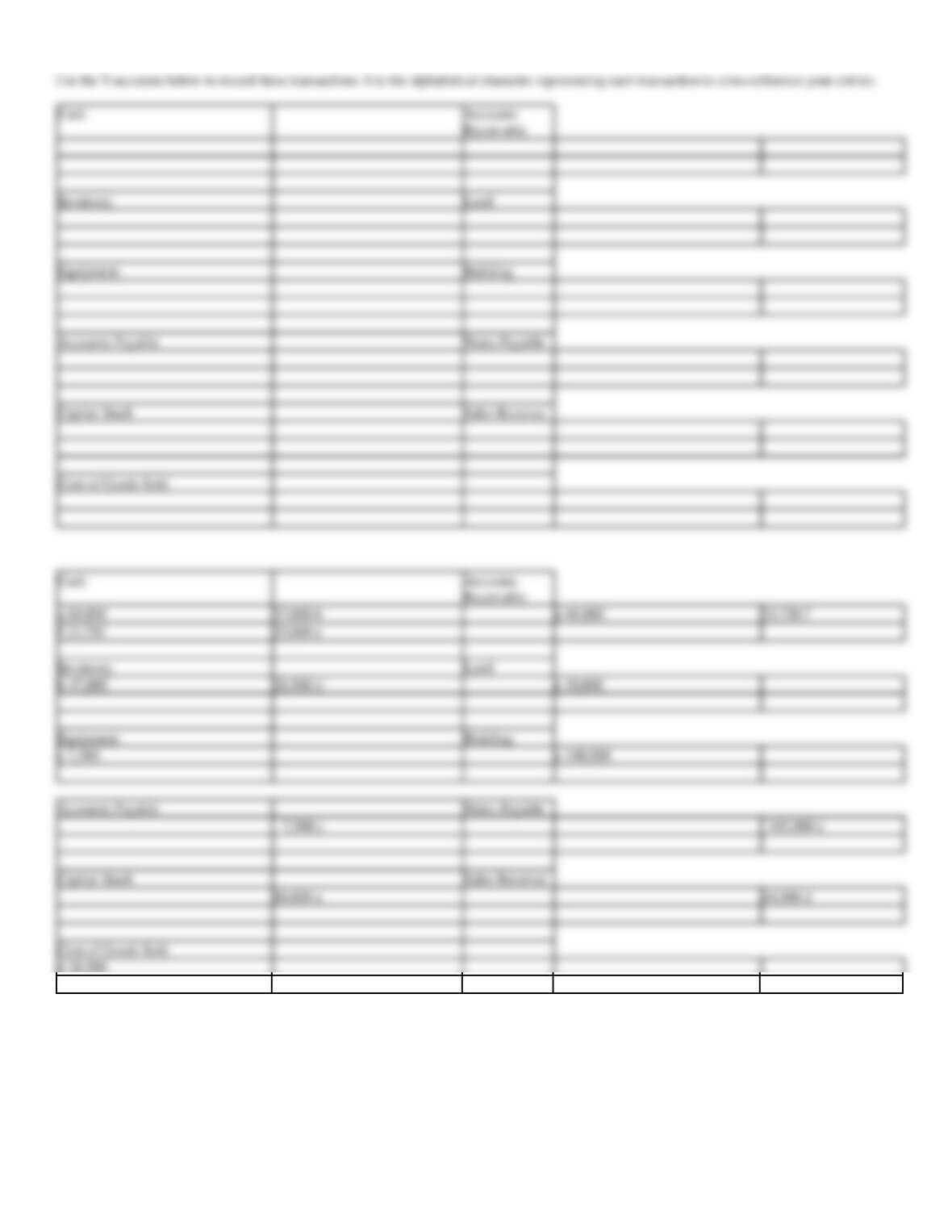
106. Cloveridge, Inc. had the following transactions during a recent period:
a.
Received $80,000 cash from the issuance of capital stock.
b.
Purchased inventory for $37,000 cash.
c.
Purchased $7,500 of equipment on account.
d.
Sold merchandise on account for $44,000; cost of goods sold was $28,500.
e.
Purchased land and a building for $30,000 and $100,000, respectively, for $25,000 cash, signing a note for the balance.
f.
Collected $23,750 from customers who had previously purchased inventory on account.
Accounts Payable
48,000
b.
Land
50,000
Cash
65,000
Notes Payable
160,000
Cash
2,000
d.
Cash
100,000
e.
Accounts Receivable
56,000
Sales Revenue
56,000
Inventory
35,000
f.
Equipment
15,000
g.
Cash
24,000
Accounts Receivable
24,000
h.
Notes Payable
2,000
Interest Expense
300
Cash
2,300
Accounts Payable
9,000
Cash
9,000
Supplies
1,200
k.
Wages Expense
3,000
Cash
3,000
Inventory
Land
Equipment
Building
Accounts Payable
Notes Payable
Capital Stock
Sales Revenue
Cost of Goods Sold
a 80,000
37,000 b
d 44,000
23,750 f
b 37,000
28,500 d
Equipment
Building
Accounts Payable
Notes Payable
7,500 c
105,000 e
80,000 a
44,000 d
Cost of Goods Sold
d 28,500
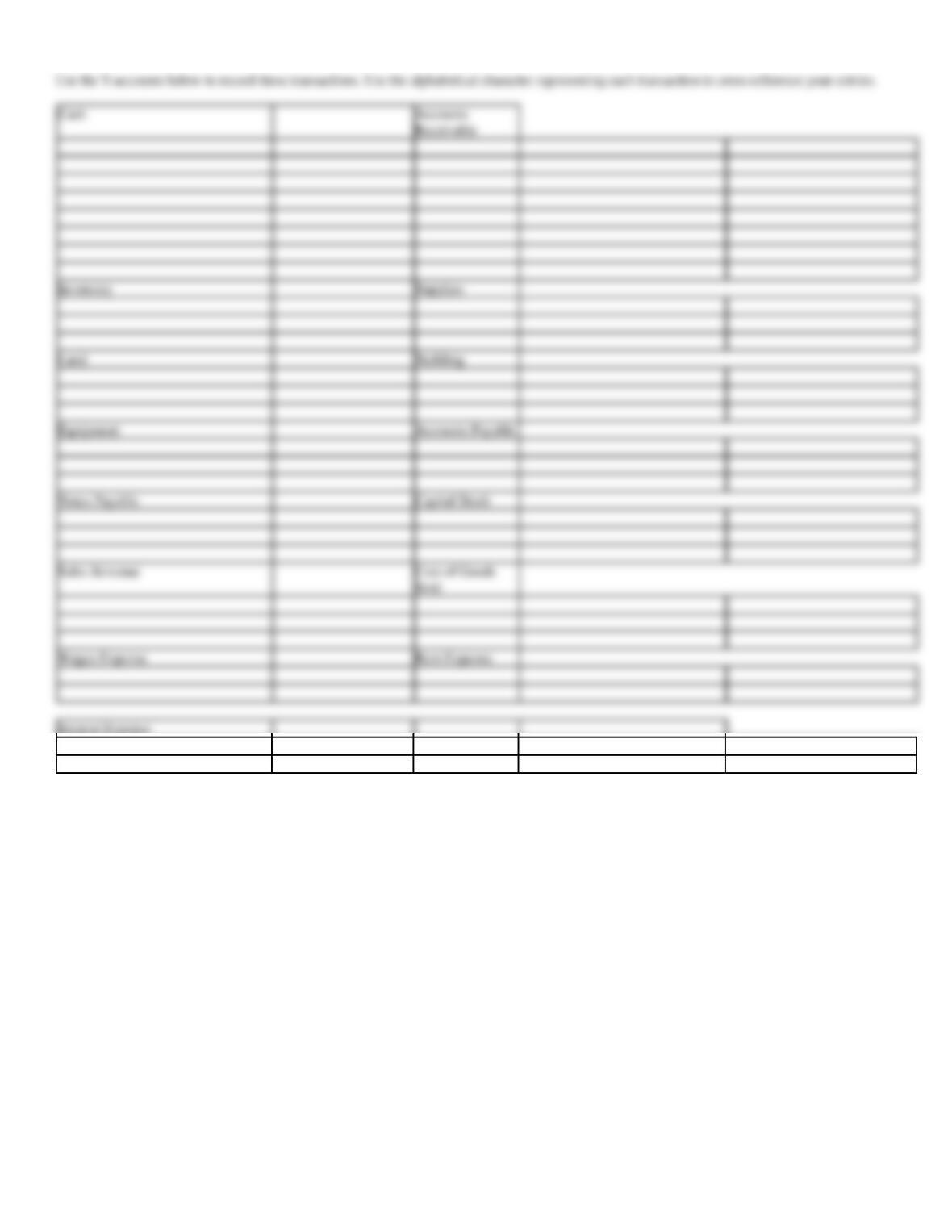
107. Marbletop, Inc. had the following transactions during a recent month:
a.
Issued stock for $100,000.
b.
Purchased land and a building for $50,000 and $175,000, respectively, for $65,000 cash and signed a note for the balance.
c.
Paid monthly rent of $2,000.
d.
Purchased $80,000 of inventory, paying 40% in cash and the balance on account.
e.
Sold merchandise on account for $56,000; cost of goods sold was $35,000.
f.
Purchased $15,000 of equipment on account.
g.
Collected $24,000 from customers who had previously purchased inventory on account.
h.
Made a payment of $2,000 plus $300 interest on the notes payable.
i.
Paid $9,000 on accounts payable.
j.
Purchased supplies of $1,200
k.
Paid monthly salaries of $3,000
Land
Building
Equipment
Accounts Payable
Wages Expense
Rent Expense
Interest Expense
108. Marbletop, Inc. had the following transactions during a recent month:
·
Purchased $80,000 of inventory, paying 40% in cash and the balance on account.
·
Purchased land and a building for $50,000 and $175,000, respectively, for $65,000 cash and signed a note for the balance.
·
Paid monthly rent of $2,000.
·
Issued stock for $100,000.
·
Sold merchandise on account for $56,000; cost of goods sold was $35,000.
·
Purchased $15,000 of equipment on account.
·
Collected $24,000 from customers who had previously purchased inventory on account.
·
Made a payment of $2,000 plus $300 interest on the notes payable.
·
Paid $9,000 on accounts payable.
·
Purchased supplies of $1,200
·
Paid monthly salaries of $3,000
a 100,000
32,000 d
e 56,000
24,000 g
g 24,000
65,000 b
2,000 c
2,300 h
9,000 i
1,200 j
3,000 k
Inventory
Supplies
d 80,000
35,000 e
j 1,200
Land
Building
b 50,000
b 175,000
Equipment
Accounts Payable
f 15,000
i 9,000
48,000 d
15,000 f
Notes Payable
Capital Stock
h 2,000
160,000 b
100,000 a
56,000 e
e 35,000
Wages Expense
Rent Expense
k 3,000
c 2,000
Interest Expense
h 300
At the beginning of the month, Marbletop had the following account balances:
Accounts Payable
$ 2,000
Notes Payable
$ 40,000
Accounts Receivable
12,000
Rent Expense
8,000
Building
40,000
Retained Earnings
55,000
Capital Stock
10,000
Sales Revenue
125,000
Cash
10,000
Supplies
1,000
Cost of Goods Sold
75,000
Land
30,000
Equipment
33,000
Wages Expense
10,000
Inventory
11,000
Interest Expense
2,000
Based on this information, prepare a month-end trial balance for Marbletop, Inc.
Cash (1)
19,500
Accounts Receivable (2)
44,000
Inventory (3)
56,000
Supplies (4)
2,200
Land (5)
80,000
Building (6)
215,000
Equipment (7)
48,000
Accounts Payable (8)
56,000
Notes Payable (9)
198,000
Capital Stock (10)
110,000
Retained Earnings (11)
55,000
Sales Revenue (12)
181,000
Cost of Goods Sold (13)
110,000
Wages Expense (14)
13,000
Rent Expense (15)
10,000
Interest Expense (16)
2,300
______
600,000
600,000
10,000 – 32,000 – 65,000 – 2,000 + 100,000 + 24,000 – 2,300 – 9,000 – 1,200 – 3,000
12,000 + 56,000 – 24,000
11,000 + 80,000 – 35,000
1,000 + 1,200
30,000 + 50,000
40,000 + 175,000
33,000 + 15,000
2,000 + 48,000 + 15,000 – 9,000
40,000 + 160,000 – 2,000
10,000 + 100,000
No change until year end
125,000 + 56,000
75,000 + 35,000
10,000 + 3,000
8,000 + 2,000
2,000 + 300
109. Based on the following account balances at December 31, 2013, prepare a trial balance for Uniflex
Company.
Accounts Payable
575
Notes Payable
7,000
Accounts Receivable
1,800
Rent Expense
1,500
Building
19,000
Retained Earnings
2,275
Capital Stock
10,000
Sales Revenue
35,684
Cash
1,160
Supplies
556
Cost of Goods Sold
17,969
Utilities Expense
849
Equipment
6,700
Wages Expense
2,000
Inventory
4,000
Cash
1,160
Accounts Receivable
1,800
Inventory
4,000
Supplies
Building
19,000
Equipment
6,700
Accounts Payable
575
Notes Payable
7,000
Capital Stock
10,000
Retained Earnings
2,275
Sales Revenue
35,684
Cost of Goods Sold
17,969
Wages Expense
2,000
Rent Expense
1,500
Utilities Expense
849
_____
55,534
55,534